The KEY To Reducing Your Marketing Spend with Tarek Chouja | Industry Change Ep 18
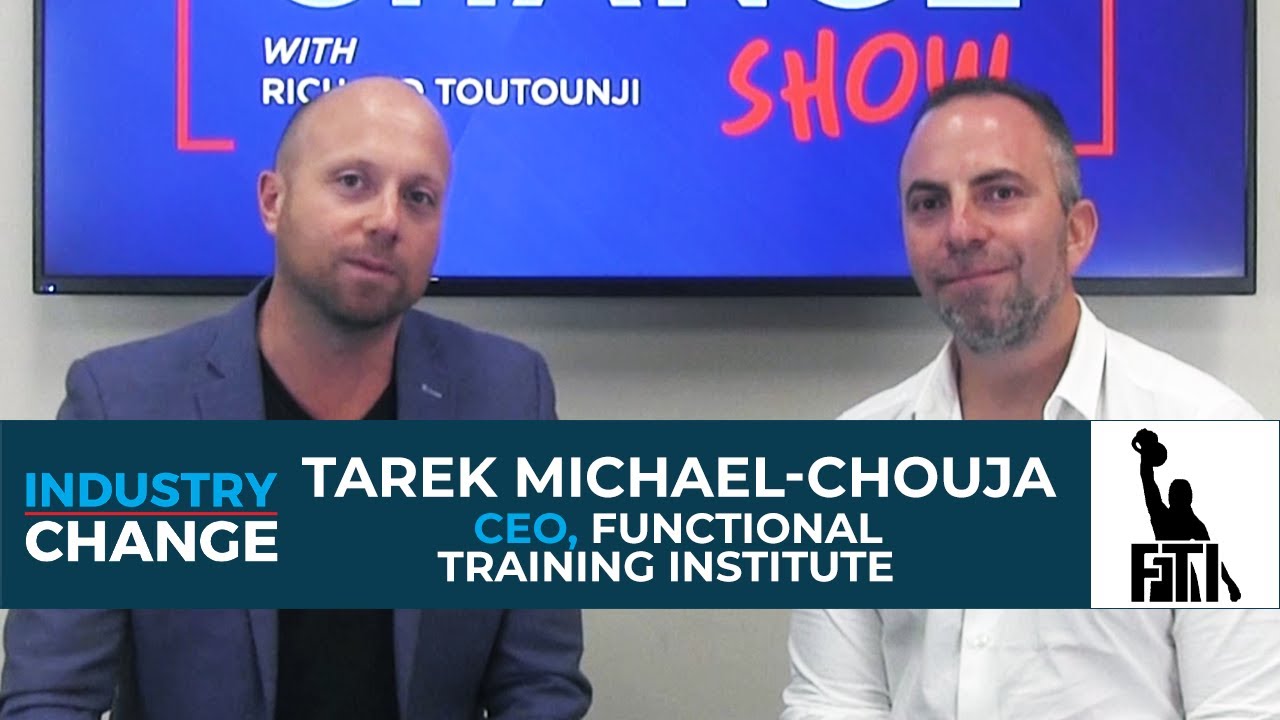
In this Industry Change podcast episode, host Richard Toutounji interviews functional‑training pioneer Tarek Chouja. The conversation weaves together three core themes: (1) the importance of a high‑quality product as the foundation for effective marketing and sales in the fitness industry; (2) the evolution of Tarek’s business – from a modest Sydney kettlebell workshop to the globally‑scaled Functional Training Institute (FTI), including strategic moves to Asia, partnership building, and a contributor‑focused, purpose‑driven business model; and (3) the upcoming book Purpose‑Driven Movement, which distills a decade of work into a scientific‑anecdotal guide for coaches, introduces the Adaptive Functional Training System and its five pillars, and ties the educational content to a charitable “gift‑box” program. Throughout, Tarek emphasizes movement over generic fitness, the Golden Circle (why‑how‑what), continuous improvement (kaizen), and the role of branding and storytelling in scaling a coaching business. The episode also highlights specific programs (Game Changer, Master Functional Trainer, Movement Restoration Coach), global presenter network, and the launch details for the book (Amazon, March 18).
Chapters
That's very key. I mean, 10 years you've said there, and we wouldn't be 10 years in the making if we didn't evolve, if we didn't collaborate, and if we didn't innovate and also contribute.
Welcome back to Industry Change. My name is Richard Toutounji, and today I've got a very special guest. We're kind of talking about marketing and sales, but I just thought let's go a bit deeper because what happens when you want to market your product better, when you want to be the number one in your space, I actually believe it comes a little bit deeper than that. I actually believe that you need an amazing product, and to have an amazing product, you need to have the technical requirements of that. So I've got my very good friend aboard today. Hey, Richard. Tarek Michael Shuja.
Welcome. Thank you, mate.
Did I say that right?
You did indeed.
Yes. You know what, I've known you for so many years, I've never used your last name for some reason.
Yeah, everyone knows me just as Tarek, right? So yeah, I've got the Michael and the Shuja. My father actually is Syrian.
So there you go, we've got something in common there. Background's Syrian.
And mother's Irish, so go figure.
And the reason why I brought you aboard, because you've got a new book coming out, which we're going to talk about later, Purpose Driven Movement. And that's what I said at the start, is that I love marketing, as you know, I love branding. And a lot of our viewers are into that space of really taking their business to the next level. And the reason why I love what you guys do, yourself and Dan, your business partner, is that if you don't have a very good product, meaning if a coach is not getting good results for their clients, it's very hard to market what they do. Absolutely. And so I just actually think sometimes it's really important to— as much as I can talk about marketing and sales and branding all day long, I actually do believe that if you don't have the technical requirements to be a great coach, it's going to be very hard to scale your business up.
Yeah, absolutely. I mean, that would be, you know, you look at the golden circle, you've got the what and the how, you know, and then that big factor there is how, you know, how can I become a better coach? And that's where I feel that this resource will allow the coach to tap into that how. And of course, for us, our big why factor was to inspire coaches rather than this simply being a marketing piece, which it also is. It's a very comprehensive guide to functional training. So our big why factor was to maximize the impact of coaches globally and to reach as many coaches as possible.
Amazing. Let's get into your story right now. You've got a very interesting story because you were, you know, one of the, I guess, innovators of bringing functional training not just to Australia, to the world. And you've gone on this journey, and every time I see you, you're on a— you're in a different You're in a different country pretty much, and you're really sharing your message in a very unique way. The message of movement, the message to inspire coaches all around the world. So, can you just kind of take me into a really fast-forward step around functional training? And I've had your business partner on here, Dan Henderson, in the past. We've talked about FTI. So, if you haven't seen that episode, go check it out. But yeah, tell me about your journey of functional training and why you do what you do for.
Yeah, so we can go way back. We can really strip back to when I was 18, working at a pool parlour of all places. I wasn't a bad kid, but, you know, I didn't know really, I had no direction insofar as what I wanted to do. Nothing really interested me besides, you know, I played soccer, I coached a lot, did some martial arts. I was always into movement and especially team sports.
And you use the word movement, you don't use the word fitness, I've noticed.
Yeah, I think so. I mean, look, you know, fitness can be very generic, it can be very sometimes uninspiring. Fitness this, fitness that, but it encompasses a lot more than just the body. Whereas when we say fitness, fitness is something that, you know, we— our cardiovascular system works, okay, great. So there's all these physiological benefits to fitness, but I believe movement attaches itself to the mind. So movement equals motion and it affects our mental state.
Right.
And there's plenty of good studies out there that show that, you know, exercise, which I would call movement, affects the body
Sure. And this is what you've been about over the last decade. I believe you started Functional Training Institute, FTI, I know now, 10 years ago, is that correct?
Yeah, 10 years ago, all this way back. So before FTI, as you well know, it was Sydney Kettlebells at the time, back in 2009, Dan and I.
Sydney Kettlebells, and then you had another one which was
Australian. Yeah, Australian Institute of Kettlebells. And this is where you were quite pivotal because we, interestingly enough, I'll put it back We met up for a coaching session in this special space here, and you recommended, hey, you know, it hedges us, you know, Australian kettlebells. We're moving beyond that, and we were moving beyond that.
Yeah, I didn't think we actually dreamed big enough. We didn't inspire big enough because now the functional training is changing.
Well, we didn't, but, and I think that's where you tapped into it and said, hey, think bigger, think, you know, beyond just Australia and kettlebells. That's where Functional Training Institute was born.
Let's talk about that because, I mean, you're in— we share the same office complex, so it's good to sometimes see you and catch up with you. However, when you're not here, you are traveling the world. When I say traveling the world, you're going to places like Egypt, Africa, India, everywhere in Asia, you go to the US, you're going everywhere around the world to really share the message. I would love to understand a bit more why you do so much traveling. To get that message across when you might be able to run that as an online program or people come to you, but you actually go to them and you share your message there. That I think is very powerful. Can you share that kind of concept?
Yeah, sure. I think it was born out of a few years ago, precisely back in 2013. I went with PTA Academy with Dom Dos Remedios, Andrew Chadwick, which some of you may well know, and a few others. And we taught in Bangkok and spent a few days there. And I made such a good impact that I was told to— asked to come back and teach more of the concepts. And really from that point on, it started to kind of grow and grow, the interest in functional training, especially what we were doing at that time. And so, yeah, we got called back. And then probably about 2 years later, Dan and I sat down and said, well, we've got to really give this a shot. If we can just do it bit by bit and hope to get a little bit of work, we thought, well, that's pretty uninspiring, right? So, let's give it a shot. Yes. As us Aussies like to say. And so, we said, How about if I move over there and actually grow the global operations? Which I did. So I lived abroad for 12 months in Malaysia. In fact, that was really pivotal because I formed these hosts, these partners, these relationships.
Let's talk about that for a second because this is key. I think this is a key moment that you, with your partner Dan, had the vision to say, listen, let's go global. And you didn't just talk about it or rebrand or anything, you actually went move locations to actually get the message across there to, I guess, a place that was a lot easier to get to on events and conferences and functional training events that you ran instead of being in Australia. How was that movement when you did that? Was it hard to go and find pivotal partners? I mean, from a business aspect, how did you actually go and get partners at that stage? How did you go in there and kind of find partners?
At that point, we were doing some internal work for Fitness First Asia, and then through these networking events that you alluded to, especially AFC, the Asian Fitness Conference.
Yes.
Pardon me. We started to form some interest because, you know, we're just essentially networking. I mean, networking is such a key part of what we do. And so I wanted to tap into that at a higher level. And out of that, we just again started to just chat with people. That's how it all began. In fact, we then plunged ourselves in 2014 to actually have a booth at AFC. And it was at that point we started getting interest about our programs. Wow. That's how it formulated.
And when you're getting interest, then in your mind and your business decisions, you're saying, hey, I've made the right decision, I'm going to continue through that path. Is that kind of how you understand if it's working or not?
Absolutely. Yeah. I mean, it was just— I think we had overwhelming interest Which was even surprising for us. We believed in it, but we didn't believe we'd get that much interest. So it was a pleasant surprise. So we wanted to really jump onto that.
And I remember in Australia when you were launching, it was at that time when I think, I believe, CECs weren't even available for functional training, especially for kettlebells when you started. Is that the case in other emerging countries? Is it like the chicken versus the egg? What has to come first? You're coming there with your systems, is it that you have to wait for the traction to come aboard? How does that whole concept work when you're going into a new country every time?
I suppose it all comes down to demand. So abroad they have accrediting bodies, there are many PTs who don't have a qualification over in Asia or even other parts of the world. So those who do usually work for gym chains, and so they're always seeking to upskill. And especially in these areas of broader interest, i.e., functional training. And of course, people would argue, and I'm happy for them to certainly make a case in point, that functional training can be quite broad. And we'll kind of maybe get to that in a moment to say, can we actually narrow down a definition of functional training? So, sort of going back to your question, it's all about allowing them an opportunity to explore the repertoire of programs that we created because there was a need. for that in the market. So in that case, some trainers will invariably look for Upskill because they need points. Others are very much interested in the concept to make them a better coach.
What can coaches expect to get in the Purpose Driven Movement book?
Yeah, I'll get to that in a moment. What I will say is that 10 years, yes, so it's a lifetime worth of work. It's 3 years in the making to the day that Dan and I said, hey, we need a book. And that was the initial inspiration, is we wanted to think about not just from a place of ego, because I can tell you that this— it wouldn't be this if it came from a place of ego, because we would have rushed to try to get it done. And I can tell you that when we got it, when we started the process, we worked hard at it for the first year and then we parked it. We go, we had enough.
Yeah.
It was only until about 9 months ago actually that Dan and I said— I said to Dan, look, we need to bring this book back up. I just felt inspired. So, you know, throughout my travels, I was just like working on the book, working on the book, working on the book. And of course, we've had some great contributors to it too. So, you know, the book isn't just about Dan and I, it's contributors, it's collaborators. And we have some of the very best minds who also contributed in their way as well to make this book possible.
And I think that's all about what you're about. You're very much on contribution. Your whole business philosophy, if I can kind of butt in there, It's all about, you know, you mentioned something before, it's not about transactions, it's about transformation.
Yes,
correct. And what I see from this book, and, you know, the first thing you're talking about, hey, it's not just me and Dan, it's been a collaboration effect, it's been a transformation factor over a few years. What do you put that down to when you're out there focusing not on business for transactions, you're actually focusing on the goodwill, the movement, you know, the purpose, the higher purpose? How does that— how do you get into that space? That's a very rare space that I don't see a lot of people in.
Yeah, absolutely. It's really dedication to one's craft. Myself, and I can attest to Dan too, we're both dedicated. We entered what we're doing through passion, through a love, and that's never fizzled. And so for us, it's always about kaizen. In Japanese, they talk about continual improvement, and that's what we've always lived by. I mean, we've got Dr. Luke Del Vecchio who's been on board with us. We've always hired people as collaborators To help bring our knowledge to a world-class level. So within this book, you're gonna see that the methods are all born out of striving for progress and ultimately to be world-class. It's the little things that in the end matter.
And I love the coaching instruction. You said this is aimed for coaches. I mean, what type of coach could really use this?
So obviously, looking at the term between a personal trainer and a coach, that can be interchangeable. However, my philosophy is that a trainer— we think trainer, we think someone who affects the client during the session, whereas a coach will, as Martin Rooney would say, ignite a fire within that client.
And talking about just Martin Rooney, I mean, you guys are bringing the best of the best over. I recently spoke at your Functional Training Institute Summit in Sydney, and, you know, you had world-class presenters like Martin Rooney, and you're always bringing world-class presenters to the table. I think that's a testament to both yourself and Dan. In what you've done and the structure of how you do things as well. You've got a very good movement. You have a very, very good movement, a very good following of people. Do you think that comes down to just mastering that craft and staying on that course?
Yeah, it's an interesting point, Richard. So in fact, Martin Rooney's done the foreword on this book. So we've formed really deep relationships with those not just in the US but around the world. And I think that what they were attracted to was just, as I alluded to earlier, our passion and devotion to our craft. So I think to kind of hopefully answer your question, it's really embedded in our very own philosophy. So Dan and I really were able to— been able to sync, you know, our own missions to something even bigger. And I'll give you an example. So only just very recently, we've evolved our vision, mission, and values. So, our vision is to impact, maximize the impact of coaches globally. And talking about service, what we wanted to do was create a service mission.
Yes.
So, through our high-end programs, the Game Changer and Master Functional Trainer, every time someone signs up to those programs, we attach to their purchase a gift box that will go to a child in need. And so, if you purchase the Game Changer, there's 2 gift boxes, MFT, 1 gift box. And so we had massive targets there. We want to have 7,500 coaches go through these programs over the next 5 years. So we've become a lot more specific and targeted and certainly contribution-minded too.
I love it. I think that's when you get to a point, and for you guys, you're at the top of that mountain. And for you now, it's like, okay, I think that's a massive credit to you guys because that is I think that's really how you continue to stay current in the trends and actually helping out the people that actually really need that.
That's very key. I mean, 10 years you've said there, and we wouldn't be 10 years in the making if we didn't evolve, if we didn't collaborate, and if we didn't innovate and also contribute.
I love it. And I want to talk about something about the book which I really found— because I love images and diagrams in the book. You know, you sold me on this book. If you're a coach out there that loves your images, your diagrams, your images, this is the book, right? Purpose Driven Movement. Remember, it's launching March 18th on Amazon. And you talk about the 5 pillars of functional training. I'd love just to go on this a little bit deeper in regards to this and how you've come up with the 5 there. Can you talk about the 5 pillars?
Yeah, definitely. So 6 years ago now, we formulated the Master Functional Trainer. And so out of the Master Functional Trainer, We thought, well, the journey of a coach would be going through these 5 different pillars.
Yep.
So pillar 1 is looking at exploring the concept of restoring function and movement.
Yes.
So before you load a client, we're gonna restore their full function. And a lot of coaches go, yeah, I can understand that. And so we have a whole system behind that pillar 1.
Yep.
And then pillar 2 is starting to use bodyweight applications. Yes. So looking at crawling patterns that animal flow utilize and other creatures. great organizations like Original Strength too, but also the suspension trainer. So looking at how we can then start to integrate or build our movement patterns, understanding that. Pillar 3 from there goes into loading the client's foundations.
Yep.
So how do we do that? How do we build more stability and strength? Pillar 4 is looking at going into more advanced levels and understanding of strength application and even power now. And then pillar 5 looks at integrating complex functional movement
All correct, by the way.
Yeah, all correct. And it wasn't till 3 years ago we met up with Steve Brosman, and a shout out to Steve Brosman, who you know well. He really inspired us to look at our model and inspired us to actually take action with the book. So Steve, we salute you. And so we came up with this system called the Adaptive Functional Training System, and so that became a lot more comprehensive. And embedded in that is the 5 pillars. So you certainly learn a lot more about it in the book.
Yeah. Well, as I say, it comes out March 18th, Amazon. You most likely get— and listen, if you've been, I think, in the fitness industry, you most likely have come across one of your mini courses. Give me some stats on your courses at the moment. Like how many courses do you currently have that you're running at the moment, both online and face-to-face?
Good question. Only recently, like we had a lot of concepts, some obviously don't work. And so we, you know, obviously look at how can we reshape that and look at either just shutting it down completely or revitalizing it. So the Master Functional Trainer, the Movement Restoration Coach is our latest one, is a collaboration with rehab trainer Ulrik Larsen. Yep. And I got together and created the Movement Restoration Coach. So rather than just single focus of courses, what we've done is we've using a lot more blended model, which is online through our great system and also face-to-face. So, we're not just really individual course focused now, we're more about programs. And I think what's critical here as well, Richard, I'll tell the audience, is that we've mapped all of our programs to the National Competency Units. So, anyone who goes through Cert III, IV, Diploma will get credits or recommended prior learning with what we do. So, we've gone through the whole rigours.
Yep.
Of mapping out each of the units that we cover in all of our programs. So we do have a combination of online, solely face-to-face, but our big ones are the flagship programs.
Amazing. And a lot of people have been through that KB, Kettlebells Level 1 and 2. That's been a very popular program, very original. Yeah. The original, for the originals, right?
The original Kettlebell 1, yes. And it was the very first course to be accredited with Fitness Australia. So when we first designed that, we rolled that out in 2009. So it's coming on 10 years in May, actually. So we'll be celebrating our 10-year anniversary as a company, which is very exciting. And it started with humble beginnings. You know, I remember when Dan and I first ran our workshop with 5 trainers back in Bondi Junction at Levity Health, as it was called then. And it was just amazing. You know, we got great feedback and then we got requests to do more and more.
And let's talk about that. We probably should have maybe mentioned this to start, but let's just understand what functional training is to you now. How many trainers and coaches do you have around the world now?
Well, we've got in Australia, we've got coaches or educators in each of the states. We've got a team of about 12 solid ones in Australia. And how it works overseas, and this is where my role has been pivotal and more prominent, is just building teams. So in China, I've got a group of 10 trainers, and the company that we collaborate with They work for them and us, and so I go in there and I educate, but I also build teams to raise their level of competency to be able to educate these concepts. So it's hard to kind of give a final number, and it's not really so much about the number because it's about quality. And I do have another few global presenters. So I've got Philippe, who's based in Portugal. We've got Jack. who's based in Malaysia. We've got Danson, who's based in Indonesia, and we've got Marcelo, who's based in Brazil. They would be regarded as our global presenters. And then within each country, we have, as I alluded to before, teams who would be able to be competent and at a great level to deliver the education.
Amazing. Well, one of the things that I mentioned at the start is that with marketing, Tarek, it's all about making sure you have a very good product. And I truly believe that You know, we can help people market the best brand they possibly have, but if you don't have a good product, meaning you don't get results for your clients, I think it's very hard to market something. So that's why I'm very pumped about this book, The Purpose Driven Movement. As I said, I think for any trainer who really wants to up their game, not just their technical game but also their marketing game, if you can get a hold of this, Absolutely. and then from there you can actually understand that how, wow, I can actually get now, I can get better technical results for my clients and then I've got better case studies to share, you know, better stories on the front end, and that's what I love to talk about, the marketing piece. And so I always love working with your type of coaches that come through your program because these are the guys that actually love what they do. They're very passionate about what they do.
Absolutely. And the book, I will say, it's scientific and anecdotal. I think that's what's unique about it. It's not just a hardcore textbook. It's very researched, but it's also anecdotal too. It's a lot of storytelling within it. And I will say, Richard, I mean, we had a discussion just the other day over coffee. Yeah. And it's just like Seth Godin says, you know, your brand are the promises you keep. And you're very big on brand, you know, and putting yourself out there. Hence, probably was for me pivotal to be out there actually exposing myself to reaching more people.
Yeah.
And that's probably why I took the plunge, if you want to know the why. You know, to express me as the brand and the living embodiment of that.
Love it. Well guys, as I said, March 18th for people that are super early, you can probably put pre-orders in. March 18th it comes out. So get yourself a copy on Amazon. Amazon, is that right? Where is it?
Amazon, that's correct.
Amazon, that's where it's at. So I'll put some links here. I'll put a link to the Amazon site from there. As I said, get that and let's crank this to a bestseller. Thanks for your time today.
Pleasure, Richard. Good to have you aboard. Thank you very much.
Awesome. Guys, thanks so much. That's another episode of Industry Change. Now, if you like this, what you see, the best place to get more of this, you can subscribe to our podcast, our YouTube channel. And if you want to go deeper in the conversation of marketing, all you want to do is jump on Facebook to our private Facebook group. It's called Crush Your Fitness Marketing. It's called Crush Your Fitness Marketing. And we can continue these conversations in there. Thanks so much. I'll see you next time.
Cheers.









