The Untapped Niche of Disability Fitness with Scott Hunt 💯
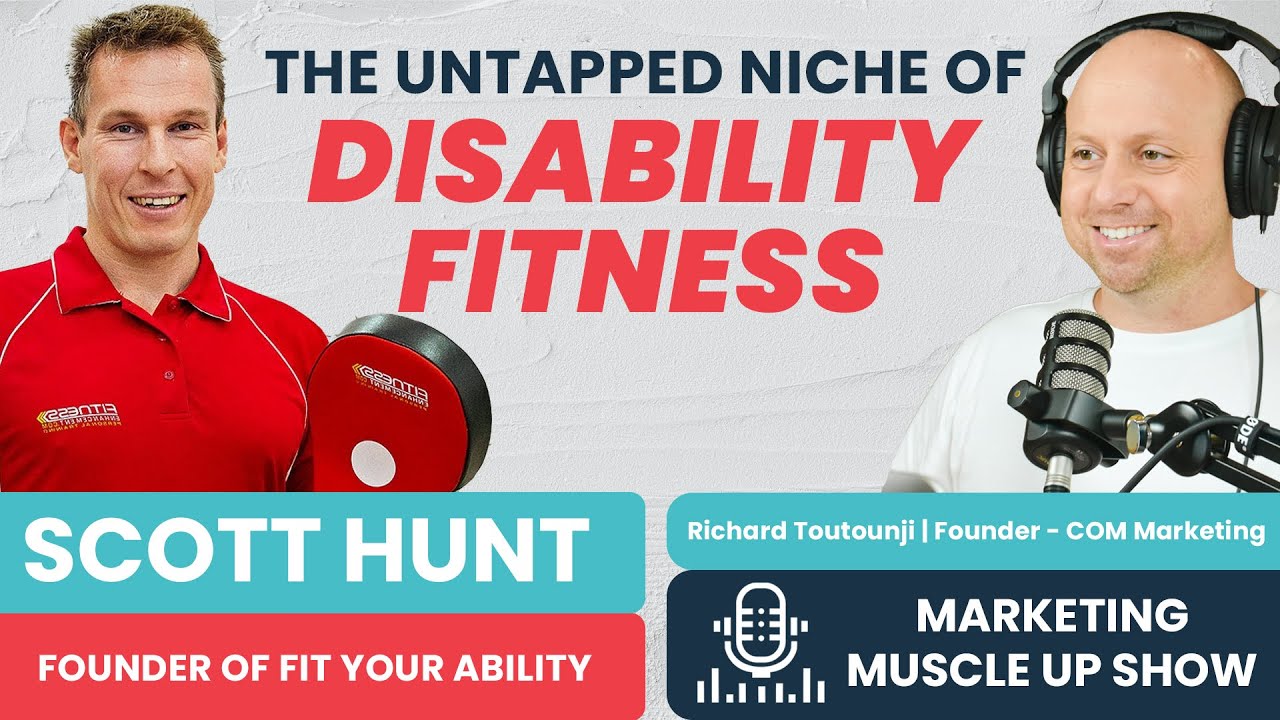
In this episode of the Marketing Muscle Up Podcast, host Richard Toutounji interviews Scott Hunt, founder of Fit Your Ability and Fitness Enhancement, about the largely untapped market of disability fitness in Australia. Scott explains how his personal experience as a young trainer led him to focus on clients who avoid traditional gyms, prompting the creation of a mobile personal‑training model and later a private‑studio brand that emphasizes 100 % privacy. He details the growth of his business through franchising, the development of a national footprint covering over 2,000 suburbs, and the importance of hiring people with the right personality rather than just skills. The conversation then shifts to the National Disability Insurance Scheme (NDIS), outlining its purpose, the distinction between core supports and capacity‑building (the line‑item that covers personal training), and the options for trainers: becoming a fully registered NDIS provider, operating as an unregistered provider, or joining an existing registered organisation like Fit Your Ability. Scott shares concrete client stories – an autistic client participating in community activities and a vision‑impaired half‑marathon runner – to illustrate how NDIS funding can be applied. He also offers practical marketing advice (targeted ads, disability expos, inclusive imagery, language that refers to “participants”), hiring and retention strategies (personality focus, clear expectations, under‑promise/over‑deliver, timely payment), and financial logistics (plan‑managed vs self‑managed funding, invoicing). Finally, Scott reflects on his long‑term motivation: helping people achieve goals, especially those facing the biggest challenges, and continuously evolving his business model to stay engaged.
Chapters
You know, obviously 4.3 million people have a disability. That's 17% of the population. I don't know the percentage off the top of my head, but people over the age of 60 who are not gym goers are never going to walk in there. But we all know the benefits of exercise as you get older. It starts at creating that awareness and growing that awareness for people first and foremost, and talking about the benefits of it. As soon as we're going lift weights and pump iron, it scares people off right away.
Welcome back to the Marketing Muscle Up Podcast Show. I'm your host, Richard Turturgen. If this is your first time listening, welcome to this show. Uh, today I've got a special guest for today. His name is Scott Hunt and he's the founder of Fit Your Ability. Uh, if you haven't heard of Fit Your Ability— cool name, by the way— it's an NDIS registered personal training and disability support company servicing over 2,000 suburbs across Australia. Now, this began in 1999. I think that is the year that I got involved as a personal trainer, possibly. We can, we can come back to that. And the brand is Fitness Enhancement, which a lot of you may know if you've been in this industry. Franchise from 2014, mobile personal training locations. Scott's company's always been around helping those who need to exercise but aren't comfortable in a typical gym setting. I wanna touch on that because it's really very interesting where Scott's going now. And I know last year or this year, Scott was the AusActive National Employer of the Year. So that was a huge, huge win and well done on the awards. You've been doing this for— that makes you— so it sounds like 20 years doing it in this game, Scott. Is that correct?
Yeah, almost 25 actually, in '99. So—
I mean, '99 was the year, '99 was the year I believe that I I did my TAFE course, so I got involved somehow, started my studio on there. So it's a pretty cool year. Welcome to the show, Scott.
Thanks. It's the same year Google was invented too, you know. So to anyone younger, Google did not used to exist. That was '99.
Wow. There you go. Yes. That's the year that websites and you had business cards. I remember I didn't have a website on a business card in 1999. You had fax numbers on 1999. So it has come a long way. Scott, you've been doing a lot of interesting things over your period with Fitness Enhancement and now Fit Your Ability as well. I want to— like, there's so many ways we could have this conversation, but I thought, hey, I really want to bring you on to talk about something that I've been hearing a lot of questions on lately, and it's the conversation of NDIS. That's the government's national scheme for the disability sector. We have quite a few actually NDIS provider companies that we work with across Australia because at Comm we are all about health, wellness, and this is a sector that is, I guess, is getting more news. Like there's a lot of people tapping into this and I want to kind of hear it from you what it is and how you go about it, especially if you're a personal trainer or you're saying, I want to do an NDIS role. There's a few things that we want to clear up as much as we can. So first of all, how did you— I mean, I liked how you said, um, you've always been about getting people to exercise that aren't comfortable in a typical gym setting. Now, as you know, um, most people in Australia are actually not members of a, uh, of a gym or a health club or a studio. Um, you've been doing mobile personal training when other people's— other people have left that And you're still at it. And because you've got this drive to help people who aren't loving the gym setting, tell me a bit more about that. What's the fascination of that for you?
Yeah. Look, it came on 2 levels really. I mean, I was 19 when I started the business and I really, as a probably 16, 17-year-old, looked around the gym as a person going, who's looking at me? And realized a lot of other people going, who's looking at me as well? And the person who really needed to go was never going to walk in that place. So partly as, I guess, just wanting to help people. that's my passion and partly as sort of finding out marketing niche and being fairly entrepreneurial. I went, that's just a massive market and it's not really a niche. It's the bulk of the population who could do with the services that we offer but are probably never gonna walk in your mainstream gym. So it's a bigger market than the people who are attending gyms. So it's more than a niche. It really extended from there. From there, I started my business on my whole $400. Very importantly, I had a Yellow Pages ad back then, which was—
Oh yeah.
absolutely essential back then.
So
totally. Yeah, we don't anymore, to be clear. So, and it really grew from there. I was probably one of the first PTs in the country to actually have a website back in 1999, I think. So, which was pretty awesome. It's grown a bit since then. Opened up my studio, I think 2003 or '04 or something from memory. That's still going as well, of course. And funny enough, as we got bigger in that and we're then seen as a credible place and we started getting mobile inquiries, we pushed more and more into mobile because Then we were seen as a credible place, not just some random teenager in his car coming to the house.
Right. So
that really created a credibility around Mobile PT for us. The fact that we were by that stage credible. I was always dedicated and professional and trustworthy, but I may not have been perceived that way as a kid with nothing more than $400 to my name in a business.
Well, when I got involved, Personal training, I, you know, this is, this is a lot. This is, this is what happened between you and me, Scott. Um, I, I lied about my age for a good 4 or 5 years because I, I got involved when I was 17 and I was— most of my clients were 50 and I thought, oh, they're not going to trust this skinny little kid, you know what I mean? Yeah. So you do what you need to do, right?
Yeah, exactly. I, funny enough, I didn't, I didn't— everyone thought I was older than I was. I was, you know, 19, 20, 21. Everyone thought I was 25, 26 or something. So Unfortunately, they no longer think I'm 25 or 26.
It's like that. We want to be younger, we want to be older.
Yep.
And so you found out really fast that people didn't want to be in gyms. And so you then said, okay, let's go to their house, let's go to their home. And so tell me about that now. How many locations, you're servicing 2,000 different suburbs. What does that look like in that side of the business now in 2023? You know, 2023 is recording.
I've really got a couple of things. I've got my original business that I started. So that's in Nerang on the Gold Coast. We still have our studio there. We have 100% private personal training rooms. So that's our thing. We've put a lot of work into trademark what we do and really built that wording around 100% private for our fitness enhancement studios. So the reality is we're all gonna claim we're the best, but we can go, well, we're more private. It's just you and your trainer. No one else allowed in. No one even sees what you're doing. The bloke down the road, look, he may be just as good as us, but they're not gonna be perceived as private. As for not seen as private, it's probably not gonna be perceived as good by a certain market out there. So that's been a really key thing, that 100% private niche with our mobile PTs who obviously, well, really everyone can claim that they give some privacy in mobile sessions, but it's having the credibility of being that bigger business. So then franchised in 2008, I think it was. No, sorry, 2014. It was 2008 was when we expanded up to Brisbane and everything from the Gold Coast and we ended up— Yeah. Covering all of the Gold Coast and Brisbane with my own PTs. Like every business, staffing is the hardest thing. The most dedicated person is normally the boss, and franchising is a great way to get more bosses involved. People who want to have a real business. We get a lot of people who have, you know, might have done gym rent and gone, it's a business, but I can't grow it. I can't sell it. I take on— can't take on staff. I'm in competition with every other PT in the place.
Yep.
It's more like buying a job than a business for some of those people. So that's really been the market that we've done well with is PTs. Now, busiest mobile franchisees tend to have around about 10 staff working for them with no bricks and mortar expenses.
Wow. 10 staff working with them, no bricks and mortar expenses. That's excellent. And when people are wanting to get a franchise, I'd love to know what type of person, you know, and I'm I want to get to the disability questions in a second because I think it's really interesting, but I just want to sidestep a little bit. When someone's looking to grow, you focused purely on personal training, you know, 100% dedication to that, which I love. And you're the best at that process, right? And so when people want to get involved and they say, I want to be a personal trainer, and even if they come across you and they say, hey, I want to get a location, because I know there's a lot of people signing up to get your locations at the moment. What type of personality do you look for, for somebody who's going to be a great owner-operator of the fitness enhancement location? Yeah.
Well, personality is where it all starts because we can teach skills, we can do a lot of things that they don't need to do or don't want to do, but we can't teach personality. That's how people are. So we're really big on that and that company culture as well. So down to earth, friendly, caring, nurturing, focused on the client, and just a selfless person in general is really the biggest one. And every interview, whether it be for someone working for me or a franchise, I'm quizzing people on those questions about that. And I've done, you know, obviously I've spoken to a lot of people about buying franchises and then for regular job interviews, I have a big team who works for me. I've done thousands of interviews. So it's really trying to figure out if that person's the right fit for us and the right fit for the role we offer and they're gonna be with us long term. So yeah, that's pretty much the million-dollar question of how we figure out that answer.
Right. A lot of trial and error, it sounds like to me too.
Yeah, it is. And look, it continues to be. And I relate it back when I'm talking to franchisees with their struggles with staffing, because that's business. We all have it. It's the same with when you're getting clients. How do you find that client who's going to be aligned with you and be with you for 10 years? It's hard to get clients like that. The better you get as a PT, the more clients you get like that. So we are like that with getting people on board with us. We've had heaps of people stay with us for more than a decade now, which is absolutely awesome to have people in your company for that long.
Wow. Um, I want to touch on— I want to sort of deep dive a little bit into, I, you know, what we call the untapped niche, possibly. Um, you have been focused on that one-to-one people that are not, um, that don't want to get into the gym. Um, the NDIS scheme, I'd love you to take us through it and, you know, what you've been pretty much doing in the Fit Your Ability, uh, side of the business. Can you take us through First of all, what NDIS is for anybody who doesn't actually know what it is.
Sure. So first of all, overarching answers that everyone would relate to anyone out there. NDIS is National Disability Insurance Scheme. The way it functions, it has a reason why it's called insurance, but it's not about the day-to-day function, which confuses people even further. Essentially, it's government funding, our taxes going towards helping people with a disability live a more able-bodied life and be able to do the basic things they should be able to do. I think it's a 30-something billion a year of tax dollars going into it right now. Yeah. And it's growing to $50-something billion over the next few years. It is an unbelievable thing for people with a disability to be able to get that support and that help that they deserve to get. A lot of it's more around people who need full-time care, they're qualified support workers or they're nurses or they're medical and so on. And then there's a small element of it that relates very directly to the fitness industry. Whether it be a PT or a disability support work with a passion for fitness, or as we say, a PT with a passion for disability support work. There's that small sector that's just absolutely perfect for our industry. And as you said, it's an untapped niche. You know, think about how many gyms out of the thousands and thousands out there are proactively inclusive to someone with a disability and proactively making that clear to them. It's not many. And— Considering we have 4.3 million people with a disability in Australia, that's something that we are pleased to be playing a part in changing.
Yeah, super interesting topic. As mentioned, we've worked with an NDIS provider and we've filmed a lot of different video contents for their participants. And, you know, there's some stories on every length of the scale you could actually imagine. And I walk away from those days and I'm like, wow, super lucky, super thankful. And what you talked about, Scott, you talked about just so they can actually live a normal, a normal-ish life, you know what I mean? The basic things that are required to live a normal life. And so we're talking about, you know, someone to bath them, shower them, walk them, take them to the grocery store even, some take them to the gym, all those kind of things that we take for granted. Yeah. You know, the NDIS provider will have that in place. So Let's go a little bit deeper into, okay, I'm a personal trainer and hey, how do I get involved in this, Scott? This sounds like the government's $50 billion scheme. I can take a slice of that. That's what people are thinking in their head. Scott, tell me about what's the next steps and what do you need to do if you're actually interested in helping this sector?
Yeah. It really depends on the size of your business, how much money you can put into going through it as to how you do it. There's many variables in there. So if you're a business like us, we're a decent-sized business, good turnover, we're already very aligned with training or abilities. It was a natural progression for us to go, well, now we can actually get paid by the government to do what we've always done. And those 9 out of 10 people who we have to turn away because they can't afford a personal trainer, we can tap into. And there's 1,000 more of those people who are going to go, oh, I didn't even realize a personal trainer could help disabilities. That's what we've done is we've tapped into that. So I guess with our story, area was going and getting the registration for that, for personal training. That was about 4 years ago. But then realizing that that was just the beginning. So for us then to say in quick summary of what we've done, we've then gone and become registered for core supports too. So in layman's terms, that makes us a disability support company, which means we don't have to turn away the people who only have funding for personal training. So I think we're probably the only company out there who's done the core supports too. And that's been really important for us too.
Talking about the core supports, what's included in core supports?
Core supports, so there's a whole bunch of things on there. So daily life skills, for example, innovative community participation. There's all these words that the descriptiveness of it kind of makes sense, right? So it's the things that don't— so there's a specific line item for personal training that's called capacity building. This is my layman's term that everyone seems to get. It's sort of almost like a luxury purchase. And then core supports are more your essential things. If you think about some people with a disability, without that support, they wouldn't live 24 hours. That's what core supports can sometimes cover.
Great. So you have the ability now to do some parts of core support and then the fitness, the personal training side too?
Yes, that's right. So in our case, it means that the person who doesn't have personal training but have core supports, if they're saying, If their goals align with what we as personal trainers offer. Now, we all know that we do far more than just help people lose weight and yell at people. We all know that. But the pencil pushers in the government— I hope they're not listening— don't necessarily agree that a personal trainer does more than that.
Can you take me through a specific example of one of your trainers doing core support so people go, okay, I could do that, or I couldn't do that? Do you have an example you could share?
Yeah, sure. Um, Probably the most common clients we get are autistic, I would say.
Yep.
So a lot of the time it's innovative community participation, for example, which is essentially we're going out in the community with that person in an innovative way and we're doing something with them to have them engaging in the community and being an asset to that community and getting them social. We just so happen to be doing that with some weights and a set of boxing gloves, but it is being participating within the community. And so people get funding for things like that. So that's the most common type of thing that we'd be doing. And that's technically speaking disability support. The fact that it's a personal trainer delivering that in a personal training session, that's irrelevant. First and foremost, it is that, you know, if everyone's got different passions and we'll help them follow their passion. Another great example we had, and this one is a bit abnormal, but it lets people sort of think outside the scope of what we're saying.
Yep.
We had a guy run a half marathon with one of our PTs. Yep. was vision impaired. When he had sight, he was a triathlete. Um, he's in his late 50s, I think, maybe 60. Um, he couldn't get funding for personal training. He's too fit and healthy.
Wow.
But he had funding for innovative community participation. He had that bucket list goal to be able to complete another half marathon. Yep. And we had one of our trainers work with him and train with him. Uh, she, in her case, had no experience. She'd never run more than 5K in her life. She'd never worked with a vision impaired person, but we helped to upskill her and work with him. And clearly he's a— he has a lot of experience And so she managed to be able to work with him. And the thing, back to what we're saying about personalities, the reason this lady Kelly was so great for it is she was the perfect person for him in regards to how keen she was, how supportive she was. And yeah, thanks to the NDIS, he could tick off that goal. And before the NDIS existed, he would've had to pay for someone to run with him out of his own pocket.
Got it. Got it. All right. So as we're all sitting on the edge of the seats going, Scott, this sounds too good to be true, You know, tap me into this and I definitely can help out. If you're a solo, let's say personal trainer, right? Or you're running a studio or what it may be. And I know, you know, paperwork is not at the top of everybody's to-do list. How does a personal trainer or somebody that's, you know, saying, I'd like to test this out and try this, how would they get— can they get started without having to actually become an NDIS registered provider? What's another option for that to happen? Yeah,
they can. There's a few ways. So for starters, if we're talking business who's turning over less than a few hundred grand a year, you're probably going to be going, the time, the costs, the paperwork, especially if you don't love paperwork, which I sure don't, is not going to be worth it for you to do it. It's an expensive government system. You can imagine the bureaucracy that goes along with that. Every day we have headaches with it. For us, it's well and truly worth it and one of the best things we've ever done. But if it was where my business was 10 years ago, I would not be able to achieve it. And I had a book-solid studio, Mobile PT across the Gold Coast 10 years ago. I myself would not have been able to achieve that 10 years ago. Thankfully, we're not in that position now. So if you're not in that position and you're a one-man show, 2, 3, 4 staff, whatever, anyone can be a more inclusive business. And I think from that marketing point of view, NDIS is just one part of disability. It's not everyone with a disability has NDIS funding. It's about being a more inclusive business and letting people know that you are more inclusive. The pictures on your website say a lot about how inclusive you are to all abilities.
Mm-hmm.
The wording on it, the way you talk about it in NDIS terms, they're participants, they're not clients. Getting your wording, your language right around it shows that you're sensitive to those things and will definitely increase the odds of people coming towards you. In our case too, we've written a lot of blogs as well. For example, you can't get a gym membership on NDIS. Doesn't make sense to me, but I'm not that pencil pusher in the government. We're certainly not listening again. But we've written blogs and articles and educational things on it. So we get a lot of website traffic through that type of thing as well. Anyone can do that. You don't need to be an NDIS registered provider. You just need to be taking steps to show the market you cater to. And that is more than just whacking a picture of someone in a wheelchair on your website. It's got to go deeper than that.
And, and can that person work for any, uh, let's say I'm a personal trainer, I go, yep, I'm going to put down the website, I'm going to change my word to participants, I'm going to change my images. I even might be training somebody who possibly is, or, you know, is already training them, they're paying me and they've said, hey, you know, do you— how do I get involved in that? Can they work for somebody like yourself, Scott? How did that work if I don't want to get down and actually do all that?
So I'll get to how it works with us in a sec, but excluding being with us, anyone can actually be an unregistered NDIS provider. When you say unregistered, it sounds not right, I know, but it is a legitimate thing to be an unregistered NDIS provider.
Okay.
Those PTs have come along and gotten 1 or 2 clients, normally friends or family or referrals. They're absolutely allowed to do that. And there's workarounds with the funding, workarounds in a legitimate way, just to be clear. It sounds bad when you say workarounds.
Yeah.
For that person to be able to be paid as an unregistered provider. So if you're a one-man show, Stick to doing that and work on being a more inclusive business. If you're going, I want to walk my own walk, and you don't want to join a place like us, that's by far the best way to do it. The downside of that is, though, you will have to turn away 90%, at least, maybe 99% of the business you could potentially get doing that. And when someone jumps on Google or whatever, they're always going to look for a registered provider first and foremost. If the person is plan managed, which is essentially the humongous companies that manage everyone's money with the NDIS, they're always gonna either look for a registered person or a company they've dealt with before. When they can't find that, which is not uncommon, they can't because very few people have what we've got. That's when they'll look outside the square and go, this person looks really great and inclusive and they're unregistered, but they look like a great person, a great PT. I might use that person.
And who would pay that person then? Let's like, is it like, is it the registered provider who pays that individual personal trainer/carer?
Yep. There's one of 3 overarching things. I won't get into details, I'll put everyone to sleep. But there's NDIS managed, which you can't, if you're not registered, get that. Plan managed, and there's self-managed. The latter 2 you can get paid by if you're not NDIS registered. And then depending on how it's structured, it might be like a, one of these big like plan partners. There's a company we do a lot of work for, for example, they might be paying that person direct and they've got their own sort of invoicing system. If anyone's done corporate PT, it's almost a bit like that, I find, where they've all got their weird little frustrating ways to invoice. But if you want to play with the big guys, you've just got to follow their rules and do it their way.
Got it. Okay. So there's a couple options just to recap what you've said here, because I find it really interesting, Scott. I think a lot of people that I'm hearing talking about Some are already established, some are thinking about it, some are just trying to understand it. So, you know, if you want to, if you're doing a few hundred thousand dollars or more and you've got this space to take this aboard, you could go out, go the government site, I'm assuming, and search how to become a registered NDS provider and go through all those paperwork and so forth. That's option one. Option two is that you could be an unregistered, which is a word, provider. And otherwise you can work inside somebody who has already got that and they're paying a rate, I'm assuming, that's somewhere aligned with the government rates. Is that correct, Scott?
Yeah, kind of. And there's a million variables within that, but that's the ballpark sort of side of it. And then the third option is then people come on board with us. So that's what we've done. And Name Fit Your Ability, just to go back to inclusiveness, the reason we made that name was we went, fitness enhancement, personal training, NDIS registered doesn't have quite a ring to what we want for the disability community. Fit Your Ability makes it very clear that we're a disability company. So that's been a great sort of marketing angle. And with us, whether it be, you know, fitness enhancement or Fit Your Ability, same company, same people, just 2 different sort of target markets. That's the other option is people come on board with us and they can do one of 2 things. They can work for us, no rent, no expenses, we provide all the clients, just get paid. Work for one of our— myself or one of our franchisees, or they can bring their business under our NDIS registration and essentially stick the Fit Your Ability badge and all the other funky badges behind me on their website as well and actually brand themselves as that. Because obviously as a brand where there's NDIS and then there's our brand, the two together is what works really great for us.
Great. Awesome. Some good insights there. So you can sort of choose the way that you want to get involved in this, which is, you know, I think it's a great way to see which path you want to go down. And I'm a big believer in charging more. I'm a big believer in making sure that you're getting paid for what you're worth. And I think it's important to realize that when government sets out particular amounts of what someone should be paid for that, I know that differs, but when somebody sets that out and then we look at what we're getting paid as a personal trainer or running, you know, unlimited sessions, and we work out what we're actually getting paid hourly rate, and I— and this is to me, when we realize what we should be paid and then what we are getting paid, I think this is a kind of a wake-up a little bit to say, hey, this can be a great career long-term. You could make a lot of money off it long-term, and you could really help a lot of people that are needing your help long-term. I just think more people should be involved in this sector because I just think, as I said, 4.3 million Australians with disabilities are possibly able to be some of your next clients and also give them what you've taught to someone who's fit generally and what you can actually do to change their lives. So I think it's a great initiative that that people should definitely start to think about more if this is a path they want to go down. I want to change tact a little bit, if that's okay, Scott. Sure. And you may have already answered this question, but I did want to touch on marketing. Now, I think what we're talking about here, if you've got a great business and a great product, it will market itself. For example, I can see if you're watching this on YouTube, you've got your NDS provider. Obviously that's a good understanding. If people are in that sector, they know what that's about and so forth. Tell me a couple good, like, we'll take a little, like a little preview here. I'd just like to know 2 or 3 really good strategies, marketing strategies that you've done or your trainers have done to get people involved that are not so much lining up to go the next F45 class or lining up to go for that 20K run. You know, how do you— Talk to people who do want personal training, who do want privacy, who don't want to go to studios, who don't want to go to gyms? How do you plug into this market, Scott?
Yeah. Well, it's funny, isn't it? It's a bulk of the population, as we said. Obviously, 4.3 million people have a disability. That's 17% of the population. A whole lot of, I don't know the percentage off the top of my head, but people over the age of 60 who are not gym goers and never going to walk in there, but we all know the benefits of exercise as you get older. It starts at that. It starts at creating that awareness and growing that awareness for people first and foremost and talking about the benefits of it. As soon as we're going lift weights and pump iron, it scares people off right away. So showing some of the benefits, showing some testimonials of like-minded people. So we'll do a lot of, a lot of whether it be Facebook ads or Google articles on the website to rank higher on Google or networking where disability disability expos and so on as well. We're doing all those types of things for people to be aware. And the most common thing we probably have people say when we're at a disability expo, I've got one this weekend right again. Yep. Is probably, oh, I had no idea a personal trainer could help someone with a disability. And it drives us crazy to hear that 'cause we're like, what's a huge portion of our industry has been saying for a long time, we can help. But we certainly have. But it gets that awareness out there. And once they get to meet us face to face and sort of realize, hey, we're just ordinary people and we're not there flexing and we're just here to help, then yeah, that's half the marketing. As you said, the best marketing is a great product. So letting people see it and trying to break down those barriers and concerns that people have is a massive part of it.
And you touched on images just before. I mean, do we have to change, like let's say we have Facebook or our websites and so forth, what sort of images have worked well for you? Has it been somebody with a disability in the actual shot? Has it been taking pictures of like one-to-one? What generally works in images for you, Scott?
Yeah, I think showing images of people who— that people can relate to. So if it's someone elderly, so if it's, you know, let's say Google AdWords, they're clicking the ad for seniors personal trainers, going to a landing page with the senior training it. If it's NDIS, same deal with someone with a disability, making sure the personal trainers in the photos are down-to-earth, healthy, normal-ish looking people as well. We have certain trainers who we want to put their faces on the website a little bit more than other trainers. We go, they just tick that perfect avatar of what we believe represents us. They're all great trainers, to be clear, but it's about getting the right ones.
So shirts on, Scott?
Shirts on. We actually get people saying, I rang, so I'm on the Gold Coast. We know how the Gold Coast can be, right, people? I literally get some people saying, I contacted you because you were the only people with shirts on in your photos or something along those lines.
Yeah, right. Yeah, it's a thing.
Yeah, as I say, it's like people can tell you're ripped with a shirt on. Leave it on, people. You don't— you're not gonna get any more clients with your shirt off unless that's your market. If you're a bodybuilding market, that's not my market, but there's a market for that. But if you're after training people who are a bit scared to go into the gym, keep the shirt on. They can tell you're pretty buff. Don't worry everyone, it's okay.
So the shirt, they could see the muscles through the shirt and shoulders and so forth.
Exactly. The other one as well is also not just the images we use, but the images we don't use as well. It's not like we've got a page with people with disabilities and then there's another page completely contradicting everything about that, right? Going, we're about health and then another page showing something that's very unhealthy. Some sides of our industry are like that. And then same on social media. You know, we know that clients are gonna go on social media and just do a Facebook stalk and we make sure all of our trainers, well, before we hire them, we do a little check, of course, to check they're aligned with our brand. But once you're on board with us, you wanna make sure, and this is for any brand out there,
Yep.
who you're trying to say you are as a professional, your personal personality, what people can see on social media should align with that as well. It's very hard to say you're all about helping people and being healthy If they just look up your Instagram account and that says you're the opposite to what you told them you were. So people look, so make it all on brand.
Yeah, love that. People look, make it all on brand. Take the pictures off that don't represent, put the pictures on that do represent. I think that's some great strategies around that. Scott, you mentioned that you did start on the Gold Coast and you've branched out. Talk about now in regards to anybody who may be in that same position as yourself, You know, possibly looking at the fitness enhancement, you know, brand. I know they've kind of merged as one. When you are trying to hire the second trainer, the third trainer, the fourth trainer, when you can't actually see them every day, you know, you've got mobile trainers. Sometimes you're in a studio, you can manage and say, yep, I've got these trainers in here. But when they're mobile or when you've got another location, what I'd love to know is like, what is the one or two things that helps you to keep everybody as a team? Instead of going out and saying, oh, well, all these trainers don't know Scott, don't know Fitness Dance, but I'm just going to take them. I think a lot of people are scared of that, Scott, when they hire somebody else and it's such a personalized world, especially when you are doing personal training, not studio. Is there any strategies you can give for those people that are struggling to keep that team tight?
Yep. Well, I'm still scared of it too. Don't worry. So no, there absolutely is. So I think one is that there's a lot of things there. One is outline clear expectations at the start when you're hiring people, make it clear. So in our case, our clients are our clients, they stay our clients. If you decide to move on, so franchisee is a whole different world, it's a longer-term commitment. But if you're just working for us, you know, we have regular jobs, which is rare in our industry. If you're working for us and you move on, that's okay. But our clients stay our clients. You can't take them with you. We make that very clear. Not all things in the fitness industry make that clear. And then when you part ways, there's sometimes a debate about whose is whose.
Sure.
The other one is under-promise, over-deliver. If you're keeping people happy and you're respecting them and their time and you're doing what you said you were gonna do, they're a lot less likely to try and rip you off. It's basic, not just common courtesy, but common sense and strategy to make sure people are looking after your business. That's a really, really big part of it, right? I think a lot of people when they're nicking clients, which is a, you know, happens the whole time in our industry, They're partly doing it because they felt they were getting ripped off and weren't getting a fair deal. And it's two sides to every story, of course, but that's why they went, well, stuff you. You didn't look after me. I won't look after you. I'm out of here. So look after people. They might move on, but it'll decrease the chances of them actually taking people.
And how do you— just touch on that for a second. How do you look after somebody? Are they focused more on communication and training or teaching? Do you have to pay them? Do you have to keep taking their rate up? Do you have to listen to them? Is there something that you've—
So we're very clear on expectations. So let's say, for example, so we have a lot of trainers who might do 10 or 15 1-hour mobile appointments per week for us. But now it's independent contractors because they're mobile and it's only 10 or 15 sessions per week. And we're just checking that we're aligned with what they want. So when in the interview we say, you want 10 or 15? Here's how long we think it's going to take you to get those 10 or 15 sessions per week. We make sure we hold ourselves to that.
Got it.
If we're for some reason getting it wrong, we pump more money into marketing so we can come through on our word. Clearly, that's good for us financially, but it's also good for us just in retention. And then if the person's not doing the same back in return, if the person says I'm available the whole time wherever, and then we're offering them clients and they're saying, oh, actually I'm busy at 5 AM, which is code for I like to sleep in, then we're holding them to their word and we're saying, you didn't tell us that, be honest. And so we're holding them accountable. Not everyone's gonna like it, but everyone's hopefully gonna respect that we're doing that. So that's a massive part of it. We show that trust from day one and hold them to those standards from day one. So this is, I would like to hope, why we've got the Employer of the Year Award. It's a lot of things like that. Because even though we can't get everything right the whole time, I don't think there's many trainers who would say we were deceptive when they came on board. Hmm. Whereas, you know, we've all heard horror stories of different things out there within the industry. The other one is we pay people when they work. It sounds common sense in any other industry, but we know in our industry a lot of people are expected to do certain amounts of work for free.
Yeah.
And that's not always clear when the person comes on board, which comes back to that trust and deceptiveness as well. So we're very clear, if you're working for us, you do, you know, if the client's a no-show or a free promo or rips us off or pays late, we pay you on time correctly the whole time, no matter As long as that person did their job properly and we're not trying to pick and find little loopholes in that. It's just simply you did the job right. Even if you didn't do it perfect, you did the job largely right, you get paid. It's then our job to then charge the customer. If we don't get paid, we shouldn't, we're the business owners, we shouldn't be forcing that loss on the person working for us regardless of the legal, I guess, entity structure or whatever. That's a whole nother discussion just from a pure handshake agreement.
You
work, you get paid.
I think this, you know, I think what I'm, you know, seeing from your business over the years, Scott, is that if, if you actually just want to be a great trainer and not want to own a business and run the business and so forth, it's a great, uh, it's a great option. You know, I think people forget that, oh, I've got to be a trainer, I've got to get my own business going, I've got to do this. You don't actually have to. I think businesses work really well when they've got great people working in those businesses that actually want to work in a business. It's not all like, let's just hustle and hustle and get our own business. You literally can be a bit easier if you don't go through all that.
Yeah, absolutely. It's about putting people in the right seat as well. There's a way to it. Let's just find the person who's the best PT as opposed to an average PT, an average marketer, an average accounts person, an average everything, which is how some people may be in their business. You can't be great at everything. So let's just go, you're a great PT, but geez, I'd never want to put you in front of a computer, some people. But you're a great PT and a great person. That does all we care about. So that's a great thing. And then that's where also too the franchising model came into. We were going, look, we've got people who want to step up, they want to grow. When you work for someone, there's only so much money you can make. Of course they want to step up, they want to grow. Um, back before franchising, we're sometimes losing people who There's not enough opportunity here. So it was creating an opportunity for them to go into their own business. And some of our best people have started working for myself, one of our franchisees, and then gone on and opened their own location because they've gone, I want to take it to that next level and I'm prepared to put some skin in the game to do that, basically.
Yeah, very good. Okay, Scott, one final question. You got into the business 1999, the same year I got into the business, and I want to know, So what overall keeps you in this industry doing what you do? What's that one thing that you say, you know what, this is the best industry, I'm happy what I'm doing and I'm loving that. Is there one thing that you could summarize?
Well, I'm probably going to put it down to 2. So one is I genuinely still just love helping people and love seeing people just achieve their goals. And that's just for whatever reason what I've always enjoyed doing, in particular, the people who are the— have the biggest— the bigger the struggle, the bigger an achievement is when they achieve a goal. So that's what's really great now. But the other part of it is just evolving as time does, as the business does, as I evolve and get older. I don't train people now. I spent 12 years training people all day, every day and probably spent too many years doing it. As much as I love that, it was continuing to evolve so I can continue to keep interested, you know, helping a few clients achieve their goals. That was exciting for me once. Now it's helping a whole country. That's exciting for me. So still that excitement, it's just evolving as things grow and change and so on. And that's it really.
Love it. Now, Scott, you mentioned before you've got webinars on this and we talked before and I'm keen to see if anybody's interested in understanding a little bit deeper into NDIS and how they can get involved and so forth. You've got webinars on this topic because I know that It's quite a complex, you know, conversation. If you want to get some more details, can you just let us know the link of where they can actually find that webinar from,
Scott? Yeah, I'll make a shortcut to it. Now I'm thinking off the top of my head, it'll be at fitnessenhancements.com/richard-toutounji. I'm going to set that up in about 5 minutes' time.
What we'll do, what we'll do, guys, if you are listening to this, I'll have a link We'll get the link to Scott's webinar. We'll get the link and you can get access to it. The best place to connect with you, Scott, is it Fit Your Ability or Fitness Enhancement? Which is the best direction?
They're both— anything direct to me comes through to me. So a general inquiry site on the websites will go through to our team. But try to get me direct personally, probably through Facebook's the best way. Just look up Scott Hunt and hopefully you'll see me there. But otherwise, yeah. website inquiries and just mention you're after me directly would be the other way.
Great. So guys, you can check that out. Scott Hunt on Facebook. Go hunt him down.
Never heard that one before.
Never heard that one before, I bet. So go find Scott Hunt on Facebook, have a chat to him and say, listen, Scott, I'm interested in NDS. How do I get started and what are the opportunities? And he'll probably lead you into his webinar or sort of see how you can get connected.
At the very least, even if people are going, we're not for you, because some people like to walk their own path. walk in it, that's totally fine. Watch that webinar because it will— I've got in there some of the really common questions we get and myths and fallacies. So even if you're doing it unregistered, registered with us, without us, either way, that way you're not falling into some of the traps that are easy to in a very complicated government system because the less traps we fall into, the more we can all be out there helping people and showing what a great inclusive industry we are.
Perfect. I'll have the link to that webinar in the show notes so you can check out that. And thanks for coming on, Scott. It's been super interesting, NDS, and talking all about that. And congratulations on the, uh, duration of time you've spent in the industry. It's so good to speak to people who've been in the industry for long term because it kind of proves that it's not a, you know, a short-term industry if you don't want to make it be. You can make it a long industry if you want to. You can make it a short industry if you want to. But I do love the progression of, um, You know, what, what, what you wanting to help people do always. And it's just like people are not comfortable in a typical gym setting, and you're progressing and keep— and you're staying in that, and you've just done it in, in different ways. And I think that's, that's growth. And I think everybody should take a leaf out of that. Um, out of that book is just the continuation of, um, you know, what, what you're here to do, what you put on planet Earth to do. So, uh, well done on the duration you've been involved in this industry, Scott.
Thanks, Matt.
Thanks guys, and thanks for another episode, tuning into another episode of the Marketing Muscle Up podcast show. I got a whole bunch of notes taken here in regards to how do you market better to somebody that you really want to target, someone niche in this industry. Today we're talking about disability sector, but it could be any industry. Take that away and go and use that. If you want to watch this on YouTube, you certainly can. If you're not watching this on YouTube, go to our YouTube page, ComMarketing, and find that. Otherwise, go to our website, commarketing.com.au. And for those who do want to help with your marketing, go to our website and find our guarantee. In 90 days, we're gonna guarantee you a certain amount of clients based on your revenue level. So if that interests you, jump onto our website and you can find more about that. Thanks so much. I'll catch you next time on the Marketing Muscle Up Podcast Show. Bye for now.









