Turning Chaos Into Success: Behind the scenes of the fitness industry
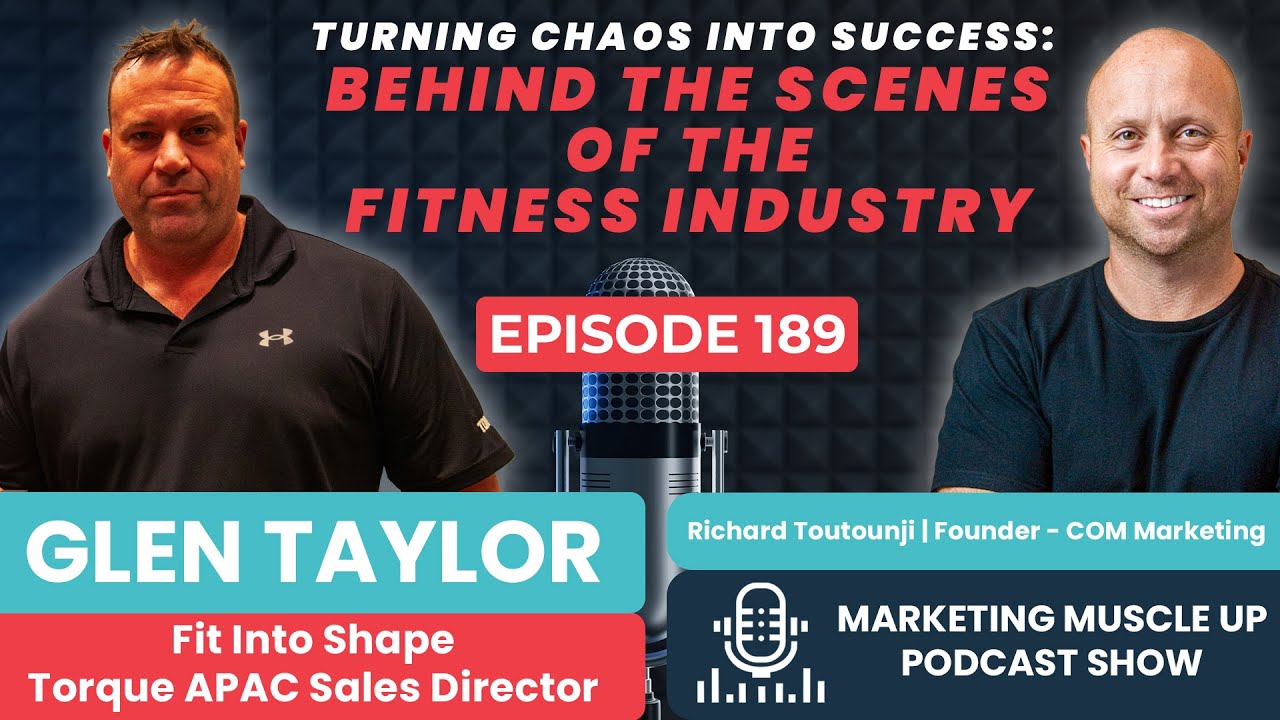
In this episode of the Marketing Muscle Up Show, host Richard Toutounji interviews Glenn Taylor, a veteran of the fitness industry with a background as a military sniper and over 22 years of experience in gym design, equipment sales, and business development. The conversation covers Taylor’s career trajectory, the importance of building trusted partnerships rather than one‑off transactions, and practical advice for new gym or studio owners on defining brand identity, targeting the right demographic, planning phased growth, and ensuring adequate circulation space. Taylor shares insights on the rapid growth potential in the APAC region compared with Australia, citing club counts and penetration rates. He explains Torque’s flagship products – the Torq Tank and the upcoming Ripper ski‑erg – and highlights emerging wellness trends such as NFTs, blockchain, relaxation capsules, and mental‑health‑focused offerings. The discussion also introduces Taylor’s new podcast, "Taylor Made Chaos," its branding rationale, and how he leverages existing content and low‑budget social‑media advertising to maximize exposure. Throughout, Taylor emphasizes patience, discipline, and the value of genuine relationships in driving sustainable growth in a still‑young fitness industry.
Chapters
There's enough business in the marketplace for everyone, but when you can work with people that you do know, like, and trust, business becomes a little bit more enjoyable.
Welcome to the Marketing Muscle Up Show, and my next guest has just introduced himself. His name is Glenn. Taylor. Welcome to the show, Glenn.
G'day, Richard. Always nice to get caught on audio when you're not 100% certain that you're on there. Nice to be here.
So good to have you, Glenn. Um, uh, you've had an interesting experience in the fitness industry, and that's why I've brought you on, because you've pretty much been everywhere in the fitness industry. And I mean that with the nicest, um, the nicest respect. You've Yeah, I'll just give a quick bio for those who don't know.
I get around, Richard.
But you do get around. So I think everybody should know your name and what you do. But the reason why I had to bring you on this podcast, Glenn, because you've got a few things that are, that are quite interesting that's happening in the marketplace. You've probably been in more gyms than most. Most people have one gym membership, but you've pretty much been in every single gym across APAC, Australia, New Zealand, America. And you understand the game quite a lot when it comes to gym design. Jim Fitout, and just a good way to retain members the best using these strategies. At the so currently you're the APAC Talk Sales Director, and you're the CEO and founder of another company called Fit Into Shape. And I want to talk about those two things. At the moment, you're doing a lot of You're driving the role in the Torque products across Asia and the Pacific region. And the big thing that I do want to touch on, because you've got something new that's come out, you've got a brand new show that's come out called Tailor Made Chaos. Interesting name, Glenn, Chaos, but we'll get to that. And you are known for really helping businesses get their goals, not just provide equipment. And that's a little bit different in this marketplace when you've got a lot of people selling, selling, selling. You're coming— you've done it a very different way. So welcome to the show officially. Good to have you here.
Thank you. Now that I'm officially on the show, I'm going to put on my official glasses.
That is what we need.
Just, just add a little bit more professionalism to this, uh, to this event.
I love it. That is what we need. Now, um, some say you've been in the fitness industry for 27 years, 30 years, 40. What, what number is it, Glenn? How long have you been involved in this industry for?
I don't know if that is kind of like when you ask a male how many people he slept with and he gives you 3 times the number. And a female, it's a third. I'm not 100% sure, but for me, it depends on where you sort of start that from. I guess, you know, my journey in fitness started at about 19 when I started to put on a bit of size at university. You know, first time away from home. eating junk food, doing late-night study, back where the internet only just sort of started, which is a whole other topic that we won't go into. Yeah. But then, you know, a couple years later, I joined the army and kind of took fitness very, very seriously and went down a path of physical training instruction in the military. So, I guess it kind of Depends on where you date that start date. I guess officially I would say it was when I became a physical training instructor in the army, uh, which is back in 2000. So,
yep.
Sorry, 2001 when I was technically sort of become that. Uh, so 22+ years, I guess.
Well, had a very, uh, similar age, uh, game there. I, I did think about joining the army, Glenn, but I just knew that I'd I didn't know if I was about to follow instructions or kicked out. So instead, I, I worked on cruise liners instead around the same year doing, um, doing personal training. So that's a really good thing I didn't know about you. Now, the thing I do know about you though, Glenn, before we get into some of the cool things you're doing at the moment, which is one of the shows I want to talk about, um, you sent through in your bio here that you've been a, uh, sniper. I want to talk about that. Nobody talks about it, but you have been a sniper. PTI, and then you transitioned out of the, out of the defense into equipment sales. Can we just quickly touch on a sniper? How do you become a sniper? How do you know that you're good at that skill set in the defense?
Uh, look, I think if you talk to any of my school friends growing up who, you know, we used to go out and do a bit of shooting with, they, they would have laughed, uh, and certainly would laugh if they didn't know. That, that was what I went on to do. Uh, so obviously a lot of people think it's just about shooting. Um, there's a lot more skills that go into sniping, and it's, it's navigation, it's memory games like Kim's games, it's, uh, you know, using skills of reconnaissance, it's the ability to camouflage and actually withdraw after doing a shot.
Mm-hmm.
Um, which is all the boring stuff that, that people don't kind of highlight on. Um, how you get into it, um, I suppose my journey is not that different to most other people. Um, I was in infantry and then had the ability to, to elect to go into, to that role. Um, we had to go through what was called your Sniper's Number 2 course to do selection for that. Um, once you passed that, which was at a, a regiment level, Uh, you then got the ability after several years of doing it to go on to become a sniper team leader that was run out of, uh, Singleton, a course that, that was run by the School of Infantry there. Um, I, I guess not too dissimilar to, to most other careers is, is you work hard in it, you develop in it, and, uh, and refine your skill set in it.
Yeah, great. Well, what did that skill teach you, uh, when you transitioned into Um, you know, fitness industry and equipment sales? What do you— what— how did that come about?
Uh, I'd love to say it's patience and discipline, um, and to a degree that's probably correct. Uh, you know, many of the, the jobs there were— was an old army saying, hurry up and wait. Um, you know, you'd rush and rush and rush, and then you would sit around for days. And sometimes on a, on a mission, that could be You know, in a training environment where you're out in the field and you might have been hour on or hour off or 2 hours on, 2 hours off, depending on how things work with your colleague, where you're just simply watching and waiting for something to happen. So, I guess that patience was certainly a part of it. And then the discipline to remain silent, the discipline to take in your environment and the things around you. Hopefully those things are have what's have continued on in my my career beyond the military.
Yeah, love it. Now, Jen, what was it? Jen Taylor Taylor. I can't even get your name. I can't even get the name. What's going on?
That's because you've got a couple of Jens in your life. I do.
I do.
And the good thing is is Joey knows about them. So we're not disclosing anything here that's going to get you in trouble.
Now we met about a year ago, Glenn, and we were on JT's Supply Roundtable. You're a supplier, I'm a supplier in the fitness industry, and we, you know, came to realize that you do more than just supply equipment. And I think that's where I found a very refreshing viewpoint. That, because we have a lot of clients that come to us as well and they go, hey, we want to open up a studio, and, um, and they always look for equipment. But it's, it's the things that people don't tell you which I think is super valuable. Um, I know that because I'm, I'm renovating a house at the moment, and, you know, you go from the architect to the builder, and, um, nobody tells you certain things that Maybe I should have known what to ask, but I didn't know what to ask. If that— I'm thinking everybody can relate to that. And you just don't know what you don't know. And when someone's opening up a studio or a gym for the very first time, cuz that's what a lot of listeners here are, they're, they're studio owners or gym owners or PTs wanting into a studio. And you just don't know what you don't know. And that sucks when you make the mistake. Yeah. And getting equipment to a gym is, is A big process, and it's probably the most costly part of the setup for some gyms if they're a big box gym or whatever. I want to touch on that, and I want to sort of put you on that spot. It's not a question I have, but what are like straight off the bat? What are three things, two, two, three things that that businesses need to know if they've never opened up a studio or they're opening up a new gym or they're renovating? What should they know? about the setup and the style of the gym, the studio? How should it be set up? What are the common problems that people face and then nobody tells them this information? Love to know from your side.
Yeah, really good question, Richard. I'll probably backtrack to the first point that you made before. I should credit a former colleague of mine, Ben Weil. Ben and I used to work together at Cybex. He was the education director, for want of a better title, for his role. And he used to try and educate us a lot on not just mechanics and things in the industry, but he'd talk about how to sell better and things like that. And one of the key areas that he touched on was a book called The Trusted Advisor. I guess that's something that I've tried to take away and run with my whole career is When you have experiences and you interact with people, I tell, you know, a lot of people you can sell to them once. And to sell to them once isn't that hard. You can discount the product, you can give away stuff, you know, you can jam in as much equipment as possible. Yep.
But
what that doesn't do is build a relationship with that customer. And that building trust is about making the right equipment recommendations. So the long-winded answer in the back on that was to kind of explain, but the 3 things that you kind of lead with is one, the type of facility that you're trying to operate. And a lot of people want to be all things to everyone. I think it's understanding what your brand is and then trying to make not just the equipment but the whole layout fit in with what your brand is going to be. So things like if you are looking to cater to, you know, the, the +55s market, then televisions and consoles might not be that important in the cardio equipment that you're looking at. Yeah. Whereas a lot of suppliers will try and jam in the equipment with the consoles because it increases the sale value.
Yep.
So it's actually understanding what the brand is and what you're trying to achieve. I think secondly, it's then getting them to have an understanding not only of their brand, but their target demographic and audience. So, you know, in marketing, you talk about an avatar. For us, I think, you know, the avatar of what the intended member is going to be, again, is very, very important in what the equipment mix is, and the equipment layout. So the two go hand in hand, the demographic and the business. Yeah. I think thirdly, remembering things like circulation space, and coupled with that, the ability to expand your business. So something I talk to people about is you might have a stage 3 that you want to get the club to, but you should be opening at stage 1. And then have an intended plan for stage 2 and stage 3. Make all your plans around what stage 3 is going to look like, but open at stage 1. And when you hit some key markers in the business, then look at your purchases for stage 2 and stage 3.
Yeah, I like that. That's good, good, good advice there.
An additional component to that is use then what your intended plan is, but market that to your members so they feel that they've had a say in your growth, because 9 times out of 10, they're going to be saying the things that you already were planning on doing anyway.
Yep.
But if they're having that interaction, then they as a business feel that they're a part of that growth with you. So, they're along for the journey with you, which goes into that sense of community that a lot of clubs, gyms, and boutiques and businesses are trying to develop. So I think that's one of the key things.
Yeah, I like that. I like that a lot, especially, especially, um, you know, the stages. I think as entrepreneurs, as somebody with their dream business they want to create, they want to create that dream studio, obviously you want to just take every good piece of equipment and jam it in there, right? You want to make sure that you've got everything there. But I think that's a really smart move, especially as you grow your members, your revenue grows, you don't have that debt that you're going into. There's a, there's a really smart, a smart, a smart way to run things. So that's awesome.
It's not just debt as well. It's also the wear and tear on the machines. It's the warranty on the machines. There's other facets to it that, you know, the overall cost of ownership needs to be, you know, weighed up and analyzed. So yes, the upfront cost is, is a major component, but also remembering if you've 6 months in, if you've launched with everything, what are you giving back to your members? You've got nowhere to go. You don't have some tools at your disposal to market with. The excitement that members feel when you add to it allows them to feel that you're reinvesting back into the business, even though it was part of your original strategy in the first place. It can just be a very good growth strategy for the business.
Yeah, I love that. Love that. Really good insights there. Never thought about that. Glenn, I want to talk about at the moment what you are working on. You've got a few very interesting points. I think a product that's on the market at the moment, which I'm, yeah, I think it's definitely one of those products that reminds me of the, like the StairMaster, one of those things that everybody needs, right? You are now Talkfitness.com, Talk Fitness. And you've got some really cool, interesting equipment. I was lucky enough to hang out with you in Adelaide, and we went to visit some— we went to visit some clubs, and one of them had, one of them had what we call the— what you call the tank. I don't know if that's from the sniper days, but I'm really interested. First of all, just tell us about Talk, but I am interested in what the hell is that tank? Take me through that.
I feel like that should be an audio catch that, you know, every time I introduce that, I've got to put on that, you know, more masculine tank voice. Maybe that's what I'll take away from you today. Yeah, look, the Torq Tank is one of those sort of product-defining categories, and if people know of the brand Torq, usually their association is with the tank. Torque obviously does a far greater range than that, but that's a really great product category that I feel Torque Fitness owns. But the Tanks, for those who don't know, it's a sled on wheels, it's all-terrain, it's got a magnetic resistance. You don't need a sled track to operate it because it's on pneumatic wheels that won't damage any floor surface. It will go over all terrains. Yeah. The resistance is generated through a magnetic braking system or electromagnetic braking system, and it's got variable resistance. But the way it works is the harder that somebody pushes or pulls on that sled, the greater the resistance gets.
So you basically never win, it sounds like, Glenn.
You never win against the tank. No, no. Ask Brian Shaw, world's 4-time World's Strongest Man. He's probably one of the biggest advocates of the product. Yeah. I'm sure you can find some YouTube links of it with him, his family sitting on it. You know, a super impressive athlete, and it's a major part of his training is to have that product. It's very good in the strength category, but it's also great in cardio development. So many other references to it. It's just a very strong product category for us. And from my mind's eye, it's like, as you say, the StairMaster. Or the Concept2 rower or something. It's its own product category, and I think for many years going ahead, people are going to refer to imitation products as the Tank anyway.
Yeah.
Which is great, and it's nice to be associated with that type of product.
You mean the Tank?
I mean the Tank. Maybe, uh, we actually internally at Torque used Arnold Schwarzenegger, uh, for some promotional Internal promotion of another product called the T800, which is an aesthetic air bike. You know, maybe we need to get him as a voiceover and do some Terminator footage of him using the tank. Could be useful.
No, really good, really good. And tell me about— I'd like to know a little bit more about the Asian market, right? You are now going across to India and Spending a lot of time, um, in Asia Pacific, obviously. For those that are our fitness operators, they've got a gym, they've got a studio, they've got a single gym. What, what is the future? Like, it's a two-pronged question, you know. What, what's happening in Asia? Um, I was at a Fit Summit event a couple weeks ago— sorry, Beyond Active— and, um, just forget the right name here.
Marketing, branding. Yes.
And, um, you know, a big part of that is Asia, right? But for a single operator studio in Australia, Right? He's got one location. When people say, oh, Asia's taking off, want to be involved in it, what does it mean for them? What, what, what should we expect? Does it have a difference for a— if you're a community business here? Um, yeah, what are your thoughts on, on the future of Asia Pacific?
Uh, it's certainly an interesting question. Um, I suppose part of that comes to why I, I decided to take on the APAC role. I, I feel like The industry in the greater APAC region in many areas and markets is where the industry was at 25, 30 years ago in Australia. The penetration rates into the community are quite low, but the populations are quite high. The middle income is coming up quite substantially in a lot of growth markets, and that's creating this hunger for what the middle class have throughout the US and Europe and in Australia. So that is stemming a lot of growth. But with that, and, you know, some people who do come from a lower socioeconomic background and the like, it drives innovation. And the driving of innovation from even the APAC market will extend back into the Australian markets as well. So as some of the players grow in strength throughout that APAC region, I mean, India is booming at the moment and there's some really impressive chains that are coming out of there. Some of them are established businesses like Gold's or Anytime in those markets, but there's new players that are coming out of there. Thrive is a brand that's growing out of there and there's countless others. So there will be that growth back where some of the chains that are established over there will look to extend into our market, or the innovation that they drive from there will look to come into our market. And, you know, I think if you look at markets like Hong Kong and Singapore, you know, they're quite mature markets that are kind of like the jewels of APAC. Yeah. some of the brands from out of there, like Evolution Wellness Holdings, have extended some of their offerings into Australia and throughout the region. So it is, it is going in both directions. Um, yeah, I kind of hope that answers that question. It's a, it's a difficult one to answer because, you know, none of us really have crystal balls. We can only use history as a, as a determinant for the future.
So yeah, well, I probably want to answer One other question to really highlight, I think growth in this continual industry. I don't know, I'll put you on the spot here again, Glenn, but how many, I don't know if you know the question, but how many kind of gyms in Australia or facilities and how many kind of facilities in APAC? I don't know if you know that, but I just wanted to highlight what is the difference of growth over there to here?
Yeah, again, a super question. Then look, I'll use as reference a couple of the brands that I'm fairly strongly associated with. So in Australia, Anytime Fitness has about 550 established sites.
Yeah.
You know, we have a penetration in the community of about 20% of people have memberships in various facilities. Some members will say 17%, some will say as high as 21%. If we just say around that 20%.
Yeah, sure.
Going back 20 years ago, that number was more like about 7 to 9%. So we've seen continued growth over the last 20, 25 years of members joining and the clubs that are growing as a result of that. If we look into Asia, we have the master franchise of Anytime Fitness is called IBA, Inspire Brands Asia, they operate Anytime Fitness in 9 countries throughout that APAC region. And currently, after about 10 years of operation, they're at 335 Anytime Clubs in those 9 countries.
Wow.
When you talk about a population of in excess of a billion people who are in that 9 countries, it starts to give you an idea of the scope of potential growth there. Now, the penetration in some of those countries into the population is somewhere between 0.2% and 5%. So, it's nowhere near the figures that they are in Australia, but the growth opportunity is exponential there. So, again, I'm not sure if that totally answers your question.
I totally understand that, you know, even from doubling the rates of people coming to gyms, but The growth over there. I asked the question because I think it's important that we may be a local business here, but we've sort of also got to understand that it's still a young industry. And we look at other industries, it's relatively young and not that mature compared to other industries. And there's always growth there.
You know, I mean, you date back, the first commercial treadmill was only made in 1979. Now, for some of the younger listeners, 1979 feels like a lifetime ago. You and I, Richard, we know that's not quite as far back in people's life cycle as what it might be. But that was sort of the first commercial treadmill. Yeah. Now, through the '80s and '90s, some of the big companies that we now know grew to be major players. Matrix, as an example, is one of the key international suppliers globally, yet they only started as a commercial brand in 2002. When we start to look at that, we realize as an industry, we are still very, very young, and there is so much more growth to continue to go in that. And obviously wellness has become, you know, the buzzword and catchphrase at the moment that a lot of the fitness industry is jumping onto. Um, it is a natural evolution, and, you know, in part, probably Hong Kong and Singapore have been ahead of the Australian market in that, and that along with the US and some of the European markets are bringing those trends into Australia more significantly now.
Yeah, really, really interesting. Really interesting. Um, so yeah, if you are You know, looking and going, hey, the opportunity, where is it? There's, there's plenty of it. And, um, it's, it's, it's definitely growing, uh, not just in Australia but abroad. Glenn, I want to talk about something else a bit different. Uh, was we're, we're, we're moving into something else, and that is I've heard a rumor that you've got a new, uh, online show, um, that's popping every couple weeks, and it's called Taylor Made Chaos. Take me through what Taylor Made Chaos is, and if you haven't yet seen it, um, you can definitely go, uh, go check out Tailor Made Chaos. It's, it's, uh, you can find under Glenn's profile on, on YouTube. What, what is the show and, and why the name for— I thought you were supposed to make gyms, not chaos.
Uh, fantastic. Well, this is an unsolicited plug for ComMarketing. If you're looking to do, uh, their Market Leader program, speak to Richard. Richard has got some, uh, some great ideas and innovation for you with ideas for content and ways and means to make what you do as a company interesting.
Thank you.
I suppose Taylor Made Chaos, as I've discussed with you in the past, I had long wanted to do a radio show called Inappropriate. I guess I don't have the balls to do something like that unless it comes out as a pseudonym. So, if anybody has or hears of a show called Inappropriate in the future, quite potentially it will be me as a pseudonym. I'm giving it away now. But what that stemmed was the idea of, well, how can we do something within the fitness industry that's a little more interesting, that's a little bit more authentic? For people who know me, I do have a fairly wacky sense of humor. that borders on inappropriate. But if you're looking to promote to the broader industry, you obviously need to create something that is of interest, but is PG-rated, I suppose. So, there wasn't a name in play until we were on a shoot sighting or a sight shooting. And I came out with the words, it's chaos. And then We kind of workshopped the idea and we tied in the name Taylor being my last name, Taylor Made Chaos, because, you know, there is a lot of chaos on a lot of job sites and you are trying to organize that chaos. So I guess, you know, by extension, my life's pretty chaotic. You know, I am operating my own business in Australia. I am acting as the APAC Sales Director for Torc and do quite a few other You know, interests in the fitness industry. I have a Pilates studio. I've had a number of gyms in the past. My life is pretty chaotic, you know, throw the family mix into it. And I guess the name encapsulates, you know, probably my life and my personality a little. So.
Yeah, love it. Well done. And you haven't seen it, check it out. It is Really entertaining, if I had to say so myself, just in regards to like, yeah, it's that, you know, I guess the Market Leader Program, what you're talking about is it just gets that ability that you've been in the game for so long. It's just making sure that people are seeing that out in the marketplace because you're doing it every day. And that's the most important. You're doing it every day. And I think we are all in this game of whatever you're doing, your personal training, if you're running a business, like start documenting a few things down because you realize that what you do is pretty cool and you can really help a lot of people and connect possibly with your potential great audience that you actually want to connect with. And it's crazy, isn't it? When we think about that, we think, hey, let's go out and run ads. And talking about marketing for a second, let's go around and ads. But if we just really document what we want and the know, like, and trust method, which we know, we all know works the best. referrals, walk-ins? Oh yeah, I heard that you were good, my mate referred me to that. We all want those clients a little bit more, don't we?
Yeah, look, I think, you know, a big part of it is awareness, as you touch on. And, you know, I'm a Brisbane Lions supporter, and, you know, for the last 20 years, that's been really hard. For a period in the early 2000s, it was great. But You know, there'll be people who, by me saying that I'm a Brisbane Lions supporter, are automatically going to like me, or at least we're going to have a common or a shared interest. Um, you know, I'm a Canterbury Bulldogs rugby league fan, and we're just not even going to talk about that because that's a life of misery since the early 2000s as well.
Yeah.
So, you know, maybe I'll just enjoy sporting teams that are constantly on the rise at the moment, and they're just not quite hitting the peaks that they should, though the Lions are back up where they should be. But that association, that creates that genuine interest and a shared commonality. I think there's enough business in the marketplace for everyone, but when you can work with people that you do know, like, and trust, business becomes a little bit more enjoyable. It's not just about the race to the bottom or the lowest dollars or selling somebody once. And I think most businesses would probably appreciate that, that if they can have relationships with people, the common thing that most people talk about is they're proud to partner with. What does a partnership actually look like? Selling them once at the lowest price is not a partnership, that's a transaction. Yeah. True relationships, I think, with customers can be really beneficial for both parties. for the vendor and for the customer.
Yeah. Well, that's definitely my takeaway from this so far. I love that. True partnership, not a transaction, that's for sure. We're on a marketing podcast, so I thought it'd be appropriate or inappropriate, as
the
case may
be,
to ask you a couple marketing questions since we're kind of on the topic of marketing. I like to ask this question. If you were down to your last $100 in business, What the hell would you do with it? Or what would you do?
Well, I have a couple of interesting responses to that. I've actually just recently been watching Grant Cardone's Undercover Billionaire. I've been sort of watching the whole thing on YouTube. I'm at about week 12 or 13. And the whole premise of that show was he got stripped of his name, took his private jets, He took everything. They left him with a phone with no contacts, a $100 bill, and a rental truck. And they drop him in a city where he doesn't know anyone. So theoretically, I should be taking a leaf out of Grant Cardone's book.
Totally.
But what I will do, to long-winded answer that question, if I had $100, I'd probably use the assets that I already have, like episodes 1 and 2, in the marketing videos that we've done, I'd double down on those things. I'd start marketing those on social media. I'd also be using that $5, $10 spend a day to try and create some form of call to action with those marketing pieces. That's, I suppose, what I'd be doing is just really double down on that ad spend, looking at what Gary Vaynerchuk refers to as the underpriced attention. With $100, you're probably not going to get much attention, but that's what I'd be looking to do.
Love it. Well done. So take your content that you're currently doing, hustle it out, push it out, DM people, getting it out in the marketplace so people know that you're actually there. Love that advice. Glenn, couple things on— let's talk about the industry and where it's up to. And I wanna— I had a question, but I wanna blend 2 questions in one. So tell me about the industry. What do you think? It's like a quiz, right? So let's talk about bleeding edge. Do you have anything that you think are bleeding edge in the fitness industry at the moment? Like you think they're pretty good, But they're a little bit too early. What are your thoughts on that? You got one or two things that you could share? Don't have to give the names.
That'd be Glenn Taylor. Imagine if I had this knowledge 25 years ago. Uh, no, on a serious note, uh, look, I think to a degree some of the wellness space is that.
Yeah.
Um, I think everyone's racing to fill that space. You know, and if you look into, you know, marketing at the moment, and everyone's talking about NFTs and blockchain, and, you know, over the last few years that went up, crashed, it kind of, you know, everyone's talking very, very negatively of it. But reality is, is, you know, the NFTs is going to be a big part of the future, and everything will be on the blockchain. And And everything, but a lot of companies have failed in that space. When you translate that analogy into the fitness space, I think there's a lot of people who are racing to get into the wellness side, but I think they're just doing a me too without actually doing the full research that actually goes into delivering something that people want and need.
Want and need.
Yeah. I think, you know, there is going to be some great products that will come out of there. Um, but that bleeding edge is sort of that wellness space at the moment. And I just don't know that we're not just leaping into something blindly. Um, do consumers really want ice baths? There are benefits in it, but it's a little bit like going to the dentist, isn't it? You know, it's causing pain, it's causing discomfort, and we're asking people to pay for it. Yeah. Yes, it provides an outcome, but I just don't know if we're there yet.
I love it. Great, great, great response. Okay, what's the leading edge, Glenn? What's something on the leading edge at the moment? Hot, hot, hot. Is that the tank?
Yeah, look, I guess it would be an opportunity to discuss about some of the things that Torque do have coming up. You know, we've got a great new product called the Ripper that's coming out.
The Ripper?
It's nothing to do with strippers or analogy based off of that. The Ripper is— it debuted at Ursa in March last year. It'll be going into production very, very shortly. But basically what it is, is a ski erg that can bolt onto a rig or a wall mount. And there's some really cool benefits of that. It's an extension of some of the tank electromagnetic generated resistance products such as the endless rope trainer, the technology in the StealthBikes, and obviously the technology in the tank. But I think that's one of the leading-edge products. Yeah. There are some other products. A company that does hydro massage does another product called RelaxBase. In Australia, Forte Fitness do that. Check them out. A colleague of mine, Mike Heffernan, is now their national sales manager. I think that relaxation space with everything that's going on with mental health is something that is going to develop. And everybody just using the ability to create some time out and some mental health space, I think, is You know, very, very big. And of course, yes, in that leading space, there are some great wellness products that are out there. I think it's just— I think we just need to breathe and take a step and go, okay, well, what is it in that space? What is that space? Absolutely beneficial. But that relaxation space, I mean, just to go back on that, I saw it about 18 months ago. At, uh, Ursa in Miami in 2022, I think it was. Um, it's a capsule that basically has scents in it, it has audio experience, it creates a quiet space. It's not a sleep capsule, but it is a relaxed space. And I think that one's a really nice product that a lot of people can learn how to monetize in their environment. You know, it might be a black membership or an additional You know, membership revenue, but to have that sort of space in a lot of clubs, I think is something that, you know, more and more clubs and boutiques will learn to encompass.
And it's called the Relax Capsule, Glenn, is that
right? I think it's Relax Space or Relax Capsule. You know, Google it, I'm sure it'll come up.
I just need to relax. So I'm just trying to find it now, you know what I mean? So I'm looking out for it. Glenn, this has been a great conversation and I'd love to do some more of these. I think from what I'm hearing here and in my summary from today was, well, the biggest takeaway I got here was that whole communication piece. It's not a transaction, it's a partnership. I think that was such a solid piece and I love what you're doing with Your, you know, 30 years in industry and really bringing all that out so people can understand that, hey, they don't need to be left alone if they are wanting to put equipment into a studio or gym. They can get advice without having to be sold to, and they can go check that out. So finally, before we wrap up, Fit Into Shape, that's kind of like the home of where your where you hang out with, uh, where you're hanging out at fitnashape.com.au. You can check, uh, Glenn's everything out there, and you can probably contact Glenn from there. Otherwise, um, if you haven't yet, Glenn's all over on social media— LinkedIn and Instagram and Facebook. Just type in Glenn Taylor or Taylor Made Chaos, which is even better. You can check some of those videos out.
Come and be YouTube subscriber number 2. We've got our first subscriber. That position is taken. But, you know, as this thing gets big, you want to know that you're in that top 10. I was there when it took off. Love it. There's my plug for the YouTube channel.
Fantastic. We'll put all those links in under this bio so you can just check it out and take that subscriber shot up. Glenn, thank you so much for being on the podcast. It's been a pleasure to have you on to get your thoughts about what's happening in industry. And how you deal with running great businesses and having great relationships for many years in this industry, where a lot of people struggle with sometimes they do that transactional sales and they go, oh my gosh, I got nothing else to sell. So well done on that. Congratulations. Thanks so much, Glenn.
Wonderful. Thanks for having me. Cheers, Richard.
Guys, if you enjoyed this episode of Tailor Made Chaos, oh, sorry, I mean Marketing Muscle Up Show, definitely go and check out some of our other episodes. You can go to our website, commarketing.com.au. And you can check that out as well if you have listened to Glenn and, um, you are interested in actually









