Women are taking charge in today's fitness industry with Rebekah Strachan 🙌
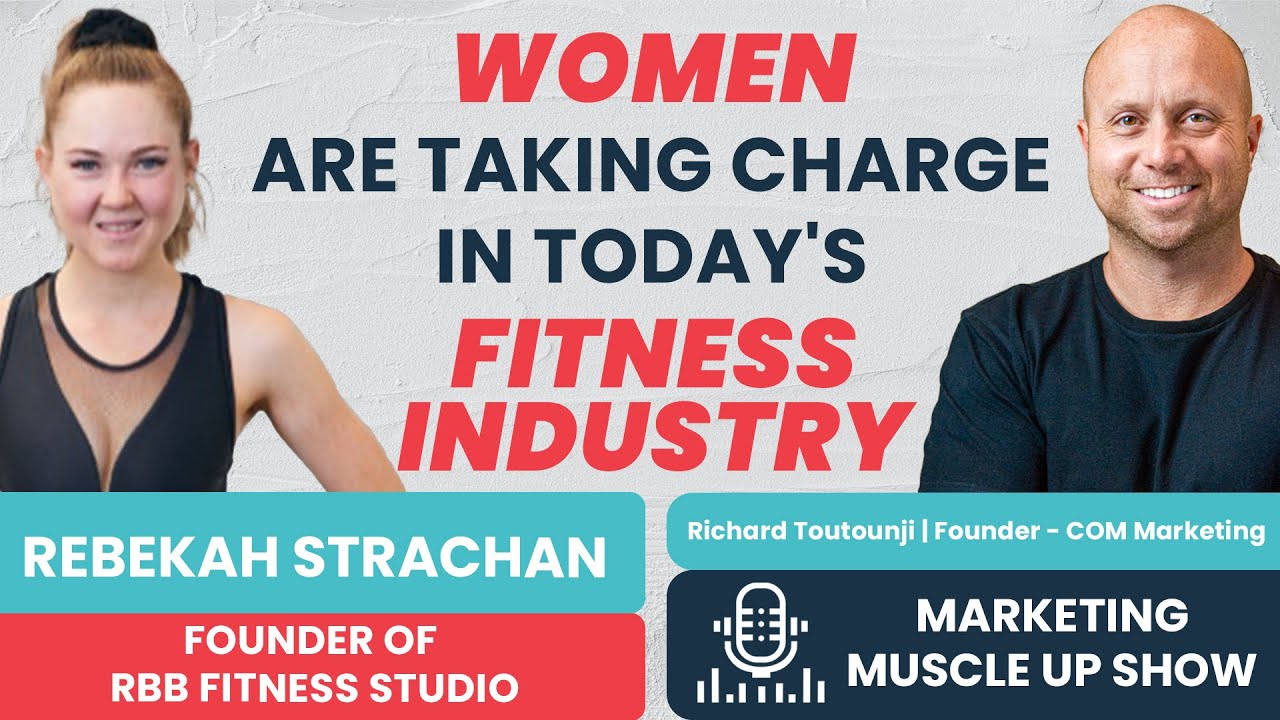
In this episode of the Marketing Muscle Up Podcast, host Richard Toutounji interviews Rebekah (Beck) Strachan, founder of RBB – Australia’s first HIIT‑to‑the‑Beat boutique fitness studio. The conversation traces Beck’s path from a business‑savvy upbringing and a brief stint in teaching to becoming a personal trainer, then creating a small‑group training model that evolved into a full‑time studio concept. She describes how a trip to the US inspired the fusion of music‑driven HIIT with functional training, leading to the launch of RBB at age 22. Beck recounts the financial and emotional challenges of securing her own space, including a month‑by‑month warehouse sublease, a $20k equipment investment, and a costly legal battle over a restraint‑of‑trade clause with a former gym. The discussion shifts to gender dynamics in entrepreneurship, highlighting how young female founders often must prove themselves twice, face skepticism from landlords and peers, and balance emotional labor with business decisions. Beck explains how she builds a strong community experience through meticulous studio design, team culture, and systematic member engagement (social media, Facebook groups, events). She shares practical marketing tactics: multiple sales funnels, daily organic Instagram posting, TikTok advertising, and targeting a female‑focused audience (mums and babies). Finally, she reflects on broader lessons learned about contracts, Fair Work, taxes, scaling, and the impact of COVID, emphasizing the importance of mindset (“nothing to lose”) and relentless hustle. The episode ends with Beck’s Instagram handles and a note about her upcoming Bali trip.
Chapters
I think a big thing too is I had nothing to lose.
Yes. Right? Love it. Love it.
I literally had nothing to lose. So that was definitely a big, a big factor for me. And I do know, like my dad said to me one day, cool, if you fail, doesn't matter, just, just start it again.
Welcome back to the Marketing Muscle Up Podcast Show. In today's episode, I am pumped. I'm thrilled because I've got a special guest in the house and her name is Rebecca Straughan. Welcome to the show.
Thank you. It's nice to be here.
It's so good to have you on. We've been talking about this for a long time and before we crack into it, I do want to read out your bio. It's a pretty impressive one if I can. But before I do, I want to talk about what we're talking about in today's episode. I've been— I've known Rebecca or Beck. I call you Beck. And I've known Beck for a few years now. I'm pretty sure we met at a Filex event in Brisbane. I was hosting or facilitating an event. I remember very clearly there was a, there was a group of about 8 or 10 of us in a circle. I asked some questions, went around, and you had some amazing answers, and you were really moving and shaking. I can feel that you were a leader in what you were doing, and you caught me, you caught my attention. you caught my attention as a great business operator at that time. I think that was about 3 years ago, Bec. Would that be right? 3 years ago, Mish?
Something like that? Yeah. I think it was about 2019. So yeah.
2019, well before COVID days. And it was great. So I want to just tell everybody what you do. So you are based in Brisbane. You've got Australia's first HIIT to the Beat workout experience. And even that, I want to sort of dive into a bit. And you started this because there was a need in the industry In regards to you hired out gym space, you were doing these cool beat workouts, you were just pretty much like filling up the sessions. And all of a sudden you said, hey, I need my own space because I just don't have any space in these gyms we're at. Now, you know, fast forward, you've set up an amazing studio, you've moved to a brand new studio, like it's epic, epic. So anybody who's been to a warehouse space, you've now moved to a shop front. And You're really up there as an up-and-coming business that is starting to roll out more locations. You have been a finalist, a Young Entrepreneur finalist in 2020, 2021, and 2022. You're shaking the ground and you're making your mark in the fitness industry, but also in the business world. Now, I do want to talk to you about a few things today. Number one, I want to talk about entrepreneurship. I want to talk about female entrepreneurship because I know that you've had a few conversations and I've seen some stuff on Facebook and you're really sparking up some conversations there. I'm super interested into that. And you are a great marketer. You've been in our Marketing Ninja program and Scale program and you're doing some cool things. So I'm pumped for this episode, Bec.
Thank you. Thank you. No, I'm pumped too.
Now, there's one thing that I know about you. You're always looking for opportunities and you always turn up for opportunities. more than probably anybody I know. And you put yourself in those locations. Tell me about that because you've had to do that through your history, putting yourself at somewhere, going to the next place. It's like that typical entrepreneurship, right? We jump off a cliff and we make the parachute on the way down. Tell me about your early story, Bec.
So initially I knew I wanted to be in business. I have known for a long time, even though I maybe didn't acknowledge it myself. My dad is in business, so I grew up in a family where I saw what running a small business is. He's an engineer and runs his own engineering company, and it essentially started where he would have his office under the house, you know, it was the bottom level of the house that then went to its own office building and expanded, expanded. And I saw the incredible opportunities that you can get when you do business well. And so I think from having that upbringing, I've always had an entrepreneurial part of me. And I left school, went to uni, started studying teaching because I thought, yep, that's what I want to do. Realized probably 6 months in, it's absolutely not what I want to do.
Yep.
And I just remember one day calling my dad and saying, hey, you teach me how to be an entrepreneur? Like it was this new buzzword, entrepreneur. Yeah. And from there, I started doing some small business courses, but then transferred into a business degree and did a business degree. And I kind of left that knowing I wanted to do something in the fitness industry, but really not sure what it was I wanted to do. And so I started as a personal trainer and I was working as a group fitness instructor. And I very quickly came to this roadblock in my life where I loved group fitness. It was my joy. It was the thing I'd do every day for the rest of my life if I could. Um, but personal training was my bread and butter. You know, you earn significantly more doing that than you do group fitness. And so, um, that's when I was like, I have to do something here. And so I actually started running these small group training classes, quote unquote classes, where they were 4 people at a time on the gym floor. And so I started running those, and they very quickly became my personal training business. So they grew very quickly. So then I expanded that and took these 25 sessions a week I was running, and I actually started hiring the group fitness studio off the gym that I was I was working at. So then it kind of became this thing of my 25 sessions a week became one session a week, and that's when my brain started really doing the math on, I can earn the same amount doing 1 hour of work as I can doing 25 hours of work.
Wow.
So that, that then gives me all of this extra time to create the program, right? And so I invested the next sort of 6 to 12 months. I took myself to the US, saw what was happening in the industry there, and very quickly saw this need in the market, specifically in Australia, for a group fitness exercise experience that was like a personal training experience, but like a group fitness class on steroids, right? So this— and considering this was, I want to say, 2015.
Yep.
So this is like F45 at that time, I think had 2 locations in Brisbane. So it was the beginning of the boutique studio experience in Australia, and it was the beginning of functional training. In Australia. And so, I essentially created a concept that combined those things, which, as you mentioned, it then grew very quickly. I was running about 14 classes a week in the gym, and it just got to the point that the amount of rent I was paying to even just do that, I was like, I actually need my own space. So, yeah.
And, you know, 2015, you know, you've had a lot of awards in the young entrepreneurship. Can you just You know, kind of take us back. How old were you at 2015, if I can ask?
2015, I was 22.
Okay. So this is interesting because I love the journeys of, you know, people are always looking around, how do I get a bigger space? I'm working as a PT. I'm too old. I'm too young. I'm not smart enough. I am, I'm, I can't do it. All those kind of things that pop up, you know, as a 22-year-old, 23-year-old, you're saying, I need my own space. You know, what goes through your head? In that world? I know you said you had your father as the— had his own business, but what happens through your head when you've got to outlay expenses and back yourself and things like that?
Yeah, it was the most nerve-wracking experience of my life. The years 2015, 2016, 2017, so those 3 years, I feel like I learned more in those 3 years than what I probably did in 10 years normally, right? So the biggest scare, obviously, for anyone who is going from a hired space to a studio is rent.
Yeah.
That was the biggest scare for me. I had a little bit of a, like an in-between move that I did where I actually found a company that had a warehouse that I subleased.
Right.
So it was on a month-by-month basis. So, that enabled me to test the waters a little bit.
That's smart, testing the waters.
Yeah. And so, that's when I initially invested what I had saved. So, everything that I was earning from those classes, I saved to put towards the business. And that's when I purchased my own equipment, you know, installed flooring and mirrors and, you know, so it was probably like a $20,000 investment there that I did initially. But then obviously it gave me this opportunity to go, all right, this is my next step. It enabled me to then grow the business again because we were in our own space to then moving to our own proper full commercial lease premises. That was scary.
Love it. And you got a very similar story to myself, Bec. You know, I've those early years, I got a studio, you know, 18, 19, and it really scared the hell out of me. You know what I mean? Yeah. You just don't know what to do because you're so young. But I love business when we're young. You know, I think we always think we're young, but when you're young and there's a beautiful part of it because, you know, call it naive, call it green, call it You know, just go out and get it done. You haven't been burnt before. There's less things, risk factors and all those kind of items. It feels a bit freer. I know when you're there, it doesn't feel free, but it does. There is something magical about it in those times if you can lean into that youngness as well.
I think a big thing too is I had nothing to lose, right?
Yes. Love it. Love it.
I literally had nothing to lose. So that was definitely a big factor for me. And I do know, like my dad said to me one day, cool, if you fail, doesn't matter. Just start again.
If you fail, doesn't matter. Yeah. Great. Awesome.
So I think going in with that mindset was definitely hugely beneficial. But then again, I agree with you. When you're younger, you don't have responsibility. Well, the other thing too is I hadn't come from a huge corporate job where I was earning $100K plus, right?
Yeah.
So you don't lose that as well.
Bec, we're unemployable. Let's be honest. Okay.
I, I did corporate for 9 months.
Right.
I loved it. It was amazing. It was great getting dressed every day, you know, going to the office, but I am just not a good person bound by the hours of 9 to 5.
Bec, let's talk about the other part, the other interesting part you did. I want to touch on Which is you call your— so your studio is RBB. Yeah. And it's Australia's first hit-to-the-beat workout experience. Can you explain to me how you become Australia's first of anything and Australia's first hit-to-the-beat? I'm really interested in this part of it because I think this is where your marketing genius and trademarks come into place. And I think this is where it's a different story here. You're not just opening up a studio, but you're opening up something essentially that has the potential to really grow and expand around the world. Talk to me about this whole hit to the beat and how do you become first at something? How do you know when you're first at something?
Yeah. Yeah. On the, just a quick note on what you said in terms of like, I'm not just opening a studio, I'm actually opening a program. That was potentially the most challenging component of doing what I did was that I was learning how to run a studio Without a franchise or help helping me. But then also too, I was creating a program at the same time. And so that took so much of my time and so much of my energy. So it was challenging in the early days. But in order to be the first at something, so it was really interesting. I had been, obviously, as I mentioned, to the US. I'd been to a lot of studios, quote unquote studios here in Australia. Yes. And I just noticed that there was this need for HIIT training in a group fitness setting. So all of the HIIT training that was and generally is on the market is circuit-based, right? So you have stations, you go around stations, do a thing, there's a timer, you move to the next. And without, um, being rude to other businesses, because I think what they're doing is incredible, they're all kind of just doing a variation of the same thing. Right.
Yep.
Um, whereas what we're doing is we're taking the old-school aerobic feel that your mum and, you know, grandmas used to do, um, making it cool, so making it current, but then revolutionizing it. So firstly, using music like current original Spotify music
Yep.
But then also too, tapping into functional training in a way that has been proven to be highly effective.
Yes.
Putting it in intervals that again, highly effective, but then also giving you that community experience that people want and that people chase. So there was nothing like this on the market. And to be completely honest with you, I created it because I wanted to do it. Um, I had been to the US and had fallen in love with SoulCycle.
Yes.
And the experience that they can create on a bike. I was 22 years old and did not have $100,000 to buy bikes, right? So I created SoulCycle on the ground is essentially what I did because I had no equipment.
You didn't have the equipment, you didn't have the money, so you got to create your own. Outstanding. Great. What a great story. And so through this whole process, and I get it, you're opening up a studio plus you're doing a program, 2 very different things that anybody has to conquer and get to that ground. Let's kind of move into the other part of the journey where I've seen you talk a lot about, which is, first of all, I mean, as a young entrepreneur, and I understand this solely when I had a studio when I was really young, and there's a few things that came up for me at this time, and I think they're coming up for you as well. Leadership, you got a team, you got to grow up a bit faster than maybe your other friends who are going out and doing their thing. You got to turn up. Tell me about that journey and how that— if someone's listening to this and they're in a similar age and they're going, oh, I'm too young. I'll wait till I'm 30 or 40 or 50, whatever, and I can't do it. Tell me about this mindset that you need to get through these parts.
I truly believe that we're a special breed, entrepreneurs. I think it's ingrained in who we are. I really just don't think you can become an entrepreneur. I think you're born one or you've at least had that inherent desire inside of you since you were young where you aren't satisfied with the status quo. A big thing, and I'm sure you relate with this as well, is that my priorities are not the same priorities as my friends. They haven't been for a long time. You know, like I never really was into just wasting my days. Not that it's wasting your days, but, you know, I always had such a— and I can even remember being a teenager and just having such a passion inside of me to want to make a difference in the world and to want to do something, to be a leader. You want to lead something. Yeah. And so it's been challenging. It's been really challenging in terms of, one, people understanding. Two, we still have human desires, right? Where we still want love, we still want affection, we want friendship, we want all those things. But you just have this weird part of your brain where the most important thing in the world is to work.
Hmm.
You, you can't stop thinking about it. And I think that has been the most challenging thing to admit. Yep. Because rather than living for the weekend, which, yeah, we live for the weekends as well and it's a good balance, but we actually just love to work. Yeah. So, and I think like people listening to this, for example, they'll know, they'll know straight away if they're an entrepreneur, they'll relate immediately.
Yeah. I love this. It's not a work-life balance. There's no such thing. And It's interesting, as you progress through, you see at different ages, you're wanting different things as a business owner. And my mum always used to tell me back, she always said, Richard, you're working too much. Smell the roses, slow down a little bit.
Yeah.
And God, she was right, but geez, she was wrong as well. And every way we need to smell where we're at, but in every way we need to just go charging how we want to do it. And it is a tough balance.
Yeah.
Let's continue that on as a— I've seen you're doing a few amazing— you've been Young Entrepreneur of the Year 2020, '21, 2022, but you're also going out there and waving the female flag. I know some people go, oh, aren't we all the same? We're entrepreneurs, we're business owners. What's the difference, Bec? Tell me about female entrepreneurs versus a male entrepreneur. And what's your take on this, Bec? Because I know you've written about it a few times and every time you do, you get some amazing comments and conversations going through. Take me through this process.
Yeah. So there's been a couple of different experiences I've had as a female entrepreneur. I think definitely I came into the business world not realizing there actually was a hierarchy and expecting that I would be taken as seriously as everyone else. So I had a couple of things working against me that I learnt very quickly. Number one is I was young. I was very young. Number two, I was quite naive. But number three, I was a young female. The other thing that also doesn't work in my favour is I actually look younger. So, when I was 22, I looked like I was 18.
Right. Yes.
Right?
Yes, you do look young, Bec. You're always looking super young.
Thank you.
Thank you. It's all that RBB training, you know what I mean? Come to RBB and look 10 years younger.
I'm actually 60 years old right now. It's amazing. But so I think because of that, like the struggle I had to get my first commercial lease signed, you know, because people just, real estate agents didn't take me seriously at all. Obviously, I had a huge amount of issues leaving the gym. I was working for, again, people trying to just walk all over me and take advantage of me. But I'm experiencing it more and more as I'm now growing as well, where they think you're naive. And so, as women, we almost have to prove ourselves twice as much to have a seat at the table. Hmm. And it's really interesting because I'm definitely surrounded, like, I definitely wouldn't say the people in my life think less of me. Like, My dad, for example, has always had big picture conversations with me. I've never felt mistreated in any way. My boyfriend, you know, he's very much, we're equal. But I've just found in business, number one, we have to prove ourselves so much more. But then in complete honesty, as females, we actually just work differently than men. And it's something I've fought for so long and I've brought myself to a position where I realize, and you'll see this like with working with Joey, right? She thinks with her emotions.
Mm-hmm.
It's, it's the way that we operate as women, and it's our biggest strength and our biggest weakness, um, because we take offense to things. But then also too, you know, if, if we feel like we've been mistreated or there's a staff member that's done something and there's a conflict, it ruins our day, right? It really impacts how we work. Whereas men have a really, really good way, like they can shut stuff off and they can just focus. The other thing that is also a huge benefit to women and a huge misbenefit for us, disadvantage, is we can think of a million things at one time.
Yes, you can. And you can do a million things at one time, too,
Bec. We can be doing everything all at once, all at the same time, which is great, right? Because we remember that we have to do X, Y, Z, plus the dishes need to be washed, plus I need to take this out, plus it's my anniversary next week, plus I need to organise this, you know, blah, blah, blah, blah. Whereas a guy has the ability to focus on a task and they're focusing on that.
But I don't think it's the ability, Bec. I think it's just we can only do one thing at a time, Bec. It's not a skill we have.
Okay.
I can only do one thing. That's the reason why, Bec, I have 80% to 90% of my team are females. I don't know if you noticed that, but they're all females because I can only do one thing. So we need some people that can actually do some work, you know?
Totally. And so that is our greatest strength, right? Is that we can do a lot of things, but then also too, it's a huge weakness because it means that quite often we do a million things good, But not well. Yeah. Right. And we don't have the ability to shut emotions out. So that's been a growing process for me. I'm also managing a team of 8 females.
Yeah.
So I'm also dealing with 8 hormone cycles.
Right. So, so that's what I need to learn more of, Bec, you know what I mean?
How to deal with the hormone cycles.
Right. So we can definitely exchange notes on that later. Hey.
Yeah. Yeah, we definitely can. But, but yeah, so being a female in business, I think there has never been in a time in the world that we have more opportunities. And I don't think that we are discounted in any way, but I do think there is still this underspoken hierarchy where we feel like we need to prove that we belong where we are, if that makes sense.
Yeah, totally. Well, you know, I'm definitely here waving your flag and every female's flag, too. I love it. And—
Thank you, sir.
It's, you know, I remember the first day that I met you. As I said, I think there was, I don't know who was in that room, but you definitely had a distinct ability to say, I want to lead, I want to step up. You were clear, you were precise. And I personally think that anybody that has that ability has some big things. And I'm obviously not a female, so I don't know it from your viewpoint. I know that in our program we somehow gravitate. I think we have a lot of probably more female mix than males, I would say.
Yep. Yep.
I don't know why, but that's just the way that, you know, I don't know, females are great learners, they're great educators. I mean, saying that males are too, but again, I think there's— maybe there's something in that, you know, it's It's like we want— you want to better yourself. You want to prove, like you said, you know.
I think also too, we know what we don't know. You know, like we— I definitely, like an example for me when I joined comm was I knew that I did not know how to market my business and I needed someone and I was actively looking for ways. I was taking myself to conferences and Filex and all these things. often as I possibly could because I was so desperate to know what I didn't know. Right. And so, I think that that is a big part. I'm not saying that that's women in particular, but maybe this could be the case is that we know, hey, I don't know how to do that. So, I actually need to find someone who can show me how to do that.
Yeah. Great. Love the concepts in that. And I'd love to hear from women who are watching, listening to this and guys too and say, hey, what do you think about this? Do you think what Bec is saying, are you resonating with this? Is this what you are going through or not? Love to know on your views on this. Bec, tell me about— I'd love to know 2 sort of more questions for you. I've got some big broad questions, so I'll try to tighten them up, but I'd love to know maybe first some really big lessons that you've learned. You said you were negotiating your rental. Is there something that I personally learned from Mistakes. I think we all kind of do, but I love to hear the journeys of someone's mistakes. We can always share the war stories when we're not in the war, right? But when we're in it, we have no idea. Is there a war story that you can share, a really big mistake and the lesson that you've learnt from it?
How honest do you want me to be?
Well, we know honesty always gets more listens, Bec. So, I'd love to have some honesty.
Depending on how you want to get to that. Okay. Okay. So, I've had a couple of huge, huge lessons in business. The first one was when I attempted to open the studio in 2016. So, as I mentioned, I was at a commercial gym and I was running those classes in a commercial gym. I then moved. During the relocation, I was served with a restraint of trade. From the gym that I was working at because they believed I was attempting to steal their members, which resulted in a huge legal battle. Um, so put on top of opening your own studio, creating a program, fighting the biggest gym chain in Australia, um, in a legal battle. So that there was the hardest point in business ever. That takes the cake. That there made me wake up every day and question, how much do I actually want to do this?
Hmm.
And I still have pages and pages in my, like my notebook of plans that I had made to pay for the things that I had signed up for. For example, my rent. So how much money did I need to make to pay my rent if I was not able to operate in the fitness industry, right? Because a restraining trade is 12 months where you have to drop off the face of the industry essentially for 12 months. And so fought that, ended up winning it, which was amazing. Took a lot, but it also left me with a hefty, hefty legal fee, right? that I then had to pay off in my first year of business. Um, so that was a huge lesson that I learned. What did I learn from that lesson? To be completely honest, I actually did nothing wrong. So it wasn't a thing of I should have done something differently. Now looking at moving into a second location, am I gonna pop up in another gym somewhere? Probably not, you know. So, so that was a huge lesson. But the biggest lesson I learned in that one was probably How much did I actually want to do this? Because if this was going to take me out, you know, what would that look like for me? And so that was a resounding, I want to do this every day. So that was a big lesson.
Great lesson. And that's kind of like where I think a lot of people have gone through over the last few years through COVID, where it's been tough. They've been closed down. Some have had it way tougher than others and everybody's had to make that call, you know, do I want to keep going? Do I want to push on? And I think that also comes when a competitor opens up down the road. You know, someone goes to someone else down the road or, and, and you, and you gotta second guess yourself, you know? And, and yeah. And you always gotta step and say, hey, do you wanna continue doing this? And I, I think that's a really good lesson because early on the piece, yeah, it obviously, you know, who wants to go through that? But you're going through that and it's, it's getting that fire in your belly. Yeah. Sounds like.
Yeah, yeah, absolutely. So, so that was a huge lesson. Um, other lessons I've had, a staff member take me to Fair Work. Um, so that was a huge lesson in and of itself. Um, just to make sure your contracts are tight.
Just an average, just an average day in running a business.
The funny thing about it is, is I had a client at the time who was CEO of a company of like 1,200 employees. And he said to me, he's like, Bec, one day this is going to be your everyday where you're just, yeah, I've just got this thing that's just going on. It's going to be fine. And so that was a huge lesson again. In all of these things you learn, right? I learned what not to do. I learned my rights. I learned the law better. Yeah. You know, like all these things, it's interesting. Like I had a business degree, I did not know how to run a business at all. And then you just kind of get like thrown in the deep end and they're just like, hey, so just run a business. But also on top of that, know how to pay your taxes, know how to do your books, know how to market, know how to sell, know how to grow a team, know how to scale, know how to do contracts right, membership contracts plus employment contracts, make sure you're paying people correctly. What's an award rate? Where do you find an award rate? Just this whole world that no one tells you.
Yeah. Outstanding.
It's
just everywhere.
Yeah. Yeah. So that was a big lesson. COVID was a big lesson.
COVID was a big lesson. All right. So let me just change the subject a little bit. And you mentioned before you didn't know marketing, but we did another training to our ninjas in our program around one of the skill sets I think you have. Everybody has what I call a superpower. I think you have a great superpower. One of the superpowers I think you have is like a sparkle effect. You, you give some sparkles, what I call sparkles. You give magic out to your community. You've got a great community, a thriving studio, and you're about to open another one up. And you're giving the sparkle out. People, you know, I always say people don't come to the equipment, people come for the outcome. But I think I heard a saying, I don't know who it was from, I think on the podcast, maybe I'm quoting somebody, but I'm not, don't know the name, but the name will come to me. But it's not, it's also about the experience that you give Then I think you give a great experience in what you do. I think it was actually— it'll come to me. Yes, Bec, what are your thoughts about that? Tell me how you give an amazing experience to your community because I know you do.
Yeah. So when we set up the studio, that was one of the key points is that we had to create an exceptional experience every time someone entered the studio for a couple of reasons. Number one, the reason why we created RBB and Hit to the Beat, yes, was to give people exceptional workouts, but it was to provide somewhere that it became a lifestyle for our people. And I had such a heart and a desire to create a space where people felt really, really safe. Um, being from the generalized fitness industry, I saw that that was not the case in commercial gems. And so I wanted to create that. So that for us came down to a few different points. There's the people power, right? So it's hiring the right team, um, and training your team to share in the same mission statement, values, and culture that you're trying to create, right? Because it takes 2 seconds to break culture, it takes years to create it. So you need to start from the beginning, a really solid foundation of what do I want my culture and my team to abide by and what I want that to feel like. And so we have a really, really strict onboarding process for our team where if they don't fit with the team, they're not actually right for us. And so I'm heavily invested. in the team, um, and ensuring that they feel like they can give the same experience to our members that I would want to give to my members. And so that's taken a lot. Um, the other component of this is creating a space, right? So creating a beautiful environment. It's the cool lighting, it's the nice flooring, it's the, it's the mirrors, it's the the pads and tampons in the toilet. You know, like it's these little tiny touches that makes a member feel like this is my home. But the other part of that is that's really interesting is I don't think it needs to be perfect. Like our studio is in no way perfect. It's not a $500,000, million-dollar fit out. Yep. The community is interwoven into the fabric of this space, and it is their second home. So to them, they're the first person to put their hand up and say like, hey, I just realized that there's like a little bump in there. My husband's a chippy or whatever, he can just come in and fix it. Yeah. You know, like it's their second space as well, and they only do that because we provide somewhere that we are heavily invested in. And we have systems upon systems upon systems in place that make it look like we're sporadically connecting with our team, but we're not. With our members, we're not. Yes, we love them and we care for them, but there is a system around how we make sure that they feel loved, if that makes sense.
Yeah. So it's not just you're accidentally leaving the tampons in the bathroom. It's a system. It happens all the time. Because the first time I went in the studio, I was like, Oh, this is pretty cool. So, so all those little touch points are in there because they've got to be there to make them feel comfortable all around. And I see that you do a magic job on that. So well done on that.
Thank you. Thank you. You know, it even comes down to a customer journey, right? Connecting with a customer. We have a way that you create a customer journey, but then Even just in my trainers, like with our closed members Facebook group, there's a system around how we connect with our members in that. And we have a system around events and we have a system around group chats and everything is systemized.
Yeah. Great piece of marketing there. Beck, this has been outstanding. I've got a lot more things to ask you, but I think I'm pretty happy how we got today. And I'm Probably just one more quick marketing tip that you could, one of the great marketing things that you currently are doing now or have done that's worked really well. Could you just maybe share one of your strategies that have worked well over the time?
Oh, give away my secrets?
Just give away one if we can part with one.
Yeah, totally. So something that is preached at COMM is to have multiple funnels, right? So you know that someone has to see you 7 times before they take action. So it's our responsibility to do everything we can to be in their face as often as we possibly can.
Yeah.
So it's— I know it's not a thing of being like, hey, this is my ideal marketing strategy, but an Ideal situation is to start with one funnel and then make it 2 and then make it 3 and then make it 4. Um, something— Instagram and TikTok is where it's at. That's all I'm saying. So we haven't really doubled where we just started in the world of TikTok. We're investing in TikTok ads, uh, and moving into that world.
Mm-hmm.
But our biggest membership growth is in Instagram. So start today. organically posting once a day, every day. Create a plan, make it look like what you want people to think your studio looks like. Where for us, it's incredible workouts, community feel, pretty studio, right?
Love it.
And so we focus on female community, mums and bubs, just that whole world. It's there so people can go, they can see it. We have people who join and say they've been following us on Instagram For years, right? So that, that's our thing. So start with organic posting every day, once a day. Engage with your people, reply to their comments, reply to their messages, actively seek out people, and you'll create a really good little marketing bundle there.
Love it. Uh, very, very good. Now, Bec, what's your Instagram if those who want to follow your magic and what you do?
Thank you. Well, you've got 2. So there's RBB, which is RBB Fitness Studio, all one word. Even if you just type in RBB Fitness, you'll find us. And my personal is Bek Strachan. So B-E-K-S-T-R-A-C-H-A-N.
Awesome. We'll put those in the show notes. Bek, this has been outstanding. I'm definitely going to have you back. I want to continue these conversations. I think they're great. And I think you do a great job to empower entrepreneurship, female entrepreneurship, and especially someone who's really at the early stages of their business career and going, what the hell did I get myself into and how do I get myself out? Well done, especially on RBB. I'm here loving to hear the continued success you are having. So good. Thank you so much for the insights that you share and enjoy your trip to Bali. I think you got a holiday coming up.
Yeah. Yes, I do on Saturday. I'm so excited. Thank you.
So good. Team, if you've enjoyed this episode and you want more, All you have to do is you can check this out on your favorite app, which is Spotify, or you want to go to Apple Podcasts. You can listen, you can watch this on YouTube too. If you really want to see how young Bec looks, jump onto YouTube or go to ComMarketing and you can see the RBB Youth Experience happening in a store near you. Team, I'll catch you next time on the Marketing Muscle Up Podcast Show. Bye for now. Bye.









