Build your Brand with Tactical, Strategic, and Epic content (with Robin Daniels and Warren Daniels)
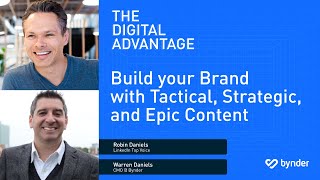
Robin Daniels and Warren Daniels break down Bynder's State of Content 2023 report, arguing that content drives higher-quality inbound and long-term brand loyalty. They present a three-tier framework: tactical, strategic, and epic content spending. The biggest operational challenges are measurement, asset control, scale, and repurposing content across channels while keeping brand consistency intact.
Chapters
Average content does not cut it anymore. Incrementally, better content does not cut it anymore. You really have to have a strong point of view. You have to stand for something. You have to be surprising or delightful or quirky or different or super insightful. Something that people haven't seen before.
Welcome to the Digital Advantage by Binder, a show by marketers for marketers who want to create engaging content experiences to differentiate their brand from the competition. In each episode, a member of the Bynder team will host a conversation with a leading marketing expert to discuss trends, challenges, solutions, and how to remain competitive in an uncertain economic landscape. Our guests will share stories that showcase innovative ways of using content to inspire marketing leaders to take action, optimize their content strategies, and ultimately achieve the success they seek. Let's jump right in.
Hello, and welcome to this episode of the Digital Advantage. My name is Donald o'. Marrellon. I am director of lifecycle Marketing at Binder, and this is a show for marketers who want to create standout content to differentiate their company from the competition. And to help us explore that theme today, we've joined by two marketing leaders, and we'll be diving into Binder's State of content report from 2023 and some of the trends and findings from that, and using their experience and insights to add some color around that. So without further ado, I'll introduce our very special guest who is a serial CMO and one of LinkedIn's top voices, Robin Daniels. Robin, how are you today?
I'm great. I'm great. I'm so excited to be here talking about one of my favorite topics of all time, but thank you for having me.
Fantastic. Good to have you. And Binder's very own Warren Daniels is joining us as well. Warren, how are you this morning?
I'm very good, Donald. Thanks so much. And excited to throw some ideas around with you, Robin, get your perspective on state of content content operations. Really, really important space. One that I think has perhaps not been as progressive as other parts of tech marketing. So it's about time.
Very good. Okay, so I set you up two people that people should listen to, so maybe you could give us a sort of the sale there, Robin, about yourself. What's your background? Why does your experience matter when it comes to talking about content today?
Well, well, I mean, I've been a CMO three times. I've taken a few companies public, I've worked at. I feel like some of the most iconic companies of our time. Not everything I touched unfortunately turned to gold, but I've had luckily more successes than failures. I worked at Salesforce fairly early days, then at Box in the early days took them through a hyper growth journey that ended of course with them becoming a public company. I was at LinkedIn for a while, then I was at WeWork during a lot of turmoil there as well which is super fun journey. And then my last company where I was CMO was a company called Matterport that I took public in 2021. So it's been a, it's been a great journey by the core of of everything I've done and what I stand for and why I'm excited to be here today is storytelling is at the core of the how I see the world of marketing. You know, at the end of the day it's really around how do you connect with people through stories. And of course content is the key vehicle that we do that with. I'm excited to dive into exactly what that means. But. But no, it's always been fundamental to the way that I think about go to market and making companies both successful in their growth but also stand out from anybody else who's in the market.
Fantastic. And I think that hopefully you bring to bear some of that sort of experience within the content management space as well. Time of Box so okay, brilliant. Warren, tell us a little bit about yourself and again why people should listen to your expertise on these matters.
Sure, yeah, I'll be a little bit more pragmatic than perhaps Robin has so 25 years old experience in B2B tech marketing. You know, I've worked in organizations of all shapes and sizes. Startups scale up those that go to market with a wholly direct sales model and those that have gone to market in a wholly indirect model as well through partners, distributors and the like. And I've done corporate as well as the startup scale up as well. So I spent eight, nine years leading teams at IBM and SAP. Lots of different categories. Analytics, procurement, purchase to pay, and then more recently of course Martech and E commerce here at Binder. And why does my experience matter here? I guess I've seen firsthand over the last quarter of a century the evolution of content as both a marketing practitioner and then of course a marketing leader who has to make difficult decisions around where to invest, where not to invest, what's important, what's not important. And of course those priorities change over time as we see different priorities emerge from our customers and our prospects in the market. And I think content is at an inflection point.
Well, that leads us nicely in. Right. If we are Indeed, at that inflection point to what we'd like to explore there. Thank you very much for setting us up. And we got clear. We've got a bit of a stellar cast here. So we're going to base this around our state of content report that Binder released in earlier this year. One of the key things we want to explore with both of you is the data point that says 76% of tech marketing leaders in 2023 are planning to maintain or increase their investment in content. Robin, really simple one, why is that?
From my perspective, it's because we're in the golden age of storytelling. People are hungry to find content that resonates with them. And so when I say we're in the golden age of storytelling, what I mean by that is, and again, content is at the heart of storytelling. There are so many interesting ways in which to tell your story. This, this could be videos, it could be podcasts, could be LinkedIn content, it could be long form content reports, it could be TikTok videos, it could be all kinds of interesting things. And it's interesting to see, I think that, that as a content marketer there are more options than ever to get your content out there, your story out there. So that's a good news. And I think every CMO that I talk to are thinking about, well, how do we invest more in content? The, the other reason, besides being in the golden age of storytelling and content is of course that if you get people to be interested in your story and they raise their hand themselves and come to you, the quality of the lead, the quality of the purchase is going to be much higher than if you have to go buy their attention. Like in any good marketing strategy, you basically have three ways to get customers to raise their hand. You can either get it through paying for their attention through paid digital, you can do it through content, or you can do it based on word of mouth and community based marketing. And of those three, right now the one that has seen the most promise, that has the lowest cost, I think, and the most potential is by far content marketing. So you can basically find people if you have great, great story, great content. If people see it and they want to raise their hand and say, this is so interesting, I want to go learn more, of course, the quality of that, that inbound is going to be way, way higher. So that's the good news is every single CMO is thinking about this. I've been working for the last couple of years as an advisor with several high growth companies, Series B companies, series D companies, series F companies, they're all investing more in content, in their production of content and how to distribute it. Now, the downside I think, of being in this golden age of content is that there's so much out there and I think it's going to get even worse with of course, the rise of AI, which means that there's. It's just going to be flooded with content. So average content does not cut it anymore. Incrementally better content does not cut it anymore. You really have to have a strong point of view. You have to stand for something. You have to be surprising or delightful or quirky or different or super insightful. Something that people haven't seen before because we're so flooded now with content everywhere that unless you have something that's worth sharing, talking about, you're never going to break through. I think of that quote from Jurassic park, which is one of my favorite movies, where they see the dinosaurs kind of roaming riles and say life will find a way. I think of the same with content. Good content will find a way if it's interesting enough, if it's good enough, it will be shared, it will be talked about. But the bar has been raised significantly of what that looks like. So I think I'm not surprised by the stat that more and more marketing leaders are going to invest in this because this is by far the best channel. You have to differentiate yourself and also get the highest quality inbound.
The way that customers want to buy as well. Isn't it? Robin? I think to the point that you made early in your response there, you know, 15, 20 years ago, if you wanted to gather information and education, you pretty much had to go and speak to a rep within a. A vendor. They held a lot of the cards and the power, that power has shifted to the buyer. There is so many resources out there for them to educate themselves around. You want to be front and center and have had influence them through content because it's a primary way in which we do it today so that at the point that they are ready to engage, they're engaging with you versus some of the competition.
Couldn't agree more.
So this commercial imperative really is what's underlying this here. Businesses waking up to meeting customers where they are on the channels in which they exist, conveying messages in the way in which they, you know, consume content and messages on those channels. Is that the only key trend you've noticed, Warren, or what is driving the.
Yeah, I think Robin.
Importance of content.
Yeah, sorry. I think Robin hit on some of the Key points there. I think storytelling absolutely is more critical today than it ever has been before, just because the need to differentiate is so important. I hit on a few other things. I think the, that certainly we see in talking to our customers and our partners. I think first and foremost we need just to recognize we're living in a world in which content and more broadly content experiences are absolutely critical to capturing interest and action and driving engagement. I think there's just greater recognition now than ever before of the criticality of content. And then I think the second thing is most organizations have got a growing demand on the volume of content that they're producing. And we know that as a vendor in this space, of course, we're a digital asset management vendor. Yeah. We've seen exponential growth on our dam platform in the last 18 months with the, the volume of assets on the platform have doubled in the last month. Right. So there's this proliferation of, of content that's going on. Right. And we, we see it everywhere. And then, yeah, I think content creation and especially content creation in, in tech I think has kind of moved on from the days in which you'd pump out a white paper, create a few emails, ads and social posts to promote it. I think there's now combinations of different generations of folk that consume content and different varieties of content very, very differently than ever before. And so this variety of content is growing exponentially as well. You know, you need shorts for TikTok and so on and so forth. So yeah, I think it's not more of the same that's required. I think just the complexity of content operations and content content strategy has developed. And then I think the final point here, tech and while smartech I think has been fairly pervasive across so many parts of marketing over the last 15 years or so, I think the ways in which content operations operate and work to create, manage, distribute content hasn't dramatically changed in that period of, of time. And I think the senior marketeers and content operation practitioners are waking up to that fact and figuring out, hey, we need to find new innovative ways of working in order to scale demand. Because we know we're not going to be able to scale resources at the same pace that we're going to need to scale content.
Yeah, I would also just add to that. I think it's super well said and it's obvious that you have such deep experience in, in this as I've been talking to a lot of founders and VCs, so many of them start out a conversation saying, ah, you know, our Marketing is not working, or we're not seeing the performance through Google or Facebook or LinkedIn. And then I usually say, well, what, what content are you sharing? What's the story? And they go, what do you mean? I said, well, that's the problem right there. You haven't focused on how you differentiate. So it's not maybe the channel itself because there are so many different channels. Like you said, Warren TikTok and whatever. At the end of the day, the channels come second to the content. What the content is all about, the story that you want to share. And so this is where I get why so many, of course, founders or CEOs are interested in optimizing digital. It's the easiest one, but it has traditionally been the easiest one to measure and also the shortest term. If I suddenly have a my CEO breathing down my next thing by the end of next Friday, I need, by the end of this week, I need a hundred more leads. Where am I going to get them? I'm going to go invest in digital to get them. But can I guarantee they're going to be quality? Can I guarantee they're going to be the right icp? Can I guarantee there's going to lead to any sale? Probably not. Which is why you need to invest in content marketing. It is the trajectory of content marketing does take longer to have an effect. I've seen it every time in my career. But the quality is so much higher. And I can guarantee any company, if you don't start investing in it now, you're going to look back a year, two years, three years from now, say, why didn't we invest in this earlier? Because you're going to start seeing compounding effects of, of the investment in here, in the quality of the customers that you get. The deal sizes is going to go up, the loyalty, because they buy into the story of who you are and what you can do for them. That all, all happens to, to content marketing.
Yeah. And actually, Robin, just on that topic, because, you know, I get the privilege of speaking to a lot of content operations teams, content practitioners. One of the key changes I've seen in the last few years is a shift from content operations teams being almost a service function. The marketing organization and the wider business. We're going to take a brief and then we're going to deliver on that brief verbatim to actually stopping and being the bastion of, hey, does this make sense for the audiences that we're trying to engage and what's the story and the narrative that we need to deliver in order to drive maximum engagement while maintaining the integrity of the narrative that the organization wants to deliver as well. And I think that's a key strategic shift in terms of the way content operations functions are beginning to evolve as well.
Completely.
Can I direct us back to something you're just talking about there, Robin? You were talking about talking to CEO and the commercial demands today. This report came out this year and we're in the middle of very turbulent economic times. So how do you have those conversations around content and strategic importance in the face of a down economy as well?
It's a great question. That's not a simple thing to answer because of course, what company, what founders are looking for, what CEOs looking for is efficiency and a path to profitability or path to growth. It's very clear. And the path through content is not as straightforward. Yes, we are getting better at measuring the impact of content, but it's not as of course straightforward as digital. It's just because of the many touch points and how I would say content gets shared on what's sometimes called referred to as dark social or other ways, word of mouth. And it's very hard to measure those things. But you can do it. There's a ways to be smart. The way I try to navigate that conversation is around the fact of what you want to be in three years or in five years because this will blow over. I've been through many recessions. I know it feels like the world is falling now that you're in it. I went through one in 2000. I've been 2008 and the pandemic, I mean then to my fair share. And there is, it does end at some point and you don't want to miss this opportunity to invest in the right things. You don't get, like I said, you don't want to look back at three years of mine said, oh, we started too late and now the competition has overtaken us because we didn't invest in the right things. So content is at the heart if I if you want to create an epic brand, this is a lot of what I talk about in my posts and my speeches. You have to be able to have courage and you have to be able to invest in the long term strategy. An epic brand is never created, never in days or weeks. We're talking months, quarters and years do so and it requires three things to create an epic brand. It requires consistency, focus and time. And at the heart of that, guess what is what the heart of it? Storytelling and content. Because that's what people fall in love with. If you want to create a brand that people love and every founder says that they want two things right now. I want to create a brand that people love and I want path to growth. Well, the two can, can exist, coexist, but the first one, creating a brand that people love happens in a much longer time frame. And the way to do that is investing in the right stories that people can resonate with in an emotional way that gives them something that they didn't know about before, didn't have before. And then of course it comes into the mechanics of, well, how do you actually then set it up, what channels do you invest in and all these kinds of things. But it starts with having an executive decision. This is important for the long term growth. Now if you're a company that's just focused on short term survival, surviving, maybe you don't have the time to actually invest in content because again, it does not just work in a week or two or even a month or two. Sometimes it takes longer to see the results of that. But if you are in it for the long run, you have funding, if you have survivability and you think you're going through some turbulence, but you know it's going to end, now is the best time to invest in content. By far.
By far.
It's the best way to differentiate yourself. Your buyers are not going to understand what you do by clicking on a Google Ad. It just doesn't happen. And so you're basically paying to interrupt people and paying for their attention. But it rarely leads to loyalty or love of the company. Love and the loyalty of the company comes from them being bought into what you do at a deep fundamental level. The best customers always come from there. And that that's why I'm saying with the long term retention of your customers, it comes through great content for sure.
Warren, anything on that? Is there content? Maybe sort of a lifeline for companies at this time.
I'll go back Donald, to the question you posed in relation to the down economy because we listen a lot to our customers and the themes and the topics that are important to them. The one theme and topic that has risen to the fore in the last six to nine months as there has been a more volatile economic environment, is a topic of content reuse and repurposing. Hey, we've been creating a bunch of content for the past 10, 15 years. There's got to be some stuff that we could reuse, repurpose there before we have to go and spend additional money on agencies or hey, Hire a bunch of additional folks in order to fuel this proliferation of content, this deluge of content that is being asked of content teams today. And I think that you can build a strong ROI around content reuse, content repurposing. And one of our customers estimated they save $4 million a year just by identifying content that could be reused and repurposed, as opposed to creating, creating new. So I think that's a real tangible thing organizations do before they have to go invest more.
This is a super interesting thing. I actually ran a poll on LinkedIn a couple of months ago, I think, where I asked a question, kind of a leading question in some ways, but I asked, what would you rather have one piece of high, super high quality content or 20 pieces of just decent content? Right. And guess what? I got close to a thousand responses. Everyone says high quality content, okay. Which I knew they were going to say. But then the reality within businesses, because I've worked with a bunch of businesses, there's always we need more and more and more. We need it now. So there's this tension and I think you have to get very clear on what your content strategy is, which of course, what the stories. We've talked about that, but also then the frequency and which channels and all these things and some of it. I'm a big believer in reusing great content. For sure, you don't have to go reinvent the wheel all the time, but it requires alignment internally on this because a lot of times I see content teams just being frustrated or burning out because we're being told that we need the highest quality. But then we're also being told we need more and more and more the volume of it. And I think we have some work to do in proving to the world that quality content actually performs better. Now, I'd love to see more stats on this than 20 pieces of average or just mediocre content. Does it kind of test itself? Of course it sounds obvious, but it's not obvious to a lot of CEOs or leaders. I think today. I don't know what you're seeing, Warren.
No, I think you're absolutely spot on. I think if we look at the performance metrics for our content within this organization, I think four of the top 10 pieces of content, quarter on quarter, are exactly the same ones. So we don't try and reinvent the wheel there. We try and update and augment them based on some of the hot trends in the market. It may be content reuse and repurposing. It may be AI, both topics that you've, you've hit on today. And then I think the other thing is being really clear about what you're trying to impact and where in the buyer's journey that you're trying to. To impact. I often find, Robin, I don't know whether or not you've seen this. One of the biggest challenges for organizations is management and control over content in order to provide visibility the folks that consume it, both internally within the organization as well as externally. So the organizations can say, no, we don't need to go and build something new there because we've got these 10 other things that we've developed in the past that fit the bill or perhaps we can update in order to satisfy requirements. And because there's a lack of management and control over content is spread to the wind, people don't know what exists and where it is. So getting that under control is critically important to be able to push back on what I call those random blacks of content marketing.
You have really hit on a nerve there because I see this all the time. I see a CEO who I'm engaging with say, we're not putting anything interesting out there, we're not putting enough out there, all these things. And then I go do a little bit deeper, dig a little bit deeper, talk to the marketing team and I'm like, wow, this content is amazing. And there's so much of it. Wow, the performance grade. There's definitely a disconnect in the visibility or the understanding of what is driving it. And this is again, another opportunity, I think, for really elevating the role of content, not just for the executive suite, which is more, I think, informational, but also for how it's driving sales and how it's helping sales actually close business. I couldn't agree more. I see this all, all the time. There's a lack of understanding of the impact and the power, but also just what the team is actually doing. Most, most content teams are really good at focusing on quality. They want to. And of course, there's a lot of quantity in there as well, because you got to keep things going on certain channels which require smaller, you know, pieces of information. Could be, if you're posting on, let's say, LinkedIn or TikTok, could be much more organic quickly. Quick posts versus a big content report, for example, or state of the whatever before. Those are big things, right? You need both. You need both, obviously.
Again, I think never a truer word spoken. We're doing this Digital Advantage podcast here today. The way we measure the success of this is reach and engagement into our target audience and our tam. But you know, if I look at a Forester Wave report as an example, an analyst report, when we look at how we measure the success of that, it's MQL to SQL, conversion against other types of written content, movement of opportunity through the sales funnel to one and booked revenue and influence. So you've got to drive a mix of content and have different metrics around it to measure success. And in aggregate, getting a good mix and balance of content, that's what fuels your funnel drive your demand and your revenue in the long term.
Let me jump in here because I feel like I can let you guys go for a few hours here, but I just want to. I think one of the really valuable things for anybody listening today is that we have two people who are leaders of teams and in charge of making those big decisions, those big strategic directional things that are going to set the course for a longer period of time. And one of those things of course is budget. Right? So two of you are sitting down today. You've got a budget in front of you, a blank slate. Let's say for the sake of argument, you're looking at content. How are you planning? What are the things you're looking at within your budget? Why are you planning to make those investments around content? And I'll throw that out to whoever's got the, whoever wants to take the lead on that one.
Yeah, I mean, I'm happy to go first, I think. Kai? Yeah, I think there's two, there's two parts of this, isn't there? There's the investment in content and content against all the other things that you would spend money on in a B2B organization. And then once you've determined what the right level of spend is or what you're prepared to spend, it's what are you spending that content budget on and for what impact, for what outcomes? And let me just touch on the second one first, because I don't think we could get to a conclusion here. We could argue all day about what the right level of proportion of budget is on content versus demand gen and so on and so forth. But the things that I'm looking at first and foremost is how do we serve customers with the best content experience possible. When I say customers, that's internal and external, it's prospects and its existing customers. And I look at it through the lens of kind of five or six things in terms of investment, brand consistency, how do we ensure that we're always on brand, always consistent, always across Omnichannel, buyer journeys, because that's what they are to today. How can we continue to be more relevant? Some people use the word personalized. I use relevant and contextualized in how we communicate to our customers. So to that overarching theme of content experiences to support our target audience is better relevancy, contextualization, personalization. If someone's coming to me with investments around those things, my ears are always pricking up and nine times out of ten it will be. Let's explore more and build a business case around it. Speed and agility. Because I think speed and agility is so important in this day and age. When you are ingesting data from the likes of Google, Facebook, TikTok, Twitter, all these channels, you don't want to put a brief into a creative team and three weeks later get something back. You need to be in market within minutes and hours in order to get first mover involved in to take advantage of the opportunity. So speed and agility as well, and then scale and performance. Yeah, how can we scale content in a more efficient and productive way? That always is going to get my attention because I know content demands are always going to outweigh the ability of the teams that we and our customers have got in terms of delivering on that. So I just look at it through those lens. It kind of doesn't directly answer your question, Donald, in a way because I haven't been specific. But they're the things that I look at to determine whether or not I'm going to spend more on content versus some of the other things that that perhaps we would do.
I mean, I'd make it simple. I'd spend 100% of my budget on content. No, I'm kidding. I don't think that would apply. But it would definitely be a big part of it. The way I think of it, I totally agree with what Warren said. I would add that I think of it in this way as I have this framework that I've used for many years and I continue to use that. You operate at three different levels, tactical, strategic and epic. Whether that's a project, a campaign, how you build a company, new things you're doing, but also in the realm of content. And I think that tactical content, or you might call it always on content, where you're constantly putting out things, is probably should be 20% of your time, 20% of your content should be spent 20% of your budget and 20% of your content you put out. There are more these tactical, incremental things. You have data that's saying, this works, let's do more of it. And you're constantly tweaking and optimizing. When you're in the tactical realm, you're tweaking and optimizing to constantly get better results. The next level is strategic content, usually centered around certain pillars that you want to be known for, certain themes and so on. And I would say these are the things that can linearly prove to be much more valuable for your company. But over time, these are things where you have a theme we're going to run with for the next year. All kinds of different angles, but a core theme. We should spend probably 60% of our time on this, 60% of our budget, too, on this, and really put effort into it, because that's the way you create ultimate momentum and also potentially much more of a category leadership for yourself. And then there's a third bucket, which I call the epic stuff. And the epic stuff is where you have very little data to guide you, lots of unknowns. But I usually classify epic things as in one of two ways. You find something that's so broken and you say, we can do this 10 times better. Or you try to do something that's never been done before. And the greatest companies I think of are the ones who dare take a chance in the epic realm. So I always try to encourage my team, we should be spending our time thinking about what this could be. Something that's so different, that stands out, that nobody has done before, that's brand new, and there's no guarantee it's going to work, because again, there's no roadmap or data to guide you, because it's never really been done before. But if it does succeed, if you have a strong thesis, you have a strong point of view, strong conviction around it, it could also be a game changer for the company. This is where you see exponential growth, like something that takes off, becomes viral. Everyone shares, you become known for this thing, but it's more risky, which is why so few companies, I think, truly end up going here. Because it feels uncomfortable. And the way I've always said to my team is when we present our ideas, I usually try to bucket them in tactical or strategic or epic ideas and so on. And in the epic realm, you know, I always say, unless it makes me feel a little bit uncomfortable, I don't know if it's quite epic enough. I have to go in my mind and think to myself, can we do this? Should we do this? This is stupid. Has anybody done this before? You know, what will people Think about us. These are all good questions to start asking yourself when you're thinking about creating epic content. Doesn't mean you should pursue every harebrained epic idea. That's not what I'm saying. But at some point if you want to create this exponential growth and momentum around you, you have to do something that's a little bit different. And again, coming back to how we started is that we're at this golden age of story time. There's so many opportunities for you. If you have the courage, you could really create some epic momentum for your company. But having said that, strategic, that middle bucket is where I would spend the majority of my funding and also my team's time.
It's interesting. Warren will tell you I'm a big fan of those sort of, you know, rubrics, right. Like putting things in a boxes. I think it's really good sort of directionally and I love that sort of. I think that's a key takeaway somebody probably take today if they listen to this. How to get people on board probably goes back to that conversation we're having earlier about how do you manage, let's say there's the CEO or the sales leaders who are making certain demands of the content team and how do you carve out space for that really sort of game changing stuff that you're going to, you need to invest in today for the future as well. So it's probably a good way to sort of align people around getting a little bit of what you want as well as, you know, giving them what, what they need or what they're demanding at different times. You know, as we go through this conversation, I'm not sure if I'm, I'm equally, you know, resolving some of the issues that I see marketers experiencing and you know, uncovering new ones and understanding that, you know, this managing and creating and distributing content is a real challenge. You know, one of the key things, I think it's one of the statistics in state of Content report that we have that sticks out to me is that 66% of marketers distribute content across more than 11 channels with some, with, you know, a frightening amount above 20 channels as well, I think was in the 20 or 30%. Right. Like that's a key change that we're seeing over the last few years as well. So maybe as we're coming to the end of this chat, what I'd love to just sort of hone in on from your perspective is we've established the value of content. We just understand how important it is today for business. You know, business goals, short term business goals. We've also established that growing the business in the long term is going to require content and those epic stories as well that you're talking about, Robin. But what are the obstacles teams are facing today in creating, managing and distributing that content? And what actions are steps, steps can marketing leaders take to resolve those issues?
I mean, I can start, but I mean, I think Warren probably is even more of an expert in this here. But I'll just start from some of my, my observations is, I mean, like you said, well, there's, there's so many channels now and, and when teams go out and across, kind of spray and pray across all these channels, I think that sometimes it's a lack of either focus or lack of understanding of your icp, your ideal customer profile, where they are, what they do, what they care about, all those kinds of things. I'm not against necessarily going out on lots of channels. I just think sometimes you're going to see diminishing returns. You're probably maybe even going to burn out your team because you're asking for too much in a way that they just can't live up to. Unless you're one of those lucky companies that just have endless funding or endless budget. So I don't know if I love the strategy of just going super broad. That's just one observation. The second is I find a lot of content teams really struggle with measuring the impact of the content. This is where usually it gets kind of tripped up. You know, everyone, even at the C suite, honestly, they mostly nod along and say, we want to do this, it sounds great. And then when it comes to how are you going to measure the impact of this, it starts getting a little bit fuzzy. And we can measure engagement and reach, but if you really are disciplined about it, I think porn said it well, you can also start actually implementing, measuring how it leads to sales. You should be able to see, let's say you have seven steps in your sales process. If you're putting out content each of those steps, you should start seeing higher and higher conversion between those steps from MQL to SQL to opportunity to close one or whatever other steps you have. If you have great content, I can virtually guarantee that it's going to impact those metrics, the conversion metrics from each stage in a positive way. And if you're disciplined about it and you find the right ways to maybe engage with your buyers or customers and ask them maybe, and you've recorded in your CRM system or whatever you're using, you can start actually measuring the impact of content. But it feels like that that's where there's a, there's still a huge opportunity for companies to get much smarter at measuring the impact of content. Everyone agrees that they need to do it. They just are a little hesitant because it's a hard, harder one to measure than like I said earlier, digital, which is, you know, you're flooding in data when it comes to digital, but it's a misnomer because just because you're flooding in data doesn't mean it's, it's valuable. Like we also talked about dark social and the way the content is actually truly shared. It's a tough nut to crack. I don't know Ward, you, you, you're, you're, as I said, you're more of an expert here. What, what do you think?
Yeah, I don't know about that, Robin. But you know, I, I, I shared some of the metrics earlier that we use to measure different types of content that we produce and then, and then syndicate and you know, then we look at things in aggregate that contribute. For example, to always use air quotes, free, free traffic, organic and direct traffic. Right. And you know, I think that you, you look at cause and effect, right? These are things that we weren't doing before, these are things that we're now doing. Here's some metrics and indicators that suggest that in aggregate those things are having the desired effects on brand presence. Demand, whatever it is, is your, your ultimate goal. For me, you know, this proliferation of content has created absolute chaos or content teams, creative teams, and they're just not equipped to manage the, the growing demand that is being placed on, on them. And I think there's some real challenges. First of all, how do you maintain brand equity? Because in my experience, when people can't get what they want quick enough, they tend to find another way and go rogue. So all of a sudden you've got a proliferation of content, but you've got this proliferation of content that isn't on brand and it erodes brand equity and consistency in markets. I think that's a significant challenge. And I think that most organizations still don't have an authoritative source of truth for their assets. It's spread across an uncontrolled network of shared drives and folders and emails. How do you know you've got the most up to date content and that everyone's using the same thing? Yeah, it's very, very uncontrolled. And then I think just the third thing here, if you speak to content and creative and you ask them what their, what their real challenges are, they'll tell you they're spending vast amount of time doing small iterative changes to content. Can you change this logo from 92% transparency to 93% this word, from this to this and so on and, and so forth. And I think it's creating an unnecessary burden on these teams, which is why I think now you've got organizations that are looking at how to automate and scale content production and democratize content production so you can still deliver on brand content, but the whole of the organization could do that. So we've got a client, Clio, they are a legal tech firm. They're using some of our solutions in order to scale content creation. They're getting a bunch of requests from social media posts all the way through to adverts for jobs that were going out onto the market. They built on brand templates that then can be augmented by everyone in the organization. And the quote that they use, I think it's a really, really great quote and a great takeaway for the audience that's going to consume this is they went from a creative team in effect of 6 to 600 overnight by enabling them to do that whilst maintaining control and consistency over the brand.
I love that story as well. Shout out to Daniela Cleo. But one of the, probably what you're touching on, Warren, there is that and we've been the capacity to distribute these messages or rather the channels on which they can be consumed far outstrip the capacity to create them or get them to those channels. Right. That led to that disjointed, no single source of truth experience that you're sort of speaking to there. My favorite, you know, our favorite one, we released report in February that said Binder delivered 18 billion assets to websites, over 5,000 websites in a month. And I think that clarifies for me the scale of what's happening in content operations out there. Something that we, you know, I don't, I haven't seen that figure measured or displayed from anybody else. And I think that's re. You know, if you break that down per company across those 5,000 websites, that's what's happening day in, day out for content teams. That sort of scale is being managed by people who do not have the, haven't been equipped up until now with the tools in which to, to sort of manage those processes. Gents, we've gone through a huge amount of sort of the, you know, content management space here. Let's just say, right, we've talked about budgets and everything. I wonder if as we wrap up here, you would give us maybe a key takeaway for anyone listening, maybe something they could start doing, stop doing, check in on it within their process to make sure that their lives are a little less or their content is a little less chaotic and their teams are managing to thrive as well. So maybe just give us your key takeaway.
I'll just say this. I think we're in the golden age of storytelling. Take advantage of it. Have the courage and conviction to do something epic. Be brave. This is your moment to stand out and create a brand and a company that people absolutely love. But it requires you to lean in and have the courage to do so.
Perhaps I'll set a challenge out to the content operation folks that are sitting here. And you know, because we're talking tech organizations today, you know, I always think DG and demand generation is such a heavy focus for the tech organizations. And my challenge to content operations folk is to help you elbow your way into the top table and have folks recognize that you can't drive demand without incredibly engaging content. The correlation between content, both creative and editorial, and your ability to drive quantity and quality of demand, those two things are so intrinsically linked in my opinions. And just don't forget channels that you execute through, they're consistent. It's the content that you execute through those channels that will move the needle in terms of engagement, clicks, conversions and the like. So, you know, focus on content experiences always with the audience at the center.
Fantastic. Yeah. Time for content to get that seat at the table. Robin Warren, thank you very much for your time today. This is going to be great ones to listen back to and I'm really excited for us to also get into our repurposing as well. Right. And that sort of thing. So we'll live what we discussed here today. So, gents, thank you very much.
Thank you.
Thank you.
Thanks for listening to this episode of the Digital Advantage, brought to you by Binder, the leading digital asset management platform. Finder helps you conquer the chaos of growing content touch points and relationships. If you found this episode inspiring, you'll love our additional content on our social channels, YouTube or your favorite podcast platform.
More from Robin


Why Teams Struggle to Adopt AI in Microsoft 365 and How to Fix It with Robin Daniels





How to cultivate trust with teams to ensure alignment? | Robin Daniels, CBO, Zensai