New Research! What’s WRONG with Content Marketing Today?
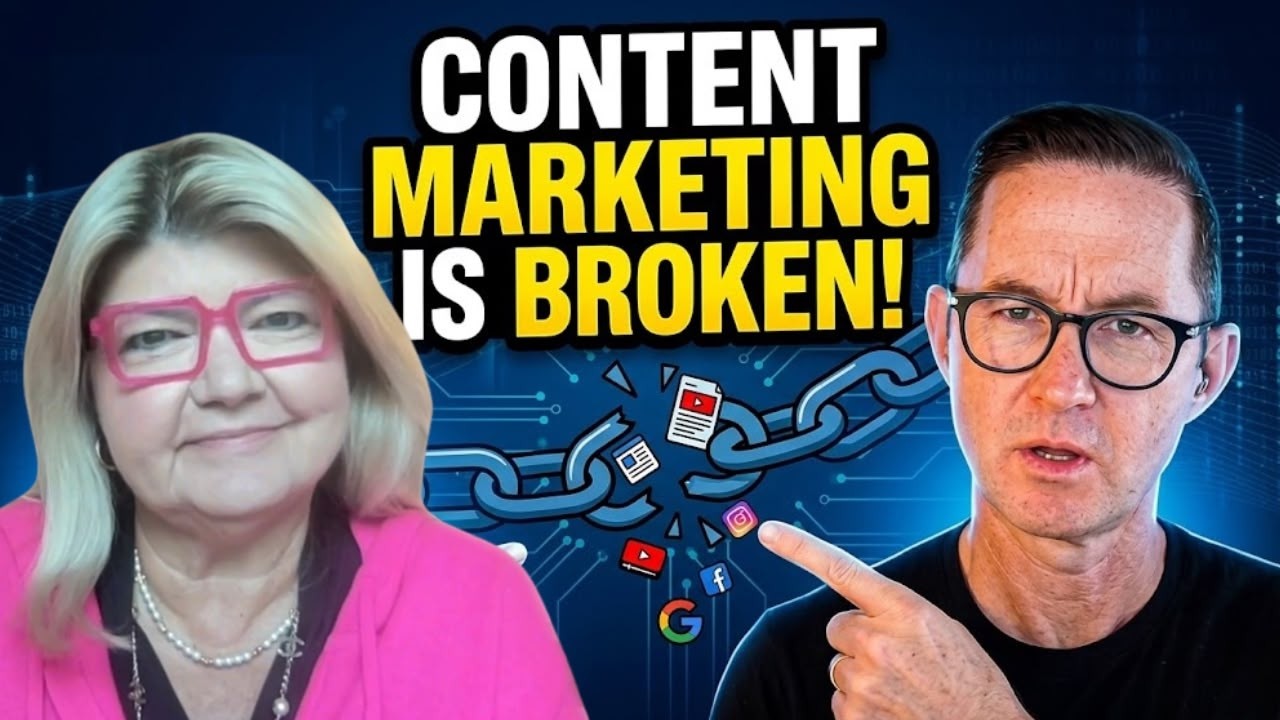
Andy Crestodina's annual survey of 1,000 marketers found only 14% report strong digital results, down from 20-30%. Despite 92% using AI for content, it shows no link to better performance. High-effort tactics like long-form articles, original research, and human editing still outperform, but marketers are spending less time and publishing shorter pieces instead.
Chapters
There's a question where you understand better what they're, what that means to them. But this year it's down, Sandy, it's down. It went down. It, it really plummeted down to 14%. Only 14% of my 1,000+ respondents said that they're getting strong results from digital. There's certain things that we can do as content marketers that where 30% of the people that do that report strong results or even more. Those methods, if you track them over time, which the data shows, are on the decline. There are far fewer marketers today doing the things that align well with performance. And far more marketers doing the things that don't align with performance. None. Yeah, I use it for brainstorming. I use it for editing. I use it for writing. I use it for image creation. It's basically table stakes and it doesn't give anybody an edge according to the responses. AI can't make this. AI could never make this. AI doesn't have those friends. It doesn't have the new, new data. So do something that AI can't do and you're much more likely to see results.
Well, good morning, good afternoon, or good evening, depending upon where you're listening from in the world. My name is Sandy Carter and I'm the host of the AI Marketing Companion. And we have a phenomenal guest today. He is a second-time guest, Andy Crestodino. He is the co-founder, chief marketing officer of Orbit Media Studios. It's based in Chicago. which is about to get really cold there, where he started in 20— sorry, 2011. And he spent the last 12 years, 12 years. And we're gonna talk a little bit about this, quietly building the closest thing to what our industry has as a long-term record of whether content marketing really works. Now, a few things you have to know about Andy. Semrush ranks him 3, 3 on a list of 100 most influential people in content marketing. 3. That's incredible. I feel like, uh, I'm honored to be here today with you.
No.
He's, he speaks around 100 times a year, has taught content strategy at Northwestern, amazing university, for over 10 years. For Orbit Media, the company that he helped found, has worked on more than 1,000 businesses on web design, development, SEO, and I'm sure CEO and GEO and AEO and whatever you wanna call it. He also wrote a book called Content Chemistry. It's now in its 7th edition. And if you've written a book, I have to say, I have one book that's on the 3rd edition. 7 editions means the book was on fire. He's done over 650 articles. And since 2014, this is one of the things we're going to talk about today. He surveyed over 1,000 content marketers asking them the same questions, which is why I really wanted him on here today. And I think this might be the first podcast that you've been on about this survey. So your new report just landed. The numbers are the worst that you've ever published for us for content marketing. So Andy, welcome. Are we the first podcast to get the results?
You, by far, you will be beating everyone else to the punch on publishing. I think this is hot off the press. These, this is brand new data. It's only been live for days. So Welcome everyone to, uh, these brand new insights.
Awesome. So, Andy, you started this survey in 2014. What were you trying to find out? Like, why did you decide to start it?
Well, there's a lot of data that suggests that new original research is a very powerful and differentiated format for content. I was looking for ideas and knew that if I put in the sweat, that I could get enough respondents to try to understand how people do this job and answer some questions that had never been answered, such as how long does it take to write something? And how long is the stuff we're publishing and what formats are we using and how are we promoting our content? And then year 2, it was more interesting, of course, because I had the previous year's data. And then Sandy just kept going. This is the 13th year I've had, uh, like 1,000 respondents each year to answer these 20 or 25 questions. In the last 3 or 4, this is the 4th year now we've had the AI-related questions. So I'm able to correlate which AI use cases align with performance or Or, or lack of performance.
Or lack of, yeah.
And of course, the overall performance of content in general, which always hovered between 20 and 30% of respondents report strong results from digital, self-defined strong results. Uh, there's a question where we understand better what they're, what that means to them. But this year it's down, Sandy, it's down. It went down. It really plummeted down to 14%. Only 14% of my 1,000+ respondents said that they're getting strong results from digital. So it's a wake-up call and it makes all the data more interesting to look closely and see what really does, what is still working today. And we can answer that question, which is, I think, important for all of us. Content's how we go to market.
Yeah, content is so important. I think it's like the, really the heartbeat of most companies today is their content strategy. And Andy, you know, when I said the worst year in the data, I didn't mean worst year for you, but the worst year that this data has come back. So when you said, you know, basically 14%, that's the lowest of the past 12 years. So this 13th year is the lowest. What do you think is the honest explanation for what is going on?
Well, when you look at the things that correlate with performance, and many of the content strategies out there have huge outsized results and very strong correlation with performance, there's certain things that we can do as content marketers that where 30% of the people that do that report strong results or even more. Those methods, if you track them over time, which the data shows, are on the decline. There are far fewer marketers today doing the things that align well with performance and far more marketers doing the things that don't align with performance. Disinvestment. There are fewer people putting in the long human-based hours doing the differentiated things. And we can jump into those. It's, it's, but it's really clear. The people who still do those, those high-performing, use those high-performing strategies are still reporting excellent results. We're one of many examples. We generate leads every day and we've never bought an ad and content is how we go to market. But we do all of these things that, that align well with outsized outcomes.
You know, I was thinking about it because, you know, even in the world of AI, first principles get left behind because it's the new shiny thing. And I was thinking maybe that's the case here too, because I also read that 1 in 5 marketers, 1 in 5, says now they don't know if their blog or that blog content works. Is that ignorance that they just don't know what to track or just honesty? It's just not working.
Well, it's an important angle on this because you can, it's possible that some of the respondents are in fact getting great results, but they just don't know what to measure. In other words, it's a blindness problem, not a performance problem, which makes sense to me. We're moving into an era where there's kind of less data and more difficult attribution than in previous eras when everything sort of seemed easy to measure. AI as a channel for marketing throws a wrench in some of that because a person talked to a model and they talked for half an hour and they got a recommendation and they They, then they went to a website and converted. You can't really tell easily what happened earlier in the buyer journey with AI when AI is in the middle. But separate from all of that, it's, it's, uh, there are no AI use cases in the data that correlate with performance. None. Yeah, I use it for brainstorming. I use it for editing. I use it for writing. I use it for image creation. It's basically table stakes and it doesn't give anybody an edge according to the responses.
That's a little crazy too, to me that none of those really correlated with anything that is, you know, um, standout, I guess I would say. Also, posts got shorter in words. And you said that marketers are spending about 50 minutes less. Now I will say my articles are also shorter. I write for Forbes. Forbes did a study that found that shorter articles, so our articles now are averaging 700 words versus it was 1,400 words for a Forbes article. They had told us that that was the better play. What do you think? Did, did someone decide that everything should be shorter? Is it just that we're assuming attention spans are shorter or how did that happen? Like, how are people writing shorter articles and spending less time on it?
Yeah. The, this is the survey goes across, you know, 1,000 people. So it's, it's, it's really the aggregate of all of these people's activities and performance. When you, when you give a certain brand and you say they found that a certain length correlates to performance for them. Definitely go with your own first-party data. If Forbes says that works, I believe it. So yeah, there's no, there's no generic content strategy that works for all audiences. But there is, there is data in the survey that shows that long people who tend to write long form are more likely to report performance. Only 10% of the respondents write 2,000+ word long form articles, but 25% of them report strong results. So generally speaking, effort correlates with outcomes. And all of the, we haven't named them yet, but all of the other high-touch, high-effort strategies correlate with performance. Collaborate with influencers, publish original research, highly visual content like infographics and many images, working with a human editor in a formal editing process, webinars, videos, all these things are more work arguably, right? And in the AI era, everyone kind of wants a shortcut. Well, this was something a friend of mine said years ago. Don't take shortcuts. They take too long.
It's true. So your friend was right about that.
Yeah. That's Sonia Simone, former, uh, chief content officer of Copyblogger. But that, that idea is very clear that in the, in the AI era, it's the, the very differentiated formats and strategies that drive better results. AI, I joke, should stand for average information. It's the shallow middle. It's that, it's a sum, it's an averaging tool. It's summarizing. So if AI can make it, why even publish it?
Yeah.
If on the other hand, this survey is an example, takes me 100+ hours to do every year. It's filled with data. I include, you know, strong opinionated influencers and subject matter experts. AI can't make this. AI could never make this. AI doesn't have those friends. It doesn't have the new, new data. So do something that AI can't do and you're much more likely to see results.
I love that. And your numbers show that 92.4% now use AI. Correlating with no improvement. That blew my mind. Like, you know, I use AI for research for sure, um, just because it reaches different places that I found. However, lately I've been noticing it's doing kind of what I would call offbeat citations versus the real citations. So tell me, you know, any insight on why using AI correlated with no improvement.
Well, it's a lot of people responding and it's a huge number of people using it. And if you just think of it as a magical typewriter, and why would you expect to get great results? It's really not. I, I don't think you have used it in a way that, you know, that kept your focus on differentiated content, on a very specific buyer, on how well it works in the sales funnel, on how, and if this content is going to be memorable, if it's got sharp elbows and, you know, deep insights. Most things AI write doesn't really, it's not doing that. So yeah, it's, um, it's, it's a strange moment because I think there's sometimes disinvestment from the top. Hey guys, spend less time on that blog. I heard it's not working. Or, hey, you've got AI now, you know, you should speed this up so you can help us with this event we're doing, you know, whatever else. But it's really truly a wake-up call to remember the things they never, the hype, the most performant strategies never declined in performance.
Yeah.
They're, it's consistent over a decade plus. These things work. So it's the why is a really interesting question, Sandy. What do you think? Why would, why would marketers be stepping away from these more performant strategies?
I'm, I think it's still the shiny object. I mean, Andy, I do think the big wake-up call for me out of the whole survey, maybe because I'm such an AI geek, is almost 93% of people use AI and it correlates to no improvement, no improvement. That was the big wake-up call for me, that, like, your number one stat. And I think it's the same thing we're seeing across companies where something new comes in and you kind of forget all the best practices.
Mm-hmm.
Like, you think of AI as just a technology, so you forget about your people, you forget about training, you forget about governance. I think the same thing is happening here. You forget that a great article has a great hook, right? Like you and I were talking about right up front. You forget all those basics when you've got something shiny and new. I don't know if that's it or not, but that's what I, that's my gut right now. That's what my gut says. And we are going to get into what does work. And it is these least popular things that I want Andy to talk about because one is influencer collaboration that runs at 2.6 times the benchmark and adoption dropped 22%. So I was trying to, you know, kind of guess your answers. Like, why are marketers walking away from that? And, you know, the other question that, that I heard, we had a lunch yesterday and I was chatting about some of your numbers. People were like, well, maybe they don't have money to hire an influencer. Maybe that's what it is. Right. So tell us why, why is influencer still running 2.6 times the benchmark, but adoption has dropped?
We're in an era where trust is generally declining. Sad to say, but people do believe in, you know, there are trusted voices and influencer marketing. Our mutual friend Marcus always talked about this. Influencer marketing does, has not, uh, it's a way to borrow trust from a personal brand that people believe in, you know, that has credibility. So it is a more differentiated format than ever, but like, like social and like search, there is, there's paid social, organic social, paid search, organic search. There's also paid and organic influencer marketing.
Mm-hmm.
And you can work with influencers without a budget. I mean, in this article, I have quotes from true thought leaders. You just reach out, hey, would you like an early view of this? I'm publishing this. I'd love your perspective on this. We've talked about this before. I know that you care about this. And just including contributor quotes in organic influencer marketing. This is content marketing. I'm not, I'm not putting a big budget behind it. You don't need money to, to part, to work with experts. I don't think it's, it's, uh, for them, it's a PR hit. And for you, it improves the quality of your content. It can improve the reach of your content. It can help you learn. It improves your network and, and you can make friends this way. It has, it checks all the boxes. Makes your content more visual if you put their face in there and visuals correlate with performance. Putting things in quotes makes anything more credible. Quotation marks, the most powerful key on your keyboard. Put something in quotes and you get to learn from your own blog. It's so fun. No budget required.
That is real. That's really cool. You know, Last week we had on, well, last month I focused on creators and influencers. And, and we did find that the, the budget for influencer has gone up. It's now 40% of a marketer's budget.
Wow.
Which I thought was, I mean, I've, I've been a CMO. I'm a CEO now. I haven't been a CMO in a, in a little while, but I thought, wow, that is such a turnaround. But Andy, I love your suggestions. Like you don't have to, if you're a small startup, I'm in Silicon Valley. You don't have to have that big honker budget. I love what you just said. Like reach out to people that, you know, you know, people that care about something. Last night I had dinner with someone and we were talking about a subject and he goes, this is like, I'm so passionate about this subject. He goes, I'll do a, I'll do a video with you. And I was like, oh, you know, I'm a startup. How much is that going to cost me? And he goes, no, no, no. I love that. Like, this is my subject. I will do it for you for free.
Yeah.
So people forget what you're saying, which I think is so powerful. Just ask, right?
Just ask. Just ask. I mean, neither of us is paying the other, you know.
I meant to tell you about that. No, it's true. It's true.
Obviously not, right?
Why?
Like, that'd be weird. I don't know. We're friends. So I think it's, it, that's totally underrated. It, and, uh, it's a, it's an opportunity for any organic marketer. Uh, it, and I don't know. I, it's strange to me.
Yeah.
That drop, right? 22% drop in the influencer collaboration.
Why?
So I think it's time stress or resources or people taking shortcuts or thinking that AI can do everything or trying to do content at scale. I hate that idea, Sandy. Content at scale. What? What? Oh, I wrote a bot that made me 100 keyword-focused articles. Good luck with that. Like, really, is, are any of those memorable? Do any of the others gonna persuade anybody of anything? Like, you're just, you built a machine. I'm not impressed.
Yeah, you are right. You're right. You're right. And then guest blogging was down almost 30%, 29%. And this is in the same year that AI has started deciding who to cite. So what do you think that's gonna cost people not having guest bloggers?
Whew. I'm worried. The brand that only publishes on their own domain has a big disadvantage. Always for one reason, you're not capturing the opportunity to connect with an audience directly. But now for a second reason, you're not training AI to believe that you're a credible voice on the topic. So if you needed a reason to do it, you've got 2 now. It's really the same philosophy as influencer. It is the other side of the coin of influencer collaboration. Here, you're just collaborating with an editor, putting yourself out there as a trusted voice, a new angle, an interesting perspective, some new data. that they would be thrilled, right? Oh, I can't wait to show this to my, you know, I can't wait to pub— to, yes, absolutely. We would love to, you know, for you to have a bylined article on this website. So yeah, that's, that's a, it's an, we just touched on the 2 things. The best content programs have more than one voice on their own site and they don't limit their content to just their website. They put their voice in other places and they put other voices in their content. It's really the same idea.
That is great, Andy. Would you mind repeating that? Because I really, I really think what you said was gold. So tell everybody the 2 things that they should be looking at or doing.
It's the best content strategies have multiple points of view in their content on their site, because we are in a post-single point of view era in content. The other side of that same principle is the best content strategies don't only publish on their own domain. They put their content on other people's site directly in front of their target audience, collaborating with trade publications and other blogs and So in one case, you know, you're, you're collaborating with a subject matter expert or influencer. In the other case, you're collaborating with an editor, but they're both just collaborative formats, getting contributor quotes for your site and publishing and pitching content to others. And now more than ever, because AI is reading everything. I mean, why would, why would you handcuff yourself and decide you're the only voice and you're the only place? No, you need multiple voices on your site and you need to be in more than one place. And be on other sites as well.
I love that. I love that, Andy. And it really, it really supports, you know, cause I write on Forbes. I have a lot of people go, you know, you're a guest on Forbes. Like you should take that content and use it for yourself. And I'm like, no, that gives me reach to another audience. And then I just did a guest blog post for the Peter Drucker. I'm a huge fan of Peter Drucker. And so I just did a blog post there. And you're right. I got so many questions and so many new voices coming in.
True.
So thank you for that. That's, that's pretty awesome, I think. Now you said also marketers running 6 or more of these 8 strategies you talk about hit 39% stronger results against a 14% benchmark. What are, first of all, can you give us the 8 and tell me the cheapest of the 8? If I'm a startup, 'cause I'm here in Silicon Valley, what's the cheapest of the 8 I should start with?
Yeah. Um, so they are greater investment of time and effort. Quite simple. Collaborating with other people within your content. Publishing, number 3 was publishing highly visual content. Uh, number 4 is keyword focus. Search still matters. AI searches. Those, it correlates with performance. The best content marketers do understand SEO. That's on the decline. There are specific formats, infographics, webinars, roundups, interviews. These are the higher performing formats. And, uh, those correlate with performance. Original research, huge outsized impact, right? Be the primary source. Most blogs and most content programs are not the primary source for anything, any new information. Uh, when you publish original research, you, you, uh, have answered that question. Using human editors correlates with performance. And then promoting—
And I have, I just have to ask you, 12 years ago, did you think you'd ever be saying those words? Use human editors versus— that's kind of interesting, right?
Yeah. I wanted to see like if, uh, cause a lot of people, I think, just edit their own work. I have expert content pro friends who log directly into WordPress. Okay. You know, they just hit publish as soon as it's live. It doesn't mean it won't work, but the people who are working together with others to think more, to be more considerate about the reader, that's what an editor, a good editor does. This isn't Grammarly we're talking about. A professional editor is looking for the angle, the hook, is looking for the connection, you know, thinking always about the the reader. Uh, you know, I, I use AI for certain types of editing. AI makes a great development editor. I took all the data from this that I got from the survey and talked to AI about it for a while and helped it structure the piece. You know, maybe that section should go earlier, help me analyze the data. This isn't an argument against using AI. It's an argument for using humans in the right places. And editors do correlate with performance.
I think that's awesome. Yeah, I actually adore editors, so I just think they make my work so much stronger, so much incredibly stronger and really gets to a lot of the things that I'm really looking for. So let's then go to what you're counting. Are you counting the wrong things? So a lot of marketers, and I've had a lot of them on this show, they talk about traffic, traffic, traffic. So you found that almost 40% of them today are tracking traffic volume. And you said that same group reports the lowest results. So Should that be on a dashboard or what should be there instead?
Well, you know, a second ago you almost sort of brought this up when you said you had a friend who said, why are you publishing on Forbes? Or why are you writing for Peter Drucker? The traffic-focused marketer won't fully appreciate that strategy, right? Because they're only looking at visits. If you write something that goes bonkers on Forbes, which you've done, and you're a pro at this, you get, there's a lot of reach. There's a lot of visibility. But the traffic-obsessed marketer would never fully appreciate that because that's not— it's like, well, what was the engagement rate? Or did any of them subscribe? Or what was the lead? No, no, no. We're doing brand building here, people. Brand building has fewer and less certain metrics, but some of those are the most powerful gains. Why would you bother doing Forbes if all you cared about was traffic? You would never have captured that opportunity. You wouldn't have the personal brand you do today. You would So yeah, the marketer who makes the shift from traffic to visibility, that really does open their, they open their mind to new channels and formats and strategies that the traffic obsessed marketer, volume metrics, impressions, these are not things that drive outcomes today.
I love that. Yeah. I like how you related that back to your previous points about guest blogging and using influencers and that sort of thing. So one more question on metrics. So AI sense. citations today convert at 4.55% and Google converts at 0.71%. What does a marketer do with that gap? Like, what should I be thinking about for that gap of an AI citation versus a Google search citation?
Well, here again is a shift in philosophy and strategy. So the marketer who acknowledges that AI is now a new UX for the internet and that buyers are on AI looking for options. They, if you keep thinking deeply about that, you'll conclude quickly that your goal in AI is not to be, just be visible, but it's to be recommended. And to win recommendations, you need to train AI on all the reasons to believe that you're the best fit for this buyer by first understanding the buyer quite deeply, what sent them on this journey, why wouldn't they take action, what wins the sales call. If you don't start by asking what wins the sales call and answer those questions and handle those objections in your content on your key pages, AI is just simply not going to recommend you. Or if you fail to support your claims with evidence and give people, give AI and humans reasons to believe that you're legit, why would AI recommend you? So that people who are good at that, and when AI does recommend a brand, the visitor lands, the conversion rates are absurd. It's very high. Like that's, that is surprising data. So if you're only looking for citations, I think you're going to miss out. The best AI search optimizers today. understand the buyer very well, and they're going deep into the buyer journey and, you know, objection handling and question answering and what wins the, you know, the, like a sales call transcript analysis. So that, those are the people that will win the recommendation. And I think those are the, the, that data point is an example of how that channel is more than just visibility.
Thank you for that, Andy. And I think I'm gonna actually go back and relisten to this again, cuz you're dropping so many nuggets of gold throughout this. This is awesome. So thank you.
Okay.
So we're going to do like a little fast round here. I'm going to name a tactic. You're going to say dead or alive and give me some of your own data to support that. So we'll do one to start with. How-to posts, dead or alive?
Alive. They don't correlate with performance. They're the backbone of many content strategies. They should be used to support sales funnels and answer real buyer questions and help people in their lives. But it's not sufficient.
Keyword research.
Alive. AI is searching on behalf of users. It uses a search engine. There's a search engine inside every AI, or Gemini is basically an AI built on top of a search engine. So alive and well, marketers who understand information retrieval and keyword research and fan-out queries and see better results.
Let's do infographics.
Alive. Visual content, it just can't be underestimated. Anything that you do that is, especially for social, a strong image. It's, it's just the data shows that these are, this is a format that correlates with performance in a big way. It's a huge correlation. You're much more likely to report success if you publish these kind of long-form visuals or any visuals. So I would never say dead to a visual format for content. Hmm.
How about the company newsletter? I've had a lot of questions lately. Should I continue my company newsletter?
Email is the channel you own. Email takes big tech out of the middle where you can contact your audience directly. In other words, email is disintermediation. Search engines, those are algorithm marketers. They're marketing through big tech. Social media, those are algorithm marketers. They're trying to trigger the algorithm to improve reach. The email marketer has permission from those people to send that message directly, and they're much more in control of their destiny.
Okay. Gosh, the time just went so incredibly fast. I have to say, I want to close out with a question for you. I have so many more questions, but this question for you, if you were running a content team tomorrow, which I know you are, what would be the first thing you would tell them to stop doing?
I would stop focusing on publishing frequency and cadence and instead put that time toward the highly differentiated formats, including offline formats, web events, live events, webinars, anything that's brand building. And it's a barbell strategy. Don't pocket that time that you save from reduced AI, from increased AI use or reduced cadence. Instead, double down on the, the straightforward stuff, right? The stuff that, you know, that your audience needs that you can publish just as articles and that fit into your email nurture sequences for sales and the really different, highly visual, highly collaborative formats, you know, that, uh, and including stuff that's offsite or offline, much more likely to see results.
That's great. So, Andy, thank you so much. So, I will post in the show notes. I'm going to post your link to your report. I just advise everybody to go and, and take a Peek through that for sure. Also, I will send out our company newsletter and I'll have the link in there too. How else should people reach out to you?
LinkedIn's my best network. Andy Crestodina. You can connect with me there. Uh, there's a big blue follow button, but there's also 3 dots where you can connect and just say, I heard you on Sandy's show, and then we can hang out and talk.
Awesome. Well, thank you, Andy. And thank you for doing this report so consistently because it gives us a lot of good comparisons for today. And again, thank you to everybody who's listening on the AI Marketing Companion. You know, send some questions in for Andy. Tell us what you think. And there's so much gold in here. Make sure you take and apply these. That's where this really becomes valuable. Thank you.
Thank you.