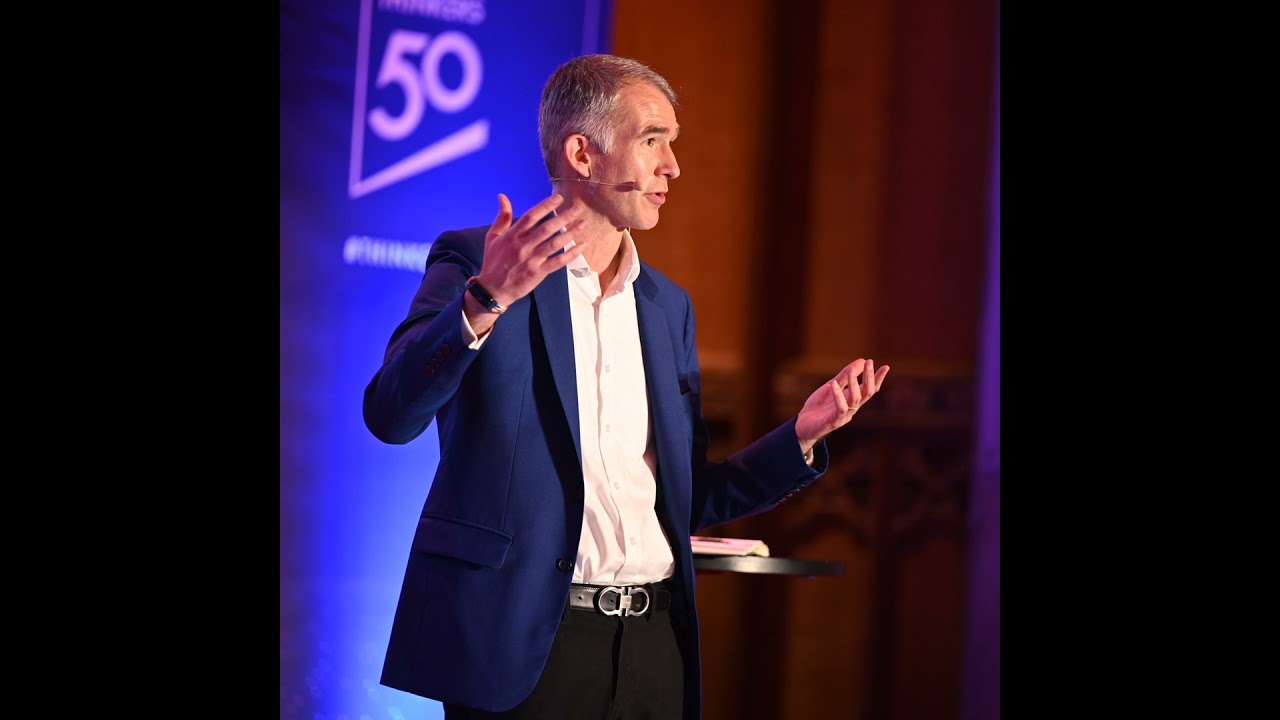
Scott Anthony at Creative Innovation 2013 Asia Pacific (Ci2013) - "The Empire Strikes Back"

In this keynote, Scott D. Anthony challenges the common belief that startups and nonprofits are the primary engines of world‑changing impact. He argues that large multinational corporations, despite their reputation as bureaucratic behemoths, are uniquely positioned to solve the planet’s biggest problems because they possess scale, deep assets, and financial muscle. Anthony frames his argument with a historical overview of four distinct eras of innovation: the lone‑inventor era (up to ~1910), the corporate‑mass‑production era, the venture‑backed startup era, and the emerging "corporate catalyst" era where multinationals act as platforms for social impact. He critiques the low success rates of venture‑backed startups (≈0.07% achieve billion‑dollar valuations) and illustrates the power of corporate‑scale initiatives through case studies such as Medtronic’s Healthy Heart for All loan program, Syngenta’s smallholder initiatives, GE’s child‑mortality work, and IBM’s data‑driven city projects. He identifies three core behaviors of successful corporate catalysts—dreaming big, thinking holistically, and building coalitions—and describes the cultural prerequisites (purpose‑driven mission, extensive internal and external networks, and an innovation‑friendly risk culture). The talk concludes with tailored advice for policymakers, graduates, entrepreneurs, and corporate leaders, urging them to recognize the leverage that large firms can provide and to foster openness, cross‑disciplinary collisions, and collaborative mindsets to unlock the next era of innovation.
Chapters
TranscriptAuto-generated · 20 min
How many of you would like to change the world in some way? Just show of hands. I don't see many people not raising their hands. So let's turn to the first poll question that I have. The first poll question is meant to get a sense as to if you do want to change the world, and everybody does in some way, Where is the best place to do that? Can we roll that question, please? So there are your choices. This isn't a comprehensive list, but you could start a company. We heard some great thoughts about that. You could enter politics. You could go work for a nonprofit. You could join a big, massive multinational, or you could become a teacher. If you want to change the world, what should you do? Cast your vote now. These won't be shared with any of your corporate leaders. 10 seconds. 5 seconds. Hmm. All right. As expected. So starting a company came up number 1. You did a good job. You know where to get funding. Friends, family, and fools is what the 3rd F is. In some contexts, it's a different word in other contexts. Politics, we got some people there. The lowest score is to join a large multinational. Only 5% of you said this, even though I suspect about 35% of you work for a large multinational. I'm going to make the case that we have this exactly backwards, that the best place to go if you want to change the world is working for a large multinational. I know this seems like a paradoxical finding, something you would not expect. After all, We know the parables. We know in the end it isn't Goliath that wins, it's David. If it's not this, we know it's the Lilliputians that bring down Gulliver. We read the academic research on this, it is no less encouraging. Back in the 1980s, Dick Foster, one of my mentors, told us about the attacker's advantage. In the 1990s, Clayton Christensen, who co-founded my company, he told us about the innovator's dilemma. It's getting scarier. The most recent book on this topic, The Innovator's Extinction: How Best Intentions and Natural Selection Will Drive Your Company into the Grave. Not very encouraging, is it? Paul Graham, the founder of Y Combinator, one of the first incubators that has now seeded hundreds of startup companies, I think summarized the prevailing viewpoint when he said, running a startup, well, that's like getting punched in the face repeatedly. Working for a large company, that's like being waterboarded. So again, I'm making the case that all of these people are wrong, that the best thing to do is go work right in the belly of the beast. Now, to make this case, I have to give you a very brief history of innovation. In my mind, up until about today, there have been 3 distinct eras of innovation. The first era, that goes until about 1910, is what I call the era of the lone inventor. The tools of innovation were available, accessible to the masses. You could, working in your garage or equivalent, come up with an idea that would change the world. You might join a company to scale it or form your own, but the magic, the magic was done by the individual. The way you know this is I've got 3 inventions here. I've got the printing press, the cotton gin, and the light bulb. You can attach a name to each one of these. We could talk about Gutenberg, Whitney, and Edison. This is where the magic happened in innovation's first era. This is another magician in the first era. This is Henry Ford. Henry Ford pioneered mass production. He didn't invent it, he drew lots of technologies from different places to commercialize it, but he is the father of the modern manufacturing era. He also marks an important transition between eras. As we began to see what mass production could do, as scientific revolutions continued to spread throughout the world, innovation grew more expensive and more complicated. The magic went from the individual to the corporation. The corporation at the time was still open enough, still willing to experiment, still willing to dream. So you had great big corporations have great big impact. Procter& Gamble gives the world laundry detergent and fluoride-based toothpaste and disposable diapers. Lockheed Martin, the U-2 spy plane and a number of other inventions. IBM, gives the world System 360. Around the 1950s, 1960s, this began to change. At the same time that corporations were becoming more bureaucratic, were ossifying, individuals wanted to become a little bit more active. They grew restless. They began to eject out of corporations, form with bands of like-minded rebels, and begin to attack their former parents. Now, innovation was still expensive. So there needed to be a new form of financing to allow these people to succeed. Hence innovation's third era, the rise of the venture-backed startup. This is where the magic happened now. Steve Jobs and Steve Wozniak, a partnership, do Apple. Paul Allen, Bill Gates do Microsoft. You have the team at Facebook, you have Cisco, you have Google, and a number of other companies. These are the companies that go and change the world. What has this third era of innovation given us? Today, innovation looks remarkably different than it did 30 years ago. Again, an individual can do some very amazing things. Innovation is more affordable, more accessible than it ever has been before. It never has been easier to start a company. Let me give you at least one example of this. In our offices in Singapore, we have a venture capital arm. About 2 years ago now, we saw a pitch from this company here, Plunify. The idea from the 2 entrepreneurs was to democratize the tools used by programmers of field-programmable gate array chips. Now, I have no idea what that means, but apparently it's a pretty big market. There are a couple billion-dollar companies in the market. The team presented their business to us, and it was a business. This was not a set of PowerPoint slides. This was a functioning website that had early customers and early revenues. They talked about their plan for expansion and so on. We were impressed. We looked at the team and we asked them, who had given you money thus far? Because clearly someone must have backed them, because this was a fully functioning business. The team looked a little bit sheepish, and they admitted they used their credit cards to build the business, because it cost them about $500 to create the first working version of their business. $500. That's what it takes to create a viable business today. Now, you might be a little confused at this stage. I thought, Scott, you were going to talk about the wonders of being a big company, but you're telling me now that $500 is all it takes to start something up. Think about it for a second. Now that I've explained to you the wonders of field-programmable gate array chips, If you wanted to start a competitor to this company, all it would take you is $500. It never has been easier to start a company, but there are some new challenges. What percent of companies that venture capitalists ultimately back end up being big successes? You can see the 5 choices here: more than 20%, all the way down to less than 0.1% at the bottom. Cast your vote. 20%. Polls are closed. Let's see the results, please. We have 37%— there's too many percentages on that chart. We've got 37% that say 1 to 5%. 2.3% of you say more than 20%. We're raising money for our next venture capital fund. We'll come talk to you about that. So let's see what the actual answer is. Back to the slides, please. So people recognize this company here, Facebook? Is anyone on Facebook as we speak? Statistics would show that a few of you probably are. A remarkable success story, a company that 10 years ago did not exist. Mark Zuckerberg, their founder and CEO, was a freshman at Harvard. Today, the company is worth more than $100 billion, more than a billion members around the globe. Unbelievable. And a very rare exception. 75%— that's not the percent that succeed. That's the percent of venture capital-backed startups that do not return a single cent, let alone positive returns, to the people who invest in them. How about the big successes? How about the ones that really break through like the Facebooks? This happens incredibly infrequently. A recent large sample survey said of the about 60,000 companies in the software space that received venture capital funding since 2003, 40 ultimately cracked through a billion-dollar valuation. That is 0.07%. Yes, it has never been easier to start a company. But it has never been harder to build a business. Because anyone can do it, the returns you get from a pure startup are really hard to capture. We have these cycles where people get good ideas, the race is on, they grow, grow, grow, grow, and then they collapse. Groupon, Zynga are examples of this. While this is happening, simultaneously, something interesting is happening in the halls of at least a few, and it's still a few, Multinationals. They've already gone through this. They've gone through this cycle. They've created unique, difficult-to-replicate assets, and a few of them are combining those together with just enough entrepreneurialism and unleashing massive impact on markets that matter to them. Let me give you one example of this, and the example that really crystallized this in my mind. Medtronic is the world's largest independent medical device manufacturer. About a $15 billion company based in the state of Minnesota in the United States. This is one of its flagship products. This is a pacemaker. This is a device that regulates electrical flow to the heart for people whose hearts don't function appropriately. This is a pacemaker being implanted in India. You can see an incredibly small yet technologically sophisticated device. Historically, this was a very rare sighting. India has more heart disease than any country in the world, but Medtronic's penetration in that market was tiny. Very understandable reasons. Primary care pathways in India are broken. You don't go to a GP who diagnoses you, who sends you to a specialist. Many people who suffer from conditions that could be treated with a pacemaker never know that they could be affected by this device. Second problem: a basic pacemaker costs about $1,000. 85% of people in India pay for their own healthcare. $1,000 is pretty expensive in the Australian context. It is impossible for most consumers and patients in India. So about 2 years ago, I went to Durgapur, a small-by-Indian-standards town, about a million people, on the border between India and Bangladesh, to see the results of a consulting project that we had been doing with Medtronic. We'd helped Medtronic give birth to a brand-new business. That business was called Healthy Heart for All, a new approach to attack this market. One key component was to bring diagnosis to the patient. You'd run in an afternoon a screening camp in a very rural village where 300 or 400 people at a time could very quickly be diagnosed. You'd do direct-to-consumer advertising. You'd have these trucks going down the streets in Durgapur to let people know about the program. And then, most critically, you found an innovative way to get over that affordability barrier. If you could read the local dialect here, it says, you too can get a 35,000 rupee pacemaker no matter what your income is. Medtronic came up with what we think is the world's first loan program for an implantable medical device. Think about that for a second. You take out a loan for a car and you don't pay it back? You give back the car. You take out a loan for a device that gets implanted in your chest and you don't pay it back? Well, that's a different matter entirely. Medtronic borrowed from principles of microfinance, social lending and so on, and has now been able to dispense more than 6,000 loans without a single default. This is the first patient. This is a 44-year-old widow in India. She was suffering dizziness and blackouts, and she didn't know why. Household income about $60 a month. Without this program, she would not likely be alive today. And not just the 6,000 loans, but now tens of thousands of people have been touched by this program. Medtronic is now bringing this to markets all around Asia. This isn't the only example. I could detail other large companies that are attacking some of the most pressing social problems in the world today, some of the big UN Millennial Development Goals. Whether it's Syngenta trying to figure out ways to make smallholders more productive, General Electric finding affordable ways to reduce child mortality, or IBM using big data to try to make cities run more efficiently, big companies are rising up to this task, and they're creating big booming growth businesses as well. This, in my mind, is the beginning of a new era of innovation, the 4th era of innovation. It needs a name. Every one of these case studies that I have studied has a familiar pattern. There is a hero in the case study. The hero isn't the mythical CEO, it's not a Steve Jobs figure, it's somebody a couple or 3 levels down in an organization who does something special. They bring together the unique, difficult-to-replicate assets with those entrepreneurial behaviors, and they catalyze them. unleashing impact in the markets that matter to them and their companies. This is the 4th era of innovation, the rise of the corporate catalyst, where the multinational can go from being the villain in the innovation movie to truly being the hero. What do these catalysts do? I'd suggest 3 things. They dream big. Uri Jain from Hindustan Unilever is trying to bring purified water to the bottom of the economic pyramid. He does not measure his business on how much revenue it produces, and it's producing hundreds of millions of dollars in revenue, but he counts the number of lives that he and his team save. This is a mission-driven group of people. They think holistically. You talk to Nick Muziaka at Syngenta, to bring crop protection chemicals to smallholders in Kenya, it takes a village. It's not just one person. He's got to involve key stakeholders, retailers, other people in the value system, to make this work. And they build coalitions. When Keane Monson began his work at Medtronic, he had exactly zero direct reports. He was able to mobilize a force within that company to drive change without having the hard assets or hard resources at his disposal. What do the companies look like? 3 things here. They're purpose-driven. They're doing this kind of work not just to create economic returns, and they are creating economic returns, but because it fits the mission and purpose of their company. They're highly connected. IBM is a great example of this, a company that has connections inside and outside the enterprise, where it can assemble hundreds of thousands of IBMers in virtual jam sessions to try and solve problems. And they've got cultures of innovation, where risk-taking, prudent risk-taking, is encouraged, where people recognize not everything's going to work, where you can try, experiment, fumble, and sometimes even fail. So last question that I'd like to ask for you, then I'll offer just a couple concluding remarks. If you're inside an organization or if you're not, what stops you from doing what I just described? You don't have any of these people? There's no Keen Monsons, there's no catalysts? You don't have a purpose or mission to inspire them? You're too insular, you don't look out and make those connections? Or we lack confidence that we can do this? Confidence. The music has stopped. It's such a serious question. Here, it's back.
It is serious, but musical as well. 5 seconds.
Too insular. Too insular. It's interesting that this theme has repeated throughout the conference, this notion of connections and collisions and trying to find new ways to bring different ways of thinking together. If you look at any study, any study at all, and you can turn back to the slides while I talk for a second, any study at all about where great ideas come from, you see one common element. The magic, the brilliance happens at the intersections when different mindsets and different skills collide. Organizations have to open up, we as individuals have to open up, if we are to confidently lead in this 4th era of innovation. So let me just end by providing some thoughts about what all of this means. If you work for the government, if you're a policymaker, there's a cult that is beginning to form around innovation and entrepreneurialism. I think it's fantastic. I think we can't have too much entrepreneurialism. At the same time, though, recognize the beauty of bigness sometimes. Scale problems require scale solutions. If we empower entrepreneurs but we shackle large companies, we might be stopping at least some of this type of change. If you're a newly minted graduate thinking about what you can do to change the world, by all means, join a nonprofit, start up a company, become a teacher, but also consider working for a very large company, because there are things that only large companies can do. Think about who else in the world could possibly have done what Medtronic did. The answer is no one. Medtronic had the technology. Medtronic had the access. Medtronic had the market understanding. It had the balance sheet to finance the loan program. No one else in the world could have the impact Medtronic did. If you're working for a startup company, it's time to change some of the language. It's not about disrupting or disemboweling some of the big competitors in the marketplace. It's about working with them and sometimes through them to have the impact we all seek to have. Finally, if you're a leader in a large company and you have no idea what I'm talking about, well, Darwin's going to take care of you pretty soon. Last piece of advice: Archimedes once said, if you give me a lever long enough and a platform on which to stand, I can move the world. Big companies have the platform. Innovation can be their lever. I believe those of you in the audience who work for these companies can move the world, and we need it. We've got big problems out there: feeding 7, 8, 9 billion people, climate change, bringing healthcare down the economic pyramid, educating the hundreds of millions of people in the world who can't afford it. And I hope you go and catalyze that change. Thank you very much.
Thank you, Scott.
More from Scott



What the Printing Press Really Teaches Us About Innovation with Scott D. Anthony