Scott D. Anthony - Seeing What's Next The Clayton Christensen Tribute
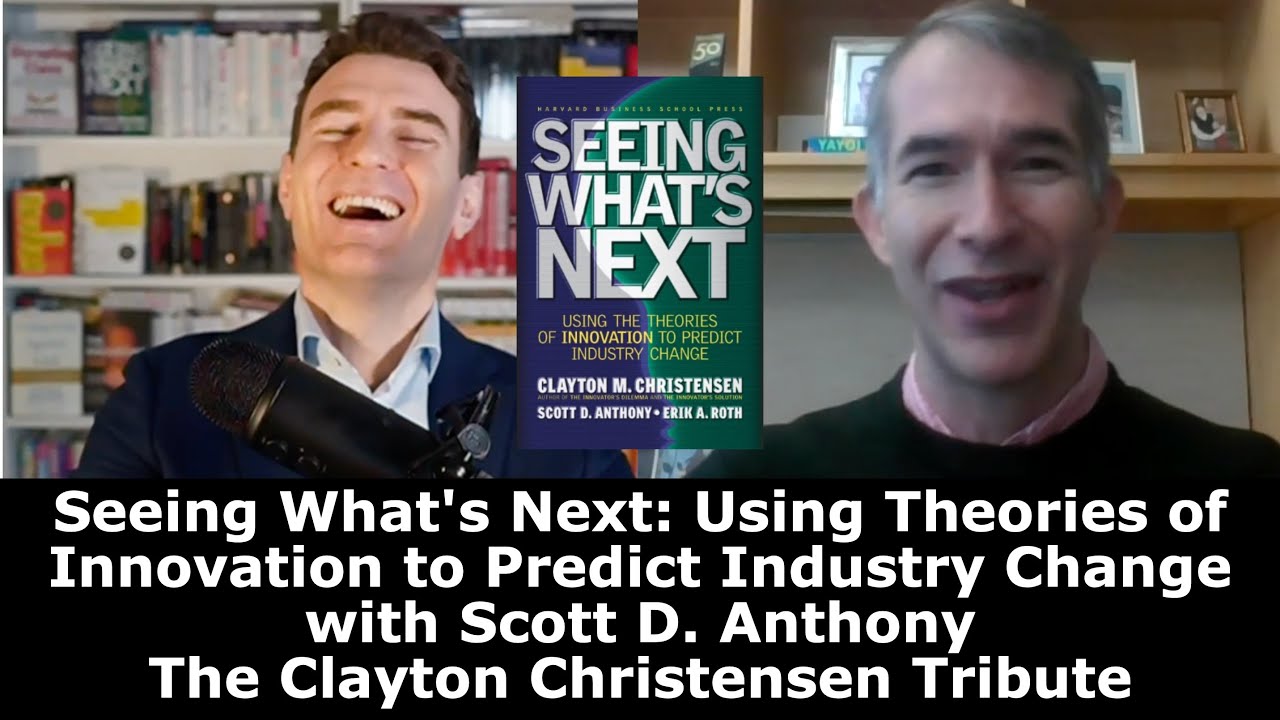
In this two‑part interview, Scott D. Anthony reflects on Clayton Christensen’s legacy while walking through the core concepts of his own book Seeing What’s Next. He defines a good theory as one that correctly categorises circumstances and links actions to predictable outcomes, then explains the disruptive‑innovation framework: two improvement trajectories (customer demand vs. technology), overshoot vs. undershoot, low‑end vs. new‑market disruptions, and the non‑consumption (WASTE) lens. He introduces the Resources‑Processes‑Values (RPV) diagnostic (later Resources‑Processes‑Priorities) for assessing incumbents’ ability to pursue new opportunities. Historical case studies—telephone vs. Western Union, AT&T’s wireless licensing, Netflix vs. Blockbuster, Amazon Web Services, Tesla, Wise, WeChat—illustrate how the theory predicts winners and losers. Regulation’s role, dual transformation, asymmetries of motivation and skill, the “tail‑of‑the‑tape” and sword‑and‑shield metaphors, incumbent response strategies, signals of change, and decision‑type thinking (one‑way vs. two‑way doors) are all covered. The interview concludes with a heartfelt personal tribute to Clayton Christensen, including an anecdote about a 2003 handwritten note from Clay to Mark Johnson that granted laptops to the InnoCite team, exemplifying his humility and problem‑solving spirit. Anthony also shares how listeners can connect with him via LinkedIn (Scott Anthony Insight / Scott Anthony Talk) and the InnerSight website.
Chapters
TranscriptAuto-generated · 67 min
By teaching managers to look through the lens of a theory into the future, you can actually see the future very clearly.
I want to thank our sponsor Next Estate, an English-speaking specialist in buying, selling, and managing of properties for the German market. They're Berlin-based, and you can find them at next-estate.com. Imagine the year is 1876. You work for a leading bank. Your boss comes to you with a deceptively simple question. Alexander Graham Bell has developed a way to transmit voice over a wire. What does it mean? How would you go about answering such a question? The world's leading communications company at the time, Western Union, dismissed Bell's invention As a toy. When it comes to disruptive innovations like Bell's, no data exists to help guide you with the analysis. Fast forward now, and the year is 1978. You work for a consulting firm. Your team manager comes to you with a deceptively simple question. AT&T is testing a mobile phone service What does it mean? How would you answer that question? How could you interpret the subsequent choices companies made as they commercialized the new technology? Now it's 2004. You work for a leading telecommunications service provider. Your boss asks a deceptively simple question. I've read everywhere about this explosion of local high-speed wireless data networks using A technology called 802.11. What does it mean? How would you go about answering that question? If you were an investor, how could you interpret the choices the company makes to either commercialize or ignore the technology? Is the company being wise, or are they being myopic? Today's book shows how to use the theories developed in both The Innovator's Dilemma and The Innovator's Solution. The book argues that it is possible to predict which companies will win and which will lose in a given situation and provides a practical framework for doing so. We are joined by a longtime collaborator, friend, and student of Clay Christensen, and a longtime friend and collaborator of the show. It's always a pleasure to welcome back for the 4th time, an author that Clay Christensen described as follows. I am particularly grateful to my co-author and his wife, Joanne, for dedicating a couple of years in the prime of his life after he finished our MBA program to write this book with me. Whereas my own mind seems to work best with abstractions and concepts, he has demonstrated greater intellectual agility as he helicoptered up and down between exploring high-level concepts and developing practical tools for using them. Over the years in my classroom, I've developed a pretty good eye for capable students, and he is one of my very best. I'm honored to have his name next to mine. And we are honored to have him with us to talk about the theories developed and expanded upon in the book Seeing What's Next. We welcome to the show, Scott D. Anthony.
Aidan, thank you so much for having me. Fourth time is a charm, right?
I thought we'd start with what you told me off air, which was, when I reached out to you to be part of this series to celebrate the theories and life of Clayton Christensen, and I mentioned Seeing What's Next, you were like, oh, I better look for a copy. And I have this beautiful hard copy myself, and you managed to get your hands on one. And it has an interesting backstory. Perhaps we'll start with that.
Yeah. So the book came out in 2004 and publishing, that means it was pretty much written in 2002 and then there's a year to get it all ready. So you're going back a couple decades for the actual writing of the book. And to get ready for this discussion, I of course wanted to refresh my memory about the things that were in the book. And the copy that I found at home was actually a copy that I had sent to my grandfather with an inscription in the front that said, without you, none of this is possible. My grandfather was a very famous accounting professor, actually a member of an institution that, believe it or not, exists called the Accounting Hall of Fame. And his fame came from writing mostly textbooks, and he wrote about 30 of them and one mass-market book called The Essentials of Accounting, which people of a certain age will immediately recognize because I got a copy of it when I entered business school. I got a second copy of it when I entered my first consulting job. I actually had received a third copy of it when I turned 8 years old. Not the greatest birthday present from my grandfather ever, but that's okay. But my grandfather was a hyper-prolific author, and I guess some of that DNA is in me.
You mentioned the dean at the time, Kim Clark, and how he said the Harvard Business School experience was transformational. And you remained slightly skeptical about that until you encountered both The theories and the man that was Clayton Christensen. And not only did he transform your life, but also altered the pathway of that life. Maybe you'll take us through that experience.
No doubt. I mean, I remember pretty distinctly, it was the fall of 2000. I'm in my second year of the MBA program. The world's at an interesting moment. So, a bunch of my classmates at the beginning of the term were like, yes, we're all going to go and join startup dot-com companies. And then the dot-com bubble bursts. And of course, Of course, other things would happen in 2001, the September 11th terrorist attacks. We were an interesting class, an interesting class at the Harvard Business School. I signed up for this class by this professor, Clayton Christensen, called Building and Sustaining a Successful Enterprise. Clay was reasonably well-known because he had written The Innovator's Dilemma, but that was his only book, so he hadn't quite achieved rockstar status at the time. The course hadn't been taught before, so there were no past reviews to look at, but it seemed interesting, so I signed up for it. First day, this massive 6'8, 203 centimeters or whatever man walks into the room and does something that is really bizarre for the Harvard Business School. He starts to lecture. Harvard Business School is case-based discussion. That's the way everything is done. But in the first class, Clay actually took out acetates. There was no PowerPoint presentation off laptops. He went and put slides up and went through some of his theories and models and all that. And you could see just a bimodal reaction in the room. There's some people who are like, What is going on here? This is kind of academic and wonky. And there are others like me who are leaning forward saying, ah, it's like the skies have parted and truth is being spoken. And I intellectually fell in love within minutes. And that is a love affair that would continue for the next 20 years until Clay sadly passed away at the beginning of 2020.
I thought we'd start with the way Clay often starts and something I've heard you talk about before, which is the importance of good theory. And the way this work has really rubbed off on me, and I hope for our audience, and in this tribute to the work of Clayton Christensen and his co-authors, I hope that it becomes these lenses that we can look at the problem and see a different solution. I'd love if you'd give us the characteristics of good theory.
And this is so central, Aidan, not just to seeing what's next, but everything that Clay stood for. So it basically comes down to 2 things. Getting the categories right and understanding causality. And, and of course, there's a lot more that you can say about it, but what a good theory helps you understand is in this circumstance, in this category, if you do this, you can predict this will happen. So you have to first understand the circumstances a manager is facing. Clay's famous theory of disruptive innovation said there are different circumstances depending on what customers are looking for, which I suspect we'll probably talk about in a little bit. And he said, once you understand those circumstances, you know what actions will lead to what results. And where this really changes things is when you're operating in a world, as we all are operating in today, where the data are not crystal clear. When leaders are making decisions about the future, the data never are crystal clear. But in a world that's changing as quickly as our world is changing, where you've got technologies advancing exponentially, lines between industries blurring, expectations from customers and clients and employees shifting and these shocks coming after you one after the other. If you don't have good, well-grounded theory, if you don't have mental models, if you don't have frameworks to guide you, you're lost. You're just shooting in the dark. So knowing the categories, knowing the circumstances, and knowing the causal connection between actions and results, that's the hallmark of a good theory.
For those who may not have joined us in earlier episodes, The theories remove the reliance on luck. And a lot of people who work in innovation, including really seasoned professionals who work in innovation, including people who have got lucky, believe that you need to place enough bets and some of them will pay off. I've fallen for that fallacy myself in the past. But understanding good theory helps you make more wise bets, at least, and give yourselves the best possible opportunity. Innovator's Dilemma and Innovator's Solution proposed some of those theories. I think it'd be great if we'd revisit some of those theories, particularly the disruptive innovation theory.
And so of course, the disruptive innovation theory, it was Clay's claim to fame, and it so influenced him. His wife Christine was famous for saying, you know, Clay wore glasses, that he had the kind of core line diagram that was in The Innovator's Dilemma etched onto his glasses, because everywhere he looked, he would see disruptive innovation. And we see it everywhere we look as well. But the basic of the theory is pretty straightforward. It says there are 2 different improvement trajectories that matter. There is an improvement trajectory that is demand, what customers demand, the problem they're trying to solve, the job they're trying to get done. That's pretty flat. There's then an improvement trajectory of what companies offer. This is the technology, the products and services they offer as they innovate and improve what they do. That's steeper. So the basic idea is people's lives change more slowly than the technologies that companies introduce into markets, which means to the idea of circumstances, you critically have 2 different circumstances. You have an undershot circumstance where what exists is not yet good enough, where companies need to invest in what Clay famously called sustaining innovation. So they offer something that's better that people will pay higher prices for. And then there's the overshot circumstance where things are actually too good. Where people don't need or want the additional bells and whistles that people can provide. In those circumstances, someone can come in and change the game with a disruptive innovation that takes something complicated and makes it simpler, takes something expensive and makes it more affordable. Not necessarily good enough for the most demanding applications in the early days, but good enough to solve a problem for a less demanding customer or somebody who's locked out of a market because they have a barrier to consumption. Finds a happy home away from the mainstream. And because the improvement trajectory of technology is steeper than the performance that is demanded of customers, it ultimately gets good enough to attract more and more customers. But the thing that makes it so hard and the reason why Clay called it a dilemma is everything you are taught to do in an established business is to listen to your best customers, innovate to meet their needs, produce better products and services, charge higher prices, etc. All of that is the right advice in one circumstance. When the circumstance changes, the advice that seemed to work so well leaves you susceptible to an attack from someone who's coming in and changing the game. And of course, there are all the classic examples that you can read in the book about the steel mini mills and the birth of the telephone, which we talk about in Seeing What's Next. And you can think about more recent examples as well. People who are coming into the financial services industry like Wise that makes it very affordable for people to transfer money internationally. Or people who have come up with new platforms like Tencent's WeChat platform that creates an entirely new class of consumers and producers doing things that they couldn't do before. Disruption continues to drive change in industries all throughout the world.
I love it. And I'd love to come back to the example that you do cover in the book. I know it's an old one, but you do a brilliant job of covering the telephone and the rise of telecommunications, et cetera. But you alluded to different types of disruptive innovation there. So there's low-end and then there's new market. And these are important concepts to comprehend.
So the basic idea is a low-end disruption is in an established market, someone who is coming in and picking off the least demanding customers by offering them something that's simple and cheap. And I think you see a lot of this again in financial services today. Wise is the example that I gave, where people are, are coming up with solutions that are using technology to just be a lot simpler and cheaper. And for people who are looking to do the basics at lower prices, it does the job perfectly well. A new market disruption, on the other hand, says there's an entire class of people who are locked out of a market. They're non-consumers because there's something that's stopping them from consuming. We use the acronym WASTE here at InnoSite. That means they lack wealth, access, skills, time, or there's an established habit that's getting in the way. When you've got one of these barriers to consumption, a disruptive innovation goes and breaks that barrier and creates an entirely new market. WeChat is an example of this. You had people in China, which is Tencent's home market, that didn't find it easy to go and buy products because they lacked credit cards or other forms of payment, where you had WeChat and, of course, Alibaba with all the things it has done as well. come up with entirely new mechanisms, entirely new ecosystems that allowed people who historically couldn't consume to consume using technological platforms to enable a whole suite of services that people hadn't seen before. So a low-end disruption transforms an existing market. A new market disruption creates a new one. That's kind of the shorthand for it.
One of the reasons I start this series with a little quote from Clay about using the past to see the future is Because so much of the book does that. It uses the past to predict the future through theory. And one of the great examples is how the incumbent missed the telephone. So Western Union was the dominant player, missed the telephone. I mentioned in the introduction, dismissed it as a toy. The question you ask here is, why did Western Union make decisions that history would deem shortsighted? And theory suggests a 4-part answer. And please go anywhere you like with this. Number 1, you say the telephone was a new market disruptive innovation. 2, Western Union's resources, processes, and values meant that what ultimately became the right course appeared to be unattractive at the outset. That's a killer for so many organizations. Number 3, Western Union saw entrants improving. However, investments in the core business kept trumping investments in the new business. And 4, by the time the right course of action was clear, it was too late. So many companies fall prey to those 4 steps.
And this is the heart of disruptive innovation. And I think one of the things that made Clay's research so powerful. So, Clay would always say the key to do good research is to ask a really good question. And the question he asked, the thing that prompted his whole exploration of the disk drive industry and led to The Innovator's Dilemma, is why is it that good, well-run companies fail? That is an interesting question. Why stupid, poorly run companies fail? That's a boring question. That's obvious. So what he identified is, again, this paradox that you do everything that feels right, but it ends up being wrong. So let's walk through the birth of the telephone as an example of that. So historical footnote, when Alexander Graham Bell came up with the technology that ultimately toppled the leading incumbent of the day, Western Union, he was not trying to take them down. The patent for the technology had the name Improvements in Telegraphy. He was actually trying to help them. So he had this way to send the human voice over a wire using electricity. He wasn't planning to set up a new company to go and do anything. Instead, He tried to sell the patents to Western Union. It was about $1.7, probably now $2 million with recent inflation, $2 million in today's terms, which is a trivial amount for a company that was really at the top of its game in 1876. And Western Union said, no, this company has no use for what is basically an electrical toy. And now today we laugh at that. But let's look at the world through Western Union's eyes. The technology was very limited. The electrical signals would only allow a voice to travel over a short distance of a few miles. Could Western Union's best customers use this? No. Western Union's best customers were people like the railroads, people like financial services organizations that were sending stock prices over long distances using telegraphy. You mentioned the idea of RPV, resources, processes, values. In later work, it was renamed resources, processes, priorities. That's a basic way to determine, does something make sense to an organization? Does it have resources that allow it— things, tangible things, assets, brands, et cetera— that allow it to capitalize on an innovation? Are its processes, the way in which it turns inputs into outputs, things like the way that it does marketing, the way that it does distribution, does it fit with the innovation? Then, most critically, its values or the way in which it prioritizes decisions. How it makes money, how big it is, what looks like an attractive opportunity does to it, will that lead to it allocating resources to the innovation? Of course, Western Union at the time had plenty of resources, but its processes were built around doing very different things. And most critically, something that looked small, that looked low margin, that looked like something that targeted a completely different customer set of customers, It had plenty of other things that it could do instead of that. So what happens with the telephone? It ends up getting licensed by a bunch of local companies. They set up local networks that allow people to communicate. Completely new market compared to what Western Union is doing. So Western Union can very happily continue to do what it's doing. The technology, as always, gets better. People come up with ways to extend the distance the electricity can go. They find ways to deal with some of the limitations. Distance gets bigger and bigger and bigger. And one day Western Union wakes up and says, my goodness, we've missed something huge. And now it's too late because the collection of companies that ultimately become AT&T is now much bigger than Western Union is. So the thing that is tricky here is every incremental decision that Western Union made made sense at the time. It was the right decision with the way that it was running and trying to optimize its business. If you were running that company, If I were running the company without the benefit of the disruptive innovation theory that tells you how this plays out, you would very likely make the exact same set of decisions. So we say in hindsight they made a mistake, but it didn't look like a mistake in the moment. This is the brilliance of Christensen's disruptive innovation theory. Once you understand the theory, it's crystal clear, and you know the things that you need to do early You don't have to wait for the movie to end because there's no plot twist in it. The ending scene is always the same. You take the early action and things look really, really different.
When we had Matt Christensen on the show to launch the series, he mentioned that it never makes sense in the initial stages. And when you have a common language, and this was one of the things Clay often talked about, is that the theories And the work you've done as well, and you've built on then in your own work, gives an organization common language. So when you have what appears to be the Chicken Little in the organization who comes along and says, the sky's falling down, bells after creating this thing, it's going to take us down, you know how to deal with that. And there's a few other terms I'd love you to share, and you've alluded to these during the examples. One is the idea of non-consumers. So these consumers that you The disruptive innovation offers a new lifeline for them in some cases, but also a new way of consuming something. And then, there's 2 other terms that are really important. One is overshoot and one is undershoot.
Yeah. So, let's go through each of those. So, let me actually start with overshoot and undershoot because I think that's— and then, non-consumer, I'll do after that. So, the basic idea is that we all have problems we're trying to solve. Famously, the language Clay used for it is, we have jobs we're trying to get done. And the question is, do the existing solutions out there, do they allow us to get our jobs done or not? If they don't allow us to solve a problem, then we're in a situation where existing solutions undershoot our needs. If they allow us to solve our problems and then some, the solutions overshoot our needs. As an example, if we stick with the telecommunications industry for a bit, Back in the day, we used to have these things called landline phones, phones that actually had wires where they plugged it into networks. For a period of time, what really mattered to people was having really good call quality because calls would sometimes have fuzz in the back of them or the call would drop. People worked on improving the reliability of networks to get to the point where they have 5 nines reliability, 99.999% of the time they work. And the call quality, there were commercials in the US a couple of decades ago where one of the carriers, Sprint, said, the call quality is so good you can hear a pin drop. So, you can hear the pin when it hits the ground. We're in a situation then of overshoot. People don't need all of that. Imagine someone came to you with this proposition: 5 nines reliability, that's so passé. We're going to give you the 6th nine. Your network used to be down for 5 minutes a year. Now, it's going to be down for 18 seconds a year. Pin drop. That's so last century. You're going to be able to hear the pin whooshing through the air. Is that something you might enjoy? Sure. Would you be willing to pay a price premium for it? Absolutely not. The technology is way too good for what you're trying to get done. When you get in the circumstance of overshoot, that's when people can change the game. They can move from competing on functionality to competing on reliability, convenience, or price. Non-consumption then. Non-consumption holds there's a job to be done that you can't do on your own. And as I, I said quickly before, there's basically a barrier that stops you from getting it done. Maybe you don't have the wealth. Maybe you can't access a solution because you have to go to a centralized location. Maybe you don't have the skills. Only an expert can do it. Maybe you don't have the time because it takes a long time to do it. Maybe you've got an established ingrained habit that you do instead of buying or consuming some other product and service. A disruptive innovator that goes and obliterates one of those barriers sets themselves up to be in a position where they can create huge amount of growth. This is one of the things that Steve Jobs was an absolute master of when he was at Apple, trying to find ways to make things so simple, so convenient, so accessible that he could dramatically expand the population of users. The original personal computer is an example of that. Computing technology always existed, but it was expensive, it was complicated to use, it was in centralized locations inside big organizations. The Macintosh could sit at your home, you could figure out how to use it without having a PhD in computer science, and an entirely new market is created. That's the idea of non-consumption. You've got a job you're trying to get done, but there's something that stops you from being able to address it.
Beautiful, Scott. And one of the things many people don't know is that the story of the Apple, for example, or the Mac, the first iteration was quite poor. It was considered a flop. But because Apple at the time weren't beholden to a stock market or an IPO or shareholders, They learned quickly from that. And initially, one of the first computers was actually considered a toy as well because it was used as a toy for children as well. These are the ideas where the low-end disruption comes in and then the capabilities improve over time. This is another important concept that happens and catches incumbents off guard.
Absolutely. I mean, I remember those early computers because I was born around the same time as Apple. I was born in 1975, so my family was always a technology family. So you name it, we had it. We had the TRS-80, the Atari 2600, the Commodore 64, the Macintosh, blah, blah, blah, blah, blah. And it was people like me who were using these things because I was playing Dr. J versus Larry Bird one-on-one on the Macintosh or Space Invaders or whatever. These are not serious applications, but that which starts innocent gets better. And today, the things that we can do with our computers is just unimaginable. And computing in general, the thing that's in your automobile is more complex than the stuff that sent a man to the moon. So, we had the disappearance of computing in everyday life in ways that have created all the growth and progress we've seen in the past couple of decades, and all done by generally new companies because the established leaders of the old computing era had a paradigm, a mental model, a way that they looked at the world, a set of resources, processes, values that prioritize one thing and not another. And it's a tale kind of as old as time, now with language around it that allows people to understand it. And if they think and act in the right way, do something about it.
And that's what I love about these theories and why I was so excited, A, to recognize the work that you and Clay have done, but also to help managers. And I know this drives you with your day job as well as a consultant is helping organizations give them that common language, give them the theories, give them the lenses as well. There was another important thing that I'd love you to share, and this goes back to the days of the telephone, and it's an important aspect to understand, which is the role of government and the role of both regulation and deregulation as well, because that played a major role in the history of telecommunications in the US.
The basic idea here is that everything happens in a context, and you have to understand that context and understand when the government or non-market forces are doing things to either increase or decrease the attractiveness of an opportunity or increase or decrease the ability of people to go after that opportunity. Even in industries that appear like they're relatively laissez-faire industries, these non-market forces matter. So if you're, as an example, a beverage company today and you're selling your beverages in what I would call aluminum, others might call aluminum cans, or you're selling it in plastic bottles, the regulations that governments will put forward in the next decade or 2 decades really matter a lot to you. You need to be thinking about what this does, what new opportunities exist, et cetera, et cetera. The telecommunications industry is really interesting. In the US, there was a very strong regulatory regime that said essentially the scale economics of the business, when we had those wires that ran to our home, suggest that it is what's known as a natural monopoly. You want to have one player who does it. AT&T was that natural monopoly. It was a regulated entity with a very clear set of guidelines about how it was regulated. Where it gets really interesting is when wireless technologies were introduced in the market. AT&T, of course, invented all of those technologies. The government did something really interesting at this moment. So the way the US market worked is there was AT&T as kind of the long-distance and network company, and there were a range of what were known as regional Bell operating companies, or RBOCs in the industry language. The government said when wireless technologies were born that a license should be given to all of the incumbent companies and a license should be given to startup companies. And critically, the government also said the incumbent companies that got a license needed to set up a separate organization to go and commercialize the technology. Now, the reason why this is really interesting is wireless technologies look like a disruptive innovation in the beginning. They're not very good. They've got limitations. It can't be used in mainstream applications, et cetera, et cetera. But if you fast forward and watch how the movie progresses, it ends up being the established companies that ultimately are the commercial winners with the technology. Why is that? Well, number one, the government gave them a license. The other people who got a license said, well, they've got a license too. We have to make sure what we're working on is compatible with their networks. We're going to build something that overlaps with the existing infrastructure, which made it a lot easier for the incumbents to understand the technology. It also made it a lot harder to introduce it. Number 2, they created separate organizations. Christensen observed in The Innovator's Dilemma, the odds of responding to disruption by an incumbent went up significantly if that incumbent created some form of structural freedom to go after the opportunity. IBM did this when it went after the personal computer. Hewlett-Packard did this with inkjet technology and so on. So the government, maybe unwittingly, made it easier for the incumbents to grab hold of what could be a disruptive innovation by the way that they managed the regulation. So this is important because as you watch other industries reregulate, deregulate, you want to watch for the same sorts of things. What is the government doing? that's increasing or decreasing the odds that the incumbents are ultimately going to get it.
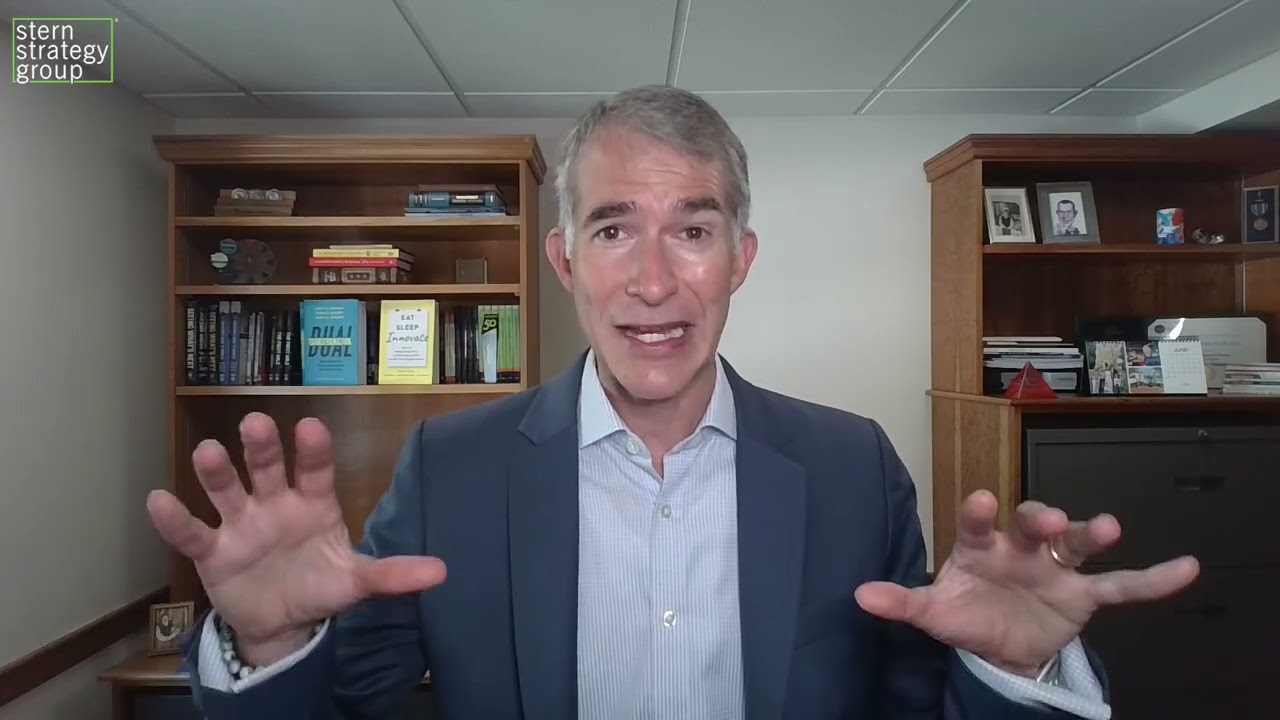
Behind me here, if you see on me, Dual Transformation, the book you co-authored with Clark Gilbert and Mark Johnson. You talked in that book about the concept of avoiding the sucking sound of the core. And you alluded to this there where you were saying that the government, and I don't know whether this was wittingly or not, made the incumbents create a separate division. And by doing that, they provided them a way to create a new business model, et cetera. This is an absolute core concept to the theories of disruption because you have to do this in so many cases. It's very unlikely that you will succeed if you're an incumbent, particularly a powerful one with a legacy business model. I'd love you to share this, Scott.
Clay would always say that the worst place to create a new business model is within the existing business model. And it's true. Because if you've got a good successful business model, you want everything to look like it. I remember as an example of this, when we were consulting to newspaper industries a couple decades ago now, the newspaper industry in the US was a very quirky industry. You had printing presses, people would print newspapers, you would have a local monopoly again basically because it costs a lot to build a printing press, and the newspapers would make basically all of their money from these little text ads in the back of the paper called classified ads. Now, these, these ads, it was just a, a business model that you can't believe, like 90% margins, cash raked in. The problem for the newspaper industry is they would ask the question, as the internet emerges and it's clear this business is going to die, what can we create that looks as good as this business? And the answer is, never in human history has there been a business that looks as good as this business. Nothing will look as good as this business. But when you're comparing it to what exists and you're doing it with one, with what exists, every marginal resource allocation decision you make goes to yesterday, not to tomorrow. You create the space where you say, okay, we got a blank piece of paper. Something is better than nothing. Go and create something. When you're comparing it to nothing, something looks good. When you're comparing it to a lot, something looks bad. So that ability to create the space where people have the ability to maybe go and do something different without all the burdens of the past—that's what allows you to break free from the sucking sound of the core. Now, one last thing: it gets tricky, but the magic is you don't want to go too far away because then you're competing against pure-play startups. That's a really hard battle to win. What you want to do is find a way to fight unfairly. Say we have. We have some precious, unique capabilities that few other organizations in the world have. We want to smartly, selectively, surgically leverage those things so we have a leg up over any startup without succumbing to the sucking sound of the core. That's the magic of dual transformation. Not easy to do, but when it works, it's an incredibly powerful thing.
There's another key term you said there, which is the term capabilities. We mentioned in the introduction how an organization will usually react when it's too late. So the horse has bolted, maybe the horse is well gone, the race is over. And what often happens because that new entrant comes in for a long time, it's really struggling at the bottom of an S-curve, if you think about it that way, really, really working hard, but builds these capabilities that are often intangible capabilities. And then the legacy incumbent organization doesn't have those new skills or capabilities. And then when they fight on the same territory, there's an asymmetry of skill sets or capabilities. And this, again, one of the core lenses that I learned from reading all this work.
Yeah, absolutely. And it's a good moment to give a shout out to somebody who influenced Clay when working on the Innovator Solution. and seeing what's next. Ron Adner, who now is a professor along with me at the Tuck School of Business at Dartmouth, his doctoral research looked into this idea of asymmetries, which is a really wonky word. But the basic idea is you have something that looks one way to one company and another way to another. It looks attractive to one and unattractive to another. So an asymmetry of motivation says this market is good for me and bad for somebody else. I want to go after it. They want to leave it. The steel mini mill example is one of the prototypical examples of this. The steel mini mills wanted to go after the exact market segments that the integrated mills wanted to leave. Great asymmetry of motivation. The asymmetry of skill. I think a modern example of this and something that's kind of controversial within the disruptive field is Tesla. The reason why Tesla is controversial is it doesn't feel disruptive through Christensen-style disruption. It does not start with a simple, cheap product. It starts with a very well-engineered, reasonably expensive product. You could argue that the government plays a big role in this. There's big grants that are given to Tesla. There are things that are given to consumers that make them want to preference electric vehicles and so on. So you've got some market distortions there. But I think the thing that sometimes the disruptive field misses is what's really different about what Tesla has done is the way that it has re-architected the value network, the way that it has fundamentally changed the business model of selling and distributing cars. Goes out without dealerships, so you don't have a third party that's distributing cars. It's a Tesla-owned place that does it. And critically, because it starts with an electrical-first mindset, it does upgrades over the air via software versus doing it in the factory via hardware. That is a very asymmetric set of skills that Tesla has built, having an integrated value chain and having a different mindset in ways that it does upgrades for cars, that despite all the money that the automakers are throwing at the problem, they still haven't figured out how to address this because Tesla's now had a good long time to hone that asymmetric skill that makes it very hard for people to respond. So it's in the value network, it's in the business model, but you have at least some seeds of a very disruptive approach from Tesla.
It alludes to another aspect, Scott, where you talk about this a lot and it's probably more a cultural one. And the cultural one is, well, how are individuals within the organization motivated? Because they're motivated by the way they make money today and the recognition of how they make money today. The decisions they make, and this is the whole concept that Joe Bauer talks about of resource allocation. So where do I allocate or where do I place my bets? Because I don't want a blemished career, so I don't want to make poor bets. And you, in the chapter called Signals of Change, you recognize some signals that organizations can spot and then the actions they take. So oftentimes they use it what you call the tail of the tape, which I love that concept, and then the sword and shield strategy as well. These are, again, big concepts. Please take it whichever way you like.
Yeah. So, let me talk about signals of change first because this is something we have, I think, advanced quite materially since the book came out. So, the question is, where do you essentially or how do you see the early warning signs that suggest that disruption is afoot? So, we spend a lot of time in the book saying, How do you spot signals that customers are overshot? And there are things that are in plain sight if you choose to look in the right sort of way. So when you see margins begin to level off, if not decline, when you see people paying decreasing price premiums when you introduce a new product into the market, when you see signs that suggest in kind of wonky economic language that they're deriving lower marginal utility for new benefits that are provided, when their loyalty is beginning to decline, when they're beginning to experiment with new things. All of those are early signs that suggest overshooting is at work. And that's one thing that as we've continued to advance in the book, The Innovator's Guide to Growth, Little Black Book of Innovation, Dual Transformation, they're all things that we have further advanced. What are specific analyses that you can do to give you a greater understanding of do these signals exist? The earlier you spot them, the better you are if you're the incumbent. It suggests you need to start playing the game differently. If you're an attacker, you say, this is a market that I can then go after. The other things that we then talk about in, in dual transformation, which is the most advanced view of the early warning signs beyond that signal that suggests customers are ready for something different. Are venture capitalists investing money into the marketplace? Are we seeing entrants in the parts of the market where disruptors tend to come, the low end or at the fringes? Do we see signs that somebody has a different business model? As Clay would teach all of us, the essence of disruption is not the technology, it's the business model. When you see people with new business models, that's a real sign that change is coming. And then finally, do you see the signals of change in the financial statements of the incumbent? This is where it gets a little tricky because in the early days of disruption, those signals can appear positive. You can have profitability going up when disruption is afoot because what ends up happening is the least demanding, least valuable customers are the ones that are being picked off. The incumbents' margins go up. The revenue growth might begin to slow, but that's fine. They can handle that. They go and cut costs so everything looks good financially until it doesn't. So those are the early warning signs that we think about. Again, it's documented more for those who are interested in dual transformation and other places. So, I'll pause there to see if there's any concept there you'd like me to say a little bit more about before I talk a little bit about the tale of the tape that we had in seeing what's next.
I love that, Scott. Brilliant examples. Maybe we'll couch that first before we go tale of the tape and the sword and shield in some modern-day examples because you work with a lot of modern-day organizations. I know you can't talk about them all. Maybe you'll give some examples of When I often thought about it as a tsunami, that there's a change in the water and there's almost a swell before the tsunami comes and hits. And this is what happens to organizations. They think it's great. And you see this all the time in the stock prices. There's this great— and all of a sudden the stock just absolutely plummets and they go, we didn't see it coming. But there was signs for that change coming for a very long time.
Absolutely agree. I mean, I don't wear glasses anymore. I have contact lenses. But the disruptive innovation diagram is kind of etched onto my contact lenses, which is probably even worse than being etched onto glasses. So you see the signs everywhere. But I think one place that's interesting that I can talk about because we wrote about it in an article early 2022 called Persuade Your Company to Change Before It's Too Late. It's about KWM, King& Wood Malleson. It's the Australian arm of a global law firm. Yeah. The legal services industry is interesting. Right as the article came out, there was an article in The Economist that said, basically, this is the best of times for law firms. The world is getting complicated. The big law firms are getting bigger. Record profitability. We have an article in the Harvard Business Review where we make the case that law firms are being ripped apart and they need to radically transform. Who is right? Who is wrong? Over the long run, we think we are, but, of course, time will tell. The reason why this is interesting to think about is you talk about the warning signs that I talked about. What are you seeing with clients of law firms? They're more demanding. They're building up their own general counsel, their own legal practices. They're disaggregating the work across a bunch of different lawyers. They're asking for new forms of contracts. Very clear signs that what customers are looking for is changing. Venture capitalists have invested a lot of money in legal tech startups. Some of those are things that can help lawyers, but some of those are following really competitive models to what lawyers are doing today. Do we see new business models? Absolutely. One of the things that's the biggest potential threat to big law firms is the legacy accounting firms. People like Ernst& Young and KPMG have said, hey, the margins that the lawyers make, those look a lot nicer than the margins we make. Let's pick up this technology. Let's go and get some of that business. Asymmetric motivation. The lawyers have no interest in going into accountancy services. It's kind of beneath them, for lack of a better phrase. So you have a classic disruptive circumstance. And then financially, how does it all look for the law firms right now? It looks great because they're having some of their business picked off, but they're replacing the low-end stuff with the high-end stuff. So we've seen this movie before. You've got some law firms like King& Wood Mallesons that are doing really smart things, that are investing in new disruptive technologies. creating new digitally infused practices and so on. You've got others that are not. And again, there's no plot twist in this movie. We know how it ends.
I often think about that where you're literally captive to your customers. You're captive to the customer because everybody's rewarded and recognized for overserving those customers. And I've seen this. I've worked in an organization, in a media company, Scott. So, I experienced this firsthand. where I was the digital team and we got really excited about small revenues. So we were like, oh my God, this is great. We've made money from this. We've made $50,000 this year. Hooray. And the organization doesn't even blink an eyelid. In fact, the way they looked at us was we were a distraction or a toy and we were dismissed within the organization. And even though we existed slightly on the periphery, But then in time, what happened was the existing sales teams became almost corporately jealous or envious of these revenues that we had. And then they start to merge them together and bundle them and cannibalize the new revenues at the expense of the old revenues, which essentially fizzle away over time. And ultimately, at the end of it was commission, because these guys were rewarded and recognized on their sales of existing revenue on existing products, and we weren't. And we had just this massive motivational issue. And I'm sure you've seen this time and time again.
100%. And I think I would add to that, as I've now been studying the dynamics of change at a deeper level over the last few years, it's part of the academic part of my portfolio. Portfolio now to really understand the hidden human dynamics and so on. It gets even harder. You know, Brené Brown from the University of Houston says that the biggest shame trigger is the fear of being made irrelevant. And what you see behind so many of those stories is there is an identity that somebody has that the change that you are proposing—the new digital team, the new disruptive team—in essence invalidates that identity. So people come up with all sorts of rational reasons why they don't want to do it that might be couched in incentives or financial. financial things, et cetera. But, what's really behind it is they're afraid that the game is going to change and they're not going to be able to win the new game. Think about the lawyers for a minute. No one would say exactly what I'm about to say, but the people who work at places like King& Wood Mallesons and other global law firms, they're really smart people. They're people who went to the best legal training programs, the best schools in the world. Their mindset is it's the dumb lawyers that have to use technology. I am hired because of my brain. Imagine a world where that brain is no longer the competitive differentiator, but it's your ability to code instead. How does that feel to somebody who spent 10, 15, 20 years where their brain— they've been the smartest, literally the smartest person in the room. Everything has reinforced that. Say, hey, here's some great news that no longer matters. You're gonna use this technology instead. Oh, well, my client could never use it and our margins are, Yeah, yeah, yeah. All rational. But what's really behind that is they're afraid. And you see this play out in lots of different ways and places. It's almost like there's a ghost that lurks in the hallways, a ghost of the future that people just don't want to recognize and address. It's deep stuff.
We try to drive change from a mechanical perspective with strategies, new business models, and it's the mental models, it's that biases that are behind it. And as you said, shame is a huge part of it, and fear ultimately the foundation of so much of the resistance as well. We could do a whole show on that, but let's get back to the tail of the tape and to the sword and shield. I love these concepts and I love how you couch them in these really visible images as well.
So, tail of the tape, basically the idea is if you've got 2 competitors that are fighting it out, you've got the incumbent and the disruptor or the would-be disruptor, how do you know who's going to win? Well, If you're gonna go and watch a boxing match, which I'm not a huge boxing fan, but whatever, they, the metaphor holds. They have a simple tale of the tape. You know, how tall is the boxer? What is their reach? What is their record and last matches, blah, blah, blah. And you look at it and you got a pretty good view. Okay, this person's much bigger. This person never loses. All right, I know who I'm gonna bet on without knowing anything else about the boxer. So the idea of the tale of the tape is how do you do that in a disruptive circumstance? Well, back to what we talked about before. You want to think about the resources, processes, and values or priorities. You want to know what are, are the skills or capabilities that an organization has? What are the motivations that they have? What looks attractive? What looks unattractive? And then you start thinking about the flip side of that, the sword and the shield. The shield is what we called asymmetric motivation. When someone takes advantage of that asymmetry, saying this thing is valuable to this company, it's not valuable to this classic example in the past couple decades. Is Netflix introducing its subscription model, doing something that Blockbuster had no interest in responding to because it would require Blockbuster to destroy its major profit driver, the charging of late fees for people who had a videotape for too long. So Netflix classically hid behind the shield of asymmetric motivation and then builds the sword, builds a capability as it builds up the network capacity to seamlessly and easily deliver movies on demand, shows on demand, demand to hundreds of millions of people globally that by the time Blockbuster says, we got to do something about this, it can't match Netflix. It can't match Netflix offline. It certainly can't match Netflix online. So that's the basic idea of the tail of the tape and the sword and the shield.
You mentioned a great example of Netflix, and this is important to understand for entrepreneurs and new entrants, is that you don't want to give away too much what you're doing. You don't want to make that too public and almost like a bait and switch. Yeah, we're working on this It's of no interest, nothing to see here. And meanwhile, you're building those capabilities or a technology behind the shield, as you say. Maybe again, you might give us some of the modern-day examples that you've stumbled upon in your research and your writing.
I go back a little bit to Tesla, which we talked about before. So, I won't go into that in too much depth. But I do think that if you look at some of the things that are interesting recently in some of the tech areas, you look at Amazon, Amazon is a very good example of this where Amazon's big profit driver today is cloud computing. And cloud computing started out in a classic disruptive fashion. Amazon had an internal problem. So the problem internal at Amazon had is its IT systems were working too slowly. So Jeff Bezos commissioned a team to work on it. The team solves the problem and then says, my goodness, we've got something that we might turn into a commercial entity, something that allows people to rent computing capacity on demand. We call this cloud computing today. So, it's something that then goes into the market, not going after big mission-critical applications in the beginning, but in classic disruptive form, going after smaller organizations that don't want to build fixed infrastructure. And as you said, Amazon basically says, nothing to see here. Don't worry about it, big IT companies. We're not on your territory, blah, blah, blah. And it's getting better and better and better to the point where it can then go to mission-critical applications with something that is both more affordable and more customizable and higher performance. And today it's minting money offering this service. So a recent example of somebody that went into a market that didn't exist, took advantage of asymmetric motivation because big players weren't interested in it. It was happy with something small in the beginning because it had nothing. It was managed in the right way by Bezos and team by being kept separate from the rest of Amazon. And here we are today.
Yeah. And it's such a great example. You said it there, the small revenue, it's exciting because it had nothing to compare it against already, which is such an essential concept to grasp. There's another important aspect, and this is where you're an incumbent. Or you're an entrant and you understand how an incumbent is going to react. These are response strategies by incumbents. I'd love you to take us through some of those because there's fight or flight, there's seed, there's co-opting. There's a few different strategies that an incumbent can take. And you give a lot of research behind this in the book, but maybe at a high level, you'll take us through these.
Yeah. So, you know, it gets back a little bit to the idea of asymmetries that we talked about before. So, you know, the fight or flight, you can predict with high degrees of certainty if you go after a market that matters to a mainstream incumbent, if you try to target a customer that matters to them, they're gonna fight for it. Uh, we saw this again, a controversial example within the, the disruption literature. You look at Uber, when Uber gets started with Uber Black, what now called Uber Black service, Going after a demanding tier of the marketplace with a premium offering, predictably everybody tries to respond to it. They struggle for lots of reasons which we could talk about separately, but it was very predictable that people were going to try to respond. You can predict that people will flee when you take advantage of an asymmetry, when you go after a market they don't care about or a market that they're not really in. So that's the first thing. Is the incumbent going to fight or not? The very simple question is, Are you treading on their turf or not? Are you going after something that matters to them or not? Do they have space? Are they in a business where there's more attractive things for them to do upmarket? One of our observations about the communications industry is when you are in a business that is a high fixed cost business that you have to amortize, spread over as many people as possible, fleeing is not a viable option because you need to be able to serve everybody. So that changes the dynamics in the industry. So you've got that as one thing. Then the next thing that you think about is if the incumbent is going to try to do something, what are they going to do? So the idea of co-option is a really important one, something that we introduced in Seeing What's Next because we hadn't really studied— Clay hadn't really studied that before. The idea is if you look at the disruptions that historically have been most successful, they have built what's known as freestanding value networks or value ecosystems. So, they go like Tesla and create their own dealers. They create their own routes to market. They have their own suppliers. They have their own marketing. It's almost like they exist in a parallel universe. If you're in a circumstance like wireless technologies were, where you're going and having something that exists within an established infrastructure, where you're using an existing network, where you've got to be cross-compatible and so on, you create the conditions where the incumbent can say, I see that. It makes sense. I might have to play a little bit with pricing and margins and so on, but I can easily take this and slot this into what I'm already doing. They can co-opt the innovation and have it as part of their overall portfolio of things. Ceding obviously is you give ground to the— but the co-option option is something that exists when those value networks are interdependent. Where do you see this today? I think financial services is a very clear example of this. I think you have a lot of fintech companies that are very understandably doing things that are operating on global payments networks, are working in ways that are compatible with what exists. That makes it pretty easy for JP Morgan Chase or Barclays or whomever to say, yep, thank you for proving that market exists. I know how to run scale businesses. I would now very much like to add this to my platform. So I think it'll be interesting to see if we do enter into a recessionary period. What happens to a lot of the fintech companies? I would predict a large number of them will end up being swallowed up by mainstream incumbents, but we will see.
There's 5 pieces of advice at the end of the book, and there's one that still raises its ugly head today. But I thought we'd take them one by one, and I'll start with number one, which is don't be threatened by someone countering your insights by referring to unassailable data. This is prevalent in so many organizations.
The simple thing that we remind people of is unassailable data, and Clay, of course, would talk about this quite extensively, only exists about the past. When you are looking into the future, you have hypotheses, conjectures, assumptions, et cetera, et cetera. So, the question then we ask people is, where did the data come from? What are the assumptions behind the data? What are the things that we're not sure about? Anything that is forward-looking, anything that is forward-looking has assumptions in it. When the discussion's about the assumptions and the mental model or theory that you're using to make sense of those assumptions, you have a much more productive discussion. It's not an either/or, it very clearly is an and.
And that links us nicely to the second one, which is the data and the theory are not foes.
100%. So what theory does is give meaning to data. What theory does is allow you to take early evidence and be able to make predictions around it. I'm a big believer in essentially Nate Silver in The Signal and the Noise talks about Bayesian philosophies for how you go and make predictions about anything, which is you make a prediction for everything. And theory, theory allows you to make a prediction even in absence of any data. You say, I've seen this before. This is what theory would suggest happens. Data begins to come in and you say, all right, I thought this would happen. Am I more or less certain based on what the data is? Do I see something different through the theory? Is this potentially what Clay would call an anomaly, something that doesn't fit? Did I use the wrong theory? Do I need to shift it? But that idea that you use theory to make the prediction, the data comes in, you update the prediction. I mean, this is the way scientists make decisions. Business people need to do the same thing as well.
That one, Scott, I'm just taking a little sidestep apart for the moment, is one that I don't understand when an organization, maybe suffers from the hot hand fallacy where it's had success in the past and then tries to use that same model of success to try and compete today when the world has entirely changed and are resistant to new models, new thinking models, new theories, et cetera. Yes, they might look at the data, but they ignore the new ways of looking at things. And ultimately this leads to disruption in so many organizations.
100%. So, you know, if I geek out academically for a minute, there was a theory posited in 1965 that just like when a duck is born, what they first see imprints on the duck, that organizations have moments of imprinting where something happens in an organization and it becomes so ingrained in the organization they can't see it. So what I tell organizations to do is go back to day one, and day one might be the literal foundation of your organization. Or it might be the moment you came out of crisis or whatever. That which happened there creates an ingrained pattern that you will follow forever without you being conscious of it at all. And that's what's behind a lot of this. There is something that organizations do completely unconsciously, which is try to replicate the success formula, try to use the superpower that came with that origin story without recognizing there's a shadow to that as well.
It links back to what you said about Brené Brown as well, about this shame over relevance. And I often think about that. If you're a leader of an organization, you got there based on the way things used to be, but you're only going to actually survive into the future if you keep updating the lenses, the theories, et cetera, and keep adding to them, which is again why I wanted to revisit this work, because it's still so relevant. And speaking of relevant, One of the next points is that everything is relative.
This is something that Clay really hammered home when people said, okay, well, the internet has come in the late 1990s, it's disruptive. And Clay said, well, it is disruptive to some, but it is sustaining to others. So, is something a good product or a bad product? Well, it's relative. It depends on the job that you're trying to get done. It also depends on the circumstance. There could be some circumstances where you're delighted with something that's simple because it's there, and other circumstances where you're super frustrated by it. So you always want to look, what is the circumstance a customer is in? What is the circumstance that an organization is in? When people make broad proclamations that says this is good or this is disruptive without doing that double-click to say relative to what, relative to this job, relative to this problem, relative to this circumstance, relative to this business model, They've skipped an incredibly important step.
The next one then is a very cultural one as well. And it's one we see so many times where you have innovation theater in so many organizations. And I also think about culture as well, where there's a great saying that you can measure the culture of an organization not by the words on the wall, but by the behaviors down the hall. And in the book, you talk about point 4, As the importance of actions, not announcements.
We've had some hero worship during this discussion. Joe Bauer, of course, is the intellectual father of a lot of this work. The idea of the resource-based view of the firm, the importance of resource allocation. The thing that this really drilled in my head is very simple. Strategy is not what you say you do. Strategy is what you actually do. It's where you're spending your dollars, your euros, your rupees, whatever. And perhaps even more critically, it's where leaders are spending their time and where leaders are spending their energy. There's an organization that I'm in a conversation with where their innovation team has said, we'd love for you to meet our CEO because they're extremely excited about innovation. I'm like, awesome. I would love your great, interesting company. Would love to meet your CEO. And they said, okay, well, over the first 16 weeks of next year, the CEO— and I'm saying this, we're recording this at the end of 2022. It'll probably air in 2023. So I could also say the first 16 weeks of this year, there's a 2-hour window that the CEO has to talk about innovation. Does the organization care about innovation? There's not a question about that. They don't at all.
It's funny because I thought about that with Andy Grove when he met Clay, and Clay tells that story. He's kind of going, we had an hour slotted for you. You now got 10 minutes, kid. It's the biggest challenge, isn't it? Trying to get those who make the strategic choices for the organizations, their availability is so, so important. And this leads nicely to the last point, which is remember that choices matter, but only up to a point.
And the idea here is that as you start talking about organizations, we're not at the level of Newtonian physics where things are deterministic and there are laws of nature that are fighting against. These are complex, adaptive organizations that have agency and the ability to do things. Incumbents can respond to disruption. Incumbents can make disruption a really good thing for them. You have the ability to defend, to attack, to do different things up to a point. The up to a point means, at some point, it's too late. At some point, you're fighting too much of a battle. At some point, you have lost the opportunity to do it. Some of the early choices you make, therefore, are so critical because they send you down a path that sometimes is hard to reverse. Jeff Bezos from Amazon likes to talk about 2 types of decisions. You've got type 1 and type 2. Type 2 is a 2-way door. You can reverse it, so whatever. Do those quickly because you can undo it. Type 1, it's a one-way door. Those you have to really carefully consider and make sure you get right because you can't undo them. So those sorts of things be really considered about. But a lot of things in life, people just take too long thinking about it and therefore end up in a circumstance where they then face this thing where they've gotta do this huge thing because they made it too hard on themselves.
I wanted to give you an opportunity to finish the, the show. Maybe you wanted to say a final word about Clay or something like that.
When we're recording this, it's been almost 3 years since Clay passed away, and I, I just think about him all the time, just the influence that he had on me as an individual, on InnoCite as an organization, on thousands, tens of thousands, hundreds of thousands of professionals, and even more people around the world. And you just can't help coming back to his humanity and his humility and what a good person he was. I'm in my office here at InnoCite. I have actually right behind me, I have a note that he wrote. This is to my colleague, Mark Johnson. This is in 2003. I had just joined InnoCite. It was a young organization. Maybe struggling a little bit to pay its bills. We had these laptops that were just horrible laptops. And Clay wrote Mark this note in the middle of a meeting. I just made a unilateral, irrevocable decision to give a notebook computer to each member of the InnoCite staff who was saddled with an ailing VAIO model. Let's take it out of my fees for this week. If I don't see the money, I won't miss it and won't pay tax on it. CMC. And it's just, you know, just that little thing. It's just who Clay was. You know, he saw a problem and he just wanted to help. He wanted to help everybody. And, I'm just so incredibly proud as an individual to carry the torch that he lit. There's much work still to do and it is my life's work to bring that torch to as many places as I can.
Scott, for people who want to get in touch with you and find out about what you're up to today, where is the best place to find you?
Yeah, I hang out on LinkedIn more frequently than anywhere else. So, if you go find Scott Anthony Insight or Scott Anthony Talk at LinkedIn, you will find me. There's Scott Anthonys in the world, so you don't want to get confused by them. But yeah, and the InnerSight webpage is always a good place to go to as well.
Scott, it is always a pleasure. I look forward to doing more in the future. I still have some books to get through here behind me, some of your books, and I really enjoy your work. I enjoy everything you do and your generosity of spirit. It's certainly that Clay spotted something positive in you, and it's always a pleasure joining you. Co-author of Seeing What's Next, Scott D. Anthony. Thank you for joining us.
Thanks again for having me.
That's the book. That was the man, Scott Anthony. And I want to thank our sponsor, NextEstate, before we finish up today. NextEstate is an English-speaking specialist in buying, selling, and managing of properties for the German market. They're based in Berlin, and you can find them at next-estate.com.
More from Scott



What the Printing Press Really Teaches Us About Innovation with Scott D. Anthony



Scott Anthony at Creative Innovation 2013 Asia Pacific (Ci2013) - "The Empire Strikes Back"