In this talk, Scott D. Anthony, clinical professor of strategy at Dartmouth’s Tuck School of Business, uses his book Epic Disruptions to illustrate how historical case studies can illuminate the dynamics of modern disruptive innovation. He frames disruptive innovation through the lens of Clayton Christensen’s theory and then adds a second lens—history—to extract timeless lessons. Four historical narratives are examined: 1. The evolution of gunpowder from alchemical curiosity to a military breakthrough, highlighted by Joan of Arc’s outsider perspective, which he likens to today’s “blank‑sheet” AI innovators. 2. Florence Nightingale’s 19th‑century health‑care overhaul, emphasizing data analytics, striking visualizations, public communication, and the creation of a teaching hospital as a model for system‑level change in modern smart‑health. 3. Henry Ford’s Model T rollout, illustrating the “messy middle” of disruption, the unintended urban chaos it caused, and the subsequent emergence of norms, traffic infrastructure, and regulation—paralleling the challenges facing autonomous vehicles. 4. The Apple iPhone’s 2007 launch, where Steve Jobs misidentified the killer app (phone calls) and initially kept the ecosystem closed; only after market pressure did Apple open the App Store, a lesson about the danger of over‑confidence and the power of open ecosystems for emerging tech like AR/VR. Anthony concludes by urging leaders to watch history for these patterns—blank‑sheet innovators, data‑driven system change, the need for norms and regulation, and ecosystem openness—as they navigate AI, autonomous vehicles, and mixed‑reality technologies. The talk blends narrative storytelling with analytical insight, positioning historical lessons as urgent guidance for today’s disruptive moments.
Chapters
TranscriptAuto-generated · 13 min
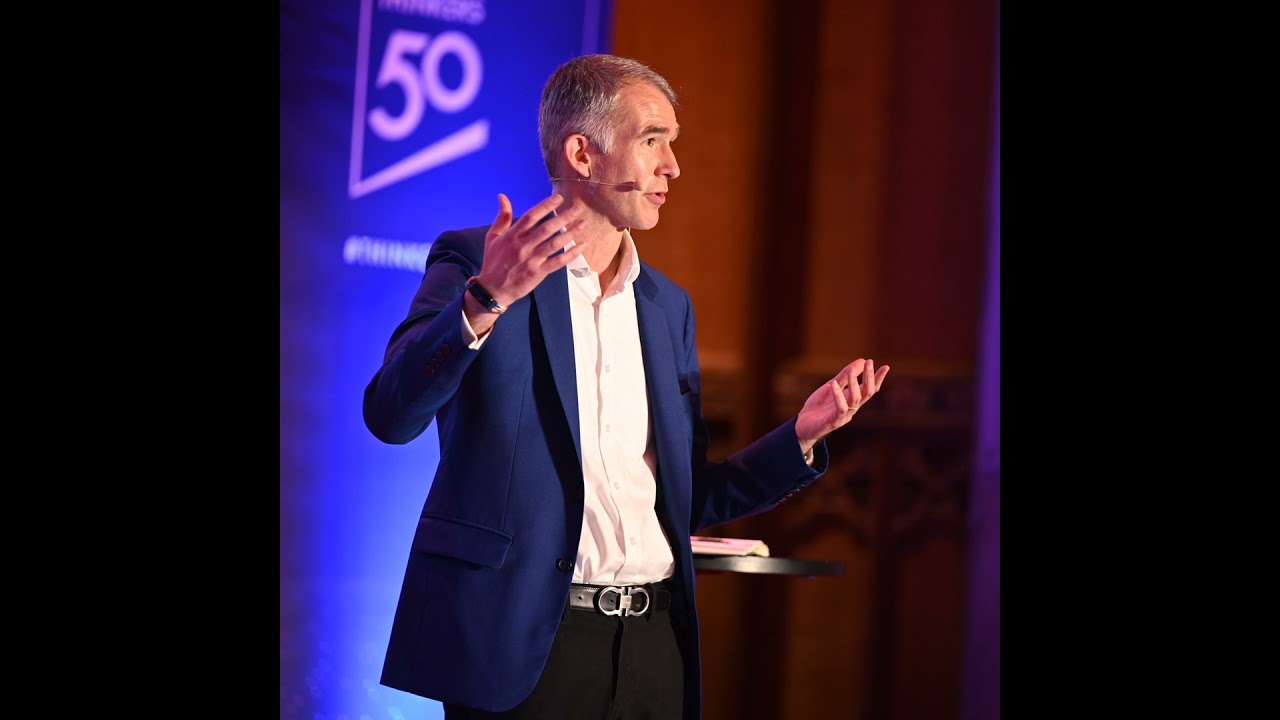
I'm Scott Anthony, a clinical professor of strategy at the Tuck School of Business at Dartmouth College. And what I would like to share with you today are lessons from my recent book, Epic Disruptions, that I want to use to go and interrogate some of the big changes that are taking place right now. You, of course, know the idea of disruptive innovation traces back to research done by the late, great Harvard professor Clayton Christensen. Who throughout my career I had the great privilege of calling my teacher, my co-author, my colleague, my mentor, and most importantly, my friend. One of the great lessons that Clay taught me was the power of using business theory as a lens, a way to look at the world and see things that you would otherwise miss. In Epic Disruptions, what I do is I use history as another lens. Try to go and investigate timeless stories that provide fiercely urgent messages for the moment that we are in right now. I'd like to share with you a few of those stories and a few of those lessons. Let me start at the start. The first chapter of the book focuses on gunpowder. The way that I set it is you're set in 1453. Imagine yourself as being inside Constantinople, As an army approaches, you're probably feeling pretty safe because you have been protected for more than 1,000 years by the Theodosian Walls, 2 sets of walls surrounded by a moat. Those walls worked brilliantly before. 142 AD, that is the first reference you can find of someone combining saltpeter, sulfur, and charcoal in a particular way to create what we now call gunpowder. Imagine how it felt. You're sitting in Constantinople. You're behind walls that had stood for more than 1,000 years. A half-ton cannonball flung out of a cannon like this one over a distance of a mile hits those walls. The walls shatter. The city falls in 47 days. The part of the story I really want to focus on is the path from 142 to that military moment. It takes about 1,200 years before gunpowder is used for military purposes. At first, people are experimenting with elixirs to elongate life, and magicians are using the smoke that comes when you mix those ingredients together to dazzle audiences. In the 12th and 13th and 14th century, people say, okay, if we combine these together and put them in a vessel with a projectile, We can do something pretty interesting. One seminal figure in all of this is Joan of Arc. She comes up with really inventive ways to use gunpowder for military purposes. Why? Well, she was a peasant. She didn't have preconceived notions of how military functioned. She could mingle very easily with the gunners that were working on the technology, which gave her insight for how to do things in new ways. I pause at this because I wonder the exact same thing about artificial intelligence today. Many organizations are saying, how can we bolt artificial intelligence onto what we're doing right now? Sensible enough thing to do. But what are the modern equivalents of Joan of Arc— hopefully they don't end up getting burned at the stake— that are thinking about really invented blank sheet paper ways of approaching AI, building entire enterprises completely new ways because they don't have to— they don't have to unthink the old ways. That will be the thing that history shows will really drive the widest disruption. Let's fast forward a few centuries. This story is set in the 19th century. It focuses on Florence Nightingale. Now, you probably think of Florence Nightingale as being a kind, caring nurse, and she absolutely was that. But she also teaches us about what it takes to drive system-level change. Let me tell you a short version of her story. Florence is born in 1820 in, of course, Florence, Italy. In the 1830s, she tells her parents that she has received a call from God to go and enter nursing. Her parents are not happy about this. At the time, nursing is a lower-class profession. But Florence persists. She gets trained in modern-day Germany. In the 1850s, she is sent to serve in the Scutari Hospital in modern-day Turkey as part of the Crimean War. What she sees there astonishes her. The conditions in the hospital are horrible. People are dying needlessly of infectious diseases. She sends a telegraph back to London. A team of physicians and clinicians come to clean up the hospital. And conditions markedly improve. She returns back to London and meets with the Queen, who puts her on a royal commission to go and evaluate the state of hospitals in the military. Nightingale then does 3 things to drive disruptive change. The first was work that she did with William Farr from the General Registry to do big data analytics and visualization. Of course, didn't call it that at the time, but that's what they did. They went and crunched the numbers and came up with compelling visualizations like the one that you see here, known as the polar area chart or the rose diagram. Once you see this, one historian said, it's interocular. It hits you between the eyes. You can't unsee it. Read the chart like a clock. Start on the right side of the page, start at about 9 o'clock and move clockwise, then move to the left side of the page and do it again. Each of the wedges represents something different. The blue wedges are people who died from infectious diseases. The light pink wedge are people who died from wounds on the battlefield. The black wedge are people who died from all other causes. What you see here is in the early stage of this diagram, the worst place to be was not on the battlefield, as bad as it was. It was inside the hospital where people were dying from infectious diseases. And it shows that if you go and intervene and clean things up, things get a lot better. Error number 1. Error number 2. Florence Nightingale wrote. She wrote the book Notes on Nursing, not aimed at experts, but in classic disruptive fashion aimed at laypeople, giving them the tools to practice good nursing standards at home. Error number 3. Teaching. Florence Nightingale got a huge amount of donations as she became a popular figure. She used those donations to open the world's first teaching hospital for nurses, taking a profession that once was lower class and not very standardized and bringing professional standards to it. Nightingales then flew all throughout the world. In today's world, a number of people are working on smart health solutions, things that are based on decoding the individual genome or using smart connected devices powered by AI. Nightingale teaches us if we are to have system-level change, we can't do a thing. We need to have data and visualization and a message and training and teaching if we're going to have the kind of change that the world's healthcare systems so desperately need. We saw this in the 19th century. It's just as true today. Story number 3. Let's fast forward to the 1920s in the United States. Henry Ford had done it. He had achieved his vision: the car for the multitudes. Henry Ford shows us the power of persistence. The car that did this was the Model T. Before that was the Model A, B, C, D, dot dot dot dot dot. It took time before Ford could crack the problem. In fact, when the Model T first came out in 1908, it did not deliver on Ford's vision because it cost $30,000 in today's terms. It required all the things that, you know, the assembly line, raising wages to decrease employee turnover and make sure employees are more engaged before the price tumbled down to $5,000 in today's terms by 1923. Ford had done it. He had achieved his vision. That was good for some, but one recurrent lesson I learned in my study of disruption is disruption always casts a shadow. There is a dark side. There is a downside to it. The shadow of Ford's Model T is the cities in the United States and beyond were not built for cars. They were built for pedestrians. They were built for horses. And chaos and sadly carnage began to come to those streets. The middle of disruptive change is always really messy. How did we get out of the messy middle of the automobile era? Well, a couple things had to happen. We needed to have technologies like traffic lights. We needed norms. When you had 2 cars get to an intersection simultaneously, who goes first? We needed to have regulation, things like driver's license and rules that were in place if people drove too fast. I think about this as I think about what is going on now with autonomous vehicles. There's a lot of work on the technology, and that work is really powerful. But for autonomous vehicles to have the kind of impact that people think they will have, there needs to be norms, there needs to be regulation, or we're going to get stuck in the messy middle of disruptive change. My 4th and final story— well, you can't write a book about disruptive change and not have something about Apple. I decided to have something in the very last chapter focused on the Apple iPhone. What else is there possibly to say about the Apple iPhone? Well, there was something interesting that I uncovered in my historical research that I had completely forgotten. People paint a picture of Steve Jobs being this massive visionary, this person who could see where other people couldn't. And there's a lot of truth to that. But one of the things that history also shows is even the smartest, even the most visionary people are are often dead wrong when disruptive change strikes. In 2007 at Macworld, Steve Jobs introduced the concept of the iPhone. He was asked, what is the killer app? We know the answer to that question today. It's the ability to have a personal computer and the internet in the palm of your hand, all the great apps that would follow. But that was not the answer Steve Jobs gave. He said, well, it's a phone, of course. The killer app is the ability to make and receive phone calls. Most phones aren't very good at doing that. He was dead wrong. Remember, the first version of the iPhone, which had reasonably disappointing sales, had no App Store. There were 16 apps that were locked onto the phone, and that was it. It was only when sales were moderately sluggish and people put pressure on Jobs to rethink his view of having a closed ecosystem that he relented, opened up, and history unfolded. I think of this as I think about what's going on now with virtual, augmented, and mixed reality. There have been fits and starts— Google Glass, Apple's own Vision Pro, the Meta Oculus viewers— and we haven't broken through yet because we're still trying to figure out what exactly will be the thing that is the unlock. History teaches me it is hard to see in the moment. We have to watch and wait, and when it appears, it becomes very obvious But the experts who tell you convincingly they know what it is, they're very likely to be dead wrong. History is such an important guide. History can teach us lessons that are hard to spot otherwise. One of the things I enjoyed so much from doing the research and writing of this book is I have found the stories to be timeless. There's something special about a great historical story, but the lessons feel fiercely urgent in the disruptive moment that we are going through Right.