Daniel Priestley: Roadmap to a Multi-Million-Dollar Business
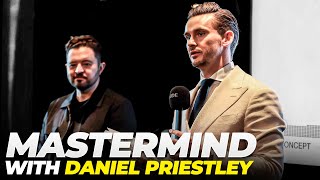
Daniel Priestley explains how to build a multi-million-dollar business by treating your team as an engine, validating demand before hiring, and scaling in steps from two to eight people. He runs nine companies and uses waiting lists to de-risk new hires, with repeatable playbooks so a small team runs itself.
Questions this video answers
February 26, 2024.
Nine active companies.
About 2% buy within the first six months.
One on track for a $100 million exit; another on track for a $35 million exit.
An eight-person team.
Chapters
In today's video, I have a very special guest, the one and only Daniel Priestley, serial entrepreneur. And he actually spoke recently here in Dubai at my Elite Mastermind. So it was an awesome event and I'm going to be sharing behind the scenes footage with myself and Daniel and I hope you enjoy it. I think it came, as you'll see in the video, it came full circle in terms of when I followed Daniel from a younger age who helped me get into entrepreneurship by reading one of his bestselling books all the way to now. He owned the publishing company that actually published my own book, Automatic Recruitment Agency. So I hope you enjoyed this session.
A couple of questions, Daniel. I think many for the room. A lot of people that have the agency here, they've did the highest risk thing which is starting their own business. The biggest fear, then they've invested in a mastermind, they flew all the way to Dubai. But one of the biggest roadblocks is actually hiring people. I think there's still an inept fear of people pulling the trigger to have three or four hires. And that was the biggest thing that shifted my agency to being self managing. It's still 12, 13 employees over the last eight years. I've never touched it for four or five years, still generates seven figures. And then we go into the other companies that I started and then I had zero fee of hiring. Now we've got like collectively 42 employees I think across all companies. But a lot of the people here are all still solopreneur going into three or four employees but having that fear. What do you think after interviewing so many entrepreneurs and being around in that industry, why are people still not being able to be scared of having a 12 man person team type of thing?
A lot of people think that it's a cost to have a team. Yeah. And a team is an engine, so it's not a cost, it's an engine. And yeah, you've got to have some, you, you've got to somehow figure out how you're going to, you know, have payroll number one. But ultimately you, you can bring one or two people on who are going to, you can even say to someone, hey look, I'd love to bring you on and train you and develop you. You know, month one we pay you a low base and then month two low base and then month three we pay out the bonuses and commissions and you know, you're really only risking a couple of low bases for three months to bring someone onto the team in that case. But you can to test if they're an engine. So I often use the example of if I know that I'm going to play football and I know that I'm up against 11 person side, I've got two choices. I can run onto the field by myself and say when I start kicking goals, then I will go recruit the other players that I need. This is what they say or I say, in order to play this, this game and kick the goals, I have to run onto the field with the team. So my hypothesis is always you can't really kick goals if it's just you. You're just running around like a crazy person. You can validate an idea as just you. So where, where most people are is stuck in validation. So stuck in validation means that you are, you validated that there are customers, you validated that there is a demand, you validated that you can create a bit of a brand. Starting to do a bit of validation. Now you've got validation. So yeah, the market saying, yeah, absolutely, we want what you've got. So then break it down into two person scout team, four person campaign team. Now we're going to see if we can work together as a 4, 4 person campaign team. 8 person section lifestyle core boutique. Okay, now we're going to see if we can manage that. That's working. Let's have a look at what we'd look like as a performance team. You don't have to imagine that it's just going to get run away, out of control. You're going to try to go from a 2 to a 4 and then you're going to try and go from a 4 to an 8. Here's one way to remove the fear as well. Waiting lists. Waiting lists is the best way to remove the fear. So you go out to all of your contacts, you say, we're in the process of bringing on some new people to the team. We're fully booked until the end of the year. We're going to be taking on some new clients in this particular space in February, March. If you'd love to be one of our first new clients, join the waiting list, register your interest. So, so you just let the customers know we've maxed out our capacity. We're really getting the right people to come and join the team. February, March is when we think we can take you on as a customer. Would you like to join the waiting list come Feb, come March? And they go, yeah, cool, we'll register our interest for that. Now if you can just simply sign up the waiting list. If you had eight or Nine customers who are ready to go in March. Do you feel bad bringing on a team? So waiting lists are a great way to get rid of the fear.
And also, obviously we didn't touch on that today, but you were telling me the other day, Daniel, you have nine active companies and businesses right now. One of the first questions I said to you is, is that not more stressful than running just one business?
Yeah, no, it's way less stressful having nine businesses than one as nine businesses. Everyone knows that you can only do high level stuff. They only bring you the high level problems. And also once you get good at buying and selling companies, I tend to say to people, look, by the way, if you run this company into the ground, it's going to be easier for me to sell it or just close it down and buy another one than to fix it. So if you fuck it up, you're out of a job. Not me, like, So you know, the only real thing that I'm interested in is reputation management. So I'll blame you.
And I think it's very smart how you've, like a lot of the businesses complement each other and you were talking about the cycle of you being the key person of influence and one business feeds into the other. So you're saving on client acquisition and cost to acquire customers.
I'm a big believer in ecosystems. I think profit comes from ecosystems. So really profitable companies tend to have a product and service ecosystem. They have something that's free that they give away, like a podcast. They have something that they have a subscription revenue that's a retainer. They have something that is a big bulky piece of work. So if you look at like really profitable businesses, they'll tend to have, oh, we do this for like 100 grand or we do a workforce planning thing for this much, that's like five grand. And then we do a bulk transformation for 100 grand and then we do retained interest. So it's that ecosystem, when you go up a level, it's an ecosystem of business interests that actually keep you very much like the whole thing becomes very profitable because there's an ecosystem, leads are coming in. So leads are coming into one of my businesses and then they get introduced to our publishing company, they end up publishing a book, they go to our PR company, they end up doing some pr, they go and buy our software products. So in the main business that does all of our advertising dent, only about 2% of people buy within the first six months. So we've got 98% of the leads that come in that we then bridge across to the other businesses. So it puts us in a position where we can monetize way more than anyone else in the industry who's just doing one business.
And for you, for your personal goals, probably in 2024, in the next three years, what is it that you want to achieve? Because you've been very successful and obviously you had a chat because when I first came across Daniel, he was very influential in the online and business space and then you sort of not took a back seat but focusing on your businesses and because there's a level you don't want to get too famous and too influential out there. But for you, like what is your goal of the next three years in terms of business and what you want to actually achieve now?
So for me personally I've fallen in love with the, the doing, not the outcomes. So if you imagine like a fitness person, like, imagine a tennis player like Federer who loves playing tennis and picking up the trophy is like cool. Yeah. But actually I love playing tennis, so I love playing business. And so all the businesses have their own business goals and you know, one of them, we're on track for $100 million exit and the other one, we're probably on track for a 35 million dollar exit. The other one, I don't want to sell, I want to buy more businesses, you know, like, so for me it's just I enjoy the doing, not the outcome. So I'm not, I'm not doing it to get anywhere. I'm just enjoying. I just have fun playing business. So I know that sounds silly but I'm not really goal orientated.
Yeah.
Just enjoy week to week, I'm having fun. I rock up and have a good time, have a chat, talk biz, hire great people. Yeah. And yeah, and just so just enjoying the journey I guess is the goal.
Yeah. And over the last two days I was telling people like the thing that's holding them back is team and actually investing in hiring a team. And would you agree to say like they're never going to get big in business or be financially free unless they delegate and start hiring a team, you.
Definitely not going to be free without a team. Teams give you freedom. Why am I here? Because a whole like 100 people are working today. So like if you have, if you have a two person business and you go, go on holiday, half the company's on holiday. Like imagine If Microsoft sent 55,000 people on holiday on the same day, that whole business is going to shut down. So it doesn't matter what Size business, if you send half the team away on holiday, that business is not running with half the team away. So the purpose of business is to build assets, build the business assets and have a team who sweat those assets. That's how it works. And if you don't have a team who sweats the assets, it's you who sweats the assets. And because you're a high performer and driven, you can also kid yourself that I don't need to build that many assets, I'll just work harder. Whereas if you've got assets that do a bunch of work and a team that sweats those assets, you really don't have to do that much. The whole business takes on a life of its own and it really does eventually take on a life of its own. Own. Like it shocks me sometimes one of the businesses is winning an award, had nothing to do with it. Sometimes we win a big client, had no idea we're even talking to them. So like the business does just start to take on a life of its own. But you need you as the entrepreneur have to build the assets and build the team, get the team into their rhythms and that's where you totally do get to be completely free. I think that structure is, that structure is where you get the most amount of freedom. Once you get senior leadership teams and all that sort of stuff. The problem with getting to about 40 or 50 people, it's always someone's birthday, it's always, someone's always getting sick, someone's got issues, dramas, someone's having a five year anniversary with the company, someone's having a ten year anniversary and it just doesn't stop. There's all this stuff that's going on all the time and your senior leadership team is always nattering and they want to natter with you. So what about this? What about this? What about this? What about this? What about this?
What about this?
So the most fun is eight person. If you get into the eight person business with, you know, you pay yourself good money, the team get into good habits, good routines, Monday morning meetings, Friday afternoon awareness lists, good little tech stack. You want a good little tech stack. You know, we use some good technology, we've win some awards, carve out a niche, run some campaigns, they all know how to do that stuff. Got some good playbooks that you, that you're using and then you can, you genuinely can check in with them once every three months.
Ladies and gentlemen, I hope you enjoyed that session with Daniel behind the scenes in one of our elite masterminds. So for those of you that don't know. We actually run these masterminds every year. So we've got a group of 50 recruitment agency owners that are going from six to seven figures and multiple seven figures and we help build on systems, operations, a sourcing team and a full system. So if you're interested, check out the link in one of the descriptions you can book in a call with either myself or one of our team and we can walk you through how we can help you scale your agency whether you're just starting out or if you've already got an agency that wants to build a more systemized process and predictable so you can free your time up more. We have a lot of very special guests in our in person masterminds as well. So the next one coming up is in London very soon. So if you are interested, like I said, you can apply below. And thank you very much for watching and I'll catch you soon.








