Your web designer can't compete with Claude anymore
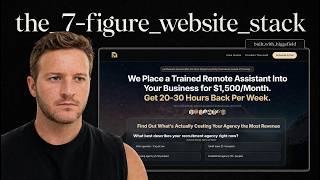
George Foley redesigned a recruitment agency's website, replacing vague copy with a clear offer: full-time remote assistants from South Africa for $1,500/month. He used Claude for copywriting feedback and Nanobanana for bulk image generation, building an interactive quiz funnel and narrative case studies to drive conversions.
Chapters
Hey everyone, what is up? We are going to take a look at a website rebuild I did for a 7-figure recruitment agency. You can see here, this is the after, looks pretty good. This was the before, a bit more vague. So I'm going to break down why I made the changes I did. I'm going to show you the two tools, Claude and Nanobanana, I used to do it and give you a walkthrough of the psychology of why I think this new website is going to close much better. So first thing we're going to look at here is just why, why I made the changes. So first thing we see, this website hits us with the future is remote. Very vague. We hire and train your remote assistants. So the second line is actually better. Tells them a bit more. The problem is no one reads subheadlines. Now that this company's got a ton of social proof, 400+ remote assistants placed. They've got lots of case studies down here, but the problem is they're a little bit hidden and I think we can do a better job of that. So as you can see here, we've really made the offer super clear. And so this isn't so much as a website change as it is like an offer or copywriting change. Shouts out to obviously Hormozy. Um, he kind of mastered the process of creating the offer and making it clear, not clever. So, um, we went with that framework. So rather than the future is remote, we now have, we place a trained full-time remote assistant into your business for $1,500 a month for business owners who are stuck doing everything themselves instead of growing. So again, refining the offer. You'll see a lot of the different pieces here rather than just hiring someone. It's around buying back your time as a founder with low-cost, high-productivity employees based in South Africa. So then we've also got something new that we're testing, which is a quiz funnel. I know a lot of people in e-commerce are running with these at the moment. I like them. Interactive. You want to make them as dopamine-inducing as possible. Again, I'll show you how we did this. We used Claude Code for this and Nanobanana. So you can click through here and, you know, you want to make everything just feel like it's got a positive feedback loop. So they get information halfway through. If you want to see the best website to ever do this, speedtest.net. This is a classic website, but if you think about what a speed test is, it's just telling you a number, right? Like, oh, this is how fast your internet is. These animations make it feel like it's actually doing something behind the scenes. It makes it feel like you're like racing a car. You're always coming back because you're like, oh, I want to see if I'm faster or slower. It's like almost, you know, it's a bit addictive. I hear Duolingo mentioned a lot. I know Duolingo is addictive. It's got things popping up all the time. This one's really simple. Like this just shows you, you don't need like scoreboard or rather it's got to go scoreboard, but you don't need like random things popping up all the time, random shit. You can just have a basic concept that demonstrates. So we took some of those principles into, into building this as well. Cool. So then the next part here, obviously there's a lot of white space here, but the first thing that it doesn't do is, um, never enough hours in the day. You need a remote assistant. And then it tells them, tells us how many they've like trained. Right. The difference here is what is a remote assistance? We're explaining, we're showing them what a remote assistant looks like. So these are one of the people in South Africa that you'll be hiring. We're real people, you know, especially nowadays where there's AI agents. I mean, remote assistant, AI agent, it's not too different. Like looking at this, I wouldn't immediately know that it's a, you know, a real person kind of thing. This is a lot more clear because we've actually got the humans on the website. And the way that we create the structure is imagine, uh, you know, if you look at this website for the first time and you've never seen it, like, what questions will I have when I get on the sales call? So you can look at your own sales transcripts if you have them. If you're working with a business, ask for theirs because that'll help. But also just, it's not, it's not that complicated. Like, imagine you're the buyer. Wipe your mind, pretend you know nothing about them. What's the first thing you're going to say? What is a remote assistant? Okay. And then we explain. So full-time person from South Africa. Why South Africa? Because most people will have tried them in the Philippines or India, Pakistan in the past. Native English, uh, you know, based in your time zone, tenure, not going to be working multiple jobs. So again, this, this offer is like, makes it so much easier because it's such, such a good offer. So we just had to basically make it clear and explain why. The section here, real human assistants trained with AI. So this is the next piece. And this part we had to be very careful because we may refine this in future too, but take your $1,500 a month AI operator, bundle them with $50 a month worth of tools, 50x their output. So that is true. Real human assistance. That part's not the hard part. It's When you look at this, even now you still feel a bit like, am I getting an AI agent or am I getting a real human? So it's okay that it comes after this piece, but thinking back to when we didn't really know the structure yet, this was a trickier piece to include. So then how it works, pretty straightforward stuff. A visual demonstration. So rather than showing, oh, we send video outreach, sorry, rather than telling you we do video outreach or the marketing sources do, Showing. So we've got a demonstration of a video from Marketing Saucer. Now this part here, I'm particularly proud of, and I think this is really important in 2026. So we can see here, we've got case studies, right? But they all kind of just blend together, which is fine. Like you need a lot of volume, but the first thing people want is an emotional attachment. So this is Ken's journey. They want to hear a success story. So pick the biggest success story you've got. Ken's a really good one because he's actually got an office that he set up for his team in South Africa. You can see his logo on the wall. And he also struggled before because he hired a lot of people in Philippines and it didn't work out. Now he's got 9 out of 11 in South Africa. You can see them working together and it was a mindset shift. Everything like you would want from a case study or journey. We've also got Susan Edmonds. We can improve the readability on this a little bit. We'll tweak this. This is still partially a work in progress. It's pretty much done, but you know, some, some adjustments we'll make. You can see the return on investment for Susan's hiring, which is good, you know, pays for itself well and truly filled 3 jobs. Happy days, right? So what we're doing before we introduce the volume of case studies, we're showing the journey. The reason this is important is because again, people attach to the story, but then they go, well, it worked great for Ken, but how do I know it will work for me? Well, look at all these other people it's worked for as well. And they have the positive association from this journey that they think, okay, well, that's what everyone else experienced. And to a degree, that's true. Obviously they probably haven't hired 9 remote assistants, but after seeing the journey, they can, you know, extrapolate that out and see all these other people having results. Builds a more complete picture. Cool. So that's the, the overview of the website and the changes we made. Now I'm going to show you the tools we used to do it. First, first tool I'm going to show you here, the one that makes all the difference is Higgsfield, but it's really just using Nanobanana. So Higgsfield here, if you haven't used it before, it's kind of like an aggregator where you can choose all of these different image models, which is useful. So I usually use Nanobanana. Pro, and you can generate up to 4 images at once. So a lot quicker, as you can see, like I've got 30+ renditions here. Doing this one-to-one with Gemini is just, it's nearly impossible. So rather than waiting for one to come back, you can generate 30, 40 in a go. It does cost credits. As you can see, I've burned through my credits, so I need to put some more in there. But, you know, if time is the key piece for you, which it should be, this will save you a lot of time. So then what I'm doing is I'm coming here and I'm telling it the idea of what I want to see on the website. We can see the prompt here. Make a new section on the website with apps like Logos. And I've given it some of the copywriting, which again, I used a mixture of my own experience with copywriting and Claude as well to help. Claude was like the writing assistant. I actually, I can actually do another video on this, but My copywriting session with Claude is more of an argument against Claude. What I'm telling it, no, that's bad. That sucks. I'm constantly just critiquing it until I sort of figure out in my own head what I want to see. So it's almost like a writing partner. Very rarely do I use the copywriting that Claude actually creates. But again, we can touch on that in another video. The key thing here is just saying the prompts need to be dead simple, like as few words as possible, unless it's copywriting, in which case that's okay. You can copy and paste the copywriting in, but making new section on the website, give it examples of the other parts of the website and it will pick that up. Don't say like make it dark and, you know, neon or glow or any of these things because it won't do a good job of it. It just, too many instructions, it gets jammed up. So what I do is I get it to create, I mean, some of these, let's look at some of the bad ones. These ones were better, like the first. What on earth, right? Terrible. It's like blended, I don't even know. So you're going to get these bad ones and that's why you're generating 4 at a time. And then you go through, you pick the one you like. So these ones here suck, right? Like, I think that's probably stealing the Google Play icon, so we can't use that. Stealing Discord, that's stealing Facebook. This one's looking a bit better, but no logos. I mean, you can see what we settled on here. So a bit of back and forth. And then what you do is you feed that. So the image you've created, code this, and then it codes it and it will do a terrible job of it, right? Looks nothing like the image. Then you just go back and forth. You just correct it. Why doesn't it keep showing the images? Like, you're just going to repeat, repeat, repeat, repeat. And this takes time. Like, I'm not going to be one of those people that say, oh, it takes 15 minutes to code a website. No, this, this took like hours. But, um, as you can see, the result's pretty good. Uh, this is live. Well, we're going to get this live for a 7-figure agency. They'll be using this as their, their core website. And, um, yeah, that's pretty much it. So look forward to catching you in the next one.








