Agency Success Interview - How Danny grew to $100K per month serving chiropractors
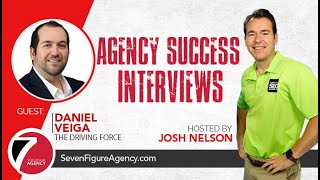
In this episode of the 7 Figure Agency Podcast, host Joshua Nelson interviews Daniel "Danny" Vega, co‑founder of The Driving Force, a digital‑marketing agency that specializes in Facebook‑ads lead generation for chiropractors. Danny recounts his unconventional path—from a series of low‑skill jobs, a brief stint in law enforcement, and a move from Orlando to California—through a period of personal hardship that forced him to work from home and eventually start a white‑label web‑design agency. After several years of cold‑emailing agencies, a tragic family loss, and a move to Texas, Danny pivoted to Facebook advertising, first for a local LED‑lighting client, then for multiple niches, eventually focusing on chiropractors after partnering with a chiropractor. He built a $2,500‑first‑month, $1,500‑subsequent‑month retainer model, using 4‑ to 6‑month contracts, pre‑pay incentives, and a referral program that pays $250 per referred client (later a free month of service). The agency scales with a lean team of virtual assistants (VAs) handling ad setup, optimization, client communication, and comment engagement, coordinated via Slack, Facebook groups, and Messenger. Danny also created a large private Facebook community (60 k members) and a podcast to share results, which helped attract clients. He highlights three core lessons: niche down, master sales, and build a team, emphasizing consistency as the overarching principle. The conversation ends with Danny sharing his contact points and growth targets for 2020.
Chapters
This is the 7 Figure Agency Podcast. Discover the strategies and techniques to grow a highly successful and profitable digital marketing agency with your host, Joshua Nelson. All right, well, hello and welcome. Thank you for joining us on this episode of the 7 Figure Agency Podcast. We're interviewing successful digital marketing agencies from across the country. Uh, today I am honored and privileged to be interviewing Daniel Vega. From The Driving Force. Daniel, thank you so much for joining us today.
Yeah, appreciate you having me on, Josh. Thank you.
Oh, it's awesome. So I know I've been able to kind of see you have massive growth over the last year here, but before we dive in, just kind of tell us a little bit about your agency, kind of where you're at right now, approximate monthly revenue, types of services, the high-level overview, right?
[Speaker:ROBERT_LEONARD] So we have our agency, we've had it since July of 2018. So it's actually technically my second agency that I've built up. So it's been a little bit over a year and a half now. We are focusing on the chiropractic market. So we help chiropractors grow their, you know, grow their practice. Revenue-wise, we're at, you know, that teetering point between like $75,000, $80,000 a month recurring right now.
That's awesome, man. So, just on the brink of 7 figures. You've grown it extremely quick. I'm really excited to unpack how you and your— you guys are doing that because you guys have had great growth and momentum within your business. So, kudos on that front.
Thank you. Thank you. Yeah. Yeah. So, I mean, you know, looking at 12-month period, right? We haven't hit like that 12th, you know, that 7-figure mark in 12 months. Last month, you know, this is obviously January 2020. Last month we crossed over the $100,000 mark, month mark. Wow. Which was my personal goal was, you know, to kind of like that milestone, like that next milestone. And then this month we're pretty much on track to repeat that again. So.
Fantastic. That's amazing. So, you've definitely got the momentum, you've got the engine purring. Tell us a little bit, you know, since, you know, this is where you're at now, I think, you know, really you guys are just at the brink of like a whole nother level. But kind of tell us your background. How did you start the business? You said this is your second agency. Just kind of talk to us a little bit about, you know, that process.
Yeah, so, um, growing up, I was, you know, I wasn't never— I was never the, the, the kid who, you know, sold candy bars at school or anything like that, you know. Um, You hear a lot of entrepreneurs where they start selling stuff when they're young. So I never did that. Growing up, I always had the vision of I want to be able to live the lifestyle, get dressed up in suits, go to fancy restaurants, be able to wine and dine my wife. So just growing up, I was always envisioning that. And Between the ages of 16 to 22, I had about 22 different jobs. So, yeah. So, just job to job to job. I went to 4 different colleges. I dropped out of all of them. Finally completed a law enforcement academy that I attended for about 10 months because my goal was to kind of become a cop in the Orlando area. I lived there for like 18 years. So the last job I had, I worked for my sister. She had a kind of an accounting office. So we did that for a while and I was just never happy. I had already graduated law enforcement and I just never saw myself either working 80 hours a week just to be able to make $50,000, $60,000, especially with overtime as a cop, I just, I didn't want to do that. And luckily we actually had to move from Orlando. Not that we had to, but we decided to move from Orlando to California. My wife's brother, she had, or he asked us to move out there because he was about to get deployed to Afghanistan. So this was back in, 2016 when he asked us to move. So during that time, working for my sister, and I was like, "Okay, if we're going to end up moving, the last thing I want to do is go apply for a job out there in California, San Diego specifically where we moved to." So I was like, "Okay, I'm going to try to find something that I could do from home. I don't care what it is, but I just want to work from home." Because at that time I thought, if I could work from home, I could work 2, 3 jobs that I can make maybe $5,000 a month. So I started applying for different jobs. I did a lot of customer service. I did a little bit of telemarketing. I was horrible at it, not any good. So I didn't want to continue doing that. So I'm like, what else is it that I can do to be able to support my family. At the time, it was just me and my wife, and we had 2 girls who were just born. They were maybe 2 years old. So back in high school, take a little bit step further, I had done a web design class, and it was something that I enjoyed. So the reason why that came up in my mind was scrolling through the internet, you see different ads coming up, right? And one of the ads that I saw was work from home doing web design and make $3,000, $5,000 a month. So that stirred up some back history of something I enjoyed in high school, which was not that long ago, probably about 5 years ago at the time. So I'm like, "Okay, let me start doing this." And what I ended up doing was cold emailing other small design agencies, just anywhere that I could find them. And the reason I did that was, you know, I sucked at sales. I did telemarketing. You know, I hated being on the phone with people. And I'm like, if I want to try to start my own business, the last thing I want to do is try to get my own client because I want to have to talk to them and convince them, you know, to use my services. And I'm like, the easiest thing that I could do is probably speak someone else's language. And at the time, that was a web design agency. So, we started doing that.
And just telling them, "Hey, look, why don't you subcontract your design stuff to me and I'll be your designer or one of your overflow designer type of thing?" Right.
Now, I wasn't into design. I was more into development. I was trying to figure out how to build a website. So, I mean, I don't even really know how to do one. But again, back in high school, I was using iframes to build a website. And I was like, this is cool. It shouldn't be that hard. And you had mentioned earlier on the other podcast about using Dreamweaver, and I used Dreamweaver to kind of hack my way through a site and then how it was built, specifically with like CSS and HTML. So I did that for a couple months until I really figured out how to build the front end of a website by manually coding everything. So I started being more of a kind of third-party developer for these small agencies who didn't have the in-house person or the skillset on how to build a website. And at this time, this was probably when WordPress was coming out. So I mean, I really didn't even understand WordPress. I was like, "Why use something like that when I could just build it by hand?" So I started cold emailing agencies. I would send out thousands a week of just cold emails, the same email template the whole time until I landed at least 2 or 3 different clients paying me kind of like a verbal retainer of, "Hey, as soon as we get a client, we're going to send them to you. We're going to give you $500." So by the time we moved to San Diego, I had 2 clients and we ended up moving out there. I had 2 clients and it took a while for me to just continue sending out emails until I landed my third one. At that point, I was like, "I need to find something else to kind of pay a little bit more per month." We were lucky because when we lived in San Diego, we moved in with my brother-in-law and we didn't have to pay rent. We didn't have to pay rent. I mean, bare minimum on electricity. The AC really wasn't used because the windows were open. San Diego is a beautiful city to live in weather-wise. But I was like, we have two girls and we live in a city that's not cheap to live in. And if we want to go out, we want to travel, we need to have money. So I started using Craigslist to kind of prospect. I didn't just focus on San Diego as the place to look for jobs. I went out and I actually looked for jobs. The one that I landed was in Arizona. I think it was Phoenix. So the Phoenix Craigslist marketplace. At the time, I was looking for a work-at-home job. And that's pretty much what I got. I got contracted with a gaming agency or a gaming business that was into They were coming out with a game. I don't know if you're into games, but the most popular MMORPG is World of Warcraft Online. It's like a huge massive multiplayer. So they were kind of developing something similar to that. So I worked for them for a little bit. I was making $5,000 a month plus the other 2, 3 clients that I had. So money was good. Money was definitely—
Not a bad gig for work at home, right?
Yeah, it wasn't too bad. So, I mean, I was probably doing at that time maybe, you know, $6,000 to $7,000 consistently a month.
Okay. So, what kind of happened there? Where did things end up and how did you kind of move past that?
Right. So, you know, we're doing that. We lived in San Diego for about a year and a half. A year into, actually not even a year into that gig that I got, It was maybe 3 to 4 months that I had that job because it was still a job, right? I wasn't a service provider or vendor to them. I was just pretty much an employee. This was 2018. So 2018, 3 or 4 months into the job, my brother-in-law, he ended up going out to Afghanistan where he was deployed. A month into his deployment, he got killed in action. So this was literally on the morning of my wife's birthday too, out of all days, you know? And it just, it was hard on mainly on her. And this was her 2 months prior to our son being born.
Wow.
So it was like all these things, like, you know, all these emotions and all these, just real life experiences that we were going through. And I ended up losing that job, the $5,000 job a month. So luckily I had just enough saved to last us for the next 6 months. And it wasn't like 6 months of paying rent because mind you, we weren't paying for anything. It was just us. So, Besides all the banks and the trust, you know, trustees and all that kind of coming into play. And we ended up having to move out about, this was 2019, June. So June, July 2019 was like, okay, the banks, you know, kind of took the house away, barely had any money left. We asked my father-in-law who was in Florida to fly out to San Diego to help us move. Out of the house that we were in. And the last thing that we wanted to do was go back to Florida. Florida, we had just left both of our parents because they both lived there, both sets. And we were like, "The last thing we want to do is drive all the way back cross country, possibly live with them again." So we were like, "We got to go find somewhere else." So during that time, we'd watch TV shows and we'd watch, I forgot the name of the show, but it was like house flippers. One of the guys, he had his own show, I think, I forgot his name, but he would always flip homes in San Antonio. So we were like, "That's where we want to go." So we were trying to do research at the last minute. At the time, the rentals were more than what we could afford. So the next place that we could go to that was close to there was Brownsville, Texas, which is where my sister-in-law lives. She had been living there for probably about 10 years at that time. So we called her up and we were like, "Help us find a rental place because we don't want to just move in with you, family of 5. Help us find a rental place and just find something for us to move in." So we got down there, the worst place ever that she could pick.
It was just—
[FOREIGN LANGUAGE] Yeah. We ended up living in Brownsville for a year and a half, but just the house, it was just way too small. I think it was like 800 square feet and the washer and dryer was literally right next to the stove and we just couldn't do it.
Tight.
So we lived with them for about a month until we found our own place. And we lived in Brownsville for about a year and a half, but it just wasn't the right city for us. We just didn't feel we could stay there long-term. So we would always drive out to where we are right now, McAllen, Texas. So we've been here now for a good 8 years or so. Pretty much been in Texas for 10 years. So living in Brownsville, we finally found a rental home. I think it was July or August. And I was like, okay, this is literally the first time as a family that we're living on our own without anyone's help. You know, we didn't live with family or we didn't live with my parents. We didn't live with cousins. And we had, you know, we didn't have her brother anymore kind of supporting us. So I was like, okay, it's finally time for me to step up as, you know, as a man, as a husband, to be able to take this and take it somewhere. You know, because the last thing I wanted to do was go find a job in Bronzeville, Texas. I don't want to go mow lawns or do anything else. So I took what I knew, what worked for me, even though it didn't work that well, but I took the concepts and the skills that I had learned, which was cold emailing and just trying to take that to a whole nother level. And I was trying to find any kind of clients that I could. It didn't matter who it was. Obviously I was targeting web design agencies, so I couldn't really be niche-specific because I had a couple of agency clients and they would service all sorts of clients themselves. But I was like, let me just try to find as many clients as I can, as fast as I can. I still didn't cold call. I never really did that, but I just sent out tons and tons of emails until finally 20— 2019 September is when we crossed over the 5-figure a month mark. So it was my first time making just over $10,000. And that was the first time— this was probably about a year and a half since I first started my agency in Florida, maybe about 2 years, that I finally had the belief that, "Hey, this is real. You can actually make "$10,000 a month by working for yourself." And even though we had gone through horrible life experiences a couple months beforehand, with my brother-in-law passing away, having to move and all that stuff, it felt like a great accomplishment just being able to hit that mark. And that's kind of where things just started from there.
Awesome. So, you kind of made this transition, you had some catastrophe. At what point did the new agency kind of come into play and the chiropractic focus?
Yeah. So, you know, 2019, this was now, you know, 11 years ago. I had grown that agency and that was more of a web design development agency, you know, kind of really being a white label. I was a white label for like 8 years. So I did that for a while and then I just got burnt out. I had clients. I mean, I was doing the best I had ever done was one month that I did $22,000, but on average I would do anywhere from $12,000 to $14,000. But I felt like I was just hounding my clients to pay me. I didn't have a recurring model at that time. My thought of passive income, I didn't have that type of passive income that I would see from other people just through different forums that I would visit. Warrior Forum was a big one back in the day that I would just every day I would just see what people are doing, try to buy the latest course for $7. And so that passive income was just something I'm like, at that time I was like, if I If I had passive income, I didn't have to work as hard. I mean, I was doing 60, 80 hours a week. And it was, you know, and I was doing a lot of it myself. I outsourced a lot of that to the Philippines as well, just tedious development database stuff that I couldn't do. But still, it was a lot of work, a lot of chasing. And that's something I didn't want to do. You know, clients would sometimes take 3 months to pay a simple $2,000 invoice and it would drive me nuts. It would make my wife crazy mad. So I'm like, "I got to figure something else out." So I started— This is when Facebook ads started popping up and being talked about on Facebook. I never really had a Facebook social media account. I built one for clients, but I never had one for myself. So I was like, "Let me see what this is about." "Maybe instead of searching forums, let me just talk to people and search out groups and whatnot." So I started learning Facebook ads. I ended up getting a local client, my first, only, and ever local client that I had worked with. And it wasn't really a client, it was more of a part-time job. So this was around the time that my downhill of my agency started. And speaking of downhill real quick, just something I want to mention, I had lost before my own approach of the Downhill Agency came about because I wanted that passive income. I had lost clients twice over. So one time was, first time was when my brother-in-law passed away, all the clients, even the ones that I had for my agency, I lost those. And that $5,000 job. And then the second time over was when my wife went through a pancreatic attack, which really I think at that point was the focus of me needing a passive income, because I'm like, "Clients are not paying me. I've now lost all my clients because I had to attend to my wife. And I just can't repeat this same process again. I'm sure I can get the clients, but I want to be able to take time off if I need to, a week, two weeks." but still have money rolling in without the fear of losing clients again. So the downhill of my agency was actually the third time where I decided I'm dropping all my clients and I'm going to try to go all in on Facebook ads. So again, at the time I had a part-time job was my very first experience of using and utilizing Facebook ads. It was for a local LED lighting company here in McAllen, Texas. Very interesting niche. I knew nothing about lighting, but I was hired to help them with their Google Analytics, kind of redesign their e-commerce website. And I think I worked for them for about a year. And towards the later half of that year, I'm like, "Hey, if you guys really want to grow, let's just use Facebook ads and see what happens." So, we had great success. They had the best success or best ad campaign that we ran was an ebook download of their catalog. And we literally got probably pennies on the dollar as far as cost per lead, 20 cents, 30 cents a lead. So the whole goal was to get as many leads in the pipeline and then to have their sales guy in-house just reach out to them. So that was a time that, you know, stopped my agency and I really started seeing the potential of ads, of Facebook ads. So I'm like, "Okay, this is interesting. It's very different than what I did. It's more of marketing rather than development." Again, I sucked at sales, but I'm like, "I think I could do this because I'm a very technical person." Wasn't that difficult to launch an ad to get somewhat mild success. So I just started going after as many clients as I could, chiropractors, mortgage brokers, real estate agents. So I had done a lot of different niches and I had success really, really quickly. Then I started posting my success online and that's where things really, really went up. So this was now about 3 years ago, 2016. The end of 2016 is when Started posting my results in different groups. For example, ClickFunnels. At the time they weren't so hard on what you could post. They were a lot more lenient. So I started getting a following very quickly. People just started reaching out to me asking for help. I'm like, I don't help people. I don't even know how to help you. I just know how to do this for myself. And then I started getting people asking for course. So I'm like, okay, this is interesting. And like, you know, so a month, two months went by, people started asking me, you know, for more and more help. I'm like, okay, let me try to launch a course and see where it goes. My first webinar was a complete flunk. You know, mind you, my wife had already had a pancreatic attack back in 2013 in December. And so I was like, okay, I'm going to launch this webinar, see what happens. At that time, she had to go to the hospital again. So, I stopped my webinar halfway through and I was like, I got to go. Just reach out to me if you guys are interested in this course. And I just rushed her to the hospital and came back and nothing. There was no sales. I was like, at least hoping for one. So, this was I think this was a couple of days right before Christmas time. So during this whole time of me posting results and just seeing what other people are doing, one thing that I noticed that all the, you know, successful people, what they were doing is they were building a Facebook group. So I was like, let me, let me do that. Let me launch my own group and just see what happens. Right. Just trying out as many different things as I could. So I did that and that completely really, I think, changed everything for me. This was, I think, the end of December. I think New Year's Eve of 2016 is when I launched my group. So I launched it and I reposted kind of, you know, my course that I had for sale. And then I started getting, you know, a couple of people interested. I started inviting all my friends. Then I started, you know, just trying to bring in more and more people. I ended up getting about 2,000 people into the group in the first month. I did, I think that month I did $30,000 or $35,000 in sales. And I was like, wow.
Phenomenal. Yeah. That's of your course at that time, right? Right.
Right. Of the course. I mean, the last, you know, 10 years of me being an entrepreneur, I only made past $20,000 once. I was always averaging $12,000 around that time. And I'm like, "Wow, $30,000 in one month." I'm like, "There's something here." So for the next year I did that. I just sold my course. I pushed it as hard as I could until I really tapped what I believe was the market. And mainly it was just my group. I didn't really— I ran a little bit of ads. I think I maybe spent $2,000 on retargeting. But almost all my sales, I did about maybe $400,000 in sales gross, was just from selling my course that year.
Wow.
So then I transitioned from that into, hey, I'm gonna do a little bit of coaching. And I did that maybe 3 months. I just didn't enjoy it. And then I took some time off, and then I'm like, okay, you know, after everything I've done for the last, you know, 10 or 12 years, What is it that I really enjoyed doing? And I'm like, I really enjoyed the agency, but the model that I had, it sucked. I was chasing clients. I was getting payments delayed. And I didn't want to do that. I'm like, I wanted to have that recurring model. So in July of 2018, I finally decided after a couple months off, income was starting to drop. I'm like, I got to do something. So I met my partner. I had spoken with him for a little bit. So we decided to go into chiropractic because I had success. He was a chiropractor. So it was like kind of a perfect fit. And I'm like, okay, great. I'm like, before— this is me telling myself before I start this agency again, this is my kind of my second one. I wanted to build the agency, but with the goal of scalability. I didn't want to just have to do all the work all the time and work another 80 hours a week. Even though that model I enjoyed a little bit more because I see results with my clients over time with different niches. I'm like, I love seeing other clients of ours have success, but I didn't want to just work another 80 hours, you know, every single week. So it was just that mindset of, you know, let me build this agency and focus on chiropractors. I've had success. He was a chiropractor. And, um, and then just, you know, just build it with scalability in mind. And that's exactly what we did.
Nice. So partnered up with a chiropractor that had kind of some background in it. Um, how did you package that? So what did the package look like? What is it that you do for these chiropractors?
Right. So, at the end of the day, it's lead gen, just to make it really simple for other agencies that are listening out there. You know, we only use Facebook ads. So, we're not an SEO web design agency at all. We only focus on that one channel of marketing for them, which is Facebook. Sometimes we split test with Instagram, but, you know, we package it in a way that got them results. But the goal was, the last thing that I wanted to do for scalability in mind was to sell them Facebook ads. Because in that niche, and I'm sure other niches as well, when you sell them a channel, when you sell them the vehicle, they're just going to be jumping from agency to agency. So we really had to push on results. We had to really find out what their pain points are, all those important factors in mind that you teach. And and really being able to get results for them, but really take their practice to a whole new level, but still offer that one thing that we're really good at. Because I had thought about offering all sorts of things for them, but Facebook ads was one thing that we've seen consistent results in and out over long-term. And it was something that I was good— I've Obviously taught that to lots of people, but I knew how to really optimize and I knew what to change and whatnot. So, you know, not getting the results with Facebook ads wasn't really something I was worried about. It was more of kind of retaining them and making sure that they stuck, you know, month in and month out. But more importantly, you also be able to acquire clients, which is where, you know, my partner being a chiropractor kind of helps because he can relate to them on a whole new level than a lot of other agencies can't.
No doubt. Yeah, what a great, uh, a great synergy, sort of speak. So providing Facebook ads, but really the offering is let us help you generate new patients and kind of grow your practice to a whole other level. Can you talk a little bit about how you package that? Is it a monthly retainer? Is it a fixed fee? Can you talk about that at all?
Yeah, so it's a monthly retainer. Um, we charge, um, it's $2,500 a month for the, for the first month. Not including ad spend. Most of our docs spend about $1,000 a month on ads. And then we actually drop our fees down to $1,500 a month after that. So it's not just $2,500 every single month. So it's a retainer model. We initially— at first we started doing 4-month contracts or 4-month agreements. Now we're at 6 months. If there's any kind of pushback at all, We'll bring them back to 4 months. That seems to work very well for them. A lot of them don't like being tied in long-term, but it's all a retainer model. It's just they pay us for our service, then they pay for the ads and they get an expected amount of an average of certain number of leads every single month. But again, we're not just selling them the ads themselves, the vehicle. We're really doing a lot of the automations for them to follow up. We have our own group where we've kind of brought everyone together where they can share some of their strategies and processes that they do inside the practice just to be able to help each other out. So it's really having that overall synergy with clients together. And they really like that because what we're starting to do now is go live with specific docs who are having success. And just be able to share their strategies, you know, in our group so that way others can relate from that. I went through 2 days ago and I pulled stats from everybody over the last year as far as appointment rates, show-up rates, and closing rates from Facebook ads. So, you know, so that's kind of what I have in mind is pulling it, you know, those who have really high show-up rates just to be able to do a live with them, interview them, and see what they're doing differently than others are not in order to get, you know, people in the door, which is something that, you know, I think all businesses struggle with.
No doubt, no doubt. So, I mean, I love the— I love the concept of generate the lead, put systems in place to automate the follow-up, and then aggregate the clients into a Facebook group to create community and kind of use that as a way to disseminate knowledge and to kind of retain clients at the highest level possible.
Right. Right. Yeah. I mean, I think to me, just having them part of a group is a good way to retain clients. I think if you're just providing like a vehicle, whether it's SEO or Facebook ads and you're only doing that, you're only providing the bare minimum that they need. Because we consider ourselves, and I think a lot of agencies, as more of a partner instead of like a service, you know, they're really partnering up with us to allow us to help them grow their business. You know, again, you're not just providing leads, you're really growing their business and you're making them more money, helping their community, all that kind of good stuff. So I think, you know, up to a certain level, the more that we can provide for them and really help them with what we're doing as a service, the better off that they'll be as well.
No doubt. Love it. Love the package. Love the service offering. One question I always like to ask is people— some people are kind of earlier in their evolution. What was— how did you guys land the first 5 clients? Because usually that's the, that's the struggle coming out of the gates. Can you talk a little bit about how you got those first 5?
Yeah, so the very first one, um, you know, as together as an agency between my part— my, my business partner and I was a chiropractor who was searching the ClickFunnels group. And, you know, during my time of me doing, you know, all sorts of niches, I would post results, right? That's one of the best things you could do on social media is post results, and you're gonna just get people flocking towards you. So I post results, and, you know, most niche business owners, they'll go into groups and they'll search, you know, their their niche, right? Like chiropractor, just to see what comes up. So I had this doc, this chiropractor do that and she reached out to me as a personal message and she asked me, "Hey, I saw some of your postings in the ClickFunnels group. I was wondering if we could hop on a call and see if you can help me grow my practice. We need to get more new patients in the door." So, I was like, "Hey, this is a perfect opportunity for my business partner to get on the phone and close them." You know? Now, at that time, you know, again, the whole— my vision was really scalability. I didn't want to just start doing everything. I didn't want to do sales, even though at this time I was better at sales. I didn't consider myself a salesperson that could just do that 24/7. So, I was like, you know, "Hey, you know, let's hop on the phone, let's get her. You know, we're on the phone maybe 20, 30 minutes and we close her as our very first client together.
Love it.
And she's still on board with us now. And the good thing is that she prepaid all of 2020 in advance.
Nice.
Yeah, which is one of our, a strategy that we use to really push over that 6-figure a month mark last month.
—pre-pays for the year for the tax savings for the client.
Right, right. Nice. And that really helped. So besides that, you know, the other 4 was just through networking. He had another agency business partner that kind of went downhill after 6 months. So he had a lot of contacts that he would, you know, he did a lot of cold outreach on Facebook. So there was a lot of, you know, clients that, you know, were— there was like one or two that were still with him that he kind of brought over with me, and then just a lot of past leads that, and, you know, and other people that he would know. So it was just like 24/7, I'm just messaging everyone that he knew and just trying to see, you know, who needed help and, you know, if we could hop on the phone with them and kind of show them, you know, my past results and what I had done in the chiropractic marketing realm with Facebook ads. And, and, you know, that was really how we got our first 5. So 1 reached out to me, 2 were from his past, uh, you know, agency, and then 2 were just from, you know, old, old networking leads that he had worked. I love it.
So, so a key insight for those of you watching or listening is, you know, share your results and, you know, share screenshots. Scare, you know, this is what we spent, this was how many leads, the average cost per lead. That makes you magnetically attractive, especially if you did it for somebody in the niche that you're going after. Um, and then leverage social media, leverage Social Messenger. It sounds like that's been a great play, uh, for, for Danny and his partner.
Yeah, I mean, I think just from what I had done in the past to, to the growth now, you know, even go— going through selling a course and doing a little bit of coaching and then the agency It's all about showing results. I mean, just like you said, it's so magnetic that you're not just going to get the business owner that is in the niche that you're going after, but you're going to get other people asking you for help too. Even like little one-off trainings. I mean, you can easily charge, you know, $500 to $1,000 for an hour of training, just showing someone how to do like, you know, Facebook ads for roofers, for example, or just these SEO strategies that you all know Um, that has been working extremely well for you all. And it's— yeah, it's just one of the best things that you can do. Show results all the time.
So, so fast forward, now you guys are, you know, you're kind of at that close to 7-figure mark, almost $83,000 per month and over $100,000 2 months in a row. Where are the clients coming from at this point? Like, what's the, what's the mix?
So we entered 2019 January, we entered with 12 clients. So it was roughly about 6 months that we went from our first client to— and there's a lot of drop-offs there. I think there are certain niches that might drop off more than others. So we had a share of drop-offs and whatever. So we came in through the new year last year with about 12 clients. And at this time, I kept hearing about the whole Dream 100 concept, right? Through ClickFunnels and just other people that had books and courses on it. So I was like, what if we just had a Dream 10? I was like, let me see, at least do 10%, right? Let me do a Dream 10. And I'm like, referrals. I'm like, we have to have, we have to really go after referrals really, really hard. And from January till about March, we just tried asking for the clients that we had for as many referrals as we could with getting at least 10 of them to just push it hard to help us get more clients. We only got 2 really that did that, but those 2 really took us to that $60,000 a month mark. [Speaker:ROBERT_LEONARD] Wow. [Speaker:ROBERT_LEONARD] So what we ended up doing And this worked for us, was for every client that they brought us, we would pay them $250. Now, mind you, our service fee is $1,500. So, for every 6 that they bring us, they don't pay anything except ad spend. So, everyone after that, we started cutting a check out every month, or actually we use Zelle. So, we just Zelle them every month, $250 per client that they brought us on board. And that helped us a lot. The most that we had ever paid out for those two JVs were, I think, about $7,000. This was last summer. Wow. In July. That's a lot of clients. Yeah. Yeah. I mean, at one point, right now we're at, you know, 55, 60 clients a month. The most that we ever had was about 65, 68, somewhere in that range. But mind you, even though we had And this was, I think, back in summertime, July. Even though we had the most clients back then, we never crossed that 6-figure-a-month mark. December was probably, besides our quick growth, was probably the month that we had the lowest amount of clients, but we had the most revenue generated in the month.
[Speaker:ROBERT_LEONARD] Predominantly through prepaids and stuff, right?
Right, right, through pre-pays. So, you know, we've, I mean, since last month, of course, we've, you know, we've had more client acquisition. We've got a lot of referrals. We're starting to go into another vertical. I had done some weight loss campaigns in the past. So we're trying to, we just landed our first weight loss client. They do kind of the non-surgical red light laser. Okay. It's like a red light that He hovers over someone and they'll lose weight. So we're starting to go after another niche just to kind of expand and see if we can kind of multiply our results with at least a vertical that's really close to chiropractic. Nice. And so we've also had a couple of clients that are starting other practices that have prepaid us this month. So that's all really helped to kind of go into our second month of hoping of passing that six-figure month mark.
Very nice.
But yeah, but referrals is definitely the, in our, the way that we've done it, the fastest way that we've been able to grow.
Yeah, really smart putting referral strategy in place. You know, they say you're one JV away from a seven-figure business. In your case, it's just putting a really smart referral mechanism in place for your existing client base and for some influencers in the industry, and that became an accelerator for you.
Right, right. I mean, I don't think without, you know, and we've shifted from paying out $250 a month to now just giving them a free month of service. And we've been doing that for about 3 months now. And we've gotten a couple other people, you know, not people, but chiropractors that are, you know, referring rather than just having 2. And I think just going through the numbers, it seems to work out better for us at the end rather than having to pay out because we're still paying out $250 for clients that they brought in over a year ago.
[Speaker:ROBERT_LEONARD] Long time ago, right. [Speaker:ROBERT_LEONARD] Yeah.
But at least in this point, we're like, because it dried up. I mean, I'll be honest. I mean, again, the most that we paid out was $7,000. Those two JVs right now, we're paying out $500 and $750 a month. So it dramatically decreased. Okay. So I think they got to a point where they tapped their own market out with just pushing referrals to us. So, we're like, what can we do a little bit differently that's still gonna make, you know, a client of ours really happy with, you know, with referring someone else, and that's just by giving away a free month. So for every client that they bring us, you know, we get those $2,500 initially, which kind of helps offset that free month cost. And they get a free month, and, you know, the next month they're gonna have to pay unless they again repeat that process. Get someone new, right? Right. So now we have about 4 that are doing this every month. So each month they're kind of referring one. So we're hoping that long-term over the next year that we'll be able to have, you know, at least a Dream 10. Of docs that are just referring at least one a month. So, kind of, you know, just spreading out instead of keeping just kind of one or two. Very nice.
So, I know one of your big focuses was scale, and one of the things you do really well is you run a lean operation. How do you fulfill for your clients? How do you get the work done? What does the fulfillment model look like? Yeah.
So, this is something that I like talking about and I like doing just because I think I've done it fairly well. Of course, there's more that I can learn, but just from talking with other agencies, I mean, we are very lean. I mean, without any ad spend, we're probably at about 6% to 7% overhead before we split everything down the middle between my partner and I. So this is softwares and especially all our VAs that we have. So, I mean, like the first, really the first year. So from July 2018 to last year in July, I had done all the ads. I got on sales calls. I did pretty much everything all day long. And then I'm like, okay, my focus at the beginning was to really scale it out. We're toppling 65 clients now. "I need help. I can't just run all the ads. I can't onboard. I can't run the ads. I can't optimize and just check stats every day just to make sure things are working the way they are and they're getting leads." I'm like, "I need help, but at the same time, I don't want to pay someone $5,000 a month to come in and do that. I've trained people. Why can't I train a VA?" to do this. So, I was trying to find a couple of VAs. I tried finding ones who had experience. That didn't work out because they always thought that— it's not that they thought that they knew more than you, but they already had a— they had certain procedures in mind that they learned from other people that they learned from, you know, on how to do things. And that never worked out because I had a very specific way of running the ads, optimizing, and Checking all those metrics on a weekly basis, I'm like, "Let me find someone else that I could train." So I had a VA that I used during my course era, and she was very, very detail-oriented. She would create slides and she would do research and all that stuff. And I was like, "Let me try to train her." 'Cause I think someone who's very detail-oriented can learn anything that you teach them. And I did that. I started her off by onboarding clients, setting up the ad accounts, just very, very basic stuff that, you know, I didn't use any of my course videos that I'd done. I create very specific, short, 2 to 3 minute videos for her. And I started her off slowly. And it worked. And, you know, now we're 7 months in from when I first trained her and she literally onboards, she runs all our ads, she optimizes everything. And now she's starting to really understand how to do things herself without me telling her what to do. Nice. You know, so it's not just changing the ads or the images, it's different. You know, we have like, you know, 5 different strategies that we use to get results that's worked time in and time out that we've rotated through. So she understands on when to do the rotations, when to try new things. And it's been great. We now have, I think total about 8 VAs. We have one that just does all the ads, she onboards. So again, she herself does all 55, 60 clients that we have in any given month. I check things periodically just to make sure I don't lose focus on what's new out there and how to do things. Because if you don't do things after a couple months, you're going to forget, right? Because I did that. After teaching ads for so long, I forgot how to run ads for clients. And it took me a couple of weeks to learn that again when we started. So, we have her and we have one, one that's really helped is, she's not really an account manager, but she's more of a client manager is what I call it. It's someone who helps all the communication for our docs. So, we have a Facebook group. We also have Messenger group chat for every doc independently. So, we put her into all that. We also have a help ticket system. So there's 3— what you do there.
So you put a Facebook group together with you, your client services person, and your business partner, right?
So it's, it's my business partner, I, um, our client manager, and then all the docs and their assistants.
So it's almost like they have a direct channel to you at any time without feeling like they're going to bombard you on a phone call, right?
Right. Um, the reason why I did the group was, you know, if there was anything that I had to let everyone know on a global scale, I had one area instead of email, because sometimes email's not checked. I had one reference point, one channel that I could do that. And that was a Facebook group. I had already grown one. I knew how to run it. We have now about 90 total in the group. And that's just not— And the one thing that I've done recently is not kick out old clients. And I think I did that now, just thinking back, because if they see us posting results and they're seeing new strategies come out, even though they've hired another agency, you know, they'll probably come back to us because we're doing something different.
It's a good re-engagement channel to keep you guys top of mind. And they're like, oh wait, those guys were actually pretty good.
Right, right. So, you know, so we have, we have the Facebook group channel. When we started, the best level of communication was Facebook Messenger. So we literally have over 120 different group chats with all the docs that we've ever acquired. So we bring in our client manager into all the active ones that we've had since we brought her on. She's been with us for about 3 months now. So again, she She looks at all the messages. She works from 8:00 Eastern to about 3:00 Eastern, which is her graveyard shift. So every day she'll make sure if there's any questions from docs being asked in Messenger, because a lot of them still use Messenger, or if they ask a question in the group, or if they send in an email ticket, she'll be able to look at that. And then from there determine, okay, do I need to give this to our Facebook ads VA? So that way she could handle things, or do I need to give it to either myself or my business partner? Nice. What I'm doing now is trying to, every day, if I see something that I have to step in, I figure out what that is and I tell our client manager, "Okay, you need to do this." A lot of it was clients would send in new pictures, I normally would get that, I would give it to my Facebook Ads VA. But now I tell her, "Hey, take this," and then just give it to her. We utilize Slack, which at first I hated it, you know, a couple years ago, but now it's like my Evernote. It's one of the best things I've ever done because it really helps. It helps keep me organized. My mind runs a million miles an hour. You know, even doing this interview, I'm still thinking of like all these other other things. And, you know, using Slack just helps keep client organization in focus, and it helps keep all the communication that is needed for each client in a place that we can always reference back at any point if we need to.
Yeah, I love Slack as well.
Mission-critical tool. Yeah. So, I mean, so we have— I mean, so again, those are two main VAs right now. Those are probably the only two that we really need to run an entire operation. So we can even be more lean if we need to be. The other ones are more part-timers. They work about 20 hours a week and they're only utilized to engage the Facebook ad comments that people leave. Okay. So the part-timers, they maybe work 3 to 4 hours a day and all they do is respond to comments on the pages that they're managing. Which can be 5 to 10, you know, per day. And just to help engagement, and then, you know, just to help people that are tagging, asking questions, just to make them feel like they're not being answered by the chiropractors because their time are limited. Back in the day, most of their CAs, meaning a chiropractic assistant, would be the ones having to do that. So we figured as an agency, let's kind of take it to the next level and provide a better service for them. And that's by taking over at least the comments on the ads. Okay, so we have about 6, 6 VAs that are doing that, and then our 2 really full-timers that are kind of keeping the— they're kind of like the glue for the agency besides, you know, my business partner and I.
Fantastic. Yeah, amazing that you can run that level of an operation with that, that small of a team and get the clients consistent results. And kudos, thank you for sharing that kind of that structure and that setup with, with us. Yeah, definitely. So if you were to look back over your, over your, you know, your career here, kind of going from $12,000 last year to $100,000 for the last couple months in a row, and definitely on track to have a 7-figure agency going through 2020, what would be the top 2 or 3 lessons that you've gleaned that you could share with, uh, with the listeners?
Yeah, I mean, and I think, um You know, this is for anyone who's either, you know, starting from scratch or, you know, or they don't know which direction to go into. I mean, you know, we've both kind of went off, we went after any client that we could. I think the top 3 things would be niche down. Niche. You know, to have that scalability in mind to be able to grow. I mean, obviously you're at multi-seven figures. We're just there. But to have that repeatable process, you can't do that by having different things that you're doing for 10 different niches, right? So I think just going after one industry is probably important to do. Second thing is sales. Can't have clients if you don't have sales. So, you know, Me, I'm not a— I have sold clients. I know I can do it. But again, I don't want to be focusing on that every day. I want to focus on operations and scalability and kind of looking at the business through a 30,000-foot overview. And then just seeing what steps need to be tweaked for higher conversions and whatnot. So just having someone or having that skillset in mind I think is critical. And the third team, or the third team, the third thing would be just building out a team. I think to scale, and this is something that I think really changed my mindset, was when you're scaling, you can't focus on, you know, how many clients can I get at any point in time? You know, it's not about, you know, let me try to get 50 clients. Because you can only handle so much yourself. So, I think building out a good team, whether it's, you know, you have a local brick-and-mortar team, you guys have probably over 30, right? We're pretty lean. But at the end of the day, we still have a team that fulfills certain tasks that we can't do ourselves. So, as long as we have people in place for, you know, for those processes, I think is really important to be able to to grow at least a 7-figure agency.
I like it. 3, 3 great tips. Um, this has been awesome. Thank you so much for sharing your success and kind of your journey. Would there, you know, would there be any last nuggets of wisdom that you'd want to share with that agency that's just trying to get to the next level?
Yeah, um, consistency is, is super important. You know, you're going to have clients that dropout. I mean, we have clients that drop out all the time, but as long as we know that we're consistent with results, with certain trainings that we do, with referrals, with cold outreach, I mean, it's just about consistency at the end of the day with everything that you do in life and business. Because at any point, if you stop, doing whatever it is that you're doing, then you're not going to kind of go to the next level, you know? Kind of like seeing the light at the end of the tunnel. You're going through a cave and you see like a really small hint of light and you're almost there and each step that you walk is that light's getting bigger and bigger. But at any point in time, if you decide that you can't take that next step, you're never gonna break through that darkness and actually see the light at the end of the tunnel. So I think just staying consistent and no matter what, You've heard, especially on Joshua Nelson's podcast, in his group, even his free group, you hear stories of people who are successful all the time, but you have to know that they weren't successful overnight. They went through struggles and they had experiences that were 5 years, a decade. That they went through and, you know, just staying consistent is really the game. No doubt.
Consistency is key. I mean, this has been awesome. I know you run a Facebook group, you're running a podcast. How can people plug into you if they want, you know, just to kind of get to know you better if they have some questions?
Yeah. So, I have a Facebook group. We're 60,000 members in. So, if you look at Entrepreneur Hustle, is the name of the group. My podcast, On Air Hustle, you can search it on iTunes. I just launched it, you know, about less than 2 weeks ago. And if you just want to follow me on Facebook, you can look up my name, Daniel Vega, V-E-I-G-A, and you can follow me on there and hit me up.
60,000 people in the Entrepreneur Hustle group, definitely should be in there. Lots of great insights. I've been listening to a couple Danny's interviews that he's doing on the On Air Hustle podcast. Amazing stuff. I highly, highly recommend it. So, Danny, thank you so much for your time. Thank you so much for your willingness to share, and congratulations on your continued growth and success.
Yeah, thank you. Yeah, it's been, you know, great being part of your group. We're definitely learning a lot of things in there, a lot of real golden nuggets, especially in the mastermind group that that we know wholeheartedly by implementing all that this year, even, even a little bit of it, um, can really take us to that, you know, you know, our goal really is, you know, 1.5. At least we could hit 1.5 this year, 2020, uh, then we're definitely, uh, on the right path and we know we'll, we know we'll get there for sure.
Fantastic. Well, I'm sure big things ahead for, for you guys. Thank you again for coming on the show. It's, it's been a pleasure and Continued success to you and your business.
Yep. Thanks, Josh. Thanks for having me. Thank you.
More from Joshua


From 26 Years in Business to Nearly Doubling Recurring Revenue | Sandy Waggett




How Luke Truetken Scaled His Agency to $110K MRR by Going All In on One Niche



Website Production at Scale - The AI Tool Stack for Modern Agencies with Marcel Knopf

