Agency Success Interview with Jonathan Bannister
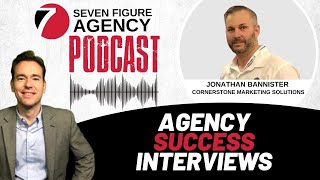
In this episode of the 7 Figure Agency Podcast, host Joshua Nelson interviews Jonathan Bannister, founder of Cornerstone Marketing Solutions, a Dallas‑based agency that serves HVAC and other home‑service businesses. Jonathan shares his unconventional path from sales and law enforcement into digital marketing, how he niched down to HVAC, and the rapid growth that led to $175‑180K in monthly recurring revenue from about 70 clients. He outlines the three pivotal shifts that accelerated revenue: (1) tightening and documenting internal processes, (2) overhauling paid‑search strategy to include Facebook, Instagram, YouTube and Connected TV while tying ad spend to client goals, and (3) building a data‑driven, results‑backed pricing model that allows premium retainers. The conversation dives into the agency’s service packages ($2K‑$4K base plus a 20% ad‑spend management fee), the detailed onboarding spreadsheet that forecasts required booked leads and ad budgets, and a KPI dashboard that tracks calls, booked leads, and revenue to hold both agency and client accountable. Jonathan explains how client acquisition is driven by manufacturer partnerships and referrals, and how a 45‑person offshore team in the Philippines—recruited via Craigslist and university relationships—provides SEO, design, and paid‑search work under a strong operations manager. He emphasizes treating offshore staff as full team members, cross‑training, and hybrid office culture. The interview also covers the evolution of the sales function, the importance of delegating sales to a smarter hire, and the core advice for agency owners: relentless focus on documented processes before scaling. Additionally, Jonathan highlights the value of the 7 Figure Agency mastermind community, where he accessed ready‑made SOP templates, peer support, and collaborative problem‑solving, reinforcing that leveraging external resources and delegating tasks are essential for sustainable growth. The episode provides concrete tactics for pricing, forecasting, team building, and client retention that can be applied to other niche agencies.
Chapters
This is the 7 Figure Agency Podcast. Discover the strategies and techniques to grow a highly successful and profitable digital marketing agency with your host, Joshua Nelson. All right.
Hello and welcome. Thank you so much for joining us on today's session. Um, this is part of the 7 Figure Agency Podcast Agency Success Interview Series, where we're interviewing highly successful digital marketing agencies from across the country and just kind of unpacking what's helped them grow, what's helped them succeed. And today I'm super excited to be joined by Jonathan Bannister from Cornerstone Marketing. Jonathan, thanks so much for joining us.
Thank you, Josh. I appreciate the invite. Looking forward to doing this.
No doubt. Jonathan and I, we must have— we've known each other for going on, I would say, like a year and a half, maybe almost 2 years now.
Yeah, almost 2 years. Excellent. Been following you for Probably 6 or 7 years though.
Good, good, good. And, um, Jonathan runs a really successful agency in the HVAC space, um, has had really, really good momentum over the last year and a half and has done some really exciting things in terms of increasing his average monthly retainer. So Jonathan, welcome to the show. If you don't mind, give us a quick introduction.
Uh, yeah, I appreciate it, Josh. So, um, With Cornerstone Marketing Solutions, we're based out of Dallas, Texas. Like Josh said, we, we're in the HVAC home service space. Been doing this for going on 7 years now. And, um, yeah, I mean, we've, we've been niched down, uh, probably 7 years. So it's, uh, it's been a lot of growth over the years and a lot of ups and downs and new changes. But, you know, big thing for us is Always growing 1% every day.
So love it, love it. Uh, Tony Ricketts says Jonathan is a marketing agency boss, so kudos. I know you guys are buddies. So Jonathan, give us a, give us a quick high level, like, so 7 years in the HVAC space, how did you get into digital marketing in the first place?
Yeah, so just kind of, you know, kind of landed in my lap, right? Like, it was never something that I planned to do or had any kind of dreams to, to do. But, you know, I'm extremely blessed to, to be where I am today, right? So, um, I was in the sales, uh, you know, industry for a very long time and then got out of sales and went into law enforcement. So I knew when I was a little boy I either wanted to be in law enforcement or be in the, um, the the mafia, right? So I could never find an application for the mafia. So I went into law enforcement in 2000, what was it, 2009, I believe. And spent a few years doing that.
My wife and I had a couple of kids back to back. We actually had kids 2012, '13, '14. And, you know, she just kind of said, you know, what are you gonna do, right? Like, you know, law enforcement in that time. And just like we're in now, just sad time for law enforcement. So she said, you know, do you want these little boys, you know, potentially not have a father, right? You know, something happened to you. So I said, all right, let's make some moves. So I reached out to a buddy of mine who was always, you know, had his hands in different projects and stuff. So I said, what are you working on now? And he said, I'm actually building mobile apps. So story goes, he's building mobile apps. He wanted me to sell them. We hit the ground running. It was a super success out the gate. But what we found was when I would go to these different businesses and pitch them the mobile app and show them like what a push notification or some kind of geo-targeting could do for their business, they said, oh, you know, it's great, we'll buy one, but can you help us with our website's awful? Or we can't be found on Google on a search, our SEO is bad. And I was like, SEO? So I might pull out my phone, I type in SEO. I had no clue. You know, what it stood for. And, you know, that's just kind of how it started. So we read and just kind of got myself as deep as I could in every book on outsourcing and everything to do with digital marketing that I could. And, you know, the rest is kind of history.
That's, that's awesome. So give us a lay of the land. So, you know, you're like approximately how much clients, approximately how much, you know, annualized or recurring revenue in the, in the business today?
Yeah, so we're sitting around, I would say, right around $175,000-$180,000 monthly recurring revenue.
Amazing.
Um, with right around 70-ish clients.
Nice.
And, um, I would say in the last 18 months, you know, like, we'll dive into a little deeper. We've changed our model for how we're going to market and bringing clients on, and that's obviously allowed us to start charging much higher retainers.
Love it. Love it. So you've, you've made some changes in the last 12 months that obviously have, have changed things around. What would you say if you had to pick like the top 3 shifts and pivots that you've made? What would those top 3 changes be?
I think the first would be we really dialed in and got serious about our processes. Um, that was something that you, you've pushed me on all of our coaching calls. Um, you know, at the end of the day, it's hard to move forward if you do not have solid processes in place. So we had processes, but once, um, I actually hired a director of sales, and what he did was when he came on board, he started trying to poke holes in every single one of our systems, and he did a really good job. And actually, Will, that's on the call today, um, Tony, who's on the call today, like, they, they played a pivotal role in these processes, right? Because they were able to poke holes in our SEO and poke holes in our content strategy. So then it just came, all right, well, now how do we fix those holes? And then how do we put processes in place to where this doesn't happen again? So I'd say processes were number one.
Love it. And what I like there is you said, you, you know, they were poking holes, but you were open to receiving that, that feedback. Sometimes as we grow and we succeed, we're like, we don't want to look in the mirror, we don't want to see where there are holes, and we're completely resistant to change. Um, so you were, you were like, we need to solve some problems, we need to look at the systems, and you took the feedback from other successful people and you accepted those holes and you started to solve them. So that, that's awesome. So that's the first one.
Yeah.
And I would say the next one was really getting serious about our paid search side of our business. So, um, we, we'd always done PPC, um, we ups and downs with it. We've had our struggles over the years. But I wanted to take it in a different direction. I really wanted to, you know, dive deep into Facebook and Instagram, YouTube, and then, you know, connected TV. So I really wanted to move and make a big shift in that area, but I said the processes have to be solid. And, um, you know, like you mentioned earlier, we do have a large team in the Philippines, and, and they're great. You know, I, I've been blessed. I've was able to— some of my very first people that I ever hired over there have been with me, you know, 7 years, and they're family to me. I've got godchildren now that are, that are part of that. So it's, um, for me, it's—
I still have to be the leader, right? I still have to make sure that the processes that are in place, they will execute, but it needs to be completely solid. So, um, so I would say that was number 2. And the number 3 was I wanted to take step 1, which was poking the holes in the systems and fixing them. Step 2, getting the paid search really dialed in. And then step 3 was, how do I back up those results 100% and then be able to charge whatever I want based off of the value I feel like it's worth? Because we're gonna start selling the client what services and what verticals they need to hit the goals that they want for their business. And then if we do that and we can back it up to 100%, you know, you know, T, like this is exactly what the return on investment was, then we should be able to charge a premium price for that service.
Love it. So those were the top 3 things that you feel like accelerated you from $1 million to what's now about $2 million in annualized or monthly recurring revenue, right? Amazing. So I think there's a couple of things that everyone's gonna wanna learn more about. They're gonna wanna hear more about like kind of that international team and how you built that, how you train that, how you kind of manage that, and then how you were able to back up the results and increase the monthly retainers from, you know, $1,500 to something much higher. Give me a yes in the comments if, like, those are some things you'd like to hear us drill down on and get some more feedback from, from Jonathan about. Yes, lots of yeses coming in. Um, before we dive into this, I'd love to get a sense, like, what is it look like? What is it that you do for the clients? So you've got HVAC clients. What's your standard package or program look like today?
Yeah, so today the way we go to market is we currently have 3 different programs that basically consist of the website, their SEO, and then obviously there's some bells and whistles on there, whether it's email marketing and some automation, database reactivation, things like that. But we start there and base the SEO off of the content strategy. So it looks kind of like how many cities are that we want to focus on, and then how much content is it going to take? So is it going to be 4 pieces of content or 6 pieces of content per month or more to be able to hit the results that we need to hit? Because we're looking at this from a book call lead. So I need to know how— what is the forecasted number that we're going to expect to get from SEO. And, um, so if I'm gonna look at a client and go, all right, your goal is to go from $2 million to $4 million. And when we reverse engineer all your numbers, if I need to get 30 or 40, 50% of my leads or book calls from SEO, then I know that 2 pieces of content per month isn't gonna do it, especially if you're in Dallas, Texas or, or Miami, Florida, right? Mm-hmm. So we start there. We onboard you with one of those programs.
And then week 1, whenever we're doing the onboarding call, the first 90 minutes of the call is with the account manager doing the onboarding process, getting all the information we need to be able to write all the content we need for the rest of our life, basically, right? Like, we want to know everything about that business owner and about that business. But then the second part of that call, we go, we dive into the spreadsheet that we built. And And that's where we're plugging in their numbers. Like what is their average service ticket? What is their average replacement on a new system? What do they wanna do total revenue? What is their net profit numbers they wanna do? What is their overhead cost? And then it'll spit out a number to say, how many booked leads do we need each month? And, you know, Josh, you and I are in a weather-driven business, right? So January lead flow to a July lead flow, completely different. So we have to look at it month to month And when we have those kind of forecasts and numbers, then my team, we can look back and go, all right, look, to hit this company's goals, here's what it's probably gonna take, right? Like we're gonna need to spend $2,000 a month on YouTube or $4,000 a month on Facebook ads. And obviously we can pivot and change as the results come in, but we need some kind of way to be able to tell that client, look, I know every company you've ever dealt with has told you it's gonna be $2,000 a month or $3,000 a month. I'm telling you, you're gonna need to spend $15,000 on ad spend this month. And here's the reason why, because here's the breakdown of where we're getting these numbers from. And if you don't wanna do it, that's fine. A couple of things have to happen. Your expectations have to go way down, or like, we're just not gonna be able to work together because I'm not gonna bring you on and tell you, all right, cool, $3,000 a month. And then 6 or 8 months down the road, you're like, we're not hitting our goals, right? And it doesn't do us any good and it doesn't do the client any good, so.
[Speaker] I love that. And really, I think that's been a big part of your growth is this, this shift from here's my out-of-the, out-of-the-box service offering and it is what it is, to really getting intimate with the client, understanding their goals, understanding their targets, understanding their metrics, and setting realistically— if you want to do $5 million, here's how much we're going to need to, need to spend. Yeah, I love that. So you mentioned these 3 programs, just kind of like, what are— what, what is the typical pricing range for those 3 Programs.
Yeah. So our price point on those are $2,000, $3,000, $4,000. Okay. So the $4,000 program's gonna be the website. It's gonna be SEO. It's gonna be 6 pieces of content per month. We're gonna post daily to GMB. We've got a Google Stack strategy that we're doing for Google Maps right now. It's email marketing, it's database reactivation. It's a dedicated account manager, obviously tracking numbers and everything like that. But, you know, that's really the base price of what it's going to be. And then again, once we figure out how much ad spend it's going to take and which verticals we're going to have to do it on, that's when we will establish what, what that number is. And then there's a management fee there. So our pricing on the paid search side is $1,000, essentially 20%. So $1,000 for every $5K in ad spend. And it doesn't matter which platform. So if we look at all of our clients across the country and go, you know, look, in Nashville, Tennessee, we're, we're getting a really, really great lead cost on Facebook ads. We're getting solid leads on Facebook. But here in Dallas, this is a really hard market with Facebook ads. So we may say, look, let's not even waste our time, we'll use Facebook and Instagram for retargeting. But let's get top of funnel. Um, let's focus more on YouTube, right? So, but it doesn't matter. It doesn't matter which platform we do everything in-house. So it's just $1,000 for every, you know, $5K in spend, and that gets tacked on to the $4K, um, you know, that original package price.
Got it. So the first $5K basically would be included, like when you go to $10K, it's an additional grand. When you go to $15K, it's an additional $2K. Is that right? Kind of.
That's the $4K for the other services. So when they come on and You know, typically if they're going to be in the $4K package, I would say the ad spend is going to be north of $10K anyway. So if it was $10K a month in ad spend, then their package price would be $6K. So $4K goes to $2K.
I like that because it kind of— it gives you the ability to, as your spend grows and as you're doing more and more in terms of, you know, results, you're, you're getting paid more instead of just getting a flat monthly, monthly fee. Yeah.
And then another big part of what we're doing is We listen and analyze every single call that comes in, and then we've built out a KPI dashboard to where, yeah, we've got all your traditional metrics of phone calls and conversion numbers on, on AdWords, right? But we wanted to take it a step further because we want to be able to say, all right, January, this is what we need for your business.
Here's February, here's March. But if we get too far off track and they miss their either revenue goals or we miss our lead goals for too many months in a row, the pivot is just gonna be too hard, right? I mean, like they're gonna have to double or triple their ad spends and their strategies later on in the year. And you know, you and I know besides plumbing, HVAC, it is very seasonal. So, you know, they here in the South, they only really have, I don't know what, May, and May's been awful here. Like, it's been 75 degrees, nobody's, you know, needing air conditioning. So they only have 2 or 3, 4 month window to really make 90% of their business for the year. So if we miss too many months, it's going to be too hard to get back on track. So for us, we want to listen to every call, put it in dashboard, and then what my team is listening for is, did this call convert into an actual booked lead? Did they hear that Dispatcher put it on the calendar, and then it gets put into a board. So then we're looking at, okay, here's what our lead flow goal was for the month. Did we hit it? Yes or no? But then more importantly, it's what the account manager is working with our clients to say, okay, we hit our lead goal. That still doesn't mean we can slap hands and celebrate because you may not have hit your revenue goal because it's all forecasted numbers. Like, there could have been a month where the ratio we were looking for of service calls turned into a new system replacement just didn't happen because the luck of the draw were the 20 calls you got, the systems were only 6 or 8 years old. They just, something was wrong with it. So they didn't need a replacement. So we still wanna be in that constant communication because it's like, hey, did we hit our lead goal? Great. Did you hit your revenue number? No. All right, next month, do we need to do something different? Do we need to throw more money somewhere to make up for last month? If we don't, not a big deal. So that's the kind of communication we want with our clients.
I love it. And I think that's one of the big reasons you're able to charge these larger fees and more importantly, retain the clients at these larger rates because you've taken it beyond let's just generate some leads for you or let's just generate some traffic for you, which is where most agencies stop. Oh, let's run some paid search. Let's do some SEO. Let's make the phone ring. You're actually looking at, okay, how many phone calls do we need to hit the targets? And then looking at how many of those phone calls got booked. And then what's the true revenue generated? That's the next level connection in your process. That's, that's really driving this. Give me a 1 in the comments if this is helpful. Like, I know this is a little higher thinking than, you know, when we're just getting started. But if you want to be a world-class agency and deliver world-class results, this is where your mind needs to be going. Lots of, lots of ones coming in, Jonathan. This is, this is awesome. Great, great work. Thanks for unpacking the programs and kind of walking us through conceptually kind of how you, how you do this. Um, a couple people are asking, before we dive into the operational stuff, like, where did you— where do you get clients from? Where did you get your first handful of, you know, niche-specific clients?
Um, yeah, really the way the relationship worked there was I— my older brother had a print marketing business here, here in Dallas. And, um, he was working with HVAC business already. Um, and he did a lot of direct mail for contractors all over the country.
And then what they were doing was reaching out to him going, hey, you did a great job on the direct mail.
Can you have anybody that can help us with our digital services? So he was just sending, you know, leads my way. And before I knew it, like 95% of my clients were, happened to be air conditioning contractors. And I was like, oh look, my team understands how to write the content for it. We understand the keyword strategy. It was like, you know, it just makes sense. The email marketing became a lot easier because we're focused down on, on it. So that's just kind of when I made a decision, you know, before I learned it from you, I said, let's just get niched down. And, um, you know, like I said, I've been following you for probably 7 years now and got a lot of my original package ideas and stuff from, you know, your other business, right? So it's just evolving and changing and figuring out. I mean, I think you and I both used to have some of the same strategies as far as where, how we would talk to clients. It would be each month about your keyword ranking results and things like that.
And it's, you know, look, if their phone isn't ringing, it doesn't matter if they're in position 1 on page 1 for every single keyword.
Um, And sometimes it may happen that way, but so that's where you have to be able to go, okay, great. Look, our SEO is really dialed in and on point, but you need more leads. We need to get it from Facebook. We need to get it from AdWords. Like you have to be able to have those conversations instead of just throwing, whether it's you or an account manager into the fire to say, hey, your keywords look great. You know? And it's like, well, my phone's not ringing. I'm not making any money. So I needed to figure out how to not lose another client based off of their misunderstanding of what we're doing. And I just wanted to get real deep into it and go, look, 'cause this is the other thing, Josh, is I look back at, 'cause I used to do sales for the company.
And when I look back at this note, these several notebooks that I had of all these sales calls that I'd done over the years, when I looked at it, I would ask these standard questions, right? Like, how long you been in business? How many employees? You know, last year's revenue numbers. And I would always say, what do you want to do in the next 12 months? And then like, what are the 5-year plan? Every single person could give me a number. So, and I would look and I started looking at it and it was just kind of funny because 98% of them would look like this. They did $1.2 million, next year they want to do $2.2 million. We did $4 million, I want to do $5 million. They all had this perfectly round number, but what they didn't know they did not have a clue how they were going to get there. And no company was going to tell them that. Like, they were, hey, I'll bring you on, like, we're going to do it. Your SEO is bad, we'll run some reports for you. You know, you've got all these meta descriptions that are wrong. But I, I just said there has to be a better way, and it has to be based off of their numbers in their business. Because I've got a client out in California, his average install is over $18,000. Well, I've got other clients, their average install is $5,500. So Talking to them about leads and stuff, they're in different worlds, right? So I tell these clients when they're looking at this spreadsheet we build is, listen, you don't have to spend this kind of money that I'm telling you, but your close rate is 30%, get it up to 60%. Your average replacement number is $6,000, watch this. And I'll plug in, I go, make it $10,000. Look what happens to all your revenue numbers. Like it just, it jumps up. So you don't have to spend more money with me, spend more money on training, get your people doing better. But if that's not the case and that's the culture of your business, then a change has to be made. But what I'm not gonna do is sugarcoat it and go, yeah, you know, look, you can spend $3,000 on AdWords and you're good. It's like, no, if we need to get 150 booked calls for you in any particular month and it needs to come from paid, $3,000 ain't gonna cut it, I'm sorry. Like I've got all the data from our other clients, it's just not gonna work.
So good. And so the takeaway I want you guys to take on this is, as agencies, our purpose is to help our clients generate more leads and sales, right? Actually grow their revenue. And so if you're not already taking a consultative approach, where when you meet with a client and you ask, hey, where are you at right now? What's your goal for the next 12 months? You know, you need to start doing that, right? Because you can't actually develop a plan without that information. Some of you guys, that's new information. It's like, okay, I need to start asking that question. Others of you are asking, and what Jonathan is suggesting is take it to the next level. All right. If there is a million-dollar goal, what does it actually take to make that a reality? How many leads would they need to generate? What would their average conversion rate need to be? What would their average transaction value need to be? So you're building a plan based on metrics as opposed to just phantom. Oh, my program is $2,500 a month. You know, I don't know if I'm actually going to get you there, but let's, let's give it a whirl. Give me a 1 in comments if this, if this is sitting for you guys. Again, you know, this is a little bit higher level thinking, but you know, this is the thinking that can really separate you from the competition.
And I'll tell you, Josh, what, what— there's a story of what pushed me in this direction, and it— and I think I shared it with you. I had a client that had been with me, I think, 2 years, but their SEO results were by far the best that we had for any client across the country. And another part, so I kind of talked about the beginning of how I got niched down, but then where we are today and where we get clients from today, as you know, we partner with a lot of manufacturers. And that's taken a lot of hard work and, you know, knocking on doors and placing a lot of phone calls and kind of showing what we will do and how we will support the manufacturers. But we are with York, we are the, we are the exclusive marketing company or, you know, marketing partner for York Factory Direct. And so I would do a lot of speaking presentations around the country at their events and stuff. So I had my presentation deck put together. And I had this particular client on a lot of the decks showing the results where they were, where they are now and that there are 52 cities or something that were in their service area. And we were ranking for page 1 for over 600 keywords. And then one day I lose that client and, you know, it was just like, all right, no big deal. And then for some reason, I just couldn't let it go. I'm like, you know, and part of it, you know, I don't think it was the money. It was, I think I was gonna have to redo all those decks and it aggravated me, right? So I pick up the phone, I call the owner one day and I just said, Hey Rick, like what happened? You know? And he goes, listen, he goes, y'all did a great job. I said, all right, so why are you not a client anymore? And he said, well, you grew my business 2 years. You were with me 2 years, or I was with you guys 2 years, 2 years in a row, you grew my business. And I said, all right, I'm still confused, right? You know, what's the problem? He said, well, year 1, we grew about $250,000. And he said, year 2, we grew about $500,000. I said, all right, I'm still not understanding, Rick, what's the problem? And he said, well, we had goals in place and our goals were we wanted to grow $750,000 the first year and $1 or $1.5 million year 2. And he goes, we just didn't do it. And he goes, I kind of staffed and did other things that needed to be put in place for that growth. And it just didn't happen. So we just, we needed to go a different direction. Man, and it, I lost sleep over it because I said, like, how was I to do that? Right? And I went back and looked at all my notes and I saw, I asked those same questions and Sure enough, like he told me in that interview process what he wanted to grow to, but I did not know, I didn't have a clue how I was gonna get there. If they told me they wanted to do $3K a month in AdWords, all we were focused on is what can we get the cost per conversion down to and looking at the CPC, and it can't be that way. It has to be on how many booked leads can you, do you need to get them to hit their goals?
Love it. Powerful story, powerful insight. Look, guys, if you can start thinking at that level, um, it will change the way you approach, and, and you will have to charge more. Because if they got a big goal, you can't limit what you're expecting them to spend in ads or what they're spending based on what your mental context is. It should be, okay, if that's what you want to do, here's, here's the plan to make it happen, and here's how much you would have to spend. Um, and what's amazing is I know over the last 12 months you've been kind of testing this concept out. And initially, I, you know, I think it's fair to say your average monthly was like $1,500 to $2,000 a month, and that was kind of the, the extent of it. And you said, okay, let's go bigger. Let's just talk a little, a little bit about how you've— now that you've started going bigger with these bigger clients, um, what the impact's been and kind of what the results have been.
I mean, really what it looks like is we're, we're bringing on the same amount of clients, but we're—
the revenue numbers are off the charts, right? Because where we had these $2,500 packages, now I had a client recently, he—
like, once we filled out the spreadsheet with him and he saw obviously different times of the year because we're seasonal, that he was going to be paying us like $14,000 or $15,000 a month, and then other months it was going to be like $8,000 or $9,000 a month. And he wrote back who did not know us. It was a brand new relationship. I actually reached out to him on Facebook and, you know, I told you about that strategy that I've been doing is finding mutual things, whether it's politics or whatever it's about, but something I can open up the conversation about. So once I got that established and passed it on to my director of sales, this guy ends up emailing us back and go, hey, listen, would y'all do me a favor and can we just make it a flat $10,000 for the year? You know, so we don't have this back and forth. And when I— we told him, yeah, he was like, man, I really appreciate that. And I'm just sitting there. I told my director of sales, it's like, man, you know, a year ago, like, we're doing these $2,500 packages. Now we have people asking us, you know, is it okay if we just do $10,000 for the month and lock it in? So it's made a huge impact, and it's allowed us to get— instead of focusing on bringing on a lot of clients and it being more of a numbers game, we're It's allowed our team to get really, really hyper-focused on processes and getting the results that we need. Because if it's not completely dialed in, then when you start listening to these calls and putting it in the KPI dashboard, it can be an embarrassment, you know? So it's, you gotta be able to get the results.
Yeah, can't charge a lot in a vacuum, right? You need to be charging in a controlled environment where you can say, yeah, we're gonna spend more and we're gonna monitor the results, we're gonna monitor the ROI. We're gonna make sure we're helping you get to that outcome, which is, I think, just amazing. So there's a gentleman on with us, PJ Rouse. He works with plumbing companies. He's saying he charges on average $300 a month, generating 500 to 140 leads. Not sure whether, you know, can you talk about how you're able to get that larger fee and kind of the distinction between maybe a one-man small operator and these more successful companies that you work with?
Yeah, I mean, I would say, you know, SEO results, it's, it's, you know, if you're just going to look at keywords, like, that's just one metric, you know. And a lot of people will put call tracking on the different verticals, whether it's GMB or on the website. So I still feel like you gotta listen to those calls. Like, there has to be some kind of way to say this turned into a book call for you. And the reason why is over the years, even the clients that we knew we were getting absolute stellar results for, if the phone stopped ringing or the business isn't doing well because they're just mismanaging it, the first thing they're gonna do is blame it on the marketing company. And if they go, what are you doing for me? Like, what is Cornerstone doing? And I've heard that so many times. And then I go back and I look at the results, I look at the calls, I'm like, like, we're getting, you know what, you wouldn't have these 60 booked calls this month, right? But they don't understand that. So now it's like we hold them accountable and say, if these are your goals, we're telling you we can hit it. Like, we can hit this lead number, but we need something from you. Like, we need you to be able to be transparent with us and work with us on the revenue numbers. We don't want the revenue numbers so me and my team can go celebrate and go, we killed it for this client. I tell them, we need your revenue numbers because if your revenue in January was X and then February was X and it's missed, we hit our lead number, you miss your revenue number, then we have to be able to pivot. And if we don't know that information and we're not working as a team, it's never gonna work out. So I tell them, or we sell them on the concept, that we are an extension of their company. We just work a little further away in another building depending on where they're at, but we are part of their team and we want them to feel that way and it has to be full transparency.
I love it, I love it. So there's in any vertical, home services, plumbing, HVAC, electrical, medical, legal, there's small operators that don't spend any money in advertising, that any amount that you charge them would probably wind up being too much in the long run. And then there's the more successful— if we look at the 80/20 principle, the, the 20% of companies that get it, they've got solid operations, they already invest in marketing, um, and, and they have growth-minded aspirations. Um, can you talk a little bit about like your experience working with the small operator and the more successful company and how working with that top 20% really is where you want to focus your attention?
Well, for me, in the past, that's what I would want to focus on. Like, how do we find those $4 to $6 million companies that are already spending the money? But what I found was we didn't really have the right processes or even enough verticals on the paid search side to really be able— and I think you and I have had this conversation, you had a real big client here in Dallas in the past, and they can be difficult. And it's difficult, especially if you don't have the right resources to be able to deliver the results. Yeah, but what I have found is we've got a couple smaller dealers now that are under a million dollars, but they're paying us $3,000 or $4,000 a month because if they have a goal— I'm at $700,000, but I want to do $1.5 million next year— it's all about their numbers. And this goes for anybody on this call. Whatever niche you're in, there's an average ticket number of something they're selling. So if it's an attorney, there's an average ticket that he's getting from a client. So you have to look at their numbers and go, alright, if I look at what you're selling, or what you're trying to offer and reverse engineer those numbers, this is what I— we think you need to be spending. Because from SEO, we're just going to forecast that we're going to get X amount of leads or traffic from it. But that still leaves us very short. So you have to set the expectations to those people and what you get them to agree to, even if they're a smaller Customer, oh, I only spend $1,000 a month. Great, well, you're never gonna hit that goal that you wanna hit. So if you're okay with that, let's move forward. But if you wanna go in this relationship saying, I wanna grow by $1 million, but I only wanna spend $1,200 a month, we're just not gonna be the right fit. And if anyone, and I tell them, if anyone tells you that they can do it for you, it's just, it's a lie. I mean, we'll set up an automatic email to go out 11 months later to see, how they're doing and if they're ready to grow their business.
Yeah, great, great stuff. So then PJ, you know, JP, on your specific question here, they're generating 50 to 100 leads per month, but you don't know how much revenue they're generating. Like, that's on you, right? You need to get with the client, get a sense of what their average transaction value is. In order to increase your value to them, you need to know those numbers so that you can help them determine you know, what should be coming out of that and ultimately how they can grow and how many leads they should be generating in order to hit their, hit their targets.
And I don't know what kind of software he uses. Um, there's things that he could plug into place to maybe help with that. Just a simple Google Sheet, uh, you know, he could build out a form. And if he's listening to the calls and could say, or he didn't have to listen to him, but he just says, all right, any call that's over 2 minutes I'm going to throw those people into some type of Google Sheet that it emails my contact at the, you know, his client's office. And then he's asking them, will you look up these people and this phone number and plug in if it was a booked call and what was the total revenue that resulted from that?
Like, you know, there's things that could be plugged in place.
We're using automation now with HighLevel. So the way it's working for us is if, if it comes into the pipeline that it was a lead, then after that lead is ran, the day that that call was booked, then our clients are getting an email sent to them. That's a simple form fill, and it's like, it's already pre-filled. It'll say Joshua Nelson, it'll be your contact info, it was an, um, a Facebook lead for a new install. Then my clients are going to answer those questions. Was it successful lead? Yes, no, did they reschedule? There'll be some options, but but I want to know what, what resulted there. So if it was a successful lead, they'll put in the value of what that was and it'll automate, you know, automatically update that in our system. And if it wasn't, then it's going to drop them into a rehash program where I'm going to help our clients bring that, that lost revenue back in.
Love it. So, so good. So let's change gears. We've talked a lot about kind of what the program looks like and your philosophy on really dialing in not just the lead flow, but the actual outcomes, which I think is the powerful insight everybody should walk away from this hot seat with. Give me a 1 if that landed for you. If you're clear, like, it's not enough just to generate the leads. You need to understand the industry. You need to understand the outcomes. When you do that, you become much more powerful. You can charge more. You're going to retain the higher level. Um, a couple people do want to hear, like, landing clients on this whole concept. Um, you know, there's a couple ways to land clients. There's cold outreach. There's you know, um, there's webinars, there's joint ventures, there's, you know, paid ads, lead generation. It sounds like for you the thing that's really worked well is kind of joint venturing with these manufacturers. Um, can you talk a little bit about how you were able to, you know, put that in place and how that materialized in your, in your business?
Yeah, I mean, you know, obviously it helps to know people in the industry, right? So I mean, that, that, that did play a key role in things. But I will tell you that we've got— we've been able to get ourselves into other manufacturer partnerships, and it's been from calling on these sales reps, building relationships with them. And then as you start picking up clients in these regions of where these manufacturers are, then that's when you have something, you know, worth talking about when you call and get someone on the phone with the manufacturer, say, hey, listen, I'd love to just be able to set up a meeting. We actually work with 6 of your clients in this region. Here are those 6 clients, and here's the success that we've had. And then they may have never heard of you at all, but then you're like, well, man, he is working with 6 of our clients, right? So maybe we will open him up to a conversation. And then if you can get into one of those sales meetings, you know, whether it's weekly or monthly with the reps in a region, and you're able to pitch it to them on a Zoom call or in person, Like, that's just kind of how that domino effect kind of takes off.
Love it. So you guys should always be looking at, okay, how can I go directly to the client? How can I position myself so the client comes to me? And then who's already selling to my client? Who's selling them the equipment? Who's selling them the supplies? Who's already got the relationship where I can align with them? I can have access to hundreds, if not thousands, of my ideal prospects. Um, and it exists in every single vertical. You want to look for those types of opportunities. And obviously it's, it's been super successful for, for Jonathan.
And like you said, no matter which niche you're in, everyone that's on the call today, find— if you, if you're having success with one of your clients, get as much information as you can, right? Like who, who, who do they buy equipment from and things like that, because they will put in a word for you, right? Like they will send an email and say, hey, listen, I don't know how this works with you guys, but we've been using this marketing company now for the last 2 years. They've grown our business by $2 million because listen, the company that they're calling is a customer, you know, the manufacturer or the distributor is a customer to that business. And they're like, well, if he's growing their business by $2 million, they bought an extra $500,000 worth of equipment from us. If he did that with 50 of our people, like, you know, so, This, this isn't a— you have to get lucky or have to know someone. You have to get results. And if you get results, it's easy to get on the phone with someone to put those results in front of them.
No doubt. Good stuff. Good stuff.
All right.
So let's, let's shift gears. Let's talk a little bit about delivery. So you've got 70, you know, HVAC clients, you're doing websites, SEO, paid search, you've got a US contingent and an international contingent. Talk to me a little bit about how you, how you get the work done and kind of what the team infrastructure looks like.
I mean, look, when I started, it was a one-man show. Um, my business partner at the time, who was the guy that I called when I left law enforcement, you know, he was a great school friend of mine and things took off, right? Well, I didn't know what I didn't know, did not have our partnership agreement locked in place. And when I started selling apps and all of a sudden started selling this SEO that I had to Google search what it meant, Then he all of a sudden said, yeah, you know, I just really always wanted to own my own business. So I'm like, oh really? Like, I just grew us to like $50,000 a month in recurring revenue in 6 months, and now you don't want to be partners. So I made a decision to just make a clean break, took no clients with me. But what I did is I had hired my first, I think just the first, uh, Philippine employee, was a contract worker at the time. And I told her, I said, hey, look, you don't really know me, you've only been on board a couple weeks, but I'm starting my own company. And if you want to come with me, you can, I'd love to have you. And she made a decision to come. She's now my operations manager, Mary Ann. One of her children is my wife and I's godchild, right? Like she is part of my family. And then from there, I I hired, so she was helping with social media. Now, obviously she runs everything in the Philippines. And then I hired an SEO person and a graphic designer. Both of them have been with me going on 7 years now from the beginning. And I just took it that way and said, I need someone to do SEO, we'll work on the processes together. I need a graphic designer that can help design websites, but then also do other graphics and stuff for clients. Let's get processes in place. It was starting with one, but getting the process in place because it's hard to scale, especially with an overseas team, if everybody's just kind of going rogue and doing their own thing, or if you as the business owner have to be responsible for all these people and, you know, keeping up with, are they doing it? So it's, um, now it looks like, you know, we're, we sit around 45 to 48 people in the Philippines. You know, we used to work at home, then we moved to a, like we rented out a mansion over there that was like 3 or 4 stories and different departments were on each level. We fired an employee one time, she went and told on us because we weren't allowed to work out of a mansion, but you can't have a real office set up over there unless you have a real business set up. So I ended up having to fly over there and start a real business and get the company set up. Now, like we're in a district where we don't lose power, we don't lose internet. It's set up for big companies that are out of Australia, like call centers and stuff like that. So, you know, it's just all of our work is performed over there. So here in the US, it's account managers and salespeople only.
[Speaker] Love it. So the people interfacing with the clients, US-based, people doing the work, the fulfillment, dialing everything in, you've got team leads. Talk to me a little bit about like the benefit of having an actual physical presence with real people going into an office in the Philippines versus everybody just kind of working remotely, um, over, you know, overseas.
Yeah, you know, since we started out working from home, you know, it was remote-based. And then when we decided to bring it in, because my operations manager was kind of like, look, we're at 15, 18 people, it's getting harder and harder to be able to manage these people. So she said, let's, let's bring it in.
And it, it was, she made the idea, I believe, that said, look, since we've all been working from home, why don't we do like a hybrid, right? So then it was like Monday, Wednesday, Tuesday, Thursday, there would be a rotation of when people would come in. And it's built a company culture over there where people really like that. So those are some of the things that we, we get some of the top talent that's coming out of like colleges and stuff over there, but still not having to charge astronomical prices for the, for work because we've built this culture of team building skills, you know, monthly, you know, there's monthly activities of how she's running with those teams. We do cross-training. So if someone comes out of school as a graphic designer, but they have a passion and want to get into SEO or paid search or something, then they— there's certain days of the month that there's cross-training stuff that's set in place. Um, so yeah, I mean, it's we still do the hybrid. So even we have this huge office that could hold 100+ people, we still have Monday, Wednesday, Tuesday, Thursday, different departments rotate out. And on Fridays, everybody comes in for training, like total company training.
Love it. Very cool. So it sounds like one of the keys there is getting like a general or a, you know, director of operations in place that can really lead the team.
That's— it's, it's huge. I mean, because As you start growing that overseas team, if you are going to be the sole person that's still going to control them, it's just going to be difficult. There's a 12 or 13 hour time difference depending on which time zone, or if we're in, you know, one of our crazy seasons where time changes for us because they don't have daylight savings time in the Philippines. So if you're going to manage all that, you're never going to be able to be the salesperson or worry about the finances of the company. So you really need to find a strong person. Plus they will understand the culture, they will be able to communicate and really build that. So I think that is one of the most important, you know, aspects of having an overseas team. Once you get an SEO person or a PPC person, like whatever staff members you need, get someone that can manage them.
Yeah, love it. Can you talk a little bit of how you recruit? 'Cause there's so many different job boards and so many different places to get talent in the Philippines. What seems to work best for you guys to find that young talent and kind of bring them up?
No, I mean, look, so for us, the— my operations manager now, who like is more important to me than some of my own family members, right? So I found her on Craigslist Philippines 7 years ago, or however long it was. And that's where I found my graphic designer and my SEO person, been with me since day one. So now we don't, we don't use Craigslist. I mean, now we've built a culture over there to where she has relationships with all these colleges and universities over there. So we're getting talent straight out of school, you know, that we're getting interns, we're getting people that have just graduated. So now we have a constant flow of talent that's coming in. But for me, it's like, how do I not suggest like looking at Craigslist Philippines? Because I found some of the best people in the world. And I know I tell people all the time, I was just extremely blessed. I didn't know what I was doing and got some of the best people. I've heard horror stories out there, but for me it was building relationships. I think that's the most important thing. Like that's how you land clients, you build relationships. So I just built relationships with these people and was like, hey, I can't run my business without you. So I love you. Like, let's be best friends. And then they felt that. And then I got some of the best work And, you know, obviously they're still with me and extremely happy. And I don't see anybody leaving. Our turnover rate is extremely low.
So, so good. I think the key insight for you guys is you think about this and whether you're going to set up an operation or you're just going to hire international talent is don't treat them as VAs, like random people that are in your company that you just throw tasks at. Treat them like as if they were somebody working right next to you in your office in the United States. Get to know them, get to know what their strengths are, like care about them as individuals and treat them like a true team member. And you'll be amazed how that resonates in a different way. That was a big mistake we made with international talent. We would just, you know, we would just hire them and throw tasks at them. We didn't take the time to get to know them and treat them like team members. So that's a great example, Jonathan, of really, really doing that in a strong way. So let's talk, let's talk a little bit about the US team. So you've got some US people that are working from home, I guess, that do sales and account management. Just talk to me about that team, how that works.
Yeah, I mean, I don't know if any of them are on this call. I mean, so I'm going to act like they're not. If I could have it in a perfect world, my account managers would be in the Philippines, right? I mean, like, it's just, it's a different world when you're having to deal with US talent. You know, especially when I've been dealing with Philippines for so long and I get the caliber of work that I do and it's, it's just pushed out super quick. And, um, so, but our account managers are responsible for maintaining the relationships, you know, that, that have been sold or brought into the business. Uh, so that looks like they have to do a monthly call with the client. So they set that up and establish the date and time. That's a recurring call that happens each month. And then if for any reason that call cannot be taken, whether it's our fault or their fault, then a Loom video is shot. So they'll, they'll cover in the Loom video basically what they would have covered if the client was on the call. And then we're still going to make phone calls and emails and text messages to make sure that if we did not hit our, our lead flow number or they did not hit their revenue number, do we need to do something going into next month? And, you know, and they understand that time is of the essence and we have to make those decisions quickly. Quickly. But when it comes to the paid side, obviously we can just turn the throttle up wherever we need to to capture those additional leads that we may need to make up for the lost revenue.
Yeah, so, so really, really important, guys, as you grow, as you scale, you know, when you're getting retainer-based clients, it's not just automatic reports that should be going out, right? You or somebody on your team should be proactively reaching out to the client, monthly reviewing the reports, getting their buy-in. Getting them to see what's coming up next. And that's, that's, you know, if you deliver great results and you have a great service like that, that's how you retain at a really, really high level. I think what— go ahead.
Understand the reports, Josh, and you and I both know this. Yeah. So it doesn't matter which platform— like, Josh, you've got a custom one. We, we use Agency Analytics. We've used a bunch over the years. I mean, we have so much powerful information inside of this dashboard we use. But it doesn't matter. They either won't log into it, or if they do, it just overwhelms them and they don't really know what they're looking at because they base everything off of their checkbook and off of the phones ringing in their, in their business. So you have to maintain a live phone call. We, you know, and I don't even— I only want our account managers using cell phones and text messages unless it's just, you know, that's how they're communicating because they become friends. That monthly call has to be done over Zoom. And, you know, they have to, uh, they'll, they'll log like detailed things from that call. Um, so then it's reviewed by our internal management team to figure out, is there anything that we need to do to pivot next month to, you know, based off any frustrations that they have?
Yeah.
Yeah.
Good stuff. I think one of the, one of the most freeing feelings in your agency is when you take yourself out of the sales process, even though we're all usually all very good salespeople and we're We usually enjoy that. I know for me, when I got my sales team in place and I had someone else taking the consultative sales process and the first couple of clients signed up and it didn't require me to do it, it was just, it was just an amazing feeling. I know you've got a sales guy now that's doing great work. Talk to me about like kind of how you work that and kind of how that's played out for you.
Yeah.
So, you know, because joining, you know, the 7 Figure Agency, I was introduced by one of my coaches on staff, right? And reached out and said, hey, I've got a guy that used to own an agency and he was part of the 7 Figure Agency and he's looking to just get back into a sales role. But this guy is a GOAT and he's looking to, he's gonna talk to multiple companies, and he's going to go where he feels is the best fit. I'm like, well, I don't— I didn't feel I needed a salesperson because I handled the sales, um, you know, business was good. But when I had my first interview with him, I could tell that this guy was way smarter than me and had a lot to offer. And I'm a big believer in surround yourself with people that are way smarter than you. Like, let the ego go because it doesn't— it doesn't do anything, right? If they're part of the team and that's the culture you're building. Like, make sure everyone around you is smarter than you. So we— him and I had 4 or 5 different interviews, and I told him flat out, I said, I do not need a salesperson. I don't need you for sales. But I know what you have is what I need to take this agency to the next level.
Because I had all these ideas.
I knew I wanted to do a lot of different things with our processes, with the different departments, and making sure that the results were getting better.
And that's what we did.
Like, for—
he came on January 6th of '20, and the first 12 months, all we did— I mean, we— I mean, I've had like 180,000 minutes or something on Zoom, and the majority of that was with him because all we did was just build out these processes and figure out how do we get better here, and what is the problem over here, and why are we not getting the results here. We fired our whole PPC team. We— I went through 2 white label agencies while I was trying to rebuild our team internally. But those are the tough things that you have to do if you want to be one of the top agencies.
Love it, love it. And so just how— like, I know you weren't a believer in putting a salesperson in place. Um, kind of for those that are at this growth rate and they're thinking, man, eventually, can it be done to remove yourself from sales? And how does it feel to not be the one, the one point of contact?
Yeah, I mean, because, you know, at the end of the day, I'm trying to run a company, so I've, I've got many hats that I'm already wearing. So yeah, I can do sales calls I can do leads that come in, but I don't have time to follow up with those leads. And I don't have— and automation only works so much. I mean, so you have to have that human interaction and you have to be building relationships. So if you aren't following up with these people and letting them know that you care, and is there anything I can do to support you to help, you know, get in front of some of your clients, if it's a sales rep or if it's actual business owner, You know, and it's like these people, they're running the same type of business we are. Like, they're busy, they're wearing multiple hats, so they're gonna call you and wanna speak to you when they have time. And I just, I didn't, I mean, I told Drew, my sales guy, I said, man, look, sales have been good over the last several years, but I know that probably 80% has fallen through the cracks. There's no telling what our numbers could be today. And so it's important to have someone because once you do turn on the machine that we've learned so much in 7 Figure Agency implementing some of these, you know, having the webinars and the podcast and, you know, having the email marketing strategy on. We just completed our book, right? We're gonna turn that on. But once you turn that machine on, you have to have someone that's gonna be managing those leads coming in. And I just don't have the time nor resources. So if I'm focused on making sure that the results from each department are going to be the absolute best, I also don't have the time to make sure that I'm handling every sales call. So, you know, once you get to that place, let it go, right? Like, make sure you've got the right person in place, but let that go. And I know it's been great for you once you got to step away from sales as well.
Yeah, no, no doubt. Amazing stuff. Lots of positive comments here. But put a, like, a 1 in chat if you're getting value, if you got some great insights. And if there was something that really landed for you that's like, okay, I'm going to take that away, would love to have you post that in comments. Um, there's a couple questions I want to make sure we don't leave anybody without, you know, their questions being answered. So, um, Daniel's asking, how do you deliver the site SEO and PPC? Do you put it on the first month? Do you stagger it over time?
Um, it's based off of the consultative approach in the beginning. So if we're working with a dealer that's $1 million, they only want to do $1.2 million. They got really conservative goals, and they're in Ames, Iowa. And we start looking at the data going, you know, look, like, we could get really aggressive with some SEO tactics and push out, you know, heavy content in the beginning. There are some things we could do with, with Google Maps that we could get their numbers up relatively quickly. We may not even need to do paid traffic, or we may say, look, for the first 3 months We need like a $3K budget for PPC or something. So we base it off of their business and their goals. But for instance, let's see, one of our last clients we brought on, they have very aggressive goals. They're going to be doing, I don't know, north of $20,000 or $30,000 a month in ad spend total across verticals. So it's right out the gate, like we get the Facebook ads and the landing pages and the AdWords campaign. Out week 1, and then we're building the site. We get the site finished within the first 30 days, and, you know, obviously the SEO project's going on from day 1, but the paid traffic I want out as quickly as we can.
Love it. So you try and try it like based on their goals, you try and get it out the gates as quick as possible. Do you charge a setup fee in the first month, or is it straight roll straight into monthly?
Yeah, so we, we do charge a startup fee. Um, we don't offer We are month to month, so I don't have the contract model in place yet. We may move to that in the future. It looks like this strategy is kind of working out because the last client locked herself into a contract, said, you know, I'll take $10,000 a month if you just put me in, lock me in for a year. I'm like, okay, great. But no, we charge a startup fee. So it's typically somewhere between $2,500 and $4,000. I don't really know Drew's strategy there for what he's charging, but I've seen those startup numbers. Um, so that goes out month, uh, day 1, and then 30 days later we start charging the first month. Because remember, week 1 is when we're establishing the onboarding call and trying to figure out what is the paid traffic budget going to look like. So once we establish that number and go, okay, we're going to spend $10,000, it's going to be $6,000 on YouTube, $4,000 on Facebook ads, that's going to be an extra $2,000 a month management fee. So if they're in our $3K package, now they're at $5K. So after 30-day mark, they get charged $5K.
Got it. Yeah, I think that really helps. That was, um, one of Brandon's specific— or Daniel's specific questions. Uh, Brandon says, Jonathan, this is absolutely amazing, down to earth, straightforward, great advice.
Thank you so much for sharing.
Um, no yearly contract, Daniel. He just explained that it's month to month at this point. Uh, Brandon's wondering, as it relates to the manufacturer relationships, is there a percentage commission for that, or is it just because you're doing great work Can you talk a little bit about that?
Yeah, so with the actual manufacturer, no, there's no kind of— no kickback. I mean, we've built those relationships and what we get is what we get. What we do is like we support them with monthly webinars and we do a York win of the week. So we put out a video that Drew or myself has created just talking about either one of the York clients that we've had some success with that month or It could be a new piece of software. So recently we talked about Local Viking and we were kind of showing what the grid looked like, and we showed this GIF that we created from month 1, and then at the end of the month where the— each week that, uh, the chart was changing colors, right? So we were just kind of talking them through, hey, this is just a new visual tool that we've plugged into Agency Analytics so that clients can kind of see where they're ranking in the 3-pack. So we just support them any way we possibly can. As far as any kind of referral numbers, we did reach out to manufacturer and ask them, can we put something in place for your sales reps? Can we give them a kickback? They were trying to work it up the corporate chain. Finally, we got it approved. So what that looks like now is we've partnered with a— one of those vacation companies to where we can buy the vouchers And what we do is for every 3 sales calls that they present to us, they get a 3-day paid vacation. Um, for every 5 or something, they get a 5-day vacation. For every closed deal, they get $500 Visa gift card. So it's like, you know, bring us 5, we've got a 60% close rate, you could have a paid vacation plus, you know, expenses, you know, you can have some spending money to go with you, right? So, and it's worked out well. I mean, the sales reps are really embracing it. I mean, because, look, at the end of the day, you think it just makes sense that they're the salespeople going out to these air conditioning companies selling equipment. Well, if their customer buys more boxes, they make more money. So you think, I want their marketing to be on point, right? Well, it just— they just— you're asking people to care way too much. So We had to find some way to incentivize them a little bit, and it's worked out so good.
This has been awesome. Um, we talked about kind of your business model, we talked about how you added almost $1 million in revenue over the last 12 months, talked about how you deliver results and kind of what the team looks like. Um, if you had one like piece of advice for that agency owner that's looking to take things to the next level, what would that be, kind of in conclusion here today?
I think it's just processes. I mean, get back to the basics. And at the end of the day, one, I don't care if you've got 5 clients, if your processes aren't in place, you, you're not going to deliver the results unless you're doing all of it yourself.
And I don't know many agency owners that are doing email marketing and SEO and PPC and they know how to do all of it and get the results. So if you have staff members that are helping you, whether US-based or overseas, You have to have processes in place. And then in order to really take it to that next level, because we floated around that million-dollar agency, but in order to take it to the next level, you have to have very, very detailed processes in place. Or when you— you may scale, like you can bring in the sales, but your, your, your turnover rate's just gonna start going up.
Powerful. Yeah, so make sure you're not just Selling the clients and watching them leave in the back end just as quickly. Get the systems in place, and, and that's kind of the, the key for momentum in your, in your mind.
And look, don't try to do it all yourself. Like, these processes— lean on the people that are doing it, you know. Lean on your head, your SEO person, or your PPC person. Get them to kind of give you an outline. Reach out to other, you know, friends or agency owners that you may have. You know, being in 7 Figure Agency has been the biggest blessing, you know, that I could have ever asked for. I remember when I first joined, and I sent you a Facebook message and said, I think you sent an email telling everyone to use the, the webinar, the thing, it was Jumpstart 2020 Marketing Guide. And you said, look, this is a swipe and deploy, use it. But it was yours from your company. And I wrote you and I said, Hey Josh, like how much of this can I use? And you said, you can use it all. Like I want you to get it out and do it. And I said, yeah, look, I don't really feel comfortable because like, all I gotta do is like swap some logos out because it's set up for the same. And you said, look, this is important, get it out and get it done, right? And then now the relationships I've built inside of this mastermind group, and I know Tony had made a comment earlier, like I've leaned on these guys. These guys have spent hours and hours on Zoom call and their personal time working with me and my team So there's resources out there, there's SOPs that people have already written. You may not have to use it word for word, but at least you have a template to kind of go off of. But processes are by far, I think, the most important thing you can do to grow your business now, to make it successful, small, or if you're looking to scale, you have to have those in place.
So good, so good.
Well, Jonathan, thank you so much for taking the time. For those of you that watched with us live today, thank you for participating. Be sure to find Jonathan online. Thank him for sharing. Tag him. Tell him how awesome this was. Um, anything you want to say before we wrap up, Jonathan?
No, I just— I thank you for the time. I thank you for the invite, and, uh, I wish everybody on here the best of luck with their agency. Um, you're going to go through peaks and valleys. Josh and I both have done it. Um, Josh has his own stories of, you know, ups and downs in the business, and, you know, so It's all about when you hit one of those roadblocks, just figuring out like, what do I do next time? Like for me, it was that phone call. When that client told me, when I heard through my account managers, we lost a client and then I just couldn't let it go. So I picked up the phone and said, what happened? And then when I heard that, it was, I am gonna figure out how to never lose another client based off of— he had revenue goals and I had no clue how to get there, right? So processes. And I wish you guys all the best of luck. Thank you for your time, Josh.
Amazing. Great stuff. Continued success. Everybody's really, really saying— I'm not sure if you're seeing the chat, but people really appreciated all of your great insights. So keep crushing it, and we'll see you guys all again soon.
Thanks, Josh.
Thanks, man.
More from Joshua


From 26 Years in Business to Nearly Doubling Recurring Revenue | Sandy Waggett




How Luke Truetken Scaled His Agency to $110K MRR by Going All In on One Niche



Website Production at Scale - The AI Tool Stack for Modern Agencies with Marcel Knopf

