Agency Success Interview with Nick Kremer from Driven Leads
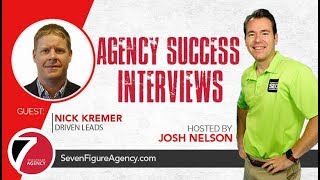
In this 7 Figure Agency Podcast episode, host Joshua Nelson interviews Nick Kremer, founder of Driven Leads, a decade‑old digital marketing agency that specializes in pay‑per‑click (PPC) lead generation for real‑estate agents and broker teams. Kremer explains how the agency entered the niche by accident through a family‑friend referral, grew to about 100 active clients without spending any marketing dollars, and now generates $65‑70K in monthly revenue with a lean team of four employees operating from a compound on a 5‑acre property in Iowa. The conversation covers the agency’s client acquisition strategy (word‑of‑mouth, mastermind referrals, active participation in Facebook groups), its service model (Google/Bing PPC, Facebook remarketing, month‑to‑month contracts with no setup fee, flat fee up to $5K ad spend then 10% of spend), and why they deliberately avoid SEO and custom website development. Kremer details operational practices such as using Data Studio with Supermetrics for reporting, Infusionsoft/ActiveCampaign for automated emails, RingCentral for phone and texting, and a proactive client communication approach that includes monthly calls and text check‑ins. He shares insights on team structure (project‑manager roles, interchangeable responsibilities), the importance of transparency with employees (open P&L, shared goals), and key lessons for agency owners: maintain legal and financial counsel, foster a culture of honesty and giving back, and stay humble and hungry. The interview provides a practical roadmap for building a scalable, niche‑focused digital agency.
Chapters
This is the 7 Figure Agency Podcast. Discover the strategies and techniques to grow a highly successful and profitable digital marketing agency with your host, Joshua Nelson.
What's up everybody? Thanks for joining us on today's episode of the 7 Figure Agency Podcast, where this is part of our Agency Success Interview Series, where we're interviewing successful digital marketing agencies from across the country in multiple markets and multiple verticals. And today I'm super excited to be interviewing Nick Cramer from Driven Leads. Nick, thanks so much for joining us today.
Yeah, happy to be here.
So Nick and I met, uh, I guess in a, in a mastermind with Mike Rhodes. It was about 2, maybe 2 and a half, 3 years ago now.
Yeah, 2, I think 2 years ago. Yep.
And I was just really impressed by Nick. He's got a great business, a great, a great acumen. And so I thought he'd be a great person to have on the show. So Nick, if you don't mind, just kind of give us a little bit of an overview of yourself, your agency, and kind of where you're at in your business.
Sure, so my agency's called Driven Leads, and my business has been running for about 10 years now. We're kind of unique where we jumped into a niche by accident. It was sort of on request from some family friends for us to do some marketing for them for real estate side for lead gen, and then enjoyed it, got good with it, and then just ran with it. We've got, you know, We've got about 100 customers, give or take, on a given month. Been doing it for 10 years and haven't spent a dollar in marketing for ourselves. So, we're kind of lucky in that sense. But the real estate industry, just like any other industry, they do their masterminding. They talk with people across the country to try to figure out how to do things better. And our name gets brought up, luckily. And we've been blessed to have a bunch of great clients that push our story and help us out with that.
That's awesome. So I think one of the toughest niches out there, in my opinion, trying to generate leads for real estate agents, and you're obviously doing it well with 100 clients in that space. Can you talk about how you've been able to make it work in that, in that industry?
Yeah, um, so the big thing that we do is we, we try to establish a good relationship right out of the gate with our, with our agents because it does take time. You know, if we're generating leads and, and typically we're doing lead gen inside Google and Bing on that pay-per-click model, it's a, it's a 6 to 9 to potentially 12-month maturation process for them to get a lead in, talk with that lead, establish a relationship, and then, and then do a closing with them. So with our clients, we start out of the gate and tell them we're not going to do a setup fee and we don't do contracts. So it's a month-to-month, and we tell them we're going to invest time and money into their program with them alongside And what we're— and we— and I'm very open with that, saying we're doing this because we want you to know that we care and that it, it is going to take a little time. So you're going to see probably 90 days before you get your first closing. Um, and then from that, it should be a, you know, it should be a very profitable program for you if you do what you're supposed to do. And then also help them work through it. So working with over 500 agents in the last 10 years We see what the successful ones do. We see what little tips and tricks that they do and how their follow-up is. So we, if we've got an agent that we know is struggling, we, we sit down and walk them through it. Um, we don't want to be coaches by any means. If they want to coach, we know some great coaches in the real estate industry. But at the same time, we can, we can get them over that hump and say, you're not far off, you just got to fix this or this. And I think that was, that's what sort of separates us from from other, uh, you know, other vendors in the, in the system and from our potential competitors is that we do sit down and sort of tell them, hey, our, uh, we're not going to do a contract, we're not holding you to 6 months, we're not holding you to a huge down payment, we're gonna, you know, we're gonna get into it and invest in it with you, uh, and then we, we need you to be successful for us to be able to maintain our business on our side. So it's not an easy industry to be in, um, it's constantly moving, there's constantly ups and flows, and there are a ton of, a ton of realtors in the industry. Honestly, in the last 10 years of us doing this, we've seen a lot of, a lot of changes from the Google side, from the real estate side, from, you know, Facebook coming into the, into the mix. So it's just constantly being, uh, you know, trying to evolve into what, what that client's needs are. No doubt.
So, um, When you deal with real estate, is it, is it the, like, independent agents, or are you typically dealing with the broker with a bunch of agents under them? What does that mix look like in your, in your business?
Uh, we, uh, we don't discriminate. We take on, you know, we, we typically work with an agent. We used to have a perfect, um, a perfect client model where our client was a full-time agent, wasn't a part-time agent. They, you know, they did between 12 to 24 closings a year. It was them and maybe one other buyer's agent, which knew. And then they would come to us and say, we want to double our business. That's an easy model for us to do. Okay, we can get you 12 or 24 more closings a year by following this pattern. Since then, we've, we've had some of those agents— I think two of our biggest clients now started out with a small budget of, you know, Hey, we're going to spend $1,500 on this, and now they're at $30,000, $50,000 a month and have massive teams. So we, we just buy on the, the fact of, of working with them and staying with them for 7 years and them growing. We now work with large teams, so we'll work with just about anybody. It's got to be a good fit for them and for us, but at the same time, we work with brokers that have teams, we work with agents, we'll talk with brokers and tell them If you're feeding your agents these leads, this is how they need to be, you know, this is how they need to be handled. When you're working with an agent and it's their money on the line, um, dollar for dollar, then it's usually not as hard to motivate them to make sure that they're following up quickly and being attentive with the leads. And then when you're working with— if you're working with a giant brokerage that, um, you know, that has hundreds of agents, then you sort of want to get out in front and say, hey, listen, I'd like to see what your plan is when these leads come in because we want to make sure that we You know, that they know that we're going to be getting them a better quality than they're used to, and then also make sure that they're, they're working them appropriately so their conversion numbers, you know, show that. So it's, it's just about, you know, anybody we can work with, just about anybody.
Yeah, interesting. I would have thought you'd say it was just the brokers. That's good. You can kind of be flexible on that front and kind of meet them where they're at, right? What is your goal? And help them grow and scale and maximize their their closings really through online marketing.
Yeah, no, it's—
I lost you for a second. Are you still with me or did we get cut off here? Oh, I think I got you back.
Sorry about that. I think I got— Had a blip in the screen here.
No, no worries at all. So then, so with 100 agents that you're working with, can you talk a little bit about like what's the approximate monthly or annual revenue for the business at this point?
For us or for them? For us?
For you, yeah. Yes.
So it's, it's a, you know, we're right around $65,000, $70,000 a month. Um, yeah. And it was like I, I had mentioned to you before, it was higher before. Uh, we had, you know, everybody has their ebbs and flows. We had a— we hit a valley with, um, you know, we're a family-oriented shop here. All my employees are like family to me. Some of them are related to me. We had some, you know, we had a really bad run with, with cancer in 2018 with a bunch of family members having hits on that. So we had, we had people that were gone, we had different focus in life, and, and we also just sort of— I got complacent. As a leader, I got complacent and we went down on that, but we're pretty excited about the next 6 months and where we're going. We've got it refocused and we still have a good core of clients. Their side of things, they didn't see much difference in performance, but for us, our side, we just had to refocus and get back at it.
Nice. Well, I mean, congratulations to be at like $70,000 per month and just feeling like, there's massive potential right in front of you when you start to ratchet the marketing up. That's phenomenal. Going back to like how you got to the niche, it sounds like, you know, the niche chose you in your case. You know, you had a couple family members that said, "Hey, can you help us generate leads for a real estate office?" And you kind of said, "Oh, let's give it a shot." And you kind of proved the model. Can you talk about how you, for those first couple clients, how you kind of proved the model and generated the results to get the confidence to go out and sell more?
Yeah, I had sort of a template from a family friend. Um, his brother-in-law was a broker, was a friend of mine as well, um, reached out and I was doing— I was running web hosting companies at the time and didn't really enjoy that, uh, that industry and was doing marketing as a sort of a hobby for some of our clients. We had a bunch of clients back then, um, and he sort of came to me and said, hey, I had this person doing this, they disappeared, they weren't reliable. Here's the model, this is what I'm looking for. We reverse engineered it and did a pretty good job of it. And we didn't know if we were doing good or bad, but we started setting it up and he came back and said, hey, this is awesome. I've got 3 other guys that I mastermind with throughout the country. Uh, can I give them your name? Sure. What do I charge them? You know, and, and we really didn't know. And it sort of came to, well, this is what the last guy charged me, so, you know, you can do whatever you want. We got a couple more, a couple more, and then it was sort of a snowball effect where, uh, the great thing is, is that again, when with mastermind groups and in your guys's group, if somebody finds a solution or a package that works really well, they want to go out and tell all their friends and be that, you know, be the hero in the group for the day. So we became that, that new shiny object and just sort of realized, hey, I think we've got a niche here. Um, we didn't— we don't have to sell ourselves, they're going to sell it for us. And and we're going to use their money to learn how to run the program properly. So we actually, I mean, very lucky in that sense. And again, with the clients that we've had, very blessed with them too. Like, we have a lot of great clients that we can talk to and say, hey, we'd like to try this or this. And they're like, 100% agree. You know, we trust you to do what's best for us. So we really did kind of accidentally jump into the niche, didn't pick it, and it sort of picked us. So So, we've been lucky in that sense.
That's awesome. Yeah. I mean, I think sometimes that's the best way, right?
Yep.
To try and choose the niche on the front end blind is tough, but if you kind of put some feelers out, you see where you have success, kind of follow the path of least resistance, a lot of times that niche will find you and it'll just be a great synergy and a great fit to build upon.
Yeah. And honestly, you know, I didn't know anything about the real estate industry. I don't have a license. I don't plan on having one. It's not anything in my interest, but we've had to learn and everybody in the office has had to learn about the real estate industry. What are sides? What are brokers? Broker cut, all that stuff that comes with it, we sort of had to learn that. If you know that, then when I talk to people about getting in a niche, the riches are in the niches. But if you're niching in something that you have a base of or you've worked in before, that definitely helps cut that learning curve down.
Makes life even easier.
Yeah. Yeah.
So can you talk a little bit about the services that you provide? Like, what is it that you actually do? What the, what the deliverable is to the clients you work with?
Sure. Um, our straightforward base main package is we do, uh, lead generation, uh, PPC management in Google and Bing. Um, and it's a, it's a straightforward month-to-month, no contract, no setup fee. And 9 times out of 10, that agent comes to us, they've already got a website platform. There's 5 or 6 basic platforms that the, that the industry uses to generate leads at a good clip. So they're, you know, again, they've already got that site established. So we'll manage, we'll get everything together and manage that PPC. We'll manage, you know, get them into Data Studio reporting. They do all the lead management on their side. We just, we basically just manage their ad spend. So we're, we're doing that in that sense. We've done a bunch with Facebook lately and doing remarketing. So we've got some other add-on packages that we do, but you know, somebody comes to us and says they just want to do Facebook only, um, they've, they've got to have a real strong SEO background. You know, they've got to have a lot of organic traffic coming to their site for us to do that because we don't like doing anything but remarketing and Facebook. So It's a, it's a real simple package. You know, when we get into Facebook, there's a bunch of different little things you can do. If we want to do listing ads, if you want to do open house stuff, if you want to do, uh, new price reduction ad, there's a ton of different ads that way. But the packages are all pretty much the same.
Nice. So it's a focus on generating leads so that they can get listings or sell homes. Um, are they charged on a per lead basis or a flat monthly fee, or it's a flat monthly fee?
Um, we've got some agents that that will go past, you know, it's flat monthly fee up to $5,000 in ad spend a month. After they go after that, we just do 10% of the ad spend. You know, when you, couple of things in our industry, you can't, we couldn't charge them, we could charge them per lead and generate that on our own. We can't do a commission cutoff of the deals because that's illegal.
It's against the law. It's against the—
Right, I'd have to have a broker license. And again, I'm never getting licensed in the real estate industry, so. Right. You know, there's some, there's some that go out and do that because they, they are licensed into the industry and they just pull it off. Yeah, they send out a referral and then charge you on, on per closing cost. But ours is a— ours is the least amount of friction and it just makes sure it's easy for everybody to understand.
Awesome. So, I mean, it sounds like nice tight package, uh, you know, a couple variations in terms of upsells. I believe based on previous conversations, you kind of strategically kept yourself out of doing the website development and doing the SEO type stuff. Can you talk about that, kind of the struggles and why you decided to stay out of that side?
Yeah, with SEO, back when I was doing the web hosting side, I actually did auditing and SEO consulting for a couple of Fortune 500 companies and understood the industry well. It's just a tough, tough road to climb. And when you're talking with real estate side, there's only a very small amount of people that understand the SEO and understand the time it takes to grow that traffic. And I just don't have the patience for it, honestly. I actually have some people that we refer over to, you know, if a client comes to me and says, I want to get stronger in SEO, we can point out a couple things they need to get done right. But at the same time, we'll we'll send them over and say, hey, listen, we're gonna give you two names to pick from that we like and we enjoy. We don't get referrals from them, but here's your route to go. And then with the website side, there's some people that have their own custom websites, but custom websites are gonna cost them between $50,000 and $100,000 to do. They're gonna have to maintain it. And we don't wanna get into the design side build. We do use Unbounce for landing page stuff if it's, a certain project. Like I said, we've got a couple of clients that are not in the real estate industry. We've got 3 clients outside of real estate that we use Unbounce for. And we'll do design stuff for that. We won't really charge anything 'cause it's pretty straightforward, easy. But just for, you know, just coming from web hosting and having a complex package of, hey, we can do this, this, this design, it was just easier for us to make a clean cut and say, we just do lead generation Nothing more, nothing less. It also allows us to, it helps me with my employee side thing. I know you'd asked, what do we do for outsourcing? We don't do any outsourcing. It's not needed because of the fact that we don't do design work, we don't do link building. It's straightforward PPC management.
Nice. Yeah, I mean, I like that model because you don't wind up having to get your hands into so many different things, right? You're running a paid campaign, you run that as effectively as possible. You can control your, your lead flow for the client and, um, and really show what it is you're bringing to the table, which, um, which is, which is wonderful. Um, as it relates to, to, you know, to team structure, since we just talked about that, uh, what does the team structure look like? And how do you, you know, 100, 100+ agents relying on you to generate their leads, how do you manage that, um, as a company?
Yeah, so, um, we manage expectations at the forefront of the, with the clients. So let them know, hey, we're not gonna charge you an arm and a leg, but at the same time, if you're only spending $1,500 a month in Google, there's only so much we can do without blowing up your campaign. So we're not working on it every day, we're not making changes and looking at it the next day. So the amount of accounts that we can manage per person at the office is a lot easier. So we said, kind of shock people when we tell them we've got about 100 clients and right now I've got 4 employees. Nice. And it's a pretty easy management. We've got some clients that spend that $30,000 to $50,000 a month and they obviously, we work on those accounts a lot more and do a lot more work in them. But as far as workload, you know, when you're running those campaigns and it's nice to be able to see those campaigns are all identical across the country. You know, there's different terms and different setups that people are doing for, you know, Florida search is different than Seattle search where people are searching for stuff, you know, there's different terminology in New York City than there is in San Diego. So other than that, there's not much variance in trying to find, you know, that new keyword diamond in the rough. But at the same time, you know, where our clients understand that we're We're not doing everyday work, but we're keeping an eye on things every day, making sure things don't explode and doing some automation on that to keep an eye on sites. But as far as the structure for employees go, everybody's a project manager, everybody can do everybody's job. There's, you know, all interchangeable parts in case somebody's gone or somebody's got health issues like we've run into. So that actually helped us through those tough times too.
So, I mean, that's awesome to have that volume of clients, that amount of revenue with what seems to be a pretty manageable cost overhead structure. Do you guys work out of an office or do those—?
Yeah. We've got an office that actually is on, I call it the compound. I've got a property we purchased about 3 years ago. I built an office that had a large shop on it, 5 acres with a pond and built my offices inside there first. And then we built our house after we had the offices set. So, Everybody sort of comes on site and it makes, uh, makes workflow a lot better.
How cool is that? So you get your house there that you built and then you've got a little separate entity that's, that's where your office is. Yeah, you basically walk, walk down the property to your office. Is that right? Yeah.
Yeah, it came in handy when we had, uh, -52 degrees in the winter here. So nobody else came to the office, but I walked. I told everyone, everybody, I walked to work that day. I don't know about anybody else. It's about a 100-yard walk, but it's an easy one.
That's cool. I think that's the first I've heard of that. That's a great way to really simplify your life. And now, you've made the investment in the property and your cost, you know, for having the office is practically nil, but you still get the teamwork benefit of, you know, having the team come in and work together. How do you recruit? Like, because you're based, is it remote somewhere, you know, kind of rural in Illinois?
Is that right? It's in, we're in Iowa. Actually, our metro area is about 490,000 people. So we've got a larger metro area. We're right on the Mississippi, about 2.5 hours from downtown Chicago. For recruiting for clients, you mean?
No, I'm saying for recruiting for team members. Team members?
Yeah. Yeah, there's a good pool here. I mean, the wage level is not astronomical. We would pay much less than you would pay in a large— like in Chicago even. Cost of living is really good. It's a very conservative area in the sense that when the recession hit, we didn't have a ton of foreclosures here. So, there was— everybody sort of is a— it's a real easygoing metro area. It's the headquarters of John Deere is where we're actually located in that area. There's some good work. There's some good employment pool here.
Nice, nice. So, so you've got, you've got the team structure, you've got the folks there. What, like, what do you report back to? Are you doing monthly review calls with these clients, or is it more, you know, showing them what's in Data Studio? Can you talk to us a little bit about that?
We try to, um, so we tell all of our clients, we'd love to be on the phone with you once a month. Uh, if it requires more, that's fine. Our phones are always, always, uh, always on us, always ready to go. Uh, we give them a weekly report Data Studio, we do an automated email out of Infusionsoft. We'll be moving to ActiveCampaign here in the future, but essentially it's an email that sends the same link because we can tell them to save that link and go back to it each week, but they won't. They don't, right? Yeah. So you send that automated email. Now Data Studio actually has those automated emails that'll send out now. It's a new feature that they have, which we might even move to that. But they get a weekly email and then they get the first of the month, they get an email on the— we've got a month report, weekly report. So each client has two reports that they set up. They're customized per what their solutions are with, you know, showing them what you spend last, you know, this week, what you spent the week before in comparison, comparison from month to month. It's separated out for Bing, Google, Facebook, um, and based on if they're doing buyer lead generation or seller listing lead generation. Uh, and then again, so once a month call is what we'd like to have. I would say 60% of them don't. Like, we'll say, hey, do you want to do a call or do you want to get a scheduled setup? Nope, no, we're good, or we'll call if we need anything is usually what we get for an answer from that. And that's great, you know. We— the other problem is, is out of sight, out of mind. We'll have a couple of clients that we think are doing really well, and then all of a sudden they'll pop up and say, hey, um, things haven't been— we haven't, you know, closed the deal from this to this. We would have liked to talk to them about it. So we've gotten a little bit more proactive in texting. We got their, we've got their cell phone number and agents are always on their phone. So text them saying, hey, it's Nick at Driven Leads wanting to know how things are going. Did you want to set up a call? Um, you, you know, is there anything you want to test or try? So that's, that's something that we've been a little bit more proactive with and it's worked well.
Yeah, that's a great, that's a great insight. You know, we think about text messaging from a marketing perspective to generate leads and communicate with prospects, Well, we don't usually think about it when we shift to the account management side. We just go back to old emails and think that they're going to get the emails. Leverage text messaging to your client base. So use that as a two-way communication mechanism. Are you doing that through like an Infusionsoft, or do you actually just physically send them?
We don't right now. We have— we use RingCentral for our phones. Okay. So from the naked eye, everybody believes it's my cell phone that they have. It's a different number. I can text in and out on it. You know, with the move to ActiveCampaign, we might get into doing more automated texting. We haven't really— we haven't done that personally. For, you know, for collections, it works awesome too, honestly. You know, we send out that automated invoice and we might get 5 to 10 days out, and then all of a sudden, you know, you send a text and say, hey, just making sure that you got that invoice, everything okay? You get a reply. So that works great too for texting.
Yeah, I would say like, so our team, we use RingCentral as well, and our team, like our account managers, all have their own number and they text message with the clients on RingCentral. It works really well. And since it's coming through the app, you're still doing it on your cell phone, but you can also choose to do it right through regular, regular text, which is, which is pretty—
yeah, no, that's been real effective. RingCentral is something that we've been, you know, we did the Grasshopper, we did the BroadVoice or whatever it was, and, and we've been with RingCentral for a while, and you can attest it's a, it's a solid solution.
No doubt. Yeah, absolutely. As it relates to the reporting, you know, Data Studio is pretty complicated to get set up. How did you do that? Did you hire a programmer? Did you do it all yourself?
Like, uh, no, we muscled through it ourselves. I— it was actually, it's, uh, Mike Rhodes and I were— when that first came out, Mike's like, hey, did you see this? We were using, uh, Raven Tools for reporting before. It wasn't overly expensive, but there was some stuff that we didn't like that you couldn't change, you couldn't adjust, it couldn't you couldn't pull in. And then when Data Studio came out, Mike and I just started tooling around with it. He had one of his guys work on it, and then we got— I just, I got lost for about 20 hours in it one week and came up with a report. And we've used similar model from that from the get-go. So we learned Data Studio when it first came out and have been using it religiously since. Nice. It's very— it's a great solution. It's easy for sharing to show people. You can show as much or as little data as you want. We've got, you know, we've got, you can customize each report any way you want. I've got a message on one of the reports. A client likes to pay, you know, they've got a budget of, let's say, $2,000 a month in ad spend, but they, if they don't spend that, they don't want to pay that into the, into the model the next month. So I got a report that we send out customized the day before the end of the month saying, here's what you spent for this month. So, you know, here's what you need to budget and put this in. So it's— I mean, you can do just about anything with it, and they absolutely love being able to get those reports too. That's cool.
And, and is it— there's no hard cost associated with doing Data Studio as an agency unless you get to a certain— is there a threshold where it doesn't?
No, no, no, it's, it's 100% free. I don't know if they'll have a pay— now we do pay, uh, for Supermetrics. So Supermetrics allows us to pull in Facebook data and Bing You can also cross that, that stuff. So if somebody says, hey, I want to know what I'm spending in Facebook, Bing, and Google, and maybe they've got Google AdWords here and then they've got another Google account for YouTube, you can pull all that and aggregate all that data together with Supermetrics and put it into one spreadsheet and then push it into Data Studio. So we spend, I think it's like $88 a month for Supermetrics to do that piping of Facebook and Bing, but totally worth it.
Yeah, not bad, not bad at all when you compare what we're paying for some of our reporting, right? In, in your space, is it mostly, uh, web form leads, or is it call-in leads, or is it kind of an even mix of both?
Well, uh, unfortunately, uh, real estate agents aren't great at answering their phone too often. We do have some call-only ads. We don't do them a ton. We do, we do track phone calls, but 90% of the leads are are them, you know, filling out a web form and then being active on that client site. They've got some good CRMs that, uh, that again, it's like 4 or 5 large platforms for the real estate industry that have a CRM cooked into the website so they can see what listings they're looking at, when's the last time they were online, you know, if they're active right now. Um, so that's where agents usually prefer to have that. They love a phone call, but when we've tested it, we've had a lot of them that, that just don't answer the phone.
They flake out on the— they flake out on the lead. So you're like, let's just get the web form so they can follow up at their— at their time.
Yeah, that. And, you know, it's funny when you're working with a team or a broker, you say— he says, well, I want all the phone calls because those are really good leads. Okay, are you gonna answer the call? Probably not. I mean, he'll admit it. He's like, no, I'm pretty busy, probably not.
So let's not bother. Like, let's just bypass that whole thing altogether. Yeah, yeah, very, very cool. So we talked about this a little bit, you know, now we've kind of— we've talked about the services you offer, the kind of the client base, how you're retaining that client base. Um, you landed on this first handful within the space from, from referral. Can you talk about your first 5 clients and how you got those and kind of how you developed them out of the proof of concept phase?
Sure. Uh, first 5, first 5 clients I, I know of— I know for sure what the first 3 were. They're still clients, uh, from 10 years ago. Um, that's a testament to the type of work you do.
Yeah, yeah.
And they were— the nice thing was, is those clients were well-versed in lead gen online. They were looking for something better. They were looking for, um, you know, they were looking for honesty and for somebody with integrity and somebody that would be, you know, open and upfront with what they're working with and being sort of a partner in that lead gen side. So What we learned from those first 5 clients was that, you know, be yourself. Um, and, and, you know what, not only be yourself, but then also be open and honest. Hey, this is— we're struggling with this and this. You know, there's— for us, if we're working in a metro area and there's 6 subdivisions and they give you all those that they want to work in, and you've got one of them that just isn't doing well performance-wise, we go to them and say, hey, can we shut this down, or is this extremely valuable? Are these leads good quality? Because you're paying double for them. So the big thing for us on our end is that we learned with those first 5 clients, and again, lucky that they were well-versed in it. Um, they, you know, they were, they were quick to respond. They were open to us testing stuff, and they understood that we didn't, we didn't know, we weren't savvy in the industry and savvy in that, in their, their niche. Um, and we also didn't charge them hardly anything to start out with. And they've actually allowed us to adjust what we bill them because we're doing a different job and doing a lot more work for them now. So they're, they're again some of our best clients. That's awesome.
So, so just kind of learning it as you went, very cost effective, proved your value, increased the price over time. And it sounds like you kind of tapped into a network of, of agents that were kind of a tier ahead. They're not your average Joe agents, they're kind of a tier ahead, and they mastermind together, and they plugged you in across the country.
Yep, yep, that, that's exactly right. There's only— there's 1.1 million, uh, registered real estate agents in North America, or licensed real estate agents in North America. There's— of that, there's 1% of them that sell 90, you know, 90-95% of the homes. Um, and of that 1%, there's, there's maybe a 10% of that that would qualify and be able to work with our solutions. So it sounds like a very minute, but that's still 10,000 agents that we have the potential to work with. We also identify with— there's only so many markets, so we don't stack in markets, uh, heavily. We have that open conversation. So it's, it's kind of ironic, but some of our clients know the exact person that we work with in their market with them, and we'll call them and say, hey, so-and-so is looking to come in and generate, and they're going to do something a little bit different than you. And we'll ask them Are they a good agent? Have you ever done a deal with them? You know, are they reputable? Are they going to be good for our program? And we've had some that are honest and said, I would, I would run from that person. Or they said, he's a great guy, I can't talk bad about him. So, um, that's, that's been great too, to have that relationship with some of our clients. No doubt.
Very, very, very cool. So I mean, it seems like a lot of times these interviews, the joint venture, even though this isn't a traditional joint venture kind of the, the affiliate network that you get plugged into can be one of the most powerful sources of growth within your digital marketing agency. So this isn't one of those cases where one guy kind of introduced you to everybody, uh, and got a percentage of your revenue. It was more just a case where you did work for him and he wanted to brag to his friends and kind of make the connection.
Yeah, and honestly, I'm happy I went that route. We've been, we've been offered affiliate stuff several times. And I've always told them I don't take revenue off of any of the website vendors that we refer. We don't do affiliate deals with any of our clients that we refer. You know, there's been time or time here or there where clients referred over like 3 people and we just, you know, wiped out their bill from us for a month or two and then just told them after the fact, hey, we're not going to bill you for a couple months. We appreciate you and appreciate what you've done. Honestly, the people that have come up front and talked about how important they are and what they can do for you in the industry, those guys are people that you might not want to, you know, associate yourself with. You can do work with them, but at the end of the day, something's going to go bad and they're going to end up speaking, you know, ill of you instead of how great you are because they want an X amount of money, you know, up front or in recurring revenue. And it's just, it's a model that never sat the right way for me. Because I don't want people going out and, you know, saying, hey, go work with Driven Leads, they're amazing, and then, you know, it comes back that this guy's getting 10% of everything that he generates for us. It just, it makes us look like we're not good at what we do and we can't do that ourselves.
Interesting. Yeah, I mean, so, I mean, different, you know, paths work different, you know, for different people. So that's amazing that that's worked well for you. Can you talk a little bit about where the clients come from today? Like what types of advertising and marketing you're doing to generate new, uh, new clients on a consistent basis? Uh, word of mouth.
10 years in, we haven't spent a dollar in marketing ourselves. Um, good, bad, or indifferent, you know, I, I always tell myself I need to start, you know, marketing ourselves and getting ourselves out there, or just doing more webinars and doing more informational videos for people. Um, but right now it's all word of mouth. Uh, you know, we've got a couple of real estate coaches that, um, have asked their, their, uh, their coaching clients, say, what, what the heck are you doing to generate this much more from you did from what you did last year? And they point back to us. We talk to those coaches, and then those coaches want all their other coaching clients to, um, all the other pupils to come and work with us because it makes them look good. So they can go back and say, yeah, look how much Our clients have grown from us working with them. So, I mean, that, that's great, great model for us. But yeah, it's, it's all word of mouth right now. Facebook is a really good spot for us on that, where people will reach out or tag me on it. Somebody has a question on something, I'll go in and answer it. At the beginning, it was me being heavy in Facebook groups for the industry, answering questions honestly and openly, um, you know, giving them advice, you know, sound advice, and not asking for anything in return. You know, don't do as much as you want to do it. Don't do a direct message to a bunch of people that are asking, you're looking for something, go on and answer the question out in the open in the group, and you'll have a ton of people that direct message you first. I think that's a, you know, we've got a bunch of competitors that have come and gone over the last 10 years, and that's what a bunch of them would do is they, I would answer a question and they would direct message, say, hey, we can do that too, let's get on a call. Right. Have we lost clients by not doing that? Yeah, I'm sure we have. But at the same time, they probably weren't clients that we wanted in the first place. So, you know, just being, being accessible on, on Facebook and answering those questions have done a world of good for us. And then just being referred. Nice.
So it sounds like for you it's just being really good at what you do, being authentic, being honest, um, you know, and kind of getting, getting people to introduce you and refer you. I found that the Facebook group strategy works really well. Getting these groups, you know, being present, engaging in the conversation. How did you identify those groups, or was it just because you had a couple clients and they said, hey, come join this, this group? Or— yeah, there's, there's some of that.
It was a couple of our clients, first few clients said, hey, I— somebody asked a question online on this group and you're not in that group, can you join it? So I'd join it. You know, and it's usually run by a realtor or a broker that has an ulterior motive of making money off of their group. And, you know, some of them would say, well, I don't know if I want you in here. And I'd tell them straight out, I'm not, I'm not here to sell my services. I'm here to make your group better by answering questions that it doesn't seem like you guys have anybody answering. So being open and honest with them, saying, hey, I'm, I'm a vendor, I'm not a, not an agent or a broker. This is what we do, and I'll never sell, and you'll never You'll never see anybody accuse me of direct messaging. So jumping in those groups early and then answering those questions. And the ironic thing was, is, you know, 4 or 5 years ago, we were getting a bunch of referrals from agents that'll go in and just try to soak up information. So if somebody jumps in your group and they're new to it and they're asking questions and soaking up all that information, I would answer some questions and maybe jump on a call with them and tell them, you're not a good client fit for us. Do this, this, and this, what you can do for free to make your stuff, you know, to work well. Once you get a business established, we'll be here ready for you. And they absolutely love that. So we'd get referrals from them. Hmm, nice. And they would say that. So just being, you know, just being yourself, and if you have that knowledge and you can share that, you know, it sounds crazy, but giving gives back so much more. And I think you've seen that too. I mean, I think anybody successful that is open and honest and giving, and you know, they receive tenfold from what they give. And it seems crazy, but it's true.
No doubt. Yeah. There's times you sit on these calls, you're like, wow, that was 45 minutes, an hour of my time, just kind of giving information value. I didn't charge a consultation fee, but it does always come back to you in those cases. Even when you start to be like, man, that was like probably not the most productive use of my time. It really was. You were planting a seed that usually grows into something that pays dividends. That's great insight. Something really valuable here that I hope everyone heard to take away, like when you join these groups and they ask you, like, why are you doing this? You're not an agent or you're not a contractor, you're not whatever space you're in. You know, tell them, look, I'm not gonna go in and sell in the group. I'm actually here to help make your group better by answering questions. But then you actually have to do that. A lot of the training out there will tell you, you know, try and infiltrate the group and like all of the people and send them personal messages. And even though that's kind of anonymous to the, you know, to the administrator of the group, that's not really the classiest play. And what he's talking about is having some class, you know, actually going to the group, adding value, answering questions out in the open, and then letting the people that are a good fit kind of gravitate to you. Yeah, I think that's, that's a really good insight. Yeah.
And it, it, it, it rings true today more than ever, honestly. Yeah.
No doubt. So, you know, you've built, you've built what is practically a million-dollar digital marketing agency. And I'm sure in the, you know, the next 12 to 24 months are going to be hypergrowth for you. You know, just looking back over the years, what would you say are like 3 big lessons that you've learned that the other agencies listening to this can, can learn from?
So I'm huge in, in giving in my community. So I'm big in Junior Achievement. It's throughout the country. I didn't grow up with Junior Achievement. It's in schools and it teaches its entrepreneur spirit. So it teaches financial literacy and work readiness is what Junior Achievement does. When working in that, you talk a lot about being an entrepreneur. I tell everybody that I run into that's an entrepreneur, If you're making over 6 figures and you don't have an accountant or an attorney, then you're about to get in trouble. And you should have both of them, and you should become friends with them. You should know, like, and trust them. Um, we don't use our attorney very often. He's actually become a really good friend of mine. But, you know, as a— you know, running an agency, you need that. You need that in place. Um, and, you know, you can use the— you can use the online, uh, legal tools too. They work great. My attorney actually says, yeah, fill that out, send it over to me, I'll amend it, and it'll save you money on the long run for it. Nice. So all entrepreneurs need to have an accountant and attorney, no doubt. So that's one of the lessons I learned the hard way early in the industry, early in business. And then also, when you're, you know, everybody says hire slow, fire fast, you know, I Yes and no with that. Be open. Let your, you know, if you share the same goal with your employees, then you're gonna be a lot more successful. I've got, you know, we're looking towards and we're moving towards this, but one of my most successful friends is a business owner, does an open, you know, an open P&L to all his office and says, we're gonna do baseline, you know, baseline every quarter, bonuses, and it's based off of this. He does an open P&L, a profit and loss statement, to a point. It shows, hey, here's what we spend on all this stuff. It doesn't itemize who makes what, but then sits down with each employee and says, here's, here's, here's our goals as a, as an office, as a group, and I want you to set a goal and, and tell me what you think you can do, and let's set your baseline for, for your bonus. If we, if we hit that revenue, everybody wins. I think that just makes a lot more, a lot more opportunity for success and a lot less resentment inside the office too. And that's something that's been a painful learning experience for me as I've grown as well. And that, you know, the third big thing is give, you know, give your time, whether it's locally, give your time, whether it's online in those groups. Give your time to somebody that could use it because you never know who you're talking to, right? You could be sitting next to a billionaire on a plane and talking about something and giving your insight to— if they ask for it, be open and honest. The next thing you know, you could have a deal that came out of nowhere. That's happened to us a couple of times where we've had people come to us and beg us to work with them because they knew we knew what we were doing and we didn't realize who we were talking to when we were doing it. So, um, just give. It's, you know, it's, uh, those three things there I think help formulate a successful, uh, successful agency and one that, that will stay open for as long as you want.
Powerful. Yeah, I love that, man. Give it to the community. Make sure you get yourself covered with an accountant and/or, and an attorney. Hire slow, fire fast, but not necessarily, right? Better to be open and honest if they're doing a bad job, like share where your concerns are. And, you know, think about maybe sharing the P&L so that everybody's on the same page with a unified goal. Yeah. And then give, you know, be willing to share, be willing to help, because you never know who you're helping out. Awesome, awesome stuff. Any— we're about to the end of the interview here. This has been great. Thank you so much for sharing. Any like last nugget of wisdom you'd like to share before we wrap up?
Be humble. You know, I openly admit mistakes that we make. I think by doing that, it sort of makes me not make those mistakes anymore. You know, everybody makes, you know, everybody, it seems perception is, hey, what a great life, what a great setup, what a, you know, you got this property, this business. I got complacent and got humbled last year. And you've got to be humble. You've got to stay hungry. You've got to have something that you— that really makes you want to get up in the morning and work at. If you don't, you're in the wrong industry or you're doing the wrong thing. Not everybody's an entrepreneur and some people try to fit that square peg in round holes. Not the end of the world. You could be a consultant, do something really good, find somebody that ignites your fire and you can work for them. I see that a lot, people trying to force themselves into that entrepreneurship when it's just— it's not what they're— it's not what they should be doing, right? Yeah, that's, that's a big thing. Be humble and chase, chase something that excites you. If it doesn't excite you, get out. Um, sounds crazy, but that's, that's how I went from my first industry to my second one. Web hosting I loved for a bit, and then I absolutely hated it and got out as fast as possible and lost money on it. I mean, you're gonna lose money if you got it, if you got to pivot that quick. So, um, that would be my other, my last sort of bit of wisdom to anybody doing doing what we do and being crazy like we are to try to, try to run this, uh, rat race of running a business with the online base.
Great, great stuff. Well, Nick, thank you so much for your time. Thanks for your willingness to share. Um, guys, if you got value from this, and I know that you did, you know, Nick's in the 7 Figure Agency Group. Make sure you tag him, make sure you thank him. Uh, sounds like Nick is— he's willing to kind of help answer questions. So, you know, feel free to reach out to him in the group. And, uh, Nick, thanks again. I really appreciate you taking your time, and congratulations on your, on your continued growth and success.
Thank you, I appreciate it. And if anybody does need anything, you know, hit me on Facebook. I'll be more active in there and respond and answer questions for sure. Awesome, thanks, man.
Well, I hope you got value from this session. If you'd like more ideas, strategies, and techniques on how to more effectively grow and scale your digital marketing agency I'd like to invite you to go to 7figureagency.com. There you'll find a training series completely free of charge that walks you through how we were able to grow our agency from zero to over $300,000 per month, uh, in less than 7 years, and how we're adding clients on a consistent basis. So we walk you through, you know, the quickest way to position yourself as the expert in a particular market and proven models to get customers coming to you preposition to buy. So if you got value from this and you would like more, you can go to 7figureagency.com. There's a free video series for you there. Just get there, you'll enter your name, your email address, and you'll get access in the next couple of minutes. So thanks for joining us. Go to 7figureagency.com now, and we'll talk to you soon.
More from Joshua


From 26 Years in Business to Nearly Doubling Recurring Revenue | Sandy Waggett




How Luke Truetken Scaled His Agency to $110K MRR by Going All In on One Niche



Website Production at Scale - The AI Tool Stack for Modern Agencies with Marcel Knopf

