How Adam grew his agency to over $4M per year serving the dental niche
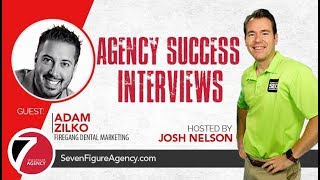
In this 7 Figure Agency Podcast interview, Joshua Nelson talks with Adam Zilko, co‑founder of Fire Gang Dental Marketing, about how the agency grew from a generalist digital marketing firm in 2010 to a $4 million‑plus per‑year specialist serving dentists. Adam outlines the agency’s history, the decision to niche into dentistry, and the service mix that now includes websites, SEO, paid ads, call tracking, call coaching, practice‑management integrations, and advanced funnels. He explains the high‑ROI focus (average 950% ROI), the bundled pricing model, and the client acquisition engine built around costly email blasts, a proprietary book, webinars, joint‑ventures, and referrals. The conversation covers the internal organization: a 30‑40‑person distributed team, dedicated client‑success managers, a COO/operations lead, and KPI dashboards that monitor budgets, churn, and capacity. Adam shares challenges with culture, hiring/firing, scaling operations, forecasting capacity, and maintaining sales conversion rates. He reflects on key lessons—building culture, hiring the right people, avoiding burnout, and the relentless grind required to scale—while emphasizing that there is no secret sauce, only differentiation, hard work, and systematic processes. The interview ends with practical advice for agency owners on sales systems, value propositions, and staying focused on the niche.
Chapters
This is the 7 Figure Agency Podcast. Discover the strategies and techniques to grow a highly successful and profitable digital marketing agency with your host, Joshua Nelson. All right, what's up everybody? Thanks for joining us on today's session of the 7 Figure Agency Podcast. We're in our agency success interview series, and, uh, today I'm super excited to be interviewing Adam Zilko, from Fire Gang Dental Marketing. Adam, thanks so much for joining us today.
Thanks, Josh. Yeah, appreciate you reaching out and having me on.
Now, you and I met through Digital Marketer. You're a part of War Room. I'm a certified Digital Marketing Partner, and I think that's how we first got connected, right?
I think so, yeah. I think it was through Ryan Dice directly or one of those guys.
Ryan Dice or somebody in that group made the connection, and I remember just being super impressed. You know, you're working in the dental space, You've got a great agency that you've built. Uh, I believe, you know, you'll share the figures with us, but, uh, it sounded like you were doing a lot of cool things. And as we've got to know each other over the past several months, I was like, you'd be a great person to come on the show and kind of share, you know, it's not without its flaws, it's not without its bruises, but share the success that you're having within your agency.
Sure, man. Yeah, I mean, um, it's been a long road for sure.
So I guess the best place to start, kind of give us a high-level overview, kind of who you are, what business you run, kind of the lay of the land.
So, I co-founded Fire Gang back in 2010, and we niched into dentistry in about 2012 or so, maybe '13, and then have been just rocking it since. Doing, you know, a lot of your— early on, doing a lot of the standard stuff and then just trying to innovate and stay ahead of the market as much as we could. And that's kind of always where my mind goes, is how do we further press, push the needle and innovate past what we're seeing out there and differentiate ourselves. And so that's kind of where we've really, I think, pushed forward on this. And it's been, like I said, it's been not without its bruises. It's been a long road for sure.
No doubt. So can you give us an idea approximately how many clients, approximate annual revenue in the business?
Yes, we've got, we've got hundreds of clients. Uh, some, some are, uh, it's some are multi-locations. We, we're seeing the kind of evolution of dentists becoming group dentists or DSOs. And so, you know, many of those that we have are just, you know, adding on more on a monthly basis and just bringing them in as they can buy them out and so on. And so we've got that and You know, we do many, many millions a year. You know, you sent out an email on that, so, you know, we pushed around the $4 million mark last year. And so, just kind of grinding through it, for sure.
Congratulations! That's a tremendous success for any agency, and, you know, to do it within the dental space, you know, I know a lot of people have tried, and that's not the easiest niche to to work in.
Certainly not, no. It's really been a difficult niche over the last few years. And just really trying to figure out what works and what doesn't. Unfortunately, we've had the size and investment capital, or not from an outside source, but internally able to invest back into testing what works and what doesn't and try things that we wouldn't have otherwise. And then, being able to take risks that, you know, if they didn't pan out, be able to just afford losses if it didn't, you know, so it's been helpful.
Nice. So, I mean, if you don't mind, it sounds like you started back in 2010, you were kind of a generalist agency and then made the pivot to niche-focused. Can you just kind of tell us a brief history, how you got the business started and, you know, just the background?
Yeah, I worked at an $800 million a year, 100-year-old company. It was a national company, they did print advertising. And back in 2006 is when I started with them, and they were seeing the, you know, the transition of, you know, Google pushing out or pushing out or displacing local businesses and how they would market. And so throughout that process, I was their first digital manager on a national scale, digital marketing manager, to really help educate different divisions, regional divisions. They operated throughout the entire United States and just try to help them bring themselves into a digital age. What I found though is they were very difficult to move. They were kind of used to their old ways, and so a lot of bureaucracy and a lot of things just didn't move quickly. So, you know, when I was seeing websites take 6+ months to go live and they weren't well built and so on. I finally said, you know what, I'm just going to do this myself. And so me and a business partner at the time, we started this up and we went out and started getting clients. And I think we grew to— I mean, we were— we definitely hit 7 figures our second year or so, maybe, maybe, maybe partly into our, you know, 1.5 years or so. So we grew pretty quick. And then just kind of went through, you know, the standard growth struggles and all that and just figure out how to slowly grow over time. But we never, you know, we didn't really had another big, I guess, growth spurt, if you will, until I think it was about 2013 or so. I went to a conference and I saw Infusionsoft there. Before that, we were using salesforce.com and I was paying, man, I was paying like $10K for developers like a month to just rebuild a system into what Infusionsoft already had. And so that was about the time our first book was coming out. And so we just went ahead and built a funnel and started doing e-blasts and partnering with Big Lists. Just created a sales machine around that and quickly scaled up from there.
That's awesome. So it was kind of like that first, that first couple years to 7 figures, kind of plateaued for a little bit, made some innovations on the marketing side, and then blasted, you know, to the next level, right?
Right. Yeah. And then, uh, from there it's just been, uh, we grew and grew and grew. And then, uh, just other, other work events, uh, business events happened. I bought out my business partner a few years back. And just with all that, we, you know, continue to grow. Uh, we had— we kind of slowly, uh, plateaued, and I bought him out, and we shot up for about a year and a half. And then, uh, you know, just had some operational issues and, um, had to kind of rebuild from inside. Uh, so we took some loss during that time, and we've been in growth mode since. So nice, nice.
So hopefully we can come back and talk a little bit about that because That's something that comes up often in this group, which is, well, I've got a business partner and I, you know, the dynamics of business partners and potentially buying business partners out. I don't know how deep we can go, but if you're willing to talk a little bit about that.
Yeah, absolutely.
Research back to that. But before we go there, you mentioned you were a generalist and then you decided to go niche-focused around 2012. Can you talk a little bit about what the thought process was and kind of why you made that shift to being— because now you're all in on dental.
Right. You know, we had a lot of success with dental early on, and the other thing that we noticed, or we realized, is that we wanted to be able to work with the owner and not have to go through a board. And we also wanted to work with someone that could afford to pay our rates. You know, we charge— I mean, I've got clients— I mean, we charge typically around, I want to say, our average around $3,300 for our services alone, and then people pay ad costs on top. We've got clients well north of $15K plus a month. So everywhere in that range. And so they had to be able to support that. And that's through, you know, having a high client value, per client value. And then, like I said, we had a lot of success with that. And so it just kind of made sense to niche into that. Back when we did, there wasn't nearly as many people trying to break into that space as there certainly is today.
No doubt.
Yeah.
So, um, so I mean, obviously that decision has served you well. Um, can you talk a little bit about like the mix of services that you provide to your client base?
Yeah, so we, I mean, we provide kind of what everyone says they do, you know, typical website and typical SEO and paid ads and whatnot. Uh, we back in 2013, 2014, we started actually listening to phone calls. We identified back then that they, that their clients were struggling to convert business. And so, what the aha moment was, is we had a local guy to me and, you know, now we deal throughout North America, but we had a local guy and, you know, we launched this program and he was getting great results and everything was going really well. And all of a sudden, over time, it started to slide. And so, we dug in and we were recording calls and we finally went through and listened to them. And we found that they were, you know, I sat down with them one day and I said, you know, What percentage of calls do you think you're answering and converting? And they, they thought it was well north of 93%. Turns out it was like just over 40%. And so we had the data to show that. And so we, you know, we, we made the decision at that time to say, listen, if we're going to see, see the outcome that we need, we need to help them. We at least need to know this data and potentially work towards coaching them in a program to help get them better. So we started call listening, call coaching, or call tracking, and then we eventually added call coaching. And then as we, as we further tried, tried to push that, we, uh, we use software that pulls from their practice management software, uh, an old API call into it to give us backend data. And then I've got a team of ladies that are well trained to understand how to, how to look at that data, typically better than what the office knows to look at. And we can, we can take that information and reapply it back to what we're doing on the front end of the marketing. In addition to educating the client as to why things are or are not working. So we know typically before they do why they're, why they're seeing business come through the door, why it's not, and where those roadblocks are. A lot of times it's on their end, believe it or not, you know, we know this. So, so then we did that and then we started saying, okay, well, how do we improve knowing that we can track everything through this whole funnel? How can we improve conversion rates throughout the whole process? We started split testing things and getting really granular with our numbers, really understanding our KPIs, and then figuring out, okay, how do we improve this at every aspect? And then as we evolve further, we partner with people to do like case acceptance coaching for dentists and things like that. So really just trying to ensure that they have all the tools they need to win. And even then, you know, we still, you know, we don't win them all or save them all, but We know our numbers well enough. We know that their ROI is ridiculously good. And so if they just follow our process from any capacity, they'll typically win. As of last month, all up, we saw an average of 9— I think it was 956% ROI on the dollar spent on average for all clients rolled up. And we've got a lot of guys in there that, you know, that are new. So, you know, it's just Did you say an average 950% ROI? Yeah, that's average. All clients roll that. Yeah, so we know that, and when we reinvest effort into looking at why we have churn and what's going on over the years, you know, we've had churn for various reasons and we've tried to address those as we've had those come up. But, you know, what we found is the more we can track and the better we can educate the client, the better likelihood we should have it, having a better chance of saving them long term and them being in alignment with what we're doing. That also gives our team the right tools to track internally as to what we should be looking at. You know, if, if a cost per lead is low but a cost per new patient, what we call it, is high, we know there's a conversion rate issue on the phones typically, or somewhere on the back end. Um, you know, but if the cost per lead is high, then we know it's typically an ad conversion rate or a website conversion rate issue. So then we have to address that. So there's that, and then we've gotten into some advanced funnels, implant-type funnels where we'll bring— build out an entire automated funnel. And that's something that's newer in the last few months that we've been really testing and seeing crazy, crazy results with that. I mean, ROI is like through the freaking roof with some of the stuff we're doing. So Just trying to really push that, the innovation forward on this and kind of what, where, how I look at it is like, how do we continue to try to stay ahead of what our competitors are doing and get the best results? You know?
Yeah, I think that's really cool. I think what you shared there is like the aha moment is something that I think all smart digital marketing agents have to think about, which is, it's not just about generating the leads, right? Everyone's talking about, getting ranked and generating leads and generating phone calls. It sounds like you're way ahead of the curve on this. You said, man, I need to not just track the calls, but like rate the calls and then put systems in place to help make sure that, you know, a higher percentage of those leads that we generate convert into, you know, booked appointments, booked service, and true revenue for the practice. And it sounds like that served you well over the years. It's obviously something you're continuing to try and improve and innovate. But definitely an awesome insight that hopefully everybody sinks their teeth in. It's like, how can we think more about the actual return on investment to the client base, right?
Yeah, we, so we listened to over 65,000 marketing-related calls last year. A lot of calls that we go through and we break them out by person that's answered the phone and types of services that, you know, and we're also doing dynamic number insertion and all that. So we're able to tell where those calls were generated from and then attach an ROI to it all. So we, you know, again, we know that, but yeah, knowing that allows us then to control more of this, you know, and I've said, I think in your group and in other groups, you know, that the evolution of this really is the more of that sales process you control and own, the more, the stronger you become. So ideally, the eventual outcome is some, somebody on like in-house on our end actually taking the calls and converting them or owning that whole process, and then you become even more so invaluable. Because then that means there's less competitors doing it and you have consistency in what you're doing across all accounts. But now you're dealing with a call center and, you know, that's not a fun thing to do.
A whole new wrinkle to the business model.
Oh yes, really, really would be a lot of work, but something we're considering for sure.
Interesting. All right, so can you talk a little bit about how you package that? It sounds like you do websites, SEO, pay-per-click. You know, whatever it takes to generate the leads, and then you listen to those calls, rate those calls, and help put strategies in place to help convert. Um, can you talk high level about how you package that?
Yeah, so we don't work à la carte. Um, we won't touch— if somebody comes to us and wants us to build their ads, or they want us to do just a, you know, a singular item, uh, we won't do it. Uh, our system is designed to work as an integrated approach so that we know We know what ads we're writing and how that aligns with the messaging on the website. Also, how they differentiate the practice in the marketplace and how that's aligned with what's on the website. And then the website needs to be structured in a way that it's going to convert and it needs to be optimized and has— needs to have all of our stuff in it. And then we need to be able to track that all through to the phone calls and so on. And then all the other stuff we're doing, if it's retargeting or Facebook ads or, you know, some other services I haven't brought up yet that we'll do. But basically, we'll bundle it into one of a couple of programs, you know. And so You know, one program doesn't typically include call coaching and it doesn't include some other types of higher-end services like software that'll basically pull in all the analytics out of their practice management software. And so, and then, you know, remarketing campaigns and things like that allow us to do, and then our higher level does. And so that's typically what we'll bundle in one or two packages, and then depending on what we're seeing and whatnot, we'll push them to one or the other. And if they don't pick up the higher-end one, we already have all the metrics in place to track against that. So let's say they don't pick up the higher program. Well, we know that through the call tracking and analytics systems we're using and through the people listening to calls, we know the conversion rates. We're now able to come back and say, listen, I know you didn't pick this up, but you know, you're converting at 40%, we have to have this. So, you know, and here's what it's going to mean to your practice. Uh, so there's a lot of that, uh, that we can do after the fact.
Nice, very, very cool. Yeah, I think it's really smart. I'm a big believer in, you know, you're going to shoot yourself in the foot to the extent you do à la carte because you're just going to do a website or you're just going to do Facebook ads. It's got to be a comprehensive solution that makes sense, that you can control the end result and charge at the end of the day a higher monthly fee. You said you've got clients paying as much as, was it $12,000, $15,000 per month, I think.
Right. It is not a lot, but we have a handful. And then, you know, with our group practices, those can scale even further, you know, 'cause they're just, every month they're adding a new location and that's just new revenue for us.
Nice. So can we talk a little bit about client acquisition, right? This is the big thing in agencies. How do you get your clients? Into the agency at this point? Where do they come from?
Yeah, good question. So, uh, for a lot of years what we've done is run, uh, email blasts to, uh, you know, partner lists. You know, we'll pay as much as $8,000 a single blast for those, uh, and, uh, we'll, you know, send out to 50,000 or 60,000 dentists across the United States that are already used to getting emails from these publications, and we'll give them a free book and we'll pay for the whole thing. And so, you know, it costs us, I want to say right now, a bit over $400 per new dentist to talk to us, to get on the phone and talk to us. That's what we pay. Okay. And then, you know, we pay thousands of dollars to acquire that after you do the math of the conversion rate and so on. But we know those numbers and we know they work out because of what we charge and all that. So knowing that, that's That's what we do. And, you know, we have, uh, we have people just drop on our list. We have a full funnel, kind of like what you're doing, and they'll drop on. We also do webinars and we do speaking events and we do other joint ventures and we have referrals and things like that. So we kind of build that out and we nourish that list. And, uh, you know, we've got dental coaches that refer people to us. And, um, I was flown out to Nashville last week to speak at an event to, you know, a bunch of dentists. And so there's You know, things will come out of those types of events as well. But in terms of the recurring kind of process, it has been that. However, that process has gotten increasingly difficult and increasingly expensive, and I wouldn't advise anyone that's not familiar with it, that hasn't done that, to go in and start it out because we've learned a lot about how not to do it, and it can be, I mean, very, very expensive if done wrong. And it's so easy to do any piece of it wrong. I mean, we, you know, I sat on a call with Perry Belcher right before I sent eBlast to a dental town, a dental town eBlast, and his variation of what he thought would work actually performed half as well as our control. So it's, you know, it's a lot of trial and error through it. And then we do a lot of remarketing and so on. And so we've got a list of, I don't know, 20-some thousand dentists on our list that we drip, drip marketing. We have been for, you know, since 2013. And so we get people to come back through that and so on. But usually, yeah, usually it's just we do a lot of outbound marketing and get people to drop on our calendar. And so I've got a calendar open and I've got just— you see them come through and they'll just pop themselves on and it'll be either the doctor or someone at the office and they'll just drop themselves on our calendar. We call them at that time and we'll do an assessment and then if they qualify, we'll bring them to take them to a proposal. That's been kind of our model for a lot of years.
Nice. So it sounds like a pretty comprehensive approach. You know, there's no one singular marketing strategy that builds a 7-figure digital marketing agency, right? It's, it's comprehensive. I've seen your website, it looks great. I've seen your opt-in funnel and your retargeting, it's on point. Plus you're live at these events speaking at these groups.
Physically sending out books and whatnot too. Yeah, I mean, getting— just spending the money. I think it costs us on average about $10 per book and we send out you know, hundreds of them a month. So, it's, you know, we're paying for that just to get in front of them, you know, and we tested charging for it and it just, well, we got, you know, what people would pay, we also got less opt-ins and I'd rather have the lead and the opt-in to nurse long-term. So, in the dollar, yeah.
So, how big a play would you say the book is for you over the last couple years? Because you've got a nice book and a nice funnel.
I mean, it's made us millions of dollars for sure. We've run a third version of it. It was rewritten when we released this current version from the ground up, but we had, you know, two versions before that. When we wrote our first book, we were— I mean, I think we were one of the first in the industry to have a marketing book for dentists of any kind, you know. I remember going to Amazon and, you know, there was nothing really there, so it was kind of a just a new thing and it served us really well. And it got us a lot of publicity. Now a lot of people are doing it and it's becoming kind of a— I mean, it's still a good book and people still read it, but it's not as cool of a shiny object anymore. I don't think it's, you know, as you probably see.
Not quite as impressive as it was, but still a valuable asset to say, hey, we wrote a book on this and, you know, use it as a tool to get in the door. You know, don't expect someone to buy it off, you know, Amazon and then enter your funnel. But you guys are strategically placing this with your JVs, with your email lists. And it sounds like actually like sending it out to brand new people on a monthly basis just to create raised hands.
Exactly. Yep.
That's awesome. This one might be hard to answer, but you know, out of all of those things, what do you feel like drives the most activity for you in terms of filling that calendar with appointments?
It's the email blasts. Okay. Yeah.
And do you go back to the same list Often, or is it you kind of rotate?
We rotate, but yeah, I mean, the ones that work, and then we'll have different offers. So we have different pieces of content. We've tested what works and what doesn't. Uh, you know, we've got, we've got guides for all sorts of things— how to run certain types of ads or how to answer your phones. We have scripts. I mean, we really kind of pull back the curtains and give people a lot of the information that they might get when they hire us, knowing that they'll never execute on their own if they you know, or not well. And, uh, you know, just, just try to give it away, and then, uh, you know, they'll— again, they'll sign up to chat with us on what we can do.
So that's, that's a play that's working best, you know, access one of these—
in terms of— yeah, in terms of, uh, volume, uh, that, that's, that's the one that generates the most. I mean, like I said, we'll still do webinars and get people from that. Uh, the best source is always referrals and joint ventures that, you know, and that's like Those are slam dunk sales every time. But, you know, those aren't predictable. And that's the challenge there. So we need predictable revenue. And that's kind of always been the goal of what I've been after is how do we create a replicatable and consistent sales machine that we can depend upon? And that I know if I spend X on the front end, I'm gonna get Y on the back end. And that has changed over the years. When we— our old sales process doesn't work anymore. And it took, it took a long time to learn that because it's like, there's got to be something else, this has always worked. And it just— the market evolved and we had to learn the hard way that what we were telling people was no longer what they wanted to hear. And that was— that was— that took, uh, it took me getting back involved in our sales process directly instead of letting our salespeople do it. And I didn't have that capacity until I brought in basically like a chief operating officer, and that's really helped change everything for my business. I bought out my business partner. I tried to move people in the right roles, but I took— I started wearing a lot of his hats and worked well for a while, but I just couldn't keep up after enough time. And so it started to— we started to fall backwards. And so I was able to luckily bringing the right person. And since then, I mean, I think I told you before this, but right now this month, I mean, we brought in, I'm looking at the numbers here, uh, $22,984.50 in recurring revenue so far. We've got more deals out. So, I mean, just cranking, cranking through and trying to have big months and keeping consistent while also having people focus on how to reduce churn and further innovate to reduce that. Awesome stuff.
Thank you. Thank you for sharing. So one question that often comes up, um, what, what is your activity like threshold? Like, what are you guys targeting in terms of scheduled strategy sessions per month? Are you looking for 10, 20, 50? Like, what's the average that you guys are shooting for on that front?
Yeah. Um, I've got— I have to pull up my KPI sheet. Um, I believe it's 42 a month, uh, assessments attended. Okay. Usually though, we range anywhere from 30 to 40, give or take. And so, we're usually in that, and that's actually people that showed up. And then, I want to say right now, we're averaging about 30% on our conversion rates on sales, which has been a little low. We're working to fix that too. So, I've hired a consultant, which you know, he's in your mastermind group, and reworking some things to try to improve that process. So, So, we'll see how that pans out, but you know, I've got, I've got some, I think it'll work well.
Something that sticks out to me, and you know, I'd love to have you guys comment if you're watching this, you know, in the Facebook group or if you're live with us on Zoom, is that, you know, Adam here is running a, you know, $4 million plus digital marketing agency. He's been very successful over the years, but he's constantly iterating. He realized the sales process wasn't working, so he had to roll up his sleeves and get back involved in that. He's noticing his sales rates, you know, aren't where he wants them to be, so he's looking at that sales process and investing in support. Um, I think that's excellent on your front because it's easy to get complacent when you're at that level of success and just be like, oh, what I've done to got me here, you know, it's just going to continue to work into perpetuity. And that's not always the case.
Yeah, you know, I, I think it's almost like, like being a CEO is almost like, you know, those games where you have the ball on the board and it's always moving around and you got to move it through like the maze and not have it drop into the holes. You know what I'm referring to?
Yeah.
It's like, it's like as one part of your business starts to go one direction, it affects everything else. So let's say you have an influx of sales. Well, all of a sudden now your operations and fulfillment team are pressed and design is pressed, and all of a sudden you're trying to figure that out. And so it's just, it's, it's just a balancing act constantly and trying to just move really all shifts at the same time and be able to plan for that. And that's a, it's a very difficult thing that unless you've got the right people to help you manage that, uh, you won't see things before they, they get away from you. And that's really where problems, uh, appear.
That's a great analogy for it, right? Because you're not always focused on sales because, you know, sales come in and then you got to shift a little bit to the fulfillment, and then, you know, the churn starts to happen.
Like, oh man, we got to focus a little bit on that marketing and whatnot. Yeah, I mean, we've hired several people in the last 2 weeks and they're just trying to support different roles that we need. And then you got to get ahead of it too, right? So it's just trying to plan for it, knowing that, hey, if I'm going to ramp up marketing and I want to see sales come through, I need to have people in place ahead of time and they've got to be trained ahead of time or you're going to piss off clients, you're going to lose them. So it's just trying to stay ahead of this growth and lots to do. I mean, it's certainly You know, it starts to get very complex, more so than I think, like, at a million. When I was doing a million, it was so much simpler, uh, less, less staff members in-house, uh, you know, less complexity to the business. And just over time, it, you know, you just got more moving parts for sure.
Yeah, no doubt. And I think that's a great— it's a great analogy. I appreciate you sharing that and kind of being so forthright with the whole situation. Can you talk a little bit about fulfillment? We're talking about hundreds of clients, we're talking about let's call it 5 to 10 new clients every single month. What does the fulfillment engine look like and how do you keep up with that kind of volume?
So we have, uh, we have our departments broken out and I've got somebody— I've got a fulfillment team, I've got a performance team, I've got a local SEO team, uh, I've got a paid ads team, I've got, uh, you know, HR, uh, people, I've got, uh, executive, um, kind of roles and support roles, and then I have a client success management team. And so there's kind of all these departments. And so the fulfillment team is really the ones that— so I've got a dedicated onboarding manager that really just takes clients as they come in and works them through this process and then hands them off to the fulfillment team. And it's, you know, designed to be a pretty structured process with a structured website. We try not to deviate too much on our websites. There's no reason to. And so just follow a process to get them live and get the client onboarded as quick as possible, get the site up and start running everything. Typically what we'll do is we'll charge either a setup fee or, you know, whatever their first monthly fees, monthly recurring rate is going to be. Let's say they're going to pay us $5K a month or so, we'll charge typically a setup fee of that, so it'll be $5K, and then we'll waive the next month for them And that gives us the time we need to kind of get everything live and built out, and then we'll start billing the following month, and that'll become month 1 of the recurring billing process. Excellent.
So how many— approximately how many team members, you know, on your team at this point?
I mean, between contractors and full-timers, I want to say between 30 and 40 at this point. Nice.
So, big team, big organization chart. We were talking a little bit about the KPIs and the financials and the things that you keep your pulse on a daily basis. Can you talk a little bit about those KPIs that you monitor?
Yeah. So, I have, you can't see it, but I have two long monitors to my right and then, I have a big long monitor that I'm watching you on. And on one of those monitors, 24/7 in real time is my up-to-date budget. And so, it's got all my financials and I see everything in actual real time. And I know up to the second when it's edited, I can see it. It's a Google Doc. I mean, we have QuickBooks and all of our financial accounting and we've got people hired to manage and handle that that are specific to that. So, CPAs and all that. So, that's part of team members, I guess, I forgot to even count. But I've hired people that that's what they do. And so, they do monthly reconciliation and all that. But I have my own up-to-date reporting every month, and then we have all our KPIs. So we're looking at, you know, just company-wide metrics, and everyone has their own set of reports that they've got to fill out each week to roll up into that. Nice. And so that's— those are the big things. In terms of the KPIs, though, I have my VP or my COO really kind of managing those KPIs and watching those. And I really look at the budget. And so she kind of handles that and makes sure that everyone's kind of doing what they need to be. And then I'm— more recently I've been focused more on business dev and growth and so on, strategy. So handing that stuff off to her has allowed me to free up time to really focus on this other end. And that's where I've identified that one, that's some of my stronger strengths are there, and there's not really anyone else in the organization that can do this. Quick enough and at the skill that I'm going to be able to. So that's really where I focus my efforts, and it's really been helpful for me. I couldn't do this a year ago with trying to manage everything else without her.
Yeah, there's definitely power in focusing on your strengths, right? You're great at sales, business development, and then, you know, kind of freeing yourself up from the day-to-day of the operations. How did you go about finding someone that could step in and kind of be your, you know, your integrator, or, you know, from EOS terms, or your operations director to help kind of run with that side of the business?
I lucked out. I lucked out in a way that probably no one in this group's gonna luck out. So my, one of my, so I own, I own, I'm a 50% owner in a group medical business that serves patients throughout Idaho. So I own half of that company. Nice. It's a full-fledged medical practice that treats people for various things. And so, and the part owner of that is one of my best friends, and he's a director of ER at a local hospital, but I've known him for years. So he and I have been great friends for a long time. We started this medical company and it does well on its own. But his wife, who went to like a top, I don't know, top 20 MBA school or business school, she stopped working when he was going, uh, when he came out of medical school, uh, and started being a doctor, she stayed at home to, you know, raise the kids. And he does really well on his own, and they just really didn't need her to be working. Uh, but, you know, as the kids have gotten older, um, you know, she's over this time, she's taught at colleges for, uh, you know, financial— I don't know, I think she did like, she did like high-level college, uh, education or teaching for like CPA-related, you know, classes and things like that. She's basically like a full-blown CPA in addition to MBA, in addition to project, like fully trained project manager. And so she's got all this experience and just really hadn't been using it. And I'm, you know, I sat down with her and I knew she was looking, and I was starting to see that we were having issues within the company. I said, let's chat, you know. At that time I was like, all right, well, I know I need a C-level operations person, right? I need someone that can actually just take this stuff and run it. And I was interviewing, and it just happened that she was also considering looking at doing that as well. So I just said, let's give it a run, and that's what we did. And it was really helpful. Nice. Definitely, definitely a super A-player. And if I had to pay her on the open market— I hope she's not watching this— I have to pay her a lot more money. Right. Hundreds of thousands of dollars a year base salary, I'm sure.
Good. So just fortunate timing on your end and kind of knowing what you needed and like kind of putting it out into the, you know, to the sphere. Hey, look, here's what I need, and connecting with just the right person at the right time.
Yeah, you know what, I, I still think I would have been able to find someone, but I eventually— but I mean, it's just so hard to find the right person and hope that they're going to work out, you know, and be able to also pay them what they're worth and A lot of times you got to poach people at that— at this level if you're going to ever get them. So in that regard, you know, I did, I did look— luck out in a lot of ways.
Nice. So, so a couple of questions coming in, you guys. We're coming to the end of this. Adam's got a call, he's going to have to jump on right after this. So if you have questions, start putting them in now. But, um, Joshua's asking, with all of those clients, do you have account managers who speak with them on a monthly basis, uh, or do you call each of them on your own? And And how do you manage communication with all those clients?
We have a dedicated team of, we call them client success managers. And man, we struggled with them for a lot of years and figuring out how, like how to align, how to align them to improve client churn, right? Reduce it. And how to find the right individuals to give clients what they want, what things would, they need to report on. So it's been a long road and we figured that out. But what I'd say is, yeah, I've got a team of individuals that that's all they do is talk to clients and work to get them what they need. I seldom anymore talk to clients. A lot of our clients I've never talked to in my life. Every now and again, I'll be pulled into a call if it's something more complex or, you know, if it's, if it's a larger client or something like that, we need to, we need to bring me in, I will. But We have a full team of individuals and that's, that's what they do. And then they're just, they're just trained on all the things that we've identified that our clients need in order to feel like they're getting value out of us. And it wasn't what we thought, right? We, for years, we had a systematized system for how they'd interact and communicate and so on. We hired the types of people that we thought were the best. We went out and hired like dental coaches, for example, and Got out, that wasn't the right path. And so through that process, you know, we found what's worked and what hasn't. We're still working through that now. But, um, yeah, that's, that's— we have a whole team of people that do that. Nice.
And I would agree. I think really one of the first positions you need to move yourself out of as you grow your business is account management, because, you know, that will suck you dry if you're focused on serving the client, which you have to, and trying to grow the business. Something's going to give. Either you're going to stagnate because you've got to deal with all the client relation issues, or you're going to have to hire someone or a group of people that can handle that. So absolutely, good, good answer there. Build a team, know that they're going to have to be trained, know that it's a little bit of a challenge to deal with. Um, Josh had another question. It's, how do you forecast capacity in terms of staying ahead? Because I think at this moment in the interview you were talking about, you know, that, that balancing act, knowing you're going to grow But how do you know when you add some people and take on those financial resources knowing that it's going to cut into your profit margins?
So yeah, so what you can look at is, you know, what your sales rate is and then what your capacity is. And so as you start to fill that capacity, you know, that it's, you know, if you know your churn rate as well, then you can start to look at your forecasting and say, okay, well, if we progress at this rate, these are the things that we need. And it will initially eat into your margin until you sell out of that, right? That's just kind of the cycle that you're going to go through. And every company is going to. So that's just kind of what we look at is, okay, well, how at capacity is the team and how are we feeling now? And then knowing what we have coming in, plus what we sell, because we don't plan to— we budget in kind of a ramp-up period for our clients. So, you know, we sell them and then we know we have several months and then, you know, we can forecast that out as well. So, you know, knowing ahead of that, it's like, all right, well, these are the areas that we need help in and so on. And so that's typically how we'll go about it.
Nice. Good, good information there. David's asking, would you recommend cold emails, Facebook ads, or LinkedIn for, you know, getting into a niche?
I mean, I would say test it all. I mean, it's hard to say. I was telling Josh here, you know, I sat on a call with Frank Kern yesterday for an hour. He and I just were chatting about what's working and what's not in the industry. And, you know, they're not doing anything on Instagram and they're starting to pull away, I think, from Facebook. They're still doing actually a lot of Facebook. They're not doing a lot of Google Ads. And, you know, they're getting into YouTube and some other things too. They're seeing success there. But it just all comes back to testing it. I know that kind of— I know that people are saying that LinkedIn is kind of the new place to target, and that's something that we, we want to do because we're not doing. But there's also other, other ways to improve what we already are doing as well. So it's hard to just say like, well, go here, go there, because it can all work. It just depends on how effective you are in those channels.
Yep, great. Yeah, great response. You know, have a comprehensive approach, test multiple things, and find what's going to work best. It would be what I would say. Um, follow-up today is asking, you know, in dentistry, would, you know, if you were starting again, would you focus on general dentistry like you have, or would you do orthodontists or cosmetic? Do you have any thoughts on that front?
You know, um, If I started over, I do question if I would even take dentists just starting over. They're a very difficult kind of animal. A lot of them are wonderful, but a lot of them, you know, they don't understand business and they're very ego-driven, and sometimes there's just very little logic in the decisions they'll make. And that's been a challenge. And I know that it's not just me, it's others that work in this industry that deal with them. I think it's a challenge for everyone, and that's the feedback I see. But To niche into these more specific services, you know, a lot of years ago they got a lot of their business from referrals only. Ortho was really referral-based entirely. And so that would have been a very difficult market to approach potentially, you know, but we didn't test it direct, you know, we just kind of went general. So, you know, I don't know if we would niche, but there's certainly opportunity in doing so. I mean, to niche into certain specific types of services. Some of these funnels that we're building out are directed towards specific niche markets or, you know, like implants. So there's certainly opportunity in a lot of that, but there's less people too. So I mean, you're— you got it, you really got to stand apart. But yeah, I don't know what I would do if I had to start over again. I don't know if I would niche in or not.
There you go. So that was a question that Natalie asked as well, so that's kind of been answered, right? It's— he's got success in it, but if he were starting again, he may or may not do that particular path. Um, so great questions, guys. I appreciate you engaging. I want to make sure we press forward here. So looking back over the last— I guess it's 9 years now—
yeah, 9 years.
What would you say are the top, like, 3 lessons that you've taken away that you could say, okay, this is something that I learned that I can, I can share with the rest of these agencies that are trying to be successful?
And, um, you know, one of the biggest things was really trying to get our culture on board. We're a distributed company, and that has its own inherent challenges. So every single employee we have works, works remotely, uh, in our entire company. And, uh, so we have no— we don't have no central office, and Before I bought out the company, and for a while after I bought out— not the company, my business partner— we had a lot of cultural-related issues. We had high churn with employees. We're, you know, constantly letting people go, and that was a huge struggle for us, just trying to find that rhythm. We just never had it. And so that, I believe, is one of the biggest reasons we didn't grow faster than we did. We did grow, but it was almost through brute force. And so there just wasn't this like harmony and how we work together. One of the things that I first did when I bought out my business partners, I implemented full benefits. And then I also tried to structure the company in a way to promote from within and just keep people around longer. And that's helped a lot because, you know, institutional knowledge about how we operate and how we work and whatnot is really invaluable.
Long-term.
On the flip side of that, firing people that aren't a good fit quickly, quicker. And that's also a bigger challenge to, to do because people are working remotely. It's like, you know, is it— are they not getting what they need, or is it a function of— like, is it a function of the company, or is it a function of them?
Right.
So a lot of times there's a tendency to allow people to drag on longer than they really should, and I had a tendency to really not want to let people go. That should have been let go. So that's, that's been a big thing. Man, you know, also just having the right people in the right roles has really freed me up to do, to focus on what I knew I wanted to do or not want to do. And just, you know, I don't, I don't really know. I'm just trying to think of like what other big takeaways. I was mentioning to you, Josh, before this, but, you know, I had many, many months last year where I made 6 figures like take-home myself, right? And I was miserable doing that. And I would say that, you know, everyone is kind of starting this out to make a bunch of money, you know, I made good money, you know, I've got nice cars and, you know, Josh, you've seen some of the stuff, you know, and he has nice cars. Yeah, just all the stuff, right? And all the toys and all that, but I was miserable, right? And so, uh, I think that trying to just find like what's gonna, what's gonna create an environment that you're not gonna be stressed out in, you've got some predictability in, and hand the things off that are really worrying you. And I know that, and I'm able to— I put the right people in places, I feel like, or I'm always trying to put the right people in places to do the things that I know that I'm not good at or don't want to do, uh, or the things that are going to Like, I know that when we get a client that wants to cancel and I see that, it like ruins my, my day. Like, it'll ruin my evening. So I don't want to see that until it's rolled up. And I have systems in place with the right people that they know how to say that. And if they can't say that, they bring me out as a last resort. I mean, that's just one example. But, or have people that manage people better than I would. I don't like to manage people. I don't like to manage, uh, I don't, I don't think I'm a good manager. I think I bring a lot of strategy and innovation and that kind of that north star. I know where we need to go and how to kind of get there. But in terms of managing people day to day and all those things, I'm not good at that. And so, trying to put the right people in place to do that has been a challenge. That's been something that I've been working towards, but it's certainly paying out, paying off for us. [Speaker:JOSHUA NELSON] Yeah.
I think that's a great insight because a lot of people will think, well, as the owner, I have to be a good manager and I have to do that stuff. And you have to do it at some level, But typically the entrepreneur that grows a 7-figure agency or a multiple 7-figure agency is a visionary type. They're very high quick start, and they're not the, the operations person. They're not the person that wants to manage the team. Uh, so be comfortable with figuring out what your strengths are and be willing to say, okay, I'm going to find the right people to find, let's say, like an integrator or an operations person that can do the management piece for me if that's not your strength, or vice versa if you're not great at development. Like finding the people that can complement your strengths and your abilities.
So yeah, and I think the other thing to that is let them run, let them win or fail on their own. Give them kind of like their KPIs and make sure you're aligned, but let them run. And if they're the right people, they will. They're not, you'll find out. But I don't want to manage them at all. Like my leaders, like they need to be able to run it or they're going to fail and they need to be replaced. Ideally, there's several people ahead of them that can, or overseeing them, that will help facilitate that before I ever need to.
Great stuff. Well, I know we're coming to the end of the hour, so I first of all want to say—
Yeah, I've got a few more minutes.
Okay, if you have any last questions, pop them in here. Ricardo says, hey, I really love the transparency, willingness to share, you know, be real with us here. Um, any additional nuggets of wisdom that you'd want to share with the group? Just, you know, for that guy that's, you know, looking to get to 7 figures or looking to, you know, break past the, the early stages of the 7 figures, any nuggets of wisdom you can share for that guy or gal?
Um, I mean, honestly, there's, there's probably a ton. I would say that there's no, uh, there's no fast way, like there's no easy way to get there, right? There's no like secret sauce or, or item or tool that's going to get you there. It's just a shit ton of hard work. No matter what you're doing, you gotta grind it out. And you have to have the tenacity to kind of deal with the shit early on, especially, 'cause you won't have people that can deal with it for you. And that's, I think that starting an agency today is harder, probably. I mean, there's so much competition. So, you really have to figure out how you're gonna differentiate yourself And even then it can be very difficult. Um, so man, I, I, that, that's the biggest thing is it's just, it's, it's going to be a grind if you're starting out. Um, and you gotta— there's no free lunch, right? If you want to make a million bucks plus, uh, or, or want to do that for yourself, meaning that your company needs to make more, you know, no one's going to hand you that money. And there's going to be a lot of other smart people trying to get it. So you've got to really find a way to differentiate and innovate. And it's just, it's a tough, it's a tough thing, really. So just be prepared for it. I mean, this, you know, if that's what you want, you've got to be passionate about it or know like that's really what you want. Otherwise, it's going to eat you up.
Yeah, no, no secret sauce, I think is what I wrote down here. That's, you know, we're all thinking like, what's the magic thing that's going to get everybody ranked on Google Maps? Or what's the magic thing that's going to make them get lots of leads on Facebook ads. You know, there is no magic thing, right? It's hard work, it's strategy, and it's daily effort every single day that generates those types of results, right?
Yeah, absolutely. Um, you know, every, every time I think that I can just kind of take my foot off the gas and step away from it, uh, you know, that hasn't been the case. Um, you know, that's— but that's always the goal, right? It's like, how do you replace yourself in every, every role at every capacity? That's what a CEO should always be looking at is, how do I replace myself? How do I replace myself? At every role. That's what I'm currently working towards, you know, and some days, you know, right after this call, I've got to hop on with a prospective client or somebody that put themselves on a calendar that looks like a hot lead because I don't have, you know, my team's full and I've got to step in and do it because we had to let somebody go that wasn't working out and just, it's just part of it, right? And so, um, you know, it's just a grind, I guess.
Step in and step in and make it happen. So I'm gonna rapid fire hit you with like 2 or 3 more questions if you have time.
Yeah, I got time.
So, um, David's asking, are there any sales or marketing training courses that you recommend or that have really impacted you?
You know, I was a big fan of the Sandler Sales System, uh, years ago. I found though that that doesn't work as well as it once did. You know, we kind of created our own based off of a lot of learnings, but I'd say that all of the sales is kind of universal. I mean, it has been since like, I don't know, like the Roman days, you know, it's psychology, psychology, right? You look at like a lot of this, even like, and I don't know if you've ever read like Scientific Selling or Scientific Advertising, it's, you know, it's written in like the Way back in the 1800s and then redone it twice, you know, they're talking about like horse buggies and carriages and all that, but the same principles apply. There's a lot of good stuff there. There's a— I think the biggest thing that I've found for sales is just trying to create simplicity from complexity and then, you know, have a strong value proposition. We've struggled with that. We used to— as I mentioned earlier in this conversation, I built years ago our sales system and I found that it wasn't working. We were doing calls after calls after calls and we weren't converting people. And, and so trying to reinvent and really like understand why it was a tough thing. And so, you know, in terms of like a one system to learn from, I mean, I would still— I'd still read Sandler, you know, maybe Grant Cardone's System is Good, any that have probably been— have been mentioned in this. And then, you know, there's, there's consultants that can certainly help you out with with a lot of that too. But I do think more so now it comes down to really what is your unique value proposition in the market? How are you differentiating yourself? And that's kind of the challenge there. How do you convey that in a way that makes sense, that answers that need? And how do you, you know, make sure that you have like an irresistible offer that they want, right? Why would they buy from you versus the next 50 agencies down the road? And honestly, they're getting burned more and more so because there's a lot of startups that don't, They don't understand how to do it, but you know, they're working one-man shop that promises the world and they don't really know what they're doing and they burn that lead out. And the more that happens, 'cause this is kind of an unregulated market, the harder it's gonna be.
The more jaded they get, right? So you really have to get good at showing social proof, right? Not just talking, but showing, look, this is what we did for this guy and this guy and this guy. And when you're niche-focused, that all gets a lot easier. Josh is saying, you know, so you're dedicated to your niche. You know, his question is, I'm sure you get leads outside of the niche. How do you handle that? Do you still take the business? Do you pass it to somebody else? And why?
Unless, unless there's like, uh, you know, unless there's like a tie-in to what we do. Uh, for example, we had a client that wants to speak on a global level, and so, uh, that's a dentist. So, you know, we built him up speaking sites. Um, We had an employee whose mom has like a business that, I don't know, I think they do like landscape or something, but she was an employee and so we said, okay, we'll build you a site. But usually if somebody reaches out, it seldom happens because, I mean, we have dental in our name, it seldom happens anymore. It's usually maybe a coach or something that might ask us or somebody that wants to advertise a product or something like that. But that has to do with dentistry, but we seldom get it. But if we did, or if like an attorney reached out or something like that, we'd just pass it on. We wouldn't take it. Yeah, good.
I mean, the fact is your system is built to serve dental. Like, our system built to serve plumbing and HVAC, right? Want to build a machine that you can predictably land and serve those clients. And so if I get a roofing lead, I'm taking a hard pass, Josh. And I know that, um, Adam is as well.
Yeah, the, the challenge that people are going to have early on, um, is they want, they want the money. And so that's been, I guess there's another takeaway is if you realize that it's about the bigger system as a whole, then it's just not about that early win or that money there. Like you're gonna deviate your team trying to deal with something they're not used to, and that's going to harm you long-term. And you're gonna deal with a client potentially that's upset and all these other things, and it's just not worth it. You wanna create kind of a system that's like a well-oiled machine. And the more kind of, I don't know, unique or customized situations you throw at it, it's going to derail it. And that's gonna derail your ability to really scale and grow your business. And it's gonna burn your team out. So you just gotta focus on what the system is and then pass on those and reinvest that time into how do you make what you're doing better? How do you improve what you're doing? How do you go acquire more business? Those types of things.
100%, I think that was a good insight for the group. And Josh is like, wow, hard pass. That's interesting. Neither of us would have built multimillion-dollar agencies if we were just taking whatever we could get our hands on, 'cause you can't scale that. So I think that was awesome. Adam, thank you so much for sharing your time. Not every day we get a $4 million agency on here, so thank you for sharing. If you're listening to this in the group or you're listening after the fact, be sure to reach out to Adam, tag him, thank him for sharing, and, um, and we're gonna wrap there. Thanks again, really appreciate you taking the time.
Appreciate you having me. Good luck everyone. See ya.
Well, I hope you got value from this session. If you'd like more ideas, strategies, and techniques on how to more effectively grow and scale your digital marketing agency, I'd like to invite you to go to 7figureagency.com. There you'll find a training series completely free of charge that walks you through how we were able to grow our agency from zero to over $300,000 per month in less than 7 years, and how we're adding clients on a consistent basis. So we walk you through, you know, the quickest way to position yourself as the expert in a particular market and proven models to get customers coming to to you preposition to buy. So if you got value from this and you would like more, you can go to 7figureagency.com. There's a free video series for you there. Just get there, you'll enter your name, your email address, and you'll get access in the next couple of minutes. So thanks for joining us. Go to 7figureagency.com now, and we'll talk to you soon.
More from Joshua


From 26 Years in Business to Nearly Doubling Recurring Revenue | Sandy Waggett




How Luke Truetken Scaled His Agency to $110K MRR by Going All In on One Niche



Website Production at Scale - The AI Tool Stack for Modern Agencies with Marcel Knopf

