How Bill Grew his Agency to over $73K Monthly
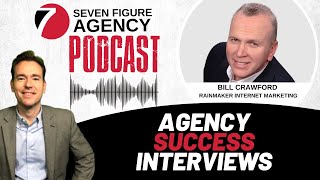
In this 7 Figure Agency Podcast episode, host Joshua Nelson interviews Bill Crawford, founder of Rainmaker for Contractors, a digital marketing agency that serves basement waterproofing contractors across the United States. Bill recounts his journey from owning a 15‑year basement waterproofing franchise to building a niche‑focused agency that now generates $73K‑$83K in recurring revenue per month, on track for seven‑figures. He explains why he chose the waterproofing niche, how he leveraged his industry experience, and the core values that guide his business (ROI focus, ego‑free culture, client‑first mindset). The conversation covers his service offering (website rebuilds, local and technical SEO, Google/Facebook ads, call tracking, social media, content, link‑building), pricing ($2K‑$5K+/month), and the typical project size ($10K‑$22K for a full‑wall waterproofing job). Bill shares client‑acquisition tactics such as case‑study video ads, referral‑driven outreach, deep involvement in industry associations, speaking at conferences, and using a book as a lead‑magnet. He details operational systems—EOS (Entrepreneurial Operating System), weekly scorecards, Level‑10 meetings, Agency Analytics, GoHighLevel, Local Vikings GeoGrid, and a trial‑based hiring model—to ensure consistent delivery and low churn (many clients return after leaving). Bill emphasizes speed of implementation, high‑quality work, proactive customer service, and continuous innovation. He also offers advice for new agency owners on building a first case study, pricing for early clients, and taking massive action. The episode ends with Bill’s closing wisdom: act fast, love learning, and surround yourself with high‑performing peers.
Chapters
Listen, I wanna welcome you to another episode of the 7 Figure Agency Podcast. Right now you're, you're tuning into one of our agency success interviews where we interview successful agencies from across the country on how they've grown and scaled their, their agencies. Today I'm super excited to be joined by Bill Crawford. Bill, thanks so much for joining us.
Hey Josh, thanks for having me. I'm really excited to be here. This will be great.
So Bill, if I, if I understand correctly, you're at about $73,000 a month of recurring revenue on, on pace to get to, to $83,000 or to, to $1 million by the end of the year.
That's right.
Excellent.
Yeah.
All right. Well, guys, if you're excited to hear from Bill, kind of how he's grown, how he's scaled, how he's continued to take his digital marketing agency to the next level, give me a like, give me a share, give me a yes, give me some type of engagement in the comments. That way we can get this out into cyberspace. So I guess, Bill, to, to kick things off, tell us a little bit about your agency, what niche you're in, kind of, you know, what your business looks like today.
For sure. So it, my company name here is Rainmaker for Contractors. So before this, I owned a basement waterproofing company for 15 years, thus the name Rainmaker, because waterproofers love rain, right? And let's see, you know, as a franchise owner in the waterproofing business, I was always just trying to figure out, uh, better ways to do things, right? So did a lot of lead generation and just kind of fell in love with the internet marketing, got really good at it, sold my business Opened this company up 13 years ago, brought someone with me. He's still with me after 13 years. And let's see, so yeah, we serve basement waterproofing companies throughout the United States. So it's getting sales reps in the door. I think some of the core values that have really, as I reflected on this, some of the core values that have really helped is like, you know, doing the right thing. Maximizing the return on investment for the customer, constantly innovating and improving, leave your ego at the door, you know, don't bring that to work, and believe in, believe in your client's dreams. Those kind of values have really just kind of pushed the company.
I love it. So, it sounds like you had a waterproofing business, sold it. What prompted you to go into a marketing agency or into digital marketing in general?
Oh, just, you know, quite honestly, the love for it. Um, when you have a lot of employees at one time, I mean, we typically ran about 40 employees, but at one time we're up to, uh, 55 employees at one time. So it's this constant, constant, like, lead generation, like a million mailers a month, the canvassing department, telemarketing, infomercials, on and on and on. Um, you're running every, you know, 25 shows a year. You're running every lead source. And for someone that's done the hustle of, you know, setting up shows, taking them down, hiring and firing in a phone room, and canvassing, going out with canvassers, to be able to sit in front of a monitor and like run Google Ads and like do local SEO and have these phone calls coming inbound, and a person's like highly interested in your services Wow, like what a game changer. That's just huge. So it makes you appreciate like the power of the internet and to be able to run ads that really pull people in. Oh, I mean that, I just fell in love with the whole concept of internet marketing. You know, the other thing is, um, like always trying to improve things. When, when you run a franchise, uh, and you own a franchise, you have the liability of it. And you've agreed to run the franchise according to the franchise rules. It's just how it is. Um, so when you own your own agency, it was total freedom to do whatever I wanted to do. So we're always still to this day, you know, that this industry changes all the time. So we're always kind of— you don't want to jump on the buzz and the hype, right? And like, oh, that's not going to lead anywhere. But at the same time, you have to constantly improve and you have to be on the cutting edge of everything. So It's, um, I'm just so passionate about it. It's the value that we're able to bring to customers, that we could figure this stuff out for them, and that I understand their business. You know, when I'm, when I'm talking to a prospect, like, we were onboarding someone yesterday, and I'm able to ask those really in-depth questions that are really important to waterproofers. You know, like, how many times do you sell a 4-wall job? Because sometimes waterproofers are only going to sell, you know, the cheaper version, this the— so I'm just able to bring in a lot of insight into, uh, into my job from my basement waterproofing company into this niche. So that's been a lot of fun. A lot of it.
So, so you grew this successful waterproofing business, you sold it, you realized you had really had a passion for marketing, websites, SEO, pay-per-click lead generation, and you're like, hey, why don't I start a business, you know, doing this, right? And that was kind of the business you started after you sold your original waterproofing company.
Absolutely, yeah. And actually, you know, the last 2 years that I own the waterproofing company, I came in to do internet marketing. And I kind of knew, like, early on, that gentleman that's still working with me, I told him, oh, by probably over a year and a half before we opened, I said, hey, we're going to have an internet marketing business. And, you know, sure enough, it wasn't— and oddly enough, the very first customer that we had is the franchisor because he said like, hey, uh, oh, I said it was a just a typical phone call, uh, super involved with all the other locations. And I said, oh, by the way, you know, who's ever doing your internet marketing is not doing a very good job. And I was just about to like hang up the phone. He said, hey, hang on a second, what do you mean by that? And you know, we got talking. I'm like, well, I'm looking at your Google Ads and looking at your SEO and your website. And like, they had 3 different companies doing it, no one was working together. And like there's obvious room for improvement. And at the time, you know, I'm doing 100 internet leads a month for my location as a basement waterproofing company. And like the next best location was maybe doing like 7 or 8 leads a month. So I obviously figured something out. So I started getting hired by first the franchisor and then several other franchisees as a basement waterproofing company. And I was like, this is way more fun. When you, when you own a waterproofing company, you're You're sending in, you know, 20, 25-year-old kids into nicely finished basements with a jackhammer to open up floors and—
A little risky, a little scary some days.
Sometimes break water lines and wreck paneling and drywall for sure. And you're hauling out concrete, you know, it's a— and then the, you know, you didn't pull the right permit or, you know, it's just, it's, it's, this is, yeah, I'm super excited about internet marketing still, you know, after 13 years.
So unreal. So it sounds like your journey was, was like as good as it gets, right? So you've built a successful business, you saw success, and you said, I'm going to take what I've learned here and apply it to this niche. And so choosing the niche for you was pretty simple, right? Like you already worked in that niche. Did you decide right out of the gates, I'm going to focus on basement waterproofing companies, or was it just kind of like, I'm going to do an internet marketing company and it was almost like an afterthought?
All right. So I definitely, you know, 1000% basement waterproofing. Was the thing. But I did, I did kind of say, hey, like, I could help anybody, right? And I did have a storefront in the, um, you know, suburb of Chicago, 50,000 people in there on a main street. So decent amount of walk-in traffic. It's all sorts of weird businesses. The downside to not like picking a niche, uh, going deep, building authority, is is, you know, when these people would walk in, and honestly, like, the strangest businesses you can imagine is sometimes signing non-disclosures for, you know, an idea that you're kind of rolling your eyes. Um, is this even gonna work anywhere, right? Yeah, right, right. But, you know, it's like, all right, you know, I'll listen, I'll listen. Um, you gotta figure it out, right? And you gotta really, really invest heavily into that industry. And all right, who are the leaders? What are they doing? Why is this working? Uh, it's just game-changing that when every single person on your staff is doing the same exact thing and your systems get so much more efficient that you're able to just blow away the competition that's trying to sell to, you know, anyone that's willing to pay them money. It's, it's definitely game-changing. And when I joined a 7-figure agency, I think it was about— I'm going to say 2 years and 4 months. There's a couple key things that I picked up. One was, you know, definitely go deep in your niche, and I did that. And so I started saying no to other projects and other jobs. And then the other really important one was say no to any one-off projects. You know why? Because they just, they suck your time and you're trading dollars for hours and it's not going anywhere. So those are kind of two 2 big lovers at the beginning that I'm like, okay, I gotta embrace these. So that was really helpful.
If you add the point to a third, because I think if we go back, I think when you started you were at about 50-ish in monthly recurring revenue, and you know, you've kind of gone to 73 on your pace to 83. Like, what would be another one that helped to kind of accelerate the revenue growth?
I'm a fan of— all right, so You know, it— when you join 7 Figure Agency, like, you're firehosed with like a lot of ideas. And it's not just like, oh, we'll give you some of the good secrets. It's like, we're giving you all the secrets and we're going deep, uh, and you get to implement it. And the better you are at implementing, the more successful you're going to be. You know, speed of implementation is absolutely critical. So not every lever that I pulled worked right away. Um, I, I had struggles with the cold calling method and reaching out and making videos for people. That was fairly time-consuming. It didn't work that well. I am a fan, and I was able to pick up some clients by recording some video testimonials, just like 8 to 12 minutes of some of the best customers that, you know, they're just gonna say, this company's amazing, and Bill's amazing, and the team is so awesome. So I did a couple of those, and then we just shrunk them and just took the highlights and made them into like 45 to 60-second videos. And we ran those on Facebook. And so, you know, Facebook's great at targeting whoever you want to, right? And so when those people, those waterproofing contractors, they're either frustrated or feel they're getting mediocre results from an agency, and they come across a video and this, this waterproofer who they're respecting because it's not an agency trying to sell them, this established waterproofer is saying, man, you got to go with this one agency. That's a, that's swinging a door open for sure. And we definitely picked up some clients from, from running that. And we're still running that ad today. So there's my kind of a, the case study builder approach.
Find those good clients, interview them, and then you've been able to feature them like through Facebook ads, get people into the top of your funnel, onto the calendar, pre-position to buy.
Absolutely. And you know, you mentioned the word pre-positioned. Boy, I think how you enter a relationship in the sales process is like absolutely critical. Like, if you're entering in from a cold call and they don't know who you are and you're trying to establish authority, you're really not that different than the 10 other emails that they just received in the last month or two. But when you're, when you're coming in as a referral, it's like, oh wow, I saw your book. Oh, you know, this other waterproofer highly recommended you. Like, that's just coming. So now your closing percentage, your authority is, it's, it's totally different. It's much higher percentage that you're going to close that lead.
Love it. Powerful, powerful stuff. So, so obviously the choosing of the niche part for you was, was you already had experience, you kind of made that foray, you were already kind of working with the franchise. Um, if you had to think back to like the first handful of clients you got within the niche, did it come from that channel, or what was it that worked for you to get those first seedling of kind of clients in the niche?
Well, that was when I was, um, that was when I owned the waterproofing company. And yes, they were waterproofing contractors. And it's because I spent my own money learning the internet. Um, I didn't experiment with someone else's, and I hired the best, most expensive coaches, uh, that I could find. Like, this literally happened. I had, I had a couple friends who knew Perry Marshall, and I had been meeting with these guys once a week, just 4 of us kind of had a small group going, and they, they would say, go meet with this guy, go meet with— I'm like, no, the internet, you know, back then I said the internet doesn't apply to my industry. Like, people looking for waterproof, they don't go to like the internet. Yeah, no, not at all. So yeah, right, right. So, you know, once like the light bulb went off in my head and like, hey, maybe— so I, I went to, uh, a store that's closed, but it was my all-time favorite store, Borders Bookstore, similar to Barnes Noble. And I, I stumbled across the the internet marketing books, right? And my heartbeat went so high, I couldn't stand still. So I would do laps around the bookstore 'cause I was standing in front of here and I was like, I have to know what's in these books. I have to do this. I have to figure out internet marketing.
So you bought all the Google Ads books and the SEO books and you started studying and researching?
Yes, yes. Like, I gotta do this, I gotta do this. So, you know, I walked out that first day with like 5 books and I ended up hiring within 48 hours. I ended up getting into like Perry Marshall's, like, you know, funnel where he's gonna keep selling me things and I'm gonna pay more and get more coaching. Um, and you know, I just, I got really good at it. So my first customers, um, were in the basement waterproofing and they were the franchisor and franchisees, but they saw what I was doing. I read an article a long time ago in this business and it said you can grow your agency two different ways. One is to increase the quality of work, which will create more referrals. And that's the method that I took. And the other one is to increase the quantity through like advertising and so on. So for a long time, I largely just focused on, I'm just gonna do the best possible internet marketing that I could do. We're gonna be committed to learning and growing and, you know, just modeling like good quality work. And they're gonna tell their friends. And so up until the time that I joined Seven Figure Agency, that largely was our model with the exception of I, for 13 years, I've always been heavily involved with our industry association. And that, you know, if there was a fourth that I were to add, I would say is involvement in, in the association that I've been involved with.
For sure. Yeah.
Yeah.
So, so it sounds like initially it was research, figure out how Google works, figure out how to generate leads online for yourself. Then how do I get even better at delivering that for, for other clients in the, in the industry? Um, and it was like really just focus on how do I deliver this at the best possible level to deliver the best results and like build a better mousetrap and people will find their way to your door.
Yes, absolutely. And create referrals by doing like high-quality work, right?
And the fact that you were already known in the industry and you were already part of the association that, like, the word— oh, this guy Bill from Rainmaker knows what he's doing, you should talk to him. And that led to more and more clients referring you and more and more clients coming on board.
That's right, that's right. Love it.
So let's talk— I'd love to kind of hear a little bit about how you package your, your service. Like, what, what is it that you do for your clients? How do you charge? Can you tell us a little bit about that?
Absolutely, sure. So we are a full-service digital marketing agency, right? And You know, it's funny when I, I've been to Google headquarters a few times with some other agencies and, you know, the first couple of times we were there, it's like, oh, what do you do? What do you do? What do you do? And it's like pretty much everyone in the room is a full-service digital marketing agency, right? Like there's no surprises there after about 5 of those conversations. So, you know, yes, we'll take over their website and usually rebuild the website, make sure it's high-converting website because our focus is lead generation, right? And and get the right SEO in there. And high emphasis on local SEO. I'm a huge fan of maximizing the client's return on investment, and I think there's always some good low-hanging fruit when you do a great job with local SEO. And we do the call tracking, and they could measure their ROI and play the calls. And so then we'll do social media. We're really efficient on social media. I like to not paint huge expectations with, with social. Um, under-promise, over-deliver. So I, I tell them, you know, don't expect leads from just our post. Now, if we're going to do paid ads for social, that's a different program. But if you just, you know, hey, so-and-so does a great job, you know, you're not going to get a lot of leads out of that one. And, uh, you know, we'll tie in link building, citation work, content, blogs, press releases, We're pretty much doing the whole gamut.
And then, so, so it's website SEO, pay-per-click, social media, paid ads, tracking, email marketing. What, like, what do you charge for that?
So it starts at $2,000, uh, and depending on the client's goals or depending on how many— like, some of the clients that we have will have, um, multiple services. Um, and they're, they want to do different things. Like some people will dabble into mold remediation, mold restoration, in addition to basic waterproofing. Some really emphasizing foundation repair. So when you get into foundation repair, that could be anything from crack repair to a carbon fiber material that's going to strengthen the wall, to beams, into peering. And so there's different levels of that. So kind of depending on where their goals are, what they're trying to accomplish. And it could be all the way up to like $5,000 or $6,000 per month. Yeah.
So somewhere between $2,000 and $5,000 per month, depending upon their services, depending upon what they need from you. And then what's the average waterproofing project worth? You know, what's the average?
All right. So that's going to vary between— that gets to that, gets to the question of like, hey, how many of these jobs are you selling all four walls on? So let's say it's a 4-wall job. That's going to vary between $10,000 and $22,000.
Okay. So they only need a couple of jobs to more than justify the expense.
Yes, absolutely. Yes. Yep. And, you know, we know Google Ads gets expensive, right? As hard as we work in our, in our agencies, Google and Facebook, they're getting a nice chunk of change. I always think when someone's putting too much money into Google Ads and they're not balancing that out with SEO and local SEO, they're really missing opportunities. Because when you talk about a return on investment, you know, I was trained as a waterproofer in the franchise world very much as, you know, what are you spending and then what are you paying per lead and what is your cost percentage divided by net sales. So we're generally in, you know, it's daily, weekly, monthly, quarterly, and yearly reports, really, really granular and detailed. So we're measuring everything. So I brought that mindset to my business. And then when— so when you look at local SEO and organic, gosh, there's just so many leads that could be generated from that. And oddly enough, too many clients have this mentality of like, oh, I've got to throw— I've got to throw more money at Google Ads, I've just gotta— and, and I'm like, okay, well, you got to balance that with local SEO because there's, there's great returns for local SEO, no doubt.
Yeah, same thing. I, I'm a big believer you want to diversify that service offering where You know, maybe the, the Google Ads generate some great results right out of the gates, but you've also got the long tail of the getting the website ranked, getting it ranked on Google Maps, and starting to blend that with SEO and paid. And then you start working their existing database. When you combine those three with retargeting and some other things, you can really generate a consistent return on investment for the client, which is really what they want, right? They wanna know they can spend a dollar and they're gonna get a return and it's gonna continue to grow.
Yes, absolutely. Yep.
Love it. So you mentioned a couple, you know, a couple of things you did to study, to learn Google Ads and to learn SEO. What were some of the best— I'm a big fan of Perry Marshall— what were some of the best books or resources that you used to kind of form the strategy for the service that you deliver?
So this is going back. So the world's changed. You know, I think webinars, you know, enrolling in courses and learning from others, obviously. I mean, this isn't something that you go to a college college. I mean, you actually now you can, like, colleges just to kind of survive, like, they are offering, you know, courses in digital marketing. Actually, I either hired or tried to hire a guy who had his MBA in, like, digital marketing, and I was like, so what really, like, what was it? Like, walk me through the curriculum. And it was, he had a business degree undergrad, and then he, he took, like, 4 or 5, like, classes. You know, one was Google Ads, one was social media, and I was like, All right, and you have your MBA in digital marketing.
Um, but anyway, is practically useless.
Yes, like you've got to have that experience, right? So it was largely webinars. Um, you know, I mentioned speed of implementation, how important that is. So I'm— I can be a little bit of an analyst and a thinker. And so I mentioned that gentleman that came from Basement Waterproofing, and we'd watch these webinars together, and I would take like 3, 4, or 5 pages of notes in the hour-long webinar, and at the end he'd flip his laptop around. He said, I just kind of implemented as they went, and I'm pretty sure this is what they, they did. And he would do that over and over again. I was like, dang, I have all the notes to be able to do that. You just did it. So for me to surround myself with people that implement quickly, that's been really helpful. So webinars is really helpful. You know, I bought those books initially, and it's like, books are slow to, to implement, right? And so That's when I just reach out to these people. I said, you just gotta show me. And we all learn, we learn differently. So I think we gotta honor the fastest way that we learn. So for me, it was webinars and applying the stuff. And quite honestly, I felt a lot of freedom to, when I owned the waterproofing company, had quite a marketing budget so I could afford to hire the best and to experiment with my own money with like no shame or guilt, remorse, because I knew it was an investment and it worked quite well. So, yeah.
Love it. Love it. So, kind of, you think about the hierarchy of education, right? At the very bottom, you get some books, you get some resources, maybe you read some blog posts and you see what's going on, and that's going to get you some information. On the top of the hierarchy is go find those people that wrote those books and hire them like you did with Perry. Like, how do I get direct access to the information to learn as quickly as I can to shortcut this process and get to speed of implementation as quickly as possible.
Yes, absolutely.
Yeah, very cool.
You know, if I could throw this out, I, um, this happened on Friday. I got paid one of the biggest compliments that I probably all year, and I really think it's a reflection of the folks that I run with in 7 Figure Agency. Because he said, uh, he said, hey, I'm gonna— I'm about to negotiate price with you, and what I'm gonna say right now is probably not gonna help my cause, But he said, I've been talking to 7 different digital marketing agencies and you by far have way more knowledge and passion, uh, head above shoulders than any other agency that I've talked to. And you know, in the groups that I run in, I don't consider myself one of the knowledge gurus, right? I, I go to them to learn, um, passion. You know, I'm really passionate about it, but I kind of feel like our whole club is like super passionate about it. But getting back to knowledge, it's because we share so many secrets with each other And it's like an unlimited amount of information that no one can know everything and apply everything, but it's very accessible. And then everyone is like really generous to share this stuff. So I was reflecting on that and I appreciate the compliment, but to me it's really a reflection. There's that saying that says you are like the, you know, 5 or 10 people that you hang with. That compliment is really a reflection of the people that I hang out with in 7 Figure Agency.
That's awesome. Yeah, that, and that's super cool, right? And, and the fact that you have the background in the industry, you're such a student of the game, you're in a community where you're around all other really successful agency owners that are sharing, it makes you so much more compelling to the prospects that would want to do business in your, in your niche.
Yes, absolutely. Yep.
That's awesome. So let's, let's shift gears. We, we've learned a little bit about your niche. We've learned a little bit about kind of your backstory, how you got into it. We, We know kind of what you're bringing to the table and what you charge. Talk a little bit about how you're landing clients. You've grown to $73,000+ in monthly recurring revenue and you kind of have this, this steady clip going with your growth. What's working best for client acquisition these days?
Well, I would say, you know, if we're focusing on client acquisition without the churn, that's a race. So our churn has always been extremely low. And my favorite thing is if a client leaves us and they come back, which I really think that 50% of the clients that have ever left us have come back. And that's a beautiful thing. And you know, we've not had someone leave a second time. Nice. So keeping the churn low, and that means, you know, doing the right thing, doing the highest quality work, committing to like customer service. I'm shocked at how many digital marketing agencies like don't prioritize their customers. Like when a customer reaches out to you, and you can't get that call or respond to that email quick, like, you gotta, you gotta get back to them and help them and do everything you can.
Um, so let's start there. Like, what, what are some of the key things that have worked best for you for, like, how do you retain that high of a level of your client base and get so many of them to come back?
Well, I think, um, all right, so as far as coming back, you know, one of the things I realized is, uh, how committed we are to customer service. Gosh, one gentleman left. He was paying us $2,000 and he had been gone for like way too long, probably 3 years, and he was paying $7,000. And I reviewed the work that he was getting and it was like ridiculous. Like, he would have gotten way more work from us at $2,000. And I said, like, you know, why did you leave? What— we're friends. And he says, um, He said, well, they had promised me, uh, to measure my ROI so that I knew exactly if I'm spending these dollars, I know exactly where that lead is coming in. Back then we didn't have some of the dialed-in features that we have now, and that was attractive to him. But, you know, it was just kind of a sales pitch, and it wasn't, uh, I mean, they still not— they didn't really figure it out in the first place. But anyway, So he came back at, you know, $2,000 even though he's paying $70,000. He's gonna get way more work. We're just kind of reconnecting with him. But then also, gosh, I think too many digital marketing agencies just make poor choices. When you listen to these clients and they'll say they did this, they did this, I leave a voicemail and I don't hear back from 'em for 3 days. It's like, wow, like how much, what do we say in 7 Figure Agency? The number one reason why people leave is perceived indifference. Yeah. So you talk— I hear that. I see that expressed over and over again with disgruntled clients that are considering coming back to us, or just that want to jump on board with us in the first place. Perceived indifference. So like, to me, that's half the battle, just like caring and trying to do the right thing. And then that's doing everything you can to, um, deliver results. You know, ultimately they want leads. Like, You could have the coolest reporting system in the world, but ultimately we have to put their sales reps— in my industry, we have to put their sales reps in front of customers, and they want the best return on investment. And the more that we could do that, we could help with their profitability, and then they're happy. And if you keep doing that, there's no reason why someone's going to want to leave. Like, do they really want to risk all that and go with someone else that might like undermine all that? So we're just committed to constantly innovating, doing the right thing. You know, here's another thing is you, you never want your client to say, you know, I was talking to my other contractor buddies and like they're getting this service. Do you guys do that? It's like, you know, you can't come back with like, well, yeah, we kind of looked at that. That doesn't make that much sense. But the conversation they had with their buddy is they're killing it with this new thing. And so We have to be on the front edge of things, not chase every single hype thing out there, by no means, but we have to be constantly innovating and delivering results and doing everything we can there.
I love it. So it sounds like being responsive and proactive, right? Really just being like when they email, when they call, paying attention, really caring about the client and being passionate about the results that they get and kind of being forward thinking. Hey, here's where we're headed next. Here's what we're gonna be bringing to the table. It's funny, I asked the question on how you land clients and you immediately said, you know, for me it's more I want to make sure I've got a great arm around the existing clients I have and that I don't have to land as many clients, right? Because I'm actually keeping the clients that I get.
Absolutely. But let me, let me, let me give you one that I think is underutilized, and that is involvement in your association. And I encourage a lot of people to get involved with their association and to volunteer. So our association is smaller. There's probably 165 members. Some of these, like the radon folks, have over 1,000 members. So, you know, you're not gonna be able to— in tip of the industry, you're not gonna be able to jump on the board of directors, right? You're gonna have to volunteer, and you're gonna have to work your way up to those positions of influence.
And so he's talking about— every industry—
the associations in your niche.
So we work with plumbing companies. He's like, go find the Plumbing Association. If you work with painting contractors, go find the Painting Association. So I just wanted to make sure that was clear.
Keep going. No, thank you for that. Absolutely. Yep. So every industry has an association, you know, get involved and volunteer your time. And you might think, oh, I don't have time for that, but it's worth it because business happens through relationships and you get to meet people. And boy, you know, if that's your niche, Niche, um, you know, those are the shoulders you want to rub with. It, it's really powerful. So we continue to get business from our association. And then I do buy— now since I've, since I've joined Seven Figure Agency, I buy more of these. But in our industry and many others in our association, at the conferences, you could either buy a booth or in, in our association, We could buy 5 or 10 minutes of speaking time and get a booth. And that's a great opportunity to kind of give your sales pitch. And our, our contractor members really enjoy that because they get to learn, like, what's out there. And that's part of the reason why they go to the association events anyway, just to keep up to date and to stay current with all the different services that are being out there. So over the years, we've picked up several clients, just not, not so much even pitching them or buying the list from the association and hammering them with, with emails, just through relationships. And they get to know you and trust you and like you, and it's like, hey, what are you doing for internet marketing? Do you think you could help us? And that's how we've gotten a lot of clients.
Love it. So for kind of being present in the association, that's kind of again looking at layers, right? You could just join the association and put the logo on your site. You could exhibit at the events and kind of be an exhibitor. What Bill's talking about is actually getting like actively involved, figuring out, hey, how can I participate? How can I, you know, be in part of these boards and help set up the planning and be like an insider in these organizations as opposed to just being an outsider that's, that's prospecting into the, into the list.
Exactly. Yep. Love it.
And so it's, I mean, it sounds like you're kind of, you're volunteering, but you're also investing in it, right? Because you're going there and you've got the booth and you're investing in the opportunity to speak. What other ways do you market to the industry association that's been productive for you?
Well, because I have 15 years in the business, like, I don't know, 12, 13, 14 years ago, there's a few guys that asked me to to coach them or mentor them in basement waterproofing because I had kind of the franchise training and there's a lot of independents. Um, I called my buddy and he said, gosh, it's odd, you know, I've kind of got the same thing, like who mentioned you? And they were different people. And he said, why don't we just do like a sales training conference like 2 or 3 times a year? And so we do, we've been doing a sales training conference and it's not super well attended. Um, it's anything from 10 to 25 people that come to our conferences. And now we're getting sponsors just because over the years we've gotten to know the sponsors and distributors of the, of the industry and association. So that's, you know, to me, that's another way of like hanging out with them. You have a meal together while you're there. You might go out at nighttime, and that's how business happens. So that's one way that we've been able to kind of leverage the association. We really only market that event to, uh, members of the association. Um, let's see.
I love that idea, by the way, for, you know, for all of you guys in your niches trying to figure out, you know, once you've gone as deep as you can in the niche, and let's say, you know, if they've got great events and you can plug into that and you've got a lot of attention, that's awesome. But there's a lot of power in running your own live events, educating through your own life, because then you can control the narrative, you can control the message, and you can really bring on a lot of clients in one fell swoop. Um, Bill from SMB Team is doing that in legal, and it's just had explosive growth. Um, so I love that idea, and I love that you're, you're doing that. Um, would be interesting, you know, to look at maybe promoting even outside of the association, because there's only 100 and change in there. If you could go to the entire industry and say, hey guys, come learn how the most successful, you know, waterproofing companies are growing and scaling, and, you know, get a much bigger group there. I think that would be an interesting play for you.
I do, I do. You know, it's a pretty small— it's a pretty small niche. Um, it doesn't really fit the qualifications for what Seven Figure Agency says to, to pick a niche. Uh, it's supposed to be bigger, but you know, when you have 15 years of experience into, into a niche and yet a decade of internet marketing, it's like it's not really the right time to just go, you know, I think I'll do like divorce lawyers or something. I don't know anyone. I just had way too many inroads for basement waterproofing. But I would say like I'm really involved in this right now. We are in the association, we are changing management companies. These associations like have a management company that kind of take care of things typically. Sometimes they're big enough to have their own staff. And so there's about, I don't know, 3 or 4 of us that are kind of taking on the management There's— we've hired— one of the contractors has some extra employees. But when you help, when you're that involved, like, there's a lot. There's hiring an accountant. There's the whole Infusionsoft world that the association is on and training someone else to do that. The emails are daily and texts, they just go on and on and on. But, you know, in a way, I mean, I'm actually— for the— for maybe a month, or we'll see how far it goes— I'm actually the person that returns all the phone calls. For the association. Now there's not that many, but you know, guess who gets to start the conversations with anyone looking into the association? And I, I bet you they need internet marketing. Now I'm not going to hit them up, but they're going to get to know me and I'm going to get to know them. And we'll, you know, we'll see where that goes.
No like trust way early in the process. I love this idea of like, first of all, you're proving that you can, you can really grow a 7-figure agency even in a very micro niche, right? And sometimes the smaller niche where you've actually got authority, where you've actually got, you know, knowledge that you're bringing to the table, can grow much quicker than a big niche where you're just a, a peon that doesn't really understand the space, that doesn't have any powerful positioning. I love this idea of really getting involved in the association, becoming part of it, you know, rather than just being on the outside, and putting on your own content and your own training to kind of position yourself and land clients. Um, let's shift gears a little bit. So we've talked about how you land clients, we've talked a little bit about retention. Let's talk a little bit about delivery, right? So, you know, we're working with lots of clients, providing lots of different services. What does your delivery model look like, and, and kind of how do you manage the team to keep them productive and to keep up with the requirements of all these clients?
Sure. So we have formed a leadership team. There's 3 of us. We have, you know, this is a 7-figure agency angle. We have implemented EOS, Entrepreneurial Operating System, as a way to manage the company, as a way to do weekly meetings to kind of, you know, check different things. We have scorecards in place. A scorecard is like a weekly report that everyone presents to say like, hey, here's my like 3 or maybe 3 things that I'm I'm responsible for, and I'm just kind of giving you an update. And we're able to kind of just briefly go through those. We're able to dream and say like, OK, this quarter, what do we want to accomplish? What do we accomplish in the year? So we use EOS for sure. Not everyone has a weekly meeting. It does work for us, and I'm working on that. We just started a weekly meeting with a new employee last week. Let's see. And You know, we have really good employees that deliver. We, we tend to like to do a trial when we're having a new employee and we kind of see how that goes. There's been talk about this. You know, sometimes when you hire someone for a job, they, they ask, you know, outrageous fees like they want, you know, $30, $40, $50 an hour and they're overseas and you're scratching your head and you're looking at their jobs and you're realizing they've done every job for $6 to $8 an hour. Well, I, you know, if you offer them weekly pay and weekly work, that number is going to change drastically. Like, largely, if you pay someone $8 an hour overseas, they're just going to be thrilled. What they need is consistent work. So we've been able to kind of give people trials over sometimes even several months, and usually someone on our team would say like, hey, we're using this person, like, they're awesome. Like, can we get them on our team? Like, how do we hire this person? We're giving them so much work. So, um, you know, the key is, is with that, we are always thinking in terms of systems and scalability. Uh, another thing we picked up from 7 Figure Agency is a tool, Agency Analytics, which gives someone 24/7 access to the reporting. We used to do reports by, by hand, and it would take 45 minutes to do all the screenshots of all the work that we're going to do. And we realized that, like, you know, well over 90% of our clients would never even look at that. And I realized, I'm sure they would appreciate us putting those extra 45 minutes to an hour into their account instead of trying to prepare a shiny report for them. And then we actually found a better reporting tool that was just available 24/7 anyway. It's so many different little things like that that help us with deliverability. Call tracking is something that we did not do, and we knew it was there, and we knew like the big dogs were doing that, but we just didn't put it all together. And then when we got the game plan from 7 Figure Agency, we're like, okay, we could, we could do this. And then, uh, we're using GoHighLevel, and they're able to play their calls back to GoHighLevel and mark them if they're leads that they want to. And it makes very much of a a powerful sales presentation when you're able to show all these different things. We've picked up, um, Local Vikings GeoGrid, which— so like you could track where somebody ranks as they drive around in their service area because they're going to rank differently, especially when they get further away from the location of their building. And that's a way to track to see how we're doing and where we need to improve and in what area we can deliver better results. In our— so I mentioned earlier on, we're using EOS as a kind of a management system. In our Level 10 meeting, what gets prepared beforehand is what our clients are paying per lead and how many leads they've gotten And so we're really trying to anticipate like, hey, wait a minute, this is going down or this is going up or, you know, this is good, this is something. So before it gets outta hand, we're able to tag that account and say, we've gotta prioritize this account that we need better results on this. So we're able to really keep a good grasp on this. We, gosh, every, I think it's once a month or it's no more than once a quarter, we do an audit of their Google Search Console and we make sure— so Google Search Console tells you where anything wrong, anything that might need fixing, there's a lot of messages in there. And so we'll go through the whole thing and we'll do a spreadsheet by hand, and then these fixes get assigned to our clients. You know what's interesting? I'm sure this is true with a lot of agencies. There's a ton of stuff that we do behind the scenes to make sure that the quality is there. And I'm sure the clients have no idea that this stuff is being done. You know, they just expect results, but, uh, there's a lot of systems in place so that everything is covered. This is, you know, just going back to core values, like what's the right thing. I like to think in terms of this, if this were my company, what would I want to have done on this account? And the difference is If you, you could ask that to a contractor, but they don't know what we know. But being an insider of an internet marketing, and if I owned a, like, you know, in my business, a, a waterproofing company, what would I want applied on this? What are the best practices? What are, what kind of work do I want? And, and that's how I try to make the decisions. Does a client always know that? No. Do they, you know, but they pay us for results and they trust us and, um, that's how we execute here.
I think that's a powerful insight and we should all really, really be thinking along those lines, right? Like if this client was a partner, if you were a partner in that business and you own that business, would you do anything differently with how you structure the website, with how you structure the on-page, the off-page, the link building, the citations, the content, the, the whole strategy? Pretend like it was your company and make sure that those are the types of decisions you're making on behalf of your clients. Because, you know, that authenticity, that care, that passion will carry forward to what the client's results are, as well as kind of how they perceive the value that you're bringing to the table.
Yes, absolutely.
Yep, love that. Great stuff, guys. If you have any questions— I know we've got a bunch of you guys watching live— post it in the comments if you have any questions for Bills at kind of as we as we come to the, to the close here, some great insights on how you're landing clients, how you've positioned yourself in the space. I know you recently published your book in the niche. Tell me a little bit about that and kind of what you're thinking about doing on those lines.
Oh man, that was a project. I started that probably 2 years ago, and, uh, I, I struggled with writing, so I, I actually hired a writer, and I probably got half of the book done by sending. So when I do a webinar, like, I really want to own that, and I don't want to present anything in that webinar that's not something that I do and that I really believe in. And this strategy works, and, and I know, like, if someone were to come on board, we would do that for them. So because I put so much time into those webinars, I was able to give those webinars to a writer, and I said, hey, can you put this in like a readable chapter? And so that's probably how I got half of the book done. The other chapters I either wrote myself and, you know, gave my Pig Latin to the person that had to, you know, decipher it and make it readable. Or it was a combination of like, all right, I'm taking this, but I have to own it and adapt it. And this has to be ours. And our team helped as well, like, a couple of the guys in leadership team that kind of went through different things of like, all right, we got to change this, we should do that. So combination of all that, and it took a long time, you know, there's a couple of start and stops in there. Um, and then I did hire someone to do the COVID and I, I didn't plan on this. I think the first photo on that book was, you know, my daughter just took a picture of me in the basement and then I ended up paying like $150 to a professional photographer and, you know, made the COVID look nicer. And so I finally got it published. Sales keep coming in, and quality is more important to me than quantity. So I have not really promoted the book at all. It was fun though to get the— it was the number one, uh, new books, or I don't know, number one new release, new release for small, for small businesses. I did get that, and that was, that was awesome. And part of it, you know, I probably picked up 5, 6, or 7 purchases from 7-figure agency and between family and friends and so on. You know, that's kind of what you do to promote these books. Yeah, I got that. So that was fun. I wanted to get that, um, but I'm not—
you're at least in the small business category. Do you have it there that you can hold it up, or is it— um, I don't— don't sweat it, it's all right. I thought maybe you had it like—
I do, it's here somewhere. I should have been ready. Some guys have it like right there the whole time. Yeah, you could be looking at it.
Congrats on getting that done. That's a project for you.
Yeah, I should have been ready for that one.
No, no, not, not at all. So I would assume you've mailed this out to the association, so all the association members have a copy of it.
No.
Okay.
I have a lot of plays to put in motion for the book, right? So yeah, I— a lot of it has not been done at all.
All right.
I am sending it to you.
Now the book is done. Let's, let's make sure we're leveraging it to the fullest. Possibility.
You know what I am doing, and I think it's powerful, I am sending it to prospects. So when, you know, if they're talking to like 3 different companies and, you know, they get my book, it's like, okay, this, this person has a leg up already. And there's not a lot of other companies that are specializing in basement waterproofing. There are some, but, um, no one's got a book for this space. So that was good. First, first to get a book out.
Amazing. So, so when they, when they schedule in, you mail it so they get it before the meeting? Or how are the prospects getting it?
It's usually after the presentation.
Okay. So it's kind of in your hot lead follow-up process. They meet. Wow, Bill, this sounds great. Now they've got a copy of your book. They're like, oh, wow, this is like nobody else in this space has experienced.
Exactly. Yeah, I got it. I got to pull it out.
He's like, now I remember where it is.
There it is.
There it is. That's a nice, thick-looking, powerful book right there, man. Well done.
How many pages do I got? Something like 255 or something.
Solid book. So guys, like, cool, cool hack that he shared, right? You could swipe and deploy a book, or if you really want it to be yours, you could be a great writer and spend, you know, months writing it. Or like Bill did, he does his webinars consistently, promotes them, records them, has them transcribed. Those webinars then become the chapters that are very much in his voice, that are very much congruent with what he believes. And so that book is going to be completely unique to him and completely congruent with what he's selling and how he positions himself in the marketplace, which I think is really cool.
Yep.
All right, so one last— so we do have a question, so we'll answer this one last question and then we'll look to recap. Painter Marketing Crew asks, do you have any advice for getting your first 5 clients?
Well, I don't know exactly where you're at, but you know, you got to have a website that communicates that, hey, this is my niche and I do painters. And ideally you're going to have one client that you have a case study and maybe you have a video from them and you want to put that on the front page. And then if you could take that video case study and run it through Facebook and maybe make a 45 to 60 minute video, that would be, that would be a good one. If that person has referrals, that would be a good one. Uh, boy, in, you know, speed of implementation. So, you know, I don't know if you're in 7 Figure Agency or not, but there's a whole bunch of ways to fill your funnel. And the more you could like implement, execute— is this working? Is it not working? It's not working, find the next one. And the faster that you can implement, the faster you're going to find your first 5 clients. Love it.
And, and, and, you know, Patriot Marketing Crew, I don't have your name here, but I think what he gave you was, was some great advice. Some of us are going to be more the cold outreach approach, but you still want to have your website. You still need to get at least one client in that niche that you knocked it out of the park for. And so whether you get a discounted rate for that or you give it away, like, go cut your teeth. Bill proved he knew what he was doing in basements and he did it for himself, right? If he wasn't doing it for himself, he'd go get a client and prove the value. And then with that one client that you've proven the value with, you go to others and say, hey, I worked with this painting contractor, I got him this result, would you like me to do it for you, right? And this is how much I'm going to charge. That positioning is so much more powerful than just blind calling and like, hey, no, I don't have any case studies, I've never done it before, but I want you to pay me top dollar. Like, that's really, really important to get that initial case study. And then, you know, you can either cold outreach, you know, if you can get a list and you can kind of follow some of those processes, or if you're more like you want to bring people to you, like Bill said, get a video of that client saying how good you did, put that on Facebook, figure out ways to get clients to come to you pre-positioned to buy. Brooks, hopefully that was helpful. And the other thing Bill said that I think is really important, and Bill and I were talking about this before, it's like a key thing we wanted to make sure landed on this interview is like the, the process of, of accomplishment really is be clear on what you want, right? Set an intention. I want to build whatever, a 7-figure agency. Figure out why you want that. Like, why do I want to accomplish this? Is it because it's going to give me more freedom? Is it because I'm going to be able to buy that nice house? Get really clear on why. Take massive action, right? Be quick to implement. Take ideas, start testing, do the work, Make the calls, do the outreach, sit in BNI, whatever it is that's gonna work for you, take massive action, but then really pay attention to the feedback, right? What works for one agency doesn't work for every agency, right? And so the better you can be in tune with, this is what I tried, okay, that didn't work for me, and try something else. That works for me, okay, I'm gonna do more of that. And really like have that closed feedback loop You try, figure out what the response is, and continue taking massive action. That's really what's going to get you over the hump.
Mm-hmm.
You know, maybe you can flesh that out a little bit.
Yeah, the great ideas, Josh. The only thing I would maybe add to that is maybe you lower your price for the first 5 just to kind of establish, and you start getting your clients and start getting some reviews on your Google Business Profile. I mean, you, you get someone to believe in you and they're looking at maybe $2,500 versus maybe you go to $1,500 or something, it's going to be tempting. And then you pick up some more clients and then you start to scale a little bit and start to add your tools and you get more efficient. It's another common way to, to find your first 5.
100%.
Love it, love it, love it.
Bill, great stuff. Lots of great insights here. Um, lots of, you know, appreciation coming in in the comments. So, kind of as we wrap up, if you had one piece of wisdom for that agency owner that's trying to get to the next level, what would, what would that be? Kind of in closing.
Massive action, no doubt. Speed of implementation. And like, love what you do as best you can. You know, find the areas that you're really passionate about. Have fun with it. Enjoy the journey. Learn to love learning and implement as much as you can as quickly as you can. And hang out with people that you know, that you want to be like. Those kind of people, that will help.
So good, Bill. Thanks for being on here. Congratulations on your growth and success.
Thanks, guys. Thanks for having me. It's awesome.
Oh man, thanks for your willingness to share, guys. Uh, be sure to tag Bill. Thank him for, for sharing today. He shares that out of his willingness to help others. So, Bill, appreciate your generosity of spirit. If you'd like to hear other interviews like this with other successful agencies from across the country, be sure to go to 7figureagency.com, um, and join the Agency Success Facebook group. It's free, um, you can connect with Bill, you can connect with me, connect with 11,000 other agency owners from across the country at this point. And so be sure to, to engage, be sure to connect, be sure to ask questions, and we're here to help you and support you and celebrate you on your journey to 7 figures and beyond in your, in your digital marketing agency. So that's it for today. Bill, thanks again. Thanks, Josh Nelson. Talk to you guys soon.
More from Joshua


From 26 Years in Business to Nearly Doubling Recurring Revenue | Sandy Waggett




How Luke Truetken Scaled His Agency to $110K MRR by Going All In on One Niche



Website Production at Scale - The AI Tool Stack for Modern Agencies with Marcel Knopf

