How Paolo & Greg Gullo grew their agency to 7 figures serving the Asphalt Niche
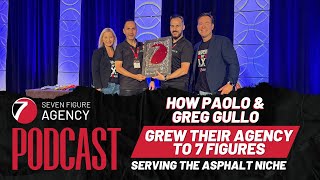
In this episode of the 7 Figure Agency Podcast, host Joshua Nelson interviews Paulo and Greg Gullo of Asphalt Marketers. The brothers share how they built a 7‑figure digital‑marketing agency serving the asphalt paving niche. Starting as generalist marketers in 2004, they gradually shifted focus to construction, then to asphalt, eventually dropping all non‑asphalt work after joining the 7 Figure Agency program in May 2023. They now serve 27 clients with about $85K in monthly recurring revenue. The conversation covers their niche‑selection process, the creation of tiered service programs (Activate, Accelerate, Elite) and pricing, client‑acquisition tactics (sphere of influence, trade shows, cold outreach, content, paid ads), team structure (remote staff, white‑label partners, freelancers, SOPs), operational habits (weekly Slack meetings, Monday check‑ins, SOP development), retention strategies (high‑touch relationship, onboarding, annual strategy meetings, gifting), reporting methods (lead volume, cost‑per‑lead, highlighting big wins), scaling decisions (when to hire vs. white‑label), and the biggest impacts of the 7FA roadmap (niche focus, program packaging, quarterly project planning). They finish with practical advice for agency owners: niche down, avoid shiny‑object syndrome, focus on execution, and leverage the 7FA community.
Chapters
Hello and welcome to the 7 Figure Agency Podcast where we're interviewing highly successful digital marketing agencies from across the country on how they're growing and scaling their businesses. Uh, and today I'm, I'm super excited. We've got an amazing agency that's joining us. We've got Paulo and Greg from Asphalt Marketers. Uh, they've recently crossed 7 figures in their agency, and so I'm really excited to have them on and kind of let them share their story and their journey. So Greg, Paulo, welcome to the show. Thank you so much for being here.
Thank you for having us, Josh.
Thanks, Josh. Thanks for having us here.
We're super pumped about, uh, this interview today, and congratulations on, on building the 7-figure agency. Uh, just, just so the group knows, obviously, like, tell us a little bit about the agency. How many clients? How much recurring revenue? Okay, what's the lay of the land right now?
All right, you want to go ahead with that?
Yeah, so we are at, uh, in our niche agency, we're at 27 clients right now, and our MRR is, uh, about $85K. Um, so yeah, we just passed that mark, um, in our niche. And, um, when we, uh, started, uh, with 7 Figure Agency, I think it was like 13, 14 months ago. It was May 2023 when we joined you guys. And, um, since then we grew by 97%, so almost double.
So good, man. Congratulations. So tell us a little bit about your background. Obviously you guys have been in digital marketing and marketing for quite some time. Tell us how you got into the agency space to begin with.
Yeah, so a long story and a long journey. So we started back, I'll try and speed this up, but we started back in 2004 with digital marketing, okay? And in those days we were selling information products online through Google Ads and all that. Google Ads, AdWords just became a thing back then. We were selling information products, affiliate products, ebooks and stuff like that. And then in 2010, we said, with all this knowledge and, and digital marketing— or internet marketing was more of a buzzword back then— we said, why don't we offer this to local businesses, everything we know? So in 2010, we started our agency, and we started as a generalist agency. And so what we did was we went to our network of friends and, and everybody we knew, and who had a business and we offered them our services, whether it was website development, pay-per-click management, whatever we can do for them to help bring them forward, that's what we offered them. And in those days, it wasn't really well received because this is 2010. It was like, I don't need this for my business, or what is this? Like, we get business so many other ways, by referrals, by word of mouth. It was very new to companies accepting it. And then fast forward a few years, then things shifted where everybody was calling us that they needed, as opposed to us kind of like pushing it on them. And so going back to it in 2010, our network was, was built of mostly construction companies. That's what our friends had. And beyond friends, people we knew in our network. And Um, asphalt was a big one. So I had my best friend, his family owned an asphalt paving company. Um, our next-door neighbors on each side owned an asphalt paving company, and a couple other friends had one. So we went to them first and, uh, we built their website. They were happy with it. Uh, we started doing some Google Ads, getting them some leads. They were happy with it. We're saying, you know what, this is a good niche for us. Um, but as, as we went along, we always had the generalists side by side because we thought we'll have the niche, we'll have the generalists, because why would we shut down anyone and anyone that comes to us? That's business, right? Like, we want to take it all, don't like shorthand ourselves. And then when we joined 7FA, uh, let's say 14 months ago, it was May 2023, we said, okay, this This is the day that going forward we are not accepting any more generalist clients. We'll keep the few that we have grandfathered in, but going forward, that's it. We're done. And that was one of the best decisions we ever made. Nothing wrong with the generalist side. It's just that the focus we have today is like, it's beautiful coming to work every day, speaking to the same audience, speaking to the same niche, as opposed to like Oh, I have a meeting today. Oh, it's a restaurant. Oh, it's a manufacturer of some sort or a furniture store or whatever it is. It's like you always have to shift your mind, right? And yeah, I think that was a big decision for us, just saying, okay, we had generalist and the niche asphalt contractor agency and we just focus on the asphalt now.
So good. How do you feel like that helped you guys? Obviously it helped with like focus, but do you feel like you would be at 7 figures if you hadn't made that decision to say, let's just focus on this?
Um, no, I don't think so. And I'll tell you why, because there was a point where we kind of reached the 7-figure mark pre-pandemic, but it was mainly project work and it wasn't, um, it wasn't predictable. It was— it is, again, you know how it is, project work, it's like you don't know where you're gonna have the next month, right? Yeah. And then we also, uh, picked up a lot of the wrong clients or small clients that just um, we were like their saving grace. Like, they needed it to work, and like, they didn't have any money, and it was just the wrong— we were just doing the wrong thing, right? Like, even though we were, uh, trying to niche down, it was side by side with our generalist agency. We didn't know what— 100% what we were doing, in a sense, in that way, right? We're just kind of going at it trial and error. Um, but yeah, ever since we actually made that shift and just focused and really dive deep into who our ideal clients are, who we want them to be. Same thing with the programs that we created, right? Like that, that was a big help as well.
Yeah.
And I think to add to that, Josh, it's, it's crazy because once we decided on going niche only, it's like the law of attraction or the universe. All of a sudden now your niche leads start coming in and booking discovery calls with you. I don't know what it is. I mean, we're doing things for momentum, that's for sure, but it's just something happens when you make that decision to focus on the niche.
What you focus on expands, right? So if you're listening to this and you're in a generalist agency today and you've been playing around with, you know, I know I should go niche, but you know, there's all this other general business out there. You know, this is a great example of why just narrowing that focus, they were able to systematize a little better, they were able to become more attractive to their industry, and it was one of the accelerants for growing your digital marketing agency. Um, kind of coming back then to, to niche selection, because I know this is a, an issue a lot of people struggle with. You guys had home service clients. What was it that, that made you land on asphalt companies? Just kind of talk us through the niche selection process that you guys went through.
Yeah, so, uh, like Greg mentioned, at first when we started going after our network, a lot of them were in construction in general, but Um, there was a handful or so that we had that were in the asphalt industry. So in 2012, when we decided to like, let's try running a niche agency alongside our generalist agency, we did some due diligence and just kind of looked to see who was marketing the niche and what was out there. And there wasn't too many out there that were going after the niche. And that's why we said, you know what, let's, let's, let's go down this path, right? Um, and then it just snowballed in that sense, right?
Yeah. And just to add to that, so Josh, we had generalist, anybody and anybody, everyone. Then we had the asphalt niche. And then because of the construction, uh, network we had, we're like, okay, let's have one that focuses on all type of contractors. But we've also now shut that down as well in terms of like, okay, no, just the asphalt niche.
Yeah, love it.
And I think it's an important, like, thing that if you're listening to this and you're a generalist, you're trying to choose niche, don't go too broad because home services or contractors is too broad and it's not really that relevant to anybody. And it's also, um, it's not easy to systematize because it's going to be different for asphalt than it is for decorative concrete than it is for fence companies. And so be specific, be magnetically attractive. So that's how you guys picked the niche. We'd love to know kind of how you package it. You talked about your growth programs built specifically for the industry. Can you talk to us a little bit about like kind of what you include in your program for the clients you work with?
Yeah, so we have, uh, we have 3 programs that we're working on. Okay, 2 are finalized, and our first one is our Activate program, which we charge, uh, $2,997 a month plus ad spend. Okay, um, and that includes, uh, website development, uh, paid search ads management on Google primarily, and we do a little bit of ad spend on Bing. We do SEO optimization, um, and online review management, and we also offer, uh, our HighLevel CRM to our niche as well for that program. Okay, and we typically, uh, focus that on asphalt contractors from $1 to $3 million in revenue. Our next one up is our Accelerate program, which we charge $4,997 a month. And that one has everything that Activate has. We do a little bit more in terms of content with SEO per month. And then we bring in social media management, paid social ads management on Facebook and Instagram, and email marketing in terms of a monthly newsletter. And then on the website development side, we just offer a few more pages like Activate is a 10-page site. Accelerate is a 15-page site. And now we're also building out our Elite program. And Josh, we got a lot of these names from 7FA in terms of what we're naming our— and Elite is going to be for asphalt contractors who are $10 million plus. And we're thinking of charging about $9,997 a month for that and stacking it with more good stuff, video production content, cold outreach, whatever we can do to really help our clients, right?
So relatively high ticket, right? We're talking about the Activate being $3,000 or so per month plus ad spend, the next level up being $5K per month plus ad spend. And so if you're listening to this and you're still charging $1,000 a month or $1,500 per month, you get to choose your price, right? And you might as well go a little bit higher and make sure that you're adding enough value to to the program. And what these guys have done is their program includes the website, the SEO, the paid search management, marketing automation with the follow-up system. And so have you had a lot of resistance to that pricing? You think, you know, a blue-collar industry like asphalt— talk to us about how that's received in the marketplace.
Not at all. You know what, ever since when we started and joined with 7FA, our average client was approximately 21 $3,150 a month, the average that we were getting per client. And since we introduced these programs, now our average is $3,150, right? So by doing the programs, it helped us increase our, our, the value of each client, the average value. But also we haven't had any resistance. And the only thing is we're finding is like the $1 to $3 million revenue clients we're kind of seeing a little bit of not so much of a resistance in the sense like they're questioning anything, but they're just not closing as much. So we're really considering we might increase that to having our minimum client's revenue to be at $3 million if they want to work with us. Right. We're not sure if we're going to do that yet, but we're really contemplating. Yeah.
So I would just say the only resistance we get is, you know, under a million. And then one day, once they cross over, there's a little bit of resistance, but it's all over the map. You know, you have guys that are at a million and they're spending $6,000 or $7,000 a month, which is fantastic. And then you have others who it's like they don't see the benefit in marketing or they've never done business that way, so they can't justify spending money. But you just keep focusing on the ones that want it, right? And there's enough of those out there, you know.
Hi, what you said there is super important in that your pricing to a certain part of the market, even if they're the same size, could be like way too high. But there's another side of the market that's growth mindset, that's willing to invest in growth, that wants to work with the best of the best. And so you just have to be marketing enough, talking with enough prospects to get to the ones that are willing to invest at a little higher level, you know, if you're starting to get resistance early in your agency.
Exactly, Josh. And I just wanna add to what you're saying there. So one thing is you niche down, but then when you niche down, you start figuring out that within your niche there's ideal clients and you start niching even more down as to who you wanna go after, right?
Yeah.
For sure. So, so we talked about how you pick the niche. We talked about kind of how you package it. Let's talk about that first couple of clients, right? So you had, I know, some asphalt clients, but as you decided, all right, we're just going to focus on asphalt, what worked best for you to land that first, you know, 3 to 5 clients in the, in the niche?
Yeah, so I would say like the first 3 to 5 were, you know, the friends and the people we grew up with who had those businesses.
Your sphere of influence.
Yeah, exactly. So it was that, and then from there, you know, referrals started coming in locally, and then we started attending national trade shows for the niche. So that started building momentum and getting leads. And sometimes you don't close those leads right away, but maybe 2 years later, like, hey, I seen you at a trade show 2 years ago, I came to your booth, and it's like you close them that way. We've also done cold outreach in terms of like, you know, messaging people on the social platforms, whether it be Facebook, Instagram, LinkedIn. That's a good way to do things. Uh, we have some organic ranking because it's a niche, so people come to us, hey, I did a Google search, I found you. Um, yeah, posting on social media, just— we have momentum in all the areas. We'd like to have more, we want to put out a lot more content, but for what we've done, we've attracted, uh, those first few clients, and then you grow from there, right? But there's a lot more that can be done.
Talk practically speaking here. So let's just say, you know, you're an agency that's got, you know, a dozen clients that are generalists and you decide you're going to go down a niche, um, working the sphere of influence, getting those friends, those colleagues to do business with you. Can you talk to us a little bit about how you, you know, approach those conversations, those meetings, and, and got those opportunities to convert into deals? If you have any feedback on how you pulled that?
Yeah, so I would say, uh, when we're doing outreach or for other show and we're at our booth, whether it be whatever, which way it is, our first thing that we do is we offer them a discovery call. So we kind of tell them like, hey, let's set up a call, kind of get us to learn more about your business, uh, you can learn a little bit more about us and see if we're a good fit for each other. So just kind of leave it easygoing, not too salesy, right? And then they're like, yeah, sure. And then we have that, that 20— we say 20 minutes, for some reason we go a lot longer on our recovery calls because we ask, we ask a lot of good questions and they appreciate it. And then from there, uh, we then book a strategy session proposal call where in the meantime— and Josh, you, you know this whole method— but, uh, we, we do our due diligence. We check their website, we check their keyword ranking, we dive deep into everything that they got going online, uh, in terms of their assets. And then on that strategy session call, we go through it all with them, and then we, at the end, we offer our program that we feel is best suited for them. And then, you know, sometimes it's they close on the spot, and sometimes it's like, okay, can you send that to me? I need to talk to my team or whomever. And they, they need a third call, and we call that the sync-up session. And so from there, uh, you close more that way as well. And then it's, it's a numbers game, right?
You don't close everybody.
You know, you talk to 10 people in your niche, you might close 3, you might close 4, you might close 5. You want them all, you feel like you're going to close them all, but it doesn't always happen that way.
So good, guys. If you're listening live, and I know we've got a handful of you guys on this live, feel free to post your questions or your insights in the chat, and we'll do our best to engage with you and answer your questions as we go. Um, so kind of coming back to the, to the question, um, personal connection. I know that you guys did some business with some friends and with some family and with some colleagues. Um, how would you, like, how would you have reached out to that person and had that initial conversation about internet marketing and possibly doing business? Just curious on kind of how you approach those personal contacts.
Yeah, that was like a while ago, so you're like, I gotta think back, I gotta rewind a little bit, right? Yeah, so, uh, you know what, it's just, uh, the way we just basically called them, picked up the phone and said, hey, listen, this is what we're doing right now, um, we're focusing on your niche 'Right, like, in this industry, uh, we've been doing this for a while now. We had success with, uh, other clients, but we're focusing on, on this industry, and we want to give it a go with your business, right? Like, give us the opportunity, right?' And I think when you're friends with them or you have that relationship, they'll, they'll most likely give you that opportunity. Or maybe there's a way of— like, I think back then we weren't like as confident as charging so much as we charge right now, right? So we say, hey, listen, we'll do it for this much. Let's, let's get it going and we'll see how it goes, and then we can talk in a few months and, and see if we gotta do more at that point. And then that's when we upsold them to doing more with them, right?
But I think if, if someone's just starting out, I would say, you know, set up your niche website, uh, set up an Instagram, you know, maybe some other ones, but an Instagram first, and start following companies in your niche. That's the first thing I would do. So you have, you know, a little bit of authority there in terms of your niche. People, they start coming, they start seeing it, and then just do some outreach. Just start messaging them, like their photos, comment on their photos, compliment them, right? And then when the time is right, after a little bit of relationship building, just offer them a discovery call. That's, that's what I would do to pick up your first few clients.
And our first outreach message, just to add to that, is, uh, not like, hey, this is what we're doing, uh, do you want to have a discovery call? We're like more like asking them about their business. Hey, how's your speaking going so far? How do you pick up your jobs? Or whatever.
Like, we just get that focus on residential or commercial, industrial, right? We just started talking about it, right? So yeah, that's what I would do. And I would also say, uh, start out maybe locally in your state. Maybe knock on some doors there in your niche, right? Just to build some momentum that way to get your first like testimonial, your first video testimony, whatever it is, just to have, build your first website. And I think it'll pick up and you'll gain momentum from there.
I love it. I think a lot of great nuggets here. I think oftentimes getting that first couple of clients in the niche comes down to your sphere of influence and being able to reach out to that family member, that cousin, that uncle that runs a business in the space And, and, you know, just like they said, hey, you know, we're looking to go deep in the pool building industry. You know, I know you run a pool business, would love to just schedule a couple minutes of your time to chat about what you're doing, how you're marketing yourself, get some ideas from you, and maybe even talk about how we can help you generate better results. Like, if you come at it like that and you're open, we're looking to break into this space, we'd like your feedback, they're going to be much more willing to have that meeting and oftentimes more willing to be like, hey, I want to help them build this, right? Whether that's becoming a client or referring you to friends or pointing you to groups that you can plug into. Um, so thanks for rewinding back the playbook a little bit for us and kind of thinking about the thought process you were going through in that early phase. I think what you said about, you know, getting a lead list, setting up your Instagram, finding people in the space, connecting with them, starting with engaging with their posts— your clients, whether they're asphalt companies or plumbing companies or dentists if they're posting on social media, they're not getting the love that they expect. They're not getting as many likes, they're not getting as many comments, and so if you can become a fan of their stuff and say, "Hey, that's awesome. That's really— I really love that you shared that." Not trying to just go straight to the DM and schedule an appointment. I think that was a great tip as well.
Yeah, definitely.
Okay, so let's talk a little bit about how you're landing clients today. So we talked about the first couple. It sounds like maybe the trade show play has been a big move for you guys. Talk to us about where the strategy sessions are coming from today and kind of, you know, how you've gotten the, you know, the bulk of the last 20 or so clients.
Yeah, so for the trade shows, like the bulk of the strategy session or discovery call bookings, they usually come around the trade shows. It's not like it's a consistent thing all year long, right? But it's a good way to, you know, create content, use that throughout the year, just remind people that you're there, right? There's also the, the list from the trade shows or the associations. When you do a trade show, sometimes they give you the list of attendees prior to the show. You get access to that. So what we did was we would cold call and just say, hey, we're going to be at this trade show on this date, come and see us at our booth number, whatever. And then we'll email them as well as a reminder. And then anyone would come to the, to the booth if we got them on the list or if they registered for a discovery call. What we would do is that we'd have— we scan their badge, and then at the end of each day, I would export that list into our CRM and then send them an email, say, thanks for coming to visit us today, it's great talking to you about your business, and we look forward to having that conversation. So we get things going that way. We try to— we have more ideas going, going forward for the future, making a better funnel than that. And, uh, one thing we don't have yet is our book, and we're working on that. We just started working on that, so we're hoping to get it done by the end of this year so that in the new year when we do all our trade shows, because they're all in the wintertime, uh, we can give out our book at the next one. So we're hoping to do that.
Yeah.
And another thing we're finding, uh, momentum with is putting out video content to our niche. So, and we learn all this from 7FA and Josh, but, uh, and we're like, you know what, if we can put out one really good piece of video content— doesn't have to be perfect, it could be like iPhone level out on a job site, whatever it may be If we could put out one and get one discovery call out of the thousands in your niche, what if we put out 20 pieces of content a month? Would that result into 20, uh, discovery calls? And so that's what we're going to focus on next, because we feel like every time we put out a video, we start— they start coming to us inbound, right? Whether they DM us, hey, we need to talk, hey, I seen your video, or just so a whole bunch of that. And then other ways we land clients, Josh, is again through Google Ads to our niche nationwide. That helps. Um, uh, SEOing our— like, uh, optimizing our niche and our niche keywords, that also helps.
Sending out a newsletter to our list.
We're now also creating our Dream 100 list and, and working with, uh, list providers as well to grow that and start doing outreach and and thinking about the gifting program and a lot of these advanced strategies. So we've reached this point, but I would say we have a lot to do with the 7-figure agency roadmap. There's a lot of pieces that we still need to plug into and we're really, really excited about it and we're very ambitious too. So we're at this point, but like we see no reason why we shouldn't 10x this. Like, you know, our mission is to work with 500 asphalt contractors across the nation, right?
So yeah, we haven't even scratched the surface with just 27.
Yeah, I love it. You know, the fact that you're at 7 figures with only 27 clients, and there's so much opportunity, so much meat on the bone that you guys are going to be able to put in play to continue to accelerate the growth. Um, so guys, you know, if you're listening to this or watching this and you're like, you know, what, what's a practical takeaway? If you're not involved in the industry group or association within your niche If you're not finding opportunities to get out from behind your computer and live and in person elbow to elbow with the trade show at the event in the after hours, you're leaving a big opportunity on the table. And they just kind of walked you through their process of how they're working those trade show opportunities and how that was an accelerator to grow their agency kind of to that next level. So let's talk a little bit about delivery, right? So you can like, now we've got a bunch of asphalt companies we've got this relatively complex service offering with the website and the SEO and the paid search and the marketing automation. Talk to us about how you get the work done and kind of what the team structure looks like.
Yeah, so even though we're at the level we're at right now, we still have a lot of cleaning up to do. It's a never-ending, it's a beast, right? So the way we have it now is we have about 8 people in-house in-house, but they're remote, remote, uh, full-time. Um, we also partner with some white label agencies, um, and we also have a handful of freelancers, right? So that's what our team kind of looks like. But in-house is more account managers, CSMs, stuff like that, just to make sure that, you know, they can keep an eye on everyone else and making sure things are getting done on time.
Um, I handle all the sales side of things. So there was a point where I got off that and we had salespeople, but I felt like I lost the— my finger being on the pulse of the business, right? So it's really good when you're starting out or at our size or even larger. I plan on doing this for a while, really build those deep relationships on the sales side.
Things.
But I'll let Paul speak to the—
yeah, we had a few salespeople and then we had to get rid of them. They weren't producing as much. Um, also they were making false promises just trying to get that commission check or whatever, right? And we learned that the hard way when, when we were churning a lot of clients, right? Uh, because of the way we do things now, we have our finger on the pulse. So that's one big thing that Greg just said— keeping our finger on the pulse was one of the biggest things we could have done in the last a year or so, which has allowed us to have a retention rate of 97.71%, to be accurate. Yeah. So, uh, and, and before that, we don't even know what we're— what the retention rate was. It was horrible.
It wasn't tracked. It was like, you know, whatever it is.
It was a mess. We were losing clients like every month. We're losing, picking up. We weren't going anywhere ahead, right?
So can I just speak a little bit more to this?
Yeah.
If you kind of look at our structure, we have myself, on handling the sales. Paulo's my brother and business partner. He's handling the fulfillment side. So we kind of got that split going on. And then on the fulfillment side, we have our website developers and coders and, and content writers. And, um, then we have our, our marketing coordinator who works in between our clients and our web development team, collecting all their, their, their assets. Um, we have graphic designers paid search specialists, social media specialists, um, trying to think of all our services here. Basically every year, basically the whole— every— we have a very comprehensive program. So we have someone who works on each piece. We don't just have one handy person who does it all. Like, we have specialists. So whether they're full-time in-house, whether they're through white label partners that we greatly appreciate and who have helped us or freelancers that we, they're not full-time, but they help us with certain things. That's kind of the structure right now. And we're building out our SOPs, our standard operating procedures, and our onboarding process, and just trying to deliver the 7-figure agency world-class experience.
Love it. So it sounds like a great, you know, great team, virtual, you know, environment, Any tips on how you keep your arms around a virtual team? I know a lot of agencies have gone virtual, our agency as well, but any tips on how you keep the team engaged and keep them productive? Sometimes it's hard when they're not like sitting right next to you and you can smack them around when they're not doing their work, right?
But we used to, pre-pandemic, we, we had everybody in the office. We had an office. We, at that point, we already had a lot of project work, like 15 people in there. And then the pandemic hit, everybody went to work remotely, and then we're like No one really wants to come back to the office. We're like, okay, we don't need an office anymore, right? So Paulo, we have an office, we work together in an office, and, uh, I don't know, you want to speak to this at all?
Yeah, so remote and what we do, to be honest, it was the best thing that ever happened to us remotely because, uh, we felt like everybody was coming to us with questions all day long. And with our team working remotely, we feel like they're taking the initiative a lot more and seeing things through on their own before they're coming to us all the time. But we try to meet with them once a week, uh, to just, you know, make sure that they're good. If there's anything, uh, any type of roadblocks they're having from the previous week, or they need help moving forward, uh, we do that Monday mornings at 10 AM.
There's always a meeting of the team. You know, Paulo and I are on those a lot, but if we're not, we have someone else in our company who kind of pushes the, the team forward on those.
And then I'm also overlooking every single— so I have my time structured. I have my mornings, uh, focused on just checking in with my team, uh, if they need my help for something and helping them see something through, taking care of a client or whatever it is. I do that in my mornings. My afternoons are for development, all the stuff, you know, from our, uh, 7-figure agency intensives you know, we have that roadmap, the project plan, I block off my afternoons for that. I don't talk to no one in the afternoon. So I can just focus on that. So every morning, I'm actually looking into everything. I'm going on Slack, I'm seeing if there's anything that needs help from me. And I'll move things forward. I'll meet with a team member ad hoc and just kind of come up with a game plan, just to make sure everything's running smoothly. Because we don't want to lose any client and we want to make sure our clients are 100% happy.
And then lastly on that, we also use Slack. So we have a Slack channel. They're all working remote, but like we all communicate via Slack. We have one for each client and all the different services we do for them, right? So everybody stays connected that way. And we haven't done any like time tracking or anything like that on our team members, but like At this point, we're looking at it like, if you're not doing your work, a fire is going to start, and it's going to come back to you, right? So every— everyone's doing a great job.
Yes, love it.
Lots of great insights here, kind of how you've structured the team, how you pulse with the team during that weekly meeting, how you leverage Slack to kind of keep things in the loop, kind of the, the leadership philosophy— not micromanaging, not like time doctoring every minute of their day, but Having people that you trust, that are capable of doing the job, that you can let them go run their day, and you know, if there's problems, obviously it's gonna come back and you're gonna have to go deeper with that person. I agree with that, that operational philosophy wholeheartedly. So let's talk retention, 'cause you mentioned 97% monthly average or higher, which is fantastic. Talk to us about kind of some of the key strategies you've put in place that have helped to improve that, that retention rate?
Yeah, so I think it starts from the sales side of things. Like, Greg does all the, the sales calls. He builds a really good relationship and rapport with, uh, each prospect again, and once they become a client, um, and then he also checks in on them once in a while as well, just so that they know that they can reach out to us if there's something that they're not happy with a team member, right? Um, so we really make it clear that we will have their back no matter what. So even though we pass them on to our team, they know we're overlooking, we're seeing things, or if they have to come to us, we got them. So that's one big thing we did, because when we took our finger off the pulse years ago and we were churning a lot, that's one of the reasons why we were just not present with our clients.
Um, we thought that was the way to grow, like, we need to be working on the business instead of in it, which is the way to grow. Like, you shouldn't be too deep into it. But I think on the sales side at this level, you got to build those solid relationships because these are, these are business people, right? They got a solid business. They're giving you a lot of money. They want to feel like they're dealing with the owner in some cases. Not forever. There's bigger agencies in 7FA who now have salespeople, and we look up to that. And one day we're going to go that route as well. But for now and for a while, I think that that has helped in terms of retention. I feel like I could do a better job in terms of communicating with clients after the sale. Sometimes I have that background stress, like, has it been too long since I spoke to this guy? What if he turns? What if he feels like I don't care about him enough? Or, you know, but we're now also working on our onboarding process. So we're really excited about that and having automations help because, you know, we know from 7FA the first 30, 60, and 90 days is crucial to long-term retention. So we're really excited about having automations and, and a roadmap of what their first 3 months or what their first 12 months with us looks like.
Yeah, and on the manual side of things, because we're not fully automated with that yet, um, that's where I come in and I'm always checking every Monday morning. I'm looking at everything that's happening with our, with our clients, especially our new ones, right? And then I'm checking with our account managers saying, okay, where's this at? Where's this at? So we put a lot of passion and a lot of— like Greg said, we have a lot of stress into making sure that our clients are happy, right? Um, we have SOPs in place, but they could be better. I, I feel like that's a never-ending process. One thing I did learn from the last intensive, uh, earlier this month at our roundtable was we were always looking at the SOPs as a project, like this massive project that we're like, how are we going to start and finish this beast? But someone at our table told us, hey, look at it as a process. It's an ongoing thing. You're just always working towards it. And just that one thing that was said to me is like, I took a deep breath and I was able to like kind of relax. And now we put it in a process. So it's just It's being worked on in every area, and it's going to get better and better and better as time goes by. And we're not stressing over making sure it gets done overnight type of thing, right? But yeah, like, all that, all that, all that. But Greg and I, we put a lot of passion into each client and building that relationship. And I know some people want to try to get off that and just kind of let their team run with their clients. I think it's still key to keep engaged with your clients Even if you've got to put out content and be on, be the face of your company and making sure your clients see that on a regular basis so they know.
And send them, I would say to send them like gifts at like Christmas time and stuff like that. Show them that you care.
Yeah, we do that a lot. We send, we send, whether it's a bottle of alcohol or if it's a basket or whatever, we send gifts.
Love it. So good. I think a great insight, great takeaway is If you put a salesperson in place and you're like, you're starting to see an increase in churn, know that that typically happens, right? If you get an aggressive salesperson that isn't setting proper expectations, that's selling the moon, selling the guarantee, selling the money back if it doesn't work out, on the back end of an increase in sales is going to be a massive spike in churn. Happened to us at Plumbing and HVAC SEO. It sounds like it happened at their agency as well. But also know that if you get the right salesperson in place that can sell in the proper way, you can sell clients that stick. But if you can step in and take the sales process, set proper expectations, and the continuity of the relationship, I think is a big reason these clients are signing up at a high ticket, staying around long-term, 'cause they know you guys are both owners, you both really care about their business, and you want to keep them long term. And I think that's one of the big things that's helped you guys elevate that retention number.
Yeah, one thing you just said there— sorry, Josh, um, in terms of the setting the expectations on the sales end, yeah, that's a big part. Because what we found in the past was a lot of the churn was because a lot of customers came thinking that they're going to turn on their campaigns and they're going to be successful overnight and crush their competition. And, uh, that's when we started saying, okay, we need to make it clear that marketing is not a one-size-fits-all, set it, forget it, turn it on, and you're gonna— like, we had to make it clear in the sales process that this is a partnership. We're working together. We're going to be trying things. We're going to be testing. We're going to get the data. We're going to see what works, what doesn't work, right? And, and when, when it's like that, they just now look at you as an extension of their team. They're not looking at you as, uh, you're just a company that they're paying and has to get them the results, right?
Yeah, do I have time to add a little more on this?
Absolutely. Yeah, I'd love to.
Okay, so another thing in terms of retention and long-term retention is that, you know, what we find is once they hit 12 months, if they make it there, which a lot of them do, right, then if they cross that point, they're there for the long term, right? But now it's like, okay, because we have clients that have been with us for 5 years, some have been with us for a decade. When we go back to those friends who stick by us and they're loyal to us when they stick that long, it's like what we do is every time the calendar year changes, we, we go through all our long-term loyal clients. We're like, okay, let's have an annual meeting with them. Let's show them that we care. Let's talk about what we're going to do this year. You can't, you can't take them for granted and let it ride like, oh, they're loyal, so we'll just— we know that they don't need our attention. It's like, no, we make a point. The calendar year changes, go through all the loyal ones, 5-year, 10-year clients, and and have a strategy with them in terms of what else we could offer them, 'cause they wanna know. They wanna know what else you're gonna do for them. You know, the current results are working, but what else can we bring to the table? And so we make a point to all the long-term clients, every year we put an annual meeting effort into it.
I love that. I'm glad you brought that up, 'cause I think, you know, the reason clients leave is perceived indifference, right? They feel like you don't care. I think you guys do a great job showing that you care, The other reason they leave is they feel like their vision for their business has outpaced your vision in terms of what you're bringing to the table. And so constantly seeing the vision, hey, here's where we're headed next, here's what the next 12 months looks like, and spending that time with the client, not just to report like back, but to, here's what the plan is year 2, year 3, year 4. I'm glad you brought that up as a key initiative that's helped you guys expand those relationships.
Yeah.
So let's talk a little bit about reporting. So you've got, you've got a high-ticket service that these guys are selling. I wouldn't imagine there's tons of volume, but if you get them a couple of these asphalt projects, you can show ROI. Like, what is it that you report to the clients? How do you show the value to keep them on board?
Uh, one thing we do is like, if when we're generating leads for them, um if they— like, usually there's like the same type of— like, there's like an average sale or average type of project they get. But when there's those really big impressive ones, we always highlight those. Like, we always make a big point. We'll even do a Google Earth image shot of the property to show the building that, you know, say, hey, this one came in. Like, we want to really highlight it to them and make sure that they actually, uh, call them right away or get on it? Like we'll be their speed to lead, you know, in a sense say hey go—
Go sleep on this one guys! This one's good, all right, go get this one.
And they appreciate it, they'll be like yep seen it got it on it. It's like we're pure integrated because like to Paulo's point they're getting leads throughout today not everything comes from online, right? They have their own business that they're operating so we just want to highlight the bigger ones, the home run type of leads to make sure that they get to them as well as they have something in the back of their mind like, yeah, this is working for me. Oh, that came from Asphalt Marketers, you know what I mean? So, okay, so we highlight those. We also show like the amount of ad spend that they did in the month, the amount of leads we generated, the cost per lead. Sometimes we say in terms of their local service area with our our conversion metrics, we can sort of see that some cities or towns are generating more leads than others. So we'll say, hey, why don't we shift the budget there, right?
Yeah, we'll look at the cost per lead. If a cost per lead in one area is like really high and another area is really low, we'll shift more of the budget that way. So like, we, we have these conversations with them to show like it's not just a set it and forget it. Like, here's the data, here's what happened the last 30 days, here's what we can do and try it for the next 30 days so that we can see how that improves, right? Like, we took one client that in the beginning it was a big struggle, that leads were converting at like $600. It's way too high. Yeah, it's like, it's got to work, right? And we're like, we're, we're gonna make it work, we're gonna figure it out. For some reason it's not— it wasn't working out. Anyways, we got that down to $100 a lead by doing these type of things, right? But we had to wait for the data to come in.
And we, we sell high ticket, but their jobs are high ticket as well, right? Like, their jobs can be $5,000 to $10,000 for a small one, or $50,000 to $100,000 to $300,000 for a big one, right? So we're all in line there.
We only need a couple of jobs to justify the expense. So if you're— as you're listening to this, like, think about how you're reporting back to your clients. Are you dumping a lot of data? What you didn't hear them say was, we were on a ranking we show them analytics, we spend 45 minutes going through all the click-through ratios. No, they said they talk with the client, they show here's how much you spent, here's how many leads you generated, here's, here's what your average cost per lead is, and then they highlight the big opportunities that have come in. So there might be dozens of leads that come in, but if there's a big job in a big area, their team's paying attention and say, hey, look, this one's great, make sure you guys jump on this. And that shows care. It also kind of helps demonstrate, man, if we could have just closed that one job, probably that pays for a year worth of these guys' services. So lots of great insights and takeaways on kind of how you're reporting that and also how that contributes to higher retention long-term in the agency. Exactly. So we've got a question here from Mill City, and they're asking, um, when did you guys start building the team for the agency? We talked about the team and kind of how it looks today, At what point did you guys start building that team?
So I'll just go back to the early days. So the early days, it was, uh, Paulo and I were both selling, and then we, when we were on the road back then, we'd go to the people's, like, to their offices, and then we'd come back and do the work. So it's like selling in the morning, doing the work in the afternoon, right? And then we grew a bit, and then our first hire was a project manager. So now that freed freed us up of watching all the projects. And then we started building, building our, our team that way, like having a web developer, and then our project manager would work in between the client and our web developer. And then as you get, like, you grow, you start realizing, okay, now I need a client success manager or an account manager.
Um, yeah, like Greg said, like, we would start— we started off by, like, doing the project management ourselves and hiring, like, you know, some freelancers on Upwork and, and places like that just to get that help. So we're not doing— first of all, we didn't know anything about coding and websites and all that type of stuff back then, right?
Yeah, like we're not experts in every single piece in terms of doing the work, but in terms of strategy and knowing digital marketing, all that, that's our forte, right? But that's why you hire the people who are specialists in web development, paid search, SEO, social media specialists. There's people out there that can do that for you. But I would say if you're, if you're just starting out and you're like $0 to $10K MRR, try and do things yourself. And then you'll realize, you know, Josh has this all laid out at what size you're going to need to start having your first hire and your second and so on and so forth.
Yeah. And working with a freelancer or a white label agency where you're paying per client rather than hiring someone full-time, hiring someone full-time is a big expense, right? You need You have to have more than one person because one person can't be an expert at everything, right? So the best way to go about it is hiring freelancers or white label— partnering with a white label agency who can, uh, you can pay piecework, right?
Yeah, I think, you know, there's economies of scale, right, that are at play in that first, that first $10,000 to $20,000 in MRR. You might want to lean a little bit more on white label for providers and freelance contractors. But eventually, that piecemeal, once you're at, you know, $30,000, $40,000 per month, start to pay too much to the white label. You could start to build your own team. And by building your own team, you can have better control, you can drive better results, you can innovate more. And so I think it's a great question by Mill City, is kind of thinking through, you know, what are you good at right now? Maybe you're really good at websites, or maybe you're really good at SEO. Do that piece in addition to selling find people to help supplement, but know that long term you're probably going to want to build your internal capacity so that you can deliver world-class results and you can innovate within the niche and become the very best in your industry.
Definitely. And if you're using white label or, or freelance contractors, if you do have to hire in-house, what we choose to do is I hire the account managers, project managers, CSMs, in-house so that they can keep on top of your, uh, contractors and, and white label agencies to make sure they're delivering the results that are required, right? Yeah. And at least you have that person who's going to advocate for your client.
And then once that outsourced person has a full portfolio, now you say, okay, I can bring it in-house because paying someone a salary versus white labeling makes sense, and I'm not burning through cash when I don't have the work for this full full-time person.
But, but keep your white label relationships or your contract relationships, because when you have an overflow— like, let's say you have an extra 5 clients and you don't want to hire that second person full-time, you need someone to handle that, those, uh, clients as well. So keep those relationships going.
Absolutely. Great answer there. Great insights on kind of how you think through who to hire when, as you're growing, as you're scaling. Um, you guys have shared some some great takeaways on how you chose the niche, how you packaged your program, how you land clients, how you deliver results and retain the clients at the highest level possible. Retrospectively, kind of like the 18 months you've worked here with us here at 7 Figure Agency, if there were like 2 or 3 key projects that you feel like you implemented from 7 Figure Agency that had the biggest impact, what would those be?
Well, I'm gonna say a mix of projects and also like advice. So it was deciding 100% on the niche and, and forgetting everything else. So that was one big thing. The other thing is the programs, because we were selling everything à la carte. And à la carte, you get people knocking off this, that, that, that, you know, like take this off, take that off, or they're comparing with another agency because now they're looking at how much is the paid search portion, how much is the SEO? Well, these guys are charging me this much, these guys, right? So we, we did the programs, and the programs allowed us to increase our average, uh, value of each client, right?
And as well with the programs is, uh, cutting out the project work, the 7FA way, and including the website. So now everything is about MRR. It's not about, uh, having some on MRR and then some we're doing a website for separate. Right? So that was another key thing.
Increasing, increasing our average client by $1,000 a month at 27 clients is $27K a month, is, is a big chunk of the growth in the last, uh, 14 months or so, right? So, um, that was a huge thing. The other thing is, um, focusing. So there's a lot of shiny objects, there's a lot of different ways we can all get pulled when we're, when we're starting out and doing the, uh, you know, the, the roadmap at the end of each intensive.
Yeah, the intensives have been huge for us. So anybody watching, we highly recommend, uh, going to the agency intensives in Miami and showing up live if you can.
Yeah, because that roadmap we do, especially at the end where we, where we can say, okay, these are the projects that we're going to focus on for the the next quarter. That was a huge thing for us. And the other thing is making sure that we block out the time to be able to do those projects. Because if we just say we're gonna do those projects in the next 90 days, weeks are gonna fly by before you even start anything. Or you might start something and then it just stays on the back burner, and then another— you find yourself a month later and you haven't even done anything. So we actually reorganize our schedule after every intensive. We say, okay, projects we have at hand, this is how many hours we need. We're gonna do, uh, every Monday is this, every Tuesday is this, every Wednesday. So we block out those times and we work on those projects, right?
Love it. So good. So many great insights there, kind of how you've plugged in, how you've gotten the results. Congratulations on growing to 7 figures. You know, I believe, like you guys said, This is just the starting point for you guys. I mean, uh, 8 figures is definitely within reach as you implement more, as you execute more. You know, our goal at 7 Figure Agency is to help you guys help, you know, agencies in general make more money, have more freedom, have a bigger impact. You know, now at 7 figures and kind of having a more systematized operation, um, how's life different or better than, you know, what it was prior?
Um, you know what, the biggest thing for us, like, the fact that we're able to, like, keep clients happy and retain them is the best thing ever because our stress levels dropped drastically. And, uh, we just, like, are way more pumped coming to work and, and, and doing this because, like, the agency life, like, everyone knows it can become very stressful. Um, so that's one big thing. And I think because we focused on that, it allowed us to get to this level as well, right?
Yeah. If I could just add to that, another big thing is being clear on the direction we're going. You know, I tell my wife, you know, ever since we've joined 7FA, it feels really good to know the direction we're going and that the success we're going to have, because I have no doubt that we're going in that direction. And we thank you, Josh, Yessenia, and 7FA for that. Big time.
Yeah, yeah, you guys are a huge part of this.
So just being clear and knowing that we have the roadmap is way better than the days where we had a generalist and agency and we're just trying to get anybody and everybody. The path we're on now is the right path, and we're happy that we came across this. We wish it was sooner, earlier on in our journey, so that we, we didn't make all the mistakes we made. But, um, we're happy that we came across this now and where we're going.
Amazing.
So many great insights, so many great takeaways. If you're watching this live or after the fact, in the comments, like, what are a couple of takeaways, a couple things that you'll implement that you heard from Greg and Paolo? Kind of in conclusion, kind of wrapping up, if you had one last piece of wisdom for that agency owner that's trying to get to the next level, uh, what would it be?
If you're trying to get to the next level, I would say definitely niche down. And, and when you're picking a niche, you know, be passionate about it. Like, not so passionate, but don't be like, you know nothing about it, right? I would say, you know, and if you're considering one over the other, there's factors to look at, like what type of clientele do you mesh well better with, uh, will you be selling high ticket or low ticket to them? That's another thing to look at. I would definitely recommend joining 7 Figure Agency and getting all the tools and roadmap here that will guide you in the right direction.
And do everything right the first time around. Avoid all the pain and just get out there, get those first few clients.
Don't overthink it. Don't overthink it. Don't have the shining object syndrome. Like you got to do everything. You have all these half-built bridges and nothing's done. Like, I would say focus on getting things done and, and start building that momentum in your niche, and you'll get that first client, that second one. We always say the first one is the hardest, and then once you have that first one, then the second one comes, and the third one comes, and the fourth one, and so on and so forth.
And done is better than perfect. Yeah, yeah, you can perfect later, but done is better than perfect. And we've, we've been We've made that mistake many times.
Like, we want it to be perfect, so we never get it done. Now it's just get it, get it out there.
Yeah. So good. So many great insights, guys. Congratulations. Thanks for coming on. Thanks for your abundance mindset and your willingness to come on and share from your heart kind of what's worked for you, where you're headed, what you've accomplished. If people wanted to connect with you further, is there any suggestions? Would they just go to your website, or how would people connect with you if they want to?
Reach out to us.
You could email me, greg@asphaltmarketers.com, and myself is paulo@asphaltmarketers.com. Or even if you find us in the group on Facebook, you can DM us, whatever, whatever.
Yeah, we're part of the, uh, the 7FA Digital Marketing Success Group, I believe it's called. So you can find us on there and DM us.
Yeah, we'll be more than happy to help and guide you in the right direction.
So good.
Well guys, thanks so much for sharing If you got value, be sure to reach out to the guy— these guys on Facebook, send them a DM thanking them for sharing their wisdom, congratulating them on their success, and cheering them along because I know they're going even higher and farther in the next couple months ahead. Thanks for watching today. Thanks for listening. Be sure to hit the like button and subscribe button wherever you happen to be hanging out. And if you could drop a comment of some sort, that'll help with the algorithm as well.
So thanks
More from Joshua


From 26 Years in Business to Nearly Doubling Recurring Revenue | Sandy Waggett




How Luke Truetken Scaled His Agency to $110K MRR by Going All In on One Niche



Website Production at Scale - The AI Tool Stack for Modern Agencies with Marcel Knopf

