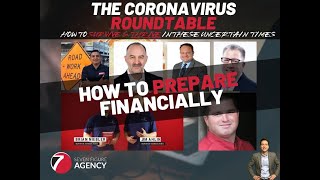
In this April 2020 roundtable, Joshua Nelson (founder of 7 Figure Agency) convenes several digital‑marketing agency owners—Alan, Jim, Brian Stearman, Danny, and a moderator—to discuss how agencies can financially survive and even thrive amid the COVID‑19 shutdown. The conversation covers the importance of having a contingency plan, establishing credit lines and tapping SBA disaster‑relief programs, maintaining debt‑free, profit‑first reserves (often six months of operating costs), and building strong relationships with business‑focused banks for rapid loan access. Participants share tiered revenue‑drop scenarios and corresponding operational adjustments (e.g., reducing hours, layoffs, expense trimming). They also discuss leveraging low‑interest 0 % credit cards, short‑term state loans, and the potential to acquire distressed agencies or hire talent released from larger firms. Danny recounts a personal story of using high‑interest merchant‑account financing to stay afloat, underscoring the value of clearing financial pressure before focusing on client service. The session concludes with Joshua promoting a downloadable action plan (7figureagency.com/actionplan) that outlines step‑by‑step guidance for prospecting, client retention, team management, and contingency planning.
Chapters
Oi, this is Joshua Nelson with 7 Figure Agency. I hope that you and your family are staying safe with the whole situation that's going on here with the coronavirus. I wanted to give you some ideas and insights on how to not only survive this situation, but to really thrive. And so I pulled together a group, what I call a roundtable of highly successful digital marketing agencies on kind of what they're doing, how they're approaching this situation, how they're thinking about it, and what you can do to really make sure you're positioned to emerge from this as strong or stronger than when you started. Check it out.
I want to talk a little bit about financial planning, right? You know, right now we're in a place where things are okay, right? And if, if, if the government doesn't keep this shutdown going 3 to 6 months, everything will be fine. But on the outside chance that this does like kind of spiral a little bit further, have any of you guys done any type of financial planning or contingency planning? Just curious, would love to hear what your thoughts are on potentially getting some backup funding and/or, you know, looking at who would we have to cut if we had a much larger drop than anticipated. So we'll start with you on this one, Alan.
Again, this is something I'm not faced with. I think that, you know, all of us are at different stages of our lives as far as financial planning goes. I don't have a contingency plan in place. We're not losing clients, and there's no need for me to consider lining up any SBA loans or setting a program up for my clients that they can use as a resource, as was discussed earlier in this webinar. They just don't need it. So I think that for this question, I'm going to take a pass.
Yep, fair enough. And listen, you know, no, I'm not doing that. I don't think it's necessary. It's fine. You don't need to explain it any further than that. Yeah, good deal.
Jim, uh, so we had— I, I'm a background in finance a little bit, and, and I, I thought of, um, one of the things that happens is when you— banks don't like to lend to people who need money, right? So always put yourself in place. Now we're kind of in an odd situation here, right? So if you haven't established some of these contingency plans, it, you know, it may be— maybe do it now before, before your recurring revenue looks different, uh, to the, to the bank, right? So maybe setting up a line of credit. We have lines of credit. We have all of those types of things in place already. Um, but, uh, so having those things in place Making sure you're aware of all the disaster relief because not only it will, it can affect you also. Economic disaster relief through the SBA is something real. I think that they usually do it on a specific location-by-location basis, but I think that now that this is a national crisis that it's available everywhere. And then from a From a monthly recurring standpoint, what we did and what we're still working on is creating levels. If we get to this level, this is our action plan with our employees, with our own salaries, with, you know, with all of those things. And having that, you know, that emergency plan of, hey, if this thing does spiral out of control, we know where we're gonna continue to, you know, we have a plan in place of You know, we'll have a plan in place of who's going to go, when they're going to go, who maybe reducing hours, maybe, you know, things like that. And just having— but having that plan is definitely important.
You know, I like it. Yeah, it's— I think it's advisable to have some type of backup. You know, you don't want to focus on it, right?
It's—
you can't just go into disaster mode, you know, like when the revenue goes here, we're going to do this and not do anything else. But you want to have a little bit of time earmarked, you know, for worst-case scenarios.
Yeah, good point.
Brian?
Yeah, so we're positioned well. We're a debt-free company, I'm debt-free, and we use profit first. We have quite a bit of reserves, about 6 months for the business, so I mean, things would have to get really, really bad for us to have to lay people off or do anything, but it's something that I've certainly considered. Consider, like, so now they're giving away cars for 0% interest, We've certainly considered leveraging some of that and cashing out some of the vehicles we have, just in case. But, you know, at this point we're not in a desperate situation and really haven't, you know, I just, I guess I don't believe that it's going to last longer than we have the reserves for to carry us forward.
Got it. Makes sense.
At least I certainly hope not.
Josh?
Yes, so what Jim said is in fact the right way to go. We've had some discussions similar, probably not to the level Jim has, not having the background in finance, but I think it's important that you do start to create some planning with some different tiers of, you know, what to do if we lose this amount of business, what to do if we lose the next level of business, and so on. We've set those thresholds. And we know, you know, right now, we'll talk about this in the next session, section about managing the team and their expectations. But one of the things we did, and I want to stress this to everybody, is to establish a good banking relationship. And right now in my email, I have a loan package that I haven't even opened yet from my bank. And we made a strategic decision about a year and a half ago to to switch from a large, probably the largest or second largest bank in the country, you don't need to mention names, but we can probably guess who it is, to a regional business bank. And I wanna restate that, they are a business bank. Now, do I have personal bank accounts there? Of course I do. But they are a business-focused bank and they want, they are in the business of helping small businesses grow within the community. So the level of service that I have, if I downloaded that package and, called my representative and said, uh, listen, can you come by tomorrow and help me complete this paperwork? She would be here. So, so, um, I want to urge you moving forward to try to establish that type of relationship. And the sooner you do that, the smaller you are, the better the relationship's going to develop because they're going to be there to help you grow.
Good point.
Good point. Danny? And that's, that's the part I need to work on.
So I need to call Josh and Jim.
So I'll pass on this one.
I'll pass on this one.
I have a lot to learn, guys.
A lot to—
yeah.
So for us, I mean, I said it yesterday, I look like a genius selling my business in August of last year in the middle of a crisis. We were backed by two private equity firms. And, you know, for our employees, as I shared with them, I mean, We work from home anyway, so we haven't missed a beat in that standpoint, but we're so lucky to be part of this bigger company because we're not worried about cash. And prior to me selling, I was more month to month. I commend Brian Stearman for implementing Profit First to the fullest extent and gotten those reserves and being debt-free. So, I mean, one thing that I'm doing naturally because I'm working so much is I am cutting back personally. I think it's always a good opportunity to say, hey, what could I cut out? In terms of financing itself, look at your state also. Connecticut right now, yesterday they were offering 0% up to $75,000 loans. Gotta pay it back within 18 months. Short-term loan, but 0%. And again, if you— even if you don't need it, I think it's a very good idea in a time like this to get these types of things in place. So we're recommending to our clients, you know, if you don't have a personal line of credit, get a personal line of credit. If you don't have a business line of credit, get a business line of credit. Get, get these— the SBA loans. I've been through that process. Previously, it's typically a very, very arduous process. It's a pain in the butt. I've worked with the big banks, I've worked with the small banks. In either case, you know, the small banks, in my— what I've experienced is they've been more likely to call a loan due early. So I've been through the, you know, the 2008 crisis and everything, and Credit lines were shrunk. And we're not there at this point because the financial markets are very strong from the security side of things, of the loans. But I would get it because it is going to be harder to get it when you don't get it. On the 0% credit card stuff, I use websites like NerdWallet that have links right over to the 0% credit cards. I get them in the personal. And the business, even if you don't need it, get it. And, uh, and then, because, you know, most of these things are no fees. Sometimes the credit lines would cost me a couple hundred bucks a year, but if I could have a $200,000 cushion, you know, for $200 a year, it, it's worth it. Um, and this last resource, I don't know if anybody's watching this that is in this position, but to be transparent, if we If we went back, uh, probably about 7 years ago, uh, 7, 8 years ago, um, I didn't know what I was doing in marketing and I racked up about $200,000 in credit card debt trying to advertise to get clients. So here I was, the marketing company that didn't know how to market. Kind of funny, but my back was against the wall. I had to sit down with my wife and say, look, we're near bankruptcy here. She said, what, what are you talking about? 'Cause I shielded her from it and tried to protect her from it. And I said, yeah, you know, we owe about $190,000 right now. She's like, what the hell? She said a couple other explicatives. I'll keep it clean. So I said, but I did find this bank that's going to loan us the money. She's like, you're kidding, because my balance sheet was terrible, everything was terrible. And there are companies out there, uh, they're like these merchant account financing companies that will most likely get you approved. Um, I, I'm telling you, the terms aren't 0%. They were like, at that time it was about 15%, and I paid $10,000 in fees. They would take money from my merchant account deposits each day to pay them back, uh, but, um, it got me through and, uh, it enabled me to keep going. And just, you know, things started to click once that— for me, once that financial pressure was off, I started really focusing on how to serve the clients instead of trying to sell. And really, I think if we bring it back to that, where giving as much value and serving as much as possible, you're gonna get through this and you're gonna get paid, maybe not today with certain industries, but certainly tomorrow if you can help some people out as well.
That's great, a great testament to like, you can be at that place and now you've grown it and sold it and that's awesome. So, some good feedback, some good insights here. Right, I think, I mean, from a financial preparedness perspective, you probably— now is a great time to look at all your expenses in your company. And we all are probably getting eaten alive by death by a thousand cuts. You know, you've got all these little tools and softwares and things. Now's a great time to look and see like, where's the wasted expense and the fat in the company, and kind of see what you can trim back. And I think it, you know, it's a good idea to have a contingency plan, not to focus on it, but like, look, if our revenue is at $120,000 a month right now, if it dropped to $90,000 What does that mean, right? And if it dropped to 75, what does that mean? Like, what would we have to shift? What we have to change? Just for your own peace of mind, so you kind of have a contingency plan. I think that's smart to have in place. Um, I'm all for zero debt. We never took on a dollar of debt in our company to build it. Um, but at the same time, it's good to have, like Jim said, a little bit of a backup. And with financing being available at less than 5%, you you know, in the 3% range, you know, it's worth looking at that SBA Disaster Recovery Fund. It's worth paying attention to the stimulus stuff that comes out, 'cause there should be things we should all be able to capitalize on as small business owners. So be looking for that. And also, this can turn into a great opportunity to maybe buy an agency in your space that's gonna fold, right? To potentially hire great, great talent that just got let go from a major company. And if you've got the financial resources to capitalize on those opportunities, you can do it. Like, if you don't, you can't. So just something to think about on those lines.
Well, I hope you got value from that video. You got some good ideas and insights that you can go back and implement. And you might still be thinking like, how do I proceed? What do I need to do next? I just want you to know, I put together an action plan on what you can, should be doing to truly maximize your potential as it relates to prospecting, as it relates to client retention, as it relates to managing your team, as it relates to contingency planning. And if you want to download that, you can just go to 7figureagency.com/actionplan— no dash— 7figureagency.com/actionplan. There you can download the action plan and really get the step-by-step instructions on how to really take your agency from a potential place of struggle to, to really being able to thrive in this environment. So go out there, be successful, keep your mindset in the right place. Let me know how I can help serve and support you, and grab the action plan at 7figureagency.com/actionplan.