How to Scale Your Agency With SOPs (Full Guide)
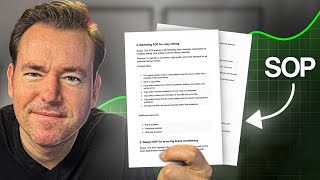
Joshua Nelson shows how to build SOPs that scale a marketing agency to seven-figure monthly revenue while cutting founder hours to just a few per week. He walks through documenting every process, creating video instructions in Loom, storing them in Google Docs, and tracking tasks in ClickUp. Real examples come from his Plumbing & HVAC SEO agency.
Chapters
My agency's doing over $500,000 a month in revenue and we have close to 50 employees, but I only need to work a couple hours a week and I'm able to take vacations whenever I want because I have a business that's running like a well-oiled machine. Now, there's one thing that made all this possible: standard operating procedures, SOPs, or playbooks as I like to call them. In fact, the difference between agencies that stay stuck at $10,000 to $20,000 per month versus those that scale to $100,000 per month often comes down to how well they've systematized their business. So in today's video, I'm going to walk through how to create and implement playbooks in your agency that will allow you to scale to 7 figures and beyond. Let's dive in. We've all heard it a million times, right? We have to put SOPs, standard operating procedures, in place in order to grow our business. But as entrepreneurs, typically we're high quick start, low follow through from a, you know, mental clarity perspective. And it's not always our strength. But if you've read Clockwork, or if you've read Buying Back Your Time, or if you've read The E-Myth Revisited by Michael Gerber, you know, if we want to grow, if we want to to scale, we have to put systems in place. Really, it's the only way to scale your agency to 7 figures or higher is by having systematization of all your operations and creating repeatable process. This means having a playbook or SOP, whatever you want to call it, for everything. Onboarding, account management, you need to have an SOP for all of that stuff. What happens when you don't systematize is you'll stay trapped in your business. You have to do it all yourself. Employees don't have the processes they need to do great work. You'll have no time to work on the business because you'll constantly be working in the business and probably wind up stuck in between $20,000 or $30,000 in monthly recurring revenue for all the reasons listed above. You'll be frustrated that there's inconsistent quality within the delivery. You'll get the client, you'll feel like you've got a team, but then little things start to fall between the cracks. But when you create playbooks the right way, you'll be able to have easily repeatable processes, maximize the performance of your team, remove yourself from the operations, and scale fast. And I can tell you this firsthand because as we grew Plumbing and HVAC SEO, I was personally involved in every aspect of the business, right from initially marketing, selling the client, then we would get the client. And I was involved in developing the strategy and I was involved in setting up the website and doing the content and creating the graphics and setting up the email blasts, all of the stuff that we did. I quickly recognized, well, hey, listen, if I'm going to grow this business, I can't do this myself. And if I'm going to hand it off to somebody else, I'm going to have to find someone that's system-oriented so I don't have to necessarily figure it all out myself. But I also have to make sure that I inspect what I expect. Let's talk about what it really means to create playbooks. The first step in creating playbooks is to to document everything that you've got going on in your agency right now. You think about the way things run, regardless of how large you are, regardless of how established you are. How do you onboard clients? What does that look like? What are the steps? Your service delivery process. Once you get the client, what are you doing with the website, the SEO, the paid search, the content, the SEO, the ongoing content? What's the service delivery process and what does that entail? How your team should communicate, project management workflows, how one thing works to the next, and client reporting system. Once you've got all of that documented, you needed to turn it into executable instructions. We want to make sure we use the same format every time that you've got a simple process and that it includes video-based camcorder method style training that somebody can watch and be guided through that process. I read all of the books on creating playbooks and SOPs, but I really liked the way Dan Martell explains it in Buy Back Your Time and really embraced that concept. And so we use a version of that, which was cobbled together with the help of Chris Rodriguez from GrowPro Marketing. And we call this the new playbook method. Some of the tools that we use for this is Loom. I love use Loom. Because in the digital marketing space, most of what we do happens online. From marketing to sales to delivery and everything in between, Loom gives us the ability to record the screen and it automatically captures that recording, automatically stores it into the cloud. You don't have to download and upload it. It's just very quick, literally runs in the background just by pressing a button. I prefer to keep all of the playbooks in Google Docs and on Google Drive just for the sake of simplicity, right? Anybody can get into a Google Doc, knows how to edit, knows how to update, and it's not some secondary system that's locked behind a separate password portal that you're never actually going to use. For the actual operating checklists, we like to use ClickUp, right? And for like the actual to-dos and the actual this has to be done by this date by whom, there's a whole massive project management process inside ClickUp for that. So I just want to show you real quick, I'm going to pull up one of our playbooks specifically, like within any area within your business. Let's say we've got a Google folder and this is just specifically local service ads. Lots of little steps that go into this. Let's go into how to turn off and on messaging. This is the format, right? We've got the context, we've got the date it created. We've got the frequency and how, how often it gets done. We've got the context, which means what does this look like when it's done? Who's the owner? How long should this take? And then we've got a couple of key elements on every playbook, which is the loom video, and then we've got the actual steps, and then we've got the checklist. So another example of this, if in our case we do a lot of webinars for ourselves at Plumbing HVAC SEO, and this is something that has to happen every single month, right? It's part of our growth system from a marketing perspective. And so up here we've got the camcorder method. Each of the key steps, we've got to do these different things in this particular order. Then we've got the description. We're gonna go here, we're gonna log in, we're gonna set this up, we're gonna copy paste that. And then we've got the final checklist at the end. And we found that that works really, really well. It can be one simple to follow process. If somebody's doing the training for the first time, they can watch the Loom videos. Now, once they've done it a few times, they'll just go to that checklist of items and check along. And once they're really efficient, they're just going to the final checklist to make sure they didn't miss any of the most important steps. Having a Google Sheet sheet that has a list of all of your playbooks and then a Google folder for each of the departments and then a specific doc for each of the playbooks gives you a nice tight place to have things set up. The other really great thing about playbooks, it's also great for onboarding new team members because either we've got to bring somebody in brand new that we can plug into the role or we've got to train somebody new because that one person moved up or moved out. When we've got these documented playbooks for each of the different functions within the company, when somebody new comes in, we can put them through the playbooks, we can have them actually do the process and learn how to do it. So we can provide those playbooks in the onboarding process, get them started and into work extremely quickly, monitor their performance. It's really important that we measure and inspect what we expect. And so you can't just say, hey, here's the playbook, hopefully you figure this stuff out, but you give them some guidance, some direction, right? We want to make sure we thought about what are all of the key things we do within this organization, the most important things, prioritize those first. We want to put them on a Google Sheet. What are the playbooks that we need to develop? And then figure out who does that today within the company, right? If it's being done already, then you can assign that to that person, figure out who's going to set these up, train them on the framework, right? So like, this is the playbook. We want a video, we want a step-by-step, and then we want a checklist, and then set it up. And then it has to be a living document. Like, these documents can't just be set and forget. The way things work change. And so you need to be— as things change within your organization, you need to be updating these documents as you go. And there you have it. That's exactly how you can use SOPs and playbooks to scale your agency. However, this is just one of the things we teach to the agencies we work with in 7 Figure Agency, where we've helped over 153 agencies hit $1 million $1 million per year. If you're also looking to scale to 7 figures without wasting years and tens of thousands of dollars on figuring everything out on your own, then click the first link in the description and book a free agency acceleration session with us. What we'll do on this call is we'll look at your current situation and give you a custom roadmap that you can use to scale to $1 million per year. Now again, click that first link below and book your free call and let's chat. And if you want a free course on how to build a 7-figure marketing agency from A to Z, then click here and watch it for free.
More from Joshua


From 26 Years in Business to Nearly Doubling Recurring Revenue | Sandy Waggett




How Luke Truetken Scaled His Agency to $110K MRR by Going All In on One Niche



Website Production at Scale - The AI Tool Stack for Modern Agencies with Marcel Knopf

