The Accelerated Growth Model | Seven Figure Agency
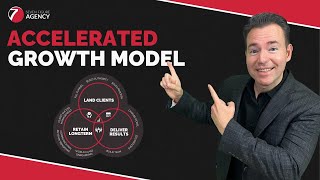
In this 75‑minute live session Joshua Nelson (and the 7 Figure Agency team) presents a step‑by‑step framework – the Accelerated Growth Model – that agencies can follow to reach a seven‑figure (or higher) revenue run‑rate within 12‑24 months. The talk begins with a promise that the plan is proven, having helped over 111 agencies hit 7‑figure revenue, and outlines the four growth stages (Startup <$10K MRR, Stability $10‑30K, Scale $40‑70K, Significance 7‑figures+). The core of the model is three strategic pillars: (1) adopt the right business model – a single‑niche, high‑ticket recurring service (minimum $1,000‑$1,500 per month) – and avoid low‑ticket project work; (2) fill the sales funnel consistently through daily outreach (cold multi‑channel outreach, Facebook ads, content creation), monthly webinars/podcasts, and quarterly live events and case‑studies; (3) systematize delivery with repeatable processes, project‑management tools, and a dedicated operations team. The session then details the sales process (appointment funnel, consultative discovery, 30%+ close rate) and the retention system (world‑class onboarding, regular performance reporting, account‑manager team, 97% retention target). Key performance indicators (15 strategy calls/month, 30% close ratio, churn <3%) and tools (HighLevel, sales‑retention tracking sheet) are shared. Throughout, the speaker uses case studies (Jim Malin, Austin Hauser, Tony Ricketts, Alan Hillsborough) to illustrate each step and encourages participants to model these behaviors. The talk ends with a Q&A, reinforcing the importance of measuring churn, hiring full‑time talent, and using the provided resources.
Chapters
Fantastic. Everybody renaming themselves. Thank you guys for doing that. So here's my promise for you. Here's what we want to do on today's session. I'm going to give you a plan that if followed will absolutely help you accelerate your agency to 7 figures over the next 12 months or help you add an additional 7 figures in top line revenue over the next 12 months. If that sounds good, just type good in the comments. If we can walk away with a clear plan for accelerating our growth in that way, Type good if you feel like that would be a productive use of this, you know, hour, hour and 15 minutes we're gonna spend together. Fantastic. Lots of goods coming in. And so I can now say that with confidence that this isn't a plan based on theory. It's not like, okay, you know, some people have tried this and sometimes it works and sometimes it doesn't. At this point, over 111 agencies have followed this process, 7 Figure Agency Roadmap process. And grown to 7 figures and multiple 7 figures. And really it's a, it's a function of having the right model, having the right package in terms of what you're selling, having a proactive approach on how you get clients, and then how to deliver the results and get those clients to stay with you long term. That's what we're gonna be talking about. But we've got lots of other agencies that have been through this journey and kinda gone from the, the startup struggle phase in their business to where they're now in the significance and even Titan status within their business. They know guys like Jim Malin from Roofers Marketers who started in the program, you know, as a startup agency, grew to multiple 7 figures, recently sold the agency to JobNimbus for multiple, multiple 7-figure exit. And, you know, this process is exactly what he did. Austin Hauser, who you'll hear about, who, you know, you know, decided he was gonna focus on painting contractors, really positioned himself as the go-to expert within that space, you know, has grown in the last 13 months from about $10,000 in MRR to over $170,000 in MRR. So just if you're okay with me sharing some of these examples and case studies to kind of fill in the learning while we go, just like case studies in the comments, if you're okay with me sharing some examples like this and making this, you you know, not just hypothetical, but in the real world, in recent time, people have done this. This is what they did, and this is the results they got. The reason I like to use case studies in that way is I really believe the best way to learn is by modeling. You know, it's good to read books, and it's good to listen to podcasts, but really the, the most effective way for me to learn is to model. I look at other people that have been successful. I figure out what they did and how they did it, and then I model their actions. I model their behaviors. And so that's what I like to do with these case studies is give you role models that you can follow. That way you could say, okay, if that worked for them and that's how they did it, if I model that behavior, I can get a similar outcome. And, you know, this training today is being brought to you by the 7 Figure Agency Community, which is our coaching and mentorship program and our mastermind. At this point, program has about 237 active members. We have 111 as of today that have gone to 7 figures. We have 33 that are multiple 7 figures. And the cumulative revenue in the organization is over $250 million in annualized revenue. So it is a $100 million mastermind, and you're getting the exact framework, the exact strategy that the entire group is built upon. We're one of the fastest growing organizations in the country. Last year we ranked 275 on Inc. 5000 list of fastest growing companies in the United States. I don't say this stuff to brag. I say this stuff to give you some confidence that what you're hearing and what you're gonna be learning isn't like theory. It's not pie in the sky. If you do the work and you execute the strategies, you can get oversized outcomes. And so hopefully that makes sense. Hopefully that, that's good with you guys. I really think that your agency goes through these 4 stages of growth as you grow and as you scale. We kind of start down here In startup, where we're less than $10,000 per month, we're just trying to figure out how to get some clients, how to get some revenue, how to get some consistency within our business. And then we get to stability between $10,000 and $30,000 in monthly recurring revenue. At stability, we've got some clients, we've got some revenue. There's not a lot of abundance, but at least there's some consistency going on. And then we move to, to scale, kind of that $40,000 to $70,000 a month. Range. And at that point, we get to shift from, you know, just kind of getting by to starting to make some hires, remove ourselves from some of the delivery, some, some of the processes. And ultimately, we want to get to 7 figures, which we call significance, because that's really where the business starts to become fun, where there's enough money to have a good team in place, to have a lot of happy clients that are getting great results, but also to have created some freedom and to create some financial abundance where there's enough money to live a pretty good lifestyle, you know, to drive the nice car and have the nice house and do some of the luxury things that you want to be able to do. I'd love to just real quick, if you could find yourself on this path, and we're all at different places. The fact is, all of us, whether we're at 7 figures, multiple 7 figures, or 8 figures today, we all started at startup and we went through stability. So there's not no shame in being where you are. But if you could just find yourself real quick, I'm gonna put this up in the, in the, in the poll. But actually, you know, it might be better just in the comments. Let me know, what stage are you in? Are you in startup? Are you in stability? Are you in scale? Are you in significance? Are you at 8 figures maybe? And then you'd be like at the Titan status. Let's just see what we got. Alright, so some startups, some stability. Some start— excellent, fantastic. And I appreciate you guys chatting. We got lots of chats coming in, so it's hard for me to keep up, but seems like a lot of us kind of between this startup stability stage in the business, which is great. I think the things we have to solve for in startup is we gotta get clients, we gotta get some recurring revenue, we gotta get some basic systems in place to go from stability to scale, we have to start to transition to delegating more of the deliverables, delegating more of the work, really creating more operational procedures so that we can continue to move up these stages of growth. So I, I really believe that in order to move through these stages as quickly as possible and, and to go to 7 figures and multiple 7 figures over the next 12 to 24 months, you need to have the right model. Right? My first digital marketing agency was a website design and hosting company called Novellacom. I worked 40 to 60 hours every single week. It was right, right out of high school. I was hustling. I was building websites. I was sitting in BNI meetings. I was making cold calls. And you know what? I never made any money. Literally, I would have made more money if I'd gone and gotten a job at McDonald's or Burger King or something like that. And the problem was I had the wrong model. I was selling too low of a ticket service with like an offer that wasn't compelling. And regardless of how hard I worked, the economics didn't make sense. And so I'm not gonna tell you my whole life story, but I had to shut that business down. I wound up going and getting a regular job working in business-to-business sales. And I wound up at a company called ReachLocal, which is one of the big pay-per-click management companies that does you know, $250, $300 million per year. And I was trying to figure out like, what is it that they did within their business to have success? And keep going back to the fastest way to grow is to model other successful people. And what were they doing? They were selling recurring service. They were selling a charge of over $1,000 per month. They were focused on generating lead flow and revenue growth for their clients, not just building websites and brochureware and activity-related services. And being in that environment and seeing this really successful company, so, okay, now I've got the right model. And I left there, started my own agency back in 2011 called Click Incorporated. Within 2 years it had grown to 7 figures. Over the last decade it's grown to multiple 7 figures. We made the Inc. 5000 list of fastest growing companies 5 years in a row. And so I say that to say that when you've got the right model, the right like, way that you're operating the business, everything becomes more effective, right? Your outputs start to get outcomes as opposed to just you chasing your tail. And so really what we want to build, what we want to engineer within our agencies is a business that provides money, freedom, and impact, right? The money we need to pay our bills and live our design lifestyle. The freedom to do the things we want to do, or we don't have to feel tethered to a job, or we don't have to work 40, 60, 80 hours every single week. And we also want impact, right? We want to feel like it's not just a cash grab. We're actually helping our clients. We're actually developing our team. We're having an impact in the world around us. If you think about, like, what you're trying to build within your business, you had to prioritize one of these. What would it be for you? Put, put it in the comments for me. Is it the money? Is it the freedom? Is it the impact? I'm sure it's a little bit of all, but if you had to prioritize one for you, What is it? Put it, put it in the comments. Impact. Okay, a lot of you guys saying impact. Bruce, money. Absolutely. Money. Absolutely. Freedom. A lot of freedom, right? So it's, it's a mix of all of it really. But if we do this right, we can absolutely engineer our business to provide all 3 of these things. And in order to have an agency that provides money, freedom, and impact, really have to solve for landing clients, having, building the process to get clients, to sign up into our world on a consistent basis. We have to deliver world-class results, right? If our business is an agency, then our clients pay us to generate leads, to generate sales, to generate return on investment from the money that they spend with us and that they spend in their advertising expenditures. You have to be good at actually delivering the results consistently for your clients. And then we have to retain those clients long term, right? We have to create such a great experience and such great results that we're not constantly getting a client, losing a client, chasing our tail with churn, but we're retaining those clients long term. And then ultimately, we've got to scale, right? We've got to put the systems, the procedure, the team in place so that all of that can happen without us personally having to do it all ourselves. And so when you think about, like, in this, what is it that's missing for you right now? Is it landing clients? You got to dial that in. You got to kind of amp the client portion. Is it retention? Is it delivery? Let me know in the comments, what is it for you that you need to focus on the most? Landing clients. I see a lot of landing clients. Absolutely. Excellent. So a lot of clients, a couple of delivery, a little bit of retention. I find that going back to those stages of agency growth, when you start out and you're at startup or you're at stability, it's all about landing clients. That's the big problem you have to solve because there's not a lot of clients to serve and there's not a lot of you know, operational complexity. As you get to the scale phase in your agency and you've got a lot of clients, you got a lot of revenue, you probably have started to solve for landing clients. And it's more about how do we systematize the delivery? How do we build that team and put those systems and procedures in place? So I'm seeing a healthy mix of client retention, landing clients, and, and delivery. So, so the model that I found works best, and I'm just going to give you the Cliff Notes version of this because we've got a short time, I don't want to make this as action-packed as possible. One, one niche, right? This is what's worked for me. This is what has worked for all the agencies, the 7-figure agency that have gone to 7 figures and multiple 7 figures, is that rather than trying to be a generalist agency that serves everybody, we choose a very specific market and we decide to focus on that market to be the best in that industry, to become known in that industry, and to develop a program that generates just oversized results versus the competition. And so my business, Plumbing and HVAC SEO, serves plumbing companies, right? We decided we're gonna focus on plumbing and we joined the association. We published a book. We put out lots of content and we've, we've become one of the go-to players in that space. Again, doing over $5 million per year in that business. You're much better served to focus on a very specific vertical like that or roofing or chiropractic or dentistry or whatever vertical, you know, you might want to consider versus trying to be all things to all people. Number 2 is I really believe recurring revenue is the only model. If you've got project work, if you've got one-off payments, you're gonna run hard, you're gonna get a payment, that payment's gonna come in, you're gonna do the work, then the payment's gonna be gone and you won't have actually built anything. The way we do it and all of the other agencies in this program that have gone to multiple 7 figures is we sell one thing and it's a recurring program. Now we might have a couple different tiers and a couple different price points, But everybody that signs up with us is gonna be signing up for a monthly recurring fee for us to build their website and do their SEO and generate the leads that they need in order to grow their business. This creates something that you can sell, that you can build a sales team around, that you can create consistent, reliable revenue and consistent, reliable growth within your business. So no one-off projects, no check payments. So we're talking about a recurring, it should be ACH-based or debit card or check or credit card that hits every single month until they say cancel, till they say stop. No partial deposits, and the minimum fee needs to be at least $1,000 per month. I really think in today's market should be at least $1,500 per month, but it's a mind-stretching thing sometimes in your mind, like, think your clients aren't willing to pay that much. Trust me, there's plenty of people in your space willing to pay more. But if you make your program a minimum of $1,000 per month, that number starts to grow, that number starts to accelerate. And again, if you're already selling these types of services, make it $2,000 a month, kind of go a little bit higher. This is the model, right? I could, you know, I could talk longer about it. Any questions or thoughts on this? Or like, what's the one that you're like, eh, I don't want to do that? Or like, what's the thing that's creating some level of resistance for you right now within your agency? You can just let me know in the chat. How do you, how do you service everyone successfully? How, how do you go from serving everyone successfully to a niche? So Brandon, if you've got a general agency, and I'm imagining you're telling me right now you've got a general agency, like, I'd like to shift to a niche, but I don't know how to make that transition. I'm gonna try and make this as quick as possible. So doing 5.6. Okay. So you got a really successful agency right now. I would say in that case, don't abandon ship on your existing business. Right? Keep that operational rolling. The challenge of being generalist is that you're hopping from, you know, one type of client to the next, and there's a lot of, you know, complexity within the operation. I would create a division of the company that focuses on one particular vertical, like plumbing or roofing or AC, or if you can find something even more niche, even more pocketed than that, then have a division within your main company that focuses on that. We've had a number of members that have been successful in that, in that way. Hopefully, hopefully that helps. So any other thoughts on this? Like any other sticking points on like what, like what you wouldn't want to change, or kind of where you're like, I don't want to, I don't want to have to do one niche, or I don't want to have to be at least $1,000 per month. Okay. Here's, here's the bottom line. I really believe that you want to simplify to multiply. Simplify to multiply. Have one core thing that you sell to one very specific market so that you can systematize the offer. And the bottom line is this. If you can land 5 clients per month at $1,350 per month over the course of 12 months, you'll be at a, at a 7-figure run rate, over $83,000 per month. Focus on that. Like, focus on, okay, my goal is to go to 7 figures, which means I need to land this amount of clients at this amount per month. There's going to be churn in this process, but at least you'll be really aggressively headed in the right direction towards where you want to go. So I asked for you guys' feedback. I didn't see a lot in the comments. What is it that you need to change within your model right now? Just write something down. Maybe it's you need to decide what the niche is. Maybe it's that you need to stop selling project work. Maybe it's that you need to increase your monthly fee. Everyone type something in the comments of something that you need to change within your model. Again, that's the Cliff Notes version that pretty much me and the other hundreds of agencies in the program have built to 7 figures. Have followed. Stop doing project work. Stop selling project work. Focus on a niche, says Darryl. Find a niche. Excellent. Alright. A lot of you guys doing the project work stuff. I'm gonna tell an example based on that because it came up so often. So one of our members is Tony Ricketts. And Tony Ricketts runs an agency called Online Marketing. It's an agency that serves the lawn care companies. And he's really good at websites, really good at SEO, runs an amazing operation. But he had grown to like $60,000 on average in a given month. $30,000 of that was recurring, and he would sell about $30,000 in project work every single month. And we had this conversation. I said, look, Tony, in order for you to accelerate your growth, you need to stop doing this project work so you can focus on the recurring revenue. I promise you, your revenue will accelerate when you take all that energy out of doing this project work. And he was very resistant to it, but he decided, okay, you know what, let's do it. Let's, let's shut the project work down. He had a little bit of a dip, right? Because he's very consistently selling these, these higher-end projects for web design. A little bit of a dip, and within a 3-month window of time, he had replaced all of that with recurring revenue. And fast forward to today, a couple years later, his agency's doing over $250,000 in monthly recurring revenue. And that was a pivotal change point for him to stop, you know, trying to chase the project work. So hopefully that story anchors in like one of the key, key strategies you want to move from. Alright, let's see a couple questions here. What's a good product mix for the $1,350? So You wanna have a program in my mind that has a comprehensive approach, right? Like, try to figure out what it is within your niche that you can do that will have an actual impact in terms of lead flow, in terms of revenue, so that you're generating a return on investment where they can see they gave you that $1,350 and they generated $15,000 in revenue. It's like, okay, great. This made a lot of financial sense. I'm of the opinion that you're much better to come in and say, hey, look, in order to generate that results, we need to run some paid ads. We need to optimize the website and the GMB, the, you know, the Google local listings. We need to try and build up your authority with some retargeting and some link building. And so we're gonna do this suite of services, website, SEO, pay-per-click, retargeting, database reactivation to generate results. Right? And usually that combination of services is actually gonna generate an outcome. It's also gonna be more sticky, right? You're not just saying, hey, I'm gonna run Facebook ads for you. Let's see how it goes, right? It's like you've got one point of failure with that. When you've got a number of services mixed together, you can blend the result. You can be more consistent with the outcome. There's more moving parts, so it's more complicated. But it usually results in better outcomes for the client, better retention for you. As the agency. Hopefully that answered the question. Awesome. Cool. So we've talked about the model a little bit. Really good example of this. Because again, I saw— I want you guys to have things you can model, right? The fastest way to grow your agency is to model other successful people, is Alan Hillsborough. So Alan Hillsborough was a great generalist. Like, it seems like a lot of you guys in here, like, you have a general agency, you know how to do websites, you know how to do SEO, you know how to do pay-per-click. But you're hopping from one niche to the next. You're kind of reinventing the wheel for every client. And he was, he was kind of bobbling between $5,000 and $25,000 in a given month. And, you know, on average it was something around $10,000 a month recurring revenue for years. And he, he finally bought into this exact model that I'm sharing with you guys today, right? If all you did after today's session, you know what, I'm gonna make some of the changes Joshua's recommended. And you commit to that and you run down that track, you will be able to see accelerated growth within your business. So he made these changes, and over the years he's grown the agency to over $115,000 per month focused on the funeral home business. So his niche, funeral homes. His program, I think it started at $1,500 per month, now it's more like $2,500 per month. Builds website, does SEO, runs paid search, does some other things specific to the niche. And you always want to be looking for things very specific to your niche that you ranked and has had accelerated growth and just runs an amazing business within that space. And so I'm not gonna play the video, but this is a great video here from, you know, Alan, if you ever wanna check it out where he explains his story and he kind of tells the backstory of how he grew and how he got his business out to that level. So let's get in, let's get into the practical aspect of this and kind of exactly what we need to do. So, to land clients, we have to do 3 things. Number 1, we've got to fill our funnel, right? We got to have a process to get our prospects within that niche that we're going after to raise their hand. Right? And that could be through cold outreach. It can be through Facebook ads. It could be through joint ventures and affiliations. Talk about some of the specific strategies here in a minute. We gotta fill the funnel. Then we've got to build authority. I think a lot of agencies miss this. We decide we're gonna go after a niche. We start sending out a bunch of cold email. We get some appointments and our close ratio is really low because there's no authority, right? People want to do business with the experts in their type of business. So when somebody's thinking about hiring someone to do their marketing for their funeral home and they get to Alan, he's got a published book, he's got webinars, he's got stacks of testimonials, he's got case studies of the clients that he works with, he's got authority so that the clients are eager and excited to hire him and pay for his services. And then number 3, we've got to have sales process mastery. You need to have a nice tight process where you can take an interested prospect from, hey, I, and I want to generate better results online to, yes, here's the $2,500 a month. I can't wait to see what you can do for me. Right? We want to develop a sales process that meets them where they're at, that answers their questions, that shows them the vision for what's possible, that shows them where there's gaps in their current online marketing strategy. And then makes our offer, right? That's what we found looks best in terms of that. So to land clients on a consistent basis, these are the 3 things. We gotta fill the funnel, we gotta build authority, and we gotta have a nice tight sales process to get prospects to say yes. That takes care of the money piece. Like, seriously, if you can land clients month in and month out, money won't be an issue. Like, you'll be able to write your own check. If you had to rate yourself right now, and just kind of imaginary because we don't have like markers in front of ourselves, but If you have to think about this here, how would you rate yourself? Well, are you pretty full? Are you getting, you know, quality prospects raising their hands, scheduling in day in and day out? Green if so. I would probably give that a red if you're not. Are you looked to as an expert within your space? Do you have case studies? Do you have examples? Do you have social proof? Are you active in the association where somebody looks at you and says they understand this industry, they're an expert, they're not worried about whether you know what you're doing, they're confident of that? And you have a nice tight sales process where you can ask clients to say yes and kind of close at, at least 30% from appointment to sale. So let me know on these. You don't have to rate them all. Like, maybe just type in the one that you feel like is the biggest stuck point for you right now. And if you're not having any appointments, it's probably filling the funnel. Angie says, red. We're trying to cold call and it's not working. Yes, cold calling is super hard regardless of the niche. That's your end, right? I think at some level you need to do some outreach, and mostly it's going to be outreach multi-channel. Like, if there's one thing I can emphasize, if you're gonna have to go out, then you want to do it not just on the phone. You want to do it on the phone, you want to do an email, you want to do on social messenger, which is like LinkedIn, Facebook Messenger, and Instagram. And you want to hit them from a lot of different channels. And in my opinion, rather than trying to go after thousands and thousands of prospects simultaneously, choose a handful of really good prospects that you really believe that you can help, starting in your local area, in your niche, and try and meet with those people in person, trying to develop those relationships. That's going to be much quicker than trying to, you know, just blast a massive list and expect to get a bunch of replies and people falling into your funnel. Okay, cool. So I'm seeing lots of, I'm seeing lots of fill funnels in here, which is good. That's something to focus on. Okay. So from there, Once we solve for delivering results, we've gotta— I mean, once we solve for landing clients, we've gotta deliver the results. We're getting— we need to deliver the results in a very intentional way. And so there's 3 strategies for this. Number 1, make sure you choose the model. Running an agency, we could sell— we could sell anything, right? We could sell funnels, we could sell Google Ads, we could sell a comprehensive turnkey service, we could sell to a generalist. Where we can sell to a very specific market. I gave you guys the cliff notes on what I think you should do from a model perspective, and I told you how the right model made all the difference for me chasing my tail to having a multiple 7-figure agency within a couple of years. Make sure you choose a model that's scalable, right? The one that I just showed you earlier. Number 2 is you have to systematize, right? If we wanna deliver results in a way that's gonna generate freedom within our agency, We can't be chasing our tail. We can't be reinventing what we're doing from one client to the next. We have to say, okay, when we get a client in our niche— somebody type in your niche, or at least the niche that you're thinking of. Type a niche in the chat here for me. I saw HVAC. Okay. If we're gonna focus on positioning ourselves to land clients within HVAC, We're gonna build authority. We're gonna have a great sales process. And then we wanna deliver results. We need to systematize. Okay, for that HVAC client, what are we gonna do? Build a website. We're gonna write content to make sure it gets optimized. We're gonna update the GMB. We're gonna run Google Ads. We're gonna set up retargeting. We need to systematize that. And so we wanna create a project plan that says, okay, here's all the deliverables. Here's when they need to be done by. And Could be as simple as putting it onto a Google Sheet. Ideally, you put it into a project management system like ClickUp or Teamwork. That way you can confidently say, I know exactly what we're gonna do for this client. I know exactly when it needs to get done. And as, as you grow and as you build your team, you're not involved in it, right? Ideally, you're not involved in the day-to-day operations and running of what you do for your client once you get out of the startup phase within your business. And then from there, we've got to build the team, right? If we really want to deliver results at scale, we're not going to do it ourselves. Right? And I really think as you grow, as you scale your agency, the first thing you remove yourself from is the delivery piece of the equation. It's setting up the website. It's writing the content. It's doing the on-page optimization. It's building the links and citations. It's running the Google Ads, right? Ideally, find an operations manager that gets it, that can take it, take that stuff and run with it and really even start to manage that stuff. So that this is happening at a world-class level so that you can focus on continuing to grow the business and expand. I, I see comments coming and I might have missed a couple. If I missed it, let me know. But when you do it this way, when you structure your delivery in this way, you will be able to create an agency that also creates freedom, right? And that's what we're after. We talked about what we really want. We want to make money and we want to have freedom. Right? Because if the delivery is happening without you, you can have the autonomy to do what you want to do, right? To take the travels, to be at your kids' games, to not be working 60 hours a week trying to sell the client, trying to deliver the results, trying to manage the relationships and everything in between. Give me a yes in the comments if that tracks. Kind of, this is how we want to structure the way we deliver what we do. Awesome. All right. From there, we have to retain long term. I think most agencies fall down on this part of the equation. Most of us are really good at landing the clients, or we're really good at delivering the results. Some of us are just like, we're passionate about the SEO and the Google Ads and the Facebook Ads, but it's usually one or the other. But we don't focus on, like, how are we creating an experience so that the client sticks with us? Not for a couple months, but for the long term. Well, nature of the relationship. And so in order to retain, there's 3 things we need to do. Number 1 is we have to have world-class onboarding. The way you come out of the gates with your client in the first day, in the first week, and in the first couple of, couple of weeks will dictate whether they're with you a year down the road. Really, if you don't have an intentional onboarding process, if you aren't wowing the client out of the gates, You're gonna have a constant churn engine within your business regardless of how good the results are. So really build a world-class onboarding process within your agency. Number 2 is we have to develop a communication rhythm, right? Oftentimes we get the client, we start to get to work on building the website and doing the SEO and tracking all of the results that we're gonna get for that client. But we fail to show them, hey, here's what we're doing. Here's what we're bringing to the table. Here's the return on investment we're seeing. Here's where we're headed next. If you're not having those conversations with your client on a very consistent basis, they're gonna turn out. And so at a minimum, I think you should be shooting to do a quarterly live meeting with your clients. If you're over $2,000 per month, it should be a meeting once a month on Zoom where you or an account manager is showing them, hey, here's what we did. Here's the results. Here's what we're focused on next. What feedback do you have? Right? If you don't have that kind of feedback loop in place and very intentional reporting, you're gonna have a churn problem within your agency. And then number 3 is we need to have client success management, which just means you're intentionally recognizing you are not going to be that point of contact with the client long term. Right? Once you get to 15 or 20 clients, you have to decide, am I gonna try and manage these relationships myself? And stop because you won't have the energy to grow. You won't have the energy to continue to sell. You won't have the freedom that you're after, or you start to build an account management team. And so if we're gonna retain our clients at scale, we've gotta get really good at hiring, training, onboarding account managers, and making sure they're as good or better than we are in the client relationship side of the business so that we can keep our arms around those clients, continue to show love those clients, continue to see the vision for where things are headed. And I think when we do this right and we'll retain our clients, that's where we're really having a big impact within our agency, right? Because yes, we're making money. Yes, we've got freedom and flexibility because the work's getting done. But we're having an impact because we're growing a team, and that team is being developed. That team is being able to take care of their family. We're also serving our clients, and those clients are growing, and those clients are getting a great return on their investment. And then ultimately, that's how we scale a business. That's how we get a business that can grow to 7 figures, multiple 7 figures, 8 figures, and beyond. Any questions about this model? And we're gonna get into some very specific tactics on how to ask them to land clients, because it seems like that's what you guys want to focus the most of the attention for today's session. Any questions or thoughts on this model and kind of how to create an agency that can provide money freedom, and impact. Or just give me a fire emoji if this is landing for you, if this is useful, if this is beneficial. Steve says makes, makes good sense. Fantastic. Any questions? Oh, I got some fire emojis. Alright, cool. Let's keep going then. If you have questions, post them in the comments. I'll do my best to engage with you on that. So when you think about your agency right now, on, on all of that, what's the big thing? A lot of you guys said landing clients. Is there, is there anything within like delivery or retention that stands out as an area that needs to be focused on right now within your agency? Automation, says Brandon. Absolutely. Reducing churn, says Bob. Fantastic. Okay. So here's where I wanna focus on. This is what we call our Agency Growth System. I'm gonna try and bring this in close enough that you guys can see it. The letters are big, so don't feel like you have to focus on the super close. Like I said, now we've got over 111 agencies that have gone to 7 figures. We've got our Titans Mastermind, which is the agencies that have built multiple 7-figure and 8-figure agencies. And we've really studied, it's like, what, what did those agencies do to get accelerated growth, to, to land the clients and to kind of get over the hump within their business? And we boil it down to this growth system in terms of the things they're doing daily, monthly and quarterly within their agency to keep their funnel full. And then what they're doing to land clients and retain the clients that they have, and some of the key KPIs, the key performance indicators that they keep a pulse on over time. And so what they're doing daily, and what I would encourage you guys, especially those of you struggling to land clients right now where you don't have the consistent momentum, on a daily basis we should be doing some type of cold outreach. So somebody mentioned cold calling. That's part of it, but don't just do cold calling. What, what I would encourage you to do is say, okay, I'm gonna go after this niche, right? HVAC companies was the example shared. Let's get a list of the top HVAC companies that are actually actively looking to grow, right? And so you can get that through Coldlytics. You can get that by joining the National Association. You can get that in a lot of different places. The reason I like cold litics is because I'm able to make sure I've got legitimate contact details of the right companies within those organizations. The reason I like joining an association is because people that are part of a paid association like the National HVAC Contractor Association or ACCA is they paid to be part of that group. When I join that, I'm able to draft on the affinity of that when I reach out and say, hey, I'm reaching out because we're fellow members of the ACCA. I wanted to connect with you. So the quality of the list that you use for your cold outreach is super important. And then as you reach out, don't just make a cold call, right? Don't just send a personal message. Go multi-channel. Decide you're gonna touch your small list of prospects 10 to 15 times in a variety of different ways. On the phone, on social messenger. If they're local, at their local house, at their local area. And if you're really a micro agency right now, I know we got Brandon on here, it's a $5 million agency. We got some of you guys, you know, just getting started. If you're just a micro agency, then get the list of HVAC companies or whatever the people are in your niche, in your area, like that you can physically drive in and drop in and have a physical conversation. That's what we're doing with cold reach. You should be doing at least 3 to 5 move forward conversations per day. Move forward conversations. And Alan Hillsborough coined this. I shared his example where he grew to set multiple 7 figures in the funeral home space. What he decided to do at the beginning of every day was his most important outcome was to get 3 move forward conversations with prospects within his space, which would just be a conversation with somebody that would agree to receive a, a value video, like a review of their current website. Would agree to schedule a call, would agree to some forward conversation. And whether that was gonna take him 10 minutes that day because 3 people answered and 3 people said yes, or whether that took him 5 hours, it was his— it was 3 move-forward conversations every single day. And I think if you're in that microspace within your business, choose the local area, decide to have at least 3 move-forward conversations per day, and this will start to create some momentum. It will start to create some deal flow. It will start to create some opportunities. For you. Now, moving up from there, the second thing we want to be doing daily is running some type of Facebook ads, right? I think this is once you're out of the startup phase within your agency, you have at least $10,000 a month of recurring revenue, you've got some money to invest. The beautiful thing around Facebook ads is we can laser target our ideal prospects. And yes, I work with plumbing companies. I am able to laser target plumbing company owners. And put my ads in front of them again and again and again with value to get them to schedule in and enter my appointment funnel. So regardless of the niche you're in, you can get the custom audiences set up. You can upload custom lists to laser target your, your niche. And a lot of times that's gonna be more effective than just cold calling. But you should be trying to do both, right? You're— they're seeing you in their feed. And you're reaching out to them on the phone, on social media, on backdoor channels to try and get their attention. And the other thing we wanna do daily is, is rolling out content. Right? If you're connecting with people on social media, on Facebook, on LinkedIn, on Instagram, and you're creating new content on a consistent basis, value-added information. Hey, check this out. This is one of the clients I work with and this is how they're ranked and this is the results they got. Hey, this is something new that's happening with Google that you need to be aware of. I just wanted to let you know. If you've got new content that you're posting on a very consistent basis, prospects are gonna raise their hand, right? That's what we're looking to get is prospects to raise their hand and enter our funnel. So these are some basic things we wanna be doing daily within our agency. And I think this applies at the micro level and the, and the large level, right? So if you're a little agency just getting started, there's no reason you can't be making 5 new conversations and connect with people on social media, putting out at least one piece of video content on a daily basis. And then, and then running some type of ads. Now, as you grow, in the case of Brandon, and he's trying to build his agency for a very specific niche in addition to the $5 million agency that he's running, you've got an appointment setting team, or at least an appointment setter that's working all the prospects in that space. And you're running ads, and either you or somebody on your team is creating content. Hopefully this makes sense on the daily stuff. I got a question from Matt. What about landing your first client, a case study or a case or success story? I think the best thing you can do early on is just be authentic, right? If you're just trying to get your first client in the niche, let me know, Matt, what niche you're considering. Let me know in the comments so I can make this relevant. Give me, or give me a hypothetical niche. So wealth management. Don't have a client in wealth management, but you've decided you're gonna focus on wealth management. What I would do is make a list of the local wealth management people. I would make a sphere of influence, anybody I know that's involved in wealth management, past clients, past friends, and I would reach out to all of them and say, hey, I've been running Digital Nexus Marketing for the last couple of years, and I've decided I'd really like to focus on wealth management. And I know you're really successful in that space. Would love to schedule a couple minutes of your time just to kind of pick your brain, see what you're up to, see if I can help you generate some better results and, and, and see if we can do something together, right? Very low pressure. And, or, and, or even just like, look, I'd like to pick your brain, kind of show you what I'm thinking. They'll usually take that meeting and you can have that conversation. And I would look to get paid to prove the, to, to, to prove the model, right? Hey, look, here's what I think we're gonna do, right? I'm gonna run Facebook ads. I'm gonna set up this funnel in HighLevel, and then we're gonna put all this in place. When we're crushing it, I just need you to be willing to let me use you as the case study, use you as the example to show others what we did. Right? And then they're excited because they're like doing this with you. Right? That's how I landed my first client in plumbing. Right? I was very authentic. I went to my local plumbing guy and talked about how he wasn't getting enough leads and sales. And I said, hey, look, here's what I think we can do. I can build your website and claim your Google Maps listing. And I really think we can crush it. And I'm just gonna charge you $1,500. Right? He gave me a $1,500 check. Don't take check, but that's what he did. And got him rent, got him phone calls. Then I said, hey, look, can I use your example to show other plumbing companies? Went to the local plumbing association. I talked about what I did for him. Got a couple more. And right now it's bloomed now to where we got hundreds of plumbing companies across the country. A very simple way to start. Don't try and do broadcast messages to everybody. Work the sphere of influence. Work the backyard. Get those people that know that you're just starting, that they know that you're trying to figure this out, and they're now on your team trying to help you win and more excited to help you share the story outside, especially in the micro niche. Same thing with you, Brandon. If you're trying to break into a new niche as a very successful agency, find those 2 or 3 clients that you crushed it for and, and tell them, hey, look, we're gonna create a new division for this particular vertical, and I want you to be our case study client, right? And get them excited about that opportunity. Esteban, I see your hand is raised. What's going on? Yeah, so we have a question, uh, if on the chat that I don't want it to get missed. If they work with a specific niche, would it be unethical to work with companies that offer the same service? And then they give an example. It's like working with Nike and Adidas at the same time. What's your take on that, Josh? So air exclusivity, you know, if you think about plumbing, HVAC, there's these guys in every city across America. You know, you can literally have 500 clients before that becomes a major issue. Most of the members in 7 Figure Agency that have won multiple 7 figures, you know, I think about like Tony Diggerts who I told you guys about who works in lawn care, Jim Malin who works in roofing, they made the strategic decision that they don't do exclusivity, and they will take multiple clients in the same market. The fact is competition is competition. Right? They're gonna wind up hiring somebody. It's better that you work with me and they work with me because I can help kind of leverage the data and what's working best in your local market. Right? And they've been able to make that case and be really, really effective. We started Plumbing and HVAC SEO saying we're only gonna work with one company in each city, and we've honored that. Right? And we've been able to grow to multiple 7-figure business. So You can decide, but don't let that be like, oh man, I can only work with one plumbing company or one roofing company. You can work with hundreds in pretty much any of these verticals. Give me a yes if that helped or if that answered that particular question. Excellent. Okay. So we talked about we're gonna do monthly, daily. Next thing is things we wanna do monthly. And I think if you can just get into a consistent rhythm of doing one webinar per month, and 1 podcast per month, you will be prolific within your space. When I, when I say 1 webinar, I don't mean showing up and doing a hard pitch sales webinar. What I mean is every month you're gonna do a, a live session on a particular topic. Maybe like how to set up your website for conversion, how to get your website ranked for the most important keywords, how to tap into Google Ads to generate more leads and sales, how to convert paper leads like you know, home advisor, whatever it is in your case. Every month you do a new 30 to 45-minute short-form webinar that you can invite your entire prospect base to. You can have them live and have a conversation. Every time you do that, you're touching your database with emails. You're creating new content because you show up and you record it. Certain people register and don't show up, but you can move them to schedule a strategy session. Certain people register but don't show up and you can call them back and be like, hey, you know, you registered for this thing, so you didn't show up. And then every time you load your stuff out there and you syndicate it, you're creating new inbound content for yourself. So I find like, let's make this simple and just decide once per month we're gonna do one webinar the first Thursday of every month. And once a month we're gonna do a podcast interview with somebody successful within, within that niche. We're gonna interview them on how they generate sales and what they're doing maximize their average ticket and what's working best for them to recruit great people within their business. The information that people within your niche want to know. If you do just those 2 things every month, you're gonna have deal flow, but you're also gonna be continuing to further position yourself as the expert within your space. Give me a yes in the comments if that makes sense and you feel like, yes, I could do that, right? I could do a webinar every month and I could syndicate it out. And that simple activity is gonna make me more interesting, more relevant. It's gonna get more people to schedule in. It's gonna open up opportunities for JV and for speaking and for all kinds of things because you're creating content. You're adding value to the world. Okay. And then quarterly, this is important. On a quarterly basis, you want to be looking to find the live industry conferences and events within your niche. So wealth advisors was, was the example I think that, that Matt referenced. If I'm going after the wealth advisor space, I'm gonna find out like what's the big wealth advisor conference that's happening? Are there regional conferences that are happening? The answer is yes, and it's happening in plumbing, it's happening in wealth, it's happening in dentistry. These live gatherings happen all across the country. And as digital marketing people, we tend to be like, you know what, I'm just gonna sit behind my desk and I'm gonna send emails and I'm gonna run Facebook ads. And I'm going to leave it at that. Well, there's power in being live and in person with your prospects. And so what I would encourage you to do is once a quarter, find a live event that you can get out to, ideally that you can have a little booth and start to create some contacts, start to create some conversations. It usually starts with you having a booth. And when you go a couple of times, you start to get known, you start to meet some of the other exhibitors, you start to understand who the players are that run the organization. And before long, you start to get opportunities to speak at those conferences, to put on webinars and joint education for the industry, which is gonna create even more authority and more, more relevancy and growth. And then once per quarter, we want to at least once per quarter create a real case study of one of the clients that we're working with. So once per quarter, we take one of those clients that we, we worked with, whether it was recent or in the past, and we say, okay, where were they when they started? Where are they today? Like, what is the tracking showing us? How many leads? How much sales? How much revenue? And then we want to get them on an interview live and tell us about your business. Tell us about how we've worked together. Tell us what you would say to somebody else thinking about hiring our services. And then you turn that into a marketing asset that you put on social media, that you put on YouTube, that you add to your website. Anybody can say they know what they're doing within the space. Very few people go out of their way to create proven results and document those proven results. And so at least once per quarter, we want to take a client, turn them into a case study, which becomes a flywheel effect where it's going to draw more and more attention. It's going to draw more and more clients and more confidence that you know what you're doing within the space. So like, this is what we do to fill the funnel. If I were trying to go after the HVAC space, which was referenced earlier, I get a list of the top HVAC companies. I join the HVAC Association. I put that up as a custom audience on Facebook so I could run some targeted ads. I'd start reaching out to that group of people, ideally in my local, local backyard first, try and get some live meetings, trying to get some sales, and then I would expand that, you know, throughout the state, throughout the country. I'd start putting up content on a very consistent basis. I record videos of myself talking about how to generate better results in your HVAC business. You know, how to, how to tap into local service ads in that industry. Very specific short-form content on a very consistent basis. Every month I do a webinar, I email everybody on the database, I put it on my social profile, I put it out to my Facebook targeted audience, I reach out to the association, say, hey, I'm doing this webinar, you want to come check it out? I find somebody in HVAC, whether it's one of my clients or somebody that's doing great things, somebody was featured in a magazine, I say, hey, I'd love to interview you on my podcast. and I get them on Zoom, and I get to know them a little bit, and I ask them a series of questions, and I create great content and a great relationship at the same time, which further positions me. I find those national industry conferences that are happening, and I get a booth, and I get my butt out of my home, and I get out to that place, and I would work those conferences and associations. And without question, by doing this activity on a consistent basis, I'll be able to get 15 or more strategy sessions per month. Right? And I think that's a magical minimum KPI. Within your niche, you wanna be getting at least 15 sales appointments with your ideal prospects in your space. Because that's the volume you need in order to start to get 3 to 5 new clients every single month. So give me a yes on this. No, just like full if you feel like you've got a clear, like, visualization of what you can do to fill your funnel, right? Can you do this? Right? Should this— should be like, okay, this is achievable. This is not like super pie in the sky stuff. I could do it. Okay, great. From there, we've gotta land the clients, right? So we gotta make sure that we got a couple of things. Number 1 is we want an appointment funnel where somebody from all of this outreach can schedule in, right? They can say, okay, Schedule it a time and show up pre-positioned to buy. This could be as simple as setting up Calendly, right? And having it where somebody picks the time and they get some text reminders. Better and a little more complicated, you would have a landing page that sells the value of that meeting, gets them excited about what's gonna happen when they meet with you. And then you've got a workflow behind it where they see examples and case studies and, and there's reminders. And more of your clients or prospects show up to those meetings excited to do business with you, right? And so that's what we wanna do with the, the appointment funnels. We want to improve the expectation, improve the show-up rate by dialing that in a little bit. And then we want to have a great sales process that we're confident in, that is the same from one sales call to the next, right? We do some due diligence on the front end. We look at their website, we look at their paid search, we make sure that the meeting meets them where they're at. We understand where they're— where they're at in their company, where they're struggling, what problems they have, what their goals are, what they've tried in the past. And then we move to, hey, look, Based on what you told me, I think I can help. I did this due diligence leading into the appointment. I looked at your website and your SEO. Do you want me to show you where I think there's room for improvement? You get them to say, yeah. Okay, great. Awesome. Hey, look, you're not ranking for this, and, you know, here's the problem with the website, and here's what's going on with paid search. I— here's what I think we need to do. Right? Do you see why these— these are problems where there's room for improvement? Yeah, absolutely. And then you move to, like, hey, look, here's— here's what we would do. Like, here, we gotta build a new website. We're gonna write this content. We're gonna build the authority. We're gonna drive the, you know, the paid search. We're gonna put all the tracking in place. And I really believe we're gonna generate the result that you said. You told me the goal is to get to $2 million per year. I think by doing all these things over the next 6 to 9 months, we can get to that place. Would that be a good fit? Yeah, absolutely. Awesome. And so we're taking it through a consultative sales process that leads to yes, right? And we want our sales process to have a consistent close ratio greater than 30%, right? The average in digital marketing agency space is 12%. So don't feel bad if you're like 1 in 10. Are converting. But if you've done this where you've positioned yourself, you've got a great appointment funnel, you should be able to close more than 30% of your opportunities into sales. So that's what we have to do. 15 strategy sessions per month. This is what we want to build to get 30% close ratio. Let me know in the comments what your close ratio is today, right? If you're tracking it, don't throw me like 90%. Like, literally, literally, if you looked at your last 100 appointments, what is your average close ratio? 25. Solid. It's a little room. You can tighten that up, but that's great. Good that you know that and that you're tracking. We're shooting for 30% with our, with our appointment funnel. From there, we've gotta, we've gotta actually deliver the results, right? We're gonna actually land those clients. We're gonna retain those clients. And so we do that through world-class onboarding. Just talk a little bit about, right, we want to make sure we send a welcome basket right out of the gate. We want to make sure we've got an orchestrated conversation that we have with the client to kick things off. We've got a welcome sequence that is letting them know what's happening every step of the way. We've also got to make sure that we've got a project management system where all of the steps are being done and we're not going radio silent while we're kicking things off. We've got to make sure that we engineer some quick wins so that in the first week, not just a week like giving usernames and passwords and setting things up, we're actually doing something that's gonna generate some leads, generate some sales. The quicker you can infuse revenue and wins, even if it's through a database reactivation or just turning on retargeting within traffic they already have, if you can show them results early in addition to crafting a world-class experience, you're absolutely going to have more probability of those clients sticking around long term. So we want to create a great onboarding process. We got to dial in the communication rhythm from there, which is what are we reporting to the client? What does the reporting look like? Are we showing them a million reports? Are we just getting straight to the meat and potatoes? Here's how much you spent. Here's how many leads you generate. Here's what your average cost per lead is. Here's what your return on investment is. Here's what we're working on next. I find two mistakes most agencies make when it comes to the communication process. It's either they aren't doing it. They're like, hey, you know what? I've got automatic reporting, Agency Analytics or whatever, and I'll let them call me when they got a problem, right? We're just trying to hide behind the technology. Or they're over-reporting with, like, technical data the client doesn't care about. Right? They've got Agency Analytics and keyword tracking and they've got, you know, analytics and there's like a million data points and the client's like, I don't even know what any of this stuff means. Right? So where are you on the spectrum? Maybe the opportunity is let's just get consistent with checking in with the client. Let's take all the fluff out and really get down to the meat and potatoes so that they really want to see and have a meaningful conversation that they're excited to engage with on a month-over-month basis. And then from there, we want to develop that account manager advancement. We need to have that process to hire account managers, to train up those account managers, to, to track the most important KPIs. And the, the benchmark we're looking at here that we're shooting for— I'm not sure if you can see this due to the, the reflection— is we're looking for a 97% retention. So ideally, we won't churn more than 3% of our client base any given month. And we want to track that. And there's a tool we call the Sales Retention Tracking Sheet where we track how many clients did we get every month, how many clients did we lose every month, how are we doing goals versus actual, and then what was our churn rate and what's our monthly churn average. You can't improve what you don't measure. And so this growth system, really, if we do these things on a consistent basis to fill a funnel, we convert 30% or higher at this, and then retain at 97% or churn no more than 3%, is the— is the process to absolutely grow a 7-figure, multiple 7-figure agency over the next 12 to 24 months. JB, what system do you use to track churn? So, if you go to 7figureagency.com/racking, that should redirect you to a sales retention tracking sheet. It's my free gift to you guys that are on with me live today. And you just put in, here's how many clients we have right now. And then every month you're, you're parting. Here's the new clients. Here's how much we lost. And it helps to calculate on a month-over-month basis. What's that churn rate? Did you churn 17%? Did you churn 12%? You know, and it varies, like, you know, it varies pretty, pretty wildly. So what questions do you have? Right? We went through the accelerated growth model, the key things you need to focus on. Hopefully this has been impactful and like there's some key takeaways. Any questions? Brandon has to run. Loving the webinar. Can follow up. Yes, Brandon, please come to, come to the intensive in March. We'd love to have you. I think you'd fit right in. I think you'd love the community. So hopefully you jumped before that. But yeah, we'd love to see you there. Any other questions on this? Talking about the Growth System, nothing's off limits. Our biggest churn is we grow our clients and then they sell. Yeah, not much you can do there, right? And I think, you know, there's, there's two types of churn. Like, there's at-fault churn, which like, man, we didn't, we didn't get the results. We didn't like make them happy and they, and they left. That's Legitimate churn. If somebody gets acquired, that's, that's a different story. And we lost a lot of clients due to acquisition over the last couple years as well. So it's a legitimate thing. How do I keep employees to help me deliver results? I think you need to have a good hiring process. You need to have good systems and procedures. You want to do good pre-hire assessments. And my preference, depending upon kind of how large your organization is, what your monthly fee is, There's lots of great virtual international talent, but my preference is find the best people regardless of where they happen to live in the United States and put the mechanisms in place to get them trained up and to hold them accountable. I prefer full-time talent versus part-time talent. I think I want people that are fully dedicated, fully plugged in. They don't have to be in my office. But, you know, I do like full-time people versus freelance. Type of work. I like the text or money communication. What mechanism or product is this? So we use in, in our appointment funnel, we use a system called HighLevel. It's a marketing automation platform. If you go to 7figureagency.com/highlevel, somebody can put the chat there. We run our agency on there. Actually, we give a snapshot to our members where it's got our appointment funnel, it's got our webinar series, And we also run HighLevel for our clients to help them follow their leads, do database reactivation. So I think in the digital marketing agency game, it's one of the go-to platforms. And that's what, that's what we use. Gerald's saying, do you use in-house web design or outsource? We do our web design in-house. So we've got a team of 6 full-time web designers. Some of them are doing redesigns, some of them are doing new client launches, and some of them just do landing pages. We had freelance people. We've tried all of the different stuff. For us, it just worked well to have a team that was on salary that could just crank out the kind of quality sites that we use on a consistent basis. Now he's asking, are we having any issues with HighLevel email? We aren't. But if you don't set it up correctly, you don't set up your, your email records correctly, and if you don't follow the compliance, you will have issues. So it's really important as you set up your HighLevel account that you set up all of the, the email settings and you do it right and hire like a, the, the white glove onboarding to make sure it's done correctly.
More from Joshua


From 26 Years in Business to Nearly Doubling Recurring Revenue | Sandy Waggett




How Luke Truetken Scaled His Agency to $110K MRR by Going All In on One Niche



Website Production at Scale - The AI Tool Stack for Modern Agencies with Marcel Knopf

