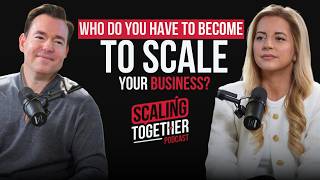
In this episode of the Scaling Together podcast, hosts Josh and Speaker B discuss the personal and organizational transformations required to scale a growing company. They explore how a leader’s identity must shift from a "superhero" who tries to do everything to a delegator who builds other leaders, emphasizing the need to place trusted leaders in charge of distinct business areas. Trust and transparency are highlighted as foundational, referencing Patrick Lencioni’s Five Dysfunctions of a Team and the EOS (Entrepreneurial Operating System) process, with practices such as quarterly addresses and open communication about performance and terminations. Both hosts reflect on internal resistance to rapid growth, balancing a desire for consistency with the necessity of change, and describe the emotional pull of staying in familiar routines versus embracing new habits. Time management is presented as a critical lever: creating blank‑space on the calendar, ruthlessly protecting deep‑work, and consolidating meetings into a single day to free the rest of the week for strategic thinking and content creation. The episode also details the elevation of a COO‑type role (Justin) to handle day‑to‑day operations, allowing the founders to focus on 10x activities and thought leadership. Throughout, the conversation blends practical tactics with reflective questions about the personal versions of self that must be let go in order to scale effectively.
Chapters
We want to get to the next level. If we want to grow, conditions are going to have to change. The way things are running are going to have to change.
Transparency is a big thing in keeping trust, and it starts with leadership. We have to show transparency first.
My identity has changed from thinking that I need to do it all. As the leader, it's like, okay, I need to have the vision, I need to create the execution plan, I need to— that's not possible. As the organization scales, we have to put leaders in place that can own their area within the business.
Peter Lencioni says it in his Five Dysfunctions of is if you don't have trust as your main foundation builder, there's gonna be issues that you'll have your team meeting with your leadership and they'll be afraid to ask certain questions because they're afraid they're gonna get fired.
Create new content to just be in my own mind creating. And I love creating. I love having blank space on the calendar. And so I think it's gonna require me to be ruthless with where my time is going.
Ruthless. I love it. On today's episode of Scaling Together, we are going to be talking about who you have to become to scale. There's a lot of changes that you have to make in your life, um, as you— things that you learn from reading books and things from trainings, things from masterminds that you pick up from people who have been there where you're headed before you, and things that you've picked up and you realize there's internal changes inside of yourself that you have to make real, looking in a mirror, and deep down, um, changes in order to continue to grow and be the leader that your team and your clients, your members expect of you. Mhm. And so that's what we're going to talk about today. The first question is, how has your identity as a leader changed over the last 3 to 5 years, would you say, Josh?
I would say my identity has changed from thinking that I need to do it all, right? As the leader, it's like, okay, I need to have the vision, I need to create the execution plan, I need to, you know, be checking all of the bases personally, to recognizing that's not possible. As the organization scales, as we add more and more clients and we add more and more team members, We have to put leaders in place that can own their, their area within the business.
Mine has been to listen more, to really hear what the others have to say and how important building trust is with your organization. It's Peter Lencioni says it in his Five Dysfunctions of a Team is if you don't have trust as your main foundation builder, then there's going to be issues that you'll have your team meeting with your leadership and they'll be afraid to ask certain questions. They'll be afraid to talk about the ugly that might be going on in their department because they're afraid they're going to get fired or that you're going to think differently of them. And so the importance of trust builders and really of having the time where you can talk with them one-on-one to discuss issues. So I think building up the trust has been something that we've— I've been focused more on doing with our team, knowing, seeing how important it is during the EOS process in order to have a good, um, trust in within the organization.
No doubt. Yeah. And I think, you know, for a long time, even, even recently, if I look like over the last you know, 6 to 12 months, I always kind of held the vision and the goals to myself and maybe to the leadership team. It was like, here's where we want to go, here's where we want to get, here's like the big things we want to get done. And if all I was doing was sharing that with the leadership team, which might be like 5 or 6 people in the organization, and it didn't, you know, kind of trickle down to the rest of the organization, they wouldn't be as excited, they wouldn't be as bought in. And so starting to do quarterly addresses where it's every quarter we did, our leadership team meeting and we set these goals, these rocks either for the year, for the quarter, and sharing that with the entire team, sharing the wins, sharing the lessons, sharing the vision. I find that that really creates buy-in from the bottom up.
Yes. And along with that line of transparency is being transparent in when we have to let somebody go. And I feel like we've always had great trust when we do the EOS annual with our leadership team. We've tracked it over every single session and Gerardo, so great, he's our EOS implementer and he always brings up the previous percentages and things like that. And it's typically 70s, 80s, 90s on these questions percentage-wise, but over time we've been improving it. And from the last one, there's a realization that happens as well of what transparency really does mean and how it affects you when you're making decisions and asking the team team for feedback. And so recently, just, we've been aware as well that if you let somebody go and you are not fully transparent as to why that is, that can also affect, you know, oh, am I next on the chopping block? Like, what did that person do in order to leave? And really our heart was, we don't want to put anybody in a bad light in order to be transparent. And so just making sure that we are being transparent while also respecting the other person who left. You know, we never want to talk badly about somebody else or, you know, or shine a light on major issues or any issues like that. So I think transparency is, is a big thing in keeping trust. And it starts with leadership. We have to show transparency first and then they'll see, oh, okay, this is a safe place, and I can also reveal what's going on in my department too.
No doubt.
What, um, version of yourself did you have to let go of to scale?
I think the version I had to let go of was the, the version that felt like I was the, the superhero of the company, right? I was the, the problem solver for, for everything. And, you know, always, always feeling like if the client was really upset, I could swoop in and save the day. And while that's valuable and it can save clients in certain situations, it trains and reinforces the team that, well, you know, they don't really trust me to solve this problem on my own. And so I had to let that version of myself die and let the team fall on their own sword in some cases so that they could step into that confidence and be like, this is my responsibility. I'm not waiting for the superhero to come save the day.
Yeah. One of the things that I had to let go of was just stepping into consistency, more consistency as a leader. And that started with my routine in the morning and developing the great— we talked about Atomic Habits in the previous episode, but just making sure that I wake up with— it just sets the tone. And waking up with my routine of working out in the morning, um, having a prayer, making sure that, you know, everything is going to go well, and being in that positive headspace, sitting down, focusing on deep work, doing the meetings with the team, and just though plugging into those things that you do every day, every week, builds that consistency. So for me, I was I, in the past few years, I've been working on that, on making sure that I'm very consistent with what I do.
So good, love that.
Uh, next question: What internal resistance shows up for you when growth accelerates? Internal resistance.
I, you know, I like growth. I'm excited by growth, but I'm also— good, growth is good. Um, but I'm also I like consistency, I like steadiness. And so when we're changing a lot of things super rapidly, I try to move back to like the, the safe harbor of the known, uh, and be like, hey, let's just keep this. If it's not broken, let's not fix it. Uh, but I also recognize if we want to get to the next level, if we want to grow, um, conditions are going to have to change. The way things are running are going to have to change.
This is what's interesting about you and I, Josh, uh, being the leaders of the company together, is that That's how you feel. And for me, that's my struggle is the consistency part. And I get fired up and excited about little nuanced changes of how can we make this 1% better? And just focusing on, um, well, this is great, but this, if we just tweaked it like this, it'd be even better. And so the consistency for me is the part that I have to overcome because as a leader, the boring is what scales. And so you do want to be consistent in what you do in the company, but also it's like one of those opposites kind of thing that go together. It's like you do want to stay consistent, but you also need to make some changes in order to continue to move the needle. Otherwise you get complacent. But that is an interesting thing that your challenge is my challenge and vice versa. So yeah. And the last question for this is, what does the next level require of you personally?
I think the next level requires me to be able to continue to step up, to be a thought leader, and just be willing and committed to focus on the things that are in my genius zone. Like a lot of work we've done over the last couple of years has been around, you know, we've got this growing, we've got these growing companies, we've got these great teams, and managing our schedule to say like, where's our time go every single day? And for a long time it was like meetings, meetings, meetings, meetings every single day, you know, meeting with clients, meeting with teams, meeting with content creation and everything in between. But then, you know, recognizing that doesn't give me a lot of time, you know, to create new content, to just be in my own mind creating. And I love creating. I love having blank space on the calendar. And so I think it's going to require me to be ruthless with where my time is going and create those blank space days, those blank space hours of time where I can just create.
Ruthless. I love it. Yes. For me, what is going to be required is time and focus. And one of the things that we did in order to make these big changes, which are so exciting that we've recently done to take off our plate so that we focus more on deep work. And less time in meetings, just have it all on one day. All of our meetings are now on one day, and so we are having the rest of the week to mostly do deep work and create content, like you said, but also, uh, the block time of getting together and look on our business as well. And moving our COO position up has been instrumental in that, um, where Justin's been wearing the hat, just not officially with the title, right? But having him move into the seat so that we can focus on those things that are going to move the needle, big picture 10x activities that we want to implement that we're really excited about over the next couple of years and have him oversee the business and the day-to-day management while we're still heavily involved in that piece with him meeting on a regular basis. So it's going to be great.
Yeah, we're talking about like the changes you need to make, you know, like you've made a lot of changes in stepping out of the things you do really, really well and saying, okay, I need to put someone else, I need to elevate and delegate. And you've done an amazing job on that front.
That was scary. Yes. The first time to like start letting go of the event piece and having other people, rock stars who are honestly better than me at these positions and just giving them the tools that I've been using. And they have been doing an amazing job. We just got the most most recent intensive with the highest rating in both of our events that we do throughout the week at the intensive, the highest rating we've ever received. We continue to excel and support our team in that way, and it's been wonderful to see the team grow in that way. Awesome.
Well, hopefully you got some good insights and takeaways here on how to really elevate as a leader and kind of recognize you're going to have to evolve through the different phases of growth both internally and within your organization. Mm-hmm. Uh, would love it if you would drop a comment or however you happen to be listening or watching this right now, and be sure to subscribe for future episodes of the Scaling Together podcast.