Confidence is Overrated - Audiobook - Introduction
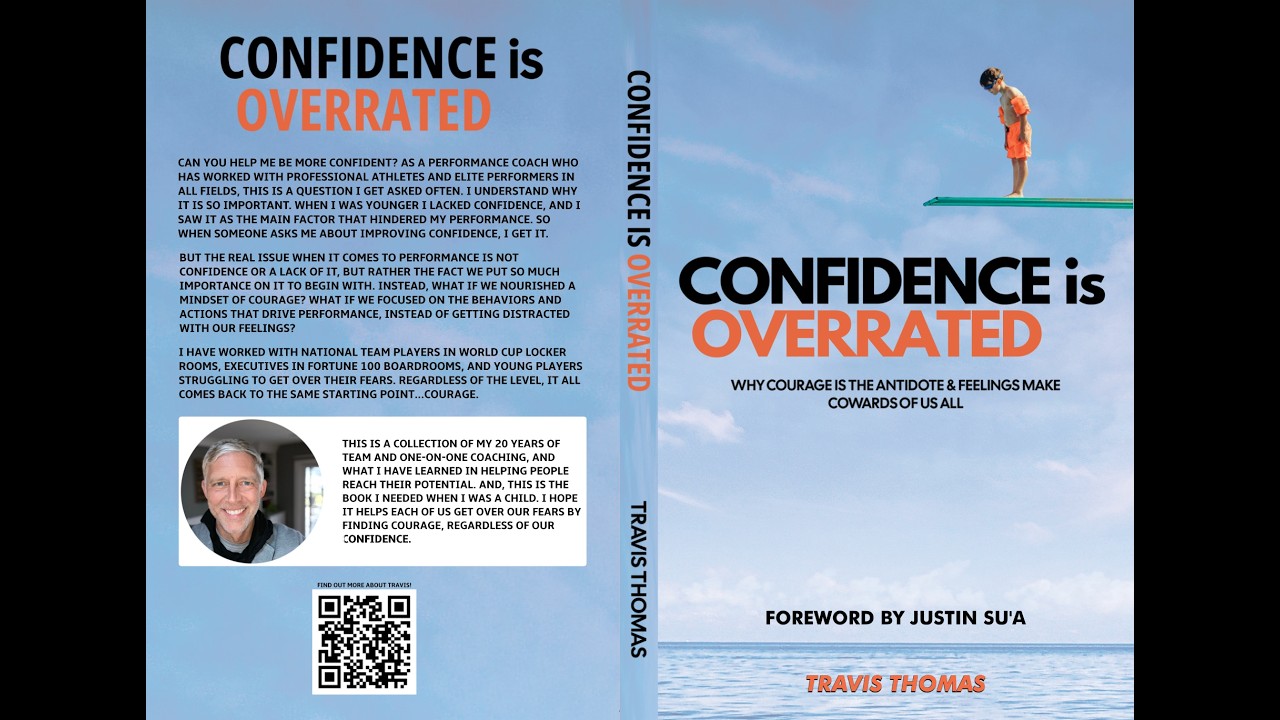
Travis Thomas reads his introduction to a book arguing that courage, not confidence, matters. He shares his childhood fears and how coaches demanding fearlessness backfired, leading him to reframe fear as fuel for courageous action rather than something to eliminate.
Chapters
Hello everyone, Travis Thomas here, and this is an audio recording of my book Confidence Is Overrated: Why Courage Is the Antidote. Hello everyone, this is Travis Thomas, the author of the book Confidence Is Overrated: Why Courage Is the Antidote and Feelings Make Cowards of Us All. This is an informal reading of my book, and this is my opportunity to not only share a video version of it, or if you're listening to it just via audio, I wanted to read my audiobook in a way where I'm able to include little side notes and Easter eggs along the way and have it feel a little informal and conversational. So this is going to be the introduction and chapter 1. So the copyright is 2024, Travis Thomas, all rights reserved. This book is dedicated to the child version of myself. This is the book I needed when I was younger. And of course, I dedicate this to Hollister, Trinity, Holland, and Shepherd, and Mako as well. He knows. I was really honored and grateful for the amazing Justin Sue to write the foreword for the book. Justin is one of the best mental conditioning coaches in the world. He's worked with, uh, Tampa Bay, Dallas Cowboys, Cleveland Browns. He has his own consulting firm now. Uh, he and I, uh, were together at IMG Academy. He was with the Boston Red Sox as well, and, uh, we became friends at IMG Academy, and he was gracious enough to write the foreword for this book. So here we go. Foreword by Justin Sue. Writing this foreword feels both a privilege and testament to the extraordinary impact that Travis has had on countless lives, including mine. Travis embodies a rare blend of courage, empathy, and unyielding integrity that sets him apart as a coach, leader, and friend. Through his work, I have seen Travis touch the lives of athletes, coaches, and executives, helping them navigate the complexities of performance, fear, and self-doubt with grace and resilience. What makes Travis remarkable isn't just his knowledge or skill, but his character. He approaches every individual with kindness and respect, seeing their potential and the unique challenges they face. He doesn't rush to fix or change others. Instead, he listens deeply, creating a space for real growth to emerge. It is this patience, this relentless dedication to helping others, find their strength that reflects the core of his leadership. Within the pages of this book, Travis redefines what it means to be courageous. Confidence Is Overrated isn't a guide to eliminating fear. It's a powerful invitation to embrace it, to run at the storm, and to find courage within the uncertainty. Through his journey filled with vulnerability and wisdom, Travis gives us the tools to confront our limitations and realize the strength that lies within. His words are a gift to anyone seeking to live and lead more authentically. Justin Sue, founder, Performance Advisory Group. Well, those are very, very kind words. And again, thank you, Justin. And I highly recommend Justin's books to any of you looking for inspiration. Introduction. Would you rather be courageous or fearless? I am not courageous, at least not in the traditional way we think of courage. I haven't fought in any wars, taken on any bullies, or free-climbed any rock walls. By most accounts, I consider myself rather scared. I worry about my health. I fear for my kids getting hurt, sick, or my wife not paying enough attention when walking alongside the road. Side note, that's caused many fights. I won't go out far in the ocean because I saw Jaws as a child, and the feeling of not being able to see what swims beneath me has kept me in the shallow end. Heck, I won't jump in a swimming pool at night before checking to see if there are any sharks, alligators, or snakes lurking below. Florida life right there. As a child, I went through a period where I could barely sleep at night because I would lie in bed and ponder all the darkness in the world. Fear was a heavy blanket pinning me down each evening, often leading me to sneaking into my brother's room for a sense of safety. As I got older, the dark thoughts subsided, but now my fears felt more practical. I have always been an easygoing guy, and you wouldn't really notice that I carried much anxiousness at all. But under the surface, my imagination would run wild, and it would often run negative. I loved sports. Soccer became my passion, but even there I felt inadequate. All my friends seemed comfortable, confident, and fearless. I was not. I was nervous about getting hurt or not being good enough. Coaches would preach being fearless, which was the furthest thing from what I was feeling. If success in sports meant not being afraid, then there was definitely something wrong with me. I looked for other ways to be effective that didn't require having to be too physical. I would rely on skill and finesse and let my teammates be tough and fearless. Yet no matter how hard I tried, and no matter who the coaches were, I kept running into my ceiling. Whether it was high school coaches, club coaches, or my eventual college coach, none of them really knew what to do with me. My coaches liked me, but they didn't know how to get through to me. They tried as best they could, and really, at that age, I didn't know how to get through to myself. I was a good player, but my inability to embrace the physical aspects of the game kept holding me back. They would yell, be more physical, be aggressive! One of my coaches threatened from the sideline, if you don't win the next head ball, you're coming off! I'm pretty sure I was taken off soon thereafter. I wanted to be better. I wanted to be fearless. I really did. I just didn't know how, and none of my coaches knew how to help me get there. So I continued to flounder. Whether they knew it or not, they were starting from a premise that there was something wrong with me, which only reinforced my opinion of myself that there was something wrong with me. They unintentionally emphasized what I already felt. As an athlete, I was damaged goods. Clearly, I was the only athlete that struggled with feelings of doubt, uncertainty, and fear. Here I am now at the age of 50, maybe 52 now, smiling at how ridiculous that last sentence is as it flies off my fingers. Clearly, I was the only athlete that struggled with feelings of doubt, uncertainty, and fear. And my guess is that you too know how ridiculous that statement is, because of course each of us deals with feelings of doubt, uncertainty, and fear. You do, your spouse does, your sales team who might— who must now pivot and adapt to an ever-changing industry and yet still meet their quarterly sales goals do. They deal with fear too. Yes, the reason we all relate to these feelings is because we're human. They are the most basic traits of being alive. They are key aspects to our— let me try that again. That's why this is informal. They are key aspects to our evolutionary survival. For millions of years, our survival was based on assuming that the noise coming from the bushes was only out to get us. So why do we have such a negative relationship with fear? Growing up in the '80s, I remember seeing the stickers and t-shirts for the brand No Fear. They were everywhere. Just like coaches yelling, be fearless, there's an inherent message in these phrases and slogans that fear is a bad thing. Fear is not some part of our personality we need to fix. Instead, we need to understand the positive role fear plays in our life. But not let it be in control. Fear left unchecked is paralyzing, yet fear understood and channeled is healthy and powerful. Despite my negative experience as an athlete and feeling inadequate as a result, it eventually led me into the work that I do today as a performance coach who specializes in mindset, team dynamics, and culture. Even before diving into the personal development and mental skills world, I took a part-time volunteer position as, as an assistant coach with my old high school soccer team. I had just graduated from college, fresh off the frustration of 4 years of an unfulfilled soccer career, and here I was getting to work with young players just a few years younger than me. It turned into 3 of the most rewarding years of my life, and I wasn't even getting paid. During that 3-year stint, the team achieved numerous first-time milestones, but the most gratifying side of the work was being able to help these young athletes overcome many of their own fears. As a player, I felt I was alone in my fears, but as a coach, I could see myself in so many of these young men. Those were the players I gravitated to most. I had felt what they were feeling. I had been there. When I saw a player struggling with fear or a lack of confidence, I would ask myself, how did I want to be coached when I felt like this? As a result of that empathy and understanding, I was able to take a different approach. I didn't need to insult their manhood, convince them to be confident, or invalidate their fears. Instead, I showed appreciation for who they already were. I emphasized the abilities and strengths they already possessed. And then helped them focus on specific actions that would help improve their play. There was nothing wrong with them. They just needed a different direction and motivation to encourage them out of their comfort zones. It seems like a simple, even common-sense adjustment, but the impact is huge. But isn't this a book about confidence? Let's go back to the opening question. Would you rather be courageous or fearless? Have you changed your mind? Where does confidence exist between these two? Most of the work that I do could easily be labeled as helping players, individuals, and teams become more confident. Our society is infatuated with confidence. We equate confidence with being fearless. If I am scared, well, then I'm definitely not feeling confident. And if I am not confident, my performance is in trouble. So as coaches, parents, and leaders, we preach confidence as the cure and often make— and often mistake courage for being the same. Courage and confidence are not the same. If we're not careful, we might teach that the opposite of courage is fear. It's not. The opposite of courage is comfort. There's nothing wrong with being comfortable, but there is rarely growth and wisdom in staying comfortable. There isn't much nobility in it either. When we find ourselves with a ton of confidence, it's not uncommon to let that confidence turn into comfort. We stop doing the work. We become complacent. We become overconfident. Fear and courage are not opposites. They're partners. Courage is not— courage is not courage without fear. It's the key component. Bravery is courage in action. What kind of action? The action required to do what needs to be done when we are filled with fear. Take away the fear and there is no courage. So you see, we can't have a book about confidence unless we understand what it is and what it isn't. Confidence and courage are not the same. In fact, they're quite opposite. Confidence tends to view fear as the enemy, as the enemy, while courage isn't courage without its main ingredient: fear. This is the inflection point we are going to dissect in this book and hopefully change your relationship with confidence and fear in the process. It's not about training you to become more confident. It's about nurturing and helping you become more courageous. Like I mentioned, as a coach, I would help players who were struggling by asking myself the question, how would I have wanted to be coached? Similarly, I am writing the book I needed when I was younger. It's a book for anyone who has ever grappled with fears and doubts. It's a book for kids, adults, executives, teachers, coaches, parents, and world-class athletes. Yeah, they deal with fear too. I will take you into the locker room of the FIFA World Cup, teach you how to run at storms, and share tools and practices for turning fear into the, into the necessary fuel to feed your courage. So let me ask the opening question a little differently. Would you rather be courageous or confident? Some of you are still answering confident, and that's okay. We have plenty of chapters left. Reflection plus action equals reflaction. Side note, I actually had a friend of mine was reading this book and she got a couple of chapters in and she goes, I, uh, I think I need to let Travis know that he, he misspelled reflection. There's a typo in all these chapters. No, she kept seeing reflaction. Reflection plus action equals reflaction. At the end of each chapter, I have included 2 to 3 questions to reflect on, and then most importantly, turn into actions. Use these questions as a spark of inspiration and motivation that hopefully leads to Transformation. The results are in the work. Reflection question 1: What situation in your life has held you back because of your own fear or anxiety? Reflection question 2: Think of a time when you felt nervous or afraid and you did it anyway. What happened? That concludes the introduction to my book, Confidence Is Overrated. Chapter 1 coming up next.









