Half-Time Talk: "Caspian Producers Seek Economic & Security Guarantees from the West!"
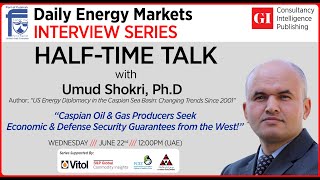
Dr. Omid Shokri explains how Russia's invasion of Ukraine has upended energy markets and forced the EU to seek alternatives. Caspian producers like Azerbaijan and Kazakhstan could fill the gap, but they want Western security guarantees and investment. Iran's oil and gas reserves sit idle under sanctions, while the U.S. has largely ceded influence in the region to Russia and China.
Chapters
Good afternoon and welcome to this week's edition of Halftime Talk, a weekly interview series where we get the opportunity to dig a little bit deeper into some of the trends that are impacting global energy markets. And it's a pleasure to welcome this week Mr. Omid Shokri, Senior Foreign Policy Advisor and Energy Strategist and the author of the book US Energy Diplomacy in the Caspian Sea Basin: Changing Trends Since 2001. What a 20 years it has been in all oil basins, including the Caspian. Omid, welcome to the show.
Thanks for having me, and hope to have a great discussion regarding the last development in energy market.
Thank you so much. There's no doubt that we are in a period of time, Dr. Omid, of great geopolitical turmoil. Obviously, at the core of that is Russia's war in the Ukraine. It's certainly causing fractures in a lot of places. What do you take away as some of the bigger new fractures to emerge? You're sitting in Turkey today. Obviously, the balance of the clearly where Asia meets Europe, the European continent. Where do you see some of the new fractures emerging out of Russia's war in Ukraine?
Yeah, you know, the world energy market last year faced with huge energy crisis. And before that, we have 2 years of pandemic, I mean COVID pandemic, and the COVID and after that, I mean energy crisis. And after that, the last development was, as you mentioned, Russia's invasion of Ukraine shows that world energy dynamics and the geopolitics of energy are changing, and the diversification of energy resource was the main challenge for energy consumers such as China, India, and EU as well. And all countries, I mean energy consuming countries, try to revise their foreign policy, their energy policy, and the more focus on energy transition, more focus on own domestic energy resource, I mean, available energy. And as the main—
That was certainly the big thing coming out of COP26 last year, wasn't it? November, everybody seemed to be pouring into the energy transition. We had Saudi Arabia identifying 2060 as their net zero, India 2070, China as well. Everybody had, you know, it was the COP26 energy transition bonanza. And then kaboom, it all seemed to crumble very quickly.
Yeah, as you mentioned, after the COP which held in Scotland, all energy consumers and energy producers announced that their long-term plan to overcome the effect of climate change and decreasing greenhouse emissions, but at the same time we can see during the next months The energy demand in oil market will be reached before pandemic, and it means that we need more oil and more oil production. But at the same time, we have to focus on energy transition process. I mean, that decreasing the share of fossil fuel in global energy means. But referring to your question, after Russia invasion of Ukraine, all countries, mainly EU, focus on diversification of energy resources. Trying to find an alternative for Russian natural gas, oil, and coal. I think finding an alternative in the coal market, it will be hard for the EU, but finding an alternative in oil and mainly in the natural gas in the short run, it is very hard for the EU. The US and EU try to reach some energy procedures such as Azerbaijan, Qatar, and some African countries.
If we, if we, if we look at first before we get into where the alternative fossil fuels can come from, Dr. Omid, where do you think that balance is now between energy security versus energy transition? The Europeans seem to be uncertain to where that balance is. Where do you see that at the moment? Will energy transition suffer because of this surge towards energy security?
Yeah, it's a very good point. Thank you. You know, it is a reality that Energy transition process needs fossil fuel. Without using fossil fuel, no country in the world, no matter located in the EU, in the US, in Africa, in South Asia, no matter, will not be able to be more successful in energy transition. Energy transition needs, I mean, it's time-consuming and needs high financial capability and high technology. Without this principle, no country will be able to to overcome the effect of climate change, to help to reducing the effect of greenhouse emission and global warming. But repeating your question, if every country wants to notice and to give priority for energy security in its foreign policy, has to focus at the center of the energy transition and using fossil fuel. And in the long term, it will be very interesting for every country to gradually decrease the use of fossil fuel more focus on energy transition, renewable, hydrogen, electric vehicle, nuclear energy, and at the same time decreasing gradually using coal, natural gas, and oil. And I think the world for the last, I mean, for the future 2 or 3 decades needs fossil fuel. But as I mentioned, the world and mainly energy consumer gradually has to decrease the share of fossil fuel and at the same time increasing the share of renewable hydrogen.
None of these things, Dr. Omid Shokri, can happen overnight. In terms of this push for energy security, where can Europe find alternatives to Russian oil and gas? You have written your book, US Energy Diplomacy in the Caspian Sea Basin. I'm wondering What can the Caspian do to support the— or to deliver more and immediate energy to Europe?
Yeah, it's a very good question. And in my book, I just focus on US energy policy and at the same time EU, China, India, and the 5 coastal countries. I mean Iran, Russia, Turkmenistan, Kazakhstan, and Azerbaijan foreign policy and energy policy toward global energy market and especially toward Caspian Sea.
We did, we did see before, Dr. Omid Shokri, that US energy diplomacy, uh, 10 more years ago in Azerbaijan, it was very strong and muscular in, in shepherding the Cheyenne pipeline in through Turkey and exporting out into the Mediterranean. Do they still have that muscle in the Caspian?
Yes, a great point. As I mentioned in my book, during the Obama administration and after Sharegas revolution, Russia— and also after the Obama administration made a decision to withdraw its troops from the region, mainly from Afghanistan, the US gradually lost its interest in Central Asia and Caspian Sea basin. As well. And after that, such development, mainly Cheyenne's revolution and the withdrawal of troops from Afghanistan, we saw that the role of Russia and China in the region will increase. Russia from the security perspective and China from the economic perspective. You know, Central Asia and Caspian Sea play an important role in China's One Belt One Road project, and China made a huge investment. I think in the last decade, China made a huge investment, about $50 billion in the region, I mean, in the infrastructure. And definitely your question, natural gas and oil from the Caspian Sea, mainly from Kazakhstan, from Turkmenistan, and Azerbaijan, will be in the midterm, hold the potential to be alternative to the Russia, some part of Russia hydrocarbon in EU energy mix. But this country needs more investment from the US and the EU companies and also needs political support from EU and the US to boost their capacity. At present, their production capacity, if want to more supply, need more investment to double, I mean, natural gas production capacity. Azerbaijan has a good potential and also Turkmenistan, you know, after two decades—
What is their natural diplomatic tendency in Azerbaijan, Turkmenistan? They've obviously lived under the influential dominance of Russia for many decades during the Soviet era. And now, as we emerge, and now with this new fracture in Ukraine, where do those countries want to move? Do they support? Do they engage? Do they want to see Putin and Moscow have a success? Do they want to see this as an opportunity to turn to the West? What do you think they see the diplomatic fracture here?
Yeah, you had a great point. Thanks. You know, After the collapse of Soviet Union, West, I mean US and EU, tried to bring hydrocarbon resources from the region to the global market, mainly EU market, without using Russian infrastructure, without using Russian hydrocarbon resource, and without Russia control. You know, after the collapse of Soviet Union, Russia was not so powerful and West will be able to more invest in the region and bring the natural gas from Kazakhstan and from Azerbaijan to EU market and help the EU market to diversification of energy resource. And, you know, two decades before, EU and Turkmenistan signed an agreement to bring natural gas from Turkmenistan.
I mean, what about now? What about now?
Let's not look at the history.
Let's look now, today, tomorrow, this week. We had Putin last week in Saint Petersburg, so somewhat nearly threatening Central Asia not to turn to the West?
Russia invasion of Ukraine shows that in any such situation, this country has no supporter from there, has no supporter, and this country's main problem is keep their own integrity and sovereignty. And, you know, by 2014, after the Crimea annexing to the Russia, and by '28, after Russia invasion of its Georgia, these countries, I think, more focus on their own national interest in the region and trying to keep their good relation with the West and also try to create a balance in the relation with the Russia, with the China, with the West, but mainly trying to, for these countries, keeping relation, a boost relation with the Moscow, not with the West. And I am happy with you. And if West and mainly EU wants to supply more natural gas and oil from the region, try to more investment in infrastructure in the region, and politically and economically support these countries against Russia's future invasion. That's it. Without solving this problem, I think—
Sorry, which problem? Say that again. Which problem do they need to solve?
Yeah, these countries need politically, military, and economic support from the West. If West I mean, mainly EU wants to supply more natural gas and the oil from the region, trying to solve the security concern of these countries.
And they have to, I think, to an extent, the Europeans— it's coming back to the earlier point, energy transition versus energy security. The Europeans seem to want to keep both, and they're going to have to compromise with energy transition, aren't they, in order to give Azerbaijan and these other countries confidence to invest in new supply, the Europeans are going to have to give up a little bit of energy transition.
Your thoughts? Yes, yeah, yeah, yeah, I'm, yeah, yeah, I'm happy with you. You know, after 2008 and 2014 and Russia invasion to the Georgia and annexation of Crimea, I have to ask the European leader, when you saw that Russia many times using energy to gain I mean to get geopolitical even, why EU gradually did not dependency of Russian natural gas, oil, and coal. They have at least one decade to gradually decrease, but we can see majority of EU countries gradually increase their dependency of Russia energy resource, and it's against EU energy security and EU national security as well. And this is the main question and everybody in the US their own leader, why did not— they did not solve this problem and did not gradually decrease dependency of Russia hydrocarbon resource. And when they see that Russia using energy to leverage foreign policy to get more geopolitical, I mean, benefit from the exporting oil and gas and coal.
What about the situation in Iran and the Iran nuclear talks? Omid Shokri, you have been recently— you've served as a visiting research scholar at the Center for Energy Science and Policy at the Schar School of Policy and Government at George Mason University in the United States. Where do you think the Iran nuclear talks are now? Of course, Iran, a big Caspian Sea oil producer as well. It looks like the Iran talks are dead. What are your thoughts?
Yeah, there is the last development in nuclear talk. If Iran did not revise its foreign policy and did not came to conclusion to that, without the lifting the sanction, without the nuclear deal, Iran will be net energy importer by next decade. Let me give you more detail regarding this claim. Last November, Iran Minister of Oil, Javad Aoudi, said that In the next decade, Iran needs $160 billion investment to keep current production level. I mean in natural gas and oil. You know, Iran is not major player in the global natural gas market. It should note that Iran holds second world reserve of natural gas, but due to high domestic consumption and many sanctions imposed regarding Iran nuclear program, Iran just has a little share in regional market and exporting natural gas to Iraq and Turkey. And regarding Turkey-Iran natural gas pipeline, I have to say this current contract will be end up by 2026 and negotiations over expanding this contract will not be successful. And Iran is going to lose its major energy, I mean natural gas destination in Turkey. And if Iran will not be able to—
Doesn't Turkey still need that gas?
When Justice and Development Party under Erdoğan came to power, trying to focus on diversification of energy resource and also more focus on renewable energy, Turkey had a plan to generate electricity from the domestic potential, I mean renewable, by 2030 around 30% and also The first nuclear power plant is constructed by Rosatom in Turkey, and it will be— first phases will be online next year. And also Turkey making huge investment in electric vehicle, solar power plant, and energy transition elsewhere.
Turkey is building up a good capability. Just coming back to Iran, the talks have been in Vienna for nearly 6, 8 months. They ended up not yet reaching a signature, but they apparently did reach an agreement. Uh, but the big sticking point, at least as reported, is that Iran wants the Revolutionary Guard to have no longer the terrorism definition in the US. The US seemed to be unwilling to make that change. Can this be resolved?
Yeah, the last one being in nuclear talk. Yesterday, some senators from the old Democrats and the Republicans said that there is no killer future for nuclear talk if Iran did not revise its foreign policy. And as you mentioned, keeping the IRGC in the terrorism organization. If Iran accepted a U.S. condition to keep IRGC in terrorism organization groups, We can see that the nuclear deal will be signed by coming weeks because everything is on the table. And before Raisi came to power—
Can Iran, the ruling, the presidents, the whoever has the authority, ultimately it's the Supreme Leader. How important is this point, the Revolutionary Guard being defined as a terrorism organization? Is that a deal breaker for Iran? Would they be willing to see this collapse?
Regarding the effect of the sanction on Iran economy, I have to say Iran economy is in a very dangerous situation. And during the last decade, you can see some protests in every province of Iran, and between workers and people, retirees, they are looking to get their monthly payment from the government, and government is unable to pay their, I mean, salary, pension, every month. Yeah, yeah, yeah. And Iran knows that the sanction is very effective. And regarding the effect of sanction on energy, Iran is the energy producer, but it will be net energy importer by next decade if sanctions continue. That's it. You have the— you hold the first oil reserve in the world, second in the natural gas, But you are going to be energy importer. Why? Because of effect of the sanction and high domestic consumption in natural gas market, natural gas sector in Iran. I have to say Iran shares South Pars field with Qatar, and the South Pars is the major supplier of natural gas. Iran produce 70% natural gas which consuming own domestic by from the South Pars.. And during the last years, the pressure drop starting the sole parts without the high technology. I mean, some European companies such as Total, Iran will not be able to solve the pressure drop.
So why don't they do a deal? Tell me your opinion, Dr. Omid Shokri. Why doesn't Iran do this deal?
I think after the revolution, the major priority for Iran is deterrence, not development. I think I answer your question. Deterrence, not development.
That's it. That's it. Well, that's where we're going to have to wrap up, Dr. Omid Shokri. Deterrence, not development. That's a sad, unfortunate reality in Iran. I agree with you. I don't think that's going to change, and that's where we'll be stuck. The question then becomes for another day, what happens when there's no deal and Iran develops a nuclear weapon? That's the big question next. Nobody seems to be wanting to answer that question, and we can't do it today on this halftime talk because we've run out of time. It's a pleasure. Thank you so much, Dr. Omid Shokri, a senior foreign policy advisor and energy strategist and author of the very well worthwhile reading, US Energy Diplomacy in the Caspian Sea Basin: Changing Trends Since 2001. Dr. Amoud, thank you for being on this week's Halftime Talk.
Thanks for having me and have a great rest of the day.
More from Dr.

Trump seeks $100bn for Venezuela oil, but Exxon boss says country 'uninvestable'
Episode 52: Impact of Iran Israel Conflict on Global Oil and Energy Supply | Dr. Umud Shokri
Yemen’s Houthi rebels attack a US-owned ship in the Gulf of Aden with bomb-carrying drone