Fully Booked Day 1: Fully Booked Offers

Zee Slingsby explains what fully booked actually means: having exactly the right number of ideal clients, not just signing everyone. She walks through her Elevate Mastermind case study, which took months to fill, and breaks down why coaches need multiple offers at different price points so clients can move between them as they grow.
Chapters
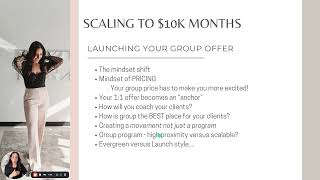
I'm gonna go ahead and share screen. We're recording, so all of you will get access to the recording. It'll actually be sent out today, so anyone who missed today can still hop on tomorrow and get caught up. So good to see some of your faces that I haven't seen in a while. I'm gonna share screen. Okay, fully booking your offer suite and fully booked. I'm gonna talk about what that actually means, right? So what does it mean to truly run your business fully booked. And what it doesn't mean is just signing every single person that you can up, because that's not really the life that you signed up for, right? That's not what you actually wanted. That's not the freedom that probably every single one of you on this call— that's why you became an entrepreneur, right? And so I'm going to talk about what it means to be fully booked, but also in a way that honors what you really— the goal you really want. We want to make money. I don't want to shy away from that. We actually want to make money, but we want to enjoy our life. And actually enjoy the money, right? Create memories with whatever it is that we're earning, not just fully booked so that you're running ragged. Because I was there. I remember running ragged at one point, and it wasn't fun for me. It wasn't fun for my family. There was one short moment I even told my husband, I don't know, should I go back to work? I said that dreaded line, right? Because I was running ragged. So that's not what we're going to talk about today. We're gonna talk about fully booking your offers that are your best offers that give you the life that you want. Also just gonna add this in here. I absolutely love, love, love when I hop off one of these calls. So if you're watching it live or you're watching the recording later, if you want to, or you feel so inspired to take a little picture and tag me in your stories, that always makes me so happy. So if you'd like to do that, go for it. I welcome that. And let's dive in. Fully booked offers. Tomorrow we're going to talk— I'll go over the agenda real quick with you guys. We're going to talk about fully booking your offers suite. And then tomorrow we're going to talk about fully booked from stories specifically, because that has played the biggest role for me, fully booking my offers and expanding my income. And stories allowed me to move much faster than actually my feed, right? So what I was able to pull off in stories without crazy story views— I'm going to go into that tomorrow. I was able to move quicker than the traction I saw from my feed, which kind of came later. Okay. And then day 3, which is Monday, we're going to talk about what to do when you're not booking your offers. So some troubleshooting you can, you can do if you feel like it's— you're not getting to where you want. And then I'm actually going to be doing live coaching on Monday too. So don't miss Monday. Today, if you have questions as I'm going along, please drop them in the comments because I do have time at the end to go through. Probably a good amount. And then Monday live coaching is a little bit different than Q&A. Live coaching, I'm actually gonna pick some of you and we can get into your stories, we can get into your offers, and that's always so much fun. So I'm really excited. I won't be able to live coach everyone, but you'll be able to learn watching others get coached. I promise it'll be fabulous. Okay. Okay. So what does it mean to be fully booked. All right, there was a time in my business where I was fully booked in one-on-one. I was more than fully booked. I was maxed out. I didn't have any free time. I was probably not the best coach that I could be because I was running ragged trying to help too many people. And so that to me is not fully booked, that's actually overbooked, and that's not what any of us want. Fully booked means I have the exact number of clients where I can shine and be the best coach for them, and I'm making the income that I want. Because you don't want to be resentful if you sign on a bunch of folks and you're undercharging. You still cannot be the best coach that you can be. You're going to start resenting the time because our time— and I want you all to think about this and write it down, and maybe it's your theme for 2025. It was my theme 2 years ago. That time is more valuable than money, right? Time is more valuable than money when you value your time. And if you've been on other calls with me, if you were in 10K Weeks not that long ago, I said this. When I started to value time more than I valued money is actually when I started to make more money. So when you're undercharging for your time, so you get on a call and you feel like, man, this is sort of a waste. I, I, I'm gonna serve because I'm a good person, I'm a great coach, but this is an hour of my life that I feel like I'm not making what I need from it or what I want. You're going to have resentment, and it's not your client's fault. It's your fault because you didn't value your time. So fully booked means I am fully booked with the right clients. I've called in the people I want to work with. I called in the number that I want, and I didn't just bring on more people because I want to make more money, right? You should actually just charge more for your time. We're gonna get into what I mean by that. And I'm not overcapacity. Okay, so this year specifically, I have seen so many coaches come to me that were doing really, really well in their business, and then their business started to decline. And I can look at their business and say, this is when it started to happen. It was when they actually started to book out, and they kept thinking, I have to bring on more clients to make more money, more clients to make more money. They believe that was the only path to actually expand their income. And then what happens is they get burnt out. Okay, you start getting less client testimonials because your clients are not able to get the attention that they want. Your clients are, are signing up for something and then maybe, uh, they're not as excited, you're not as excited. So all of this is what we wanna avoid. We want to be fully booked with dream clients in the most perfect offers that make us happy and make our clients happy. Okay? Okay. So what is the mental and actual cost of running under capacity? Okay, so there is a cost, and I want to explain what that means. If you are running one-on-one and then you launch a group offer, and your group offer, let's say you sign 2 people but your capacity is 10, you're like, I know I can serve 10 amazing, I can pour into them, I can be an incredible coach, uh, 10 is where really where I shine. But you launch your program, you sign on 10 people, and now you have 8 spots open. The cost of that group is those 8 spots. So it is a liability for you, right? It doesn't mean you're not going to shine, you're not going to be an amazing coach, but it is in your best interest to fill those 8 spots before you sign one-on-one clients, right? Because you're getting on a call that has capacity for 10. So that's the actual cost of running under capacity. The mental cost of running under capacity is simply that you start to build that resentment we talked about, because now you're getting on a call— it is not those 2 clients' fault, right? In fact, they should be getting the best of you because there's the that trusted you, that showed up, but there's still 8 spots that you desire to fill, right? So I wanna talk about my Elevate story. I have a program called the Elevate Mastermind, and my— this was the third offer. Was it third or fourth? Third or fourth offer that I launched a few years ago. Now, it was the offer that I was probably most excited about. I had poured so much into building my second course. My first course had felt easy because it almost happened by accident. This second one was incredibly intentional. I put so much time into building it. I was so passionate about this next step that I was taking, this new mastermind I was launching. But even though my other offers actually did really well when I launched them, for some reason this one was a little, um, I had one-on-one clients. I had actually too many one-on-one clients and I wanted to start my mastermind, which a lot of you might be thinking, to help alleviate how many one-on-one clients I was taking on. And I knew I could still serve in this space just as well. But I didn't get the signups when I first launched. Now, this is exactly what I want to teach you to avoid on this call. Month 1 came and I had one person sign up. She was actually a former, uh, client from a different program, and she moved right into Elevate. She was the only one in the mastermind. Now, I have clients that tell me all the time, I feel a little bit embarrassed, I just had one person sign up. I want you to take that out of your mind. There's absolutely no embarrassment. I actually went to this client, her name is Jess, and I said, hey, guess what? You're my only signup, so you're really lucky. You're gonna get one-on-one coaching until I put more people in the group. How do you think she felt? Do you think she felt awful or was she like, cool, I got one-on-one coaching and she didn't pay for my one-on-one price? So it, I, it truly is a win-win. I pitched it as a win-win and she took it as a win-win. And I got to coach her one-on-one for a bit. Now, instead of feeling down about this, right, that mental cost, instead of feeling resentment, I was like, hey, let's go, you get one-on-one. And I still believe in my program. I refuse to pull the plug on it. I'm not going to refund her and say, hey, let's not do this after all. I believe in it, so I'm gonna keep going just because I didn't fill it in this arbitrary number of 30 days, right, which means nothing, does not mean that I can't fill it in the future. So I kept talking about it, I kept believing it. I learned how to tweak my messaging too, which we're going to talk about tomorrow. I did not cut the price, I did not slash the price, okay? And so now we have 4— first 4 weeks, Jess is my only client. Week 5, Jesse's my only client. Week 6, Jesse's my only client. Weeks 7 and 8, something crazy happened. I had been doing all these clarity calls, which we're all going to also going to talk about clarity calls, and they weren't going bad, but they weren't signing. All of a sudden, week 7 and 8, those folks who I had talked to came back into my world. They were still watching my stories. And one after the other, I'm ready to join. I'm ready to join. I'm ready to sign up. Send me the link. I'm ready to go. It was absolutely crazy. Week 7 and 8, I maxed out that entire mastermind. I had 10 spots. All 10 spots were filled. And then in month 3, I decided I'm going to open up another call time because I didn't want more than 10 in there. And I opened up another call time. And this was, this was 2 years ago, just a little under 2 years ago. And since then, Elevate has consistently run almost always at full capacity. Every time a spot opens, someone grabs it. Every now and then I'll have a couple spots. Now, can you imagine if I had pulled the plug on Elevate? If I had said, hey, this is just not selling like my other programs, I'm just going to go ahead and maybe do something else. I'm going to offer something different, or I'm going to lower the price, or I'm going to just, you know, I'm going to launch a low ticket instead, which is fine if you want to launch a low ticket. But my heart was here. I knew I wanted this program. I knew it was a great program. Just took my audience a little bit longer. To feel like they needed the program. Since then, Elevate has been the highest impact on my income, and it's had the absolute greatest success stories come out of it. It is everything I thought it would be. However, it was 2 months of what a lot of folks would probably think it kind of flopped. So we're going to talk today about how to fully book your offers, because what I don't want to happen to you is you walk away from your Elevate You think nobody wants my program, so I'm going to pull the plug on it. As long as you believe in it. Now, if I had felt blah about Elevate and that was showing in my messaging, there's nothing on earth that's going to fill that program for you. If you're not excited about your program, you don't love your program, you don't love your offer, we got to go back to the drawing board and make sure you love your offer. That's a whole different conversation. We are here to talk about fully booking an offer that you actually love, but maybe your audience is not feeling the love. They're not feeling how it translates to them. That's what we're here to talk about. Don't pull the plug on something that you truly believe in. Okay, capacity versus ideal capacity. I wanna talk about one-on-one because one-on-one is one of those things where I see a lot of coaches get burnt out. They're like, I could take one more, I could squeeze one more, I can take on another person. And actually, I see it with group coaching too. For me, with Elevate, I knew for that specific type of coaching that I was doing, I knew my capacity had to be 10. I have another mastermind called Rich and Relaxed, and because of the format of that group, I was able to actually have more folks in this group. But still, you have to know your capacity and ideal capacity. That's how you end up at burnout. So burnout is not just I'm tired. Burnout is also my clients aren't happy.. There is nothing worse than getting messages of, I'm not loving this, this isn't for me, or crickets. You want people to love what you're offering. So for example, this call right here, I could put as many people on this call as possible because even though I'm doing some live coaching on Monday, you weren't promised everyone is gonna get live coached, right? So you have to know the ideal capacity of every single program that you're offering. Ideal meaning if it is one-on-one, where are you best? Are you best with 5 calls on the calendar every week or 10 calls or 20 calls? Truly ask yourself, because there's this feeling of feeling heavy and feeling light. And when you look at your calendar in the morning, if all you see are back-to-back calls, that is a heavy feeling. And here's what happens when I feel heavy in my business. I show up heavy in my stories. We're going to talk tomorrow about stories is where so much conversion happens. And when I show up heavy That is not attractive. You do not attract your dream client when you feel overworked, tired, and by heavy, there's like this weight on your shoulder right now, right? Most folks in the coaching space came on board, if not all of us, because we want freedom, and freedom is light. And to show up light, I do believe there's a direct correlation to your calendar. So if your calendar feels open, that doesn't mean that you don't have anything on your calendar. It feels open and light. Like today, this is the only call I have and my excitement level is 10 out of 10 for this call. So it feels light and energetic. It doesn't feel heavy to show up for you. Now, light does not mean you don't have anything on the calendar. It means you have what you want on your calendar. You control your calendar. That's why we became entrepreneurs. So I want you to think about what are your offers and where can you take on more Right? So if you're doing classes like this and you're like, Zee, I know I can put more people on here, that's maybe where you can take on more. If you're running a group program and you only have 2 people, but you could take on 10, or maybe for you, you could take on 20 because all of us have different programs, right? And different styles of coaching. So where can you take on more and still feel light? And where do you want to take on less? Where in your, in your business do you feel weighed down? Where you want to take on less. So what we want to do is we want to fully book the offer where you can take on more and still feel light. That's what fully booked is for you, and it's going to be different for each one of us. And this is where I'm going to remind you that if you have questions, you can pop them into the comments because I am going to come back around. Okay. Okay. So it's very common and some of you might have a different model, but I'm going to talk about this because I see it quite often is it's very common to have some one-on-one offers when you start., and then you think, I'm going to offer a small group program or maybe a scalable group program because now I want to offer something else besides one-on-one. Okay, what I see happening often in the high ticket space is a coach will do pretty well with one-on-one and then struggle to fill the group program. That's exactly what happened to me with Elevate, right? I had actually filled a course and it had a group coaching component, and I had done very well filling one-on-one,. But my Elevate Mastermind did not fully book when I thought it would. I was actually shocked too, because I had built it up. I had done all the things, right? The email marketing and the Instagram buildup and the stories and all that. But simply, it did not blow up. Okay? And so what I see happening then in the high-ticket space is coaches will continue to sign one-on-one clients and give up on the group or end up running group programs with only 1 to 2 spots filled. This is still exhausting because the majority of your income is still coming from one-on-one. Okay? And you've either given up on your group entirely. You're like, I just can't do it. The group isn't working. Or what you tell yourself is, I'm just going to go ahead and run it and it's just going to have 1 or 2 spots every single time. And so it does not have the impact on your income that you want it to. Now, even if you love one-on-one, that's fine. The reason you want to have a small group or even a scalable group, either one, is this. This summer I am taking a 2-month vacation from most of my calls. However, I am running my scalable group all through the summer. It's only one call a week. If I had a bunch of— if my income was dependent on one-on-one, that means I would have to keep 5, 6, 7 calls on my calendar and I couldn't take that time off. With a scalable group, I can have one call on the calendar and still make up that income difference. That's a huge difference in the time commitment. Now, I like coaching, so I'm not looking to have personally for me an entire year with no calls, but I do want to take a couple months off to be with my kiddos. This right here, once you fully book one of these offers, it gives you the ability to control that freedom in your life. A lot more than one-on-one does. Now, there are some months where I open up one-on-one and it just makes sense because I can easily put that into my schedule and still feel really free and light. All right, so now that I've explained what fully booked really means and why it is so important to focus on this, I'm gonna talk about how to actually do this. Okay? So you should have 2 offers to start. So if you have 3, 4, 5, that's fine. But if you only have 1 offer, I do think having having two offers makes a huge difference. And these offers should piggyback off of each other. Okay, so if you've worked with me in the past or you're in Rich and Aligned, you know that one of the— that's my other mastermind, I talk about this a lot— one of the things I talk about is your signature program does not change when you have multiple offers. So let me explain that. If you have a course or you have one-on-one, the way you coach does not change. If you're a weight loss coach, your program is the same. If you're a nutrition coach, your program is the same. The difference is proximity to you, right? So the way that you consume the information, the proximity— right now I'm not doing one-on-one coaching with anyone on this call. Even on Monday when I do some hot seat, it's not going to be everyone. So the proximity is not super close. Now, in Rich and Relaxed, the proximity gets closer. And then if you do one-on-one with me, the proximity is even closer. But what I teach you doesn't change. It's not like I'm keeping a secret that only my one-on-one clients can, you know, have access to. What I'm teaching is the same. It's just the proximity. And with proximity comes more attention on your individual business. Okay? So you should have a couple of offers that have different levels of proximity. So why should you have a couple offers? One, there's a couple different reasons. Number one, the reason you should have multiple offers, at least two, I really think two is a great place to start. So don't go launching 3, 4, 5 if you don't have that many yet, uh, is now your ideal client can decide between A and B. Versus your ideal client deciding between yes and no. So when people have two options, they're more likely to pick between the two options versus choosing just to simply not work with you. So that's number one. Two, your ideal client might start here and end up here. I have quite a few clients that have stayed with me for a year, a year and a half, even two years, and they have jumped into different offers with me depending on what type of proximity they need in their life. Sometimes we think higher offers are, are for higher earners or higher level, but that's actually not really true. I've had folks jump into a high proximity cuz they really want that highest level of attention and their business is just in a really good spot. Things are rocking and rolling, but they wanna stay in my world. So then they jump into a lower proximity and they're like, I still want to be in your world, but I don't need your direct attention in my business every single week.. And so your client, your ideal client, can kind of jump in and out and weave through different offers. Okay? So I recommend you start with 2. If you do not have one-on-one and you've already scaled a group program, you may never have one-on-one. If you are still a little bit newer to getting your programs fully booked, I do actually love one-on-one. There's a lot of coaches that will say, get off one-on-one. You don't wanna have one-on-one. I don't take on very many one-on-one anymore, but I actually love one-on-one to start because it is your boots. On the ground. So you'll see that when a company gets really big, what do you see happen? You've got the CEO up here and then you've got salespeople down here. Who are the people and account managers down here? Who are the people directly dealing with the clients? They're down here. The further the CEO gets from these individuals, the more removed he is from his actual clients. Actually, the company is to me in more of a threat situation because the CEO actually has no clue what's happening down here. So you want to think about, I'm the CEO of my business. If I'm just launching a bunch of courses and I'm not, I don't have direct access to what my clients are feeling and thinking and the results and the struggles, then it's harder to make your next move or to know maybe there's a part of my course that's confusing or there's a piece where everyone's getting stuck. So the one-on-one or even a small group allows direct access to what's actually happening. And so now your other offers are stronger. I created this program based on a lot of what I saw in my close proximity groups. It was like, okay, this is what I'm helping my clients with, so I think this is something other folks would benefit from, so I'm going to create a mini course about it. Now, as you build, you might not want to continue doing one-on-one. I do a lot less one-on-one, and I'm more strategic about the timing. Like this time of year I take on one-on-one. Summertime I'm not going to take on any one-on-one. So you can be a little pickier, but I do recommend if you're a little newer to booking out your offers— I didn't say newer to coaching, newer to fully booking your offers— one-on-one is a great experience. And maybe that's just one or two. It doesn't have to be a whole calendar of one-on-one clients. Okay, now your one-on-ones do not need to be fully booked to launch your second offer, but I do think you should fully book your second offer before you keep launching multiple offers. Let me explain a little bit more what I mean by that. So for me, I could have said Elevate is just not working, I'm going to launch another group that's lower priced. What would have happened if I had done that? I might have actually signed the smaller group. I probably never would have fully booked Elevate. I eventually, I probably would have gotten rid of it. Okay. And so I really think if you love your small group, mid-tier, scalable, whatever that offer is, even if you're struggling to book it, if you love it and you find that it's effective and you know with your heart, you know it's going to give your dream client the result that they seek, then go all in on consistently fully booking that offer before you get distracted and launch other things. Now on Monday, I will talk about troubleshooting and how there are some like mini things like this one that you can do to help book your offers. We will get into that., but that's part of a strategy to still fully book that offer. Don't launch another completely different offer because you think this one isn't working. Okay, I wanna go over some different examples of pathways. So you might have a course right now and then you're thinking, hey, there's some clients that I think would really love to have extra proximity. And so I'm gonna offer a couple one-on-ones. That's a totally valid path. You might think, I have a course that's going really well. I've got 50, 60, 70, 100, 200, 500 people in this course, and I know that the top 10% would love to work with me in a closer space, and I think I'm ready to launch a mastermind. Maybe you're doing one-on-one coaching and you're ready to do small group because your one-on-one, you realize it's not scalable. Or maybe you're already doing small group and you think, hey, I think there's a few clients who would actually love one-on-one and I could take on a couple. Remember, proximity will always help you book your offers. Clients will pay for proximity. There will always be someone that wants to pay for proximity. So if you have a different offer— and proximity is not just one-on-one. A mastermind, a small group mastermind, might elevate as high proximity. Okay, but proximity does— when you focus on selling proximity, closeness, me and your business, you inside someone's daily life, you helping someone with their nutrition, you help directly impacting someone's mindset on a daily basis versus a standalone course, there will always be people that want to pay for proximity. Now, on the flip side, not everything you offer is proximity. So you can see here there's a combination— less proximity, more proximity, less, more, more, less. So I like to have one of each. Okay, how to actually fully book your group program. So you're— one of your offers, maybe, and I put second, but that's assuming your first is one-on-one. Maybe your first is a small group. You need to have an evergreen offer if you are not fully booked. So I want to talk about what evergreen is and why it's crucial. So here's the difference. A launch strategy is where you say, I have a group program and I'm going to launch it in January, and then I'm going to close the doors, and I'm going to launch it again in May. And I'm going to promote it and sign on whoever wants to join. Let's say you've got 20 spots and then I'm going to launch it again in October. Okay, that's a launch strategy. And I will say it's a strategy. And there are times where I actually love that strategy. I actually, for the first time ever, employed that strategy recently. I'll tell you guys why in just a moment. Evergreen is where it stays open and people can join at any time. Now, If you are not fully booking your launches, you need to switch to evergreen. I feel very strongly about this, okay? If you are not fully booking your offers. Now, there might be a couple exceptions out there. I understand that maybe your business is timed with a certain, you know, something that happens in the world or the market, right? So that could be— maybe there's an exception, but 99% of the people I talk to, I will switch my clients to evergreen. If you are not fully booking your launches. Okay, I have a client that is on a launch where she only launches 2 or 3 times a year, and it is a massive launch, and she's fully booking. It's just incredible, right? She had to work her way up to that. And so she's on that launch strategy where she's got just a couple dates out of the year where she launches. She opens the doors, you get in, and then you close them. If you're not fully booking— and I want to explain why this is so important to keep your group open. Okay, option 1 launch strategy. So you have a launch, you get 3 people signed up, Maybe you had capacity of 10 or 15. You close the doors and you're like, okay, the next 8 weeks I'm going to coach these clients. It's an 8-week program. Launch number 2, you start promoting it again. You get 3 signups again and you're like, okay, doors are closed. I'm going to coach my clients for 8 weeks. Launch number 3, same exact thing happens. Also, mentally, I will tell you, you get stuck on a number. It's really crazy, but with the launch strategy, it almost like— have you guys seen or heard that, that, uh, it's the law of the lid? I think this is John Maxwell, and it's that when you put fruit flies in a jar and you put a lid on them and then you take the lid off, they will actually just fly to where that lid was even though the lid is no longer there. It's like this mental thing where we stop ourselves. With launch strategy, I see this all the time. It's like you sign up 3 and then you stuck at that number. It's almost like you feel like that's where you have to be, or maybe it's 10, whatever that is, but you get stuck there. Okay, now with an evergreen, let's say— and this is what happened with Elevate, you guys— it was evergreen. I was coaching Jess and I was still promoting and still talking about the program and still getting people involved. So with month 1, I had 3. Let's say this is a hypothetical month 1 evergreen strategy. You have 3 signups. Okay. Month 2, you sign on 2 people. Month 3, you sign up 2. Month 4, you sign up 3. Month 5, 3. Month 6, 2. So I will mention in this example, I want to show you guys something. You didn't change your messaging. You didn't actually get better at signing more people, which that's what I work with my clients on is, okay, let's change the messaging. That's what I learned even with Elevate. It's like I got to tweak things so that maybe month 4 is like 10 signups.. But I wanted to give you guys an example that didn't actually change any of the messaging or anything else. You just kept signing. Actually, even a little bit lower here. 15 total signups in a year, right? You did 3 launches here versus you just never close versus 9 signups. Okay? And you could do the math on whatever your group program is, what that looks like. And that's like I said, that's assuming we don't tweak any of your messaging. So an evergreen is what I recommend if you are not fully booking. Now, I ran Elevate Evergreen for a really long time. It's a 6-month program. Okay. Just recently I said, hey guys, this is the last time I'm— this last time to get in. I'm closing the doors for a reason. One, I now have so many people that are talking to me about it that are in the weeds, that have done calls, that are on waitlists, that I can do that if I choose to. But there's another reason. I'm taking the summer off from that program. So I literally said you have to start January because I'm closing it after 6 months. But it took me 2 years to get to the place where I could do this. Okay, my Rich and Relaxed Mastermind is 12 months and I just keep that open. You can hop in at any time. I recognize here, and I'm going to check the comments real quick, I recognize that some of you might have to tweak how you actually run your program to make this work, right? If you're teaching an 8-week program and it's a start and finish, I recognize you might have to change. And I do this, and I mean, I had a couple of you're on the call today and you're in Rich and Relaxed. And during our deep dive, we literally rewrote your program. We literally rewrote how you're going to coach because we're moving it to an evergreen model. This absolutely makes a difference on how much money you're going to make. Just, you know, straight up, that's literally what it's going to make a difference on. Okay, I want to get caught up with some of the questions and then let's see if any of them— some of them I might save till the end. Okay. Question about promoting that you're going to— we cover that tomorrow in stories very, very specifically. What price points do you consider low? That's a good question regarding pricing. So one, it's all relative to you, right? So if your highest offer is $2,000, then your lowest might be $200, right? If your highest is $25,000, then your lowest might be $2,000. So it truly is relative. However, I will say when you hear me use the word high ticket, I usually think over $1,000, right? Usually per month or per 8 weeks. That's kind of where my brain usually thinks, okay, that's a high ticket. Almost always a high ticket is $1,000 or above for a program. So it could be per month or an 8-week program or a 12-week. Okay, this is a really good question. Can I explain the difference proximity people get in Elevate versus R&R? How do you stop yourself if you're an empath and they are in a program with less proximity, but you know you can help them and they need more advice? Okay, so remember that number one, your clients can— for me at least, the way I built this is my clients can actually break contract and return lax and move into a higher proximity offer. Okay, so let's say someone was like, hey, I love this, but I want to be an Elevate. The other thing that's very important is we have a misassumption— is that a word? An assumption that's wrong— that higher proximity is better results. Okay, I'm at a point in my life where I honestly don't want to be on calls, and so I have been purchasing, purchasing a lot of standalone courses. My dream way of learning today is actually no proximity. I want to be walking on my walking pad or sitting on my couch in my PJs watching a prerecorded course from an incredible coach. The problem that I've noticed is so many coaches think that if you buy a low ticket, it means you're getting lower level stuff. However, if you can create a low proximity offer that gives all the juice, all the incredible everything, all the incredible knowledge that you have, you might have an ideal client that actually prefers that. Now, if your ideal client wants more proximity, then they can make that choice to pay for more proximity. If you have a hard time associating proximity with income, then truly that to me is you have to do the work on the money mindset, right? Because what is our most limited asset? Our most limited asset is our time. And so you have the desire. Yes, I have the desire to— I wish I could help 1,000 people with hot seat coaching because I know I'm really good at it. However, I can't, I can't, right? I will burn out and I will quit and I will actually no longer help anyone. I can't help 1,000 people with one-on-one. So number one, you have to get it outta your head that high proximity is better coaching. Okay? I'm at a point today where I could actually pay for a high ticket coach to give me the highest level coach out, not the highest level, but you know what I'm saying? A very high level coach to give me one-on-one coaching, but I don't want it. I want to sit on my couch or get my steps in and consume a course. I just wish there was more coaches that created courses that are low proximity that gave me everything. And that's what I want us to change in the industry today. Like, raise your hand. My lowest proximity is going to be just as juicy and just as good, and I'm not going to hold back on what I share. I'm going to create programs where I tell you everything in them. And if you want higher proximity, you can pay for higher proximity. So I hope that explains this new mindset shift around higher proximity being better necessarily. What helped me stay positive and focused on pushing through the disappointment feeling of defeat when I launch? And yes, this is such a great question despite being a positive person. Yes, it's— and that's why I said that the mindset cost, right? So there was a couple things. Number one, I got it out of my head that 30 days means anything. Like, why do we feel a launch has to be 30 days? It's such an arbitrary number, right? It's just like in wellness, right? If you're trying to hit a nutrition goal, you're trying to lose weight, we think that we have to hit a goal when all of a sudden the calendar strikes. But my body actually doesn't know, like, oh, you— it's 30 days. Maybe my body needs 45 days. Maybe my audience— and so it was really changing my mindset around this belief that I had to hit a goal in 30 days. I had to fill my group in 30 days. I have a client right now in Elevate. We just launched a group program for her, and she had had a group program in the past that she didn't fill. So this time she's like, I really want to fill my group program. And the same thing happened, you guys. It's just crazy. She got— I think she got 2 signups in her 30 days. And then now in the, you know, she's past that 30-day, day 45, day 50, I think day 60. She's very close to fully booking. I wouldn't let her quit is really what it came down to. I was like, we're not stopping. Your group program's amazing. You're gonna pour into those 2 people. And just also reminding yourself that one person that signed up or those two people— for me it was Jess— that's my best person right now because she trusted me before anybody else did. So reminding myself, like, I have to show up amazing for this individual who trusted me before anybody else. And so I can't look at it as like, mm, womp womp, just one. Instead, I was like, dang, this is my best person that's here because she wants to learn from me and I just need to find more people like her. So that was a big piece of the mindset shift. Fully booking is in correlation to lead gen and audience growth. How do they make the numbers fit? So I don't have crazy growth on my account actually, and I don't have crazy story views. I'm going to talk about that tomorrow. Um, but I am going to on Monday, I'll talk about how to troubleshoot if you really feel like I do need to get more leads into my space. There are things that I will cover on Monday that can help with that. Okay, because it's a fair question, but you don't have to be as big as you need to be, uh, to actually fully book your offers if you're high ticket. If you're selling low ticket, you are going to need numbers. Okay, with an evergreen offer, do your trainings start over at the end of the program? Okay, so I am going to talk about this one right now. You have to rework your offers. Okay, so with an evergreen offer You— I'm going to come back, Sandra, to you and any other questions at the end now. But with— you do need to rework your program so that I recommend the coaching in the background. So let me explain. When you join Elevate, the very first session, and same with Return to Lapse, is a small deep dive. Okay. And in that deep dive, I can get into your business and really help you map out in a smaller setting with Elevate. It's one-on-one, really map out your individual business. So when you join the call, we've already done that initial work. Work. Same with Rich and Relaxed, right? Um, it's that more intimate session in the beginning. Then all of the training— there's a course that goes in the background, but when you show up to the calls, it doesn't matter when you show up, you can just jump right in. Okay, so everybody's at different phases, and I actually like it better. Okay, I like it better because what happens is your newbies get inspired by the people that have been there longer, and the people that have been there longer sometimes when they see what newbies are doing, it reignites and reinspires them. They're like, man, I actually forgot that doing this in the beginning is very helpful. So I actually enjoy having people at all different phases of their business in the group. And so my coaching is more coaching rather than necessarily, uh, teaching bare bones, which can happen in the background. But you do have to rework your offer suite, um, to make it evergreen. Okay, I'm not gonna get into so much of how to do your offer cuz that's very individual. Um, but I will just say right here, you do you have to rework it to make it work. I can probably cover a couple of you guys on Monday though to give you examples of how you can rework it. Okay, when not to launch evergreen. So lifestyle is a really big reason. Okay, so for me, I want to take the summer off from some of my calls. Um, I have another client who has another business she runs, and so she only launches, uh, 2 or 3 times a year. And she's the one I was telling you, her launches are incredible, but it took her time to get there. It really did. And she has another business she works the rest of the year. And another reason would be if your program is synced to something, to something else, right? So if your program depends on something else in the world that's going on or something else, you know, whatever the reason is, there's a season for your business. Okay, then maybe evergreen wouldn't work for you. But I will say the path to fully booking is evergreen for 99% of clients I work with. Okay, stop thinking launches are 30 days. Get that out of your head. It means nothing. Just because 30 days you didn't get the signups you wanted honestly means nothing. You might get them at day 45 or day 50 or day 60 or day 70. Now, I'm not saying don't make tweaks. It could be a messaging tweak that we have to make, which we'll talk about tomorrow. But the whole 30 days and then feeling like, man, this program isn't going to work, that's what I want you to get out of your head. Okay, this is a really big one, you guys. Promote the group, but also you might need to make a pivot to promoting you. Let me explain what I mean. If I get on my feed today and I talk about Elevate and Rich and Relaxed, quite a bit of my following knows what I'm talking about because I've built some time to brand it. But when I first launched Elevate almost 2 years ago, I actually think that was one of the biggest problems. Well, they kept talking about Elevate and I was like, I was like, I don't know what Elevate is. So I went back, like you can go back and look at your story archives. And I started looking at my messaging, and one of the big things I started to change was this, is I started— and in stories tomorrow I'll show you guys— I started to just promote my, my style of coaching. It was like, this is my style, this is what I do, here's how I help you. So you language, this is how I help you do this, this, this. If you're interested, get in my DMs, book a clarity call, send me a message. I didn't say join Elevate. I stopped saying that because my clients were not ready— or sorry, my dream clients were not ready to join a program they'd never heard of. It's kind of like me saying, hey, do you guys want this drink called Boost? And you're like, I don't know what that is. But if I say, hey, I've got this drink and it's all natural and it has protein and it's gonna make you feel amazing, and you're like, yeah, I actually do— you don't know the name of it yet. And so it's not— it wasn't resonating. And I didn't realize that at first because Elevate to me was like, oh, I put so much time into this. I love it. My audience did not, right? They were used to what my language around one-on-one, which was more about problem-solution focused. So I did, and I, this almost, I went back and I looked at my stories. It was like 80-20. I started switching and 80% of my content just talked about what I did. And it was like, get in my DMs. And then once you're in the DMs, we could talk about different ways I can help you, whether it's one-on-one or Elevate. That was a huge shift. I'll show you guys the specific examples tomorrow. But remember, your program's not branded. Maybe it's not branded yet, right? And you'll get there. The more and more you talk about it and you develop the branding, then you can just kind of say the name and people are like, yes, I want to be in there. Don't assume your client knows where they belong. This is a huge one, you guys. I get so many clients that come to me and say, Hey, I'm thinking about one-on-one, and then we'll jump on a call, and by the end of the call they're like, oh, I actually think I belong in Rich and Relaxed. I might tell them that's where they belong. Hey, you really don't need one-on-one. You— this is where you belong. I have a lot of clients that tell me all— everyone I talk to wants one-on-one. They might think they want one-on-one, but if you think they can get the same results in your group coaching program, then maybe you need to recommend your group coaching program. If you think they can't get the same results, then that's another issue. Why can't they get the same results? You have to move past believing that better results come from one-on-one coaching, and maybe you have to rework your program. Maybe you've got to take a deep look into why you think that, why you believe that. But I actually don't believe that one-on-one is better coaching than small group program or even scalable group program. I have wild successes happening in my scalable groups, and not every single one-on-one client has had better results than group. It's— proximity does not mean better. It simply is what's better for that person in their— that time of their life, what they want right now. Your potential clients might think one-on-one is better, so when they get on a call with you, if your group program is producing amazing results or you know it can produce amazing results, it's your job to tell This is a great program for you. Yes, you could do one-on-one, but I don't think you need that. I think you do amazing in this program. Okay. I want to talk about clarity calls, you guys. Clarity calls. I see so many posts from folks that are like, hey, I hit $200,000 this month and I didn't have a single clarity call. Or I closed in the DMs. Here's what I'm going to tell you. If you're fully booking your offers without clarity calls, don't listen to me. Keep doing what you're doing. Truly, if you're not fully booking your offers, clarity calls can make a massive difference. Okay? They can make a massive difference. And I've had clients work with me that are hitting incredible income goals that will text me and say, hey, I hit this massive month, but guess what? I went back to doing clarity calls. Do you need to do clarity calls forever? No. Let your business dictate whether or not you do them. But if you're not fully booking your offers, clarity calls are a game changer. And by clarity call, I mean a free call where you get on a call with someone and you talk about their business goals and you make a pitch. I'm gonna talk to you guys exactly how to run them too, because these are a game changer. Now, I do have a couple clients who I've taken off clarity calls. Calls. Okay, why? Because they were getting too many people that wanted clarity calls. So we started creating more friction, reducing how many people could jump on a call. So I'm— if you're one of those people where you're like, Zee, I have 50 people wanting to book with me, different story for you. We're gonna have to have a different path, either make it harder to book clarity calls, uh, but if you're not getting many leads, clarity calls are incredible. So I did not have tons of people wanting to work with me when I started, you guys. I might have had 2 people show interest. Guess what? When I treat those 2 people like gold, I was closing it like 90%. I mean, I would literally get on call with 2 people and 2 people would buy my highest ticket offer. So my income was able to make massive pivots because I was willing to treat just my 2 little leads as if they were gold and get on a call and give them that time. Okay, so if you are watching coaches say I didn't have to get on a single call, great, maybe you can get to that point. Okay, but I wouldn't do that if you're not fully booking and if you don't have enough leads. So let's talk about clarity calls and how to actually run them. Number 1, this is the number 1 reason I was able to fully book my offers. I'm telling you guys right now, this was a game changer. Okay, um, how to book clarity calls. Number 1, I actually recommend you literally say in your story— so this is a story series, Tomorrow we're going to go over stories, but I just want to show you the clarity call section where I say, you know, prior I was kind of talking about some goals that I hit and I said all of this can be taught. DM me. So ready, let's chat. And someone responded and said, so ready. Another way that I love is I say available days, 20-minute call, Tuesday 1 spot, Wednesday 3 spots. Look, I did not put the time. I did not say 6:19. 5 p.m. Why? Because then that person sees it and they're like, I can't make 5 p.m., I'm not going to message her. I don't want that because we'll figure it out in the DMs. I just said one spot, three spots, one spot, DM me, chat, DM me, chat immediately. I was like, this is what I have left. We got on both of these clients, by the way, did move forward with a high ticket. Now I'm going to tell you guys this and you're probably not going to believe me, but it's the truth. I post these whenever I have openings, and a lot of times it's crickets. A lot. I will post, I have lots available, nobody wants to talk to me. Do I feel like a loser? No, but I used to, because now I just know the way the game is. Okay, did I used to feel kind of like a loser? Yes, but I just kept sharing. Here's why. Clarity Call is just like a program. Someone has to see it multiple times to be ready to book with you, okay? But when they do book with you, even if it's one person, that person is already semi-sold on you because you're booking organically. So they're watching all your content. And so please don't go and do this and then be discouraged if you don't get people running to book with you. Keep posting it every single week. As long as you have availability on a calendar, you should be sharing that you have a clarity call opening. And you let people know, you know, this one I don't think I did on these, but on some of them I'll say, uh, hey, this this is a free 20-minute call. Sometimes I say this is not a coaching call, this is a chance for me to learn about your goals and see if we're a fit. Now, if you do this and you get 15 people booking and 10 of them are total time wasters, then I would probably create some friction in there and maybe make them apply first. Okay, but if you're someone that doesn't have hundreds of leads or even 10 leads, this is incredibly effective. Now, I would not post my calendar up. Okay, I don't want to send someone to my calendar. I want you in my DMs. Okay, I want you in my DMs. If you watch my stories and you see me post my application, I'm going to tell you guys why I do that. I only post my application when I don't have a lot of time on my calendar and I want to weed out the people who might not be as serious. I want to go application when I have— when I'm not fully booked and I have more time on my calendar, right, where I'm like, gosh, I really need to make momentum, I don't have as any— I don't have as much availability, then I don't mind getting on a call with someone who may not seem like they're ready. Actually, I know this goes against what you're probably being told, but I've gone on calls with folks, you guys, who I will tell you right now, if they had applied, another coach may have said they're probably not ready, and they end up buying into a $10,000 or $12,000 package with me, you guys. And I am not salesy on calls. I'm going to show you guys how I run calls. It's simply because of that connection. So when I have space on my calendar and I'm not at my income goals, yeah, I am going to talk to a lot— anyone who'll take a call with me for the most part. I mean, if you DM me and you're like, hey, I'm broke, I don't really want to move forward, but can I get some coaching? I'm not going to do a call. But for the most part, I am going to get a call if I have space. When you see me posting my application, like January is a super busy month for me and I'm honestly not really taking calls, then yeah, I am going to post my application. I'm just going to talk to the people who are very, very serious. This. But other times in my business— and it's, it's crazy, you guys, it's no coincidence that July was an insane month in business for me because I was really pushing clarity calls in June. July was really crazy. I sold out every— I had absolutely nothing left in Elevate. Like, you couldn't even get in, I want to say, from July until almost October or so. So it's not coincidence. I got on clarity calls. So let's talk about how to run the call. Okay, you're going to start the call, and it's— some of you guys have done clarity calls with me, so you know, you start the call and you just make it— you want to make it light, right? Hey, it's great to hop on. You know, where are you located? Just a couple of, you know, icebreaker moments to make it feel comfortable. And then I want to explain the purpose of the call. I want to say, hey, so the goal today is I just want to learn about your business and your goals, okay? And I want you to kind of just tell me all the things about what's working, What's not working? So if you're a health coach, you could say, tell me what's working, maybe what's not working, and what your goals are. Now, I used to be in corporate sales. We were taught to ask questions because you want to peel the onion and make the person cry and find their need. That is not the goal of asking questions. And I think that is super old style salesy, icky methods, and I don't like it. I'm gonna tell you the number one reason you ask questions and you ask as many questions as possible until you can figure this out. I need to know, I need to know I can actually solve your problem. So if I was looking, if I was doing a clarity call with you and you tell me, Zee, I'm— this is the way my business is, I have these offers, this is what I'm selling, here's my income, my income went down, I'm looking to do this. If I'm like, I don't really understand why your business is not where it should be, like I don't get it, then I better keep asking questions or I really shouldn't take you on as a client. Same thing if you are a wellness coach and you get on a call and you're like, gosh, I don't understand, something's something's off on this, like maybe they need to see a doctor, I don't know. If I can't feel confident I can fix whatever it is that you need fixed, and it is what I'm really good at, then I don't want to work with you because I'm not doing you any favors. And there have been clarity calls that I do where I don't feel good about this, and I'll literally refer someone to somebody else. I'll say, hey, listen, that's actually not my specialty, I think you should reach out to so-and-so. If on that call I'm like, amazing, I know I can help you with this— just yesterday I talked to a gal and I was like, absolutely, I totally get your business model, I I can help you, you know what's going to happen at this point? And it might take you a lot of questions, or you might know within 5 minutes, but you need to keep asking questions until you really get it. What's going to happen is when you get it, the person on the call now has conviction. They're like, oh my gosh, yes, you get it, you understand me, you understand my business, you understand my body, you understand my mind, whatever it is that they want fixed. They're like, I, I feel that you get And that's what someone is willing to pay for. They are willing to pay when they know you can solve— you understand my problem, so I know you can solve it. I actually feel that you get it. And it might take a whole lot of questions to get there. Okay. I was on a call with someone not that long ago, and I literally said, hey, I got to be honest with you, I'm not understanding why your business isn't taking off. Like there's something missing. And he says to me, well, actually, No. And I was sorry. And I said, I don't think I can help you. And he goes, no, no, you can help me because this is one part I didn't tell you. And I was like, oh, you're right. Okay. I didn't know this. And that's why I felt I didn't feel comfortable. I didn't feel comfortable taking you on. So it's so important to just be transparent here if you can't help someone. And so ask as many questions as possible so you can get it. Okay. After you get to that point where you're like, Yay, I get your business, I can help you. Then you make the pitch, but the pitch is not price. This is the pitch, and it's not your program either. The pitch is, I feel really good about helping you get from here to here. I, I know that this is what you need, this is what your business needs. I feel really comfortable. I've helped clients in a similar situation. I, I truly believe if we focus on XYZ, you're going to achieve ABC. Okay, that's my pitch. My pitch is, I get you, I get it, I can help you. Now I might make a recommendation for the program here. I might say, and I have a couple different ways we can work together. I, I believe the best one is my Rich and Relax Mastermind. Do you want me to show you the different programs or the different offers? Okay, now I'm about to pitch the price. And so what I do is I pull this up. This is my current pricing, by the way. If you're watching this recording a year from now, it might have changed, but I literally pull this up and I say there are 3 ways to work with me. And I'll tell them, I'll say, hey, based on what you're saying, I think this is best, or based on what you're telling me, I think this is the best offer for you. Okay, this is the pricing. I'll say it, and notice I always really focus on the monthly people think with a monthly budget. So if I say this is an $18,000 program, the person's brain is focused on today my monthly budget is X amount and this is the number. So you always want to pitch the monthly and then let them know it's a 6-month program, 12-month program, whatever the options are, and let them know there's maybe an option to pay in full and save if you want to offer one. But people's brains are focused on a monthly budget, so it's important that you pitch it this way. Okay. All right, let me pull up our chat. All right, I'm going to go back up. Would I switch from option 1 launch to option 2 evergreen if option 1 is not working? Yes. So it— I, I think I'm understanding this correct correctly. Are you saying if you have a launch option, would I switch to evergreen halfway through? Yes, I totally would. I would. If you're currently on a launch offer and you're like, I am just not— I'm about to start and I only have 2 people, and you can make a change. Sometimes I have clients where I feel like they need to wait because they have to— the fit, like, their, their coaching style is going to change, so they need to finish the program. But if you're able to switch to evergreen, Absolutely. Switch to Evergreen. Yes, do it. Mm-hmm. But if you just want to promote one high ticket so you can focus all your— so that's a strategy a lot of coaches talk about, right? Just have one program and you can, you absolutely can. You focus all your energy on this one high ticket. The only reason I recommend having— the number one reason I wouldn't say the only— so you don't have to have three. Let's say it was just two. Is what I went back to about when I pull this up. This is a big reason 90% of people— and I track this, you guys who talk to me— do end up moving forward with something is because now they're debating A, they're— most of my clients are debating here, but some are here. They're like A, B, or C rather than this or nothing. The other option is nothing. So if you really want to promote one high ticket, you could also create an anchor offer. So So let's pretend your main high ticket was this one, right? You can make a one-on-one that's really high priced where 99% of people want nothing to do with it. Okay, just to anchor this one. So you might get a sign up, but you're not going to promote it to— you're not going to have very many. Now, your business, your— or your mindset, right? We're all individuals and we all own our business. And if you're just like, my heart tells me that I just need to be all in on one, one, then go all in on one, right? Because I, I believe there's always an exception to a rule, and that's why we're entrepreneurs, right? And so if you just feel like, I know my business and I just have to focus on one offer, focus on the one offer. And maybe later down the road you might choose to launch a second one after you've made that focus. Not one-on-one, okay, just Evergreen program with weekly coaching. Got it. So maybe make your one-on-one So that's okay. I think that's a fabulous additional insight that you gave me because the Rich and Relax launched in June. So prior to that, I just had these two here, right? But my one-on-one at the time was $25K for 3 months. I didn't allow a one-month option and then I had Elevate. So what happened was 99% of people were not going to do a $25K option, right? So I really was just promoting one program. Program. I had this one as an anchor offer. And if you ever listen to Alex Formosi, he talks a lot about an anchor offer. One, with the $25K price tag down here, it helps to make this one incredibly doable mentally. At the same time, it also— when people wanted one-on-one, they immediately will say, well, I want one-on-one, but that I can't do the $25K. So it gave me an opportunity to really say, you don't need one-on-one with me. Like, you don't need to spend this. You can absolutely gain this here or here now, right? So and I— and it's not a sales pitch. Like, if you've done Elevate, and some of you have, you'll know, and some of you are in Rich and Relaxed, that the quality of coaching I deliver is the same. And same with you. I know that with those of you on this call, right? Like, you are not delivering crappy coaching just because it's a lower program. So in your situation, I would say go all in on this offer. That is what I did. I mean, there were months I never had one-on-one clients. I was just promoting the middle, but I still kept it on the sheet And yes, I did get someone every now and then that did it. Okay, so that's my two cents on it, is I would still put it on here. Just make it an anchor offer that's priced so far out that the majority of people would never sign up for it. And if you do get someone, you're like, okay, well, I, I don't hate it because it is worth my time and I can really pour into them. What's the difference between your scalable group versus the program that has a cap? So you don't have to have both, but a scalable group could be like, for example, I used to course that I sold and then it had a coaching program where we did a call once a week where I would offer FAQ and you could ask questions that was scalable. I could put— I mean, at one point I had 70 people on those calls because it was just FAQ, right? Where a program has a cap, even though it's a small group, you're probably digging into each person's needs a little bit more with that, right? So I have to put a cap on it because like I wouldn't put, you know, 300 people on Rich and Relax or Elevate, you know, Elevate's 10 actually, and Rich and Relax is scalable. But I'm also not like running to blow this thing up because I really want to make sure I'm onboarding my people very intentionally. So those are— I'd say Rich and Relax is more scalable, but it's not unlimited. That would be the difference. And only you know, only you know what your capacity is. Okay. Another thing to remember is the more similar the client needs, the more you can have on the call. So if everybody on your call had a baby in the last year and you're coaching all these moms that are new to having a baby on mindset and postpartum and they're all going through the same troubles, then you could probably put more people because when Julie asks a question, Sarah can relate. Now, the more your clients have different needs, the most likely less scalable it can be because it. You're going to have to coach a little more individually on those group calls. Okay, they only come for one-on-one coaching clarity calls, but nobody— yes, okay, such a good question. I love this. Stop booking clarity calls for one-on-one. Just don't book— don't say one-on-one. Just book a clarity call to talk about your signature style. So here I say, uh, tomorrow in stories I'll show you guys examples, but I was just sharing how I, you know, hit certain certain goals. And it was like, all of this can be taught. But I didn't say it could be taught in one-on-one. I didn't say it could be taught in, uh, Elevate or Rich and Relax. I just said it can be taught by me, right? So when my clients, my dream clients, are booking clarity calls, they're not booking with one program in mind. Now, I do get clients that book calls with me that say one-on-one, and then when they're on the call, I literally just say, hey, I know you mentioned one-on-one. I'll be honest, I don't think you need one-on-one. I really don't. I actually think you need this program or you need this program. So just remember, you're the expert. Okay. I would say a large portion of my clients nowadays book with me and then on the call, they're little— they literally will tell me, what do you think is best for me? They'll let me guide them. And I've had a couple of people that have said, I think I want one-on-one. And then I'm like, honestly, I don't think you need it. You could start in this program and always upgrade later, but honestly, I don't think you need it. Okay. But I would say number one for that is just don't book calls for specific programs. Yes, Thomas, thank you for sharing this. He said, thanks to Z's advice, I started an evergreen group in December with only one client, up to 3 now. I'm trusting the process. Yay. Just keep filling it. That's the beautiful thing about it. Honestly, your numbers are better than my group program when I started. So just keep filling it. Also, it's so much more fun to fill a group program that now has 3 people than to close it and start from zero again in 3 months, right? Your energy when you pitch your group program where you've got 3 people is so much more exciting because you're like, yay, join us. We already have people in here. When you're doing a new launch and you have this like panic feeling of, oh, is it going to be nobody again or is it going to be 1 person again? That's not exciting energy. In pitch, would you talk about others you helped in the same area, or would you make the clarity call only about the person? You know, you want to make it about them, but at the same time, as human beings, we do like to know that we're not the first. If I was like, hey guys, do you want to be the first to try this drink I have? It's like, no, that sounds terrifying. Like, I don't want to be the first. So if you really do have a client, and this happens to me sometimes, I'll have someone on a clarity call and they're like, this is my problem. And I'm like, wow, this is the same exact problem that Susie had. Then I'll say, I'll say, hey, you know, I have a client very similar. This is what we did. Now I would not share client information, right? Like this is her exact launch plan. But I might say, if someone tells me I have a problem, I I have, you know, tons of people viewing my stories and no engage, uh, no conversion. I'm like, you know what, I have a client very similar to you. She came to me, she's getting 500 story views but just not converting, and we were able to tweak her messaging and now she's seeing XYZ. You know, I didn't give away anything about who the client is. Absolutely, you should share. Sometimes offer a little done with you or hybrid, so we're focused on one offer but can create two price points. Okay. Yes. And you guys can play around with it. So even one-on-one, you guys, there's different types of one-on-one. You could do one-on-one with Zoom calls, one-on-one with Voxer, right? So I do sometimes think playing around to offer a couple different offers makes a big difference. Yes, I always offer some type of office hours outside of our weekly calls that helps to support clients in lower proximity. We're going to talk about free communities and all of that. It feels exhausting. I, I'm gonna cover that on Monday. There's different feelings I have, and I think there's a way to do something a little bit better than free communities. Now, I do have some clients that have free communities that are crushing it, and I'm gonna show you guys a couple of them. Um, even one of my previous ones I used to have on Monday, but there's also another method that I like a little better that's less exhausting, and that's on Monday. All right, I think we got everybody's questions. I hope this was a super valuable. Like I said, if you feel so inclined and you'd like to take a quick, um, little picture and tag me in stories, that always makes me smile. Um, tomorrow we're diving, uh, really deep into story messaging. I'm actually even gonna show you guys a couple stories of mine that were not done well, 'cause I want you guys to see both of it. Um, 'cause we all evolve and we learn. And so I'm gonna show you guys some things where it's like, huh, no wonder that didn't convert. And then some things where you you could see just the difference. Okay. And then Monday, like I said, I'm gonna talk a lot about troubleshooting and I will give some of you a chance to get live coached so I can get into your offers and help you maybe turn it into an evergreen or pull up a couple of your stories and actually live audit them for you if you are so inclined. Okay. If you have any other feedback, you are always welcome to private DM me as well. Bye, you guys. Have a fabulous day. I'll see you tomorrow. Same time, same link.