Maker Week - Ann-Louise Davidson "Maker en Canadá"
Ann-Louise Davidson, a maker culture researcher at Concordia University, presents projects from her makerspace including adaptive gamepads for people with disabilities and soft robots made from silicone and Legos. She discusses her children's book "Amber the Maker," inspired by a real student with a limb difference, and reads it aloud to show how makerspaces empower kids to design assistive technology.
Chapters
Hello everyone! Hi!
Hi!
We're going to start today's talk, and today we have a very special guest. Who is Dr. Anne-Louise Davidson. Here, go ahead, Arito, please start with the presentation.
Sure. Dr. Anne-Louise Davidson is an associate professor in educational technology and Concordia University research chair in maker culture.
She's the director of the Innovation Lab and associate director of the Milieux Inside Out for Arts, Culture, and Technology, where she also directs Milieux Make, the Milieux Makerspace invite initiative. She created Education Markmakers A community of educators, students, and community members who strive to develop the emergent profile of maker education with a "m".
My turn, or are you done? No, no, we're— Alexa.
Oh yeah, she co-designs in book— in innovating learning experiences and concepts that draw on crucial themes such as global issues, health, sustainability, and young motivation. So, Telkom serves major activities such as building, gaming tables, gamepads, and wearable Computing. Excellent, thank you.
So hello, Anna.
Great job, great job. Well, hello everybody, nice to meet you all and nice to be with you today. Uh, shall I start? Yes, sure, go ahead.
Thank you for being here.
She's, um, all the way from Canada.
It's It's a pleasure to receive a maker celebrity here.
Yay!
You can share your screen if you, if you need to.
Perfect. Okay, so as you all know, um, I do a lot of maker work, uh, maker projects, and I want to tell you that Mexico is one of my favorite countries in the world. And I absolutely love visiting schools in Mexico. So next time I'm there, I'm going to be happy to go and visit everybody that I can visit. So today I'm going to take you to the wonderful world of Amber the Maker. But before that, I would like to share my slides to show you what I do in my work as a research chair in maker culture and also the kinds of projects that I do. So I'm going to start by sharing my screen so that you can see. So sharing earliest one shares. So I'm going to share this screen and here we go. And I wonder if I share full screen. Are you seeing this full screen now? I'm losing you if I do that. I'm going to try to make the slides bigger. There we go. Does that work for you?
Yes. Yeah, we—
if you put the play button, we see the full screen.
Okay, so I'm going to put full screen, but if something happens in the chat, could you just tell me? Because I wouldn't see the chat because I lose the rest of the screen. So let me know and interrupt me if there are some questions. So here we go. My name is Anne-Louise Davidson. I'm a professor and I do a lot of maker projects. I'm going to show you some of the spaces that I built. Chalets Camp Maker Space is a maker space in a Montreal neighborhood where there is a youth center and we created a beautiful colorful maker space inspired by some of the colors that I encountered in Mexico actually. For youth to become creative, to problem-solve, and to learn all the skills of the 21st century: 3D printing, laser cutting, vinyl cutting, and creating all sorts of objects with recycled materials, but also with sustainable materials such as mycelium. And I'll talk about, about that a little bit later. Media Make is the university research makerspace where university students go and learn to become creative through maker culture. And a lot of the projects that I will talk about are all about Media Make. So very rapidly, Education Makers is my research group and it's the community that I created. We have a lot of projects. Sometimes we create gamepads, other times embedded wearables. We create also inventions, portal devices. Amber the Maker is part of the maker projects. Rolloween, I'll talk about that a little bit later in the presentation. It's about a community that created a Halloween costume for a child in a wheelchair. And all sorts of other projects around recycling, biomaking, and creating arcade tables. So let me bring you through this wonderful game of making. Here, this is a project, maybe you know it, it starts with Makey Makey. Maybe you have played with Makey Makey before. So we are trying to find ways where we can interact in different ways when we play games. So when we play games with regular gamepads, some people can't play the games because of a disability or maybe their hand does not move in the same way. So we have been exploring different ways to interact in the gameplay through a variety of gamepads. So here you have people playing. All right, by clapping hands in action. So from gamepads to music to trying to use felt, fabric, recycled materials, Styrofoam, old keyboards, and all sorts of devices so that we can invent new ways of interacting with games through physical interfaces. So with games, we can also use the same devices as we play with games to create some interactive music. So we printed all sorts of little devices so that we could put magnets and play and create music. And here we had some students playing music even with plants because plants are conductive. So everything we can use in the environment to play with and to engage in some kind of playful interaction. This is another example of a gamepad that the students were trying to do for a person with Parkinson's disease. So an elder person, an 80-year-old who wanted to play games but was shaking too much. So he decided, the students decided to dismantle old gamepads that you can see on the left and to expand the gamepads into a cardboard interaction that the man could use with shaky hands. So pieces of foam wrapped with foil that he could press on that were bigger than the small little buttons that are on gamepads. Here again, you have music. Music with sensors. And coding. So these are all projects that we can do to engage the community. And this is another example, and I mentioned this before, the Halloween costume that we created for a child in a wheelchair. What the child told us is that all the Halloween costumes were not good because In a wheelchair, he— people could not see, for example, if he was dressed as a superhero, the cape in the back could not be seen. So that year we decided to turn his wheelchair into a Halloween costume. So we created a dragon in a castle and we involved some handymen, some seamstresses, some engineers, some designers, and some students to create this Halloween costume. So here we see him smiling and laughing, very happy because of his Halloween costume. And the dragon in the costume became an icon that other kids were able to wear the Halloweens after. So this is all fabricated with foam, recycled materials, an umbrella, 3D printers, and polymer. This is another example of a project that's also interesting. It's an arcade table. For those of you who like to play Arcade. This is an example of a project that can be done where you have to learn to do a lot of things. So you can create an arcade table. This time we created it in, in an IKEA table, an IKEA coffee table that costs, so in Canada, this is like $999 Canadian. And when you buy it at IKEA, it's probably something similar in Mexico if you have IKEA. So you learn to dismantle, you learn to solder, You learn to assemble things. You learn to program an emulation station for video games. You learn to create a prototype. A lot of things about measurements of odd shapes that are not fully mathematically logical. You learn to plan, to adjust. You learn bonding properties. So what kind of glue works with what kind of material? You learn to do group work and you learn to collaborate as well, because not everybody in the group can actually do the same thing. So this is what happens when we try to embed the buttons in the gamepad. It's a bit of a challenge. You have to cut things, you have to dig through the table, and then you have to glue everything together, program it so that it all works together. And here is more examples of how this works. We use some power tools. We have to fit little pieces into the gamepad, into the table. We have to learn to solder, to draw, to plan things out. And what happens is that because you're struggling through this and it takes a lot of time, we learn to also celebrate the small victories. We learn to have fun as we fix things and to play at the same time. So soft robots, you know, usually we think about hard robots or square robots, and this time we tried to make some organic robots. Here's what happens. Here's what happens when we can create some soft robots. So this is done with some silicone materials and some Legos. We learn to cast it and then we create a robot and then we put some compressed air in it to make it work. I'll show you again what it looks like. It looks a little bit like a worm.
Oh my God.
That's people saying, oh my God, because they were happy it was working. Okay, so here's an example of biomaterials. Biomaterials are super fun to work with. Work with. This is an example of a mycelium lampshade that students were doing. Those are the lampshades that I was showing you. Actually, if I back up and I show you again the, the makerspace here, these lampshades that you see that are lighting the bench, the table, were made by the students with biomaterial. So let me explain what that means. So those biomaterials are all materials. It's a, it's a white part of a mushroom that has to stick to some kind of wood surface. In this case, we use some shredded hemp, and then we mold it, uh, to create a cast, and we wrap it and we let it grow for about 10 to 12 days until it becomes completely grown. And after that, we cook it to stop the mushroom from growing, and then that creates an object. So it's a lot of fun and we can reflect around how we can fabricate objects through natural objects and not just plastics. This is an example. It's a lot of fun, actually. It's an example of embedded wearables. So how far can we take embedded wearables, which we knit fabrics that are responsive to us and are responsive to the environment and give us signals as well. So this is an example of a piece of fabric that plays music when there's sound. So the more it listens to sound, the more there is sound, the more it creates light. Okay, so what do you learn through this? Well, let me tell you what we learned through this, and then we can talk a little bit before I start with Amber the Maker. So basic electronics are essential because once you know how basic electronics work, you can program the sensors, you can do all sorts of things, but you need to know how that works. Then there's the tools. You need to learn how to control tools, either hand tools, power tools. You need to learn how glue works, so that's bonding properties, how you can assemble things together. You know, sometimes it's a bracket, sometimes it's a hinge, and you need to learn how to do soldering. Then there's a microcontroller concept, so you need to understand how to control microcontrollers and robotics. So you can learn, you can start with coding with Snap or with Scratch. You can learn GPIO programming, a little bit of analog digital input, and everything grows step by step. You start with something simple and you make it grow as you go. Some of the safety aspects that are important, sometimes there are some chemicals you need to protect yourself. When you use power tools, you have to wear glasses. And learning how to use tools, you need to protect your fingers. And then the aspects, the elements of prototyping. So 3D modeling, and, you know, maybe some of us have— some of you have played with this with Tinkercad or with other software. 3D printing, 3D printer modding, where you can actually change things as you work with your 3D printer. Plotter cutter, embroidery machine or sewing machine. Laser cutters and plasma cutters. So these are all the elements that need to be learned to make you a confident maker, but you can start with one at a time. So let me ask you, uh, first of all, do you have any questions or any comments about these projects? And then once we're done with the questions, we can go ahead with Amber the Maker. Do you have any questions about the project?
No.
Is there a project that you like more than others?
Yes, we have a question here.
Go ahead. Um, about your book, um, how is the— why, where did you got that inspiration to write that book?
Oh, that's a good question. Okay, so let me show you where the idea of the book comes from, okay? And after that, maybe we can read the book together. Does that work? Yeah. So let me share my screen again. Okay, and I'll do it full screen. Here we go. So Amber the Maker. From Being Bullied to a Journey of Empowerment Through Maker Culture. So the book started with Elliot, and Elliot was born as a congenital amputee. That means that he was born with a piece of a part of his arm missing. And Elliot is the son of one of my students that wrote the book with me. Now, here's what happens. When Elliot was small, he learned to swim with a very small hand. And then as he grew, they fitted a big hand for him, but the hand was so big that he could not swim with it. So it was either a small swimming hand or a very large swimming hand. Now, if you notice, Elliot here had an arm to ride his bicycle, and he had different arms that were— that are called terminal attachments. So it attaches to his artificial limb so that he can do things. Okay, so if you look at the picture on the right, the hand that is there is way too big for a small man, for a small child. Okay, so here's what it looks like. Okay, so we started observing this and we started thinking, can we create something different for Elliot? The hand is way too big. So we went on Tinkercad and we asked Elliot to start thinking, you know, how can we create different things that you can work with? So this is an example of something that you will find in the book as well. It's a, it's a card player holder. That Elliot can use without a hand if he wants to play cards. He could fit his cards in the slot that is there. So Elliot helped us to define this. And then we started thinking like what kind of hands we could do with a 3D printer, like what kind of shape can it be, you know, can it have holes, can it be smaller, can it be lighter? So we explored that. And then we started writing the story of Amber the Maker. Now, how do you write a story? That's the question. Okay. So this is theory of literature, but let me tell you that you have to think about your hero. Okay. Who is going to be the hero of the story? Well, in this case, it's Elliot that inspired it, but we called Elliot Amber. We changed her, we changed Elliot into a girl because girls need to be more confident to use makerspaces and to engage into STEM sciences. Okay, so what we wanted to do was we wanted Amber to win a swimming competition, okay, and she had to find a way to swim faster, okay. So we also had to find stories in this, so elements in the story that could help Amber swim faster. So Amber has a good family, she has access to a makerspace, there is someone in the makerspace whose name is Goodfinger And she also has a prosthetist who can help her fit her device. We also had to find in the story someone who would be mean to Amber, something that could be a problem for her. So we found Lana, who's going to be a bully, and the fact that Amber felt different. So somebody needs to send Amber on a mission. So we created a funny dragon, a nice dragon whose name is Gentling because he is gentle. And he's going to send Amber on a mission to win the swimming competition, and Amber and her family are going to be very happy about this. So this is the schema we use in the background, and that's how we got the story. Now, the children were always involved in the creation of Amber, and Amber is now in, uh, in 10 languages. I'm just about to release it. You're getting the first version in Spanish Latino, but there are 9 other versions. "Now we're gonna read Amber the Maker." So this is Emilio from Colombia who was excited for the pre-launch of Amber the Maker. Here's an example of Jacob in Canada.
This is the 12th. Amber's prosthetist says, "I think this swimming prosthetic can work, but you will need to improve the design for the terminal attachment bolt. I will leave you some information about how much resistance and strength you can handle in the water. Okay, Amber?
In the weeks that followed, Amber and our parents visit the makerspace many times.
Here we go. Okay, so when we did the initial launch, we had 30 children from 5 countries who participated in the launch, and the reactions of the children were that they were reading the book together and they absolutely loved it, and they loved the fact that there was Amber who had a member difference, and that was part of the story, is that she's going to find ways to deal with it and she's going to find her own creative prosthetic that she's going to be able to build inside a makerspace. So the book has been read everywhere. The president of my university read it to the children of Yukon, and it's being translated, as I said, in 10 different languages. And we're creating all sorts of materials so that you can use it in class with your teachers. So does that answer your question? And can we start reading, maybe? Somebody has a question? Carol has a question, or is that—
yes, that answered the question. So thank you very much for sharing that with us. Uh, are you ready, guys, to read the book?
I, I have a question.
Okay, Arita wants to make a question.
How do you come up with the character design that you made for Amber?
I didn't hear that. How did I decide that the name was Amber?
How did you come up with the character design of Amber?
The character design. Okay, so I made a draft because I have done some cartooning in the past, and I gave it to one of my students who's a designer, and, and the student completed the illustration. So that's how Amber became to be. And I thought that the name would be Amber because it matches with maker. So Amber the Maker, a little bit like a rhyme, and it's easy to remember. But the character design is basically, I started it and my student who was doing a master's degree in fine arts, actually a PhD in fine arts, finished it.
Okay.
Thank you.
Her name is Alina Gutierrez and she's from Colombia. She's in the back of the book, actually. You can see her here. Oh, what am I doing here? Here we go.
Well, thank you.
And this is Elizabeth, who was Elliot's mother. And this is right here. This is Alina.
Thank you. Thank you, Anne. We have a question here in the chat. I don't know if you can see it on the screen. It says, what is plasma cutter?
So a plasma cutter is something that you could find in some fab labs, not usually makerspaces. It's a tool with high heat to cut metal.
Okay, thank you. Do we have another question?
No?
Okay, thank you. So we are ready to start reading the book.
We are ready to start reading the book. Do you want to read it with me? Or do you want me to read it? Can we do this together, you think?
Together?
Yes.
Okay, so let's, let's try each a page, maybe. Okay, so maybe I, I, I say the first page and then I flip it and then you each try a page. Does that work? We can try if that works. Okay.
Okay, thank you.
We have Okay, so here we go. All right, so Amber the Maker is dedicated to all children, and I want to tell you that you can all imagine a better future. You can stand up to your bullies, your bullies, creatively You have to remember that you live in the maker era and you can make anything you want. You can ask questions and never stop being curious. Don't quit ever.
Okay, so are you seeing the power?
The power went off. So we are here using a cell phone so we can continue. Uh, could you share the book on the screen?
Yeah, here we go. So I'm sharing the book here. Can you see it?
Yes, yes, now we can see it.
Okay.
Amber lost her arm wrestling a crocodile, or at least that's what she told people when she was little. Her dad says that Amber always had a very active imagination.
Amber is now 8 years old. She mainly just sticks to the throne. The third is that Amber was born with a right arm that stopped below the elbow. Amber never missed having a hand on her right arm. She is able to do everything, um, all her children to do, but it's a bit more time. Sometimes she needs to help to operate the device.
I think we're getting some feedback from another device. Is that possible?
Ready?
Can you hear us okay? Yes, perfect.
Amber has an every— Amber has everyday pro— trophies and as part Prosthetic. Her prosthetic is neat because she can attach different hands for different activities. Amber has just joined the swim team and she exercises And she is excited to try out her new swimming hand.
Okay, so let me read a couple of pages now. Today is Amber's first swimming practice. The coach blows his whistle and the first racers in each line step onto the starting platform. The coach blows his whistle again and the first racers splash into the pool. Lana is very fast. She beats all the other racers back to the platform. When Amber's turn comes, her team is far ahead of others. Something is wrong. Each time Amber lifts her prosthetic hand out of the water, it feels too heavy. Amber can hear the other girls calling out to her. Amber finishes last. She made us lose. She is way too slow. I knew that having an amputee on our swim team was a bad idea, Lana says. What's wrong, sweet pea? asks Amber's dad when he picks her up from swim practice. Nothing. I just don't want to go to swim practice ever again, says Amber. That's too bad. 'Swimming cools my fire,' mumbles Gently. 'Who are you?' says Amber. 'I am Gently.' 'Are you a dragon?' 'Yes, but don't worry. I won't hurt you. I heard you say you never want to swim again, and I thought I could help you.' Amber notices that Gently has a prosthetic foreleg. 'What happened to your foreleg?' 'Did you fight a crocodile?' Amber asks. Gentling responds, 'Hahaha, that is the funniest story I ever heard. I was born this way. My mom said I was a special dragon. It was okay when I was little, but then I grew up and all the other dragons played as I was, and I was not able to follow. I often felt frustrated and hurt.' Amber responds, "Yes, I know others can be mean. Do you want to come home with me? I'll show you my room." Okay, your turn. You want to go ahead?
Sure.
Amber arrives home.
Amber arrives home, runs to her room, and slams the door. She takes her swimming hat out of the bag and throws it in the garbage.
Amber's mother comes into her room and sees her prosthetic in the garbage. Oh, Amber, why did you do that? It doesn't work, Mom. It only makes me slower. I don't want it anymore. It didn't work this time, but we can make adjustments. Why don't we take it back to your first office? Don't, don't worry, we will find the right swimming pants for you. Amber, you, you just have to be patient.
Good job.
To search for a better swimming hand on the internet. They read a news story about a man who used a 3D printer to make a prosthetic tooth to hold his kayak paddle. This gives Amber an idea. Amber learns that she can use the 3D printer at Sunday libraries, and at cool places called makerspaces. Amber asks her parents to take her to a makerspace. Are you Amber? Amber nuts. My name is good, good at good, good thing, good finger. And this is Anne-Louise. I am a maker who helps makers. Your mom told me you want to learn about 3D printing. I would love to show you all about it. Would you like to make something today?
My turn. I want to make, I want to make a prosthetic hand to help me swim, says Humber. Well, says Goodfinger, why don't we start with something smaller? Okay, your turn.
Goodfinger says, open a web browser and type www. Thinkiverse.com. Type card holder in the scratch bar.
"Cool!
Can we print this one?" Amber asks. "Let's look at it together. This one looks like it lies flat on the table. Is that what you want? Would you like to modify it?" "Mmm, let's see. I think I would like it to be a bit higher," says Amber. Amber.
What if you add spacers under this card holder? This could raise it a bit and you could see the cards better, says her father. Yes, and you could stick rubber pads under it to prevent it from sliding on the table, says her mother. Good finger sense. It will take over an hour to print this card cover. Let's watch it for the first few layers and then we can do other things as it prints. We will still need to watch it every few minutes to be safe. We never leave printers unattended. And Luis says, Amber, if you want to design your own, your own prosthesis, your prosthetic, you will need to learn how to operate this 3D printer. You need to learn how— you need to learn it. You need to learn how to How to prepare? Make mistakes and fix them. Let me show you who to— how to, how to do a paper test to adjust the nozzle. I am ready, says Amber.
Amber wears safety glasses to protect her eyes and heat-resistant gloves to avoid getting burned because fusing printers can get very hot. Your turn. So I think maybe there are some sound issues because of a double device in the room.
Maybe.
Do you hear it? No.
More from Adolfo
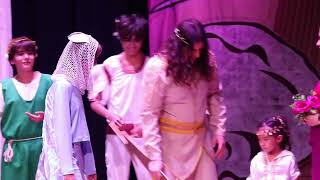
🎭 Hércules El Musical de Disney interpretada por la compañía de Teatro LIKS.CO. Función 1.
🎭 Hércules El Musical de Disney interpretada por la compañía de Teatro LIKS.CO. Función 2.
🎭 Hércules El Musical de Disney interpretada por la compañía de Teatro LIKS.CO. Función 3.
🎭 Hércules El Musical de Disney interpretada por la compañía de Teatro LIKS.CO. Función 4.

👾 Bloque 2: Genius Hours LIKS NextPlay presentado por KidZania en alianza con Colegios México Nuevo.