Maker Week: Jen Schachter
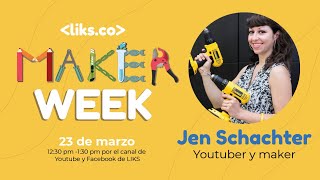
YouTuber and maker Jen Schachter talks about her path from art school to running massive collaborative projects, including a 700-person 3D-printed Rosie the Riveter and an Apollo 11 hatch replica for the Smithsonian. She shares advice on learning multiple disciplines, finding mentors, and building community as a maker.
Chapters
Hola, ¿cómo están todos? ¿Cómo les va? Estamos de regreso en la Maker Week y hoy tenemos un speaker súper especial. Miren quién vamos a tener hoy. Hoy vamos a tener a Jen, que es YouTuber y maker. La voy a presentar y después, Jen, I know you are there like looking at what is she saying. The talk is going to turn in English in just a moment. Pero mientras la voy a presentar, que también la voy a presentar en inglés. ¿Están listos? Sirve que aprendan un poquito de inglés. Si tienen dudas de las palabras, este, pues ahí las anotan, las buscan en el diccionario, después pues le hacen preguntas a Jen. Porque también tenemos a diferentes tinkers invitados de secundaria para estar aquí con ustedes en la plática. Déjenme les platico un poquito de Jen. Jen es una maker y mastermind de grandes colaboraciones, un set de letras gigantes de luz para el Obama White House, una interactiva caza de puzles para South by Southwest, una monumental 3D print de la escultura de Rosie the Riveter, and most recently, a crowdsourced replica of the Apollo 11 hatch for the National Air and Space Museum in Washington. You can catch her on TV as a fabricator on the set of Savage Builds. You should— de verdad deberían de buscarla, es increíble. Find her product reviews in Make Magazine, her tool manuals and fabrication shops in Baltimore, and her builds with Adam Savage on Tested.com. De hecho es muy conocida porque ha estado colaborando con muchos trabajos de Adam Savage y la verdad es que ella es increíble. After years of studying fine art, Jen began acquiring power tools and these days finds herself covered in sawdust and solder more often than paint. She gets her best, most epic ideas in the shower, washing off— washing off— it's too small— washing off set sawdust, and will someday pursue her dream to build a pop-up workshop tiny home inside a tour bus and travel around the Americas. Wow, you should travel here to Mexico, Jen. The next time you're doing your tour bus, tour bus, you should travel in the Americas. Sorry if I didn't pronounce something in the good way. I was reading these really small letters. And also I want to present Jen. So Jen is here. Hello, Jen.
Hi, everybody.
Hi, Jen. So Jen, thank you for coming here to the Maker Week. Here is LIX. LIX is an online school that we are based in Mexico, and we, well, we love science, technology, art, engineering, and for that we have the Maker Week. And I'm going to put your presentation, I know, your present, yes, your slides here, but first I'm going to introduce to the tinkerers that are here. Here is Emilio. Emilio. Hi, the thinkers are the kids. That's how it— we, you know. Yeah, and this is Jorge, one of the thinkers, and David. Hi. We need the girls. Where are the girls? Well, I think they didn't come here, but the next time I promise they will be here. And so this is your slide and the Yes.
All right, great.
Screen is yours.
Oh, I'm so excited to be here. Nice to meet you all. Um, this is really cool. So yeah, I'll dive right into my presentation. Um, let's see if I can— there we go. Can you all see the slides? Yep, they're changing. Okay, great. Um, so yeah, uh, my name is Jen. Uh, I am an artist and a maker, uh, in the United States. Um, I work for a media company called Tested.com, and they make YouTube videos about building and technology. Um, you can find them on YouTube, and I'm in some of their videos. And so people ask me a lot of the time, how did you get started being a maker? Where was your beginning? What's your origin story? And the answer is I can't really remember because I have been a maker as long as I can remember. When I was little, I really liked to build things out of cardboard and plastic packaging for my toys. And these are some drawings of inventions that I designed when I was about 7. I never made these things, obviously. I didn't invent a time machine, but I liked to I like to dream and I like to draw out my ideas, so I've been doing this since I was really little. So I was pretty good at drawing, and I started taking classes at a local art studio, and I learned how to draw objects from life and people. But I also really liked illustrating my ideas, that I— things I made up in my head, like this tree that has faces in it. And I ended up going to college to study art. So when I graduated from art school, excuse me, I was trying to find a job that I would be able to use my art and design skills in everyday life. And a company called Under Armour, you might have heard about Under Armour, they make sports apparel, they were hiring for a job called visual merchandising, which is basically how all of the store displays are set up. The visual merchandiser decides what the mannequins are wearing, how the windows look, and what goes in all of the different areas of the store. So these are some, these are some store layouts that I worked on when I was at Under Armour. So after, after that, I kind of realized that the, the corporate world didn't allow me to have a lot of creativity. I wasn't having that much fun making stuff for, for the stores. So I started looking for another job that would allow me, allow me to be a little bit more creative. And I found a place called a makerspace in my city that had programs for youth to learn about things like 3D printing and coding. So I applied and I got a job there. And my job was to build all of the furniture, all of the tables and the workstations. So these are some carts that I designed for the makerspace, and I built these out of 2x4s and pegboard and some vinyl cut— tool outlines. I also got to work on some fun sort of decorative projects. This is a sign that I made for the 3D printing area, and it's made out of all 3D printed, like, failed prints. So we had a bin where we collected all the 3D prints that didn't work out, and I glued them all to this big, this big board and laser cut some letters and made this big, this big light-up sign for the, for the 3D printers. Here's some close-ups of that. So one of the other things I got to do at the makerspace was go to my first Maker Faire. I don't know if you have heard about Maker Faire, but it's a big, a big convention where lots of different makers get together in all different parts of the world and they show off the things that they have built. So I got to go to my first Maker Faire, and I realized when I got there that this is where I belong. These are my people. Not with the painters from art school, not at a desk job. I wanted to build things and I wanted to be creative every day. And I realized, okay, I'm a maker. This is where I— this is my people. So I found myself after that working at a makerspace for adults. So they had bigger machinery, things like woodworking tools and saws. And when I got there, I started working there and I got a phone call in the first couple weeks that said, hey, listen, I'm working on a project for the White House for a festival. Do you want to help us build something? And they were looking for some big letters, almost like the Hollywood sign. If you've seen the big letters that say Hollywood, they wanted something like that, but the letters were S XSL, and it stands for South by South Lawn, so the South Lawn of the White House. So this picture is the, the mock-up they sent me of what they wanted me to build for the White House. And, and the, the special part was I got to build them with this, this person called Adam Savage, who hosted a TV show called Mythbusters, and for a long time. You might have seen some of his shows, but he was going to work on the project with me. This is Adam, if you don't remember who he is. So I started off right away by sketching out the assembly plan. So I figured out all of the dimensions, I figured out having a stand on the back that would help support the letters. And this is the beginning of the fabrication. So each one was almost like, it was like a cabinet with a back and sides and then a clear plastic front. And there's the letters, all the different pieces of the letters. And then to put them all together, we went back to the Youth Makers space where I used to work, and we had 50 students and their parents and all of the staff and everybody work together. And we built the entire sign in one day. And the next, the next morning, we loaded them up onto a truck really, really early, and we brought them to the White House. That, that's the letters on the White House. That's us setting them up. So we, we put these letters up for the festival, and people got to take pictures with them. And the coolest part about them was they lit up. So there were a whole bunch of LEDs inside of each letter, and we connected them to a Raspberry Pi that would talk to Twitter. So people who were at the festival could tweet certain hashtags, and it would change the color of the letters. So it was an interactive thing for people to do at the event. So here's, here's the festival. And then at night, they looked really cool because it was nice and dark, so you could see you could really see the colors. All right, so the next project that I got to work on is with a group called We the Builders, and they are a group of makers that make crowdsourced 3D-printed sculptures. So what that means is they, instead of one person making the thing, they give out parts to a whole bunch of different people and every person makes one little piece. And that way we're able to make something really big because everybody has helped contribute. So the way they usually do this— these are some of the other sculptures that we've made. The way they usually do this is we'll take an existing sculpture, or someone will make a sculpture, and then we take a 3D scan of the whole thing. We use a scanning technology and scan the whole thing in 3 dimensions, and then we'll take that scan into the computer and divide it up into a grid. So each section is a little 3-dimensional brick. So in 2018, we were asked to build a big sculpture for a conference, for an event, and we decided to celebrate women in making by making a huge sculpture of Rosie the Riveter, the "We Can Do It" poster. So I made a little tiny sculpture out of clay about 7 inches tall. So you can see there, that's the, um, the wireframe and then adding different layers of clay on top. And that's the finished sculpture. And then we took her to this place to 3D scan it. So you can see the scanning gun there. And then these are some mockups of what we wanted the sculpture to look like. And we built a whole internal, like a skeleton to support all the pieces. And we put all of the part files. So each little brick, we put all those STL files on the internet. And people could go online and download a part file and print it out. So we had— these are just some of the people who contributed to the project. We had over 700 people from all over the world send us in over 2,600 parts. So this is at the conference. We laid out all the pieces one layer at a time, and all the people that came to the event, they helped us glue it together piece by piece. And people, sometimes people wrote messages on them. So here's one of the layers, or a couple of the layers actually. This is 3 layers of the sculpture. And here you can start to see just how big it is. So the person standing next to it is, you know, maybe about 6 feet tall, so it's a really big piece. And there she is finished. That's the whole, that's the whole big sculpture. So the next project I got to work on was for the 50th anniversary of the moon landing. So the first time human beings ever set foot on the moon was in July of 1969. So in 2019, they were celebrating— the whole world was celebrating the 50th anniversary of that event. So the, the National Air and Space Museum here in the U.S. Which is based in Washington, D.C., they asked if we could make some type of project that would happen during the 50th anniversary celebration to interact with people at the event, to get people excited, to get people involved. So we decided to take a piece of the space shuttle and recreate it, to remake it ourselves. So the Smithsonian Museum did a similar 3D scanning process to the one we did for the Rosie sculpture. They take a camera and they take pictures of every surface and everything in 3D, and they create a digital model of it. So what you're looking at here is a 3D scan of just the door, just the little door. It's like the size of a car door that would go get in and out of the spaceship. And they took this 3D scan. This is the actual door. That's what it looks like. So it's a very complicated piece of machinery. There's lots of levers and knobs and dials and latches. And we worked with an engineer, so an engineering student named Andrew, and he took those 3D scans and then he took them into a CAD program, computer-aided design, and he modeled every little piece of the whole machinery, every, every gear, every screw, every single piece. He modeled it in, in 3 dimensions. And this is his finished model of the whole door. That's a rendering of it. And then the coolest part about this was we took each of those different parts of the machinery and we sent them out to different makers all over the country. So they would get a file that says, here's a latch, recreate this latch in the same size in any way that you want. So some people 3D printed it, some people carved it out of wood, some people machined it out of metal. So we had all different pieces. Some of them were students, so a teacher would work on it with their class. So here's all different, all different pieces of the hatch. And when the project was ready, everybody who made a part, they shipped them all to us at the Air and Space Museum. So here's all of those part boxes. And then we unboxed everything, and we had a big, big room full of people, about 200 people, and we were on stage in the middle of the room, and we put together all of the pieces. We screwed everything in, we attached all of the levers and the knobs. So this is the audience watching that day as we were putting the hatch together. And lots of our friends came to help us put all the pieces together. And it was a really, really amazing day to be there with the 50th anniversary celebration and working with all these different people who are helping us put it together. And this is the piece in the Smithsonian Air and Space Museum. So you can see behind it there's some spaceships and some rockets, and there's our hatch. In the museum that we made. So sometimes I do projects for a crowd, for an audience, and sometimes I just build one-off things. I like to build stuff for costumes. I like to make sort of props and dioramas. So here's an example of something I made that was just for fun. This was for a costume for Adam Savage. And this is all fake. This food is all made out of foam. So we took big blocks of foam that would be like inside of a couch cushion, and we carved it and painted it and shaped it to make it look like food. So here's, here's the food with the costume. If anyone has seen the movie Spirited Away, this is, this was that costume from that movie. I also like to make Halloween props. So sometimes for Halloween I dress up like a different character, and I'll make all of the parts of the costume. I don't buy my costume at the store. I like to make every little bit. So if anyone has seen Teenage Mutant Ninja Turtles, I don't know if anyone has ever seen that, but I watched that when I was growing up. So this is a canister of this green, green ooze. That's part of that story. So here's all the props that I made, and I dressed up as April O'Neil, who's a news reporter in that, in that show. I also like to make dioramas, so little spaces that you can look inside of, and there's a little miniature world in there. So this is one example of a diorama I created that lives on a bookshelf. Another costume I made is this big foam wig. So it's a giant hairpiece made out of flexible soft foam, EVA foam. And I cut all the pieces and I, I formed all of these curls. I carved all the strand details into it, and then I painted the whole thing. And I added some some flower details. And here's some close-ups. And this is my studio. So this is— excuse me— this is the space that I'm in right now. Actually, this is at my home shop, and it's a work in progress. But I, I keep— I'll get people to lend me tools, or if someone's getting rid of a tool, I usually will take take them up on, on adopting it. So this is my nice space where all the magic happens. And I do really like working by myself, but I enjoy more than anything, I enjoy working with other people. I think that's the part about making that is the most appealing to me. It's either building the thing and then taking it to a Maker Faire or wearing it out for Halloween and sharing it with other people, or actually building the thing with a whole group. That's, that's the part that's the most the most enjoyable, the most exciting to me. So yeah, that's the overview of what I do. I hope that you've got some inspiration for different projects. I'm happy to answer any questions that you have. And yeah, just would love to, would love to chat with you about what kind of stuff you're working on. You can find, you can find me online on social media. I have an Instagram and a Twitter. And also on my website, so you can check those out. But yeah, so open it up for questions.
Ah, Jen, wow, your, your work— I know your work is amazing. Thank you. It's— you, you maybe you, you don't know like what's the big— yes, what is it? What is this basically in Washington? Let me explain you. There's, um, one of the— I think that one of the biggest museums in US— no, or the big museum in the biggest museum in US is the Smithsonian.
I actually have the mug.
Oh yeah, that is Smithsonian. So yeah, it's a really big science museum. It's amazing museum. And there they have this amazing piece that you have, that you are watching on the screen. So now it's your turn to make some questions so Jen can answer. So are you ready? Sí, ¿están listos? I'm going to speak a little bit in Spanish. Quieran, déjenme les cuento que estas piezas que hizo las hizo con Adam Savage. Adam Savage es el fundador, no sé si han escuchado de MythBusters, y ella también ha trabajado muchísimo con él, trabaja con él en Tested, y además ha hecho esto para museos tan grandes como el Smithsonian. Esta pieza que tiene aquí lo hizo en el Smithsonian, para el Smithsonian, que es uno de los museos más grandes que yo creo que de ciencia del mundo y de Mex, y de México, de Estados Unidos, y pues está en Washington. Entonces, de verdad, aprovechen el tiempo porque tenemos ahorita mucho tiempo para hablar con ella. Y pues ahora sí los voy a dejar para que empiecen las preguntas. The questions start. Oh, gracias. Dan is saying that all your projects looks amazing.
Oh, thank you. Thank you very much.
Who wants to raise their hand to ask something? Emilio, yo sé que tú. Vas, Emilio. Okay, uh, how long did you take doing the door for the space museum?
How long did it take? Um, well, we started the project, uh, in advance, like about a couple months in advance, they told us they wanted us to build it. So there was a lot of planning and research that went in beforehand. So months of planning. The engineer took about, he took about a month or two to take all those 3D scans and reverse engineer them to make each part. So he took about 1 to 2 months. And then we sent all those files out to the makers and they had another month to make their parts. So if they were going to make one gear or one latch, they each, they all had a month to work on that. And then they sent them all to the museum, and we built it on stage in one day. All in one day, we put the whole thing together in front of, in front of everybody watching. So we were like, we were really nervous about it, but we pulled it off. It took maybe 7 hours altogether, but the whole project was a very long, you know, lots of planning and organizing, and then all the assembly happened that one day. Good question.
Thank you, Jane. Fernanda, do you want to say something?
Yes.
Um, what inspires you for your work?
Oh wow. Um, a lot of other artists inspire me. That's mostly my inspiration. I look at so many different people's work on like online, on Instagram, on YouTube. I follow— I like to follow people that inspire me. So all of my, all of my social media feeds is all artists that I love looking at what they do. Um, Nature also inspires me a lot. I like to look at nature and see how, how beautiful things are and how I can, you know, like with the wig for example, it's like, how can I make something that looks natural out of this material that looks, you know, it looks like hair, it looks like water, it's like very organic. Um, so yeah, I look at, I just look at so much image and imagery all the time and that's, that's most of my inspiration. Also really good question.
Thank you, Jen. So we have a question from the public. Giovanna is saying that it's amazing everything you have done. You're a great inspiration. But what's the reason you are start— why you are— what? The reason that you start creating, I think. What— why did you start creating?
I think I understand. Um, why do— yeah, why— like, why do I make things? What's my reason? Um, It's, it's hard to describe. It's, um, usually I want to make something that I— that is missing from the world. So sometimes I want to make a piece of furniture and I go look and I see if I can find something I like in the store, but it doesn't really— it's not exactly what I want. So I'm like, I'll just make my own. Um, it's really, for me, it's about building the environment that I want to see, the environment that I want to live in. So if I want to have this really cool wig or this, um, I want to see a piece in a museum, like, I will make it because it's something that I think I can give to the world, something that I, I want to see and that other people might appreciate. So I think that's, I think that's my why.
That's amazing. I, I think it's amazing why. Now it's your turn, David, and then Jorge. Sí, to David. What would you say to the boys of today to inspire them to be a maker?
To the youth of today?
Mm-hmm. Oh, wow.
I would say learn everything you can. And there's so many different disciplines within making. I mean, you could be an artist, you could be a sculptor, you could be a computer programmer, you could be an engineer. There's so many different things. Try, try out everything, even if you think, oh, I don't really like math, or oh, I don't really like art. Like, just try it, just taste it and see, because you never know what you will be inspired by or what will— what you'll be good at. Even sometimes you try a new skill and you're like, wow, I'm really good at this. I didn't think I would be good at coding, but look at that, I'm really great at coding. So yeah, try, try to learn any type, any type of experience. If there is someone you know that has information about something. Like, if you know somebody who is a woodworker, like, spend time with them, ask them questions, ask if you can help them in their shop, because you will learn so much from spending time with people that, that work in the fields you're interested in. And then that way, when you decide what, what field you want to take for your career, you'll have more information about what, what you're inspired by and what excites you and and all of the different aspects of what it's actually like to do that job for a living. So yeah, that would be my advice if you're interested in making for a living.
Thank you. Great advice. I'm going to ask you something from Natalia from the public. How does it feel to be part of such a great project?
Oh, it feels amazing. You can see I'm so happy about it. I would not want to do anything else. I, um, I feel very proud. I'm proud of the projects I've worked on, um, and I'm— I, I really love building things that I worked on with people that I respect. So a lot of times when I work on a big project like the Smithsonian or the letters for the White House, um, I'm working with people who I really respect and admire. So I'm like their fan and I get to build something with them and it's just It's the coolest. It feels amazing. And then we have that shared experience together. It's like, oh, remember when we did this? And remember how crazy that was? So that's the best part for me. It's like I'm proud of the thing we made, but I more enjoy experiencing that with other people.
Great.
Great.
Now, Jorge, it's your turn finally. My question is, what break do you like the most?
Oh, that's so hard to— it's so hard to decide. I think maybe, maybe the space museum one, because that was— it was so many people that, that worked on it that I really respected. Like, the Rosie sculpture was so cool because it was 700 people and it was really big. But I didn't know all of those people. When we worked on the space door, it was all people that I really admired their work. We handpicked each of those people. And having a piece in the museum, like in the archive, in the National Archive, is like, that's so— I feel so proud of that. So I think that's my favorite one. Good question.
Yes, good question. It's difficult, I think, to choose one. And I have a question for you. No, it's not from the public, but a question. Uh, do you feel that some— no, no. What do you do when you, when you create something and you have like this time that is frustrating and you don't know what to do? What are you— what are your recommendations? Because I know that some of us, we are making and building, and sometimes we fail over and over again. What do you recommend?
That's a really great question. I will say, even as many things as I have made, that happens to me every single time I make a project. Every time. There's always a stage that I look at it and I'm like, it looks terrible, or it's just not working. Like, parts of it don't fit together, or The, the computer, the controller isn't doing what I expected it to do. So every— it happens to everybody. It happens every time, no matter how much experience you have, no matter how much confidence you have, you will always get to a point with a project where you're like, it's not working, or I don't like it. Um, and I have a couple different things that, that I, I like to try to do. Um, the first thing is to take, take a step back. So take a break. Um, if you're really frustrated and it's not working Maybe go for a walk outside, call your friend. I a lot of times will ask another maker for their opinion. So because you get so focused on the thing that you're making and it's hard to see it from a new perspective. So if I'm really stuck on something, I will take a picture and send it to my friend who is a maker and say, I'm really stuck on this, or this isn't working. What do you think? Like, what, what ideas do you have? And sometimes getting a fresh perspective is really helpful to see it from another way. And then also to remember that sometimes things don't always, they're not going to work out. Like sometimes I make something and I can't fix it. And you try to make the best out of what you are able to make the best out of. For the big Rosie the Riveter, you know, the big Rosie sculpture, let me see if I, I don't know if I can go back to my slides, If you look closely at the Rosie sculpture here, let me show you. I'll show you a big mistake. Hang on one second. Maybe make me go back the whole way.
Don't worry if you need to go back.
Oh, let's see if you can see it. I don't know if you can see really close on the front arm here. It's all shiny. It's tape. We use tape to tape her arms. The whole thing is glued together. Every brick is glued together. But this is another thing we built. This is 2 days that we built this, and the glue was not drying fast enough. So the pieces, when we put the layers on, the pieces started to fall. All the glue is just falling off, and we're like freaking out. We're like, it's not working! What are we gonna do? We can't get the glue to dry faster. So we just used packing tape and we taped around the arm to hold it on. So It's not perfect. Like, if you look at that, it's not a perfect, you know, it's not finished, but that was the best that we could do that day with all of the circumstances. And you just, you know, you have to accept we did our best shot. And no one looking at that is going to be like, oh, there's tape on the arm. I know that because we had to fix it. But it's, yeah, just learning and learning from the experience. That's the biggest thing. Trying to learn if you're frustrated, if you made a mistake, trying to figure out what can I get from this that I can apply to next time. So yeah, that's a very long answer, but you get the idea.
No, it's perfect. I actually always say that being a maker and doing STEM, it helps you to be more resilient, have more resilience, work from frustration, Frustration, tolerate the failure and all that kind of stuff. So I think sometimes it's not also, it's not only about creating, it's about learning also soft skills from the hard skills that you are learning, you know?
Yeah, you could set it so perfectly. Exactly. It's, it's so many life skills that even apply outside of making, that apply to you know, you trip and fall in real life and you have to build that resilience of like, how do I get through this? How do I keep a positive attitude about this and keep going? So yeah, totally.
Yes, maybe sometimes you are learning how to turn on a LED, uh, or something with code, or, or doing crafting, but at the end you learned something else.
Yeah, exactly, exactly. That's such a good question.
So I think we have a question from here, from the public, from another— I don't know, one of you kids, do you want to say something?
Tinkers?
Yes, Fernanda.
Who do you admire, a specific person, and why? Oh, a specific person. Oh, that's hard. I have a lot of friends who are women, who are builders, who are makers. And I think they're, they are my biggest inspiration because I, you know, my, my boss is Adam Savage and he is amazing. He's really cool. He's a great mentor. He's famous and I admire him a lot. But I think I admire people that are closer to my experience, like closer to who I am and the way that I have lived my life. So a lot of like young women who are around my age that I would say like, like, I don't know, have— do they know a Stephanie? Have they met a Stephanie?
I don't think so. No, I don't think so. You cannot talk about her.
Yeah, she is amazing. She's, um, she is a YouTuber that's very successful. She's a computer, you know, she's an engineer, she's an electronics engineer, and she was able to quit her job and make what— anything that she wants. And people Really love the work that she makes. She's very creative. She's very colorful. She has this bright, bubbly personality, and she's so smart. She has so many great ideas. Yes, Estefany Explains It All. You should go, you should go follow her. And she's from Mexico. She grew up in Mexico. She lives here in the United States now, but she's one of my closest friends, and she is a very, very big inspiration to me and a mentor as well.
She's amazing. You should go and follow her. Stephanie is one of my friends. We have like a little small group of, uh, girl makers, make women makers.
Yeah.
And I, I feel the same as you, Jen. I'm like super fan of you, but I'm super fan of Stephanie.
Also have, uh, Sila Foxlin and Becky Stern, like amazing.
Yeah, I'm going to put the names here so you can follow them.
Yes, you should. They're very inspiring and all different, have different creative approaches.
I'm, I'm going to write the names here. And then who else wants to say something? Emilio, um, which is your favorite tool?
Oh, my favorite tool. Oh, that's so hard. That might even be harder than picking my favorite project. I will say, right behind me, right, literally right behind my laptop, I have 3 chop saws here. I'll turn it around, I'll show you. These are— I have 3 of them, so I must like them a lot. This is 1, 2, 3 of— so this is a It's a chop saw, a miter saw basically, and it's just a very simple tool. You know, it has a circular blade and you pull the handle down and you can cut long pieces of wood very quickly, very easily. One of the ones that I have is for cutting metal and the other two are for cutting wood, and they're all hand-me-downs. Somebody like my boss was getting rid of these and he said, I don't have a use for this, do you want to take it home? So I'm I'm borrowing them. I don't— they're not mine, but this is, I think, probably one of my favorites. It feels very powerful. Do any of you have favorite tools? What are— what, what types of tools do you, do you work with that you like? And it could be anything, even if it's like a craft tool.
Sorry, I left a little bit my computer.
Oh, that's okay. I was just asking them, um, Emilio asked if I had a favorite tool, and I, I said I will put the question back to you all. Who has a favorite tool that they want to tell me about?
Fernando, you have a tool? I know Emilio has a lot of tools that he's a little bit shy, but he, he makes amazing amazing stuff. So Emilio, what's your favorite tool?
Yeah, tell me.
Knowing that it's a very basic tool, I love the, the silicone, the gun of silicone.
Yeah, yeah, like a cock gun. Oh yes, yeah.
What's the name?
Favorite.
You can show you the project that you made. Oh, well, you can hear me? Ah, do you— you can show— you can show her? No, you can hear me? You hear me?
I can hear you.
Ah, Emilio, can you show the project that you make for the, uh, Domo? The geodesic dome. Oh, amazing project. You have the video there, you can share. Well, you are looking for that. I haven't the video, but I have my photos. Okay.
Oh yeah, I would love to see.
Yes. And David and Jorge and Fernanda, what— what are your favorite, favorite tools? Do you have favorite tools?
Yes, I have, um, is the colors because I love draw. Um, I know beautiful in that, but I like, yeah, I—
that's a tool.
That's also a tool. It doesn't have to be a big piece of machinery. It can be a pencil, could be your favorite tool. I like that.
Yes, I like that. My, my favorite tool is a laser cutter. But I don't have one.
They're big and expensive, but they're so much fun. They're so great.
So I'm going to start closing, but from the public we have a question. I think it's a parent. How can we help our kids to be makers?
Oh, um, I think, I mean, encouraging them in whatever types of things they're interested in, seeing if there's— I don't know what types of, you know, classes and makerspaces and things are available locally where you are. But for me, like, the biggest thing my parents did to help me was they found a local art, like an art studio, like where they were teaching painting classes. And that helped me to develop more as an artist. So yeah, finding— helping them to find a community where they can— their skills can develop. So it may be a local makerspace, it might be a club after school. And there's so many resources out there. There's like YouTube videos and books. There's different makers in the world that are sharing all of their knowledge. Yeah, I think just give it, like giving them the resources to be able to grow and learn. And there's so much out there. That would be my, that would be my best advice.
Thanks, Jen. Emilia, I think you're ready, right? Yeah. Okay, just put in the, in the, in the bottom that says, Sure. And if you want to pop up, David and Jorge, and say something, it's okay, don't worry. Okay. Oh, this is us in la looping. Okay.
Wow.
No, he's amazing.
You made this?
Oh my God, he has a video! So he's a true maker.
This is amazing. Wow, did you weld this? Sorry, what did you weld it like that? We welded the metal?
Lo soldaste? I'm so impressed. Because I break the screw and I shoot hit him. No, he— yes, hit him with a hammer and with a lot of heat.
That's so cool.
I like that he has made a lot of projects.
Like, I'm very impressed. I'm very impressed. Keep, keep making stuff. Don't, don't— even if you do something else for, for your job when you, when you graduate, like, from from school, keep being creative because you're very talented.
And also what I recommend all the time for him is that he, he should like upload all these videos that— because he had created a lot of amazing videos. So also if your parents let you, because now you, you're under, you are a minor, but then you can upload it if your parents let you. You have amazing videos, so Everyone, everyone that is here and create this stuff, you should like— I embrace you to upload it on the internet.
Yeah, share your work, share your work, because that's how you build community. You know, most of the people that are my community, I don't actually live near them. We, we all connect online, you know, we know each other through, through the web, through YouTube, through Instagram. So, um, it's important to build— you can make your own projects, but it's important to build community, and you learn from each other, and you network, and Um, yeah, it's very— it's— that's a big piece of it.
Thank you. I have a question. Yeah, who or what inspired you to create new things?
What inspires me to create new things?
Yeah, but no, like the— I think, oh, a person like in your first project inspire you to create it.
Uh, like, um, who inspired the first, like, the first project that I made of this presentation, or just in general?
In general.
In general. Uh, I think I— yeah, I think just looking at other, other makers. I'm trying to think who I looked at, makers I watched when I was younger. Um, I don't know that I had a lot of examples. You know, when I was little, there was no YouTube. It was only TV. So there were shows on TV like house renovation shows, like building stuff for your home, and I watched some of those. Um, and my teachers, I think my art teachers, um, helped, like, inspired me for some of my early projects. But yeah, there's so much more education available now as young people than when I was growing up, because there was no YouTube then. I don't— does that answer your question, or not really? Yeah, sort of.
Oh, it was great. I think we, we need to start closing, but thank you so much again. Now, Jorge, Emilio, David, Thank you for being here. We need to say goodbye to Jen, but if you have something, like, feel free to ask her for this, like, the last question. The last question. No, see, no, David, David. I know, I knew that. What do you do when a project doesn't work out for you?
When it doesn't work out, um, I try not to give up. Uh, I don't like to say I just let— I left it, you know, and I walked away. I try to finish it as best that I can. So like with the Rosie sculpture, we put tape around the arm, um, and we said, okay, it has to be done. This is the best it's gonna be. Um, sometimes I mess up the paint on— I finish a whole thing and I mess up the paint, and I'm like, no, I ruined it. But I can't take it off. So, um, I think it's, it's figuring out the, the best possible thing you can make with the circumstances that you have. Sometimes you run out of time, sometimes you run out of materials, sometimes you run out of budget. There's not enough money left in the budget. So you— I try to never leave anything unfinished and just say, okay, we're gonna pull it all together and do the, the best that we can. Um, yeah, and, and try to take a lesson I can learn a lesson from it so that it's not a waste of my— a waste of everybody's time to not have learned anything from it. But yeah, that's a good question.
Great question. Thank you, David. I think that's all. And if you want to say something to say bye again, it's the perfect moment.
Well, if anyone wants to reach out, you can always message me online. I don't know if everybody has different social media. I don't know if you're too young, but if you have an account, you can follow me @shakattack. It's in—
it's—
we'll put it somewhere for you can find it. But yeah, you can always, you can always message me online. I love to see what you're working on. And thank you so much. Thank you, Anna, for having me here.
Let me put it here in the comments. Thank you for being here. Let me, let me—
here, I can type it.
It's Aha, let me find the link. And I have it here. I just, I just tag you. Ah, if you follow me, I just tag her. But let me—
oh, I spelled it wrong.
Yeah, it's, it's—
yeah, I, I spelled my own name, I spelled it wrong. That's it. I put it in the— I put it in the comments.
I'm going to put it in a banner, but it takes a little— yeah, now this is it, the link.
Thank you, thank you. Yeah, definitely you can find me online and it was great to meet you all. Thank you again, this was so fun.
Thank you, Jen. So goodbye, Jen, and goodbye everyone. Thanks for being here and we continue with the Maker Week. Thank you, Tinkers, and I hope that you like and that Jen inspires you. I'm inspired, so thank you. Thank you.
Good luck.
Bye.
More from Adolfo
🎭 Hércules El Musical de Disney interpretada por la compañía de Teatro LIKS.CO. Función 1.
🎭 Hércules El Musical de Disney interpretada por la compañía de Teatro LIKS.CO. Función 2.
🎭 Hércules El Musical de Disney interpretada por la compañía de Teatro LIKS.CO. Función 3.
🎭 Hércules El Musical de Disney interpretada por la compañía de Teatro LIKS.CO. Función 4.
👾 Bloque 2: Genius Hours LIKS NextPlay presentado por KidZania en alianza con Colegios México Nuevo.