MAKER WEEK: Kids Invent Stuff
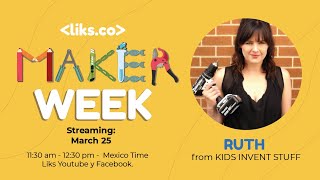
Ruth Ramos, founder of Kids Invent Stuff, turns children's drawings into working prototypes for her YouTube channel. She showcases builds like a 140 kg cake gravity racer, a popcorn-firing doorbell, and a 74-attempt Rube Goldberg machine, and explains how her team in Sheffield and Cornwall tackles the real problems of prototyping: broken materials, wiring failures, and code bugs.
Chapters
Hola, ¿cómo están? ¿Cómo les ha ido? Hoy estoy en otro lugar. ¿Qué creen? Que se me fue el internet y que le corro y dije, ¿cómo lo resuelvo? Pues que me voy a un Starbucks y por eso me ven aquí. Pues, ¿qué creen? Es la última charla del día, la última charla que vamos a tener hoy. Con puros makers, con puros tinkers, con wayaks, con todos aquí porque todo LICS ahorita está presente para esta última charla. Quiero decirles que estoy muy emocionada de todo el trabajo que han estado haciendo, me han estado enviando sus vídeos, algunos ya los presentaron en su clase de inglés, otros todavía apenas los van a presentar. Díganme cómo se han sentido acerca de eso, Si siente que se les corta, se me corta un poco, puedo hablar. Sí, estoy un poco seriada porque justamente les digo que se me fue el internet y tuve que venir a un lugar donde había otro internet. Pero I'm going to welcome here now, I'm going to speak in English because Ruth Ramos is founder of Kids Invent Stuff and she is going to give us a amazing talk about inventions, about her projects, and about a lot of things around the maker movement. Hello Ruth, how are you?
Hello, thank you for having me.
I'm so excited because you don't know, but we had this like lives like every week So all the time I show projects around people that are doing inventions, and your, and your project and your YouTube channel, channel is one of the most, uh, yeah, like one of the best inventions we have seen here, and the kids love this, so love your project. So I'm going to share with you this screen, and the screen is yours. I'm going to put here your slides, and you can start whenever you want. And at the end, we are going to have some questions from the kids. Some kids are coming, and that's it. So you can start whenever you want. If you need something, just raise your hand, and then we'll tell, 'Anna, I need your help,' and I'm here.
Fantastic, that's great. Yeah, hello! Thank you so much for having me. My name is Ruth and I am an inventor, an engineer, an entrepreneur, and a YouTuber. So I'm very excited that you might have watched some of the videos on our channel before, but hopefully I'm going to share with you a little bit more about how I became an inventor and then talk to you a little bit more about the channel. So I started inventing when I was quite young. This is my school photo when I was about 15 years old, and I started inventing because my teacher set me a challenge. His father had not been very well and he couldn't use his stairs, and so he challenged me to design something that would help his dad be able to use the stairs, and that was my first glimpse and experience of inventing. And from that, I ended up winning an engineering award and designing a mobility product called the Stair Steady, which is a special handrail which is sold now all across the world. Um, so I'm really lucky because I get to work on amazing projects. Whether it's projects of my own or as part of Kids Invent Stuff with my friend Sean, and I am lucky enough that inventing is pretty much my full-time job, so it's very exciting. But I very nearly didn't become an inventor. When I was growing up, I thought I wanted to be a lawyer, and I'm really glad that I didn't become a lawyer. But I realised that when I was younger, I didn't really understand what engineering was. And it was something that actually I had a particular view on. I thought that engineers got dirty or they fix things. I had a very narrow view on what engineering was. And luckily that is changing. And in schools, we're talking more and more about all the amazing and creative side to engineering, but I didn't realise that engineering was about making stuff happen and using maths and science, engineering technology and art. Art is really important within engineering and design. Now, for part of this, we might be joined by my cat. I just give you a heads up, she's sat next to me and she's eyeing up the screen. She does like to come say hi when I do a presentation, so If she turns up, just ignore the cats if she does turn up. My cat does. Yeah, this is it, cats, they just honestly, they just want to be famous. They want to come and talk to you all. So yeah, engineering is making stuff happen and it's working in so many different sectors from tech to film to food, sports, transport, toys. And Sean and I, who is my friend who I started Kids Invent Stuff with, we have always always been super passionate about showing people how exciting science and engineering is. So we decided that we wanted to set up a YouTube channel. We realised that actually some of the best inventors were inventors like yourself, and actually inventing starts at a really young age. You know, we would go into a classroom and hear incredible ideas from 4 or 5-year-olds and we really wanted to do something exciting and showcase that. One of the big moments for me as an inventor was seeing a product that I had designed and drawn on a piece of paper be made in a factory, seeing that go through that process of it being manufactured and, you know, boxed up and sent out to a customer. A real thing that I had drawn on paper coming to life. Was such an amazing experience, and Sean and I wondered if we could do that with kids' inventions, if we could take drawings and pictures and videos of ideas and bring them to life. And so we decided to set up a YouTube channel that does just that. Every month we set different invention challenges and we get sent in invention ideas from 4 to 11-year-olds from all across the world. So not just, although we're based in the UK, the ideas don't just come from the UK. And each month, Sean and I will build a different invention idea, whether that's a fire and water shooting piano or a crazy car. These are all inventions that are designed by inventors like you, and we really wanted to show that invention process and what it takes to create a working prototype of an invention. So we film the whole process, the things that work, the things that go wrong, and we put those videos up on our YouTube channel. So I thought I'd share a few of them with you today. Now, unfortunately, we're having a few issues sharing the sound, so what I'll probably try and do is talk over them. I think I can still hear the sound, so I might turn my mic down a little bit in my ears so hopefully I can talk over them and I'll explain to you what's going on. Which actually might be better than the sound. But if you want to go and watch these videos afterwards, they're all on our YouTube channel. So if you're wondering what on earth was happening in that clip, you can just go online and check afterwards. So I'm going to start off by sharing you Connor's crazy car invention. Now, Connor sent in his invention idea for a challenge that we had about long car journeys. Now, I don't know about you, but long car journeys can be super boring. You're sat in the car for hours on end. I do a lot of driving. Sean and I are actually based almost opposite ends of the country in the UK. I live in a place called Sheffield and Sean lives in a place called Cornwall, and that is about over 6 hours away from each other. So I spent a lot of time driving to and from Cornwall to build invention ideas. And I thought there must be some inventions that would make this long drive a lot more exciting. And as soon as I saw Connor's idea, I knew that we had to build it. So, sorry, Anna, go ahead. Yeah, go ahead. Guess what?
We have some kids in the background that just arrived, so they are going to be here with you. Oh, amazing! Yes, we have some of the kids, so it's perfect. They just arrived on time.
Fantastic, amazing. So yeah, so this is Connor's invention idea, and as you can see from the drawing, there's a car, and when you press a big red button, the seat in the car goes up through the roof, so you are sat watching the world go by about 2 meters in the air. So here is a little video of Connor's car in action. So you can see you're driving along, you press the big red button, and out of the top of the car— well, that's Sean! Sean is birthing from the top of the car. So you're driving along and you think, oh, this is boring. So you go up through the top of the car. And actually, the way that we made this invention is we bought a real car and we bought a scissor lift and a seat and we cut up a car. We took all the seats out of the back of the car, replaced it with a scissor lift with a seat on it. Don't worry, Sean is well fastened in. And then as the scissor lift goes up, the car roof, which we cut open, opens up and you're riding out in the air. I've got goggles on because there was a lot of bugs. It's great for seeing things, definitely makes it a little bit more exciting. Has a few flaws, but yes, it definitely made car journeys a lot more exciting, even if I had to wipe the bugs off my eyes. So that was Connor's crazy car invention. And next I'm going to share with you Eric's jam-firing rocket. So Sean and I like to set different invention challenges every month. And I don't know why it says age 9 on the PowerPoint. Eric is actually 7. But every month we set a different challenge, whether that be inventions to turn normal people into superheroes or whether that be around getting up in the morning. So Sean and I realised that there's loads of things you have to do in the morning when you get up, when you're getting ready to go to school. Sometimes there can be way too many jobs to do. And so we set it as an invention challenge in the hope that we would get some amazing ideas to make mornings a little bit more exciting. And so here we have Eric's Jam-Firing Rocket. So imagine this, you go down to breakfast and above the breakfast table is a giant rocket. And when you press the big red button— seems to be a theme with big red buttons— when you press the big red button, jam fires out of the rocket. So here you can see Eric's Jam-Firing Rocket. And we made all of this out of things that we either found in the workshop or we bought. And so you press the button, lights are flashing, here we go. Sean's looking nervous. And the jam fires! It actually made you jump a little bit because the there was like a bit of a wait, a pause before the jam fired. So it was almost like you were waiting and then it fires. It always made me kind of jump a little bit. I was always surprised when the jam fired. But a lot of jam. I hope you like jam with your toast because this fires a lot of jam. Sean and I needed to get lots of shots of this working, and so we ate a lot of toast and jam. Yes, in real, like, day-to-day life, Sean does not really eat sugar, and jam is pretty much sugar. So at the end of this, Sean was so hyper because he doesn't usually eat sugar, and that's pretty much what jam is. Um, so yeah, Sean and I had a lot of jam that day. And this is— oh, I love this shot. You ready?
Yes.
So yes, each time you press the button, we hit the whole thing. The lights flashed, everything. Lots of jam, lots of mess. Um, weirdly, this is one that lots of parents don't seem that keen on. I'm not sure if your parents would want you to have a jam-firing rocket above the table. Um, it's definitely a messy solution. Um, So weirdly, a lot of our inventions do involve food. Not all the time, but quite a lot of the time they do involve food. And I'm seeing a reaction. I think it's from Leo. I feel like Leo might have already seen this video because he got very excited when he saw the picture. But this is Lila's popcorn firing doorbell. Sean and I thought that doorbells, you press a button and often the bell rings and that's about it. And we felt that that was a little bit boring and actually something much more exciting could happen when you press a doorbell. So we set that as an invention challenge and 11-year-old Lila sent in her idea for a popcorn firing doorbell. So you ring the bell and popcorn fires out. So here we are with Lila's popcorn firing doorbell. Now it does actually say something as well, but obviously we don't have sound, but make sure if you haven't seen this, go and check it afterwards to hear what it says. Um, but here is us pranking a few people with Lila's popcorn firing doorbell. So essentially we're saying, this is the world's first popcorn firing doorbell invented by 11-year-old Lila. Let's test it. So here is the beautiful popcorn firing doorbell with all of its, uh, working bits behind the door. This is the postman who's delivering a very fragile parcel and is not expecting the popcorn-firing doorbell. So we had a lovely little linear actuator which pushed open, um, which pushed open the letterbox, and then we fired out popcorn, a lot of popcorn. One of the most interesting things about this build was actually how much popcorn we had to make. Uh, this is the lovely neighbor with a cake. I think a lot of people were a little unsure of what was about to happen, but they were not expecting popcorn. Lots and lots of popcorn everywhere. And then our very lovely kids next door who also just wanted to eat the popcorn. So yes, they very much enjoyed it to the point where they just kept pressing it again and again and again. I think that's definitely more exciting than just a normal doorbell that goes ding. Like, yeah. And don't worry, we did clear up all the popcorn. Uh, we fed it to some animals. It was not wasted. Um, but yeah, so we build loads of different invention ideas, and sometimes the challenges are coming up with brand new things like inventions to make mornings better, and other times they're around solving problems. So it might be how to get across water, or in this case, this was about escaping from towers. So in lots and lots of fairy tales, princesses seem to get stuck stuck in towers, and that used to really annoy me because I thought, what happens if the princess was an engineer or an inventor? She could design something that would allow her to escape. So we thought we would set that as an invention challenge, and we asked for invention ideas of ways to escape from a tower. And 8-year-old Courtney sent in this idea, idea for the Mega Fun Grappling Hook Zip Wire— a little bit of a mouthful. But very exciting invention, and it is a crossbow that fires a zip wire. So you're stuck in a tower, but don't fear, Courtney's invention is here to help you escape. Now this one has a particularly beautiful poem over the top that was written by Sean, so I'm not going to try and narrate too much of that. I'll just explain to you what is happening and maybe some funny things about when we filmed this. So this was one of the inventions that we actually took out to test. So we built Courtney's invention and then we took it to the countryside, um, a place called Derbyshire in the middle of nowhere, to an actual tower, and we had a go at escaping from the top of the tower. So you can see me at the top of a tower, very cold. Very cold in my princess dress, very bored. And so there's like a little explanation talking about Courtney's amazing invention and the fact that we built it. And here I am assembling a crossbow on the top of a tower in a dress. It's zipline time! So we set the crossbow zip wire up. Now In the video, it looks like it worked first time. This did take a few attempts to fire it into the trees, but the beauty of editing. Um, so you load it with the crossbow bolt and you pull round the, uh, zip wire and attach it to the side of the tower. And then you can zip wire out of the tower and escape. And in the background of that last shot, those two people walking did not know what was going on. They went for a lovely country walk and they ended up watching me zipline off a tower and were very confused about it. So this was Courtney's amazing invention idea, and we have built loads and loads of different invention ideas. So whether it's fire and water shooting pianos or whether it's a robot that will do your shopping and cook you food, or whether it is a giant gravity racer that is shaped like a cake and made of cake. These are all inventions that have been designed by inventors just like yourself, and Sean and I love bringing them to life. We love seeing all the incredible invention ideas that were sent, and one of the hardest parts of our job is choosing want to bring to life. And sometimes we do build more than one, but usually we just build one of them. And this one, for example, we actually took to a gravity race. So we entered a gravity race, which is a race where you take a cart that just has brakes and steering, so it doesn't have an engine, but it's just a cart that you take to the top of a hill, a little bit like the Red Bull Soapbox Racing. Have you seen Red Bull Soapbox Racing? And you take it to the top of a steep hill and you let it off and it uses just gravity to go down the hill as fast as possible. Obviously you can brake, you can steer. So we entered a gravity race and we asked for kids to send in their ideas. And this was Grace's invention idea. Now, we loved the idea, but we also loved the idea of making her cake out of real cake. So what you can see in front of you is actually 140 kilograms of cake baked in a microwave in tiny squares that are all assembled together around a wooden frame, which is then, yeah, fastened together, iced, and then I drove it down a hill. So these are some of the incredible invention ideas that we have been sent and brought to life. So everything from robot shopping trolleys through to Lego and disco jackets. We built a giant what's called a Rube Goldberg machine, where it's a big machine where one invention sets off the next invention, which sets off the next invention. And all of these inventions that we've brought to life have all had different challenges. So quite often when you watch the video, there's either a build and test video, so you see how we built it and the test of it, or they're separate. So you might see a separate build video, a separate test video of the invention. And particularly in the test videos, the ones that I've shared with you today, the invention can look quite shiny and finished, but if you watch the build video for that invention, you can see that at different points things didn't work out, things went wrong, and there are even more things that went wrong that maybe we didn't capture on film. But throughout all of these things, all building all of these inventions, we've had lots of challenges that we've had to overcome. Quite often people think that the inventions work right the first time. They don't. A good example of this is with the Rube Goldberg machine, which is in the top right corner. That took 74 attempts. We started the machine off 74 times, and 74 times it failed at different points. So it started off with a ball that swung at some bricks, and then that set off a little crossbow and so on. And it went on and on. And at different points, whether it was the Lego dominoes that didn't fall over or the chairs that didn't knock into the next stage, across 2 days, 74 attempts, we had to reset it. And it was literally worked. We had 30 minutes left to film the Rube Goldberg machine. And it worked in those last 30 minutes and we could not believe it because it had failed every other time. So quite often when we're building things, things go wrong and we have to pick ourselves up and carry on and have another attempt and hope that this time it works. So if you want to have a go and join in with the challenge, with the channel, you are very, very welcome to. We accept invention ideas from 4 to 11-year-olds from anywhere in the world. Our current challenge actually closes today, which is superhero challenges, so an invention that turns normal people into superheroes. However, because this is a special little chat between us and it's secret and you're not going to tell anyone, are you? I can trust all of you. I will let you know what tomorrow's challenge is going to be. So we launch a new challenge tomorrow and that is around inventions to make life better. So we're working with— I don't know if you've heard of Wallace and Gromit, but they are a cartoon over here. They're inventors, Wallace and his dog Gromit, and we are working with them on their Cracking Ideas competition challenge. And so we are looking for inventions that make life better. So yeah, shh, it's top secret, don't tell anyone, but we would love to see your invention ideas. So thank you so much for listening. I think we might have some questions.
Yes, thank you so much for your talk, Ruth. And yes, the questions are here from all the kids that are here with us. And so I'm going to start first with Valentina, then Leo, then Heidi, then Leah, and then Santiago. Sago, ah, he left. So you can start. I know you have questions, and also I know kids, you have your drawings. So, so you can start, Valentina. If you don't know, if you don't know something, I can translate for you.
Thank you. What was What was your most difficult, um, invent?
Oh, big question. Um, lots of them are quite difficult at different points. So the Rube Goldberg machine that I mentioned earlier, that although each individual stage was quite simple, getting them all to work together was quite hard. But one of the other hardest things to make, uh, was we made an electric vehicle that looked like a dog. So it was a furry electric dog car, and we made that from scratch. So we, unlike Connor's car invention where we took a car and we cut it up, for the furry electric dog car, we, you know, bought in a wheel with an electric motor, we welded up a frame, we made like the actual, the, the body of the car to look like a dog. We covered it in fur, so that was quite a big invention to build. Um, but I would say at different points, sometimes some of the simplest inventions can actually be really difficult depending what problem we need to solve. But there are two that particularly stand out as either bigger things that we had to build that had slightly more problems, um, or ones that were particularly difficult.
And the next question is, what is your favorite invention?
Oh, is that favorite invention? My favorite invention, as in In the world?
Yes.
Oh, that is a very good question. Hmm, I'm not sure. I, I'm particular. I like inventions that allow you to make more inventions. So like, I quite like tools and drills because I think they're great inventions because that allows you to make more things. Um, but I think an invention that's really affected all of us are things like the internet, because I wouldn't be able to do this if it wasn't for that. So things like the internet and Wi-Fi.
Okay, um, another thing that I want to say is that I like so much the video, uh, Los Zapatos de Graffiti. Graffiti sneakers.
Oh yes, thank you!
They are your fans, Ruth. I'm going to give some time to Leo. You were going to say something good?
No, I was going to say thank you. Yeah, the graffiti sneakers were really fun to make. I really enjoyed those.
My favorite one is the one, the popcorn though. It's amazing.
Leo!
Simple but beautiful.
It's beautiful. Leo, it's your time.
Which has been the funnest project you've done on the blog?
Which is the funnest project?
The funnest?
Yeah.
Oh, I can hear talking over it, sorry. Which has been the funnest project? Oh yes, there are so many to choose from because at different points so many of them are really good fun. In fact, everything that we've done. I'm trying to think of— quite often the funnest for me is watching the ones that Shaun has to test. They always entertain me because I get to watch Sean be a fool, essentially. So the one we've just made, which is the shopping trolley, that was fun, lots of fun, particularly because Sean had to go out to the supermarket in the trolley and the lovely outfit. And so that entertained me. Um, but what was it— the other ones that I like as well is when we get to— obviously we can't at the moment, but when we get to go test the inventions in front of people. So when we get to take the inventions places, I really like those. But yeah, I think probably one of the funniest ones for me are always when I get to laugh at Sean.
Thank you. The next one is, how many projects of Mexico Syndrome have you done?
Do you know what? I don't think we have made an invention from a child in Mexico, so you could be one of the first. How exciting would that be?
Um, now it's a question, but I see your YouTube channel and I love the Robo Fires.
Popcorn firing doorbell. Good choice, good choice. You know, you could maybe make one of those. I don't know what your mom or dad thinks about that. Maybe you should suggest having one in your house.
Yes, thank you, Leo. Go ahead, Heidi.
Yeah, thank you. Well, my first question is, how much time do you fail in one project?
How long does it take to build the invention?
Like, how many failures do you have?
Oh, failure. Yes. Uh, it depends on what we're building. Um, Sometimes it might just be one big failure. So when we were building the disco jacket that has LEDs that light up to music, when we were making that, Sean spent hours sewing on LEDs with conductive thread. So LEDs that should work on fabric. And we went to test it. He'd spent hours sewing them and it just did not work. And in the end we had to get a soldering iron and burn holes in the jacket and wire them all in. We had this lovely idea of how we're going to sew it beautifully, but instead we had to burn holes in the jacket and put LEDs through, and that was a big problem. We ended up having to stay up all night to get that finished in time. Sometimes it can just be little problems, so it might be an issue with some of the code. The code, when we first program it in and attach everything together, might not work, or it might work the wrong way. So sometimes it might be that we want the linear actuator to go forwards and it goes back, or, you know, sometimes little things like that. So sometimes they can be lots of little things, or sometimes it's a big problem. Um, but most of the builds have something because we're creating something brand new. There is no instruction manual on how to make that thing. We have to just have a go and, and trial and error and see what works.
Thank you. The next question is, what was your inspiration to create your channel?
Oh, good question. So Sean and I met through both winning an engineering award, and we started because of that to do work in schools. And we realised that loads and loads of students in schools had amazing invention ideas but had no idea how to make them. And we thought it would be really good fun to show people how things were made and how you could bring inventions to life by bringing to life some of these really awesome, crazy invention ideas that kids have come up with. So that's how it started, is Sean and I were talking and we were like, wouldn't it be really cool if we could bring to life some of these amazing ideas that students have? Wouldn't it be really exciting to see a drawing that someone's done and then a video of the invention? And that's how it started.
Thank you. And the next one is, how much time do you have in the tech, in the technology? How much time do you are making these like projects?
Okay, how much time does it take? Another good question. Um, usually Sean and I will build for about 4 or 5 days. Sometimes it will— we will have longer. So when we did the big Rube Goldberg machine, we had 10 days, um, and that involved building it, testing it, uh, but a lot of the inventions we have maybe 4 or 5 days where we work and we build very long hours, uh, and then we film. So a very short amount of time usually because the invention challenge will close, and then usually in about a week's time, we will have built and tested and filmed it all. And it might not go on to the YouTube channel that week. So for example, um, the superheroes challenge that closes today, Sean and I, next week, in a week's time, we will start building that invention idea, and then it will go up on the channel as a video probably 2 or 3 weeks into April, so it's a really quick turnaround to build the inventions. So Sean and I, yeah, get together, we're on it, we build really long hours, but yeah, very quick turnaround.
Um, I only want to say that I love what you're doing because I think it's like a dream to, or to read like to you to make that project.
Oh, thank you. Well, as well, a lot of these things I feel, you know, you could have a go and make some of them yourself as well. Some of them are definitely— Lego jackets, definitely make one of those.
Leah, now it's your turn. Thank you everyone. Thank you, Haley. My question is, how many How many events have you done?
Oh, okay, so we have built over 50— 5-0— 50 invention ideas. So we have been doing this now for over 3 years, and every month we've built at least one invention idea. So we've built a lot, a lot of invention ideas, and hopefully we'll carry on building loads more.
Um, the second question is, uh, what's your favorite invent?
Oh, good. It's, it's always a hard one because every single invention has something that makes it really memorable. Um, Quite often though, the ones that really stick in my mind are the ones where, when we've tested them, I personally have had to be quite brave because obviously you're trying something new for the first time. So when we built the cake gravity racer, we spent so much time building the racer, putting the cake on putting it all together that we didn't have time to see how well it steered or how well the brakes worked. So when we went to race it, that was quite scary too. And you can see I was a little bit nervous on the video. I'm a bit— because I don't know, I've got a giant cake in front of me, I can barely see over it, and I'm going down the hill. Um, so that was quite scary, and I was really proud that I raced the gravity racer because it was quite scary. So it's always things like that. Like when we tested Courtney's zip wire, the one you've just seen with the tower, I'm not a massive fan of heights. So to stand off the side of a tower and zip wire off it was a little nerve-wracking. So quite often a lot of them are ones where I've had to overcome a fear. And I've done something even though I've been a little bit scared. Often they're the most rewarding personally for me because I know that I was really scared to do something but I still did it. Great, thank you, thank you Ruth, and thank you so much for your questions, they're great.
We have 15 more minutes, but, um, I want to say hi. I want to put a video and then I want to say hi to a friend that's here, uh, because I want to show you the project that— no, Valentina made, because we have been making inventions and like stupid machines. And she, she just sent me her video, but we can't hear it because I don't know what it's like.
It's—
I don't know with the volume, but I can't hear you. But you can see. Maybe Valentina, if you want to explain about your project while we share the images.
If you want, I can show it in here in my computer to the audio.
No, it's perfect. Just explain to— explain us.
Oh, okay. Um, I recycle the elevator of a Guinea pig, and then I do a bath booster, and I do like an air mechanism to— air system to put, um, water, and then I do a catapult, and then I am like gluing the pieces, and then I do a logo. Then I use a lot of materials, recycled materials. I put lead and all, and they are— I am like sleeping, and then They are— they're the vampire. There's my dad.
I love this.
Thank you. And then it's my brother. And then I like— I don't— I, I want to do something for the vampire, so I put like a crucifix, and then I put it with a sun. And then I put, um, garlic, and then I put, um, water, holy water. And I put my brother a little bit of water, and it was like, um, what is happening here? And then We do all of that, and I like it a lot because Vampire is amazing. So what is— is a useless machine because Vampire doesn't exist.
So I love it.
That's great. And I love the video, the filming, the editing. Perfect. Wow, it's amazing.
It's really funny. And everyone, like Valentina, they are all this week, they make—
She's stuck.
Yeah, I think we can't— we've— Anna, you've broken up, I think.
Um, Anna, you are like Stuck. You have bad Wi-Fi.
Can I just say, all of your English is amazing. I'm so impressed at your English, all of you. It's incredible. I hope that I haven't spoken too fast for you because I have a very— I have a northern British accent which can be quite hard to understand. So I apologize now if you haven't understood anything.
I think now I have good internet. Hello, I'm going to present to you to Adolfo. He is a founder of LIX. LIX is an online school for makers and STEM education. So we are closing the ceremony, so we want to say goodbye and Super, I think we are having some problems with Anna.
Hi Ruth, nice to meet you. Hi, nice to meet you. Thank you for empowering and inspiring our tinkerers today. I think your work inspires that the impossible is possible, and I hope that they enjoyed our session today. Thank you very much, Ruth.
Thank you, well I'm leaving inspired by them. So thank you so much for having me.
Super, super, guys. Did you enjoy? I think— do you want to say something, Valentina? Go ahead.
That, um, now we are showing the drawings.
Okay.
Yes, yes, I asked for— I asked them to bring a drawing about an in— an invention. So yes, if you have the drawings, please.
Oh, amazing!
Wow! Valentina, do you want to explain what is your drawing? And also Leo, Lia, and Heidi.
Yes, um, is a flying chair to— if you want to go to a place, you don't have to like do a lot of exercise and you can like go different places.
Nice, I like it.
Liam, do you want to explain your drawing?
Yes, my draw is How do you say máquina? Máquina, machine. Yes, the help for the sort of muros.
Okay, the, the, well, the blinds are the— no, the, the depth, the dips.
Yes.
Okay, super. Thank you, Liam. And hey, Anahid, do you want to—
Yes, thank you. Well, um, this is a machine that play with you, um, rock-paper-scissors, but it give you like, um, the paper and the rock and this is— and the scissors.
Nice, I like it. I think Anna's just put on the group as well, if you send her the pictures she will email me those as well so I can see them in more detail because I would love to see them in more detail.
Super.
And Leo, do you want to share your drawing?
Yes.
Okay, tell me about it.
Okay, my project is about an automatic car that can paint racetrack and also erase it.
Nice, these are all amazing ideas. Fantastic.
I have a channel of YouTube. Can you give me likes?
I'm sure if you, if you say your channel's owner, I will have a look at your content. Go for it! I love it.
My channel name is Leonardo Tobar Salgado.
Leonardo, I will share your channel with Ruth, Leo. I will put it here in the private chat.
Amazing.
Leonardo. Super. Well, once again, thank you, Ruth. I don't know if you want to say something to our tinkers, something that maybe you can inspire them to become and continue making a lot of things. I don't know if you have a message for them.
I just think it's fantastic, the work that you're already doing. It took me such a long time to find my love for inventing, and you seem to have found that at such a younger age than I did. So think of all the amazing things that you could design and create and be involved with, and Engineering, inventing, tinkering, making, they're all ways that we can shape the world, and they're also great skills. Even if you don't want to be an inventor or an engineer or a tinkerer, they are amazing skills. Problem solving is something that we all need in whatever job or career we go into. So all of these skills are fantastic, and thank you so much for having me today. I'm leaving super inspired. And I will definitely, I can't wait to see your invention ideas that Ana sends over. So thank you so much and thank you for your incredible questions.
Thank you, Ruth. When you come to Mexico, you are very welcome to come to our makerspace.
Thank you, I would love to.
Yeah, we will, our next school, our next makerspace in the next school year will be next to a lake, so we will be making a lot of amazing project. So you are very welcome here in Mexico.
Thank you. Oh, sounds incredible.
Super.
Thank you so much, Ruth. Sorry, I— because I don't have like good internet, but thank you so much for being here. I'm going to say goodbye to all the kids, to you, Ruth, and we are going to close the Maker Week with other So I will say goodbye.
Thank you so much for having me. Bye.
Thank you. Nice to meet you.
Nice to meet you.
Bye, Vale. Bye, Leo. Bye, Miriam. Bye, Anaí. Los increíbles proyectos que todos nuestros tinkers y wayaks han hecho durante toda esta semana. Y la verdad quiero darle las gracias a todo el equipo, a todos los sherpas, a toda la fábrica de contenido, a las mentoras, a los mentores, y a ustedes, tinkers, wayaks, papás, mamás, que han hecho que esta Maker Week sea una semana donde nos demos cuenta que lo imposible es posible. Esto es lo que queremos, que nuestros tinkers y wayaks aprendan que hay veces que las cosas no salen como ellos quieren, pero no pasa absolutamente nada. Estamos en un proceso de aprendizaje. Recuerden celebrar los errores, aprender de ellos, para que en un siguiente proceso, en un siguiente proceso creativo, podamos crear mejores cosas. Así que les doy las gracias a cada uno de ustedes que hicieron que esta Maker Week sea una gran semana. El siguiente año nos esperan muchísimas Genius Weeks como esta Maker Week. Justamente ahorita estoy en una reunión con el equipo de la fábrica de contenido de los Sherpas porque estamos preparando las increíbles experiencias educativas que vamos a tener el siguiente ciclo escolar. Muchas gracias por enseñarnos que lo imposible es posible. Deseo que tengan unas excelentes vacaciones todos, terminen al 100% estas últimas horas que les quedan de clases, Tinkers, Wayaks, y nos vemos regresando de vacaciones. Recuerden que regresamos el lunes 12 de abril. Disfruten muchísimo, cuídense mucho y nos vemos muy pronto. Muchas gracias, Ana.
No, gracias a ti.
Y la verdad es que, eh, yo gustaría más videos de los proyectos que hicieron Por el tiempo se te está cortando un poquito, pero si quieren, lo que estaba diciendo Ana es que estamos recopilando videos, imágenes de todos los proyectos que han hecho durante esta semana para que podamos compartirles durante las siguientes semanas los increíbles proyectos que hicieron cada una de nuestras tinkers, de nuestros Wayaks. Así que muchísimas gracias, gracias a todos por ser LICS, y vamos con todo para cerrar este ciclo escolar Con toda la energía, porque el siguiente ciclo escolar vienen cosas increíbles. Muchísimas gracias a todas y a todos.
More from Adolfo
🎭 Hércules El Musical de Disney interpretada por la compañía de Teatro LIKS.CO. Función 1.
🎭 Hércules El Musical de Disney interpretada por la compañía de Teatro LIKS.CO. Función 2.
🎭 Hércules El Musical de Disney interpretada por la compañía de Teatro LIKS.CO. Función 3.
🎭 Hércules El Musical de Disney interpretada por la compañía de Teatro LIKS.CO. Función 4.

👾 Bloque 2: Genius Hours LIKS NextPlay presentado por KidZania en alianza con Colegios México Nuevo.