Deep Brain Stimulation for Mood and Anxiety Disorders
Dr. Alik Widge explains deep brain stimulation for depression and OCD, where two major clinical trials were halted for failing to show benefit despite open-label success. He argues depression is too varied (126 diagnostic permutations) to treat as one condition, and proposes DBS works by reducing anxiety about negative outcomes rather than lifting mood directly.
Chapters
All right, people are coming in and getting their food as usual, but I'm going to get us started here. I'm Jürgen Unützer. I chair the Department of Psychiatry. And it's a real pleasure and honor for me to welcome back to UW our speaker for today's Grand Rounds, Alik Widge. I'm not going to make this a very long introduction because I really want to hear from Alik, but I'll say a few things. About him. Many of you know him because he was one of our residents, I think, until 2013.
Is that right?
Correct.
Yep. Yeah. So that's the most important thing on his CV, that he did our psychiatry residency program. But there are some other really cool things on his CV that I'll just call out briefly that make him a little different from your typical psychiatrist. He got his undergraduate degree at Dartmouth in computer science. He got an MD from— oh, we got some feedback— from the University of Pittsburgh and a PhD in robotics from Carnegie Mellon. And those of you who are in the computer science and robotics field know that that's probably one of the top 1 or 2 places in the world where you could do that kind of thing. And I don't think we've ever had a resident who's had a PhD in robotics. We may be— it may be a long time to come until that happens again. He is now at the Massachusetts General Hospital and Harvard. He directs a translational neuroengineering laboratory, and I asked him to talk to us about neuromodulation broadly, and he's going to talk specifically about deep brain stimulation for mood and anxiety disorders. I know that he has a lot more that he could talk to us about because I think he has about as good an understanding of the whole field of neuromodulation as I do. Thank you, Alik Widgeon. Anybody in this field. For those of you who remember, last year we had as a grand round speaker Ian Cooke from UCLA, who talked with us about peripheral cranial nerve stimulation and what that might do. And today we're going to go a lot deeper than that. We're going to go inside, right?
That's right.
All right, very good. So with this, I'm going to hand it off to Alik. And just again, thank you and welcome back.
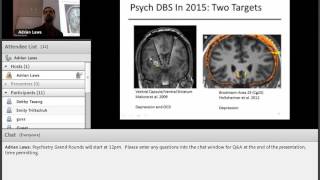
Thank you. So yes, it is a pleasure to be here. Actually, it's actually— Dr. Ernst doesn't know this, but one of the people who was with me at Carnegie Mellon is now a neurosurgery resident here. So this is in so many ways coming full circle. It is just great. It is just great to be back. So today is going to be a talk through the world of deep brain stimulation, where we've been, what we know, and the tremendous amount we don't know, and what that means about where we're going. So that means that this is going to involve a fair amount of discussion about things that are off-label or partially labeled. However, none of the work that I'm talking to you about is in any way commercially supported. It is all federally funded. And some of it actually has— continues to be supported by the Sensorimotor Neural Engineering Center here at UW. What I'm going to do is talk you through the basics. What is deep brain stimulation physically? Where do we put it, who currently have the clinical trials been done in, and why. And what does that mean? How does it work or not? Because there's been some interesting conflicting reports in the media lately about that. I'm going to take a digression to talk a little bit— Oh, right, I'm supposed to use the mouse. To talk a little bit about lesion studies and especially the clinical use of lesion procedures in psychiatry because that's still actually a very big thread that's informing a lot of the DBS work we do, and then branch back from that to use that to start to talk about mechanisms. What do we still need to know and where is the field going? What can you expect to see coming out of the research labs and actually hitting clinical trials within a roughly 5-year time horizon? And throughout the talk, a lot of this is going to focus really on two disorders. One, major depression, and to obsessive compulsive disorder. Major depression, because pretty much if you're developing a product and you're going for psychiatric indication, you go for MDD because it's the most common and most— and in many ways most difficult. There's the most treatment-resistant patients out there. OCD, because historically— and you'll hear this— one of the best uses and most evidence-based uses of neurosurgical interventions in psychiatry is actually in OCD. Having to do with the fact that that diagnosis is a lot more reliable in many ways than many of the other things we diagnose, and that it's one of the few disorders where we can at least claim to have a thought about the mechanisms and circuits that are involved, which makes it very amenable to these kinds of very focal, targeted lesion or electrode-based interventions. So, just the basics. Deep brain stimulation, what is it? Deep brain stimulation, what is it? It's a wire in your brain. It is an implanted lead that goes— and I'm going to show you some MRI pictures of this in a few more slides— down to very close to the center of the brain, so generally in midbrain structures related to or near the basal ganglia, brought back up to a small burr hole drilled in the scalp, and then with current generation technologies, a wire that's then tunneled with a connector down by the ear, through the neck, to a pulse generator in the chest, and all the computing and stimulation is actually happening here underneath the pectoral muscle. Everything else is just wiring. And the important thing to know is that everything I'm going to talk to you about clinically is a pacemaker. And I'm not kidding about this. This is— Medtronic took their pacemaker circuits, put them in a slightly different shaped tin can, changed the wire from a cardiac lead to a brain lead, and that's a DBS. So what we're talking about When we talk about this stimulation, it's a constant high-frequency train of energy, pulses at 130 pulses per second applied 24/7 continuously to the brain the same way you might try to continuously pace a heart. And whether that's the right thing to do and what are the effects of that kind of chronic pounding on a neural circuit are one of the things we're going to start to talk about towards the latter half of this talk. Now, who gets it? Fundamentally, who gets it is the sickest of the sick. This is right now, because it is an invasive intervention, and because, as many of you have learned throughout our study of the history of psychiatry, psychiatry has had somewhat of a checkered past when it comes to invasive interventions. Generally speaking, these trials have been done with people who are absolutely at the top of the rating scales. If you— many of us, unless you work inpatient for, for most of your life, you're not going to meet a Y-BOCS of 30. These are the people who are literally homebound and utterly paralyzed by OCD. They are spending all their times ritualizing and/or trying to take their meds to knock themselves out. Yale-Brown Obsessive-Compulsive Scale, sorry. Um, similarly, a Montgomery-Asberg Depression Rating Scale of 28 is vegetative, in bed all day, or literally spending all day trying to talk themselves out of killing themselves. And these are the folks who have tried everything. Every treatment that could reasonably be indicated, and some that aren't reasonably indicated, and it still hasn't worked. And what that means is two things. One, that they're neurobiologically a lot different than the average patient will see, even as a difficult case, as an outpatient consult. That really, you're talking about a rarefied slice. The go— the best study that's been done of this is a study in OCD that estimates that out of the patients who present to the good upper-level university OCD clinic, less than 1 in 1,000 actually would meet criterion for a neurosurgical procedure. Okay. The other thing that happens with this is that if you get to that level of treatment resistance, that implies that you've also been in whatever episode you've been in for a long time. Potentially a decade or more. And that means that some very interesting and somewhat perpetuating dynamics tend to spring up in your family environment and your life environment. And it means that whether— we've never been able to figure out whether these are sort of acquired or inborn. There's some very interesting personality structure that then starts to get unmasked if you get the person a little bit better. Now, it's also because of the complexity means that this is not done lightly. So one of the things I want to stress is that everybody who gets into one of these studies has been in the pipeline for it for something clo— between 6 months and a year. That when their psychiatrist refers them to us, We're going through a mountain of charts. I mean, this thick. Actually reading it, looking at the therapy notes, making sure they actually did the CBT and that they tried and the therapist seemed to know what he or she was doing, and usually sending it back and saying, "Actually, you know, they didn't really try clomipramine, and have you thought about an MAOI, and by the way, we think the ECT course should be done this way, so how about you go try those 4 things and then call us in a year if none of them worked." And then we lose about— 50%. Half of our referrals that way. They just go off and get better and don't need us anymore. Then, and only then, do they end up progressing through to actual in-person evaluations, a lot of informed consent process, and the surgery. What that also means is that in addition to what I just said about the neurobiological rarity, if you make it through to actually having surgery, You can't be— you have to be sick, but yet not so sick that you're actively suicidal. Because if we put in a medical device in you, you can now kill yourself through ordinary medical procedures like an MRI and/or by simply not taking care of the device in the right way. You've got to be able to handle life with this device, which is not easy. I will tell you that some of my patients have said, boy, if I knew what I was getting into when I had this implant, I'm not sure that I would have "signed up for it even though I'm glad I did it," which was a fascinating quote. And they've got to be medically stable. So again, these are an interesting and somewhat odd bunch of treatment-resistant patients. So that's the— with that context, let's get on to some good stuff and talk about what are we actually doing. So in 2015, and at least in the US, there's two targets. One is what we use at MGH and what's used at the majority of the centers around the US, which is the ventral capsule, ventral striatum target. So you've got the head of the caudate there, you've got your globus pallidus, putamen here, and then right down here is the nucleus accumbens, a major structure in the reward and decision-making pathways. And flowing all around it—
Mm-hmm.
—is white matter with dense projections to the prefrontal cortex. And the interesting thing about this target is that we've trialed it for both depression and obsessive-compulsive disorder. Same site. I'll get back to that and the why of that in a little bit. The alternative, and the one that you've probably also heard about, is the subgenual anterior cingulate, or CG25 for Broden area 25. And that's the, that's the target that was developed by Helen Mayberg when she was up in Canada and now at Emory. So it's primarily used by her group and by the group in Toronto. Mm-hmm.— and also by a somewhat famous former graduate of our residency, Paul Holzheimer, who's now up at Dartmouth and who did a lot of his work under her. So this is a figure from one of her— his papers. With that as the background, does it work? In open-label, the answer is pretty clearly yes. So here's the outcomes figure from that same Holzheimer paper where— and this is unipolar and bipolar depression. Starts out at a Hamilton Depression Rating Scale of 24, and over the course of about a year slowly ticks down to 12. So a 50% response. And continues to get better as far as they were following up the patients. So that's one of the interesting things about this target is as long as they've been followed up, it's slow, very, very, very slow, but there's a slow contin— But there's a slow slow continuous improvement in well over 50% of the patients in the open-label studies. We see something different at this ventral striatum target where we don't see slow. So this is from the— this is from the open-label depression study published in 2009, 15 patients, where— and this is— the two lines here are not unipolar or bipolar, they're Montgomery-Asberg and Hamilton Depression Rating Scales. You see a decline over about 3 months. Clinically, it's really more like 3 to 6, but a pretty rapid downshoot to where they're gonna stay, and then a plateau. They get there, and still about a 50% change in the rating scales, and then they just stay there as long as the device continues to function. And we see something similar in obsessive-compulsive disorder. So this is the multi-site case series. Case series involving the University of Florida, Butler Hospital, couple, couple other centers. Cleveland Clinic is one of the other ones I remember. And again, now it's Yale-Brown Obsessive Compulsive Score again. They'll go down, they'll get to about a 20, so still spending about 3 to 4 hours a day on OCD-related behaviors, but now able to get out of the house, able to volunteer, able to have at least some engagement with life. But they'll get there quickly. And 3 to 6 months, and then it'll just stay there. So this is a fascinating difference in the neurobiology, and it's not one that we fully teased out, but says there really is something different about these two targets, even though they're neuroanatomically linked. Now, here's the thing. As I said, that's the open-label data. As of 2013, there have been two completed and semi-reported randomized controlled trials. They were both in depression, and they were both sham-controlled. Meaning you stick the stimulator on, but for a randomized lead-in period, nobody except the programming clinician knows whether it's actually giving electricity or whether it's just a wire sitting in there in the brain, creating a little bit of micro lesion effect at the target. And both of these didn't even complete enrollment. They hit a minute— interim futility analysis. It was clear the trial could not succeed, and both the Reclaim trial, which was Medtronic funded, and the Broaden trial, the CG-25 target, which which was St. Jude funded, have been shut down. And so now the RECLAIM trial's published. Broaden is still sort of somewhere in process and will come out. But this is an open secret in the intervent— in the interventional psychiatry community is that these things hit a wall. Now, that doesn't mean it doesn't work, because we know two things. One, some pa— hidden in that is some patients who got radically better. And again, this is treatment-resistant depression, where if you're lucky, the placebo placebo response is 10%. Second, although the— although the IRB no longer lets us do blinded discontinuations where we surreptitiously switch it off and don't tell the patient that it's off, patients get blinded discontinuations accidentally. Batteries die, wires break, people suddenly get withdrawn from therapy without their knowledge, and when that happens, their disorder comes roaring back. Further, at the VCBS target— I'm going to talk about this in a second— we can make people hypomanic. I can— if I push someone a milliamp higher than their therapeutic dose, they will develop hypomania that looks for all the world like they're on meth or cocaine. And if I turn it back down, that goes away. I don't need anything further to prove that yes, there is something happening here beyond a simple placebo response. And I can make it go away if I turn it down and don't tell them that I'm turning it— that I'm turning it down. So it really does work blinded. My guess, and I'm gonna talk about this a bit more, is that some of this is study design. So for example, the Brodden study had a very short sham lead-in phase where I just showed you data saying that to really get to a serious clinical response, it takes a year or more. And then we'll talk a lot about patient selection. The fact that One treatment-resistant depression is not another treatment-resistant depression. Now, in OCD, we don't know yet. The only published data in OCD are open-label, and interestingly, on the basis of those data, the FDA actually approved it for general use under humanitarian device exemption. Now, there, there was an RCT. It closed in March of this year. It's under analysis right now. It recruited 28 patients. I take care of 7 of them. If the salmon I have are any guideline, there's gonna be a signal, but the signal above placebo is gonna be in the 10 to 20% range. So that's my guess, and you can call that a sealed envelope prediction, and in another 6 months we'll find out whether or not I was right. But— and this is important, we'll get to this at the end, at the very end of the talk, and this is actually data that I've been able to collect through the help of people here at UW— even the patients who get better tell us very clearly that they want more out of these devices than we are able to give them. Because just like starting someone on an SSRI and getting them better, you get them better, and then it kind of poops out after some time. And thankfully, we can raise up the amount of energy going to the brain, and that usually buoys them back up and helps. But there's something— there's something going on there. And breakthrough symptoms— in particular are a real problem for most of our patients. So is the process of actually tuning it in, which is as much trial and error as finding the right antidepressant and the right dose. And then, as I just mentioned, there's the side effects.
Ahem.
That really, there is such a thing as too much DBS. It's as bad as too little DBS, and it's very easy to underdose and overdose in the same patient within the course of a week. So how do we match this more tightly to a patient's needs is one of the great unsolved questions right now within DBS, and it's what I'm going to get back to at the very end of this talk. The other thing I will say that I'm also going to come back to is that I am absolutely convinced that our diagnostic process is not helping us here. That—
Mm-hmm.
If you— I mean, everybody in this room knows this. There are— if you count it up, there's 126 different ways to get the diagnosis of major depression. To say that you can take all comers, MDD, lump them all into one trial, knowing for a fact that there are some number, at least probably 5 by my just back-of-the-envelope guess, different neurobiologic entities living under that diagnostic label and put one electrode at one point in their brain and give one kind of energy and expect that that's going to get everybody better. And when you say it that way, it just sounds crazy. It doesn't— it makes sense that these trials failed. And we need to do a better job of thinking about who has the kind of depression that actually needs a stimulator in the cingulate versus stimulator in the accumbens versus the German group trying an MFB for more of an anhedonic subtype of —depression, and for that matter, is depression even a single place in the brain illness? Because that doesn't quite make sense when you think about the complexity of behaviors that make up these clinical phenotypes. Now one of the ways that we're getting towards getting past that is actually through going back and thinking about what we've learned from the deeper history of psychiatric neurosurgery and lesion procedures. So I want to pause for a second and take a little bit of a side route and talk about that. And it matters because what I haven't told you yet is why are we going and putting DBS in these two places? What's special about these two? The ventral capsule target is because since the 1960s based on some— based on work of very Swedish neurosurgeons, It's been known that lesioning the white matter of the internal capsule, performing a capsulotomy, relieved the symptoms of what was then called obsessive-compulsive neurosis and is now OCD. So the reason we stick a DBS there is because we know that a lesion done there is therapeutic for over half of the patients who receive it. Why do we go with CG-25? Because back when I was still in college, Helen had a study where she compared patients who were recovering from depression with patients who underwent a mood induction task and just read sad autobiographical scripts to themselves and found that sadness in both these patients caused the CG-25 to become more active on positron emission tomography. And so again, the reason she put the DBS there in the original study with Andres Lozano was because there was this idea that it was going to simulate a lesion, that by high-frequency stimulating this tissue, you are somehow kind of stunning it or acting as though you had burned out a piece of the brain. And this made sense because that had been ongoing and in fact is still ongoing. So this is the other thing I want to, I want to point out, is that in fact we still at MGH— not frequently, like one every 6 months maybe— but we still perform not just the capsulotomy but its more tolerable sibling and somewhat safer procedure, the anterior cingulotomy, where we'll lesion the dorsal anterior cingulate. And that procedure has also been around since the 1960s. And these things have a response rate that's as good as DBS in both major depression and OCD. We're talking 50 to 70% response rates. Now, open-label data, because while I can put in a neurostimulator and sham turn it on, there's no IRB in the world that's gonna let me say, "Oh, what I'm gonna do is open up your head and have the neurosurgeon actually lower a probe directly past all those fiddly little blood vessels into your cingulate, and we'll just keep it in there for half an hour pretending to do a lesion, and then take it out, close you up. Oh, and by the way, a year later we'll unblind you and offer— and offer to do the same exact thing to you all over again." That study is not gonna fly. Interestingly, What did fly was doing this with Gamma Knife. And this is interesting, and I encourage everybody in the room to check this out because this was just the subject— it's in the JAMA Psychiatry ahead of print right now— is the subject of a bit of a kerfuffle. Yeah. The original Gamma Knife capsulotomy paper reported a response in 3 out of 8 actually operated patients, 0 out of 8 non-operated patients, and that was just enough to push you over the p 0.05 line until somebody went back and looked at the tables and found a math error and found that it was only 2 out of 8 and that in fact the signal flipped over the significance line and then, then they're in the midst of what kind of retraction do you publish when the authors did everything right but made an honest mistake but it completely changes what we think about things. Now in fact, while their main outcomes still came up non-significant, a bunch of their others did. So they, they still have a paper saying, yeah, even gamma knife capsulotomy did separate from sham in OCD. So this is interesting. The lesioning idea would work. And in fact, the other reason I'm bringing this up is actually within interventional psychiatry, there are times this is actually preferable to DBS. And you wouldn't, you wouldn't think You would think, wait a minute, you're telling me it's better to cut out a piece of someone's brain— we're actually burning it out with thermal energy— but to take out a piece of a person's brain as opposed to putting something in that's elegant and tunable and reversible? The answer is yes. Because then you don't have to come see me basically ever again except for like one follow-up thing. Visit. And if you live several states over, if I tell you, "Yeah, you're gonna have to come and see me and buy those plane tickets every month for a year, maybe more often if you have any kind of complication, and by the way, I'm also gonna be telling you about all these research studies that we're not gonna tell you you have to, but we strongly encourage, and you can't have an MRI scan ever again, and you can't have these kinds of ultrasound energy applied to your head." Apply and don't go through a metal detector and don't do this, and by the way, if you don't keep it clean, you could get an infection, and don't do sports that put torsion on your neck because you might break the wires. Many patients look at us and say, "Oh, heck with that. Just give me the lesion and let me go and live my life." There's none of that hypomania risk. Now, there's also no do-overs unless you want a repeat lesion or you want a second lesion, which actually there's evidence that says putting a second lesion on top of the first actually can prefers additional clinical benefit. But there are many patients for whom this is actually the better option. And this becomes interesting as we get into mechanisms. Because one of the things we now know— and this is sort of like a lot of things in psychiatry. We start— you know, we started giving everybody SSRIs because there was this theory that so many of our disorders were some kind of monoamine deficit. That is now— False. Obviously wrong, and yet SSRIs are at least 30% effective, so we continue to use them. Similarly, we thought DBS created a simulated lesion. It doesn't. In the Parkinson's world, which has— they have since way blown past us and shown that there's a complex set of effects that happen. Some of it involves some kind of change in neural firing patterns to make them more rhythmic in the area that's being stimulated because you're hitting it with pulses of energy far faster than the endogenous neural tissue could do. And so you're in some way entraining it, and maybe if it was firing in a very stochastic random fashion, you're bringing order into some kind of chaos. And more recently— so this is work from Phil Starr's group at the University of California, San Francisco— they've shown that what it does is also changes not just the deep brain, but the cortex. So this is a plot showing that the coupling of the cortex to a kind of slow frequency oscillation that's believed to originate in the basal ganglia massively diminishes when they apply DBS in the operating room and pops right back when they turn DBS off. That there is something going on where you're changing the coupling within brain networks in a way that we are just beginning to understand. And so that gets to where this is now, where the field is going. And one of the things that I think is perhaps the most exciting bit about where we are is that we have a number of patients— I'm thinking PTSD now. There, right there. That's a trigger sound for me.
Oh.
The— but one of the things that's happened is these failed trials are not really failures because we now have cohorts at a number of institutions of like 20 people walking around with these devices in their heads. And some of them got better and some of them didn't. And now we can start to ask questions and also because it's a device we we can manipulate it. We can turn it on, we can turn it off, we can change the settings, and we can start now— we have the end— to ask questions about what does this do in psychiatric illness, and how do we then use that for rational redesign. So I'm going to show you some snippets of data of one of the things I started working on. Officially, this was my fellowship project when I first moved to Mass General. It's— and it's a study looking at some mechanisms of action, both with our neurosurgeon Ahmad Eskandar, my division chief Darren Doherty, Thilo Deckersbach, our sort of master of psychology and neuroimaging, and an amazing research assistant by the name of Sam Zorowitz, plus some collaboration from an MIT neuroscientist named Earl Miller who does a lot of work in prefrontal cortex neurobiology. And we started thinking about this because we got back to what I was just showing you with the lesions. And thinking about, all right, two things are true. One, the same stimulation, the same ventral capsule, ventral striatum, works in two very sort of different disorders. At least people— if you look in the DSM, these are totally different chapters and very separate pieces of the manual. So sort of from our nosological framework, we think of them as very different. And yet not only does DBS at this accumbens site help them both, the same pair of lesions helps them both. And so that, that got me really thinking about, well, what, what's the common pathway here? What makes sense? And I began to think about things like, all right, in some way you can think of them as both perseverative behavior— the repeat obsessions and compulsions of OCD, and maybe the ruminative phenotype of depression and that kind of stuck thinking. And maybe you can also think about things like emotional dysregulation, because with depression, a sort of dysregulated mood, and OCD as an inability to regulate the response to a perceived internally generated threat. And we can also begin to think about what I was saying before, that This stimulator is in the white matter. And that the work of Suzanne Haber at the University of Rochester doing tracings in both primates and monkeys has shown that specifically the white matter it's in goes to the orbitofrontal cortex, which has been heavily involved in OCD. It also goes to the ventromedial prefrontal cortex, including actually a fair amount of stuff from the Mayberg CG25. CG25 target, and there's some PET studies saying that DBS back here at the ventral striatum actually changes metabolism at the CG25 target. And these fibers also, especially in the more dorsal part of the target, go to the dorsal anterior cingulate. That same place that we put lesions. And so this made me start to think about, okay, so maybe there's something about DBS modulating frontal and cingulate biology, and maybe that might have something to do with the therapeutic mechanisms, or at least it could be interesting. And in the meantime, while I was thinking about this, one year later, in fact, the Mayberg group came out with a study showing that from CG25 you also have a profound projection back into the cingulum bundle and the white matters, and that probably this more rostral cingulate target is actually having profound dorsal effects as well as— this is maps of where she thinks the fibers are going in patients who are responders versus non-responders. And you specifically see in the responders there's a much broader— the white matter fibers that are captured by the electric field go to a much broader group. So maybe there's something here about how much prefrontal cortex do you grab hold of when you put these neurostimulators in white matter hubs? One of the other theories she's going after now is that actually it was never the subgenual cingulate at all. It— that was a red herring. And that actually it's the fact that there's this huge white matter confluence hiding right behind the subgenual cingulate that they were clipping. So what we decided to do was say if that is true, then you should be able to find DBS's effects if you stress test the cingulate and its connected prefrontal network. And the way we're doing that is by something called the multi-source interference test. So what this is, for those of you who are familiar with things like the Stroop Color-Word Task, think about this as the Stroop on steroids. Right. You combine flanker effects, you combine motor map, combine motor mapping effects, and in our version, you also combine an affective distractor. So you show a positive, negative, or neutral valence picture on the screen very quickly right before you make the patient do the task, and it's lurking there in the background, just like in real life emotional stimuli are lurking in the background all the time while we're trying to do something cognitive. See also, pager on Jake's hip.
Um.
Okay.
And so, what we do is we have the patients play this cognitive conflict task with their neurostimulator on. And first pass we're doing this just at their ordinary best clinical settings because that's what's been optimized over 6 months to a year to try to get them better, so it's a good starting point. Eventually we want to redo this with standardized settings to see the difference. We run them through the DM-SIT and a companion task I'm not going to talk too much about today while we're also recording high-density electroencephalography so that we can map out what's going on on the cortical surface. We can't do fMRI because it's unsafe to do fMRI with the DBS in place, which is what I would like to do. Then we turn it off, we let it settle for 60 minutes because one of the things we know from rats studies is that there's a pathological rebound. That when you take this thing away, you get a counter-regulatory response. The brain actually starts to look more like its pathological self before it sort of settles back to normal. And so then we rerun the task again and see what changes in behavior, what changes in brain. And what we found is that this makes you faster. By about 5% in a sort of normalized reaction time. You've got to account for the fact that some patients are much faster than others, so you've got to normalize this to see the effect. But by about 5% with the stimulator on, there's a general all trial types— doesn't matter whether it's high cognitive conflict, low cognitive conflict, negative emotion, positive emotion— general speedup. And interestingly, it's not psychomotor. Mm-hmm. Because the task we have them do alongside this is one where they've got to mash a key on the keyboard as fast as they can, and there's absolutely no effect on that buttons-pressing speed whatsoever. So it's not that their DBS is making them less slowed. Something's going on cognitively with their processing. But we know where it should be because this task has, for the past decade, been repeatedly deployed in fMRI studies. And it keeps coming up with a patch of dorsal anterior cingulate and broad activations near Brodmann area 46 in the dorsolateral prefrontal cortex. And those are areas that using software that was conveniently developed by the guys one floor down from me at MGH, we can actually— we can actually try to project back. So we can try to ask the question, if we're recording from sensors all across the scalp, What is the maximum likelihood spot within the cortex that might have generated that? And we can look at a variety of different cortical patches and see where's the relative signal there. So we find some deep— we find some differences. So what you're now looking at is an event-related potential analysis. You're looking at the response to trials. Red curve, stimulator on. Blue curve, stimulator off. Right here is when that affective picture comes up. This is when the numbers that they've got to judge come up. Roughly in here is where they normally respond. And depending on where the area is— what you have here is basically an ANOVA slid over time to find the point where these two curves are significantly different. That's that little gray bar. There's a change in this very early peak, which is kind of interesting, 'cause in the cingulate, the brain's conflict detector, —but it's way before you tell the cingulate what it's actually got to do. So it's some kind of anticipatory response. Whereas when you actually throw the stimulus at it, it's more the prefrontal cortex that changes. And what you can see if you do that repeatedly— Uh-oh. —for a bunch of different frontal cortical labels is you can see that main effect of stimulation marching through the brain across time during a trial where it starts up in the anterior cingulate where we put the lesion procedure even before they know they're gonna have to do something, broadly while they're deciding activates prefrontal cortex and actually a little bit the rostral anterior cingulate, that same Mayberg target again, and then afterwards, after they've already pushed the button and made their response, it comes back here to this more posterior, more motor-directed cingulate, and possibly there's some kind of learning signal going on there. That's the best guess we have right now. But that you can see that there is a broad effect of this neurostimulation over time. Now, we're still working out what does that mean and how do we use it. Our initial thought was, oh, What this is, is it's affecting some kind of mental flexibility. We thought this because there's a clinical knowledge that one of the things DBS does is it makes you more able to benefit from CBT. Ah. So interestingly, one of the clinical phenomenologies we see is that the stimulator gets you a little bit better, but then the patients who go back and do serious amounts of CBT and really try to rehab their lives are the ones who turn into good clinical outcomes. And we thought Okay, that's what we're doing. We're modulating learning. We're modulating mental flexibil— we're modulating mental flexibility. The only problem is that doesn't make sense because using this cognitive flexibility, cognitive conflict task and looking at the behavioral effect, it doesn't correlate at all to the depressive rating scale that we're using or to its subscales. So this is a true effect, but that's not what explains the mechanism of action or how the patients are getting better. So now we're actually chasing an alternate hypothesis that in many ways was suggested to me by my 4-year-old daughter Sophia, who lately has been studying this sort of acceptance and commitment crossed with musical therapy, crossed with sort of— [LAUGHTER] —sort of theory of psychiatry. And what we're thinking about now is that maybe what we're seeing here is actually a tuning of their anxiety level during the task. And the reason we think about this gets back to what I talked to you about way back at the beginning. The fact that stimulation of this target can make you hypomanic. And for the longest time, I've been trying to integrate in my head, why is it that something would fix OCD and relieve obsessions and compulsions, compulsions but also lead to this kind of impulsive, behaviorally dysregulated, cognitively impaired phenotype. And what helped was an article that came out from the Netherlands group that was one of the first to do DBS for OCD, where they just basically did a bunch of qualitative interviews with a number of their patients. And what they repeatedly talked about in their quotes was the The patients talking about how they just felt more relaxed. How stuff just didn't bother them anymore. And this is where the Frozen connection came in. Because as I was thinking about this, Sofia's singing in the background, "The things that once control me don't get to me at all." And it was just this sort of moment of epiphany. And I'm like, oh, wait a minute. OK. And this made me think about— One of the things we may be modulating here, getting back to sort of an NIMH RDoC kind of thing, is the level of the patient's concern for the potential negative consequences of their action. When you think about what many obsessions are, it's fundamentally the— it's not just, "Oh, did I leave the car door unlocked?" It's, "Oh, but something really bad might happen." Or, "Well, I don't know that I didn't run over a person back there, and I might be a criminal, or I might have hurt someone." I need to go back and check. It's concern for what might have happened that you don't know about or didn't anticipate. And we can think about hypomania as— I mean, the patient— I mean, what I thought— think about this is the patients who are going off to casinos, spending money they don't have, day trading with money, again, that they don't have, that they're taking risks. And that when we try to talk to them about those risks, they say, well, Well, yep, come on, that's not really a big deal, is it? That it's all about the modulation along this axis. So this is the theory that we are starting to chase by saying, could we find a different set of tasks that would specifically look at their relative concern against aversive stimuli and follow up those data? So that's very much work in progress, but it's something I want to plant in your head because I think you're going to be seeing both us and other groups start to talk a lot more about that theory in the coming future. I'll tell you that there's also some rodent data backing it up that are starting to suggest one of the things that DBS does is change the response to fear extinction and extinction learning, where extinction again involves overcoming a little bit of doubt about what's going to happen. Now, so where we are. As I've told you about efficacy signals and said, okay, yeah, there were trial failures in MDD, but don't hold on to that too closely because it's pretty clear that there is a subset of patients who benefit. There is clearly a biological mechanism and we need to define it. So that's one answer to what's next. But wait, there's more. Because there's the question of what are we going to do when we have those biomarkers? And this is— if there is something that is a hot topic within the field of interventional psychiatry broadly, and this actually goes also to things like TMS and transcranial electric, is the idea of closed-loop therapeutics. The thing actually the last time I stood in this spot and talked to you, the thing I basically spent an hour talking about how do we do algorithms for. The idea that what we could do is not only identify the patient, map where their neurological what the deficit is, but detect a specific electrical signal in their brain that correlates to what's going wrong, determine how to stimulate, apply a customized electrical stimulus to the moment, and automatically— instead of the patient seeing me and me titrating them up and down— automatically match the electrical current that's going to their brain to what they need. Mm-hmm. Rather than just doing a pacemaker, it becomes something a little closer to an AICD, perhaps. And this is where, to do that, we are going to have to do some innovation. Because number one— the number one thing is the hardware platforms that are available to me right now are not going to support that. The NeuroPace responsive device that is actually a closed-loop sensing responding device for epilepsy has such a teensy battery that you can't do DBS stimulation with it. It'll run out in less than a year and you have to charge it. Medtronic has actually built some something that could do this, but they ran out. The memory chip that they built into it, the manufacturer went out of business. There's a limited number of devices, and most of them got snapped up by the Parkinson's researchers. So our response to that was to say, you know what? We're going to just go build our own. And specifically, one of the things that has happened to us as part of the BRAIN Initiative is that we were selected by the Department of Defense as part of what they call the Subnet Initiative. Basically, they want to see people doing re-engineering of brain networks through invasive stimulation in psychiatry. And so we've launched a project called Transform that is all about think— about thinking how do we find these networks of emotion in the brain, how do we model them, and how do we change them with DBS. Okay. And so, whoops, I went out of order here. I'll tell you first that we are actually building a next-generation device to do that sensing and recording not just in 1 or 2 sites, but at 5 different sites across the brain simultaneously aggregated to what is basically a little sensing mini-computer that also has the capacity to telemeter that data out to the clinician. So that instead of just sticking an EEG on someone's scalp and hoping I know what's going on in their deep brain, I will actually be able to record what's going on in their deep brain. Moving back for a second, the tian transform is transdiagnostic. So I started out by showing you this slide from the DSM-5 field trials and saying, you know what, I think one of the things that is wrong here is we're not finding the right patients. The diagnosis is fundamentally not well attuned to DBS. So we're trying to change it. We're actually trying to say, "All right, so if comorbidity and diagnostic confusion make patients into this multicolored mishmush, as Darrell Regier liked to plot it, why don't we think about this more in this dimensional space similar to the NIMH research domain criteria? Why don't we use that to figure out which kinds of patients are really different from each other and how do we cluster?" Uh-huh. So this is something that we are heavily doing on the neuroimaging side, not just with DBS patients, but with patients in general who present to our clinic, trying to say, okay, how do we identify for a given one of those domains, for emotional dysregulation, for approach avoidance conflict, for mental flexibility, where is the fMRI hotspot in your individual brain that most lights up and most correlates with your dysfunction because maybe we shouldn't just be putting it at the same coordinates for every single patient. Maybe we should actually be putting it at the place in your brain where that activity is most strongly encoded. And this is— for anybody who's worked with, for example, epilepsy patients, this is what we do all the time for epilepsy surgery. We come in, we cortical map. In that case, it's for where is your language cortex, let's not go anywhere near that. But— Yeah. It's the same theory in reverse. And one of the other things that we are now more— that we have now developed the capacity to do is to really instrument the brain electrically in, again, non-psychiatric patients. This is in epilepsy patients. So there's been a real convergence where we are now working with the neurologists who put 80 to 120 electrodes into patients who are undergoing seizure mapping for an eventual resection. And those electrodes go into the dorsal anterior cingulate, they go into the rostral, they go into the DLPFC, the OFC, the hippocampus, and the amygdala. It turns out that for years our epilepsy colleagues have been busy instrumenting the structures we care about with the electrodes to do recording in the awake behaving human. It's just that nobody has really gone down the hall and said to them, by the way, could we use that to maybe understand psychiatry a bit, a bit better? So this has been one of the things that DARPA's let us do is forge that collaboration. And just to give you— just to say that this isn't all just pretty 3D rendered graphics, here's some actual photographs of prototypes from that device. This thing, there's the circuit board that's going to go in it. These little head stages that interface with the electrodes and provide recording and stimulation, there's the little folded up set of 3 circuit boards that are going to go in it sitting on top of a United States dime. I've held this in my hand. The engineers immediately say, "No, give that back. That's the only one we have. Don't break it." But I try to convince them that I do know this, that I've built things like this myself, but they still want— they still say, "No, no, no, no, no, no. That's more precious than my child." They let me have this. This is the evaluation board version. This is working in our primate lab right now actually recording neural signals. Wow. We haven't tested stimulation with it yet, turns out to have some recording issues, but it's there. This is, this is real. And so this kind of thing, devices that can really sense and respond at the same time, and as importantly, devices that are research tools that can beam signals back out to the clinician and help us understand how we're changing the brain. Yeah. This is where things are going. This is what— and I'll tell you, DARPA has charged us with turning that, these prototypes, into this within the next 2 years and actually getting pilot implants going. So this is going to happen. There are other teams working on sort of slightly different competing designs, but what you're going to see is a real explosion of understanding of mechanisms once we're able to get something into someone's head and directly monitor every day over the first month of therapy how is their brain changing. And I mean, and that's not just from DBS, right? You can think about the fact that you can then see what happens when that same patient is started on a new med. What happens when they go into a therapy session? How does it track with their subscore? What happens when they start the exposure versus are in the middle at the end, what happens to them when they go to sleep that evening and begin to consolidate that information, that we're going to be able to get a whole new understanding of the neurobiology of brain change within mental illness. And again, when I start to think about designing cures that are applicable to people well beyond the small sliver who want to get these kind of neurostimulators, that's what's to me really exciting.
Thank you.
So with that, just to finish up, I obviously have to point out that this is not work that I do alone by any means. So there is a huge team, some of whom I mentioned in part of this, backing this up at MGH from neurology, neurosurgery, psychiatry, the basic neurosciences, a ton of engineers across the— across the river at Draper Laboratory in Cambridge who are actually building the device. There's quite a bit— there's quite a bit of early-stage funding that has helped generate this and other results. And actually, a lot of this traces back in a very real way to UW. None of this would have happened, we wouldn't have gotten the grant, I wouldn't be doing all this research if not for the fact that Deb and John originally brought me here, gave me a pile of protected time, and hooked me up with a bunch of neural engineers up on main campus and said, here. Go. Learn. Do something cool and see what you can build. This all started with a grant. All directly comes out of people in this program and what they were able to do for me. And for that, I'm always going to be grateful. It's why it's kind of exciting to come back and tell you guys what you— what all of— I mean, even the clinical faculty who taught me, what you have helped me do along the way. So with that, thank you. We've got a few minutes for questions. Happy to answer them. Thank you. All right, I see one hand.
Can you say a little bit about what the programming process is like?
Sure, so just for— since I hear we've got people playing the home game, the question was what the programming process is like. And so what it is, is basically the current generation, to talk with it, you've got to hold a little coil about yay big up to the patient's chest. They hold it in place and it just communicates with with them over proprietary radio frequency communication protocol. It says, "Hi, I'm a neurostimulator. Would you like to change my frequency? Would you like to change the width of the individual stimulus pulse? How much energy is going?" You've got— So I guess what I mean is it doesn't look like you're able to see a response behavior right away. That is correct.
So Parkinson's program.
That is— okay. So this is an interesting thing. You can and you can't. The very first time you ever deliver energy to the person's brain, you can see an emotional response. There's an interesting thing called hemismile, where they sometimes smile but only with half of their face, contralateral to the stimulation. They will often report an acute sense of relaxation or of a sort of lifting or lightening or that relaxation or that sort of, "Ah, stuff's just not bothering me." right now that I was talking about a little bit. And then, no matter what, even at clinically effective parameters, you almost never can get that again once the brain's been exposed to stimulation for a day or two. You can kind of get it if you withdraw stimulation for a long time, like the device fails. But it's interesting, what we do right now is we look for the contact up and down. So a DBS lead has 4 little electrodes built into it, and you can steer stimulation up and down to any one of the 4. It's meant to let you fine-tune a little bit within the brain target. We always target the electricity to the contact that produced, if we can, that acute emotional response. There has never been any proof that that has anything to do with whether or not the patient gets better. And so one of the things that may be happening is all these people walking around, we actually needed to go, for example, more dorsal and bag a little bit more of the fibers that are going to the cingulate, or get a little bit more in the middle of the white matter and hit more of that CG25 target. But we don't know. This parameter space— that's why I'm telling you it's not just the exact fine-tuning the location, but when you add into that the exact sort of width of a pulse, and which differentially activates larger versus smaller diameter axons nearby, when you think about the amplitude which changes the volume of tissue activated, especially in very anisotropic white matter, you've got a 4-dimensional search space. It's impossible to grid that, especially because once you get past that initial moment, there's nothing that tells you immediately what's happening one way or another. So this is where I believe, once we define what the change we're looking for in the brain, is, we'll be able to program or titrate to it. But that— defining that is the work of at least the next couple years. Chris, you can ask me later. I'll go with this gentleman here. So along that same line and kind of running with Helen Mayberg's new hypothesis theory, and I guess independent of the kind of emotional affective underpinnings, in your estimation,— and your best guess, is it this confluence of white matter? Is it the more you hit, the better? Or is it a specific tract, you know, the lenticulus that you're— that's going to be like the final outcome? You know, I don't have a strong hypothesis there one way or another. I'm going to guess that it's a little bit of both. Because I don't think it's one fiber bundle. I'm almost certain And this is based on, honestly, just a postulate or overarching theme of my broader research direction, is this idea that the symptoms of mental disorders arise not from single brain areas, but from deficits of information communication between multiple brain areas. So what I would suspect, if I had to make a guess, is that what you've got to do is get the fibers that are going to two different brain areas in exactly the right way. That it's something about how— for example, OCD, there's this long theory that it's all about how does the cortex connect to the cingulate, connect to the striatum, connect to the thalamus, connect back to cortex. That there's a reverberant loop and it's all about changing activity in that loop the same way that DBS is thought in some way to change basal ganglia loops within Parkinson's. And so if that's true, presumably what you're doing is kind of interfering differentially with two— with two nodes in that network, and you get that by getting exactly the right combination of white matter fibers projecting to them. That's pure hand-waving hypothesis at this point in time. This is why one of the things I am starting up is an active rodent lab to try to tease some of that out, although some of these disorders are very hard to model, and the best we could do is work out simulation protocols that reliably grab two pieces of cortex in exactly the right way. All right. Dr. Brubaker, I think you had a question. Yeah. I mean, I remember when you were a resident here really seeking out UW weekend calls so you could be in the lab and take, you know, pages and go out and see people.
Yeah.
So, I'm glad this is working. My question was— I'm an intern here at Brown. I was hearing Steve Rasmussen talk about gamma knife surgery. And he really had the idea that people who responded to that were kind of neurologically different from more garden-variety OCD. And, you know, seeing this, it's very exciting, but I wonder how applicable this is to the more common patients. And one way I thought maybe you could tease this out was if there were any mood effects from the vast number of Parkinson's patients who have deep brain stimulations, knowing it's in a very different anatomical place, but if there's any kind of mood correlates there at all.
Yes.
There are. I'm going to step cautiously here because I don't know the Parkinson's literature very well, but there is a known limbic connection of the subthalamic nucleus. I mean, I've certainly seen, you know, while I was here at UW, one of my papers is actually discussing the sort of psychotic reaction that you can get. Other people have talked about a hypomanic reaction that you can induce from stimulation at the STN. Interestingly, somebody was asking me yesterday because they feel that they've seen patients who get more depressed from STN stimulation, although how you tease that out from the sort of hypodopaminergic depression that you sometimes see in Parkinson's, I don't know. So the answer is, yeah, it's there, it's there. Oh, but I failed to repeat the question for the— Dr. Brubaker was asking, how is this— how is OCD that responds to DBS and neurosurgery different from regular OCD, and what— and could we tease something out with DBS and Parkinson's about it? So I— the answer to your question is maybe. I don't know. That's, that's, that's really tricky, and I haven't thought about the exact way to do it. I mean, your broader question, how are these patients different from regular OCD, I mean, it's a really good one, and I think it's, I think it's absolutely right. I mean, I think that the treatment-resistant disorders broadly are just not the same thing as the, as the regular one. But maybe they're on a spectrum. And I will say that I think they're on a spectrum by the fact that what gets you better with regular OCD? Exposure. What really actually gets you better with OCD that responds to DBS? Also exposure. It's just exposure that's boosted in some way by having this neurostimulator in use. Maybe there is more similarity than we think. I see Dr. Neumaier wants to chime in about that.
I agree. We talked this morning about how extinction training may be influencing— you mentioned that. But if we're only reading for extinction learning and we turn it off, it would be sustained. The fact that people lose their memory when it gets turned off or wire breaks suggests that there's something necessary for the maintenance of it.
That is a really interesting point. So his point, again, since I'm supposed to repeat things, was that if it were purely a boost of extinction learning, they should retain that extinction learning even when the stimulator fails. Now, so I will tell you this. That does sometimes happen. So we have one case in our cohort, and he's actually one of our best responders, who early on had a severe psychotic complication from his neurostimulator. We had to turn it off. And his symptoms didn't come back. And he's actually continued to do ERP and is doing better than ever, is taking community college classes for the first time in his life, is now working— not full-time because he's taking classes, but could work full-time. And as far as I know, for the first time in his life, actually has a girlfriend. And this is— I mean, this is really one of our success stories. I love getting emails from his mom because they And yet, this is the guy who the thing had been off for the past 3 years. And what the heck is going on there? Did we cause a microcapsulotomy? Did we reset his brain? We will never know. But so some of that consolidated learning can happen. That said, I do agree with you. I mean, I said, I think there's also an acute anxiolytic effect here. And to a comment that you've made to me me before, and that we also talked about this morning, one of the effects of the treatment might just be to get someone's anxiety down to a level where they can at least consider engaging with exposure and then trying. And maybe when the simulator fails, that sort of resurgence of affect and affective dysregulation just kind of floods them and makes them unable, or maybe they've got kind of a state-dependent learning and they can't generalize it. That would be some of the theory I would put there. Okay. I'm interested in that anxiety framework that you have for how DBS works, and I really liked how you explained it for OCD, but I'm wondering how that plays back into patients with depression and how you view that kind of spectrum in terms of the classification of subtypes. Yep, so the question was if the anxiety, if that anxiety theory I just talked about makes sense, then what about depression? I mean, and this is where I get back to subtypes of depression, right? I mean, there is a subtype of depression that is the very agitated distress kind of depression versus the subtype that's much more of a neurovegetative kind. And there's anecdotally in the literature— and actually, I shouldn't say in the literature. There's anecdotally, when you get us and people from the Mayberg Group together, there's talk about the idea that maybe maybe somehow we are treating different kinds of DBS and maybe VCBS works a little bit better on the, on the agitated mixed anxiety depressive picture. Even though attempts to actually define this sort of mixed anxiety depression as a clinical phenotype have actually been very difficult, even though we all think we see it in practice. When, for example, when they tried to put it in DSM-5, they were unable to truly find evidence that it exists as a separable entity. So that would be a guess. And maybe I need to go beyond anxiety to broader emotion regulation. I'm not sure. It's an incomplete theory.
I'm going to wrap us up here in a minute. I guess just to follow on this, I think there's plenty of people who have depression who have serious concern about negative consequences.
That's true, too.
I think the neuroeconomic angle on this is really interesting. Pursuing, I mean, people are always making a judgment about is the price too high, is the reward too low. And that plays into obsessive-compulsive disorder individuals deciding whether to do or not do something. And so, it seems to me it's kind of in the decision-making domain, which we know is great. And there's a lot of great work going on. I mean, in addition to what you're doing, it's a neat thing that so much is being learned about that right now.
Right. No, so your point is, if I'm just to to sort of restate and think about is that maybe what we're seeing is that if we put in that concern for negative consequences framework, it's that they're automatically jumping to the negative conclusion. And that what we're maybe doing when we— and there is some PET imaging saying that we are changing dopamine release specifically within the ventral striatum, which makes sense given what we know. And so, yeah, maybe what we're doing is changing their risk sensitivity in a way that they're less worried about the negative consequences.
They're not like the media, they just know that this is gonna work.
That's true.
They know that the negative consequences are outweighed by the positive.
Yeah.
It was also the same thing.
Yeah, no, I think that's a very valid framework. So thank you. Thank you, Isaac. [FOREIGN LANGUAGE]
More from Alik


Healing mental illness through brain network stimulation | Alik Widge | TEDxMinneapolis


First-of-its-kind brain chip to treat mental disorders being developed at the U of M