Sustainability, consumers and marketing

In this presentation Andrea Illy, chairman of Illy Caffè and co‑chair of the Regenerative Society Foundation (with Jeffrey Sachs), critiques the conventional sustainability paradigm and outlines a vision for a regenerative, circular economy. He begins by revisiting the Brundtland definition of sustainability, emphasizing the need for a triple‑bottom‑line approach that balances economic, social and environmental goals, and argues that current growth models are inherently unsustainable because they treat planetary resources as infinite. Illy proposes a shift to a regenerative model that mimics natural cycles, where waste becomes a resource and carbon is captured from the atmosphere into soil. He explains how regenerative agriculture—particularly soil organic carbon enrichment—can sequester carbon, boost biodiversity, and improve human health by reducing agrochemical residues and enhancing phytochemical content. He highlights the complexity of interlinking society, economy and biosphere, advocating for big‑data, AI‑driven observation to generate knowledge in these non‑linear systems. Illy stresses that businesses, not short‑term politicians, are the primary drivers of ecological transition, and describes the Regenerative Society Foundation’s role in supporting B‑Corps and industry. He shares concrete examples, such as a virtual cooperative in Kenya that assists 25,000 smallholders with inputs, markets and digital tools, and notes EU investment in Africa as an opportunity. The Q&A segment underscores political inertia, the need for interdisciplinary research, and the limits of reductionist approaches, while Illy calls for a redefinition of scientific methods to incorporate non‑causal, data‑rich insights. The talk concludes with a call to action for coordinated, regenerative change across agriculture, energy and consumption.
Chapters
TranscriptAuto-generated · 35 min
Andrea Illy, who is a visionary entrepreneur. He's not only the chairman of Illy Caffè, who is a jewel of the Italian food industry, but he's also the co-chairman of the Regenerative Society Foundation that he created together with Jeffrey Sachs that has a very interesting agenda to make our world more sustainable.
Thank you so much, Michele. It's a pleasure. Beware that visionary vision without execution is only hallucination. I don't want to be hallucinated. So thank you for— I will give you a little bit of kind of a foreword. We have been working since so many years about this topic. And particularly in the last 5 years around regeneration. So I want to, to say just a few words about sustainability. Um, the Brundtland definition is satisfying the needs of the present without compromising— second part— satisfying the need of the present, second part, without compromising the future generation one. So we first have to satisfy the needs of the present. This is a very important aspect because otherwise we cannot do it. So first, let's say, implication of this, let's say, 2 sides, 2 parts, is that there is an enormous social component. Either sustainability becomes the source of well-being and prosperity for everybody in the society, otherwise it will be voted out. Um, so this introduces the concept of the triple bottom line. It needs to be economical, social, and environmental sustainability, and the 3 are intertwined. So we tend to speak too much about the environment and not enough about the rest. And other aspect, as far as sustainability is concerned, is that there is no such thing as sustainability on planet Earth for now. Because the, uh, let's say, development model that we started with the Anthropocene, so the era which is— it became a geological era, at least it's not yet scientifically accepted, but in the perception is that the human impact on the world has been so gigantic to be comparable to a geological era, to have the same impact as geological era. And this model, economical model, is intrinsically unsustainable because not only it continues depleting planetary resources like they were infinite, and they are not. As a matter of fact, everything comes to biosphere, and the biosphere has a certain limited finite biocapacity. If we increase the number of citizens, the cake is becoming to be little and little for each, each of us. But most importantly, at the end of the life cycle, it creates only waste. So the implication is that if we really want to talk about sustainability, we have to seek a new model which is regenerative, which works like nature works. Because since for billion years, actually 3.6 billion years, life on planet Earth is completely regenerative and circular over and over and over again, to the point that it violates the second principle of thermodynamics because it doesn't, let's say, create entropy, although planet Earth is an open system relative to the universe. Um, closed system, closed. Um, with that, let's talk about regeneration, which is my, my, my job. A regenerative model— we start to sum up what has been said until now— needs to start from well-being. Well-being meant as health and happiness, because the search of happiness, which is ultimately the reason why we, we are here, right, to, to is the engine of the economy, consumption, and, and ultimately the ecosystem impact of humans on planet Earth. And then we have a problem because we are the only species ever existed with a per capita consumption which is 18 times higher than the biological needs. any living species consumes for their basic, uh, let's say, living needs, which is feeding themselves, surviving, and, and reproduction. We, with all the activities, we consume 18 times more, and we have other big problems as far as our ecological footprint is concerned. So well-being first, because we— it really needs to enter in the consumer mind. It Well-being actually is about regeneration. In parallel, we need to work with businesses for the industrial transition from linear to circular. Waste is the new wealth. Probably the new oil well is the sky, because instead of pumping from underground, from the geosphere, we will pump carbon from the air in order to pull these resources. called waste is the resource, and we have to make a gigantic transition to that in order to simply recirculate and minimize every single, let's say, atom, and minimize to the lowest possible level fresh natural capital resources. But with circularity, we need to eradicate pollution, because the two— the ultimate goal is the spontaneous regeneration of the biosphere. Why that? Because life is biosphere. The air we breathe, the water we drink, the food we eat, even the health we benefit from comes from the biosphere. And this has been the stupid mistake we did during the Anthropocene, because this secular mistake— nature or culture, like, uh, science and technology could replace or curb nature, which is not possible. So now that is clear that is not possible, we have just to change the from or into and— nature and culture— so that we put all our scientific and background knowledge and background and, and technology at disposal of a spontaneous regeneration of the biosphere. How does circular economy link with the spontaneous regeneration of the biosphere? In a way that the 2 factors hindering, limiting the spontaneous regeneration of the biosphere are resource depletion. First of all, land. 50% of the habitable land now is agriculture. One century ago was one quarter of that. 2 centuries ago was Half of that. There is no more land that we can exploit for agriculture. It's finito. All the suitable land has been already consumed. We can only improve efficiency, no extra. Same for water. Out of these 9 planetary boundaries, uh, 6 has been already passed, and 2 of them irreversible, like land and water. Why this? Because they are totally dependent on the fact that we are 8 billion people now on planet Earth instead of 1. When we started all this, uh, exponential growth. So, um, and the second aspect which really hinders the spontaneous regeneration is pollution. No matter if you talk about greenhouse gases, microplastic, chemical pollution, the biogeochemical, uh, cycle with nitrogen and phosphorus by fertilizer, you name it, aerosols, ozone, whatever. Pollution is the real, which has to be stopped. No matter if you prevent it or filter, sequestrate, no pollution. With that, as you have seen, all of you during COVID we were locked down and the nature was flourishing because it was beautiful, you know, everything was— why this? Simply because there was lower pollution. Okay, so with that, uh, next comment is complexity. What I'm describing is insanely complex because we are talking about 3 hyper-complex systems like the society, like the economy, and the biosphere, and you want them to work together. Impossible to predict because complex systems do behave in a nonlinear way, unpredictable, impossible to modelize. So the only thing we can do is to extract knowledge from observation, and the only possible observation is through big data. This is how nature and culture comes together, because technology can help us gradually finding a new model. But we don't know which are the measurable, and this is why we are here today. And, uh, and this is now the time to speak about my topic, which is agriculture. So in 2018, I took a sabbatical myself as a chemist to go back to books and say, I want to find out a way to decarbonize the company in a circular way, because no, the offsetting is not a solution. Insetting could be, say, so we compress, minimize to minimum possible level industrial emissions And then we fix the carbon in the same ecosystem where we grow our coffee, because we are lucky to work with this half of the economy working with natural resources. So, and I was lucky to discover this framework which has been brought at the Paris Conference in 2015 of the 4 per mille. enriching soil organic carbon in order to regenerate the soil, increase fertility, increase resilience thanks to the soil biodiversity. Because you nourish literally by— with organic carbon, you nourish the soil microbiota. In discovering that the soil is a carbon sink 3 times bigger than the air. So it's very, very encouraging. It's even better than forests, okay? So with that, I have kept studying and developing an idea for how to transition coffee agriculture and agriculture in general, because of course I had to study agriculture in general before to focus on coffee, how to transition from so-called conventional agriculture, which is based on A few, let's say, let's say facts, which are monoculture, intensive usage of agrochemistry, and very high productivity. Good. So non-conventional agriculture is— one of the characteristics of conventional agriculture is it's more important the plant science rather than the soil science, which has been pretty much neglected. Soil science is kind of emerging. Non-conventional agriculture is kind of the opposite. You focus on soil science, biodiversity, and intercropping, very diversified. So in the model, I, let's say, understood that as far as the food security, which is the the topic in the book. We will not be able to ensure food security with the current trend, because we have to consider that we have to produce in a more sustainable way. So no deforestation. European Commission just introduced— is introducing a law forbidding importing food which is coming from deforested lands, no matter if it is Indonesia, Brazil, whatever. So this is creating a lot of hurdles to continue increasing our production, as well as, uh, produce— agricultural productivity is dramatically impacted by climate change. Okay, and then, uh, and then, uh, we have to keep improving production because we will be either 10 or 12 million billion at the end of the century. But it doesn't change the figures, because if we will be 10, it means that we have been— would have been successful in eradicating poverty. So there will be less people consuming more. If we will be 12 billion, still poor people consuming less, but the same total consumption would be the same. The problem is you can take your calculator. If we will be 10, 12 billion from at the end of the century, which is tomorrow, That means that in 50 years we will need to double consumption once again, to double current consumption. So if you are in trouble now already with the difficulties even ensuring enough food, you can imagine if we can double the capacity, the consumption 50 years from now. It's not going to work. So we also need to have a dramatic change in our nutrition. Because 70% of agricultural inputs are for animal proteins, which we need, but we eat too much. As a matter of fact, we don't eat for nutrition in the contemporary society. We, we eat for indulgence. And maybe we have to go back and eat for nutrition and maybe indulge maybe over the weekend and no more than that. Okay, so all this excess of For instance, animal proteins, which are number one cause of inflammation, triggering non-communicable diseases, which are number one cause of death in the contemporary society in the developing countries, developed countries. If we scale down our animal protein consumption, we will use less land, less water, and we will recoup the rest of this let's say, uh, resources for producing more and more diversified plant-based diet. So this is what we need to do in agriculture, okay? Um, and it works because, uh, whoever already started transforming their plantation into regenerative, they, they, they, they really find out that it is really regenerative also from the bio— biodiversity point of view. The point of my model has been, according to the IPCC recommendation, always seek a co-benefit. So when you— so if we found a, a benefit for regenerative for the planet, the ecosystem, what could be the co-benefit? Of course, human health. So this idea of the dualism, soil health leads to human health. Why that? Well, first of all, thanks to regenerative agriculture, you use much less defensive agents— agrochemistry, pesticides, herbicides— which of course leave residues which are toxicant for our, let's say, metabolism. So that means that if you have less of those residues, you will have a healthier— healthier meant as non-damaging, okay? foods. But if you leave the plant in natural condition, it will develop spontaneous defenses because they have them. And these spontaneous defenses, phytochemicals, many, many, many times are extremely beneficial, meant as good for health, triggering a positive effect. And this is the idea. The idea is then, as this virtuous agriculture model which I kind of, uh, conceived to try to figure out whether we can prove that, that if you cultivate in a regenerative way, you also have a beneficial for human health. We need 3 large databases, one agricultural one, one database for food chemistry. You take the tomato produced in, you know, in the Pianura Padana, and then you analyze, you have all the agricultural input, water, land, Composition, climate, you name it. And then you compare with the chemical composition of this tomato, and then you see if those people eating this particular tomato instead of the one made in China somewhere had better health. Initially, it will be based on epidemiological data, but eventually I'm sure that the omics, the so-called omics, genomics, transcriptomics, proteomics, you name it, and metabolomics will give us the solution to have instantaneous, let's say, markers to instant— immediately check where— how do you react to the tomato cultivated in that way. I'm 100% sure that this is where we are heading. It's just a question of time. Because whatever works in the digital world, as well as artificial intelligence and medical devices, preventative medicine goes in that direction. It's just a question of time and finding out which will be the data to be— And last but not least, as far as specifically what to measure, I believe that the wonder is that this model seems to be too beautiful to be true, because by enriching soil with soil organic carbon, you sequestrate it from the air. So that means that it's a carbon sink. But also, as I said, you enrich the soil microbiota. So the question is now to investigate kind of an integrated, uh, biodiversity model where you, uh, assess What's the impact of the soil microbiota, so soil biodiversity, for the intraspecific plant biodiversity? You all read in the plant— in the paper, these olive trees in Puglia, all gone. Why all gone? Simple, because they are monocultivar. The geneticists can tell much better than me. has been selected in one lab. This is the best plant for Puglia. And then put the same— one plant is sick, all dead. Whereas in nature, each plant is different, and the intraspecific plant, let's say, biodiversity is a significant, very strong contributor to resilience and food security. Second, how does soil and intraspecific soil plant biodiversity interact. More than that, third level, what about, uh, interspecific biodiversity? In the same field you cultivate not only olives but also many other plants, and you find out that you need much less defenses because it's amazing what's happening. I, I discovered in coffee that because there is no ants, you have more leaf diseases from a totally different animal. Why that? Because ants eat the fungi which intoxicates the, the, the, the, the pest eating the, the leaves, and so on and so forth. We don't know, but for sure we observe, although we don't know, that the more bio— interspecific biodiversity you have in ecosystem, the better. And last but not least, the ecosystem biodiversity, because for sure we know from the regenerative, let's say, experience that, uh, we must have a ratio, a reasonable ratio between cultivated land and natural, let's say, reserves where you have as wild possible, uh, let's say, uh, biosphere and, and, and, and fauna as well, uh, let's say, which are, which are protected. And this, I think, it would be one of the very first things which we aim at doing, finding, because eventually will be a model. It will be a model. And to finish my comments, this guy at the European Union, they have a problem because they adopt the reductionistic approach, because each and every direction say, I'm the one of energy, I'm the one of agriculture, I'm the one of, you know, industry and pollution, etc. But they could come up with solutions which are linear and not complex and try to fix one problem, maybe not succeeding fixing one problem, or even worse, possibly fixing one problem with many spillover effects that you cannot control. Everybody's debating now how good or bad— I'm more on the good than the bad— is mobility electrification. But for sure, mobility electrification has not been assessed from the impact point of view, considering discussion that, like, we are having with biodiversity. Thank you very much.
Thanks a lot, and we have time for questions. Thank you very much for your presentation.
Really committed. And, uh, and for your engagement in this, all this stuff. But my main concern is that it's not only a matter of time, but it's a matter of political involvement. And this is probably crucial. And as far as I see, we have not reached— all of us who are deeply engaged in this area have not been able to communicate the tremendous impact that we have made on our Earth and what is going to happen shortly. And the political go on changing their mind and trying to do something, but Not— are not really committed and would never say to the population that the, the recreation is finished and we have to do something completely different for the future.
It is true, but if they punish the society, they will be voted out, go home, and somebody else will come and say good to continue emitting carbon and so on. So there is a limit to what you can do. And this is why, pragmatically, in the Regenerative Society Foundation, which I have the privilege to co-chair with Jeffrey Sachs, we said, let's focus on business. Because politicians, they have 4 years in their mind. Election, win the election, govern for 1 year to clean up what the predecessor did, then govern for 1 year, and then you are already in electoral campaign for the next term. No way. And they don't have the knowledge and the approach. Who could have a, let's say, a systemic view in a government like this? So whereas businesses in competitive countries, they represent at least 50 to 60% of the GDP, so they do have the Economical critical mass. They do have the technology, they do have the knowledge and the incentive, because if they don't, if they neglect sustainability business, they will be wiped out from the market. And our model is to— our business model is to assist companies, colleagues. We are a group of B Corps and we want to engage our colleagues from the industry and help them transitioning, the so-called ecological transition, which is about energy, agroecological transition for agriculture, and the circular one, with the best practices and scientific knowledge, whatever is needed for them to decide pragmatically.
Short question, please.
Thank you, sir, for the presentation. My question is straightforward. I believe that applying biomodification to increase food and nutrition is beneficial. And from what you have said, I think I've reaffirmed my belief in that. And also monitoring strategies like sequestration of atmospheric CO2 and biospheric carbon into soil-plant environmental systems have proven productive in Nigeria. My institute have worked on that for years now. And I think I also seek modalities from you on how to advance that across Africa. And I also look at— looking at a full movement into a Type 1 civilization, then what you talked about will come into full force, especially in developing countries where our agricultural system is not as strong as the European system. So I will like if you can please suggest few ways that this can be achieved, ways we can quickly, using the food system, move into a Food Type 1 civilization and also Type 2, possible Type 3 and the rest types. Thank you.
Yeah, Africa is potentially the biggest agricultural, let's say, land, but most of agriculture in Africa is subsistence agriculture, so no systems. The opportunity is to make a quantum leap and to jump, thanks to digitalization, directly into a regenerative model for agriculture with a better nutrition for local communities as well as trade. We are experimenting that. So a group of ex-FAO agronomists founded in Kenya a virtual cooperative assisting, I think now, 25,000 growers in finding all the resources, knowledge, let's say fertilizer, any kind of agricultural inputs, and also helping them selling the product on the trade, circumventing all the, let's say, physical hurdles and obstacles that you can find in the market. But the good news is that Recently, the European Union committed to invest more in Africa, so that— because Africa is considered to be a potential limitless source of regenerative resources. So in my opinion, it's promising.
So thank you very much. It was very interesting as a hypothesis. of a possible future scenario. I say a hypothesis because not everything you said has a scientific basis yet. And I totally agree with you when you said that there is now— that we need more knowledge in order to define and refine the actual scenario. Something that impressed me quite a lot was the fact that during COVID and the lockdown, where climatologists had the great opportunity to assess the impact of a dramatic reduction in the emission of carbon dioxide because no one was using the car, or well, there was a strong reduction in the use of cars, flights were almost non-existing, and there was an actual reduction of carbon emission which was well beyond the goals of the politicians in terms of reduction. But looking at the emissions, the actual data in the following years, nothing changed. And there is no actual explanation for this. Apparently, the reduction in emission was not able to change a trend in the emission in CO2 over the lockdown and next after the lockdown. This is a paper published in PNAS. So this clearly tells us that our solutions might be wrong or might be right. So actually, we don't know enough about how our planet reacts to our activities. While there is— I'm not denying that there is climate change and this is provoked, is due to human activities, of course, but clearly we do not understand everything. It's too complicated. And I agree with you that a reductionist approach might not be appropriate, but at the very same time, We need more data on specific areas of research in order to be able to define whether increasing biodiversity is really reducing the impacts of diseases, whether leaving plants to react themselves to pathogens will then lead to food which is better for us. I have some doubts about this, but anyway, this is a personal opinion. So, uh, yes, it is really fascinating, but I would like to see more data. And the real problem we have as scientists is that, at least in Italy, we have a problem of not having these themes on the political agenda for climate change.
So thank you so much. Of course, there are plenty of non-scientific assumptions, observations, but Professor Morgante told that I'm a visionary. So maybe there is a little bit of a hallucination. We will see a few years ahead whether it is an hallucination. But of course, as you mentioned, the natural defenses, plant natural defenses, of course, there are many, many toxicants which can be even more poisonous than the chemical ones. But it is also proven that there are so many phytochemicals which are good for health. So of course we have to be selective, and this is the job of, of who? This is the point. I think we are opening a big, big, big chapter because the so-called scientific method is based on observation, something, making a model, testing the model until you prove the model is confirmed. Nowadays, if we are approaching this complexity of our world, this will not be the way we can, let's say, produce knowledge any longer. Machines with big data are producing knowledge, and most of the case these are non-causal relations. We have to accept that. So the question is, Are we accepting non-causal relations as knowledge? Yes or no? And this is an enormous dilemma. I tell you a story. I tell you a story. Coffee was classified by IRC, so World Health Organization, as to be possibly cancerogenic. 25 years later, they reviewed the case and they reviewed Fortunately, they reviewed most of the scientific literature. Fortunately, they created an interdisciplinary, as interdisciplinary as possible commission, and they concluded to reclassify coffee as non-classified as cancerogenic treat. First time in the history that one product has been— can you imagine the responsibility that this commission took? So is there one scientific proof, knowledge that The answer is no. They only have epidemiological data, observation, tons of paper, and they had to rely upon common sense and sense of responsibility to make the decision. And I think this is a welcome to the new science. I think we will have to need a significant redefinition of the scientific method from, from our part. Good for physicists.
Thanks a lot again. And now, last but not least, we'll hear the.
More from Andrea
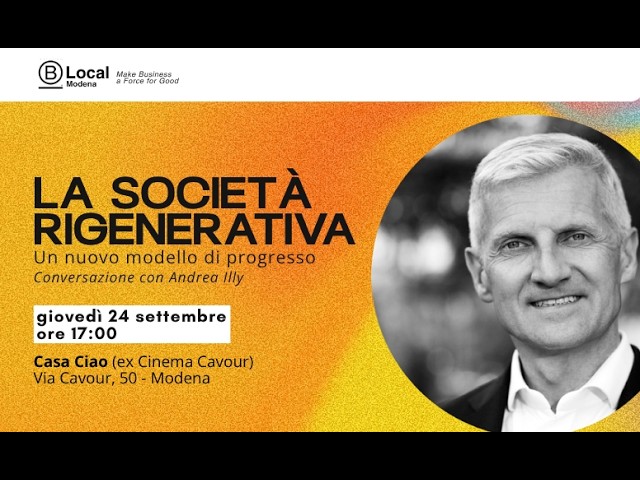
Registrazione evento: La Società Rigenerativa - Un nuovo Modello di Progresso con Andrea Illy


Feuromed 2026 - Monica Giandotti intervista Andrea Illy - Presidente di Illycaffè
Regeneration 20|30 Forum - Visioni di rigenerazione / Visions of regeneration - Illy / Vineis


Tutto quello che DOBBIAMO CAPIRE sul FUTURO della RIGENERAZIONE – con Andrea Illy
Multiplying impact series: a compelling vision for the circular economy with Andrea Illy


