Wellness Master Class with Andrea Illy, Beyond Sustainable: Why we must adopt a Regenerative Economy
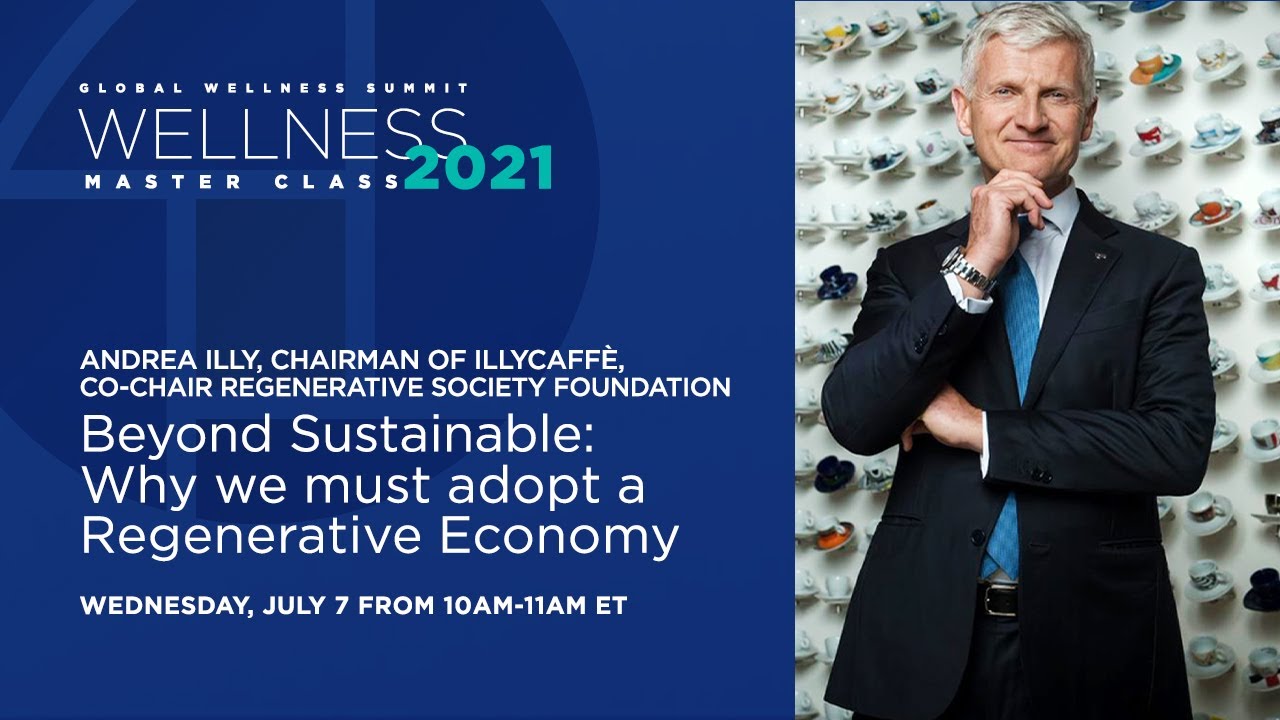
In this 2021 Global Wellness Summit masterclass, host Nancy Davis interviews Andrea Illy, chairman of Illy Caffè, about the company’s evolution from a family‑run coffee business to a model of sustainability and regenerative economics. Illy outlines the brand’s heritage, its B‑Corp status, direct‑sourcing model, the University of Coffee, and the ambition to become carbon‑free by 2033. He defines a regenerative economy as a cash‑flow‑positive system that restores organic carbon, soil health, and biodiversity while delivering financial returns. The conversation covers the scientific basis of regenerative agriculture, the massive investment required, packaging innovations toward compostable bioplastics, the link between coffee, art, and wellbeing, and the role of happiness (via the World Happiness Report) in motivating change. Illy also shares personal wellness routines, his family’s involvement in the business, and his vision for legacy and cultural harmony. The session emphasizes that scaling regenerative practices requires collective action from private sector leaders, supported by policy, finance, and consumer demand.
Chapters
TranscriptAuto-generated · 59 min
Welcome to the Wellness Masterclass entitled Beyond Sustainable: Why We Must Adopt a Regenerative Economy with Andrea Illy. I'm Nancy Davis, Chief Creative Officer and Executive Director of both the Global Wellness Summit and Global Wellness Institute, and I'll be your host for today's call. Over 664 people from 68 countries registered for this call, which demonstrates the enormous interest in this topic and this wonderful man. Before introducing Andrea Illy, I want to introduce Susie Ellis, Chair and CEO of both the Global Wellness Summit and Global Wellness Institute, and a woman who likes a good cappuccino. Susie?
Thank you, Nancy. I am delighted to use my minute of welcome to say hello to Andrea Illy and everyone who's on this Zoom call. And I know a lot of people will be listening to it later. Thank you for joining us today. As most of you know, the tagline for the Global Wellness Summit is Joining Together, Shaping the Future. And that's what the tagline was 15 years ago when we did our first summit in New York City, and that is what it is today. And so perfect segue into what we are doing with this conversation. So, Mr. Illy, I'm not sure you remember when we first met, but it was at the United Nations. And it was the first year that you sponsored the World Happiness Report. And I was there because in those early years, I felt that the worlds of wellness and happiness were becoming more and more closely related. Of course, that is exactly what happened. And then a few years later, you were one of our keynote speakers in Italy, and we learned more about your real passion for sustainability. sustainability and wellness and happiness and so on. Back then, I don't think either of us had heard the term regenerative or regenerative economy. At least I didn't. Perhaps you did. But it is what is, you know, on people's minds now, and it's what you're championing. And we could not agree more. So thank you for being here and helping us understand this movement better and to inspire our vast wellness network to do our part. So thank you, and over to you, Nancy.
Thank you, Susie. Thank you so much. And, and also on this call are other members of our team, as always: Michelle Gamble, Beatrice Hofegger, and others. We have the best team, and I'm very proud that they're joining us for these calls. Pretty much nobody needs a refresher anymore on Zoom. I'll just say that you can watch this call either in speaker or gallery view and make that choice in the top right. We're going to keep you all muted, and so please use the chat function as you already are to say hello, tell us where you're from, your company, post a question if you want. We'll try to get to some of those. You will receive a follow-up email today. We are recording this call, and we share with you not only a link to the recording session but the chat, which always has some interesting comments and information. Thanks so much for your cooperation. In a world of venti, half-caf, mocha whip, flat white, caramel drizzle with sprinkles coffee culture, Illy Caffè is an Italian brand known the world over for its integrity, quality, longevity, and thankfully simplicity. Coffee in Italy is something of a religion. And my guest today is the spiritual head of a coffee empire that his grandfather started in 1933 in Trieste. You may have thought when you signed up for this wellness masterclass with Andrea Illy of Illy Caffè that you would learn the secrets to a perfect cup of coffee or how a family business has grown to iconic stature. Well, grab an espresso or a cappuccino and get ready to learn about regenerative business from a man who is not just embracing this philosophy in his own company, but helping to lead a revolution. We'll also ask about the perfect cup of coffee, believe me. Andrea Illy is a new kind of leader looking to use his influence and resources to change the way business is done, not just in Italy, but throughout the world. Andrea wants to leave his daughters more than a coffee empire, He wants to leave them a well world. He wants to be sure their cup is full. We are so fortunate that he is here with us today, and I am thrilled to reconnect with Andrea. Susie mentioned Andrea was a popular, very popular keynote at our 2018 Summit in Technogem in Italy, and we talked then about my personal obsession with Illy and my collection of espresso machines, including the Francis Francis model, which I suspect was named for the Illy Caffè founder and Andrea's grandfather, Francesco Illy. In addition to the delicious taste, one of the reasons I love Illy, and I suspect others do, is their connection to art. Since 1992, Illy Caffè has invited artists to put their unique vision on the canvas of a porcelain espresso cup. It's part of the company culture, and part of Andrea's vision of the marriage of coffee and art, of business and beauty. Andrea's own life is like a work of art. It's a combination of vision, talent, perseverance, risk, and ultimately beauty. He's a businessman, a family man, and a great leader. We are privileged that Andrea Illy, along with his colleagues in the Regenerative Society Foundation, Including Davide Bellotti and Jeffrey Sachs and others, working to change the very nature of business and paint for us a beautiful world, one that we can be proud to leave to our children and grandchildren. Grazie mille per essere qui oggi. It's my honor to introduce Andrea Illy.
Thank you, Nancy. What an amazing present introduction. Thank you so much. I'm glad to be here. I love your organization, what you do, your team of people. So it's a reciprocal pleasure to be with you today.
Well, it is absolutely thrilling for us. And of course, we want to get to the topic at hand, but we do want to know a little bit about the coffee first. So maybe you could tell us, are you personally espresso, macchiato, Cappuccino? What's the perfect cup of coffee?
Well, thank you for asking, but let me first say that everything started from my grandfather's dream— Francesco Illy, as you named him— to offer the greatest coffee to the world. This is our dream, nearly 90-year-old dream, still pursuing the same dream. Somebody might say that it already happened. To me, there is no limit how you can improve this greatness of our product. So yes, we chose espresso as the ultimate way of preparing coffee, which is the quintessence of coffee because you can extract so much flavor and body without any this delicious espresso. We chose to have only one blend. A blend because by blending you get complexity, you get balance, and you get consistency like nothing else. And only one because the best can be only one. So this is why. And we offer this espresso blend in as many as 12 or 14 different formats in order to delight consumer in any occasion. The occasion is when you have the combination of the place, the moment, and the preparation. So we are present in the hospitality, hotels, bars, cafes, and restaurants. We are present in office space. We are present in the travel space. Of course, present at home with multiple choices globally. Globally, as I said before, with a presence in over 140 countries, always the same blend. This is what we are. We are, I think, well recognized to be the sustainable quality leader. Uh, sustainability is the other face of the coin of quality. They two, they go along, and you don't have the other— the one without the other. This is why we are really serious about sustainability. We are a B Corp since we are a benefit corporation. We have been recognized to be one of the world's most ethical companies by Ethisphere for 9 years in a row. And this is, and we also have a certified supply chain from the plant to the cup. This is more or less. And we, I would say that in terms of market share, we are much smaller than one would expect. We're probably number 12 in the world.
Andrea, can you tell us a little bit about Why this— how you developed your passion and commitment for sustainability in the business that you're doing. Like, where did that come from in your life? And then maybe tell us how that segues into what you're doing with regenerative business.
So I'm a chemist by background, and I started my studies in Switzerland. At the Polytechnic University, and Switzerland was already obsessed with the environment and sustainability in the '80s. So we were studying literally the, the topic and also developing technologies, like we were designing these solar cars in order to beat any possible emission record, etc., etc. So It's kind of, it did kind of enter in my blood, this idea of sustainability, also because besides my profession and my background, my lifestyle is to live in nature, in open air. My free time activities are either in a wood or on the sea sailing, or underwater or flying, whichever place would be a natural element. So this is why I care so much because I love nature. And professionally speaking, the reason why we embraced professionally this passion for sustainability is because we depend from 25 million families producing this delicious coffee in the south of the world. There is a virtuous circle between the well-being that coffee delivers to those who drink it, which are mostly people in the North Atmosphere, in rich countries, developed countries, and combining this well-being for those who drink it with the development, the opportunity for socio-economic development for those who grow it in, in the low-income countries. And I feel that the only way to really improve the sustainable quality we are seeking for is to work together, work together hand in hand with coffee growers, selecting those who are most motivated to do their best possible in their life, transferring knowledge, sharing knowledge with them how to elevate the standards, and rewarding them, rewarding them with better prices compared to the market and creating a long-term relationship with them. We have this, this is our business model basically. We pioneer direct sourcing And immediately after having started working with growers in Brazil first and now in 20 countries, we understood that their problem in terms of sustainability, not only and not necessarily the environmental one, but the socio-economic one because of the— we could speak for hours the struggles of the coffee sector. So we decided that we go— we have to go hand in hand and we have to care for them if we want them to produce this wonderful coffee with which we can delight our consumers all over the world.
And that was really the genesis of your commitment to this?
Yes. Say again, sorry?
And that was really sort of how it began for you in your own business, but then now take us On the journey of this Regenerative Society Foundation, what you're doing for the whole world.
Yeah, so, um, the path with coffee has been we pioneered direct sourcing in 1991. Uh, in 1999, uh, we founded the University of Coffee, which is the only one existing in the world with the presence now in over nearly 30 countries, in which trained over 300,000 people since the beginning of its activity. And then in 19— excuse me, in— we then started elevating our quality standards so that produce growers started producing specifically on our own, upon our own quality standards. And in 2015, we had our aha moment because we had the opportunity to be the official, let's say, representative of the International Coffee Organization in organizing the Universal Exhibition. So with this appointment, we started a collaboration with all the growing countries because it became centered around climate change adaptation, because it started to be quite clear how much climate change damages the coffee agriculture, both in terms of productivity and quality— quality first, actually, and productivity second. So we were very concerned about the long-term, let's say, coffee security. And we started with one thorough analysis of the situation in order to figure out if, although half of the currently suitable land for coffee agriculture will not be suitable from now to 2050, we will still have enough capacity to produce the growing demand? And the answer is yes, as long as we improve the current state of the art by improving the agronomical practices, by developing more cultivars, hybrids, more resilience to the effects of climate change, and if still necessary, also migrate the coffee plantations to better climate. So once we finished this job, it really— in the meantime, the Paris Agreement for reaching carbon neutral in 2015 became so strong, so bold, they said, okay, if we started adaptation, now it's time to address mitigation. Because all in all, agriculture, all agricultural products, predominantly meat, but all agriculture, if you consider the whole supply chain from plant to fork, it accounts for up to 35% of the world carbon emissions. So we definitely have an opportunity to contribute, to participate, to mitigating climate change. And although, uh, vegetable, uh, and, and, and a smaller production compared to the big food commodities, also coffee can do its substantial part. So the goal became for our company— we— I set the goal to be carbon-free in 2033. Um, 2033 will be our centennial anniversary, and it will be due in advance compared to 2050, date at which everybody in the world will need to be carbon neutral. And so we want to celebrate this ambitious, let's say, target with this ambitious result to be carbon-free.
Andrea, let me just interrupt. I'm sorry for a sec. That is an incredibly inspiring goal. And I know that that's the goal for your company. And you are also trying to inspire other leaders and other businesses to follow that, to do that, and to demonstrate that it's possible to do that and still be good for the bottom line and still have a thriving business. I wonder if you could just define a regenerative economy for us. Yes. Give us a definition so we can understand, understand that. Then we have a couple of questions for you around your sustainability and some of your own products. So if you could first find the—
I tell you how I landed into the regenerative planet, let's say, precisely by studying the way to be carbon-free in 2033, because it's not easy to decarbonize. We have a roadmap, and of course the energy transition will be relevant, reducing the life cycle assessment will be relevant, But the entire— because 2/3 of the carbon emissions are coming from agriculture, this is where we do— we need to do the most. So I studied myself as a chemist. I went back to my books and studying and took a sabbatical to study a model which I, I named the Virtuous Agriculture. Virtuous because it's a virtuous cycle and because it pursues the double benefit for, uh, the environment and for human health. And this, uh, virtuous agriculture is a— could be named regenerative and beneficial. Regenerative agriculture which is beneficial for human health and figuring out all the correlation between how you grow and how this has a positive impact on human health. This is why I became a kind of a, let me say, a pioneer in, in regenerative agriculture. We are now in the process of studying how to make our coffee production regenerative with few coffee plantations and also many programs to spread out this award to as many possible partners, coffee growers, so that they, they adopt this regenerative agriculture themselves. And this is why I have been approached by 2 fantastic people, Davide Bolatti and Maria Paola Chiesi, who wanted to create a foundation for regeneration. Because in the meantime, regeneration became very popular, so, and everybody wanted to be So I said, okay, uh, I tried to answer exactly what you, you asking me. What's the definition of regeneration? Because it cannot be everything. So we decided to be scientific in our approach and say, hey, regeneration is this set of processes, biological processes. So it only concerns the organic part of our planet, you know, when we live, we, we consume resources which can be either mineral or, uh, organic. Regeneration applies only to the organic one because they can be regenerated. Like my coffee bean, it grows again every year. If you cut, if you prune a plant, the branch will grow again, etc., etc. This is the wonder of photosynthesis, which is the origin— originates the life on the planet. Because— but with photosynthesis, you not only fix the carbon, which otherwise stays in the air and is toxic because it creates this, uh, several toxic impact on, on the— on our living conditions, but— Right. Besides, by fixing this carbon, photosynthesis produces biomass, which is a carbon stock, it produces sugar, which is the beginning of the, uh, food chain, but it also produces oxygen, which is the way we can burn sugars to live. Isn't it amazing? One plant does 3 things which are essential for our life by only using 3 components, right? Water, CO2 from the air, and light. So this is the magic of life. The problem— so how this magic of life is managed is through the so-called carbon cycle. The carbon cycle has 2 phases: the one of the emissions— everybody who breathes, no matter if it's a vegetal or animal, emits carbon emission, right? And then you have the other part, which is the carbon fixation, which I already described through photosynthesis. The problem with our society, uh, is that in the— particularly in the last one century and a half, we consume so much, uh, resources, both mineral and organic, boosting our demographic increase and our life living standards that we created amazing imbalances in on the planet. Basically, we kind of engulfed the emission part with too much emissions because of the our incredible energy consumptions, but at the same time we did substantially compromise the Earth's capacity to fix carbon by deforesting and also by literally deteriorating land, because the land itself per se, and also the sea, has a substantial, let's say, capacity to fix, uh, to fix carbon. So what is the idea of the regeneration then? Is that we address climate change and following the IPCC recommendation to pursue at the same time as you pursue a benefit for the planet, to pursue also a benefit for people. So it's the concept of One Health. We pursue climate change not through the energy transition, which is something we consider as a prerequisite. It's not our job, the energy companies and the energy technology will do it. But once this will be done, we will still need— after we cut emissions to zero within 2050, we will still need to heal the planet. we will still need to fix a lot of the carbon which will still be in the air for centuries. And this is regeneration. Regeneration then implies, um, land recovery. There are millions of hectares of land which has been deforested, and now they have been exploited in agriculture, and then literally depleted the soil and then abandoned it. These huge amounts of land can be restored, and by restoring it, you fix carbon in the soil, you rebuild the original biodiversity, which is also good for the soil health and the ecosystem health. And you create the condition also for more vegetation and fixing carbon also in the wood part, let's say. This is what we want to do. So it's an opportunity which embraces, as I said, soil land recovery and consequently agriculture begins, and then consequently agroforestry, forestry, urban regeneration, water system regenerations, whichever eventually will help increasing the net primary production in a way that we can both rebuild the original stock of organic carbon And to produce the extra amount of organic resources which will be used hopefully more and more in the future, because the vision is for a society which not only have a man living— a human society living in harmony with the cosmos, with no pollution, and using as much as possible regenerative resources so that we stop extracting resources from the planet without never giving back. This is our idea. It is possible, and we start pioneering that.
You know, Andrea, it is really— it's such an ambitious and an inspiring way to look at business. And, you know, a lot of people on this call have their own businesses. And is it the kind of thing that no matter what your business is, you can adopt this kind of regenerative approach? And it will— is that what your goal is, to kind of get everybody doing this so that it really can have an impact? It's obviously not going to change the world unless lots of businesses do this.
Yes, this is why the title is Regenerative, which we spoke already, Economy.
Right.
So economy is a necessity because we cannot do this transformation from an extractive economy, an extractive society, into a regenerative one without being economicos. Each and every activity, in order to be deployed, needs to have a pay back. Otherwise, you will immediately drain all the possible resources and there will be no money for, uh, let's say, financing the transformation. So regeneration— this is why it needs to be a regenerative economy— needs to be cash flow positive. It needs to be investments paying back, possibly with higher returns compared to the non-regenerative ones. It's very likely it will happen because just imagine you have a polluting business, how much detrimental for your corporate value it is. It will deplete, it will reduce your cash flow because you will have more liability to pay for, you will have less customers, more expenses to retain your customer because of your bad reputation. You have to fight against regulators. You have a cost of money which is much higher because your company has a bad reputational profile. Whereas if you are regenerative, everything is on the opposite side. So it would be easy also from the fundamental financial way, let's say formulas, to demonstrate that the regenerative business at same cash flow level is more profitable, is more— builds more value. The question is about technology. So, but before we talk about technologies, why business? Right. Because if you think about the 100% world GDP, then we have to consider that 2/3 of the GDP of one country or the entire planet is from the private sector. Governments only spend 1/3 of the GDP. And they spend this money just in order to create the opportunity for the private sector to invest. But the big chunk, the big critical mass is from corporations taking all together. They are the only one who really can make a change.
Is it— has it been an enormous—
The digital space, for instance, because all the business turned digital, the world is now digital.
Okay. Has it been an enormous investment in your business in order to transform it and point it toward regeneration? Um, you know, I know it's good for the bottom line ultimately, but has it been— has it cost a lot to get there?
So we are not regenerative yet, uh, unfortunately. I would love to have a magic stick to be regenerative. It would cost us investments around $200 million in the next decades, extra millions in the next decades to transform every single aspect of our technology from transportation, from energy for processing, from packaging technology, and whichever also, you know, agricultural transition that we need. It will be, but we consider only the extra investments. We don't consider the possible benefits of those investments, because for sure this extra investment will have a return. So, uh, answering, finally answering to your question, some industry will have the possibility to be structurally regenerative themselves. And these are all the industries manufacturing, transforming organic raw materials. So when you speak about food is a good example, but you, you also use organic material in, in, in, in clothing, clothes you use, uh, in cosmetics, you use, uh, in furniture, in design, you use, you could also in building, in real estate, you can build with with organic resources and so on. So plenty of industries, they could be— they already are potentially regenerative, or they could be structurally regenerative because they shift from mineral resources into organic ones. And those industries which cannot be structurally regenerative, because they depend, they rely upon mineral resources, they will need to be circular. So that means that once you extracted your mineral from the planet, you will perpetuate its usage forever and ever, following the 3R approach: reduce, reuse, and recycle. Be circular. But also they can be, uh, I mean, seen relatively regenerative in a relative sense through the impact they have in the ecosystems. Imagine that an industry, a factory, lives in a neighborhood and they have a great, you know, investment in order to regenerate the ecosystems from the— literally depolluting the land and planting, etc. So there are plenty of ways Business models, I would— let me say, how business could turn regenerative.
Andrea, can you address your own packaging at Illy? A number of people posted early, and, you know, we've been talking about this. You do a lot of individual plastic capsules for your deployment of coffee, at least on a consumer level. Can you talk a little bit about how that— how— what you're going to do about that? Is that, you know, what— how that figures into your own sort of sustainable program?
Exactly. So this is a typical example, a very good one. So, how— we have plastics in paper, we have— excuse me— capsules in paper, which are the ones we prefer because they are compostable. We have capsules in aluminum, which we like because they can be recycled infinitely, circular. And we have capsules in plastic. When we developed the capsule in plastic is because plastic was perceived also from the scientific point of view, LCA, life cycle assessment better than aluminium because it, it is recyclable. In the meantime, plastic production became so gigantic with 360 million tons per year, and also it made very, very clear the problem of microplastics, which doesn't necessarily concern any object. For sure it doesn't concern our objects, otherwise we would have stopped producing already now. But plastic is recyclable, you can recycle, so it's circular. Now it's clear with this new idea of the regeneration that it would be better to use a bioplastic originated by some waste of biomass, and then of course this bioplastic would need also to be compostable so that after you use the capsule, it becomes compost and it goes back in the land enriching with carbon. And this is what we are developing. We are developing a new, uh, biocompostable plastic material so that the, the, the, the, the, the future technology will, will be such. And in the meantime, it's circular.
Okay. So it is, it is circular. I know there's some plastic that cannot be recycled, but yours can be.
Yes. So, but your question is very, uh, I mean, correct in a sense that it gives you the sense of how long it takes in relative terms to transition. Because we have been working for identifying the best possible material to become cost compostable, first with paper, now with plastic, for decades. It takes very, very long time. But I see now a gigantic opportunity because so much funds, public funds. There is a kind of this race between the 3 superpowers: Europe, United States, and China, who's becoming carbon-free first and better, you know, and putting so big amount of investments specifically targeted in on 3 things: sustainability, health, and digital. This will— this is literally triggering a new gigantic economic boom because after digitalization, sustainability, decarbonization.
And I know that happiness is also a pillar of your foundation, right? World Happiness. Can you talk a little bit about how those Dovetail together?
Well, if you are not happy, you are not motivated, right? If you are not happy, you don't think about your future. So it's very difficult to try, uh, pursue such a gigantic transformation by being unhappy, because people don't follow you. they don't take the lead, they do nothing, they are just desperate, you know, waiting for— so this is why. But also intrinsically, more philosophically, we have a right to live happy. So we should pursue happiness in whatever we do in our lives. So this is why we are seeking, we are pursuing initiatives which allows us to have the double benefit for the environment and for the so-called well-being. And we consider well-being to be healthy and happy at the same time, because you could be happy without being healthy and you could be healthy without being happy, but if you are both, then it's the well-being. So, and there is a very, very clear epidemiological correlation between, uh, the quality of life in the— of people, people's quality of life and the ecosystems in which they live, no matter if it is a natural ecosystem or an urban one. So as far as the correlation between health, it's very clear. With all which became clear with all the non-communicable diseases which are caused by inflammation, by toxicants and stress in our society, which we hope in the future will never happen again. As far as the correlation between the quality of the, of life and the environment and the ecosystem you live with health, There starts to be very clear evidences with the World Happiness Report that we do every year, and also this fantastic group led by Jeffrey Sachs, which is the Science and Ethics of Happiness that we, that we, that we are leading within the Vatican Academy of Sciences.
Andrea, how do you plan personally to convince other business leaders to join you on this quest?
Well, first of all, trying to have reasonable targets. You know, what's real— what's really working in this kind of— is the so-called theory, which is pure mathematics of social networks. If I'm able to convince a few bunch of people around me, but really to be convinced, then they will become advocates themselves and they will convince many other people. But make— be sure that if I'm pursuing these ideas in this very moment, there will be thousands of other people in the world which are have exactly the same philosophy, same ideas, and they are doing the exact same goals. So the synergies between these 1,000 pioneers in the world will make it happen without even, uh, perceiving that you little man had the opportunity to give such a contribution. So this is what in all kind of, uh, with, with trying to be modest, you know, not being pretentious but I really hope that by advocating and leading by example, I can convince so many people through nice organizations like yours to embrace this, this, this, this new, this new regenerative economy, regenerative philosophy, regenerative technology, and, and lifestyle.
Well, it's a, it's a fantastic— I think everybody on this call certainly embraces what you are doing, and we can all become advocates for that. I'm going to actually ask you to just shift for a minute and talk about art and creativity. It's big in your life, and I think it's— it has been big in your success and in business. It's part of the culture of your company. You talk a little bit about what that is for you and where that
Yes, so well, there is a very strong link between coffee and culture and consequently with coffee and creativity because ultimately culture is the expression of creativity, right? No matter if you do arts or if you do literature or if you do other disciplines, but basically you have the humanistic and the visual disciplines, right? So this is why coffee had the— it inspired the most important artists and writers since 4 centuries now in literally contributing to forge the modern European culture, and from there also influencing some of the, the rest of the world. But so why does, does it happen? Because caffeine is one component of this, uh, so-called arousal effect, because it triggers your neurons with this mild stimulant effects in your neuron. But it's not only about triggering your neuron in terms of mental activities, also triggers the spaces which makes you improve your mood, improve your creativity, improve your social skills, basically predisposing you for a better social and professional performance. Okay. At the same time, coffee is about pleasure, and pleasure gives you this sense of accomplishment in your life which puts you in the mood to create, you know. This is why we— this— there is this strong association between coffee, this particular product coffee, and particularly the espresso coffee, which is this quintessence of And this probably explains why so much art and culture is related to coffee. On the other side, strategically for our communication, because we are born to have— we're born to produce the greatest coffee in the world, there is no limit how you can improve that greatness. So our idea is beauty beyond goodness. You taste the goodness, but goodness is a polysensual experience. So you have your mouthfeel, your taste, your flavor, after flavor. You have your, uh, synesthetic by touching the object with like the coffee cup. What about adding a 4th sense of it with view, with the sight? The number of digits per second that you got in your eye is a, I think, 1 million more compared to what you can taste with your tongue. So this is why it's a booster, it's a super powerful percept— perception booster for your senses, and it synergizes in a way that ancient Greeks used to have this word which is called kalokagathos, which means beautiful and good in the same sense. And it makes sense that if something is good, it must be beautiful and the other way around. So through beauty, you can not only trigger one emotion, a positive emotion like drinking coffee, but also you can communicate your quality standard. This is the strategy behind our involvement with art because yes, art is the source of beauty. Beauty is nature, and art as the best representation of nature is the best representation of human beauty.
Andrea, I can't help but think that, you know, it embraces the Italian culture in my mind too, is this sort of beauty and taste and all the senses aroused. Can you share with us your— what you would consider your greatest triumph and your greatest challenge, either in your life or your work? Preferably your life.
Well, this, this, uh, carbon-free in 2033 is, uh, is a big challenge because the, uh, uh, the, the big challenge I constantly struggle with is to grow without compromising, uh, what we are. Typically, organizations, not necessarily only business, by growing, they sacrifice some of their intrinsic value. They, they sacrifice some of their heritage. They compromise some of their standards and so on. This, this is, this is unacceptable for me because we would destroy, uh, the most essential value, which is the which is the intangible one. So growing without compromising is a struggle. Now we not only need to grow by avoiding compromising, but we need to revolutionize everything in technology, supply chains, in order to also be completely, let's say, carbon-free. So this, it would be interesting times to me for me to live in the decades ahead. Luckily, I'm old enough with my, you know, silver hairs to be hopefully, like they say, resilient in managing these future times. But it will be big, big, big, big, big challenge for sure for everybody in the society.
Andrea, Illy Caffè is a family business. Your grandfather started it, your father was in the business, now you. Are your daughters involved in the business? Do they bring a different sense to it if they are?
Some are already working in the group companies. My daughter— I have 3 daughters. Michaela, she's 28 and she's already working in one of our companies after having graduated at Imperial College and having been a consultant with Boston Consulting. She's now working in our company and an entrepreneur. Then she's entered the group. So we have a tradition to let our younger generation experience as much as possible outside before entering in the self-referential world of family business. And so Micaela is the first who, who, who's gradually entering. And then Jacqueline, the second, is is an entrepreneur in communication and advertising, so she's currently running her own agency. And the youngest, Andrea, Andy, she's now, after having graduated at NYU, she's now a consultant at Bain, so she's making a lot of experience.
That's fantastic and nice to know. Is it nice to know for you that they're There is legacy. Your legacy will be carried on by your daughters. Do you think a lot about legacy?
Yes, because the obsession is to perpetuate the binom of Illy as a family name and Illy as a brand. We believe that the family business dimension and heritage brings a lot of value to the brand and to the a lot of trust to the consumer and enjoying consuming our products. And we want to, we really want to, to be capable to perpetuate this family control, not necessarily 100%, not necessarily be involved in the execution, but keeping the family control so that we can preserve the values, the philosophy, and transfer knowledge and values from one generation to the other.
What is your wellness routine? I know that you're very— that you believe strongly in wellness, and I know you love nature. This is a group who'd love to know what your own rituals around wellness are.
Well, first of all, try to have a balanced lifestyle in what I eat, avoiding, uh, excesses in, in sugars, excesses in proteins, excesses in beverages and whatever. So try to have as much as possible, on average, a balanced diet. Uh, try to have as much as possible Open-air exercise, walking, riding, jogging, gym, and sailing, trekking in the woods, whichever activity with an average of half an hour, 20, 20, minimum 20 minutes to half an hour per day on average in a week. And then As we already spoke, really living in contact with nature. I'm not a metropolitan guy. I tend to suffer a little bit when I live in cities. My dream is for cities, towns to become greener than forests. And we have some examples here in Milan with this beautiful vertical forest, an example about how a town can actually become greener than a forest. And I hope that one day we will get rid all Of all these cars and all this concrete and have towns which will be much more, let's say, livable. Do you say that? Livable? Vivibile.
Okay.
Yes. So this is this is this is it. And and last but not least, never be overcome by stress. Stress is something that kills you. It's— I'm fortunate to get used. So from time to time you have some period of your life where you have some thresholds which become stressful for a few weeks or months, but then you get used and you are prepared to, let's say, new challenges by having a solid resistance to stress. This I practice a lot in interesting time, neuro linguistic programming. I'm I do self let's say therapy on neuro linguistic therapy or programming. I did study it since many years along with as long as trans Transactional analysis. I don't know if it is translated like this, analisi transazionale in English. And this is an important component of being— you need to be well with yourself. You need to love yourself and be well with yourself in order to be in good health and also to be well with others.
That's— it's absolutely wonderful advice.
I didn't mention in, in my philosophy of the well-being, the relation with other— with other— with the other people. This is very important because, uh, having a good and lovely relationship, altruistic relationship with others, is fundamental, uh, because you you get this sense of accomplishment on one— in some way, uh, and all— and also you feel, uh, you don't feel guilty, uh, it's, it's living in harmony. For me, the prototype of the best society is still the Japanese one. I could live in Japan tomorrow. You give me a suitcase, I go. Why?
Oh no!
Not because it is the best, uh, most beautiful landscape or the most beautiful people around, because you have this lifestyle, this culture, millenary culture, which is, uh, created, literally forged around this idea of harmony. Harmony between human and human, harmony between human and space, harmony between human and nature, and ultimately harmony within— between human and the universe. So this is what you breathe in every single activity or act that you, that you, that you, that you do in Japan. I've been there 3 times in my life and it's amazing.
It's another— It's a very sad thought for Italy, um, but a wonderful thought for Japan and a perfect moment to end on harmony. Let's end on harmony. It's 11 o'clock. Andrea Illy, you are a wonderful, inspiring man and we are so grateful for your time this morning, and, um, everyone will unmute and show you a little global love and community for you.
More from Andrea
Registrazione evento: La Società Rigenerativa - Un nuovo Modello di Progresso con Andrea Illy


Feuromed 2026 - Monica Giandotti intervista Andrea Illy - Presidente di Illycaffè
Regeneration 20|30 Forum - Visioni di rigenerazione / Visions of regeneration - Illy / Vineis

Tutto quello che DOBBIAMO CAPIRE sul FUTURO della RIGENERAZIONE – con Andrea Illy
Multiplying impact series: a compelling vision for the circular economy with Andrea Illy


