10 Tips To Unsuck Your Marketing Message with David Saltzman
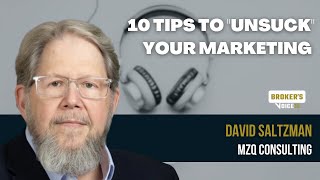
David Saltzman explains why insurance agencies fail at marketing: they talk about themselves instead of their clients' problems. He walks through StoryBrand's framework: make the prospect the hero, show their pain, position your firm as the guide, give a simple plan, and pick one clear message. The shift from self-focused to client-focused changes everything.
Questions this video answers
August 8, 2023
TheSaltzmanGroup.com
Shift Shapers podcast — about 8 years and approaching 500 episodes
Chief Strategy Officer for MZQ Consulting (recent hire)
Chapters
Hey. Hey. Welcome back to the Broker's Voice. I am excited because I have an industry legend joining me today. I am joined by none other than story brand certified guide and chief marketing officer for mz, Chief strategy officer, excuse me, for MZQ Consulting, which is very recent. David Saltzman. Welcome to the Broker's Voice.
Thank you, Andy. Yeah, it's very recent. Just happened the other day and it's, it's a pleasure to be part of their firm. I've been doing work for them for a while on a contract basis and despite the fact that they've gotten to know me, they offered me a full time gig helping to build the company.
That is awesome. Well, they are, they're blessed to have you on the team, man. You're, you're a rare, a rare bird in this industry. Now, we were talking offline. You've had the shift shapers podcast now for eight years. Coming up on 500 episodes.
Coming up on 500 episodes. And there's still, it's, it's amazing because there's still interesting folks to talk to. There's still people who are pushing the envelope, doing new things. So, you know, as long as there are, you know, it's great fodder for the podcast and, and we still get lots of people who appreciate it. We were, you powered, voted us in top industry podcast last year. So I'm blessed to be able to do it and I get to talk to people who are doing cool stuff. So what's better than that?
Yeah, I can remember it might be a little too much. Some TMI here. I can remember laying in bed, 2015, going to bed one night, and I came upon your podcast because I just discovered podcasts and as a, you know, a personal development, I'm like, who the hell is this David Saltman guy? And who would do a podcast about health insurance?
Both are great questions and, and we're still working on answering both of those.
Well, you and I are going to talk about marketing today. Two things or one thing you and I are very passionate about. And we're going to actually talk about 10 ways to unsuck your marketing, which was a title you came up with, I thought was brilliant. So before we get into those 10 things, David, I would love your perspective because I have my viewpoints, but your perspective on where in 2023, where are too many insurance agencies still going wrong when it comes with their marketing?
They're stuck in the past. They think it's all about them. I mean, I think if I had to give you one Answer that maybe superseded them all. It's not about you. The only person who cares whether the logo on your website is big enough is you. And perhaps your mom, if you gave her a nice Mother's Day present. It, it, it's. The focus has got to be on the client. And that's what storybrand is all about.
Yeah. What made you.
What made you go out and get certified as a story brand guide?
Well, you know, I, I've been writing, as you know, I've been writing non stop for now, 35 years as a monthly columnist in life insurance selling and then in national underwriter Life and Health until the the Dead Tree magazines mostly went away. And I've always been fascinated by helping people tell their story. And about 13 years ago, I decided that I had done what I wanted to do in sales and marketing and whatnot for insurance and that I wanted to do something else. And so I picked up Don's book about five years ago, Don Miller's Books, building a story brand, and said, I. And my ego said, know sweat, I can do this. For me, this is easy. And after the third attempt, I called Don's folks in Nashville and said, hey, is there an opportunity to come down and study with you? Because you've made this seem really simple and straightforward in the book, but there's a lot more to this than meets the eye. And so I went down and spent a ton of money and a lot of time with them and it's changed my entire perspective on how I help people tell stories.
Yeah. And I think one of the things I see in the industry with marketing is I think you would agree with this. If you've got the right message, the marketing will work. But if you're just focused on the looks and the fonts and the colors of marketing, without a message, you're wasting money.
Yeah. Nobody, nobody, nobody, nobody cares about that. In all the years that I ran my consulting practice, if somebody wanted to jump right into marketing without having their message, I suggested that they go find a different consultant because I was the wrong guy for them.
If you wouldn't mind, I'd love you to share a story. You were telling me this when we connected on the phone. You had a call with a prospective client in the industry and you had told him his website sucked and you hadn't even seen it yet. Talk about that.
Right. It's a true story. And thankfully it was a friend who still remains a friend, so I could joke around a little bit. But they called and they wanted me to help them professionally And I said, I'm sorry, I just don't have any bandwidth right now. As I recall, it was the fall a few years ago. And I said, but I'll probably have some opportunity to work with you in January. And they were a little disappointed, but they said, hey, you know, we've got a half an hour booked for the call, so let's talk about this. If you were going to start helping me, where would you help me? And I said, your website. And he said, okay, what's wrong with our website? And I said, it sucks. And there was a long pause on the other end of the phone and. Because, you know, I was playing you and I both do this sometimes with folks. And he said, well, okay, can you tell me the part of it that sucks? And I said, nope. He said, well, wait a minute, how can you tell me it sucks and not be able to tell me the part of it that sucks? And I said, well, I've never actually seen your website anyway. His voice went up in octave. He said, well, how can you tell me it sucks if you've never seen my website? And I said, because I can tell you what's on your website. And I started having the conversation about, it talks about your team and it talks about your products, and it talks about how long you've been in business and. And it talks about all of your excellent service, blah, blah, blah, blah, blah. And I said, it's probably even got a picture of your building. And he said, yeah. I said, that's great, but nobody gives a crap about that. There's no prospect on earth who cares about any of that shit. The only thing that they care about is that you understand their problem and that you can help them solve it. So while we're really proud of all that stuff, I said, well, I think you should be. It's a great star. You've had terrific success. You've worked really hard. Take all of that stuff and put it in a little brochure. And a week before you go to meet with a client, send it out snail mail with a handwritten note that says something like, when we meet next week, I want the meeting to be all about you. But I thought you might like to learn a little bit about us first. Now, at least you're using that for some legit purpose, which is setting in the client's mind that you're going to be all about them. You're not going to be about you. And that's where storybrand starts. It's with determining who the main character in the Story is. And for any of our friends in the business who are listening, it ain't you.
Yeah, well, let's just go. Right. Oh, keep going. Sorry.
No, that's fine.
Let's go right into it then.
Okay.
Title this topic title this episode is 10 Ways to Unsuck your marketing. Let's just. Let's kick it off. Number one.
So the first thing is you have to let me take you quickly through the story. Brand seven, the seven pieces of storybrand. So the first thing is there's a main character. The second thing is the main character has a problem. And the main character expresses that three different ways. Externally, internally, and philosophically. The reason that we delve into that psychological point of the need is because you've got to agitate tip number 10. We're going to go in reverse order. You've got to agitate a customer's desire to enter into the story that you're telling. And so we think that we make decisions with the prefrontal cortex, with our reasoning part of our brain, but we don't. Kahneman and a bunch of other psychologists have proven we make decisions with our amygdala, the little lizard part of our brain. That is where the fight or flight reflexes and all of our autonomic reflexes, like blinking and swallowing and that kind of stuff that we don't think about. If you can't touch that emotional part of a client's need, you're not going to be nearly as successful selling as if you can. So that's tip number 10. When you agitate a customer's desire, they will enter into the story your brand is telling. So then we move on to the next piece, which is positioning yourself as the guide. And the guide only needs to do two things. The guide needs to show empathy and authority.
So remember, you're not, to use a movie reference. You're Yoda, you're not Luke Skywalker. Or in the example we use sometimes with clients, you know, the Allstate commercials with mayhem, you are not the homeowner trying to drive their car. You're the person who's trying to help the homeowner avoid that mayhem guy. So the second piece that you have to do is you have to clearly understand your client's problem. So that's number nine. Number nine is speak to that client's problem. Don't speak to any of your gobbledygook. If you're in the room with a C suite level person, you've earned the right to be there or they wouldn't have given you half an hour of their time. So don't sell yourself. Ask about their problem. Understand their problem. Key on that. So that's where we go next. You become the guide and then what you have.
David, I want to say. Could I say something with that?
Yeah, sure.
Because when I. When we do our workshops, I got.
On a roll, so.
No, no, no. When we do our workshops, it's so interesting because I will. Who's the hero of the story? More often than not, the people in the room will say us.
Right?
And it's no, your prospect is the hero. You're just the guide. So I wanted people to hear that clear.
If you get really practical about it and you think about it just at ground level, anybody you're seeing in the C suite and advisors who are listening to this podcast are the folks who are going and selling to the C Suite. They're not doing the, the, you know, mom and pop, knock on the front door stuff. If you are selling to the C suite people, those folks are possessed of healthy egos. Some of them earned it. Some of them just have a title like I do now and think they're big, they're hot shit. But the bottom line is that they're the ones who are the hero in their story. And the story we need to tell is their story, not ours. So, by the way, as we go through this, I'm going to give everybody fair warning, since we're just heading into step eight. I'm going to ruin the plot of any movie you ever go to see or any novel you ever read, because you're going to see this. This story theory, which is thousands of years old. Don didn't invent it. You're going to see this story theory every place you go. Now, whether it's a commercial or a novel or a movie or any of that kind of stuff. So the next thing we do once we've established ourselves as a guide, is we give the client a plan. Now, by plan, and you and I know a lot of our colleagues, I do not mean a 42 page illustrated document. By plan, I mean exactly the opposite. I mean four or five really succinct bullet points because they've got to be able to grasp that plan. If you can't give them a plan that they can understand and move forward with, they won't. It's just that's it. Now, there may be tons of detail behind those four steps, but this is a case in all of these stories that we build where less is more. You're not Establishing your bona fides. You're not giving them a 42 page plan with 83,000 bullet points so that you can establish the fact that you know what you're doing. Again, I assume that you're in the room because you and the prospect both know that you have the possibility of delivering a solution to their problem. So we do that. We give them a very simple plan. Then we do something that I'll bet in your workshops you've also found people don't do, which is we give them a call to action. Because unless you call people to take action, they won't. Now, if you're building media like a website, you give them two calls to action. You give them a primary call to action, which is, hey, let's reach out and set up an appointment. And you give them a secondary call to action, which is download our brochure. We capture their name, their email address, we can sequentially market them in a funnel, et cetera, et cetera, et cetera. The reason we do that is because we have people who are ready to go on a date right away. And we got other people who are interested, but they want to learn a little bit more first. So we give them those calls to action. And then here's the next tip. Customers want us to cast a vision of what their lives will look like if they enact our plan. So we show them two things. We show them what the future looks like if they enact our plan, and we show them what the future looks like if they don't. And again, we're back into Psych 101. But fear of loss is a much greater motivator than desire for gain. We don't lay it on thick, but we make them understand that if they don't take action and they don't take one of those calls to action, they're going to be back in the soup. So this is tip number six. If there are no consequences for not doing business with you, then there's no reason to do business with you. And you've got to show folks that. So think of this as a continuum. We're taking them on a journey. To recap, we've determined who the main character is. We figured out what their problem is and how they express it. We've positioned ourselves as the guide who can help them do that. Then we give them a very simple plan. 1, 2, 3, 4. Then a call to action, or a primary and a secondary call to action. And then we show them what the future looks like and what the future doesn't. Look like now, we've already given you 0.5.
One quick thing there, David, for everybody to hear though. When you talked about the two calls to action, you said some people are going to be ready to date and some won't.
Right?
When somebody downloads your pamphlet or your brochure because they're not ready to date yet, guys, that doesn't mean because they downloaded it, they're ready to date you.
That's a good point.
You can't take the lead generator, have them download and then immediately hit them with sales pitches. So that's, that's a key ingredient there. Patience. Let patience be your ally. Right.
You know, again, dating is a good analogy for it because if, if, if you took that position when you were dating, you'd be single for a long.
I was, David. David, I was for.
I wasn't speaking directly to you, Andy. But if you feel the need to, you know, to, to, to share that information, go ahead, get it out. We can just think this is like, you know, Dr. Phil. It's good.
At any rate, so, you know, we've talked about the call to action. I think the last couple of principles like 3, 2 and 1 are probably the most important and I want to reiterate them before we just get into some general discussion. So the number three principle, and we've talked about this a little bit, is that nobody gives a rat's ass about you. They don't. You can't convince me they do. I've never seen them do that. They care about their problem. But let's talk about how that manifests. And again, I'll use websites as an example because they're so damn ubiquitous. How many times audience have you looked at a website and thought, that's a really cool website. Wonder what the hell they do if your prospects are wondering that you're not selling. Now Andy and I both remember a time years ago where websites were catalogs of all the stuff you did. That's not what they are anymore. In point of fact, one of the things we tell clients all the time is the best website is a one page website. Don't gobble it up. Just keep your. If the objective of your website is to attract prospects and convert them into clients, you want to speak to their problem.
Again, let's delve into that a little bit because some of the things we see all the time is a. You cannot sell two products with one website or one message. So if you do Medicare and you do business continuation planning, get yourself two websites and have two, because they're two very different messages. Somebody who's 65 and heading into Medicare territory is a very different prospect. Who's somebody who's 37 has built a business and wants to protect it in case one of the key people dies or becomes disabled or in case there's a death and they need to transfer shares.
David, in that case, should a company, are you saying, actually have two completely separate websites or could it be two page different pages on the same agency website?
No. And you've brought me, you brought me into principle one, but I want to give you principle two first and then I'll circle back. Okay? Principle two is marketing is downstream of message. We talked about this early on. If you do not have a message, you cannot market. And this is why so many companies waste so dang much money on marketing and they get frustrated. They go, well, you know, we did all this Facebook stuff, we did this LinkedIn stuff, we did this, we did that, we did the next thing and we didn't get any results. You get results because you don't have a message. Just being out there isn't enough. We'll go back to, you know, we've got to help them solve their problems. So let me, let me answer the question that you just asked. This is tip number one. It is the premier tip. It's number one for a reason. If you confuse, you lose 1000% of the time. So you need to be crystal clear in your messaging. And the process if you work with a story brand guide is you start with this big long seven piece thing that I just laid out. But then what you do is you distill it down into a narrative that's two pages and reads like a script. And then you distill that down again into what we call a one liner. Can be one line, could be two lines, but it's one or two lines, that one or two liner becomes the north star. For all of the marketing that you're going to do, that's your guiding principle. Everything has to relate to that because that relates to your client.
Yeah, I love that. Because I think one thing I hear myself say more than anything, David, with marketing, whether it's a website, social media post, an email, keep it to one problem, one goal.
Yep.
Quit trying to solve five different problems in one piece of content.
No, because, because again, you'll, you'll confuse folks and confusion is death in sales. You can get past a lot of other stuff if you're out selling, but if you confuse somebody, they're going to think you're not Focused. You don't really understand their problem. And if they think you don't understand their problem, they are not going to do business with you. I don't care how persuasive you are. I don't care how many God help you, slides you have in your PowerPoint slide deck. You know, if I can share a story. I was. I was. I was working a few months ago with a young broker, and he said to me, well, you know, I was. I was getting on him because he had too many slides in his PowerPoint deck. You and I have had this discussion even when we worked together a few years ago.
And he said, well, you know, how many. How many slides did you have in your PowerPoint deck when you were selling? And I said, oh, my dear, there was not PowerPoint back then. And he said, well, did you use a different program on your laptop? I said, no, there weren't laptops back then.
Oh, my God, what did you do? He was asking me how I slayed a dinosaur or something. And I said, well, I had a pen and a yellow pad.
And I said, well, two ears and one mouth.
And he said, well, which, by the way, we were given for a reason. Two ears, one mouth.
Two ears, one mouth. And also, you know, one of us might realize one of these days that the word listen and silent have the same letters in them. So, you know, somebody always asks me, you know, what's the hardest thing for a broker to do? And it's. It's stop talking. But he said to me, said, okay, smart guy, if you were going to go sell today with just a pad and a pen, what would you do? And I said, I would only ask two questions. And he said, that's not possible. I said, I'm thinking to myself, okay, youngster, listen. Which, of course, immediately made me feel older than I am and I'm plenty old. So I only asked two questions. The first question, you know, after the niceties and whatnot, the first question would be, why do you have a plan of benefits? And then I would shut up.
For as long as it took.
Until they started talking. And the more uncomfortable that silence is, the better, because that becomes rocket fuel. He said, okay, what's the second question you'd ask? I said, well, after I listened a whole bunch, I would say, how's your current plan of benefits meeting those objectives?
And there's this long pause. And I said, what else do you need to know? He said, holy crap, that's brilliant. I said, no, it's what we used to call salesmanship so, you know.
Well, I think you're, you're spot on about that one. You made me laugh because I can remember I had a peer a few years ago have me review a slide deck he had put together. Now, granted, David, he was talking about self funding, so it was a complicated subject. So he sends me the slide deck. There were 97 slides. 97 slides.
We all have that, friend. Right.
And so, number one, yes, it's not about the PowerPoint, it's about what's coming out of your mouth. But to your point, I think we have a lot of people in the industry as well that don't do a good enough job of just solve the problems. Your prospects have quit talking about all these problems they don't think about. Solve the problem they actually have.
Yeah, well, we have a name for those. In marketing parlance, those are called MEGO Presentations. M E G O because it stands for My Eyes Glaze Over. That's when you're sitting in front of a CEO or CFO or a chsr, whatever, whatever it is, and you're in the zone. I mean, you're, you're feeling it, you're rocking and rolling. You're right. You're right there and you look up and Your prospect is 4,000 miles away.
And you're never going to reel them back in.
Yep, they're done.
Right. Because you're talking about you and your crap, not about their problem.
Yeah, the old famous capability slide.
God in heaven.
So agency principals listening to this says, all right, these are great tips, David. We need to kind of take a look at what we're doing. Where, where should an agency get started? What, what should they do first?
Well, they can buy a copy of Don Miller's book called Building a Story Brand. And there are worksheets. Don makes worksheets available online. And he's going to hold up a copy of the book.
Because he is Mr. Multimedia. Get the right. Get the right.
Right here if you need the book.
That book's been out for, I don't know, six, seven years. Don still sells a hundred thousand copies a year.
Yep. And I grabbed the wrong one, David, but this is also a good one.
Yeah, Don's got a. Don's got a whole, a whole series of stuff and a new one called Business Made Simple. And Don, Interestingly enough, Don was a Christian author. I'm not exactly sure what that was before he started doing the story theory thing, but he works. It's such a serious subject that he works with a guy named J.J. peterman who has a Ph.D. in story theory. So it's a real thing. But it's the same principles as when we were painting on cave walls, you know, 38,000 years ago in France. You're telling a logical story, but you've got to engage them. So if you don't. But I would say read the book. Take everything that's about you out of your sales pitch. Think about the problem. Not eight problems, not 12 problems. The real problem that your client is having.
And it's not just cost of plan. That, that may be kind of a given, but, but things like you have no control resonate a whole lot better. Things like you can actually create profit from your medical plan. You can actually give your. You can give your employees a much better plan of benefits if they're more of a paternalistic type of client. There are all these things that don't settle around money. Money is a cheap shot. Money is. I didn't think about enough stuff to talk about that's really in your interest. So I'm going to talk about money and hope that you've looked at your balance sheet recently and gasped when you saw the cost of the plan. So really drill down and if you need somebody, get a certified story brand guide to help you drill into that. I'm always happy to, you know, if somebody reaches out to me at the Saltzman Group website, I'm always happy to answer a quick question or whatever. That's not my key gig anymore. But I, I love helping people, so I'm more than happy to answer a question.
I was going to ask you if somebody did have a question for you and wanted to find that website. David, what's the best way? What's the URL?
The Saltzman S A L T Z M A N Group. The Saltzman Group dot com.
Perfect. Perfect. Well, this was phenomenal. Thank you. I know you're a busy man. Thank you for taking the time to jump on.
Always happy. Andy, thanks for inviting me.
If you're an insurance profess, the. These ten tips were gold. I know when I read the book for the first time four or five years ago, it changed my career. I'm sure, David, when you read it, you had that aha. Like this is. It's. I look at it this way. Stop trying to sell products, Start selling stories. Right.
Sell solutions, don't sell your products. Nobody cares about your products. The first person who talks about product loses.
Yep. So if you got question, reach out to David. Otherwise, take this information. Run with it, guys. This is the name of the game. Today. Be well.
More from Andy

Stop living in the gray of maybe! Your job in sales is to get a clear yes or no


How elite producers use “validation” to give prospects the confidence to hire them.

The Transition, every great sales leader goes through: Stop being the hero and develop heroes.




