124. What Triathlons Will Teach You About Business
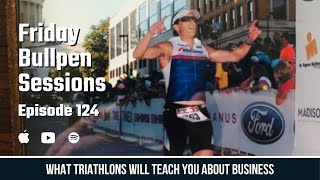
Andy Neary watched a triathlon in Boulder and compares race distances to business strategy. Sprint races demand all-out effort; Ironman races require pacing, nutrition, and patience. The best businesses mix daily sprints with long-term Ironman pacing to avoid burnout and stay sustainable.
Questions this video answers
Episode 124
July 25, 2021
Swim: ~500 to 1500 yards; Bike: ~10–25 miles; Run: 5K (3.1 miles)
Swim: 0.9 miles; Bike: 25–40 miles; Run: 10K (6.2 miles)
Swim: 1.2 miles; Bike: 56 miles; Run: 13.1 miles (half marathon)
Chapters
Hey. Hey. Welcome back to Friday Bullpen Sessions. My name is Andy Neary and this is episode 124. Well, last Sunday I did something I haven't done in a very long time. I attended a triathlon. Yeah, the last time I stepped foot.
In or near a triathlon was nine years ago, 2012. It was the last race I ever competed in Ironman, Wisconsin. And since that day I have not competed nor attended a triathlon. But last week I decided to go watch a buddy who was competing in a race down in Boulder, Colorado. And I want to use the lessons I learned from a Ted from watching that triathlon and how those lessons can apply to your business. And so let me level set. If you're completely unfamiliar with how a triathlon works, let me break it down for you very simply. In the sport of triathlon there are three different skill sets. To complete a race, you have to swim, you have to bike and you have to run. And in the sport there are different distances that you can compete in. When it comes to competing in a triathlon, at the shortest distance you have sprints. A sprint consists of anywhere from a 500 to a 15 yard swim, 1500 yard swim. The bike can be anywhere from 10 to 25 miles. And then you typically have a 5k run to finish up the race. 3.1 miles. An Olympic distance is a little longer. It's a 0.9 mile swim. The bike can be somewhere between 25 and 40 miles and then the run is typically a 10k, a 6.1.2 mile run. And then you get up to your half Ironmans. Now you're starting to talk about longer distances. A half Ironman is a 1.2 mile swim. It's a 56 mile bike followed by a half marathon, 13.1 miles. And then you have the king, the anchor, the full enchilada, the full Ironman race. That's the race you probably have seen on tv. When they come, they show the world championships down in Hawaii. That is a 2.4 mile swimming, 112 mile bike and a full marathon 26.2 miles. You cover over 140 miles in one day. It's absolutely, absolutely amazing. So when as I, I drove down to Boulder to watch Ray compete, this particular race actually had two different distances going on at the same time. It had sprints and it had the Olympics. And as I sat there and I watched the ra. The, the, the athletes compete, coming out of the water, getting on their bikes, coming back in from their bikes to get on the to get their running shoes on to finish up the race. It struck me, it brought me back to all the competitions that I have done in the past because I have competed at every single level. Sprints, Olympics, halves and full Ironmans. And what I realized was each and every race requires a different mindset. That's what I want to talk to you about today. How these, this mindset that I had to apply to triathlons can apply to your business. You see, when you do sprints, it is go time. From the minute you step foot in the water to start the swim, it is go, go, go, go, go. Especially if you're trying to place or maybe even win the race, you are just on it is. It's why they call it a sprint. You are go, go, go. From, from minute one through that entire race, you're going as fast as you can.
We. When you get to an Olympic, it can be a battle. In fact, I'm going to come back to Olympics for a second because this is the message I want to apply now. Half Ironmans. Now you're starting to talk about a longer distance, right? You have to apply patience, some perseverance because it's going to be a longer race. You can't just sprint the entire time. You would burn out even before you came close to crossing the finish line. Now you get to the full Ironmans and you just have to realize that is going to be one hell of a long day. Think about this. As an Ironman Competitor, you have 17 hours to finish a race. Most Ironman start at 7am in the morning and you have up until midnight to finish the race. There's always a, there's a.
A tradition in a full Ironman competition that when you finish the race, you come back right around 11:30, 11:45 at night to watch the last finishers come in because it's impressive. Think about this. They're coming in before midnight and they started racing at seven in the morning.
So in a full Ironman, it is just one hell of a long day. In fact, they often talk about in a full Ironman, there's a fourth sport nobody talks about fourth skill set and that's nutrition. Because when you're competing in a half Ironman or a full Ironman, if your nutrition is off, you can bonk both mentally and physically and you're done out. It's, it's, you're not even going to come close to finishing. I've been there. And so with a full Iron man is this one long day. It's about Patience. It's about pacing yourself and it's about enjoying the process, enjoying the moment. And of course, there's always. There comes that point in the race where you mentally think you cannot finish. Your mind is telling you you're done, your body is done, but you just have to keep going. If you've ever been there, it's a really interesting experience. Your mind's telling you you can't keep going. Once your mind tells you you can't keep going, all of a sudden it feels like your body can't keep going. However, if you keep going, if you keep just moving forward, you eventually reach this point where it starts getting better again. Marathon runners often talk about that, that they hit that mental breaking point at about 8 mile 18 or 19 where they don't feel like they can keep going. It's that mental wall. But then all of a sudden around mile 21, 22, they start feeling better again and they actually finish stronger than maybe they did six to seven miles back. It's a really interesting phenomenon. So the reason I bring this up is I'm bringing it back to last week's race. Ray was competing in an Olympic. And I personally feel Olympic distance triathlons can be the biggest mental battle. Why? Because. Because it is a battle throughout the race of when to sprint and when to have patience and pace yourself. If you try to sprint throughout an entire Olympic distance triathlon, you're going to burn out. Now, the best out there, the elite Olympic triathletes, they can probably sprint throughout that entire race. Remember, it's a 0.9 mile swim, 25 to 40 mile bike, and a 6.2 mile run. But it's this constant back and forth of when do I speed up, when do I slow down? And as I was sitting there watching the athletes compete, it hit me. This is exactly how business is, right? Business is a battle of when to speed up and when to slow down. Every year there's seasons, there's part of your business season about your business year where you have to sprint, you have to get after it. But then there's going to be part of your business season, business, business year where you have to slow down, you can't go, go, go, go, go the entire time. You'll burn out. You won't enjoy the process mentally, and you'll be mentally and physically exhausted and you'll fail. But at the same time, you can't go at this slow and steady pace the entire time. Yes, you may have success years down the road, but you'll be far behind your competition.
So the lesson I wanted to give you today that, that I kind of realized watching Ray and all these other athletes complete compete last week is when it comes to applying this mindset to your business, you need to figure out when you're going to speed up and when you're going to slow down. And here's my advice, here's how I approach my business today. I wake up every day with the sprint triathletes mindset. I am just gonna get up and go after it and use and take full advantage of the day. I want to leave it all out on the field or in triathlon world, I want to leave it all out in the race.
So that when I put my head on my pillow that night, I know I just got after it. However.
When I look at the success I want to have in my business, I have to apply the mindset of competing in that half or full ironman race. What do I mean? There's no overnight success.
To build a long term sustainable business requires patience, perseverance and pacing yourself.
And I know if I can mix those two mindsets where I'm going to get up every single day and I'm going to get after it. I'm not going to take my foot off the gas when I'm in the mindset of work.
But knowing success in my business is not overnight and if I apply my success mindset like that of running or competing in a half or full ironman, that it is about patience and perseverance, I know that I'm going to build a long term successful business. Yes, you can have quick success by going, going and going every single day and trying to build your business as fast as you possibly can. But you'll burn out. But if you mix the two, that's how you're going to create a long term, sustainable, successful business.
And so I wanted to pass this knowledge on to you because I thought, you know, sitting there in Boulder watching the racers compete, it really made me realize what triathlons taught me, how it actually taught me to be, how it actually mentored me to become the business person I am today. I'm happy to say I have a successful business and I want to believe because I want to believe it's because of the mindset I've applied not only in this business but in my sports career, including triathlons.
And so take it however you want, use the lessons. But the most important thing I want to share with you out of all of this, whether you choose to compete in a triathlon at some point in the future, you're competing today or running your business on a day to day basis. You got to enjoy that process. When I look at the three Ironmans that I competed in in 2008, 2010 and 2012, I will admit I probably didn't enjoy the process as much as I could have. I probably didn't enjoy competing in the race as much as I could have. Training for an Ironman is long, arduous. The race itself is a very long, stressful day. But if you can enjoy the journey, enjoy the process.
Of competing in that race, or enjoy the process of running your business.
You will have the success and you will have the happiness that you deserve. And so I leave you with that advice today. Approach every day like you're about to compete in a sprint triathlon. Get up, get after it, leave it all out in the race. But when it comes to building the successful business you know you deserve, apply the mindset that you're about to compete in a full Ironman. It's patience. It's perseverance. Pace yourself. But most importantly, enjoy the process. Enjoy the journey. Be where your feet are. Because it's one thing to have success, but it's another to feel happy and fulfilled doing it. So I hope you enjoyed today's episode. If you are getting a lot out of these bullpen sessions, and I hope you are, all I ask is that you share this with friends. Go subscribe if you haven't yet.
Leave a good five star review.
And remember, when clarity and confidence collide, massive action happens. Go make it happen today.
More from Andy

Stop living in the gray of maybe! Your job in sales is to get a clear yes or no


How elite producers use “validation” to give prospects the confidence to hire them.

The Transition, every great sales leader goes through: Stop being the hero and develop heroes.




