3 Things Every Insurance Adviser Must Master
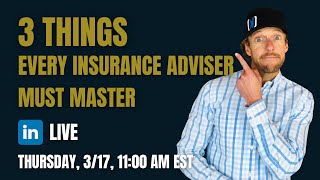
Andy Neary breaks down three priorities for insurance advisors: define your ideal prospect by their values, not just demographics. Build a brand story around the problem you solve and how. Then distribute it through social media, speaking, and podcasts instead of just cold calling.
Chapters
Hello. Hello. Welcome to LinkedIn Live. It is 9am Mountain Time, 11am Eastern. I'm excited to be on here today because I'm going to talk to you about three things every insurance advisor must master. Especially if you want to try to make selling easier here in 2022. So if you are on joining me live today on LinkedIn, I want to thank you. Feel free to leave comments, feel free to shoot me any thoughts, messages. That's what today is about. I'm going to be on for a half hour. We're going to have some fun and I'm going to share three very, very important lessons with you. And so what we're going to start with today is I'm going to walk through three things.
You must master if you want to connect with your prospects better. If you feel like you're sitting there right now and you know, you know you're good at what you do, you know you're a good advisor, heck, you might, might, you might be listening in and you're not even in the insurance industry, I don't care. But you know you're good at what you do. But dang it, you just don't feel like you're connecting with your prospects like you used to. You're looking at your pipeline. It's not as flat full as it used to be. You're a little stressed out, a little nervous because you are looking at much fewer opportunities than you're used to getting. You're wondering what the heck happened. It used to be so easy.
What I'm going to go through today is three things you can start using today so you can get your message out in front of the right people so they start to know you, they start to like you, they start to raise their hand and the right prospects come into your pipeline. So selling becomes so much easier. Now you're hearing this from a guy who is a self admitted bad closer. Yes, I was not a great sales closer. I didn't like to have to come in for the hard close. And I'm willing to bet most of you watching this right now it's the same thing for you. So what I had to do is I had to create a little marketing sales system for myself that allowed me to put myself in the best position to win so I didn't have to try to close hard, I didn't want to have to close hard.
And that's what I want to share with you today. It's three steps that I see so many skipping over right now. So many failing to utilize Right now. And it's why you're frustrated. It's why you're probably joining me on LinkedIn Live right now. So let's go right into this. Let's start with step number one. When you think about what the three things every advisor must master here in 2022, step one is going to sound so easy. But I promise, most of you right now have a take. Have not taken the time to do that. And step one is this.
Who's your ideal prospect? Do you know.
Who your ideal prospect is? You see, if you want to have a successful sales year, not just today, not just this year, heck, moving forward, you have to have absolute clarity on who your ideal prospect is. So my question to you is, do you know who your ideal prospect is? Now.
When you sit down to identify who your ideal prospect is.
There'S two ways you qualify what that ideal prospect looks like. You have demographics and you have psychographics. Now, if you've been in the insurance industry for a while, like myself, we have all been taught how to qualify a prospect demographically, right? You do that based on the industry of the businesses in. You do it based on the size. If you sell benefits, you talk about how many employees an employer has, whether or not you get the opportunity to meet with the CFO or the CEO. What location are they in a certain market. Those are all demographics. It is easy to qualify or disqualify your prospects based off of demographics.
But I promise you.
That'S not what that's not. That is not what's going to sell business in 2022.
You need to get crystal clear on how to qualify your prospect psychographically. So what do I mean by psychographic? Psychographics is something I don't believe the insurance industry has ever used to qualify a prospect. Psychographics isn't about the size, the location.
The age of the decision maker, the type of industry there. No, psychographics is about how they think.
How do your prospects think? What do they believe in? What do they stand for?
You see, if you can identify the type of prospect you want to work with psychographically, what you're going to do is you're going to build a book of business with prospects, with clients who believe what you believe.
Whether you sell health insurance, you sell property casualty insurance, life insurance, disability insurance, I do not care. I. I bet you you have certain beliefs about what it is you sell. You have certain beliefs about the industry. You're right. In the health insurance industry, it's easy. I believe health insurance costs are too High. I believe consumers don't have good access to healthcare services. I believe they deserve to get access to healthcare services at no cost. Right. Those are things I believe. I believe you should be frustrated that you're watching your costs go up, that you're health plans continue to get worse year after year after year.
When you qualify who your ideal prospect is.
You gotta qualify who they are. Psychographically, do they believe what you believe? You see, this is something I stumbled upon years ago. I didn't know it at the time that it was called psychographics, but I was so frustrated trying to sell the prospects who were not a fit for me.
I was trying to sell the prospects who didn't believe what I believed.
And at the end of the day, all that ended up happening was I was frustrated and I wasn't winning business. And if by luck I happened to win one of those, it became one of those clients six months down the road. I wish I had never had anybody feel like they've been there before.
So you have to know who your ideal prospect is. And I'd argue there are some listening in who don't even know who your ideal prospect is. You're saying, come one, come all, we can help all people, all revenue is good. It's not how you build a good business. You need to know who you're the best fit for. Who's the best fit for you get laser clear, laser clear on what that prospect looks like demographically, but more importantly, what does that prospect look like psychographically? What do they believe? How do they think? What do they stand for? Do they believe what you believe? Those are such important factors. In fact, when I was advising, I literally delivered a presentation in my intro meetings that I coined that do you believe what I believe presentation. Because I wanted to know very quickly whether or not you, the prospect, believed what I believe. Because if you don't, no harm, no fob, we're probably not a fit for you.
And it's a great, great way to make sure I was in front of the right prospects. And if they weren't the right prospects, I didn't waste a lot of time. So number one, the first thing you have to master is who is your ideal prospect.
Second thing you have to master.
If you're going to have success selling insurance here in 20, 2020. That's 2022. I can't talk today. 2022 is this. Now that you know who your ideal prospect is.
What is the prospect's brand message? What is their brand identity?
Do you know what problem you solve for your ideal prospect? Do you have laser clear, laser clarity around the problem you solve for your ideal prospect right now?
Do you have a process that you use that you rinse and repeat to solve that ideal's prospects problem?
And do you know what result your process creates for your ideal prospect? You see mastering your ideal prospect brand message. Their story starts with clearly answering those three questions. What problem do you solve? What's the process you use to solve it? What's the result that process creates? You see, what most of you are failing to do right now, and I failed for so long in my career, is your job is not to pitch product anymore. Those days are over. You've got to tell stories.
And the best way to tell stories is using the framework of what problem you solve, what process you use to solve it, and the success, the result that process creates. Because here's what storytelling is. A couple weeks ago, I actually got certified as a story brand guide. If anybody here watching in, if you're familiar, you may have read the book Building a Story. Brad. It's one of the best books I've ever read on how to market to your prospects, how to tell stories that draw your prospects in so your prospects raise their hand in the certification. You go through a lot of training, a lot of guiding to teach people like you how to tell a better story. But the story frame rack framework is very simple. Goes like this. There's a character, your prospect, who has a goal.
They can't achieve that goal right now because they got a problem.
And that problem is impacting them in two ways, impacting them externally with the physical problem, rising insurance cost, poor health insurance benefits, whatever it might be. But equally and more important, it's impacting them in prospects brand message.
So you have to master who your ideal prospect is. The days of I go after everybody, I can help everybody are over. You see if you believe you can help everybody, your message you're sharing is very bland, it's very boring, it's very vanilla and it's falling on deaf ears. When you know exactly who you're going after, your message gets clear, your message gets sharp. It's like aiming an arrow at the right target. You know exactly where you're going.
And then your job is to share that brand message. Your job is to become a master storyteller.
Which leads to the third thing every advisor has to master right now. And I'll pause for you. You could probably jump off this LinkedIn live right now. This is about creating a long see too many people Right now, going to all these conferences to learn all these hacks and all these tenures, it's by building a long term system. And that's what I'm teaching with you right now. But it has to start with these two things. Number one, and know exactly who your ideal prospect is. And number two, you have to know exactly what that ideal prospect's brand message is. Master those two things, take the time, sit down, figure it out.
Because now the third thing you have to master might be the most important thing. And it's the one thing I see so many advisors to start with these two things, number one, know exactly who your ideal prospect is. And number two, you have to know exactly what that ideal prospect's brand message is. Master those two things, take the time, sit down, figure it out.
Because now the third thing you have to master might be the most important thing. And it's the one thing I see so many advisors lacking right now. And that is a process to share that message far and wide.
I've been in the insurance industry for 20 years. And when I got in 20 years ago, I was taught two ways. Two tactics to go prospect. Number one was to pick up that good old phone and smile and dial. And the second thing was to go pound the pavement. I don't know if anybody listening in has been in the industry long enough. You remember the days going and parking in an industrial park and you literally go door to door. I remember those days. Seems just like yesterday.
We are taught how to grind it out by calling people and going and knocking on doors. But I want you to think about this when I talk about mastering a process. If you think about cold calling and pounding the pavement, which by the way, if you still use them today, no harm, no foul, but what you're doing through those two channels is creating linear awareness. Linear awareness means this. When I pick up the phone to call a prospect, with every phone call, I can only call one prospect at a time. That's linear. Same thing when I go pound the pavement. I can only knock on one door at a time. That's linear awareness. I can only try to hit my prospect one at a time. If I'm going to make 100 phone calls today, it's going to take a couple hours.
When it comes to a marketing process, how are you going to share this brand message far and wide? You also have to be able to create exponential awareness.
You see, this is something I stumbled upon eight years ago when I moved out here to Colorado and I realized I was selling at a market nobody knew who I was. I had to find out. I had to create a process to share my message far, fast and wide. I had to get one message in front of a lot of eyeballs at one time.
So when you think about how you are prospecting today.
Yes, keep picking up the phone, yes, keep pounding the pavement if that's what you do. But please do me a favor and start mixing in some exponential awareness social media. Do you realize today you can get one message in front of hundreds, if not thousands of eyeballs on social media, mainly LinkedIn. If you're in the business to business world and your prospects are there, as much as you want to disagree with me, your prospects are on this platform. We're doing this LinkedIn live from. You need to be there too. You need to be getting this message in front of all these eyeballs. The growth is too good to ignore.
You need to be out speaking. I firmly believe speaking is the number one prospecting weapon you have. Because when you're on stage, when you're talking to your target prospects, you're talking to dozens, if not 100 plus of your prospects. And when you're on stage, you've got their full attention. That is exponential awareness. You need to be hosting webinars, bring your prospects to you by the dozens so you can get one message in front of a lot of people at one time.
Look at podcasting. It's one reason I started podcasting. I can get my one message in front of of a lot of people at one time. Heck, you could even argue a good email newsletter. Good email newsletter can get out to hundreds of people at once with one hit of the send button.
The point is this.
Whatever channels you choose to share this brand message of your ideal prospect far and wide.
Just have a process.
When I look at what I do every single week when it comes to building and sharing the brand message for my consulting business today, every week I make sure I am out on social media.
Every week I make sure I am sending out my email newsletter. Every week I make sure I am podcast. I've got a podcast episode ready to go. Every week I am talking to my text community.
These are every week I am running a webinar. Today I'm on LinkedIn Live. These are all channels to share your message far, fast and wide. These are channels that did not exist when I got in the business. All we had was the phone, the pavement.
Emails was barely a thing at that time. But today, the technology, the availability to get a message out as quickly as we can today is unbelievable. But why aren't you leveraging it?
I talked to so many advisors where I share these strategies and I'll catch up with them a month or two later and I'll ask them what they're doing. And it's still the same stuff. Yeah, I scheduled some time this week to pick up the phone.
I talked to an insurance agency who sets half a million dollar revenue goals for their producers and the only strategy they can teach them is how to track their cold calling.
Guys, it has never been easier to get your message out, but you gotta have a process. So what I want you to do today when this live is over, I want you to sit down and I want you to go, what is my process going to be? What channels am I going to use to get my message out in front of the right prospects? Am I going to use LinkedIn? Am I going to start creating a series of webinars that I host monthly or quarterly?
Am I going to step into the discomfort of speaking? Am I going to go find opportunities to get my message, stand on stage and get my message in front of my ideal prospect?
Heck, I challenge you to even start a podcast.
Use the channel of the audio to share your expertise.
Because I'm here to tell you if your only strategy right now is still blocking that time every week to pick up the phone and make 50 to 100 dials, yes, it is a part of the strategy. But if it's your only strategy, it is going to be a very hard, stressful and frustrating prospecting season for you.
So I wanted to jump on LinkedIn live today. Normally, this is the space I reserve for my webinars, but today I wanted to go live. I wanted to get this message out to the masses. If you are an advisor and like I said, you might be sitting on this live today and you're not even in the insurance industry, but you sell something. Please take my words to heart.
Master who your ideal prospect is. You cannot be all things to all people.
Not all revenue is good revenue.
Sit down and figure out who your ideal prospect is. Psychographically.
How do they think? What do they believe? Because I don't know about you. I want to work with people who believe what I believe. It makes my job easier. I love working with them and they more often than not become my favorite clients and they let me do my best work.
Number two.
Master your ideal prospect's brand message. Remember, storytelling is pretty simple. There's a hero with a goal who has a problem, who needs the guide with the plan to have success and Avoid failure. Sit down and figure out. What problem do you solve for your ideal prospect? What's the process you use to solve it? Please have a process you can repeat. And then what result does that process create for your ideal prospect?
And once you've got those two things mastered, now it's mastering the process.
Whatever channels you choose to market it to. Prospect, cold calls, emails, social media, webinars, podcasting, speaking. I don't care which channels you use, just have a process. Quit waking up on Monday morning not knowing what you're going to do.
The only difference between the advisor who is absolutely crushing it, that advisor you're looking up at going, how in the world is he or she doing it? The only difference, in my opinion, that separates him and her from you is they have a process they follow.
That simple. Yes, you can argue they have more skill, more knowledge, but it's a process.
And I'm here to tell you the process that you pick, that you end up picking, it's going to change, it's going to evolve. It's not going to be perfect. Quit waiting for the perfect process. There's no such thing. Just create a process and start using it. Tweak it, evolve it over time, but just start using a process. Look at your weeks and figure out what strategies you are going to use to prospect. And then start executing on that strategy consistently, week after week after week. One of my favorite books of all time is the book the One Thing. And in the book there's a quote I love and it says, the reason most people are not successful.
Is because they cannot handle the monotony of success.
Doing those daily activities consistently is boring. It's not fun, but that's what it takes to be successful. So hope this helped today. Master who your ideal prospect is. Master your ideal prospects brand message.
And then once you have that message down, master the prospect process that you are going to use to share the message far and wide. Quit seeking knowledge. Quit going to all these conferences to seek more knowledge. More knowledge is not your problem. Your message is your problem. I know so many damn good advisors who have all the strategies in their toolbox. Tool, tool, toolkit. I can't talk. They're still not selling anything. Why? Because their message is terrible. Message, message, message. Get the message down. Know your ideal prospect. Know what their message is. Share that message far and wide and consistent. And I promise you're going to get the right prospects to raise their hand. The right prospects are going to come into your pipeline which makes your job selling so much easier. Take it from a guy who is not a good hard closer like I said. But when the right people came into my world, closing became a lot easier. Can do the same thing for you now. I want to share one thing real quick. If you're sitting here and you're listening to this, you're like, okay, yes, I am that advisor. I admit I don't know who my ideal prospect is. I admit that I have no clue what I'm saying to them. I'm just throwing things out there right now and I have no process for prospecting right now. I'm frustrated because every Monday morning I wake up and all I look at is cold calling blocks. I want you to do this. Text the word Academy to 414-622-1462. It's right here. Right here. My next broker branding Academy is starting May 4. It is built for advisors who want to master their ideal prospect, who want to master the prospects brand message, and then who want to build one hell of a marketing and sales system to make sure the right prospects are coming into your world so that you can sell with less stress, with with requiring less opportunities and you can build the business you know you deserve. But before you do anything else, before you go seeking the next product, the next silver bullet.
Sit down and figure out who your ideal prospect is, figure out what their brand message is, and then please, for the love of all things that are holy, have a process to share that message far and wide. And if you just stay consistent to it and have a little patience.
The right prospects are going to come into your world and you're going to have the best sales year you have ever had. So you got any questions, you know where to find me. I'm all over LinkedIn. Text the word academy to that number right there. Jump in May 4th. This thing will change your life. It is changing the life of so many advisors because now they're having fun prospecting. They're hitting up with the right prospects. And you know what? They're just being themselves. Which that's what we all want to be after all. So hope you enjoy this today, guys. Take care. Have an Amazing Thursday, St. Patty's Day. Don't drink too much beer. And if you have any questions, you know where to find me. Take care.
More from Andy

Stop living in the gray of maybe! Your job in sales is to get a clear yes or no


How elite producers use “validation” to give prospects the confidence to hire them.

The Transition, every great sales leader goes through: Stop being the hero and develop heroes.




