87. Andre Young: The Keys To "Get Great" In Sports, Business, And Life
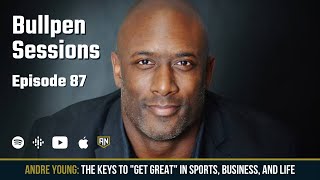
Andre Young grew up in 1980s Philadelphia, sold a painting at 13, then discovered football and played semi-pro by 15. He learned early to ask "What do you need me to be great at?" a question that shaped his approach to sports, business, and life.
Questions this video answers
13
Around 13
15
About 160–165 pounds
Kutztown University (Division II)
Chapters
All right, welcome back to Bullpen Sessions. I am super excited. Part of the new year, new mission, new audience. It's going to be awesome. I'm excited to have Andre Young join the Bullpen session. Andre, welcome aboard.
Hey, Andy, thanks so much for having me. Thank you guys for listening. And happy New Year's to you and everybody.
This is. I. I can't tell you how excited I am to have you on this, Andre. I, you know, in doing some research on you, like, you know how people.
Say, well, I didn't grow up, you know, you either had one story the other, right? You grew up, you know, with nothing. You grew up in an abusive family, or maybe you grew up with a silver spoon. You've got, you know, people who've been married, not married, divorced. Like, you've been it, all right, You've grown up, you grew up with not a lot, but you've also seen what wealth can do for you. You know, you're in your. In your bio. You know, you've been married, you've been divorced, you've been remarried, you've got kids. You've been an athlete, a pro athlete. Man, you've just done it all. So we're gonna go into so much. But I want a level set for the. The audience listening in who has no clue who Andre is. Let's just start, like, where'd you grow up? Where are you from? Tell us a little bit about maybe the younger version of Andre Young.
Oh, wow. Younger version of Andre Young. I was. It's a great question. I grew up in inner city Philly. Go Philly. And it was odd time. I like to say I was a nerd. I like staying in the house. My brother loved going outside, ripping and running. This is pre cell phone, so our parents didn't even know where we were, you know? But I like to draw. I sold a painting when I was 13. My mom used to punish me by kicking me out the house. But I grew up in a neighborhood that wasn't very good. It was good to start, but then mid-80s, the drug scene, crack cocaine, I remember it hit and it hit like a tidal wave. And it changed people that you knew that were straight A students, good people into walking zombies. And my neighborhood just became a.
A crazy place, a war zone, so to speak. And I remember my parents always saying, and they were together at the time, you know, I was still fortunate. Where if you went down the street, there was a lot of chaos and anything and everything you wanted down there. If you went up the street, it was Safer. So I remember that guideline of, look, we can't tell you which way to go once you leave this house, but if you go this way, this is the way we want you to go, and this the way it'll be good. But very small story. I used to play guitar. 1987. I didn't have a guitar case. I had a triangular box. And I'm walking down the street because that's where my music class was through all of the drug deal shootings. Police station that was stationed on the corner. I couldn't go anywhere. The mobile unit just walking through. La, la, la, la, la. So it was an interesting experience, but so much to learn, you know, of maybe what not to do. I didn't always have a lot of mentors, but learning what not to do, how you didn't want your life to become, and doing the opposite.
So I've got to ask you, you know, I was 10 years old in 1987, and there's probably people listening in who weren't even born yet. Andre, in 1987 with a guitar, what music were you playing at that time?
Not very much.
I'm trying to think of, like, what were the hot songs back in the mid-80s that we all were trying to learn. I'm thinking U2, AC, DC. I mean, I don't know. You name it.
I don't know what gravitated me to it. I. I picked it up, I liked it, I took a few classes. It ended as quickly as it started. I picked up a football and I married it and everything else that I was interested in kind of went to the wayside and I was all, football.
Yeah. And let's. Let's go there because I think your story just. It seems so similar to somebody I had on this podcast in the past. Somebody, you know, Anthony Trucks.
Oh, yeah.
You know, you didn't pick up football right away. I think you said you started at age 13, right?
Yep, 13.
When did you finally get into the sport? I'm sorry, what made you finally get into the sport? What?
Vaguely I remember watching a playoff game, and I can watch playoffs and championships in anything. I love that type of competition and intensity. But at that time, I'm a painter. I'm, you know, not doing it. I'm a painter. I'm a drawer. I'm a musician now. I remember watching a playoff game, and I just kind of loved it and, like, fell in love with it. And I don't even remember the moment where I said, this is what I want to do. I just remember When I picked it up, I couldn't put it down. And it resonated so much in this inside thing that I had. I just wanted to hit things and I don't know where that came from. I just wanted to hit things. So when I, when I fell in love with it, I couldn't play. I was, I was 13, 14, so I played, you know, my little league team. So I played there for a year. And the high school that I then went to for two years really didn't even, didn't even have a football team. So my 11th grade year I transferred to my neighborhood school. So I went from this smart quote unquote magnet school in inner city Philly to my neighborhood school with 5,000 plus kids. And it was a free for all. I have never seen anything like it.
And I left with four Fs, two Ds and a C going into my 11th grade year. @ the time I was going to school every day my 10th grade year and I didn't understand why I wasn't learning. I still remember my mom looking at the report card saying, trying to make out what this F was, this letter F. I realize now that I'm ADHD and attentive type. I have a hard time learning things that I don't care about sitting in row seats and the structure of, of something like that. And I just didn't do well with it. So my 11th grade year I couldn't play football for my high school. I remember crying like a baby the day before the game when they told me this, where I was just starting running back and linebacker and it was a great experience. Told me, hey son, you can't play. And it was one of the first lessons that I've ever learned about being an adult, being a professional, whether you're in business or whether you're in sports. And the truth comes down to a very simple premise. Do what you have to do so you can do what you want to do. Now what we have to do, what you might have to do, may be different from what I had to do. I had to go to school. So that whole 11th grade year I really went to school once a week for half a day because I couldn't play for this, for the, for the school. So I played semi pro, 15 years old, 160 pounds, soaking wet, made the team with guys that are 20, 30 years old. And the thing that saved me is I didn't get paid so I can play my senior year. And I played my senior year, I had grades, even going to school Once a week for half a day. And you know, and that was the start of getting college scholarships and things like that. So it was a heck of a two year experience growing up in that 11th and 12th grade.
Year. Well, isn't it interesting too? I mean, you think about the artist side of you. Remember I told people listening in, this man's a man of many talents. The artist artistic side of you. I think those are people who don't like structure. Right. Drawing outside the lines. And then you struggled with school because of that structure. I had to follow rules or I had to sit in rows and lines. But then on the athletic side, in order to be successful, you kind of have to have a lot of structure. Right. And a lot of will and drive to do the boring, monotonous things most people don't want to do. And so that whole story, just listening you say that is so, so interesting. So here you are, it's the end of your senior season. Here's a sport you picked up, what, just five years ago at that.
Point? Two years.
Ago. Two years ago, man. And you're realizing that you have a chance to play at the next.
Level.
Yeah.
So tell us where you're at at that time. What schools were looking at you? Where did you have opportunities to play? Like what, what did Andre look like at age 17?
18. 17, 18 years old. I remember I was probably still about 165 pounds. Wanted to hit everything. I was playing the position of linebacker. And you mentioned Anthony. Chuck's great guy, but Anthony's not 163 pounds, I don't think. I think he was probably born 163 pounds.
So I didn't have the traditional NFL linebacker body and things like that. So I got scholarships to Division 2 schools in the state of Pennsylvania. I decided to go to Kutztown University. Go Bears. And I was looking for a place at that time of what I thought I was looking for, but also mixed in with what I didn't know and what I know now. I was looking for a place that, that felt like home, but not too much like home because home was crazy and home had a lot of, you know, wild things happening and I had done too much that I didn't want to go and immed fail out. So, you know, I chose a place that it felt like home. I felt like I was safe there. And that was a new thing, safety, you know what I mean? Being there and being in an environment. And it took an adjustment going from inner city Philly to Kutztown, Pennsylvania with horse and Buggies and Amish clacking down the street. It's a culture shock, you know, so it was an honor to be able to play at that level. I didn't know what I didn't know. I love being able to work out and. And lift. I was big on being strong, and if I was going to be small, be the strongest piece of iron, you know, that you can be. Now, what I learned much later, and I wish I could go back and tell that younger self, and I feed into my kids and athletes and employees and leaders, is that most of us are very singularly focused on this thing that we want, whether that's being an athlete, getting that raise, whatever it is we are, we don't mind getting better in the way we want to get better. So I want to get stronger. But does that. Is that what my coach needed? Is that what the team needed? Is that what your boss needs? Is that what your husband or wife needs? So I can't. I know. I. I teach a lot. The get Great question. Hey, coach, what do you need me to be great at? What do you already have? How can I be an asset? What do I need to do to start? And then we got to shut up and listen. And then based off of what they said, if it's reasonable, doable, and fair for who you are and what you want, you do it a little bit outside your comfort zone so you don't wind up becoming bitter and frustrated, but you add it to your arsenal. Never stop being great or better how you want to be great, but marry it with what the other person needs. So I was a hungry athlete. I'm doing exercises and, you know, in my driveway in high school, you know, escaping crack vials and potholes and all of this stuff. I'm out there and I'm doing things to get my version of better. I failed throughout my college career of asking the get Great question. I failed in early, you know, work as an employee and relationships and asking the get Great question and being able to marry the.
Two. That's. Wow. Yeah. I mean, your version of progress might not be exactly.
Heading down the right path. It. It may. You may be thinking you're progressing, but it's bringing. It's actually not creating the value you need because it isn't supporting the team. Like you said, your spouse, your boss, whoever it might be. That. That's fascinating because I. I don't. I have to admit, I haven't thought about that. You know, you talk, people think, you know, I'm putting in the hard work when no one's watching and putting in the grind when no one's watching. But are you actually going down the right.
Path? And what it does is it leads us to our professional or athletic or adult temper tantrum of, look how much I'm doing. I deserve this. And now with that righteousness. I very rarely have seen righteousness ever pay.
Off.
Yeah. So I'm honored to be able to go into organizations and then universities, and I never thought that I'd be doing this with high schools, but being able to do this with an athletic high school team and teach them something that they would have never gotten until maybe they're 44, it's life changing because they take it back to their team, their coaches get it, they bring it home to their parents, and it's like this life changing thing. So although I didn't have it back then, I'm honored to be able to gift it to people.
Now. Yeah, I mean, and that's, you know, again, I think about.
How often you mistake hard work for progress. But if you're not, if you're not focused on the right things, that isn't getting you closer to that result. Either you, your team or your spouse or your boss needs. It's not really accomplishing the goal. And so you know what I love about your story too, Andre, is once college ball was over at Kutztown. And for the diehard sports fans out there, the name Kutztown rings a bell. There's been some, some guys who've gone to the NFL. Mainly.
Andre.
I played, you know, 15th overall in the NFL draft. And to play with that type of talent in this and to see what it looks like. Yeah, to see what it takes and to, you know, it's an awesome.
Experience. I didn't mean to ask a question on that. So who was the 15th overall.
Pick? John.
Mobley. John.
Mobley.
Yeah. He spent some time with the Broncos.
Right. I spent eight years and two Super.
Bowls. Okay. That's that. I want to make sure I have the right guy. What was it like because Kutztown's Division 2. What was it like to see a guy like that on the field? Because this applies to life too, you know, whether it's sports or business. A guy like that who is a first round talent.
Was it like watching a men among boys? Like, what was that.
Like? It's. I think that's well to say. But not only a man among boys, because you could see like a big brother go out with the little brother's friends and just plow over people. It was more than that. It was, you know, first round draft picks run different. I say like they, they float on top of the grass. They don't run on the grass. You know that the power, the explosion, the coil, but also the dedication. And I like to say, especially as a Division 2 or Division 3 athlete, because you don't get those TV timeouts. It's hot out there at 12 o', clock, 1 o' clock in the afternoon. And to go first round at that level, it means you're doing a lot. So you're playing special teams, you played offense, you played defense. The stamina that takes, the, the will that that takes, the mindset that that takes. Because it could be easy to lose yourself and your success and to watch day after day, week after week, you know, you know, his dedication, his grind, but also seeing what it takes from a physical standpoint, like you, we, I, I'm amazed that someplace like Alabama, Clemson, lsu, when you look at, okay, I played with one, you had nine go in the NFL draft and eight on.
Defense. And by the way, at schools like Alabama, when one gets hurt, another one comes in just like.
Them. You know what I mean? Moves just like them. So it's amazing, but it really does. It really did set a stage of wow, okay, that's what it looks like. However, I still even at that time failed to ask that get great question and failed to really focus on what I even call my four Cs. Like, you got to be consistent with your workout. Most people are willing to work out when they're motivated on a Monday. Can you work out that way every day in some form of your game? Because it's not just about your game, but it's also about your mental, your nutrition. How do you do your confidence? Not every person, even first round draft picks aren't confident all the time. So what are you doing for your confidence? That get right question helps with.
That, I think something I want to ask you and I want you to go talk about this because you and I talked about this offline. When you were at Kutztown. You had a routine that you would put into practice quite often because you said it earlier. D2 Games didn't have commercial breaks. You played at.
More from Andy

Stop living in the gray of maybe! Your job in sales is to get a clear yes or no


How elite producers use “validation” to give prospects the confidence to hire them.

The Transition, every great sales leader goes through: Stop being the hero and develop heroes.




