Building A Legacy One Satisfied Client At A Time with Pam Files
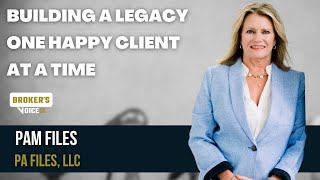
Pam Files spent 44 years in insurance, starting as an administrative assistant at 17 and building a multi-seven-figure book of business. She shares practical advice: do homework on prospects, ask open-ended questions, listen, and mentor younger advisors to leave a legacy.
Chapters
Hey. Hey. Welcome back to the Broker's Voice. I am excited today and honored to be joined by Pam Files with PA Files Consulting down in Madison, Mississippi, just outside of Jackson. Pam, welcome to the Broker's Voice.
Thank you so much. I'm glad to be here.
You bet. Now, I'm going to ask the question. I already know the answer, but I want others to hear it. When you live in Mississippi, you have two choices. Go State or go Rebels. Is it Ole Miss or Mississippi State?
Well, it's Hell State here in Mississippi.
Sorry. Hail State. I even said it wrong.
Hell State. I'm married to a former cheerleader of Mississippi State. So is Hell State.
Awesome. Well, I know you again, in that state, you don't get many choices. It's one way or the other. So both programs had a lot of success in football recently and so had a chance. I actually went to an Ole Miss game years ago and really enjoyed the tailgating. I have not had a chance to get to Starkville, but I would love to. Love to do that at some point. Those cowbells say it's a one of a kind experience.
I'm sure it's one of a kind.
By the way, can I ask, totally off the subject, how are the fans in Starkville, Starksville, allowed to have cowbells in the stadium?
Well, the NCAA ruled on it several years ago where you could ring the cowbells.
Outside of playtime. So the monitors in the stadium say.
Ring the bells, and then it turns off when the play begins and says start the yell. And so you know when to yell and you know when to ring.
Got it, Got it. Got it. If you've never watched a game at Mississippi State, go watch video on YouTube. You'll know exactly what we're talking about. The cowbells. All right, let's. We're not going to talk sports the whole time. We're going to talk about insurance here, Pam. But let's. So let's start out. You've been in the industry, I think you told me, offline, 44 years.
Yeah, right. At 44 years.
How did you find yourself in this industry? How did you get in the insurance industry?
Well, in my day and age, it. It was generally by accident, and so I was. By accident. I left home at age 17 due to very poor conditions and found myself trying to get a job that paid me well. And I found out that there was a broker that.
Administrative assistant had retired, and so I had an in with him and I went in and I begged him to let me just help him in his office and if he didn't like me after 90 days, he could fire me. So after a two year stint and I was offered another opportunity with more pay, I moved on and he was begging me to stay. But that was with anybody that's old school knows Mutual Benefit. They were a mutually owned company and we did minimum deposit life insurance. And so for there I just progressed my career into retirement planning, estate planning, was a licensed Series 7 broker and all the while still doing insurance planning on the back end. So. And then moved to be a carrier rep with Anthem when they rolled out the Accordia companies and then they rolled the Accordia companies back in. So I found myself with a small book of business and a friend who had a brokerage agency who allowed me to come part my business there and start production. So it's been a very exciting career from that point on. I went to a bank owned agency and spent the last 20 years and decided to have a career change and a couple of years ago went out into consulting. So it's been a long and very prosperous career only because in insurance as you know, it is what you make it.
Well, that's what I want to talk about. My first question, going back to your days as an executive assistant, how long was it between the time you were hired as an executive assistant and then you were actually selling insurance?
Well, that is a great question because I don't know if there's a deviating line because one of the gentlemen that I worked with, he set me in a room in the afternoon and shut the door and gave me a giant, I think it's 11 by 17, green bar paper that was about 4 inches thick and said call these names in this paper and set up appointments for us to do sales calls with them. So if that's considered actual production, it would have been way far back. You've got to train your mind on green bar paper first.
What was that experience? I didn't intend to ask this, but I'm curious, like, what was that experience like? Because you came to him and begged for the job. Like, you're like, I want this job. And little did you know, you know, almost out of the gate you're being asked to call people to book appointments. If you don't mind sharing, like, how old were you at that time?
I think I was 20 or 21.
What?
Maybe 20 or 21.
How did you feel? Because trust me, there's people in their 40s and 50s still hesitant to make cold calls. What was that like for you all of a Sudden finding yourself being asked to call people to book appointments and here you are, new to the business, you're only 20, 21 years old. I gotta believe you had your hesitations.
Well, thankfully he had a typescript. So the second thing, as I mentioned earlier, I was poor and hungry and the third thing is I was dumb and didn't know any better and I was doing what somebody told me to because I was getting a paycheck. So um, during, after that time I worked with a guy that allowed me to go into courses, guerrilla marketing, Dale Carnegie. So after I learned really what I was doing, it was the ability to take it somewhere further.
Is there any, you know, knowing what you know now, being as in the business as long as you had have, if you had a chance to go back to, to talk to that 21 year old version of you, is there any advice you'd give her today if you, if you knew better back then?
I don't know that there would be any advice because to me some of the best advice is on the job training. And also ignorance can be bliss. I was just happy to be there. So it, it really was a wonderful experience. Even though it was so hard, it was a wonderful experience. But the beauty of it is looking in a rearview mirror at 61 and a half is a different experience than when you're 21.
Yeah. You know this is one of the reasons I wanted to have you on you. I hate to use the phrase because it's cliche rags to riches story but like you, you, you shared with me offline. You came from very, some very humble beginnings and.
Went on to build a multi seven figure book of business which is phenomenal. And I, I know you share with me offline. I hope you're okay with me sharing. You make comments like I'm debt free now. You know, light life's pretty good. And this is such a cool story because I think one of the things you have done so well, which so many in the industry I shy away from or at least have a lot of fear around is when you and I talked about some of the companies you've worked with in the past and you currently work with, we're talking about some pretty sizable organizations and I think a lot of people would again be hesitant to go after a piece of business that size. What was it like for you starting in the business, making calls to all of a sudden finding yourself winning and working with businesses that have hundreds if not thousands of employees. What was that like?
Well, it was pretty daunting in the Beginning and as I mentioned, I worked with Anthem with the Accordia companies. They had rolled out and I was industry specific, specific in that I called on only local governments. So I had the big map and they said call on all these red dots on the map. Some might be 20 lives, some might be 100, 1000 or whatever. So I had to turn in a report basically of all the calls I'd made. So I didn't take anyone for granted. I called them. It was scary when you're in front of a council meeting trying to get 4, 7 or 3 of 5 votes and you have to have your votes counted before you get in there. And I learned how to count to three and five very quickly. And so it was the fear of that that really motivated me. And then as I progressed in my career and went on to the bank owned agency, fear had almost left my, my being. I was strictly a shark. I got up in the morning looking to taste blood and didn't come home until I did. So it was, it was pretty scary in the beginning, but it paid off. And I think the advice I give to anybody is just keep moving toward the lane you want to be in and set yourself a lot of goals. I had tons of goals. They were self imposed, but I think to me those are the hardest goals the company would set a goal. But my goal was totally different and it was thankfully above the companies.
I like that. So even though your company was setting a sales revenue goal for you, my guess is your goal was probably even more dramatic than that.
A lot more.
Two questions that came out of what you just said. I'd love to ask. Number one, you talked about I was a shark looking for blood every morning. Have you been somebody, you know, who has just always been driven and that's how you were built, or did you train yourself to be that hunter as you started to progress within the insurance industry? Because I think that's a question that pops up. Are people born to be sales rep, sales professionals or can that be something that's trained? Were you somebody that's always had that drive?
Well, I think the lines crossed on knowing it was a drive to becoming a drive and when I say knowing it was a drive, when you're in poverty, food is an issue, lights and water are an issue. That, that motivates you in this way. And then when you progress on and you see there's light at the end of the tunnel, I can make it, I can do something with myself. Then you have a whole nother set of training and goals and And Dale Carnegie and.
The other brokerage classes I took, the guerrilla marketing, they really carved a place out that I could see a path. And I'm, I'm one of these see and learn. I saw it, I learned it, and then I said I can do that and I took it that much further.
I love that. It's almost like a combination of looking back and looking forward, knowing where you came from, you know, where you said food and water and electricity were an issue. You never wanted to go back there. Right. But then you reached a point in your career where it really wasn't about that anymore because you were successful. So now you're looking ahead at what could be the next level and what was ahead became your motivator.
That's right.
I love that. I love that. Well, what about the advice? You know, again, I know a lot of advisors who start their career writing groups, you know, 20, 30, 70 lives, they want to get up to the writing 100 life group, then a 250, then a 500, then a thousand. In your experience because you've seen it all and you've worked with all of them, what advice would you give another advisor that maybe has spent his or her time on, let's call it smaller opportunities, but now they want to go upstream. Is there any advice you'd give them?
The advice that I would give is do your homework before you walk into the door of somewhere. If you see a big company that you've always wanted to call on, you need to find what your niche is, but more important, what their niche is. And then be prepared when you walk in the door, ask what you know, ask those open ended questions, ask what their issues are. And then the hardest thing in the world to do is shut up. And shutting up and listening instead of regurgitating everything about yourself.
Is worth more in sales than anything else. Because if you listen, take notes.
Ask the open ended questions, if I meet these objectives, do you think we have an opportunity to work together? And once you identify those and write them down, stand up and leave. Stand up and leave. And that's the again, that's the hardest thing to do.
I love, I can remember how many opportunities I've seen in the past go to waste both with my own guilt and people on my team who are part of a meeting where it's the account is one, the the prospect is one, but you don't shut up.
You can't shut up.
Literally talk yourself out of the sale.
Yeah, we had a rule in my office, if any of my.
Co workers went out on a call with me and I told them when we got out of the car, when I stand up, you stand up.
I love that.
Because we're walking out.
I love that.
You just have to know when to stand up.
One more question with that, that just popped in my head and I don't want to offend anybody, but it is a gender specific question. Knowing you've built a multi seven figure book of business.
When you go into those bigger opportunities, and I guess it doesn't necessarily have to be bigger opportunities being a female when most insurance brokers are men. Did you see any or did you have your own challenges with that as walking into rooms with big organizations when it comes to being taken seriously, whatever it is, did you find yourself having those challenges being a female in the industry?
Well, I really did. And some of it was internally I was the only female producer in the agency I worked with. So that was a challenge. And of course my goal was to beat all the guys. So by going out into calls, really, I used my gender as my strength. And what I mean by that is.
Anybody wants to talk to someone of the, of the opposite gender either conversationally or nervously, you know, a man might not in, in my day know how to talk to a woman that comes in and starts talking about insurance because as we all know, insurance is something you can't see, touch or feel. If I'm trying to sell you a real cool pen to write with, I can show you the pen, show you the.
The different features of the pen. But when it comes to insurance, you really don't have anything like that. It's on your trust and on your word. And so I always had to work extra hard to gain the trust and to let them know I just wasn't a dumb female coming in their office. And to me that's working extra hard. But again, I was doing it anyway so it became a lot more natural. So if you're a female and you're trying to grow your book of business.
You can still smile and have a conversation, a personal conversation. But I think working that extra amount is what will gain you either the opportunities or the business.
Well, and I like what you said there, the gap I think is just as long as you remain full of integrity, you remain transparent, you remain honest. Whether you're a man or a woman, you're going to have success. That's what it comes back to the day. Well, you know, a question I wanted to ask you, and I'm going to say this and I'm going to have some Fun with this. So when you got in the industry, I want you to know this, Pam. I was one year old.
So here's what I want to ask though. You're at a point in your career where you could easily shut it down.
And, and kind of ride off into the sunset, but you're actually reinventing yourself, which I, which I love. And I know you and I have had conversations. I've challenged you to put yourself out on LinkedIn a little more, which you've done. What has that experience been like? Because again, it would be so easy to be like, I'm good, I don't need this. What continues to drive you at this point in your career?
Well, I finished my bucket list pretty quick when, when I started looking at doing consulting, I thought, wow, I just want to do these few things and work some. And I blew through my bucket list. And so that allowed me to have a little bit of solace in myself to know that I could continue to grow my business. So it gave me an opportunity to say, I'm not done yet. And it gave me an opportunity to just look forward and maybe not do the exact same thing I was doing every single day, but to really look for additional ways that I could.
Build a business and have a lot of fun. And as we've discussed many times on our calls, our collaboration calls, and that's what I call them, collaboration calls. I love helping people and that's, I have a heart, a passionate heart for the blue collar workers and so I know that I want to continue helping people. I have a love of people and so I'm just doing some different things, different ways, just like back in the early 90s, so excited about that.
I love that, you know, I, it's, it's the love of people, you know, what advice would you give man or woman who's been at this industry, in this industry for a long time? Because I see this with our own clients, they feel like it's passed them by a little bit and they, you can almost sense the head games are playing with their self of, am I still a valid, do I still have a valid presence in this industry? You know what, I, if that makes any sense. And they're out to, like I said, validate their, their, their existence in the industry and still prove they still have stuff in the tank. I see it so often from veterans. What advice would you give that person who's sitting there going, man, I feel like the industry's passed me by, but I still want to prove myself well.
And I think anyone like that to prove themselves. When you say I want to prove myself, is it to me or is it to somebody else? You know, is that a selfish reason or is it I have to beat my own chest because I think more of myself than I probably should? So once you get past that set of.
Mind games, I think the best and the easiest way is to go out and help someone else. And what I've, I've really put myself out there to younger brokers that don't think they're all this in a box of rocks, but really do seek and want some mentorship. I love helping, I love figuring out problems, I love figuring out how to close cells and helping them close sales. And, and so that's my give back.
So, you know, I would encourage anybody that is thinking, I'm not done yet, I want to do something, but I don't know what to do. I mean the great thing about insurance is you can go out and partner with a younger person and say, hey, I'll help you open sales, I'll help you close sales.
Just be available. And a lot of people are fearful of going by themselves, so. And then you're sitting here on the sidelines thinking I really could go help someone else.
I think that was good advice for anybody at any stage in this career in this industry because what you're talking about is self worth issues, right? Which is am I still a valid.
Advisor in the realm of today's industry? But the best way to get over that ego, because that's what it is, right, Games with you is to go help somebody else. The best way to get over any self worth issues you have is to go help somebody else whether and you're at a stage in the game as many are. Go help a younger advisor. Yeah, you've got so many years of wisdom to share with that advisor. That is one of the best gifts you could leave on this industry.
I'm telling you, somebody did it for me. Several people did it for me, but one was a gentleman that I work for on the weekends. He was a preacher. And during the week we did financial planning and estate planning and insurance planning. And he invested in me and taught me how to write letters and how to write. He was a, an extremely unbelievable writer. And so I absorbed everything that he taught me in that. And I have people that come to me and say, will you write this letter for me? Will you write? And I really appreciate that because he taught me that. So I want to perpetuate that for somebody else. And so you just have to find that one thing that you're really good at and say, you know what, I can use this to help somebody else.
I think that's the biggest takeaway is if you're a young advisor, find a mentor you've been around for a long time. You want to leave a legacy on this industry, be a mentor. Because everybody needs help one way, shape or form. And so I love that. My last question, Pam, it might be my most important from a selfish perspective. So in college baseball, Ole Miss won the title last year. Mississippi State won the title the year before. So Mississippi's kind of on a nice two year run. Are we going to see the the Bulldogs come back here? I don't know.
It was a tough weekend in Texas this weekend.
So sweat.
Well, they won on Sunday, but they took a black eye on Friday and Saturday, so it was pretty tough. But you know, the great thing is we've got a great park, they have a great ballpark. Just come to Mississippi. If you haven't visited either one of the ballparks, that's you need to go and.
I want to take in a game at Mississippi State that's on the bucket list for sure.
So it's for you.
Done. Everybody on LinkedIn heard this, so no Pam, thank you. This has been phenomenal. If you're an advisor who's had a chance to watch this, number one, if you're an employer who's watched this, you need to reach out to this woman for consulting. Number two, if you're an advisor who has taken the time to watch this, take Pam's advice, find a mentor. Be a mentor. It is the best way to grow in this business. It's the best way to leave a legacy in the business. And I know we are in an industry for whatever reason, everybody views each other as competition, which I think is crazy. But collaboration is everything. So, Pam, thank you so much for sharing that wisdom.
Thank you.
And everybody else, you know what happens when you create clarity and you mix it with confidence. You go do amazing things. So get after today and do some amazing things. Take care.
Thank you.
More from Andy

Stop living in the gray of maybe! Your job in sales is to get a clear yes or no


How elite producers use “validation” to give prospects the confidence to hire them.

The Transition, every great sales leader goes through: Stop being the hero and develop heroes.




