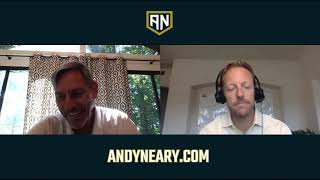
Former NFL player Robert Steele signed with the Dallas Cowboys in 1978 as a free agent, arriving at training camp 20th on a 20-player depth chart. He trained 12 hours a day for six weeks beforehand and made the roster by embracing special teams and his daily rule: do something spectacular every day. Steele maps his athletic success to sales, breaking big goals into small weekly targets and accepting that the first three years will be overworked and underpaid.
Chapters
All right, welcome back to Major League Mindset. This is episode two. I'm excited today because I am here with former NFL athlete turned industry colleague Robert Steele. Robert, how are you doing today?
Andy? I'm great. Good to see you and good to be with you.
Awesome. Well, Robert, much of the audience listening today or watching this video knows who you are. But for those who don't go in for a minute or two, tell us a little bit about your background, professional athletics, and a little bit about what you're doing today.
So it'd probably be best if I could just back up a little bit and say that anybody that's listening to this podcast may or may not have been the best player. You've heard me say this before. May or may not have been the best player on their team. I was never the best player on any team I ever played on. True story. And when I got to college, I ended up with two knee surgeries, which, as you remember, one knee surgery generally gets a guy out of bald. The second one kills him forever. I ended up becoming stronger, faster, quicker after two knee surgeries, which hardly ever happens. And so I signed a free agent contract to try and make the world champion Dallas Cowboys in 1978. And in order to do that, I was dumbstruck at what I might have to face because I couldn't spell training camp at the time. I had never. I didn't know anybody in my life that had ever played pro sports. So there was only one person in the little town of Florence, Alabama, that had, and that was a guy the name of Harlan Hill, who was the number 15 draft choice for Chicago Bears in 1954. And I called Coach Hill up. He was coaching at a high school. I said, coach, I just signed with the Cowboys. I have no idea what I'm about to experience. You're the only person that could share that with me, and I need to speak with you. Share a little bit later about that. But again.
What he did tell me was I needed to convince the Cowboys to let me come to Dallas prior to training camp to get acclimated before training camp started, which I was successful in doing that. Ended up working out six straight weeks, 12 hours a day. When I got to training camp, I never broke a sweat.
That's awesome. And what I heard you say right there with the one person in Florence, Alabama, that could help you out is mentorship.
Right.
Whether you're. Whether you're in athletics or you're in business, it is so important to have a mentor. And as you know, Robert this show is all about mindset. So here's what I want you to do. I want you to take me back to that first training camp. When you walked into that camp, the Dallas Cowboys. The Dallas Cowboys camp, there were 20 wide receivers fighting for four spots. And if I have the story correct, you were number 20. So take me through the mindset. You had to have to work your way all the way up to spot number four.
So it does go back to the six weeks of prior two. I probably ran. No kidding. I probably ran 500, 600 routes for either Roger Staubach, Danny White, Glenn Carano, any other rookies. If they needed someone to throw to. It didn't matter. If I'd already run 100 pass patterns that day, I'd run another hundred. And so the beauty of that was being there early. And that's called preparation. Being there early. I got acclimated to how they throw the ball, how hard they throw the ball, and what I need to do to catch every pass. And so, again, when I got to training camp, funny thing happened. I get out there to Thousand Oaks, California, Cal Lutheran College at the time, and I looked the depth chart, Andy, and I was number 20 on a depth chart of 20. Now, if you've ever played sports and you're listening, you do not want to start at number 20. Everybody wants to be number one. And so.
The beautiful thing is, when I looked at that depth chart the first day, I never looked at it again. To me, that was the mindset that I had to take is I don't care where I was. I care where I'm going. And going for me was I had to become one of the four. And there were draft choices ahead of me. There were former players who had played on other teams. Actually, Brian Billick, the former coach of the Ravens, was one of the 80 free agents that signed a contract that summer. He didn't make the team. Not that that's a dig, but he didn't make the team. And so it was. It was all about the mindset of number one, Harlan Hill. Coach Hill, this is what I wanted to share at that point in time. Harlan said, keep your mouth shut. Prove to the coaches that you know how to play the game by what you do on the field. Number two, go full speed every day on every play. And number three, do something spectacular every day or you will not have a jersey in the morning.
Wow.
Again, I put all of that motion. So, again, let's go back to business. Business is all about making a plan, working your plan. And in some cases, improvising your plan when things don't go according to the plan. And so I literally was getting close to the end of training camp, and my plan was working. I was basically number five at this point in time. And I looked at Coach Ditkin, I said, mike, have the Cowboys ever carried five wide receivers? He said, nope. I said, any chance they will this year? He said, probably not. I said, then what am I going to do? What possibly can I do? Change a game plan? What possibly can I do to make the team? He said, robert, you better get your butt out at practice today for special teams and volunteer to play. Which I did.
If it were not for that advice, I wouldn't have made the team.
There are so many lessons for somebody in sales from that one story. Robert, number one, I heard you set a big goal. I'm going to become. I am going to make the Dallas Cowboys. I am going to get to spot number four. But the second you made that goal, you forgot about the goal and you just focused on the next step ahead of you. And I think you and I can agree, in sales and business and sports today, nothing in this country has ever won without busting your butt. And that's exactly what you had to do, is preparation and getting coming to work every single day, ready to be your best. And then when you got to that point where you thought maybe the goal was unachievable, you thought outside the box and had that conversation with Coach Ditka that allowed you to. To ultimately make that Cowboys roster.
So it was the big goal. The big goal was making the team. And then I set a series of small goals that I did on a weekly, week by week by week basis of what I was going to do. And of course, my mindset for every day was do something spectacular. There are hundred stories I could tell you, but I truly did something spectacular. And part of that, when you go full speed every day on every play, you make stuff happen.
And, Robert, there's so many lessons you've already taught the audience. So I want to finish with one big question. You're in sales today, so you've transitioned from a career as an NFL athlete to a successful business owner, successful sales professional. What would be the one piece of advice you would give to a younger sales professional today?
My first year in the business selling insurance.
My mentor.
Basically said a couple of things, but the one one key takeaway that I did take away was, you know, Robert, you got to study just as hard as you did for the plays that you worked on with the cowboys in this industry. So you need to go to do more sales training. You need to read more books. You need to do this. You need to. He laid that out. But he said, robert, I'm going to. I'm going to be real honest with you. He said, as a young salesperson, your first three years, you're going to be overworked and underpaid.
I didn't have a problem with it. I've been overworking my whole life. He said, for the next seven years, you're going to be paid extremely well. And he said, After 10 years, it's just a simple math equation. You will be overpaid for the work you put in. And again, I teach that to every one of the salespeople I've ever hired. I said, you've got to put in the effort. You got to plant the crop. The time to plant the crop is today. You plant the crop, the crop will grow. As long as you tend to the crop, you can't just plant it and go away and have a vacation. You have to tend to the crop. There are so many analogies from different areas of life, and not just sports, but as you know, my background is sports. I love sports. And again, there are so many business analogies from sports to sales. And again, I am passionate about what I do. I am passionate about teaching people, giving back, paying it forward, and I appreciate you letting me be on today.
Robert, this is awesome. If you are out there right now listening to this video, watching this interview, and you are in sales, there were so many takeaways from today. You know, number one, it starts with being prepared. Set that big goal, and then forget the big goal and create a series of small goals that will get you to that ultimate destination. Robert, one thing you said, every single day, you need to get up, get out there and do one thing spectacular. So sales professionals, take note. This man has done it both on the football field and in the sales profession. And that's it for episode two. Remember, you're always one mindset away from greatness. All right, take care.