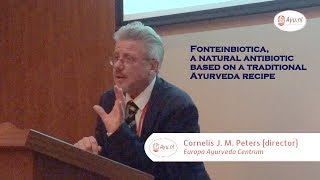
Cornelis Peters presents a talk about Fonteinbiotica, a natural antibiotic derived from aquatic plants used in traditional Ayurveda. He frames two linked problems—widespread antibiotic overuse leading to antimicrobial resistance (AMR) and invasive aquatic plant biomass being treated as waste—and proposes harvesting those plants as a source of antimicrobial compounds. Peters recounts policy engagement (notably 21-11-2018: Ayurveda discussed in the European Parliament), describes sending plant samples to a certified antimicrobial lab in Münster for agar plate/serial-dilution testing, reports visible inhibition zones against pathogens including MRSA (Staphylococcus aureus) and Klebsiella, and urges combining traditional knowledge with scientific validation and grassroots practitioners.
Questions this video answers
21-11-2018.
700,000 people per year.
10 million people (estimate for 2050).
28 million people pushed into poverty.
Agar plate test with serial dilutions (inhibition zone/clearance indicates activity).
Chapters
My name is Cornelis Peters and I am going to talk with you about a natural antibiotic. What we are going to throw away. This is waste. But I'm going to tell you, this is very valuable. What you see here is the center, what I started in the Netherlands. And the aim, the aim is to bring the thought of the traditional medicine, the wisdom of that medicine into the conventional health care. 21-11-2018. Remember that 21-11-2018, for the first time Ayurveda in the European Parliament. Because I thought we have to be there. We have to sit on the tables by the people who met us. We have to tell how they have to move, how they have to take the next step. Because these are the people who are making the rules, who are going to say this herbs are allowed, and that is not allowed. And conventional medicine is allowed, but traditional medicine, certain parts is not allowed. Now my talk from today is about two problems. We face a huge problem with our overuse of antibiotics. And the result is that we have a huge amount of people suffering from antimicrobial resistance. Whatever you give, it won't work. And we have another problem. We have lakes and rivers in Holland and that is grown and they call it invasive pond feed. With two problems I have. One solution, in short, is actually the problem from today. What I want to present to you how serious it is. And this is 2018 now. It is now happening. So that antibiotic resistance is one of the biggest health problems in the world today. As we speak, 700,000 people every year are dying from this disease. 700,000. An estimate in 2050. That is 30 years from now. 10 million people, that is a country like Sweden, a whole country like Sweden has 10 million people will be wiped away. Is this going to cost us a hundred trillion of trillion? I cannot even think about how much that is money. And it put 28 million people right away in poverty. I like to visualize things. So I thought, okay, how I show this with the presentation, how I show how serious it is. Look, this small Blue line is 2018 and how steep it is going up to 2050. This is a fact. This is a fact. And then this, this figure should go all over the world. This is the evolution of us, each of us, because we started life with connecting, with finding way to connect, to survive, to develop, to improve. And that is how nature works. I have bacteria in my belly who helps me to digest my food. They help me. So we have a whole evolution. And this evolution is billions of years, billions of years. And you see how long we have that antibiotic? 80 years. And in that 80 years we managed to destroy all small microbes on earth. Because when we take an antibiotic course, our whole intestine, our whole culture will be affected. Not only the one who we don't want to be inside us, but the whole structure. So we are totally out of balance. I've always big problem with getting people back in balance when they have this course. I show you that other problem now. Here you see heaps of plants. And then Mohana said, these plants are used in Ayurveda as a natural antibiotic for infections. And you see how weird the problem is in the world. We are trying to find an answer and here we are throwing it away. So this is the problem we face now. And we wrote the Ministry of Health and the Ministry of Agriculture and we wrote about our amazing discovery, telling, listen, you are throwing it away, but please hold a minute. We have another solution. In the beginning of this year there was an avian influenza disease among the poultry in the Netherlands. So we found at the right moment to give our answer to the government because it is their property also. And we got this letter back. Thank you very much for thinking with us. But there is no scientific proof. And then I thought, this is always the way, there is always resistance and not seeing what the answer is. But in a way I was also happy because I thought, hey, they give an answer, they want scientific proof. I want to have this plan. So I approach the government, I, I approached the cooperation and I approached other things because it is not like this. When it is floating in the water you can go and collect it because that's not allowed. So we need permission for that. And I had to buy it at the end I had to buy it. But I thought, I'm so convinced, I want to have that proof. So I asked them to throw four times a heap from different places from the waters in Netherlands. I went to my friends in Munster and they have the best antimicrobial research lab in Europe. They are even certified for that. And they invited me to the lab and they said, okay, we are going to do that research. And they did. So here you see the research and these are the research method, what they use. So each herb they made five different dilutions to find out what is really working and how we are going to do that. This is the agar plate test. When you put your dilution in the middle and it will clear the plate, it will eat away the bacteria. Then you can see how strong the Bacteria growth is or the power of the plant. And they did the serial dilution. And that is these are the dilutions they did. And these are the plates they use. And these are the agar plates from our herbs into the lab. And then you see already the first two, it's working. You see it. Third one not. You see it all I want to hear the answer. Yeah, it is clear. That clear means it is working. This is our natural antibiotic. And you can imagine how enthusiastic I am because I have the truth here in my hands. And this is the conclusion. These are the bacteria. Our water plant is working against it. And the funny thing is some bacteria are not at all pathogen. They are using it in Probiotica. We all know Probiotica. After some, sometimes after antibiotic doctors give people probiotic and that means they add some more of their normal, what is it? Bacteria. But even this Probiotica bacteria can become infectious because we are in war with them. Every time when they get that antibiotic, they have to defend themselves. It is very logic. And what we do when we are attacked, we are going to defend ourselves. So that is what on micro level is happening. So these are all the Staphylococcus auris. This is an MRSA bacteria. This is one of the bacteria. Hospitals are very much frightened about this bacteria. And our water plant is working for it. Our water plant is working against it. We know Klebsilla pneumonia, that is very, very dangerous. Now this one is Klebsilla varicola. And we thought that is not so dangerous. But the latest reports, because I'm reading my scientific papers, the latest report is that this one is even more violent than the other one. So there are also unexpected things happening, what people don't expect. So how to survive the superbug? How to survive the superbug is I found because we are not all bad that we know we need them. Even we need them, we cannot without them. That is a fact. And what we have to do is we have to find a way to balance the system. To balance the system, we need to balance. We cannot fight, we cannot win it, because they are in us. So simply, we are one of them. We are a little bigger like that. So the more we fight, the more resistant they come. So they will always find their answer. Because there are already billions of years here and we destroyed with eight years of wrong thinking. So I want each of you to think very, very seriously about this problem and whatever work you are in it. Try to find in your own country, in your own way, just some, some People most of the time. I show you that people in the beginning, these are just farmers or local housewives who work with these plants. Go and look what is it? Where they use it for. Try to collect that information. Do you know this woman? Yes. You tell it. Very good. Very well. Very good. That is true. That is true. And nobody knew her before. She never came out of China. So when she got the Nobel Prize, they were searching like anything that journalists to find what we shall write about her. Because she was so unknown. But what she did, she went to the traditional healers all over country to find out what are the herbs, what you use, what are your recipes. And then she wrote it in a small book. Sometimes this kind of things, you know, you smoke that are treasures that are not the big things. I have no confidence about that huge alliance with a hundred pharmaceutical big industries together. I have no faith in that. But I have faith in these small people around us who are doing this just daily. And just because they even don't know, they just do it. My own grandmother and my own grandmother was using always herbs when we were not well. So she won the Nobel Prize for traditional medicine for her research for a bioactive component, artemisinia for malaria. And how many people she saved all over the world. We have to unite the wisdom from our tradition, from Unani, from Siddha, from whatever. This is our team with the center. And this is my wife. The air under my wings. The reason that I'm here. We really have to mingle with each other. We have to share ideas. We have to take this to the next level. Because we are the answer. We are the answer. Thank you for your attention. It.