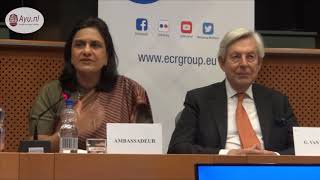
An Indian Ambassador spoke at Ayurveda Day (European Parliament, Brussels) to introduce and advocate for Ayurveda’s historical roots, current status in India, and prospects for scientific evaluation and collaboration with Europe. The speech recounts Ayurveda’s origins (claimed >5,000 years; Vedic/Atarva Veda references), translations of classical texts (Sushruta and Charaka) into Chinese/Arabic/Persian, and traces diffusion to Europe by the 12th century. The ambassador emphasizes India’s modern recognition of Ayurveda (Act of Parliament in 1970; Drugs and Cosmetics Act 1940), institutional infrastructure (Ministry of AYUSH, ~300+ teaching institutions, ~7,500 manufacturing units), the 2017 national health policy update, and ongoing diplomatic efforts (non-paper to the European Commission) to enable scientific evaluation and acceptance in Europe. The speech frames Ayurveda as holistic, plant-based, time-tested, and complementary to allopathy, and invites Europeans to study and visit India for treatment and research collaboration.
Chapters
I'd like to first of all congratulate Mr. Bamra and thank Mr. Van Orden for this initiative in organizing this forum and to bring Ayurveda to the European Parliament, the first ever time that, the first ever occasion that this is happening here. So this is certainly a very special day for creating awareness about the efficacies and relevance of this ancient science. Maybe it's a possible first step towards eventually having scientific evaluation in the European Union, who knows? But I'd like to start by establishing a few facts, maybe well known to many of us, but just worth reiterating. Ayurveda is an ancient science. It's an ancient science and it belongs to India. It's the oldest surviving system of medicine system of medicine in the world. Its origins have been traced back more than 5,000 years. It's believed that the concepts of Ayurveda were known to the people of the Indus Valley civilization. This developed during the Vedic period of our history. In fact, the main source of knowledge in this field are the Vedas, particularly the Atarva veda, written around 1000 BC. We know that the 5th century treatises of the greatest of our Vaidyas, Sushruta and Charaka, they were actually translated from Sanskrit into Chinese. And in 700 AD, the Chinese scholars were studying medicine at the University of Nalanda. By the 8th century, these texts were translated into Arabic and Persian. And then we see that the Arabic derived from Ayurvedic texts reached Europe by about the 12th century. Now, all this can be debated or refuted or corrected, but the point is that it is a traditional practice in India. We rely on Ayurveda in our daily lives. Even those of us who are not formally trained in Ayurveda, we actually practice it daily in our dietary combinations, in our routine, in our daily ablutions. In all parts of India, herbs, spices, plants, leaves, flowers and oils in countless combinations are prepared by households, by housewives, included in our food, and administered as supplementary preventive medicine or medicinal remedies for those who are ill for addressing and treating ailments, grave ailments, or just the beginning of the symptoms. It's unfortunate that Ayurveda as a science was disregarded for a while when training and education in this science suffered. But fortunately, this system of medicine, Ayurveda as a system of medicine has been revived. And in fact, it was under an act of the Indian parliament in 1970. It's been recognized as a science of medicine. Its teaching is regulated in India by the Central Council of Indian Medicine we have a Drugs and Cosmetics act dating from 1940 which regulates manufacturing and sale of Ayurvedic drugs. And today the Government of India has encouraged hospitals all over India to add the facility and service of Ayurvedic, preventive and clinical treatment in whichever way they can. Something like the complementary medicine that His Excellency just mentioned. About the science, of course, we know that the main pillars are preservation and promotion of health and prevention of diseases through natural means. It's a holistic treatment and its products and the medicines are derived mainly from plants and natural resources and natural sources. And it involves a careful synergy of ingredients with individual need based treatment plans. The safety of the system, which is a big question in Europe, is attributed to time tested use and to scientific evidence. Now, the body of scientific evidence, the data of scientific evidence, there will be a time when we are able to put it in the form and the format that is required for, for evaluation in the societies that we would like to partner with. But in India at present, it has become an integral part of our national health care delivery system. We have a well developed infrastructure in our educational institutes, our research organizations, drug manufacturing units. There are more than 300 institutions teaching graduate courses, postgraduate courses and PhD programs in India. And this infrastructure is rapidly expanding the outreach of Ayurveda to our communities. And the drugs are being manufactured on a large scale by approximately 7,500 manufacturing units. We even have updated our national health policy in 2017, which foresees comprehensive development of Ayurveda in the contemporary context. So it's not something that belongs in an ancient text and you have to pour over that. We have, we impart scholarships to international scholars who Indian embassies recommend to come to India to take up Ayurvedic studies and Indian institutions. And we have reserved seats in premier institutions for international scholars. I remember when His Majesty the King of the Belgians had gone to India, our Prime Minister, you know, invited him that, you know, Belgians speak English, let them come to India and, you know, learn our languages and then read our ancient texts, including the texts of Ayurveda. And we have of course, a full fledged Ministry of Ayush which promotes Ayurveda and other indigenous medical systems. Medical pluralism is a big, you know, concept and a goal and a very central theme in our Ministry of Ayush, their approach. So, and these ancient texts which I mentioned a little earlier, the Sushruta Samhita and the Charaka Samhita, they're now available to students in Hindi and English. So English is available for foreign students. Sometimes I think that it would be wonderful if we could have practitioners and doctors of Ayurveda work with their counterparts who work with allopathy and see how they can address some of the most challenging medical sort of diseases. For example, Ayurveda and Siddha has laid down protocols for successfully treating diseases that resembled what we today know as HIV and tuberculosis. If these remedies, I feel if these remedies could be researched and scientifically sort of addressed, then they could bring new hope to millions and revolutionize modern medicine again in a complementary kind of a way. So I'm hopeful as there has been a resurgence of interest in Ayurveda and the Indian systems because more and more people prefer products that have a natural origin. I'm very, very hopeful. And of course, as we know, there are several countries in Southeast Asia where Ayurveda is officially recognized. In other countries where it's not officially recognized, there's no restriction on the practice of Ayurveda in Europe. I'm told it's relatively well established in Netherlands and Switzerland. And with regard to the acceptance and practice in the European Union, I had a good conversation about this with the ministry in ministry concerned in Delhi this January. They said that they were preparing a non paper to give to the European Commission to respond to all the requirements of the European Commission for actually accepting to study what Ayurveda, how Ayurveda can be scientifically sort of proven, and to go through all the evaluations of the different treatment protocols and the drugs. So I'm pursuing that with my embassy, through my embassy, with the colleagues in Delhi. But there's always a first step. This is the first step here. That non paper is the first step. With the European Commission on this side and with our ministry concerned in the government of India. We are not overly excited that Ayurveda must be accepted. It must be sort of inculcated in the medical system over here. We believe that just as yoga has been revived in India and all over the world, people have understood its value and embraced it. And so will the science of Ayurveda also be recognized in the Western world sooner or later. Later or sooner. Meanwhile, it's there in India. It's there. You're most welcome. It's flourishing. It's relied on by our populations in all parts of our. The diverse communities in India. It's a pillar of our medical tourism industry. And you're welcome. People are, people of Europe are welcome to come and have pursue treatments over there once they are convinced and once they feel that they'd like to believe in it. But I'm confident that today's discussions will serve to give a new impetus to the awareness of the practice of Ayurveda. Enough, hopefully, for people on both sides to decide to work together to use it in a modern and scientific context. We feel it's scientific enough, but that's what I'm saying, to use it in a modern and scientific context the way your partners in Europe would like it to be. And I'm confident that everywhere, Ayurveda, if practiced properly, will prove itself. Thank you so much.