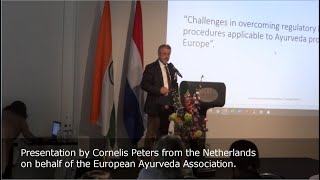
Cornelis Peters (Europa Ayurveda centre) gives a brief conference speech on regulatory challenges for Ayurveda products entering Europe. He explains that Europe is a patchwork of countries with varying competences, distinguishes pathways for botanical products (medicine vs food supplement; well-established vs traditional use), notes evidentiary gaps (example: turmeric clinical trials vs. EU "insufficient evidence" finding), and reports tentative Feb 19, 2020 EU-level movement toward accepting traditional-use claims for botanicals.
Chapters
Doctor Peters studied pharmacology and physiology at the University of Ohio Science and became a research fellow working in different living hospitals. He founded the Europa Ayurveda center which is actively involved in research projects with Ayurveda medicinal plants that are completed on site.
Thank you very much for inviting me to give a three minute speech. It is reduced from 15 to three. I understand that, but I really want to transfer some information. What I think it is very important, but I'm going to fly through the slides. This is the European map. And as you see, Europe is. Is actually a patchwork with many different countries. And in that big area of land there is only. Oh, thank you very much. 15 minutes. There are 27 member states and that is the European Union. And beside that, Europe has also other countries and that is also Euro. So when you ask me what is the rule for Ayurveda products to enter Europe, then that is quite difficult. Difficult in the sense that it is not one country. But when you are in the European Union there is something of course, what is combining you and one of the things, what is important is that you can see that there are different competences and competence in according to European Union means authority or responsibility to act. And we have exclusive competence and shared competence. And we have a supporting competence. And in this three, you have different strength of factors. What is combining? In the next slide you see the four items. What Ayurveda want, what we want to discuss here and what we are discussing here. Education, healing, research and products. You see that research is highlighted in yellow. That means that the shared competence has much sharing within the European Union. So that is something to remember that is important for us. And is there a general European law to enter products into the market? The answer is no, there is not. But there is of course a supporting competence. And that means that we are thinking about how we can combine certain things, what is important for each country. And that is of course to enter with our botanicals the European market. And there are different possibilities. We can have an herb as a medicine and then we need a health claim. And a roadmap is then through the Ministry of Health, Welfare and Sport when I talk about the Netherlands. But for the other countries it is also going through government. And we have a food supplement that is without health, without the extensive rules for the medicines. This is more in a relaxing way. And then we have two divisions. We have the well established use and we have the traditional use. And both have different degrees of evidence for well established use. We need 10 years of safe use. With scientific proof. And for traditional herbal medicine products we need 30 years of safe use and 15 years in the European Union. And I tell you that is very difficult. How you can prove that something is already 30 years in the market. I try to register myself some products so I really know how difficult that is because it's almost impossible. Do you need an article from the newspaper? Do you need a letter from somebody who wrote to the doctor that was helping? You know, there is not really something strong. So what is important? We have a European medicine agency and recently it is residing here in the Netherlands and they have made a committee on herbal medicinal products. And they were looking into the matter to find out how we can help the industry. Because it is a large industry, it's not small. And this working group published around 200 community monograms for different herbs. And that looks like this. And I selected one. And this is something important to know, Mr. Burke. Last year, in 2000, two years before, we discussed something about scientific evidence that we have actually already so much proof, but somehow it is not entering. This is the website from the European Union. So it is not a small website. It is really an authority in itself. What is written about turmeric and I highlighted there you see insufficient evidence from clinical trials. And what is here? This is the research on the PubMed on Kurgma itself. 3858 clinical trials are done. And when I select you can see Curcuma Ayurveda. Then I highlight that we can see 119 scientific reports. And this is something. And now I look at my political people how we can talk with the people to say, Listen, you are all the time telling it is not evidence based and it is, it is. We can show you. But how we enter it and we can see it again. This is the website from the European Union and this just recently done. And they are telling insufficient evidence. It is not so that is very difficult. In summary, are the rules to enter products in the markets? No rules, but there are guidelines. We need extensive dossiers and we need. When you have an herbal supplement with a health claim you need the approval of the government. Otherwise you need an approval or help from an established consultancy company who can help you to make that dossier. I have also very good news and that is that just. Is it working? Some breaking news because the 19th of February 2020 the European Food Law, Food Policy, Health and Nutrients Commission leans to accepting traditional use for botanical health claims. This is really, really very important because there were $2,000 on hold. There was a list on hold. That means it was looked after like this. It was. What is the English word for that? Tolerated. But not really. You was not really free to make advertisement for your product. Now it is coming in the spring. So that is good news because it is a big market and it has to change. So that is very important. I have that paper here. I got it from the scientist and researcher from Wageningen University. Because I just gave her a call. I said, what about on hold list? She said, nakonelis, I give you good news so you can bring this to the conference. So by this I will give you some good news. Then I have something I want to see if that is working. Ayurveda is an ancient science. It's an ancient science. My name is Dr. Oleg Sarokin. I'm head of the National Ayurvedic Medical association of Russian Federation. Ayurveda is a science. My name is Madan Tangare. I am the general secretary for the European Ayurveda association and a molecular biologist based in Cambridge. Ayurveda is a science. Ayurveda is a Weightenschaup. Ayurveda is a science. Ayurveda is a science. Ayurveda is a Veda's hub. Ayurveda is an Ayden Dach's Betascope. Ayurveda is a modern science. Ayurveda Jeevan nelanartana Uru shastramana. Ayurveda is a science. Umbrella is a science. I found.