Fastest way to write & finish a book in 90 days | Ft. Shaa Wasmund | Link in description
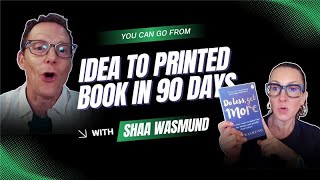
Casey Zeman interviews Shaa Wasmund about writing and finishing a book in 90 days. They cover hybrid publishing, using books as business tools, and practical frameworks for getting it done fast.
They were sleepless nights where I was waking up and I was trying to figure out, what am I. How am I going to do this? How do I structure this, how do.
I plan it from having an idea to actually having a book ready to be published in 90 days. Right. There are thousands of other books written on a similar topic, but there is only one book.
The biggest thing I learned was trusting the process that you gave us. So that I think was invaluable.
Looking for progress, not perfection.
All right. I am so pumped and excited because I have a very good friend of mine who is. Is. Is a brilliant mind, an empathetic human, and just one of the greatest out there. This is Shah Wazman. And I. I wanted to do this interview with Shah today on a couple for. For a couple reasons. One, Shah and I got together maybe four years ago. Geez, man, it's a long time. But she and I, she came and she did an easy webinar summit several years ago and just blew everybody away with wonderful content. And so she and I have kept close contact with each other. And then she launched a book program that I jumped in. I said, shah, what is this? I think I need this. And I jumped in, and it was such an amazing experience. I. Because of Shah's program, because of, like, working with her framework and things like that, I was able to actually get this book off the ground. The first book, and then we're working on a second one right now. So anyway, that's why I wanted to bring Shah in. And so, Shah, thank you for coming in today and, you know, doing this.
Interview, I'm really excited to be here. And I've just got to note that I might start melting because for the first, I'm in the uk you can probably tell from my accent. But apparently today is supposed to be the hottest day in the UK ever. And just for those of you who aren't based in the UK who are watching this later, I mean, like, 99% of the UK does not have air conditioning because we never need it. Right. So I'm just going to throw that out there. If I turn into a pool of water before the end of it, that will be why.
Well, I'm here in India, and actually the weather is about the same as it is in Los Angeles right now, so. So everything is pretty good. But definitely it's probably not as hot as where you are right now, which is really ironic.
Yeah. Which is crazy, right? Never happens in the uk.
It never happens.
I'm excited to talk to you, Casey.
Okay. Well, I, so, so yeah, I want to, I want to jump in because, you know, I was before, you know, I saw that you had this program. This thing was bugging the shit out of me. This thing where I was like, I had a good portion of this thing written, but I didn't have the final pieces. And then I had this idea for another book that also was a plan to launch. And I just. They were sleepless nights where I was waking up and I was trying to figure out, what am I, how am I going to do this, how do I structure this, how do I plan it, am I creating the right type of content? So I wanted to bring you on so we could talk about these things. Talk about some of the things I think that people have. You know, like really, I want to demystify this book stuff. Right? And I want to ask you, like, like, because for me, I think it was like, I want to do a book. And it was like I kept pushing it off, right? It. I was like, I want to do a book, but it feels like too big, too heavy.
It's going to take too much time. Can I just. Is it going to give me an roi? Is it really going to help me make more money? All of these things that people think.
Yeah, yeah. And that was kind of like the nagging thing is. So what, what is one of the biggest hesitations you think people have for. For just getting started? Like, is it that. Is it just the unknown or the it's too big of an idea or.
I think the top three, and in this order, number one, I don't have the time. People think it's going to take them way more time than it actually is. Because as you know from being in the program, you can go from having an idea to actually having a book in your hands ready to print in 90 days. And the reason why people think that it's going to take more time than it does is because most people start writing book with no structure. So they don't have a framework, they don't have a path to follow. And so they are typically looking at a blank screen or a blank sheet of paper. And that's hard work that does take a lot of time. And so, you know, I've sold over half a million books and we've helped thousands and thousands of entrepreneurs write books. And over the years, what we know to be true is if you build out a, almost like a color by number framework for people to follow to write their books, it's super simple. And it literally works every time because you take, you take that, you know, the moment where they call it writer's block, where you're just stuck staring at a screen, you remove all of that, just mapping it out in advance. And so I think that the way I look at writing books, whether it's for myself or for helping someone like you, we don't start just writing a book. That's not what we do. We start by, you know, spending time thinking, what's this book for? For, like, if you want it for your business, which is what I recommend, what do you want it to do for your business? If you want it to generate leads, or do you want it to raise your profile so you can raise your prices? Or do you want to do all of those things and then you've got to reverse engineering? Okay, let's make sure we're writing the right book at the right time for the right business. So I think the first thing is people think it's going to take way more time than it actually is. The second thing, interestingly, is that people think, oh, but my, my, my idea is not new. Nobody's going to want to read my book. Like, I, I'm passionate about. But actually, other people have already written this. And my attitude to that is, look, this was my first book. This was. Stop talking, start doing. This was the book that really kicked off my, my, my journey into writing. And it, it's about procrastination. And, and let's be like, brutally honest, there are a million and one different books around procrastination, but there is only one book that has been written by me.
Okay? So, so, Shah, I want to, I want to talk to you. What, why, why won't someone start a book? What's the, what's the, what's holding them back? What, you know, I mean, you, you know this. I know what was holding me back, but I, maybe I didn't think it all the way through. I just want to, I want to hear from you. What, what are your, what are your thoughts on what holds people back?
So it's interesting because what doesn't hold people back is a desire to write a book. Right? Almost every entrepreneur and business owner I know wants to write a book.
Absolutely.
What does hold them back is a false thought that it's going to take them too long. So the first thing is the three top things are, number one, they think they don't have enough time. And the truth is, as you know, because you've been through the program, you can go from having an idea to actually having a book. Ready to be published in 90 days. And by the way, that does not mean that you have to stop working for 90 days. It just means you need to genuinely put aside three, maybe four hours a week for three months and you're done. And by the way, that includes the editing, includes all of it, includes the marketing, includes the sales funnel, start to finish. So the first thing is, is that people think it's going to take too long.
Can I just say, okay, my own experiences with that. I was definitely thinking that and I was like, no, no, no. This was like I had to spend two and a half hours a day, every single day writing or you know, like, like. And it was just like, it felt like it had to be this big overwhelming mountain that I couldn't actually, you know, climb over. Right? And you're right. When you kind of guys kind of created this structure, when you created this actually framework and structure to follow, it gave me permission to relax a little, like get out of my friggin headspace and just execute on certain things. And that was lovely. That was just lovely. I'm gonna let you keep going though.
No, no, no, no. It's a really good interjection because we always say, just trust the process, right? Just trust the process. And I liken it to. If you've, if you've never been to a gym before, right, and you just walk into the gym and you see all of this equipment, you are overwhelmed and you think, I don't know, like, shall I start there or should I start here? Like, where should I start? What should I do first? What. So what happens is you spend an hour walking around the gym, looking at the equipment and actually not doing anything. And that is what it's like for most people when they start writing a book. They look at a screen and they're like, well, I know what I want to write, but why is it not coming from my brain to my screen or to the piano, right? And that's because the key to all of this, and I don't want to sound like a braggadocious twat, right? But you know, I've sold over half a million books, I'm published by the world's biggest publishers and I've helped thousands and thousands of entrepreneurs. So what I would like to think is all of that combined experience, I genuinely know what it takes to write a book. And I'm not talking about the writing skill, I'm talking about the framework. Because it really is as simple as, you know, when we were kids, we used to do those color by Number drawings, right? I could never draw a horse, but I could follow 1, 2, 3, and before you know it, if I follow the, if I trust the process at the end of it, I've got a horse. Honestly, the same thing is true for writing a book. But the second thing is, the second reason why people don't go from wanting to write in a book to actually writing a book is this fallacy that it's been done before, that somebody else has already written it, that nobody's really going to care about what I think about this topic because all these other people have already written it. And what I always say to people is, I use this example. So this was my first book, stop talking, start doing. And it's about procrastination because I know that when I start to self sabotage, my trigger is I start to procrastinate. So now I. So that's why I wrote the book on it, right? It's lived experience.
Experience, right?
This was not the first book on procrastination or time management. It wasn't and it definitely won't be the last book, right? There are thousands of other books written on a similar topic, but there is only one book written with my kind of my voice, with my experience. The same is true for you and the same is true for anyone who writes a book. So I think that's the second biggest challenge is people think, you know, I wasn't good at English at school and nobody wants to listen to my voice and the topic's already been covered. And honestly just all of those things aren't true. And then the third reason is because they haven't yet figured out how to make the book truly work for their business and for me, that of them all. Because getting a book to work for your business, to drive leads, to raise your profile, to raise your prices is, is like, you know, that's light work. That's the easiest part of the whole equation.
That's funny because a lot of people think that's the hardest part of the equation, right? But once you have that, once you have the book, it's like, it's the calling card. It's the thing that you can sort of hang your hat on. And what I really love about what you've also done, when I was talking with you and going through the program, it was about like, what's the use case of the book, right? What, what are you trying to do with this thing? What is it intended, as you just said, to generate leads or is it intended to raise your profile? You know, what's what are you, where's the ROI in the book? Right. And for us, after I got a little clear on that, you know, we used it as a, as a, we use some chapters of it as a lead magnet, which then helped to drive people into a launch. And I think the book certainly helped with sort of setting that authority, you know, and, and sort of getting, getting to that point. So. Yeah, yeah, this way.
Casey, do you listen to podcasts?
Yeah, of course.
Okay, so give me a couple of your favorite podcasts you listen to.
I, I love.
See, ideally mainstream ones that other people would probably listen to.
Yeah. What's the one where they're smart lists? I love that podcast. You know, I'll, I listen to some personal film.
Diary of a CEO.
No, I, I, oh, I, well, yeah, Stephen Bartlett has the video, the video podcast. I definitely have. I, you know, it's like I watch them, you know, on certain, on other, other platforms, but not necess listening to it.
So the reason I'm asking is this, and I want everybody who is listening to this to think about this for themselves. Think about the podcast that you've listened to recently. And I want you to think about the episodes where the podcast host was interviewing a guest. And now I want you to ask yourself this question. How many of those podcast guests had a book? Yeah, almost 90% of them.
Oh, well, that's, and then that's how they find, that's how they get the podcast.
So if you're listening to this and you're thinking, I need to grow my audience, I need to be more visible, but I don't really want to do social media. I've got a love hate relationship with social media, but I'm stuck. How do I, how do I, you know, build an email list? You do all of this by getting a book. Because the book, this and this and this, these are calling cards that get you onto the podcast, they get you into the Huffington Post, they get you columns on online magazine. It's the thing that is an external validation that you are the expert in your space and that opens doors.
I love that. I mean, I think that's the exact reason for doing it. What happens when people, they want to write a book, but they're not sure what they should write? Like, you know, like how, you know, what's the, do you find that to be a problem that people are facing?
So I would say if we take 100 people who have joined the program, I would say 80% of them know what they're writing and 20% of them want to write a book. They want to write a book for their business, but they're not sure exactly what book to write. And I. You know, one of the things that we do is we've got this amazing exercise that helps you map out your book in 30 minutes. And it's completely free. You know, we do it with you inside the program, but it's completely free outside the program. So, you know, link and your guys can test it out. And what I would say to people is that the way that we teach books is very much with your business in mind. So we start there, right? So the first three weeks or the very first thing you should do is think about, what do I want this book to do for me? Do I want this book to generate leads? Do I want it to raise my profile so I can raise my prices? Or. Or do I actually want to do both of those things? Right? And once you got that, first, you then say, okay, if I wanted to generate leads, let's say I want it to generate leads. So if you want this book to generate leads, then the subject, not the title, but the subject of the book, like the content in the book, has got to be about what you do. So, Casey, for you, it's exactly what you've done behind you, right? It is about how do you make webinars work for you and your business. It's taking all of your learned experience, your lived expertise, and put it into a book. So if you want to write a book based on, you know, to generate leads, then the. The subject, not about the title, but the content within the book, what you want it to do is to demonstrate that you're an expert in that field. And I. I look at a book like a first step. So if we talk about funnels, I talk about steps, right? First step to working with you, you don't give people enough that they don't need to work with you. You give people enough that they now recognize what their challenge, their problem is. They can name it, they can label it, they can talk about it, and they know that you can help them provide the solution, right? You are the expert to help them. That's the first step. And then we work on the titles. Because I actually think that when people say, I'm not sure what book to write, if you dug deep, they'd be like, well, I want to write a book about what I do in my business, but I don't know what to call it. So sometimes they might think that they don't know what to write, but what they really mean is I don't know what to call it.
Right. Right. Yeah. Well, I know for me, I was. I was struggling with that. I was also struggling with, like, you know, I had the idea of what I wanted to write, but not necessarily how much to include how much not. You know, when we are not. You and I were chatting, like I have. There were almost like two books in one that were kind of like an idea. And so obviously, like, being able to come into the program, you. You kind of get that. That becomes clear. It's like you're like, okay, this is the thing to start with. And what. The other thing I like that was presented is the act of just writing, right? And I think that that's the other part that stops. It's like, what is the first word that I write when I'm doing this thing? It's like, that is the. That's a struggle. As you pointed out, it's like you're thinking about drawing a horse, right? And you're like, well, how do I start this thing? So what I love is that you gave that permission to sort of just start and just write anything and know that this is going to. It's going to change, it's going to morph into what it needs to be. And sort of the biggest thing I learned was trusting the process that you gave us. So that. That I think was invaluable because it just.
We're looking for progress. We're looking for progress, not perfection, right? And there's a couple of things I think are really interesting in this. You know, I learned this from Tim Ferriss, so. So back in the day, I went to one of his conferences, and he said, you know, if you want to write a book, just get used to writing two crappy pages every day. And he really emphasized the crappy pages, right? He's like, you're gonna write shit. Some days you'll write. You. You write. What you write is gonna be brilliant, and some days it's gonna be shit. So if you just get used to writing two crappy pages every day, what will happen is at the end of it, we edit the editing process, removes all the crap, and then you have your diamond, right? And it is so true because, you know, it's like when you renovate a house, right? If you. If you were looking for perfection, you'd never get started. And. And the whole point when you're renovating houses, you just get started, and then how it looks so perfect at the end is because you do all the snagging at the last minute, which is the editing in a book. Right? So that's really the key is don't wait for perfection. Focus on progress. Just get started, trust the process. If in fact, you know, in the program we spend the first three weeks working on your concept, working on your title, really understanding how this book is going to help you for your business. We don't even start writing for the first three weeks. So those first three weeks are all about setting out the color by number, right? That's what we're doing. We're doing the color by number chart for you. So that in the next six weeks, which 82% of all of our students get to 30,000 words within those six weeks, which is phenomenal. I mean, you know the industry, we don't have that kind of success rate in any of our other programs. But for this program we have 82% of all of our students get into a place within those six weeks where they are now have enough words where they're ready to publish. But the reason is we don't just start by writing. We start by setting a framework by putting all those numbers in place. So when you start writing, just join the dots.
And that's what I think. I'm in that camp because I was able to get those words. I was actually very impressed with how many words I was able to write. Like I was, you know, once I started doing it, I, it was, it was, it, it felt the process was better than I thought it was going to be. Like I was really friggin nervous about it, but it really, it was, it was a good flow and I actually then looked forward to doing. Right. Doing some writing. So, so I want to, I want to ask you a couple more ideas on this because you know, you really, what I, the program was really intended to say how does the, how can the book help? Is there also this sort of like. I feel like there's a stigma that people get stuck in, in this idea that you have to go to a big publisher, you have to, you know, and the publisher, you'll get a book deal and all these things. I, I feel like it's, it's important to sort of, you know, sort of like take that, take that idea, come out, kind of talk about it and sort of demystify it or, or, and, and, or you know, just clarify it a little because I, I think that that's like the, the goal that people have and you know, you, but obviously like, do you need, is that, is that the goal you're shooting for? And oftentimes in what I've discovered in your program is it's not the case all the time. You know, it's like, it's, it looks and sounds great, but it might not be the thing that you want to pursue. And do you want to talk on that for a second?
Yeah, I'd love to talk about it. And interestingly, I'm going to start with saying, you know, to my knowledge, we are the only program that actually works with the big publishing houses. They may have their own internal programs, but as an independent, we are the only program that actually works with the big publishers. We work with Hay House, we work with, with Penguin, they're actually now owned by the same company. We work with Wiley, and we work with them because all the students in our program actually get to pitch directly to the publishers as being part of the program. So I'm going to start with that because I want to, I want to frame it by saying, you know, having access to the publishers is fantastic. And, you know, again, as far as I'm aware, we are the only program that is, you know, that provides that. But now I'm going to say however, right? However, the reality is that I would say for 95% of the people who go through our programs and I would say for 95% of those who are listening and watching this, a traditional publisher will not be the best path for you, or at least not the best first path. And there are multiple reasons for that. Number one, you have no control over whether they take you or not. So it's, you know, they are looking for very specific things and your thing may not be a perfect match for them right now. It might be in two years time, but right now they are looking for this very specific thing. And unless you meet that criteria, you won't be eligible. The other thing is, is that publishers now today are usually looking for people who already have a platform. Because contrary to popular belief, the big publishers still expect you to do a lot of marketing now. Right? And that didn't used to be the case. But I think the most important thing is that what people don't understand is if you are writing a book to drive leads and to increase your visibility in your profile so you can increase your prices, you probably want to do that now, right? Like you're doing this because you want the impact, the positive impact of the book now, not in 18 months time. And the reality of going to a big publisher is that even if they take your book, it will not be published for 12 to 18 months because that's their lead time. So I would say that the vast majority of people want to go to what I call a hybrid publisher. So that means you're self publishing. So you earn all the income, you make all the, that you have all the control so you can really use.
Coming in, you know, the leads, you know who's buying.
Right, exactly. You have all of the data, you know all of this and you literally can get your book out to market and working for you in 90 days instead of 12 to 18 months time. So I, I think the world has changed and, and you know, I've been published by all the big publishers and, and this year is the year that I'm actually doing my own hybrid book because I actually want a book that is dedicated to driving leads into my business. And if that's what I'm doing, I would choose first and foremost to hybrid publish, not to go to a traditional publisher.
Well, I was going to say that I remember that session where you had all the publishers there and we did this pitch and that was such a wonderful experience because it required us to have that pitch ready to go. And you were so thorough about this is what you have to write and things like that and all those pieces and so that was wonderful. And that energy of everybody sort of doing it and then you stepping up. And I know you do it live, you did it in the UK live. But I had to jump on a zoom and do it. But.
We have people zooming in from South Africa, from Dubai, from all over Europe, from America, from Australia. We do it in person. And if you fancy like a week in London, then you get on a plane and hang out for a week in London.
Exactly. I think there's nothing wrong about that. I actually think that's a reason for someone to fly in, just to be able to have that experience with you guys. But that's why I wanted to ask that. Because if you just sit on your book waiting for a publisher to say, yes, I'll publish you, nothing is happening with that book. It's not working for you. It's just collecting dust. It's sitting there. This is after you've written it. It's like I love the proactiveness of doing it and I love that you talked about the hybrid method or model because I think that, you know, you have control and, and then with that, that doesn't mean that it can't get published later, correct?
Oh, absolutely not. This again is like some kind of, you know, old wives tale that if you go hybrid publishing you won't Get a publisher afterwards. Now, the truth is that a publisher may well want to work out a couple of new chapters and they may want to rework the title, but what they won't want to do is change the whole book. Right. So absolutely. And in some ways, what we've seen is. We've seen some of our students who they hybrid publish first. They then use the book to drive their business. They sell 5, 10,000 copies, and then they go back to a traditional publisher. They say, look, I'm working on my next book. Now, here's what I did with my first book. Would you take my next book? And then a traditional publisher is looking at what they did with their first book on a hybrid publisher and go, yeah, actually, you know, that's a really great model. You've been successful with this. We'd be happy to work with you on the next one. So one does not, you know, exclude the other.
Yeah. And it's very strategic, you know, the way that you're, that you're using books. So I. This was, this was really great. I. I'm excited for. I know you have some cohorts and some, some of these opening up again soon. Is there. Where, where can someone go, what can we know more about, you know, when. When these open up again? Because I don't think you. It's not something you can access all year round. Right. This is.
No, we do. We typically do two cohorts a year. And, and the reason for that is because we teach the program live. And, you know, you've been through the program. So one of the things that I'm so proud of about the program isn't just that we have an 82% success rate, which I think is phenomenal for any training and program. But I think that's due to the way that we run the program. So parts of the program are, you know, self study, so you can go at your own self pace, but the bulk of the program is live. So you have live coaching every single week. You have an accountability coach, you have a writing coach, and then everybody has access to both myself and the whole team every single week to send in video, ask questions, which I love. And I'm sure you guys use video probably more than we do in the uk and it's where if you get stuck, you just send me a video or an audio or a text saying, hey, Char, I'm stuck with this. Can you help me? And you get that kind of, you know, hand holding to make sure no one's left behind and everybody's Moving forward. So I think the best way for everybody to find out is we can set up a direct link for you guys for when our next cohort is. I can tell you what that is now or you can add it to the links. What would you like me.
Well, we'll talk about it. We'll get something. And I think what the goal would be that we would get maybe something on the books to do specifically with our audience and stuff like that. So, guys, you'll hear about it. You'll know about it when we launch it out. So, Shah, I just wanted to thank you for the time today. This was awesome. I know it's re. You're. You're probably dying of heat in your. In your office right now, so thanks for, for putting up with the heat. And. And we had a technical issue. You guys probably don't even know about it, but, you know, we dealt with that too, so well.
And I'm so proud because behind you, I can see your book up there. And, and honestly, that is one of the great things about books. Because if you, you know, if you think about social media, this is what we do with social media, right? We. We have our face. We scroll, scroll does. Do you actually remember anything you saw on social media yesterday? Because I don't. I can't think of a single thing because it's just come and out. But if I said to you, casey, can you name me, you know, your top three favorite books?
Yes, I can. Yeah. Other people are, damn it.
No, but you get the point, right? So if somebody says to me, you know, what are your three top favorite books? I would say it's an oldie but a goldie. The Magic of Thinking Big by David Schwartz. Another one would be Hustle Harder, Hustle Smarter by Curtis Jackson, otherwise known as 50 Cent. Another one would be the Celestine Prophecy. So the key thing is, is what we all can remember. We can all remember books that we read. We can't remember social media. So the thing about having a book is it's a physical thing, even if you read it on a Kindle. Most people, by the way, I don't know if you knew this stuff, but most people who buy Kindle books also buy a physical copy. So they might read on a Kindle, but they have. And holding something in your hands, like, you know, I know it sounds corny, but, you know, a book has a much longer shelf life in somebody's memory than social media. And you think how many hours we put or waste in social media if you fraction of that time into writing your book, you would have something that you could reuse and repurpose for the next three to five years. And books just hold. We build a very different relationship with a book than we do with social media.
Yeah, no, I think you're right. I think that we covet the things that we really love. And my brain, when I'm put on the spot, I literally can't think, but like a breathe comes to mind. I had an, A book by Ogilvy on the, on the desk that we were reading. So, like, yeah, I have, I have certain books that, that, that, that I absolutely love. So. Yeah, but you're right. You just remember those and you remember the things you read when you were a kid too.
Of course you do, James. In the drive, each would be one of my. And my point being is that I just want people to really understand that you invest so much time and effort into social media and it's here and it's gone, and it's so much harder to, to maintain algorithms and traction on social media than it ever used to be. Just put a fraction of that time into writing a book and it will reap you so many more rewards.
Well, it's also, when you write a book, it's there and it's legacy. It's like, you know, it's, it's yours that you can, that, that's just, it's now out there, right? Like it's. And it's a tangible thing that's out there. Your words laid out for an audience to listen to or read and, and, and you know, you pass it down to your, to your family. They can, they can have it, you know, so I think that's, that's the other power of it, you know, it's, it's something tangible that's going to be there forever, you know, really? So. Yeah. Oh, shah, thank you so much. This was great. Yeah, yeah.
You guys in LA soon.
Yes, I know. We want to, we want to have you. We'll be, we'll be back at the end of the summer, so please, come on, come on back. Bring your, bring your husband. You know, let's.
And, and Jack, because I know that Jack wants to interview you for his podcast.
That's right. He was, he was even out in LA at one point, wasn't he? I think we missed each other.
Yeah, he was interviewing a guy called Bill Bellamy who was the founder of Def Comedy Jam or the co. Founder of Def Comedy Jam. And yeah, he's doing good.
That's great. He had Bill Bellamy. That's awesome. That's so cool. That's really cool. All right, well, we'll definitely. Well, yes, come to. Come to la. We'll take you to all the places. Just like when I was in the uk, you took me to some amazing restaurants and stuff.
All right, thanks.
Thanks. Yep. Bye. Bye, everybody. Spot. I literally can't think, but, like, a breathe comes to mind. I had an A book by Ogilvy on the, on the desk that we were reading. So, like, yeah, I have, I have certain books that, that, that, that I absolutely love. So. Yeah, but you're right. You just remember those and you remember the things you read when you were a kid, too.
Of course you do, James. And the drive would be one of mine, right.
More from Casey


How to Scale Your Business With AI | The Casey Zeman Show Ep#7 | ft. Gary Guseinov & Sean Whiteley
Terrible at Golf, Great at Building an Audience | The Casey Zeman Show #6 ft. Kira Peterson
Certainty Is a Lie. Clarity Isn't. | The Casey Zeman Show #5 ft. Keith Cowing