He Went From $3M to Negative Net Worth — Then Rebuilt With Daily Webinars | Brandon Lucero
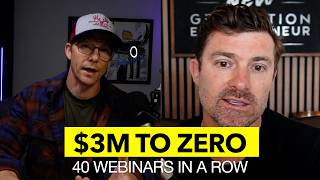
Brandon Lucero lost everything to divorce and AI disruption, dropping from $3M revenue to negative net worth. He rebuilt by running 30-40 daily webinars, testing offers and messaging relentlessly. Within three weeks he made $200k, cutting his cost-per-lead from $19 to $8 by shifting from selling AI tools to selling guaranteed outcomes.
Chapters
All right. What's up everybody? We're back with someone who I've really enjoyed conversations with. This is Brandon Lucero. And I started the conversation with him with letting him know that it was hat day for me personally. So if you can't see my eyes, this is just a much needed sort of expression for the day, considering I just came back from the mountains and need a, you know, the hat, the hair's not doing the thing. The hair is not doing the thing I want it to do. But if you guys watched, and I would encourage you to go back to our first interview with Brandon, he shared some of the things around business that are really important right now. AI slop versus really understanding your messaging, high conversion messaging, and so much more. So it's super valuable. Go back to that interview and check it out. But today we wanted to dig a little deeper with Brandon because Brandon's story is really interesting. You know, as, as we talked about in that first interview, he had some programs he was running very successful. And as what normally can happen, life happens. Life, it's life, life's at that point. And, and, you know, his, his story is much like I think any, a lot of people's story. We're not on always this like upper trajectory. Life is, is these moments of moguls that we have to traverse over. And I want to kind of dig in and talk about his because it hasn't always been easy. And, you know, as a father, as a father of 3, and he's a father of 3, I resonate with his story so deeply. We were just talking about this idea of like the lack of balance that's found in both raising kids and trying to grow a business. And it's like, how do you even work on that equation? And the smartest scientists in the world probably can't figure out what that equation answer is. And maybe that's okay. And that's what this conversation is all about. So Brandon, if you're cool, we're going to get the real real, as the kids are saying nowadays, if that's okay.
Yeah.
To dig in.
Yeah.
So Brandon, I wanted to ask you, you know, say that when we had a conversation before, you were talking about that you kind of lost everything. What was happened with that? How did that happen? What were the reasons? Don't mind going into your own story on that. That'd be great.
Yeah. Yeah. I mean, I remember in the last episode we talked about you and I started relatively around the same time. We were both doing video stuff around the same time. And I mean, maybe a couple of years difference, but yeah, we've been in the game for a while. And so for me, I'm like, I got into this industry because I wanted the time freedom. Starting a family at the same time. And I wanted the financial freedom to be able to like go do things with my kids. And my goal was just to make $10,000 a month. That was my goal. And I was just like, if I could just do that on the internet and like go mountain biking all day and the internet made me $10,000 a month, that would be great. And that was my intention. And then when you get the $10,000 a month, you start to realize like, oh, okay, well, there's expenses. And then also maybe I can make more. And so that idea of making $10,000 a month turned into a multimillion-dollar business. And it took a long time to get there. And there was, you know, moments of going into debt and, and just like trying things and falling on my face. And it took me 4 years to even make my first $100,000. So when I, when I got to the point where our company was doing between $2 and $3 million, I really focused on like systemizing. Optimizing. And, and that allowed me to work about 10 hours a week. And so my company was doing about $2 or $3 million. I was doing about 10 hours of personal time in the business. And it was like, great. Like, that's what I, I remember telling my wife at the time, like, I don't even want to grow the business right now because I'm just enjoying life so much. And I know that if I grow it, systems are going to break and things are going to break and it's going to pull me back in. I'm like, I just want to stay here. Um, long story short, I stayed in that version of the business and life for about 3, maybe 4 years and went through an unexpected divorce. I really didn't see it coming and hit me like really hard. And I will say my ex and I really, we put in a really good effort to try to reconcile and there was multiple times of trying to make it work. And I just got to this point where I'm like, this isn't working and we had to go our separate ways. And that was really rough because I mean, it felt like my soul was being split in half. Talking about now, it still makes me emotional thinking about it. Yeah. And that's what it was. And like the idea of like not seeing my kids every single day and, and all of this stuff and like, what does this look like? And what do holidays look like? And then this version of what I thought my future was, was just gone. You know, I thought we were going to have grandkids together and like all of this stuff. And that was just shattered. And so what had happened was it basically also destroyed the business because when I had been running pretty much on autopilot for 3 or 4 years, this industry moves really fast. Like this industry, new things come in, new competitors new people come in, like people build followings really fast and come out of nowhere. And so like, I kind of got left behind and right around the same time, like as I went through the tail end of the divorce where things were getting finalized, all of our offers stopped working. And so I didn't think anything of it. I was like, okay, we'll just do another launch and we'll do like a new offer and, you know, it'll come together. And, and then all of a sudden it didn't. So we, we would, the way the business ran is A million to a million and a half of our revenue would all happen in a launch that we did in the beginning of the year. And then we would do like, you know, the tail end was all backend offers and stuff like that.
Yeah.
Well, my first launch after going through the divorce, I was barely hanging on by a thread emotionally. I was still just giving it everything I had. And then it's hard when you have students who are coming in and like everyone wanted something from me and I'm like, I just need, like, I'm giving everything to everyone and I'm like, I just need someone to give to me. And I just didn't feel like I had that. And so the, the not only was that going on, but then the launch, um, did about half of what we would normally do. So we did like $500,000 when we would normally do a million or more. And I was just like, okay, well, it's fine. We'll do like another mini launch or we'll make up for it. But what I wasn't recognizing that AI was also coming into the picture and had completely changed this space. And like buying behavior, a lot of things changed in a really fast period. And then at the same time, when we went through the divorce, all the financials were operating and decided on on and signed on a business that was doing about $2 to $3 million. And then all of a sudden my business wasn't doing $2 or $3 million, right? And I still had to like buy my ex out of the business and do all this stuff. So I essentially lost all of them. I went from being a millionaire to being in debt, like a, a net, like a millionaire net worth to being literally having a net worth that was below zero. And I was just like, oh my gosh, I don't know how to pull myself out of this. And then over this past year, it was just trying new offers and trying new offers and trying new things, slowly letting go people, people slowly quitting. And it's like everything this past year— when I say past year, I mean like this was early 2025 to mid-2025— it all fell apart. And so it was like re— I basically was restarting from zero on all aspects of my life, like my own personal life. I was starting over on business, finances. I would have preferred to be broke because having $0 would have been better than having negative dollars. And so, and then that's basically what led us into creating what we're creating now. And, you know, working with EasyWebinar to help us get there. And that whole thing. But when I say like starting over, it's literally I had to start over on multiple areas of my life in 2020.
I mean, um, I think that people don't take stock in the fact that life can change so dramatically quickly. And I think it's not about— I think, I think part of that, and I was really moved by like when you're talking, I'm like feeling that. Um, so Like, I, it's not necessarily about that, that we're going to have a cruised life, you know, we were going to go through life without any bruises, but it's really about that, you know, what you do after you've gotten hit. And I think that you're, you know, you were hit, you were hit hard. And in fact, I think that, I think a lot of people can relate to the fact that, that AI and changes in business, it happened so very fast, you know, we also dealt with our own same things happening in our business, you know, you know, AI changed. So we had to pivot a lot of ways to build more AI into our platform and to go more AI-centric and to really look at where the landscape is going. So I feel this has happened to everyone and it happened to you at the absolute wrong time. It seems like, like it happened at a really hard time. You know, now, as I said, though, I think it's, it's about what you're, you know, once you get knocked down, what do you do after that? So yeah, 2025 was a hard year. What have you been doing since then? You know, after, after you've realized your, your new reality, because I think a lot of us, when we go through something so quickly, the new reality is hard to either accept or, or move into. You know, and once you went in, moved into that, and but because once you accept the reality, it's almost like you can— there's a bit more breathing room, like you can figure out where you're going from here, right? Yeah, it's the transition of this is where it was and now I'm here. It's like, it's the— excuse me, it's the moving away from, you know, being this person to now being this person and, and to like that new, you know, sort of, you know, you shed off what that was. Now, now that you're this person, like, what are you doing in terms of, of now changes and moving forward? And like you say, you're rebuilding. Like, how's that working for you? And what moves did you make to, to do that?
Yeah, that's a good question. You know, when we headed in, went into that launch, which is about a year ago to when we're recording this, so 2025 is, you know, April, March time, time frame. Coming out of it was like, we did $500,000 which I know to a lot of people listening, it's like, that's great. But it's also, we had a lot of affiliates that I had to pay, you know, a commission to. And then not all of it is paid up front. So there's people on payment plans. And then there's also, you know, we spent, I didn't, I've left this part out, but like I had, when going into that launch, I had about maybe $100,000 to $150,000 in cash left. Like that's what I had left over after everything was paid out. And, and I put, I put all of it into Facebook ads going into that launch, every single dollar. And I was like, I'm either going to hit a home run or I'm just absolutely completely done. That was it. And that was very stressful. And then I at least got my money back, but there wasn't any profit. The bank account was exactly the same. And then I had operating expenses and all this stuff. So, you know, I had that money sort of like tucked away, but, and was able to use it to start hopefully like paying the salaries and stuff like that. But things also just weren't working. So as we head over the summer, like the bank account was getting smaller and it was getting smaller and it was getting smaller. And I remember calling my buddy James, who we talked about last time, James Wedmore. And I'm like, this is scary because everything I've known over the past 10 years to work and pull myself out of this, all launches, all funnels, all things, they're not working. And I'm like, and I don't know, I— this is the scariest part is I don't know how to fix this. I don't know what to do. I don't know how to fix it. I don't know what I'm gonna do. And if I don't fix it, I still have all this money I owe from the divorce. I, I have payroll. I'm like, the business— this is really hard— is the business was so big that I'm like, I can't even do all— if I fired the whole team, I can't even do all of this stuff on my own. Like, there's just so many things that need to be done. And James goes, you and I are very good at building businesses, but we're not great at scaling down a business. And so— and he's like, and that's what you're learning right now. And so what I ended up doing is doing exactly that, is like scaling down, started going through expenses, started cutting as much stuff as I could. But I just started like putting new offers together and was like, try this and that didn't work. And then try this and that didn't work. And then it— and that— and then like something started to work a little bit the more I leaned into AI. And I was like, okay, anytime I talk about AI, this is gonna be really great. So I went super heavy AI-centric, and I went too much AI where then it was like working, working, working, and all of a sudden that didn't work anymore. And so we went into like November of 2025, and I just told the team and I said, you know what, like we from, from from the launch to now, we have done X amount of— I can't remember what it was, like 7 different things. Like we tried this, this, this, this, and some of it worked and some of it didn't. I'm like, the only way that we're going to get ourselves out of this. And I think I only had, I only had like 2 team members left at this point. I said, the only way we're going to get— besides our virtual assistants. I said, the only way we're going to get ourselves out of this is if we take what we've done over the past 7 months and we condense it into like 3 weeks. And I said, so that's what we're going to do. We're going to do a 2-day launch. We're going to try this offer. We're going to try a webinar at the same time and go this offer. We're going to do this. And the team just looked at me like I'm crazy. I'm like, guys, it's either this her like, we're done. Like, I'm done. I'm going to have to go get a job. Like, that's how bad it had gotten at the end of 2025. I'm like, I— and that will like kill my soul if I have to do that. And we pulled off $200,000 in about 3 weeks. And we did that because we did a JV with someone who had a very AI-centric audience. We did a 2-day launch to our current audience that hadn't bought from us before. We did a web— a single webinar and we tried different offers. To all of them in different ways of positioning it. Same product, but we offered it differently to— in different ways. We pulled off $200,000. Okay. But it was, but it was great. It was great and it was not great. It was great because it gave me some more money to operate off of, but then it all of it— but the problem was, is I did— there were so many things going at the same time and all kind of working that I was even more lost on what the direction was going to be to like get me out of this. And so I just said, it's, it's got to be AI. And I said, but we're not selling it at the level that we need to. So we're going to do a webinar day. Like we're going to do a webinar day and all we're going to do is test messaging. We're going to test offers. We're going to test different ways of positioning it. And I got input from friends and I did, and that's what we did. And that's what we used EasyWebinar for is I, I literally did a webinar day for probably 30 to 40 days. Just every day we tweaked one thing. So I tweaked this and we tweaked that and we tweaked this and we tweaked that. And in the beginning, that $200,000 in revenue that I, because we did that in November, We didn't really do anything in December, so I still had payroll and stuff. And then by the time January hit, that like was dwindling a lot already. Also, like I'm in this constant feast or famine. It's like, it's like money comes in and then it's all of a sudden out and money comes. There's never any surplus and I'm always stressed out. And then that's when we started using EasyWebinar and we're doing a webinar a day, every single day until we found out the process that worked. And what we landed on was that it's not really AI-centric. What it is, is people still have the same problem. And the problem is, is they can't create content. That gets any traction. I was trying to sell AI when I should have been selling that. Where AI comes in is AI is the tool that allows them to get that. Because people don't care. They don't care if they're buying a course. They don't care if they're buying— they just want the end result. And if they could click a button and get the end result, that's it. But they still want the end result. And I realized that I was making the number one mistake, which was I was just selling, leading with the tool when I should have been leading with the end result. And now we're developing a product, leaning into that, building a bigger product right now. But during that period of, from like January up until now, we were doing a webinar a day and that's what was bringing in the money to keep us going. And, and we're finally starting to see that like traction and things are looking clear. And I'm like finally smiling every day and not stressed out so much because we have money coming in and a lot of our business model turned to recurring. But there was a period from like November till now where like I just had to buckle down and go, we're only going to get out of this if we're testing every single day until we land on the magic combo. And that's what we did.
You know, I, I, a lot of people I don't think would put that level of testing and energy in, you know, when they're— unless they're put up against the wall, you know. It's like, you know, and you know, there's this really scary time that happens when you're forced to, to experience that, but then you also see something miraculous happen, which is, um, you see your fortitude and you see your own willingness to solve the problem. And, you know, even while you were going through it, you were trying to really nail, nail that problem. And it's so interesting that you say that, you know, you were, you were selling the tool because I think a lot of people jump into AI and that's what they think has to happen. It has to be positioning the AI instead of positioning the outcome that everybody wants, right? And, and, or what is the thing that will that they're really struggling with. AI helps with the outcome. And, and I love that, that you sort of work that through on your own and, and doing it in a way where you buckle down and you didn't do a webinar once every 2 weeks, you know, once a month. Right, right. What you did is you figured out your offer over a series of running webinars every single day. And this is the, you know, the scary— this is the part most people don't want to hear is that sometimes you need to put that energy, that level of energy in to be able to get the outcome you're looking for. And, and now, you know, the, the power of having that outcome is that once you figure out that best webinar, you know, obviously you can, you can start to like lean more into automated, you know, if you know that this is the messaging, this is the webinar, this is the experience that works. Now, how do you automate that to drive sales, you know, on a consistent basis? you know, through ads to an automated webinar, things like that. Right. But I absolutely love that the thing that sort of worked was running daily webinars. You know, I, I have this thing called the Webinar Sprint Method where I'm like, run a series of live webinars. And then once you hit that conversion number that you're happy with, now you put it into an automated webinar. And it sounds like what you did is how many days? Can I ask how many days you ran? A live webinar?
I think it's like somewhere in 30 to 40. I can find that number and tell you, but it was, it was, I mean, we didn't run them on the weekends. It was like 5 days. And I think, I mean, I think we did it for about a month and a half probably. So whatever that comes out to be, it's like we did like 30 or 40 webinars. And I think we went through maybe the 8 different styles of teaching and we probably did like 10 to 12 different offers. I mean, the product, remember the product always stayed the same, but the offer of how we offered it and presented positioned to change a lot of different times. So there was like a, a maybe 24 different versions between the teaching and the offer and the pitch versions that we tried over the course of 30 or 40 webinars. I mean, there wasn't a single webinar where 2 days were exactly the same. That like, that never happened. It was, it was different every single day.
Which, which is very interesting cuz that does take, hey, how do we tweak and refine this? How do we, what do we change in the positioning to do that for this particular day? Yeah. And then you measure results, you're measuring results on a daily basis, having to decide where that change can occur and then going in and actually making that change for the next day. That's, that's huge. I mean, you know, I did— you guys, I know maybe you don't know, maybe your team went in and maybe looked at the analytics to like kind of understand drop-off or understand what people's questions were that were coming in, or, you know, reanalyzing the past day to understand what we're going to apply to the next day. Did you, did you guys go through any of those?
Um, yeah, we did a couple, we did a couple different things. So every single one we would run through AI. So we had a Claude thing set up where we would analyze like where are the blind spots and where are this and that. And then we also surveyed, um, non-buyers every single day. So they would give us results on where they were, because that was part of the problem too, was because this was all cold traffic. And so we're trying to get a ton of like like, who is the cold traffic? Where, what level are they at? What sort of like the mess? Because we were getting a great cost per lead, a cost per lead I hadn't seen in years. And who is that person? And we're trying to match up the offer, the messaging to who that person was. And so we're trying to understand that. Um, and then obviously I'm fortunate to have some like really great friends, James being one of them, who would like sat down for me for an hour and a half and like went through the slide deck. And even James pointed out a bunch of stuff that I wasn't seeing. It's like, try this, try this, da da da da da. Um, you know, part, part of it was really humbling because a lot of the advice that I give my students when it comes to webinars, I was making the same mistakes. And James is like, why are you doing that? Like one of them, he was like, you're offering 24 courses on this one slide. He's like, no one wants a course. He's like, just call it like fill in the blank templates to go viral. And I'm like, oh yeah, yeah, I should do that. And so there's a lot of like little blind spots that I, I didn't see. But so we would, we would look at the, uh, that data. So Claude. Outside people that we did look at the data of show up rate was one of the biggest ones that we were monitoring. And then how many people were on at the beginning of the pitch and at the end. And so we would go through phases where we would actually get the first goal was like, let's get a high number of people that were at the beginning of the pitch staying all the way to the end. And we were able to do that, but a lot of them weren't buying and we're like, okay, well, they're interested enough in what we're talking about. So now it's, it's something to get them over the edge. Why aren't they over the edge? And then we would go through and offering different bonus or objections, or we would condense it. And then we started to see people buy. And when we really knew we were onto something is when people started to buy live on the webinar, which didn't happen a lot, but it would be like, because it was a $1,000 offer. And so, you know, we would get off the webinar and there'd be a sale there. And I'm like, man, I haven't had live purchases in a long time, especially on a $1,000 product that cold traffic. And then when we made the decision to upgrade our product and to stop selling it temporarily, we were at a 2.5% conversion rate is what we were seeing with with cold traffic from register. So cold traffic register, 2.5% were buying.
That's not bad considering show up rate and everything.
Yeah, we, and we were seeing about a 20, I think it was a 22 to 28, 28% show up rate. Like it was pretty high. We were pretty at, cause when we do big launches, we're seeing like 10 or 11. So to get above a 20% was, was huge for us. And then we were able to get our cost per leads down from $19 to about $8. And so that was huge. So we dropped our cost per lead, we doubled our show-up rate, and then we were converting at 2.5. And I was like, we finally figured out a really great combination here. Yeah.
Can I ask, can I ask a couple— I mean, this would get into the more of the webinar stuff. How long was the webinar, the one that finally hit those numbers?
It was— we were— if I was done with pitch and everything by 60 minutes, we were calling it a success. I think I would enter the pitch and maybe 45-ish minutes and it was about a 15-minute like pitch and then a couple Q&As and, and that's about, about it. But the goal was 60 minutes or less for the whole thing.
Did you find, so when you said you were doing a lot of, uh, of tweaking and refining, do you feel like it was mostly at the point of the pitch that you were refining things or was it earlier in the workshop where you maybe applied, you know, read some comments or understood objections a bit more so you you kind of applied that to the content prior to the pitch?
So we went through the teachings first to get people, and, and part of the reason why is I wasn't convinced it was an offer problem in the beginning. I was a little stubborn. My team was like, no, it's probably the offer. And I'm like, no, it's probably the teaching. But to be honest, it was, it was both, because the version of the teachings that we landed on, I mean, even my team was watching it and they were like, the teachings make me want to buy. Like, you make a really good case, it's a really good point. I— this makes me feel like this is I want this. And then once we got— once we felt our teachings created enough demand, and that's the thing people don't realize is when you teach, you're selling. And so we didn't— I didn't feel like the teachings were selling enough. They were— it was too educational, it was too tutorial, it was too like, do this and do this. And people were either overwhelmed or they're just like, I have enough to go try. Right. And so there wasn't enough demand being created. And so when we finally got the teachings to a point where I'm like, okay, there's enough demand being created and they're still not not buying. I remember feeling so confused and we were getting a lot of buyer questions too. Like people were asking us questions like, well, what about this in the offer? I'm like, this is just— but they're not buying. And I'm like, okay. Then that's when we were like, okay, it has to be an offer issue. And then that's when we started moving to shortening the pitch and changing the offer around at that point. So that part was kind of the tail end of what we were tweaking.
And I absolutely love this stuff. Like this is where I start to geek out on this. When, when you're talking about the pitch, uh, stuff, so, so you found that, uh, shortening the pitch, more transformation in the, in the content. And then with, uh, the shortening of the pitch, uh, did you, you follow like, you know, some of the things that you and I were probably brought up on in terms of like webinar conversion, right? Like, you know, the, the bonus stacking and, and, uh, you know, the Q&A after the bonus stacking and reiterating the bonus stack, but you know, the bonus and the outcome of the, the benefit of the benefit of the bonus. Like what, what commonalities did you find to the sort of traditional way of, of doing a webinar versus now versus what maybe is almost needed now, like a different— did you find anything different than that past sort of way of doing things?
Yeah, so I actually didn't go too heavy with the bonus stacking, but things started to change when we threw a guarantee in there, which is something that, you know, from way— it's always— that's always been a thing, the, the risk reversal So that, that helped to complete, like, you either get results or you get your money back. We, we threw that in there. But the shift actually really happened when I wasn't trying to sell an AI. And what I was selling instead was a system. And it was a system which is AI-driven, but I didn't say like it's AI-driven. I said it's, it's a 3-part system where we're going to help you create content that goes viral. And then once you have the following, then we're going to show you how to design a webinar. And then we're going to show you how to build out an entire funnel. And I said, but here's the trick, is it's going to be infused with all the persuasion points, all the like trigger points that you need, and you're going to be able to create content in 5 to 10 minutes. You're going to have a webinar designed in 30 to 60 minutes, and you have an entire funnel with all your messaging done in 2 hours. And I didn't say 2 hours, I said in less time than it takes you to watch a movie. And I said, so this whole process, if I did this on my own, would have taken me me like 3 weeks to do. And I just remembered like saying, it's 11 o'clock right now. By 2:30 today, some of you guys will have the entire thing built out. And this used to be like better than you could even do yourself because, and then that's when I said, we do that because our AI is trained. And I would hold up my book, are trained on our entire system that I've been selling for the last 13 years. And then when I positioned it like that, where it was like a very, I leaned in on speed and ease is, is we're going to do it better, faster, and easier than what's as ever possible for anyone. And we have the, we have the training, we have the social proof, we have all the, like, all the results that this actually works. It's just faster now. And then that's when people started to buy, is when we made that shift.
Wow, man. And, you know, I, I have to say, like, guys, we'll have some links so you guys can be a part of this. We want to tell, you know, highlight Brandon and his webinar. So we'll have links, uh, below probably so that you guys can come in and learn his method for creating high-converting content. I love that you leaned into the thing that AI can support, but you didn't say AI, AI. You said the system is what will get you there. AI is a part of this unique system that will get you there in a much faster way.
Yeah. And what I, you know, one of the things I realized is I thought that AI was like, I thought the tool, the tool is amazing. And I just thought that was enough to sell it. But then I realized from a, like a user standpoint, They're, they're getting slammed every day with an AI something, right? So it's like AI for this and AI for that and AI for this. And then, or it's like courses. It's like course over here, course over here, AI here, blah, blah, blah, blah, blah. And I'm like, I'm just going to get you the result faster and quicker than anyone else. Who cares if it's a course or whatever? It's just, and they don't care either. Like I said, if they could just push a button, they would just push a button. And when we leaned into that, it was more of like AI gives them the reason as to Be buying it for. Yeah.
If there is any takeaway from other people leveraging AI or pushing AI, I think this is— this part of our interview is so important that people need the outcome more than the tool itself. So, well, Brandon, I mean, I feel like you shared all of the good stuff, uh, and, um, we're, we're gonna, we're gonna be putting this on the blog and, and then we're gonna have this you know, on living on YouTube, but we're also going to have links to your webinar for this so that people can come in, learn more about what, you know, what your journey has been. So we'll have, I would love to like share your social media and things like that for people and then also links to, to your webinar. So I just want to thank you for sharing very challenging things today. And I know that so many people will resonate with this because a lot of us have gone through challenging times. And I love and appreciate how when you were, you were up against the wall, your reaction to that and how you fought and how you are, you are, there's the light at the end of the tunnel and now you're, you're moving in this really wonderful direction. And, um, and we're here to support you. Love your journey. Love you, man. And, uh, thanks for coming on today. Sharing with, uh, with the audience today.
Of course. Well, thank you for having me, and thank you for having a tool that helps me do it. I mean, to be able to come in and have the technology analysis to make it a very easy process to do a webinar every single day and to like get the data and do all that stuff was, was astronomical for my— for me. So thank you, and thanks for having me. I appreciate it.
Yeah, no problem. At some point I'll, uh, I need to show you some of the new stuff that we've been rolling in. We have a new analytics Insights system that we just rolled in that shows and highlights more of this stuff. You can actually dig a little deeper on the insights. And I think eventually maybe you and your team, we could do simulated live events, maybe moving in from live into doing simulated live where you play the prerecorded video, but there's still the live chat going. So your team can sort of manage the chat and you can measure that and even have that running on a daily basis without you burning yourself out on a daily basis.
That would be so great. So great.
Well, we'll talk to the team about that so that we can, we can do some of those with you, but, uh, that would be awesome. Yeah. Love this, man. Much appreciated. Thank you for hopping in and, uh, we'll talk to you soon. Great.
More from Casey


How to Scale Your Business With AI | The Casey Zeman Show Ep#7 | ft. Gary Guseinov & Sean Whiteley
Terrible at Golf, Great at Building an Audience | The Casey Zeman Show #6 ft. Kira Peterson

Certainty Is a Lie. Clarity Isn't. | The Casey Zeman Show #5 ft. Keith Cowing