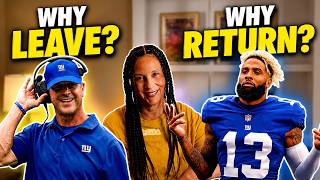
Dr. Cara uses Odell Beckham Jr. and John Harbaugh's NFL moves to show when leaders should reposition people or themselves. Gallup research shows strength-based work drives six-fold higher engagement. Harbaugh left after 18 years to start fresh; OBJ circled for seven years before returning to the Giants.
Chapters
O'Dell Beckham Jr. is a New York Giant again. The kid who made the greatest catch most of us have ever seen back where it all started 11 years later. And the man who brought him home just walked away from the most stable job in football. John Harbaugh spent 18 years building an empire in Baltimore, a Super Bowl, and almost 200 wins. He left all of it to start over with the Giants. What looks like a sports story is really a masterclass and one of the hardest things any leader ever has to do. Knowing when to move a piece, when to move on, and when to circle back. Whether you run a team, a company, a classroom, or just your own career, this one is going to meet you where you are. The principle comes down to this: knowing when to move the pieces. Moving is recognizing the same person in a different spot, or the same you in a different room, can finally fit. Moving a piece is not giving up on someone. It's not a failure. It's not disloyalty. It's reading through the board with clear eyes and admitting the current setup has stopped working. Most leaders wait way too long to do this. You can tell you're avoiding a move you already know you need to make. You keep coaching the same person on the same thing and nothing changes. You've got a star stuck in a seat that hides the very thing that they're great at. Or you're the one in the wrong seat yourself, telling yourself that loyalty means staying put while you slowly dim. The last one is the tell. Look at John Harbaugh, 18 years in Baltimore, the kind of run that most coaches never get. He could have stayed forever and nobody would have blamed him. Yet he left. And listen to how he framed it. Harbaugh said the best advice came from Randy Reid in 4 words: Change can be good. Then his own brother Jim told him the thing that he needed to hear. You're going to be really excited to walk into that room for the first time with a different team and just a fresh start from beginning and build it up the way you want. 18 years of winning, and the move that excited him the most was the fresh start. Not running away, not reading the board. If there's a move that you've been circling, a person, a role, a team, maybe your own, Take it somewhere safe first. My Virtual Mind. It's the closest thing I've got to helping you think through it before you make the call. The link is in the description. How does moving the piece matter this much? One word: fit. Gallup has studied this for decades. They found that people who get to use their strengths every day are 6 times more likely to be engaged at work. 6 times. Same human being. The only thing that changed is whether the seat fits what they're built to do. So when a leader leaves someone stuck in a wrong spot out of loyalty, that is not kindness. That is 6 times the disengagement dressed up as being nice. There's a line from Harborough I just can't get past. When they asked him about bringing Odell back, he didn't gush. He said this: It's got to be right for both parties. Both parties. Not just this is a good fit for me. Is this a fit for the other person too? That one sentence is the whole philosophy of moving pieces well. Watch how he built it. He didn't chase the biggest names. He brought in the players who fit the vision he was selling. Juju, Braxton, Odell, veterans who knew their role and could show a young quarterback how it's done. Each one a piece chosen for a fit, not for a flash. And the most emotional piece on the whole board was the one coming home. This is where it gets personal and where connected leadership shifts it for you, because moving on is only half the lesson. The other half is this: moving on doesn't mean that you can never come back. It means you circle back if and when it makes sense. Picture an airplane in a holding pattern. The runway below is socked in. Wind, storm, no visibility. A panicked pilot forces the landing and people get hurt. A wise pilot does something that looks like doing nothing. They circle, they stay up there watching the conditions, waiting for the runway to clear. And when it clears, they bring it down clean. Circling isn't quitting, circling isn't lost, circling is timing. That is Odell Beckham's entire journey. He left the Giants the first time And yeah, it was pretty messy. A trade years away. Cleveland, a Super Bowl with the Rams. A season with Harbaugh in Baltimore. Miami, a full year out of football. And he circled the whole league for 7 years. And the moment the runway cleared, a coach he trusts, a city he loved, a real need, he came home. Listen to what he said about New York. It's a place I never wanted to leave, and it's just a special place in my heart. Just hoping for the best. And when the deal was finally done, he wrote a quote: "Nothing was ever given to me. I worked for everything I have. Never give up on yourself. Home team, I'm back." He didn't force the landing 7 years ago. He circled until it made sense. The step underneath that is what I call perceive. Perceive is the pause where you question the story that you've been telling yourself, the story that says leaving means failing. That coming back means weakness, that a door closed is closed forever. Remember this: the only control that you have is how you receive, perceive, and respond. Most people jump straight from feeling to a move. Perceive is the part in between. What this looks like for you is one honest question. Think of a piece that you keep avoiding. The teammate in the wrong role, the relationship that's been off for a while, The job that you've outgrown. Before you force anything, ask, is this a runway that I land on today or one that I circle and come back to when it's clear? Sometimes the answer is move now. Sometimes it's not yet. And not yet is not the same as never. Either way, you just made the call on purpose instead of by accident. If you want to see which moves you tend to force and which ones you avoid until it's too late, Take the Leadership Origin Profile at the link in the description. It's free. It shows you the pattern that you've been running since long before you had a title, the one that's been deciding when you hold and when you let go. Leadership without reflection becomes reaction. Know your worth, know your truth, and know when to pivot. I'm Dr. Cara. This is Connected Leadership. Connect to yourself so you can elevate and expand for yourself and those you lead.