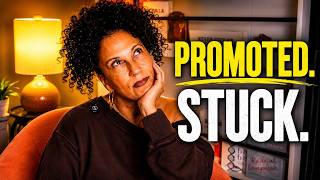
Dr. Cara explains why newly promoted leaders feel they're performing worse despite working harder, using the Peter Principle to show the skills that got you promoted aren't the skills you need now. You must shift from doing the work to leading others, from being the smartest person to making your team smarter, and from controlling outcomes to influencing them through people.
Chapters
You used to be really good at your job, then you got promoted, and ever since you feel like you've barely been keeping up. You're working harder than you ever have, but you're getting worse results than you used to. And maybe in the back of your mind, you don't want to admit it, but you're thinking, "Maybe I'm not actually good at this." Well, there's actually a name for what's happening to you. It's been around since 1969, and almost no one explains it in a way that actually helps you fix it. We're gonna break down what the Peter Principle actually is, why you're feeling isn't incompetence, and 3 shifts that you can make this week to actually show up well in this role. I'm Dr. Cara, and I spent years working with leaders who got promoted into roles they were absolutely qualified for. Smart, capable, earned every step, and almost every single one of them, somewhere between month 3 and month 9, says the same thing. Think, I don't feel like I belong here anymore. Back in 1969, a guy named Laurence Peter came up with what he called the Peter Principle, and the idea was really simple. At work, you usually get promoted for being really good at the job that you're in. So the best engineer becomes a manager, the best nurse becomes a director, and the best salesperson becomes a VP. And eventually you end up in a role that you never actually done before. He said that people rise to the level of their incompetence. Mm. He said people rise to the level of their incompetence. And that's the part that everyone quotes. But honestly, that's not the part that really matters. You're not incompetent. You just got promoted out of the work that you were really good at into a job that requires a completely different skill set. The skills and the talent that got you here aren't the same skills that you need anymore. But that's not you failing. That's just a gap no one ever explained to you. If this is the season you're in right now, I built a resource called Dr. Cara's Virtual Mind for moments exactly like this. It's a partner that can help you think through what you're facing, and it will talk to you the way that I would talk to you in the middle of a meeting that didn't go well or the morning you have no idea what to say to your team. Link is in the description. Now let's get into what this actually looks like at work. There are 3 specific shifts that no one prepared you for. Shift 1: from doing to leading. You used to deliver the work. Now you're responsible for work other people deliver. You can't control the quality the way you used to. You can only build people who care about the quality the way you do. You used to be the smartest in the room. That was a value that you brought. Now your job is to make the room smarter. If you keep being the smartest one, Your team stops thinking, and then you become the bottleneck. Shift 3: From outcome to influence. You used to control the outcome by doing the work yourself. Now you can only influence the outcome through people, systems, and timing. The harder you grip, the less influence you actually have. These 3 shifts aren't personality flaws. They're a leadership skill set that most of us were never taught. So how do you actually make those shifts? For me, it comes down to 3 pillars, and I call this my framework for connected leadership. Pillar 1: Recognize value. Your worth isn't in your output anymore. That's the hardest part of this transition. For years, your job was to produce deliverables, numbers, wins. Your job is to produce people who produce. If you keep measuring your worth by what you personally finish today, you will feel useless every single day. Recognize the value of building the conditions for other people to do their best work. That's your work now. Pillar 2: Embody grace. You don't have to be perfect at any role. You didn't have to be perfect in your last role at day one. You learned it. You grew into it. You're allowed to grow into this one too. The leaders who burn out the fastest are the ones who got promoted and then refused to let themselves become a beginner again. You can hold high standards and be at a learning curve at the same time. It's not a weakness. That's grace. Conquer control. Think about a basketball player driving to the hoop. A defender shows up. They don't force their way through. They pivot. One foot stays planted in their purpose, their values, their standards. The other foot moves. That is what the transition asks of you. Stop trying to control everything that's changing around you. Start measuring how you receive what is happening Perceive what it actually means and respond in a way that fits the moment. That's what real leadership control looks like. Not gripping tighter, pivoting smarter. If you've been working harder for worse results, if you've been wondering whether you can actually do this role, if the gap between who you were and who this job needs you to be is keeping you up at night, the next best step is the free assessment on my site. It will show you how you tend to lead under pressure, which matters because the way you handle this This gap is the way you'll handle every promotion that comes after this one. The link is in the description. You lead well. Now lead as yourself. I'm Dr. Cara. Connect to yourself first and then elevate and expand for those you lead. Until we connect again.