Conversations with My Former Self: Navigating Career Transitions with Dominic Imwalle
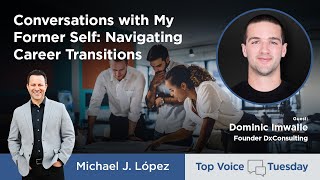
Transcript of a Top Voice Tuesday conversation (Oct 21) between host Michael and Dominic Imwalle about Dominic’s recent transition from a Big Four consulting role (Deloitte) to founding a coaching business focused on helping job seekers and professionals. The discussion covers Dominic’s content strategy (LinkedIn focus, newsletter, weekly videos), reasons for leaving corporate (desire for focus, values alignment, financial preparation), early entrepreneurial challenges (uncertainty, seeking community), practical advice on client selection and feedback, and personal reflections (childhood curiosity, importance of showing up).
Chapters
Hello and welcome to Top Voice Tuesday. It is October 21, deep in the heart of fall. I hope everyone is enjoying the weather, the season, and I'm excited to have Dominic Mwale with us here to talk about a conversation with my former self. It it sounds like an interesting title and we're going to get into it, but when I met Dominic about three months, four months ago, we knew that he was in a place where I was years ago and is now making some changes. And I thought what better way to have an episode than imagine I was talking to myself 20 years in the past. Or in this case, Dominic's future self. We are kind of on the same track. So really excited to have you here, Dominic, and excited to have the conversation going. For those of you that are on LinkedIn live at the moment, please do leave us a question, a comment in the chat. We'll be sure to get to that. For those of you that are listening on your favorite podcast platform, please go ahead and subscribe. If you haven't done that already, stay tuned to the end. We always talk about what's coming next week and what's coming down the line. So, Dominic, we have an opening question here that's the same for everyone. Tell us who you are, tell us what you do and how did you get to the top of the Top Voice mountain?
Awesome. Michael, super happy to be here. I love these. I love riffing on these and just having this conversation. I've loved the title since we talked about it and so a bit about me. You'll see it in my headline and what I'm talking about each day, but platforms, not people. My goal is to build job seekers and professionals who look back on their career with a network of advocates versus an inbox of rejections and notices. I want people rooting for them, inviting them into the fold and unlocking their career for them. And to your point about the Top Voice mountain, my first response there is who knows, right? At some times I've had people reach out to me, ask to sell that as a hey, can you sell that as a service? Can you get me up there? And there is no blueprint except showing up every single day is what I've seen. I've been engaging on here for the last five plus years and was just blessed to meet a lot of cool people along the way. A lot of people who lifted me up, picked me up, asked me good questions and showed me how to do it to the right way and just serve people at a high level. So it's definitely this Platform continues to change. Day.
Oh, I lost you there.
Yeah, I lost me for a second.
That's all right, say that again.
So I would just say it's changed over the years, this platform and whatnot, but I like to think I show up on here real and raw and post great informative contact. And that's what I've heard from LinkedIn about why the top voice is there. So that's what I'll hang my hat on.
Yeah, yeah, it is a little bit of a mystery. And it is, I think you mentioned there's a. There's a key attribute which is showing up consistently. And what's your strategy across your different social platforms? I mean, obviously we're, we're on more places than just one. So do you have kind of a game plan that you think about as you put content out there?
Yeah, yeah, I do. And I would say it's, it's a risky one because I'm all in on one and it's LinkedIn. And that's. It's been that way since the start. You can find me on Twitter talking about the job search and also just business building and life in general. But LinkedIn is where I'm serving people, waking up every day and I'm on it and. Right. That comes with the risk. You see people get locked out of their profiles, you just see different things happen at all times. And so outside of LinkedIn, I'll spend time on a newsletter where I can just go into a deep dive, learning. Right. I usually post a video once a week on Saturday mornings or whatnot. That goes about four or five minutes, where I just talk about one thing. Hey, this is one thing I believe you could take away or implement this week. And so my newsletter is where I write about that more. Just write about what's going on in life and whatnot. But I've been all in on LinkedIn and it's been fun so far, but I'll definitely have to consider my avenues as we go forward. Sure, sure.
So you've just made, before we get into the time dimensional conversation that we want to have, you've just made a change in your career. And part of why we started this topic was you were, you were at a big four company. That's where I started much of my consulting career. I started a little bit different, but. But ended up there before I made the jump. So tell us about the journey that you've been on and the change that you've recently made and why you made that, that shift.
Got it, got it. Yeah, we got to argue about who's the best. Big four, right? So I started at Deloitte and I spent five years there. And so from zero to five years simply doing the work. I came out of school and I had all these different professional experiences, industry startups, whatnot, before I jumped into Deloitte. And then naturally people just started coming to me for resume, career advice, what not. And that was early on. And so I had always had a business building mindset, so to say, or just was around those voices all the time. And that just led me to say, okay, what am I natural at? What's in my gift? What do I love doing or enjoy doing? And so I kept coming back to people and helping them unlock their careers. And so I would say about two years after school and just head down at Deloitte and you know how it can be just those many hours and whatnot. And I had started during COVID so I was living online a bit more and whatnot and starting to create on LinkedIn. But I got around people who were doing this for a living. I had no idea you could be a coach for a living. And it's almost the same route I coach people on these days. I'm like, hey, go right? You got to go spend time with the people who are doing what you want to do.
Yeah.
So after I had learned enough, I was like, wow, this could be a game plan. And so then I spent the next three years building, you know, an exit strategy, so to say, if you look at it and call it that. Sure. But at that time I was also just trying to rack up as many professional experiences as I could because you and I both know you can collapse time in these professional services firm. You can have the wildest experiences from week to week. So that's what I did.
Yeah. Why now? Why, why did you make the change now versus it sounded like you were balancing these two things pretty effectively, which is hard to do inside of a big four. Why, why did you decide to make the jump now?
Yep, this is one I've wrestled with for sure. You, you don't leave behind a six figure salary and traveling the world and cool opportunities and great people. I love the people I worked with before I exited, but it just started to eat at, eat away at me and I needed some added pressure. Like it was just, I was coasting on by. I didn't see too much growth and I just wanted to create a place where, hey, this is. You wake up every single day and this is what you focus on. And if you go back to a couple weeks ago on LinkedIn, that's what I talked about. I said, hey, I'm here to obsess over this for a year. How can I help people break into the roles they want? How can I help them unlock their career? And I'm going to focus on this for the next year. And so that's what I wanted to do. But it took forever to build and I don't think that's what people realize. Like there were some things I wanted to do financially in my personal life, like I got to take my parents on vacation, I got to buy the house and in Cleveland, Ohio, like I got to do all these things that took a few years and what felt like forever and all those hours you bill and whatnot to then go ahead and build a cushion to say, hey, you know, this is what you're going to focus on for the next year and it's not going to be pretty all the time. I can tell you in the three weeks that I've been working for myself is not all glamorous moments. At lunch you're, you're riding a low and then at the evening you're riding a high and it's, and you're trying to find that, that balance and whatnot.
Yep, yep, we'll talk about that. I, I want to get into the conversation about again, kind of looking forward and looking back, but one other question about your maybe let's talk about the experience and culture of the big consulting world because that is such a, an alluring and all encompassing environment and you chose to exit from it. I, for years went through a couple different companies trying to find something but, but you've always had a little bit of this, maybe other different kind of demeanor. I remember when we talked about this and I was always the same. I, I was always somebody that was very much cutting against the grain, a bit of a troublemaker, not afraid to raise my hand, push boundaries. And I remember somebody saying to me inside of one of the companies I was at, I don't need to label them necessarily. I worked at ey, I worked at kpmg, so the story doesn't matter. And I remember someone saying to me, we have a business model and this business model is what it is and it will always be that way. And you can only be successful in the business model, so stop trying to break it. How did you feel when you look back and you started your career again? Five years in a big four is not very long. What was your trajectory? What was your path and how did you feel the pull of kind of staying there versus this pull of going out and going on your own?
Great question. I mean, you spend 10,000 hours doing something and it feels like forever when you're in it, and then you look back on it and you're like, whoa, what just happened? For me, when I look back to the situations in there, I was kind of those first few years just kind of so excited to be a part of drinking all the corporate Kool Aid, of being in a Big four firm. And then when Covid unlocked and I had the chance to travel and go coach internal audit departments and go work with different folks and find a different group within Deloitte, that helped me a ton. I went and chased getting around different people and people who kind of broke outside of that traditional business model, if you will. Like, we're not on the same traditional talent models that Deloitte has, and that helped me a ton. And when you talked about that bug, right, like. Or that thing, right, that, hey, I always went against the grain. I found people that lived that life, but I can't discredit the first two and a half, three years where I did not find those people. And it was just ugly at times, right? Beautiful moments, but ugly for a majority. I was struggling to find my footing and whatnot. I got involved with a ton of different groups, worked with human capital side, worked on internal audit. Like, worked with different people. And that's what helped me kind of expand and see what was next. But when you talk about pathway and whatnot, right, it's pretty rigorous where you're going to go, right, hey, next year's manager. And then after that, what's your case for senior manager? And what does this look like coming out of that? And so I just was done playing that game, and that's all it was. It's a beautiful game. It works for something crap. You have the MD title. You know, you've seen this game, you've seen how it works. And I still think it's a great game to play for most people, but I was just trying to play a different one at this point in life. And that's what led me. It just had finally eaten away at me. And so then it was, okay, how do we make this leap?
Yeah, we had Firus on two weeks ago and we talked about him. He's somebody who balances both of those, but he's in a different sort of traditional corporate job. So let me give you a chance to ask me some questions now that you've made the jump. And I'll maybe share one thing in advance of the questions that you asked, because when we started this, you were still at Deloitte and you hadn't made the move. So now you've made the move and you've got the entrepreneurial side in front of you. But let's maybe address this idea that you've shifted from a job with high security and high income potential and high certainty in terms of the business model and the outcomes and all of that, and you've traded that in for something different. So as you think about what you're about to trade in, what questions do you have for somebody who's maybe 25 years ahead of you? But in some ways, we've now made the same jump. Although I'm just. I'm sort of 25 ahead years of you in life, but two years ahead in the entrepreneurial journey. But, you know, 15 years ahead in the big four space. So have at it.
Okay, awesome. So you see those two years go, right, like two years on your entrepreneurial journey. And that time, I imagine, moves so fast, and there's so many different ups and downs throughout it. And right. Each week, I'm learning from a different client and how they show up and whatnot. But has there been a favorite favor failure, if you will, or time where, hey, we just missed the boat here, or this didn't work out how I expected? Because one of my concerns is how do I know when it's time to just pivot in an offering or pivot when, you know, I need to go serve someone in a different way? And how do I realize that and admit it to myself? Because it's. It's just me behind the scenes right now.
Yeah, well, there's. There's many. And I'm actually going to give you two answers. I'm going to give you one from my consulting days, and I'm going to share it because it does relate to my entrepreneurial business. Now, I don't think I've ever really told this story, but I got. I got fired from a client job because I pushed back against a client. And I only found out because I showed up to the client site. This was in Colorado, just like in Fort Collins. So it's a beautiful part of the country. And I travel there on the normal Monday morning. I leave, it takes like eight hours to get there. By the time you travel, fly, you know, get, get, get in the car. And I, I figured it out because they deactivated my badge and they didn't tell me why. Did they do that? Because we were running a little pilot to take 100 people that had volunteered. This was a big SAP implementation and we were sort of trying to change culture at the same time. And there was 100 people that had formed this core team and they were going to be the kind of disciples and functional experts for the different work streams within the SAP structure, order to cash all these different things. And they had this consultant come in and he was a no nonsense, hard charging, get it done, process technology kind of guy. And he came in to get the schedule back on track. He and I very quickly did not see eye to eye on things because the first thing he tried to cut was all of the work that we had done for these hundred people. These people had moved, they had changed their lives, they had left promotion paths to come join this. And his whole strategy was, we're going to get to green, meaning the schedule, and we're going to do that by stopping all this other stuff. And I simply didn't allow that to happen. And we got into some disagreements. Not really, you know, verbal shouting, but just a different seeing eye to eye. And my whole point to him was we've made a promise to real human beings that have lives. And if you say to them their lives matter and their careers matter and the first thing you cut is the thing that they raise their hand to go do, then you're, then, then you're simply telling them that they don't matter. Well, after several different interactions of this, I show up, my badge is deactivated, and nobody will tell me what's going on. Two things happened out of that. Number one, I got to say I was fired from a client job. First time it had ever happened. If you work in consulting long enough, it's going to happen to you. First thing was I realized something really important about me as an individual consultant is that if you want to work with me, you have to work. You have to understand that I have a certain style and a certain value set. That's really important to me. And there were some things I could have done differently in terms of maybe managing the client. I made some mistakes in execution, but I didn't make any mistakes in my values and in how I show up and pushing people to be better selves, better clients, better people, better humans, better managers, leaders, whatever you want to call it. And it really helped me understand that that's who I am and those are the kind of people I want to work with, not the ones that are just going to upsell you on some job later or the slimy consultant kind of Persona that was first thing. The second thing was that night I had another client that I'd been talking to. They asked me to write a proposal for them. We had met with them a year and a half before, and this proposal comes out. 24 hours later, I write this proposal. We had gotten snowed in, so I couldn't fly home. I was stuck in the hotel. Twelve hours later, I write this big proposal. And we won that job, a several million dollar job. And a week later I was on a plane to another client. And it reminded me that there's always something else coming that you don't know is just around the corner. And that's a long story, but I share it because as you make this transition, yes, you're right, the time windows condense and, and you're paying yourself, so it's not like you have a salary to lean on. But over the last two years, two things have become really staples of my business. My values and my faith that the things I do and the way that I work and how those values get put into place. There's a client out there that needs what I do. And rather than trying to go find the universe of clients that have a problem, I need to find clients that want to work with someone like me. And that's. Those are the two biggest things that have come through in this journey that I've been on over the last couple of years.
God, I love it. It's so easy to get behind someone who has admitted, who can admit, like, hey, I made a mistake here, but you know, I stayed true to who I was as a human being. It's a, it's a beautiful thing.
And. Right.
I could run 100 million miles per hour behind someone who can admit that. Next one I got for you changing a little bit here. There's obviously a ton of people that you love in your life. Congratulations on the twins. I saw the LinkedIn post and whatnot. As you go around, family, immediate, extended, whoever it may be, close friends and whatnot, and they, and they ask you how things are going, what has been your maybe go to or how do you bring people along for the ride because you as the owner, you on the backside know the 55 different things you've touched that day and how you've operated and how you show up and what this looks like. And you could go on that for hours. And they don't understand that and, and you don't need them to, but you want them along for the ride and you want Them, you know, maybe want them to understand. But any advice in. In that lane?
It's a really good question. It's sort of the equivalent of when I pick my daughter up from school and I say, how was school today? And she goes, good. You know, there. It's. It's. It's. It's. Obviously, it's a very incomplete answer. You know, certainly my. My wife, who still works at ey, she's on maternity leave now. She understands very deeply what I do and how I do it. And we work from home a lot. So, you know, we're here listening to each other, talking about clients, and she is a big. Obviously a big recipient of the success of my business, and we've got a growing family. So, you know, certainly, first and foremost, she's the one that gets all the. In the raw form. And she's somebody I trust deeply, personally, of course, and professionally, she's got a lot of really great insight. So I'll riff with her a lot. And then I have, you know, next in line is my best friend, who's my chief creative officer, Brian meddling by in. And he does all my brand work, and he's done all my website design and all of the journey that we've been on to create the Persona and the image of what I do and how I do it, because that's such a big piece of my business. It's not just, you know, the easy way to understand it is I do change management, but that's not enough. It's how I do it that's different. And so that story. We're on the phone three, four times a day when you start working on concentric circles, out. I think there's two dimensions there. One is there's people that love you, that want to know you're okay, and you're taking a bit of a risk. Your mom, your dad, your family. Are you doing all right? Are you eating? Are you sleeping? All these kind of questions. I think you want to give them enough to know that, yes, you're okay. And the hard parts, even if they're hard, they're serving a purpose. And it's supposed to be hard, and it's supposed to be hard because it's worth it. And so I think those conversations are really important to curate in a way that doesn't get people too worried about what you're doing. I think there's another category of people that are like business associates, mentors that you do need outside of that group, where you need to be able to talk about the Hard parts and, and be really, you know, add me to that category for you. Right? You know, I spent a day doing stuff. What did I do? Was it worth it? I've worked on my website. We did, you know, all of these things. And so you need a place to go. Is the experience. I'm having the right experience. And right doesn't mean good. Right means, yeah, this part sucks and it's very difficult. So I think you've got to have that category. And then there's the, there's the looky lose, the folks that just come by and like, what are you working on? You know, and that's a, you know, that's a networking event conversation where you're just talking about high level stuff. I think, you know, I think I would say that it's really important to just be real about what's going through, what, what you're going through. Share the highs, share the lows, ride the highs. As long as you can dig your way out of the lows and, you know, understand that. I think the last piece is understand that the people who aren't going through this journey will never fully understand it the way that you do. Yeah.
And I feel like I hang my hat on that more often than not. And honestly, it's such a measure for when I go have a conversation with someone, hey, can I admit it in front of them? Like, hey, this isn't all that it cracks up to be like I'm doing right now, right. There's times where you're super low and hey, I just did this wrong. I showed up wrong here. And having people around you has been around me that I can just share that statement with has been a, have been a game changer from the start.
I have a question for you on this because I think it's important to hear from your perspective about one of the big differences as we move through from a big consulting world where you're surrounded by resources, leaders, service offerings, clients, you don't have to go really sell, you just have to show up to project kickoffs and you get plenty of your revenue money and all that stuff. Now you're kind of on your own. So how are you starting to set up yourself and surround yourself with people and how are you managing that energy of just being you in the computer in a coffee shop somewhere? I saw one of your LinkedIn posts and you were doing some of that. That, that's a big piece. I wish I had known early on I always sought the safety of other people around me and just to be Very frank. I was scared to do what you're doing now. I was scared it was easier for me to be safe in a big company and be a little bit of a rebel.
Thank you.
Than to actually go out on my own. Because when you're on your own, you're on your own. So how are you managing that experience? And what are you starting to put in place for yourself to be successful?
Yep. Got it. The biggest part I was scared about when I was leaving Deloitte was telling people I was gonna leave. And I quickly realized over the last few weeks that the scariest part is actually the few weeks after when you're alone with the work. And I should have been more scared of that because you're spot on. I've done a good job at.
Right.
I have a good community here in Austin and whatnot. But, like, it is just me, my orange covered laptop and just banging away most mornings and whatnot. And so what I've been doing to try to get out is right. There's a couple friends, hey, are they working on their job search? Are they changing up their career? How can I go spend time with them? Okay. As I try to find my rhythm? Because right. This is week three, week four, you're talking to me in today. Actually a couple of coaching calls this morning. And then I'm actually headed to Austin's Capital Factory for just Austin Tech Week to hear from. There's a hiring panel and whatnot that I wanted to hear from. So really pushing my. And then I'm going to a job seeker happy hour just to listen to professionals tomorrow evening. And so forcing myself to get out into the market and just listen and talk to people and. And be okay with saying, right, hey, Dominic, founder, run my own coaching business. This is what I do. Because you're right.
Right.
Like, I got on a plane every week, every three weeks to go spend time with a, you know, 25 different people. And it was super easy. And I had. And someone pulled me aside actually when I was leaving. They say, hey, you're probably going to miss the professional development piece of it. Right? Like someone always investing into you or getting pulled into meetings or cool webinars and setting up experiences. So that's how in the immediate term, right. Just getting out in my domain and trying to be a better person. I actually spent an evening volunteering just to, like, go see people and. Right. Like, be out in my community and whatnot. And then one of my bigger goals for next year is actually to do an in depth, like, experience with a Job seeker or professional looking to make a change next year and go spend three to four days with them in person. So bringing that consultive travel back to the. To the game. But those are some things I've been working on the immediate term because it is. It's a weird way trying to structure your days around, hey, what am I doing? Deep work, when am I coaching? What does this look like? So, yeah, that's been what's worked so far, at least. I feel pretty good this week.
Yeah. I would say, as a piece of advice to you as you embark on that is you asked me this earlier. How do you know when to adjust? Getting out and being with people is incredibly important. And you're.
So.
You're doing the right thing there by not sitting alone in a room typing away, because there's only so much you can. Only so much feedback you can give to yourself. And you need feedback from other people, particularly in this job economy, which is really pretty tough. And there's probably two ways to look at it. One is you need a. A hiring coach now more than ever because it's so competitive, or, you know, how are you really helping me? Because it's just so random that in, you know, in the way the job search is kind of moving on. So. So that's. That's. That. That's worth exploring and getting some feedback. As you get that feedback, what I would tell you is ask people very specific questions about what they think they need and why they think they need it. Why would you hire someone like me? Why would you not? Let's be honest. You're not. I'm 52. You're not 52. Being 50 comes with a bit of experience of, you can sell the idea that I've been around. You're much younger in that career arc, so why would you hire someone like me? What value do you provide? Not that you don't have skills or experience, but people look at that and they go, oh, well, yeah. I mean, how much can you really know? You've only been around the block for a little bit. Right. So it's important to ask those questions just like you would at the end of a consulting engagement. What did you like about what we did together? What did you not like? What could make it better? What recommendations do you have for me as we go forward? So those sorts of things, as you get out, be very transparent. My name's Dominic. I'm starting a new business. This is what my business is. Hey, I'd love to know what you think about it. Why do why do you think it would be helpful? What makes me different or what do you think would be different from all the other coaches? And you know, I, when I look at the first version of my website versus what I do now, I've probably changed it 50 times. And we're going to change it again because in 2026, we're doing some, some cool new stuff. And so that process of continuous engagement and questions and feedback and adjustment really never stops. You have to be the one to bring the energy into that interaction, just like you would in a consulting firm where you've got to meet other partners, go to other client accounts, go to other projects, you know, get outside of your bubble, because that, that bubble is going to hold you back unless you're willing to go move outside of it.
That's the goal. Show up and listen. Show up, listen, ask your questions and be a student of the game.
Yeah, the other thing I'd say, and we're almost at time, and I want to get to your bonus question, but you have a question for me that I think we're going to rapid fire a few things. Things. The other thing I would say is it's, it's, it's. It. There's a real pressure in this world of entrepreneurialism after you've been in a big consulting firm to chase any project or any client because you need it. And I certainly would say that, you know, revenue is important in the early stages, being able to not eat into your nest egg that you've set aside to buffer you. I was really fortunate. I had a client that I had signed on before I made the transition, and so it made it easy, easier, but there's certainly some dips. I think it's important for you in that feedback mechanism to really understand what is the kind of individual that I want to work with. There's a ton of search firms, there's a ton of executive hiring panels and search firms. And so who is the person who, that you want to work with? And in the early stages, I think it's important that you then decide, am I trying to make money on that or am I trying to cover my costs so that I can build a bank of success stories to be able to go out into the market and charge higher rates or whatever it might be. And so I would just encourage you to be thoughtful, not careful, but thoughtful about not just chasing something because it's in front of you. You might do that and learn the hard way that it wasn't the right one. And so you've probably got to have that experience too, but. But that's just something that I know. Looking back, I wish I would have been more willing to say no in places where, see previous conversation, that individual maybe didn't line up with my values.
Yeah, I have to spend time with the people on the call before I work with them. And it makes so much sense. It goes a long way. You're going to be working with these people for a good bit.
Yeah. Yeah. All right. Right. Before we get to your bonus question, you have a, you have a question for me?
So question I have for you. Just a couple. If you had, you know, two to three tweets or just takeaways around your life that, that you love, or just sayings that you keep in the back of your head that keep you going throughout the day, or just something you've learned and want your one liner. Um, if you had two to give me, what, what would they be?
The first one is attitude and effort are the only things you can control. And I share that. I share it with my athletes that I coach. I think about it every day because, you know, the energy and perspective that you bring to this experience every day. No one, there's no one behind you. It's up to you. And, and what, what separates most people from success is, is not the desire to have the outcome. It's the willingness to generate the inputs that are necessary for success. To do the work and to do the work when they don't want to and to do the work when it's hard. That would be the first one, I think, and that's something that I share quite a bit. The other thing I would say is maybe this is a little bit too cliched, but you've got to enjoy the effort, enjoy the ride, enjoy the journey. Stop focusing on the, the outcome. It's not the out. The outcome happens when you're willing to do the work for the input. So focus in the moment, focus on the effort, focus on what you're putting into this journey and the failure that comes with it. Every failure is one step closer. I think the phrase is every. No is one step closer to the next. Yes. And I think you really got to enjoy that process. Enjoy the journey of running your own business and being your own boss. There's so much flexibility and awesomeness to it. There's a lot of challenge. But enjoy the journey that you're on because you've made the first big decision, which is to be in it. I wish I had made this decision. At the same time, you Are I truly do if I don't have many regrets in my life. And it's not a regret. It's a. I wish I had done this a little differently. I was just too scared. And so enjoy it. Enjoy the. Enjoy the stress, Enjoy the journey. Enjoy the uncertainty. Enjoy the fact that you don't know what's coming next, because that's part of the beauty of what you're heading on. That's more than a tweet. That's probably a longer post, but, you know, the tweet is enjoy the journey.
I'm hanging around for all of it, man. Thank you. Yeah.
Yeah. So I want to get to your. Your bonus question. As you know, we always have a question every week that's left from the last guest. I've shamelessly stole this. And so here's yours. And. And this is perfect. They always work out so well. So do you have a childhood interest that has informed who you are and what you do today? And. And how is that showing up in the choices you're making in your career?
Oh, that's a good one. So I. I left it on a comment yesterday, but my mom and. And to this day, love her to death, can talk to a brick wall. And she instilled that as much as she could in all of her kids. And so from a. And it's actually one of my tweets I was preparing. Right, Right. I tweeted it the other day. Funny that your ability to say good morning to people can completely change your life. Right. So my ability to just talk to people, even. Right. Like, I gotta go do it this afternoon, or I've been doing it since such a young age and just wildly curious about. Right. How did. How does that relationship work? What do they look like? What do they bring to the table? What does that person do? And just being curious about people, but being people focused from the start has changed the game for me. And it started all the way when I left Ohio and moved to Austin and was down around a bunch of different people doing different things. But I would say that's more of the childhood memory, because my mom can tell you about times I was asking questions when I was way too little to be asking those questions and whatnot. And so it's just that curiosity and people focus that. Right. You see me coaching and teaching people about it to these days. But that skill and that ability that she kind of gave me has definitely paid off and is one that I continuously take with me.
Yeah, I love that. And as someone who now has little Kids again, I can tell you we are who we are when we come out. We're pretty much the people again. We learn a lot of stuff and we grow and we mature, but there are some core elements of our personalities that are pretty established. And so I just love that you've been able to track that all the way back. Before I ask you where we can find you, you said you had some other tweet takeaways and I didn't go back to you. So what are your other context?
The other one was we leave rooms a little too early too often. There's great people in awesome rooms that you're hanging out with or just people that are doing that. Right. Like when I got around you. Oh, you're doing or transformation work at different. What? That's so awesome. And you run it on your own. And just to sit in that room, even if you don't have a talking piece, is so important. So important to just hear how it operates, what's being said, who's the leader, whatnot. And just understanding that has been pivotal for my 0 to 5 years in corporate America. And then the last one, I love getting outside. I love training and whatnot. And so I said no headphones for 10 miles. The world will provide you a movie. So just getting out, being active, enjoying life a little bit, and then getting some exercise in really resets the day. So those are some of my tools, tweets that I've had recently.
Love it. Love it. I don't think we follow each other yet, but I'll, I will make sure we do. And I'll. I'll retweet some of yours. Dominic, where can we find you? Where can we learn about your new business beyond LinkedIn? Is there anything else we can. We can find and anything you also you want to leave for our audience today?
There is nowhere dramatically else that I'm working outside of LinkedIn. You can come to LinkedIn, you can, you can head to my newsletter, which has all my past editions, and there's a nugget you can take away. There's free gbts. There's just all these different tools that you can take with you. And it's free advice like there, you don't have to pay me for it. And whatever it's out there, I'm posting every single day on LinkedIn practically. Again, free advice for you to take with yourself. And if you just wanted to start a conversation, shoot me a ping on here on LinkedIn, I'm happy to chat. And then outside of that, I'm continuously bringing folks into my conversations over applications, community right now and coaching those folks through that. So that's what I'll be working on for the for the next year.
Love it. I love it. Well, I'm proud of you as someone who sees his younger self in what you're doing. I'm proud of you to have the courage to make the steps, to follow your passions and to be willing to take the risks and step out of fear. Those are things I wish I had done sooner. I'm glad I'm doing it now at this stage. This was my path. It was meant to be. And so here I am, here we are. And you can count me as someone who's going to be in your corner and whenever you need it. And for those of you who are in similar spots and deciding where to go and how to think about your future, you know, remember there's someone who's been on the path before you and ask those people questions, reach out to them, understand. And not just ask them questions, but listen to their answers. Because there aren't many experiences that we have that someone else hasn't already had. The issue is not whether or not we ask the question, it's whether or not we listen to the answer. And sometimes I think we're all a little bit too caught up in our own journey and ask somebody. And I think that's what you did here. Ask me, you know, listen to the answers and go, hey, okay, I want to listen to that and put that into practice. So I'm proud of you. I hope everyone reaches out to you. I'll be a big supporter of your business as we go forward. For those of you that tuned in today on LinkedIn Live, thanks for. Thanks for joining. For those of you listening to your favorite podcast platform again, please do subscribe. We have a newsletter that comes out every week based on this platform and based on this conversation. And heading into 2026, we've got some new stuff coming. I. I won't tease too much of it, but we're going to be expanding and going even bigger and look for that information coming in the next several weeks. So, Dominic, best to you and we'll see you all next week on Top Voice Tuesday.
Thank you, Michael.