TEDxKC - Francis Cholle - The Intuitive Intelligence Movement

Francis Cholle argues that intuitive intelligence—blending analytical thinking, instinct, play, and letting go of control—is what business needs to solve creativity and sustainability problems. He maps it on an intuitive compass and shows how Google, Hermès, and the Obama campaign used it to break through.
Chapters
Thank you.
Good evening, everyone. The subject I would like to share with you tonight has to do with intuitive intelligence, just like Mike just said it. And I believe it is an approach that can solve America's business creativity and sustainability crisis. Now the question is, why this subject? Well, because I believe that without a higher level of creativity among all of us, we will not be able to solve the main, main big and challenges, huge challenges that we're facing here today in terms of sustainability. So when it comes to creativity in business, most executives, or a large majority of executives today, believe that actually innovation will be key to their success. And not only this, but most of them. It's another survey will tell you that creativity is number one leadership competency in the future. This being said, at a time when we probably most need in this modern age, creativity to help business reinvent media, car industry, food industry, but also creativity to reinvent our education systems, our health systems, and deal with international affairs and warfares all around the world. Actually, in America, creativity has been declining for the past 20 years. So the Newsweek magazine was actually showing about two or three weeks ago, America's Creativity Crisis as their main title. So my observation, when it comes to creativity, innovation and change are going to be the subject of this evening. But before I do this, maybe I should share a little bit about my path. So I was born in France, raised in Paris, as you can hear, probably, and my education is in business. So I went into the publishing world early on in my career. And this was a creative business, obviously. And after about four years, I decided to move on to something else. We had been very successful with the business. I had a little bit of money ahead of myself and I felt like it was time for me to do something else. So I went to New York to pick up business ideas. And actually what happened is a turn of fate. I entered an acting school at the time to study singing and acting. Okay. Which was really to my surprise because I never thought that day when I was leaving for New York, that's what I would be doing now. I've been living in the United states now for 16 years. I became an American citizen. So everything has been just changing according to no plan of mine, really.
But what I've learned on stage, I think had never learned in business school. And that's what I think has helped me to put together a model and a concept that I think can really be an interesting key into creativity and change and more importantly, sustainability. So I believe the two big things that are left out when it comes to creativity in Business is the first one, okay? Be ready. Okay? We are essentially unconscious beings as much as we see ourselves as being those who can think, analyze, and look at the world in ways that are very interesting through science, for instance, actually, neuroscience has proved that our gray matter, what makes really our intelligence, is more dedicated to our unconscious thoughts than it is to our conscious thoughts. Okay? Now, would you know by which percentage? Well, you know, this is the good old 80. 20. Okay? 80% of our gray matter is actually working on things that we have no clue about, okay? And only 20% of our intelligence is actually dedicated to what we think we know. All right? So that's the first thing. Now, what's really important, though, is that actually a great deal. And that's, by the way, research from Rochester University in New York State from 2004, 2005. Now, the interesting thing is, obviously, in our unconscious leaves new ideas, okay? Because if it were not in our unconscious, then it would be our unconscious. If it were in our unconscious, then it would be known ideas, okay? So a big deal of our intelligence is actually dedicated to live in that world where so many creative ideas are. So that's an interesting thing. And then the question is, how do I access my unconscious? Okay? So I could get to all these creative ideas. Obviously, this is through our sleep. But when it comes to business, sleeping is not exactly the answer. So I've been thinking, okay, so how do I do it? How do I get to my unconscious? All right? So the next thing that I realized as I was on stage, really to get to that singing or that moment of epiphany or that moment of drama was actually not through volition. It's through indirect ways. And that indirect way is play. What I call play is really the ability to immerse in a process, to really be fully present to what is. And when you do this, actually play allows us to elude the rational mind and takes us out of that 20% and brings us to that 80% where so much lives in terms of creativity. So, bottom line, simply put, play is our best instrument besides sleep, okay? To get and dream, to get to our creativity and new ideas. So my conclusion, putting together my experience on stage with what I've done in business, trying to help today business to be more creative and innovative, is that our analytical approach is actually quite a handicap in the Western world. Look, if you're thinking of boardrooms where these major strategic decisions are being made about the future of organizations, and if we think that innovation is key to success in the future, then look at These rooms, whether from the past or from today, they are all but straight lines, extremely geared towards conscious conversations in a very linear, efficient way, which is good to a certain degree, but that leaves out the 80% of our intelligence. That's quite a problem. So I would think that an office where people can actually play like kids would probably bring us closer to our creativity. And places where people can be re engaged physically will get us to that place that we call the unconscious. And then if we're able to do this, then your boardroom will be able to really break through that mental glass ceiling that's actually keeping us stuck, in my view. So I thought we absolutely need a new model for creativity and that's why I invented the intuitive compass. So let's get into it. We all went to school, most of us in any case, and we've been trained to develop our reason, our ability to analyze and to think rationally about things. Well, actually, in 2006, research at MIT proved that our instinct is actually always involved in our decision making processes. All right, so it's really not about opposing reason to instinct, but it's really about allowing a powerful synergy between that rational mind of ours that we've trained at school, which, with that other part of our intelligence that we call instinct that we traditionally leave out as being the thing that gets us closer to animals and really to our higher self. But actually that's not exactly true. The second dimension of the intuitive compass is this axis which goes from east to west. And that's the idea that in business we very much focus on results. We want to get things done, which is fantastic and great because there's a lot of efficiency there. However, if we do this, let's remember that Buddhist saying that goes, you know, it's not about the destination, it's about the journey. All right? And if you don't take in the journey, then there's never ever anything new that you can encounter. So if you're too much focused on the result, on the destination, then you never allow that playful journey where you can actually take in the world in a way that's new to you. So again, it's not about opposing one to the other, but it's about allowing that linear efficiency can be also complemented by a playful journey that's actually the one that the kid or the one of that musician that you just saw on stage now, or even the one of, of the greatest scientists at Kerry Mullis, who's a Nobel Prize in chemistry, who's been talking on TED stage many Times who said when he came up with the idea that got him the Nobel Prize, it actually was playing and not working that day at that very moment. So that gives us the compass. And now let's look at how it applies to business creativity. Well, in the northeast quadrant of the compass, it's really all about our logic applied to linear efficiency, to getting results. Okay? Okay. This is typically administration, traditional management. That's the yellow quadrant. In the southeast quadrant, which is all about instinct and gate to getting results, this is your sales type of attitude. Get them out of the door, they'll come back through the window. Okay? They will do everything it takes to close the deal. Now, if you apply logic to a creative process of thought, okay, here is your creative marketer. Here's your strategic planner. Okay. Here's your architect. Here's your designer. And now, ladies and gentlemen, when you apply instinct to play, here comes genius. Nothing ever gets invented, whether in the arts or in science. But going through that quadrant, the red quadrant, where actually you have the interplay between instinct and the creative process of play. But that's also the most difficult to manage when it comes to business. So let's put it very simply, the blue quadrant is really about knowing what's in the fridge for tomorrow. Okay. The yellow quadrant is about making sure that what's in the fridge is fresh. You need to manage what's there. And the green quadrant is about producing so that you have something in the fridge. All right? So those are three adaptive functions to life, but they're not life really. Where life unfolds is this interaction between instinct and our ability to play. This is how actually life manifests. And this is where, if we work together and allow that southwest quadrant to actually breathe in organizations, the way we approach work, that we can have absolute breakthrough ideas and a level of engagement that cannot be achieved otherwise. So let's talk about two case studies, actually, where we can. Okay.
Where we can see how it applies. Okay. Well, Hewlett Packard, about three years ago, was not getting really the level of the level of profitability that they wanted. So they called in a new CEO by the name of Mark Hurd. Okay. What he did, obviously, was a very traditional northeast approach. Streamlined budgets, put processes in place, and made sure that everything was well organized, which was good and fine. But R and D soon enough said, but we have less time to play, we have less budget to really explore. And at the end of the day, we are the people who bring the long term value to this company. So it was again about a balance from this Northeast approach to the Southwest approach. But what's important to understand is that conventionally we would go more for the Northeast and we would would type of sacrifice the Southwest when actually deeper value gets created. Okay, another example, the fragrance industry. Fragrance industry in America has been losing about a million consumers over the past. Every year, about the past two or three years. So, of course, what do marketers do? Instead of being so creative, they really more focus on the P and L. They really want to get more profitability to their products, and they want to bring more products to the market. Okay, so again, they focus on a very northeast P and L driven type of approach, when actually the consumer lives on the opposite quadrant, which is the Southwest. Because the relationship that people have to a fragrance is actually very emotional and physical. And the way they buy a fragrance, much more to play than any other rational reasons. So you see, there's not much of an overlap, and there's not much of a possibility for redemption of this industry if the marketers are not able to really get into that southwest quadrant where the consumer lives in the same way. The marketers try to engage perfumers to come up with amazing fragrances. And again, there's not much of an overlap because of perfume. Live in the same way as the consumer live in their relationship to fragrance and inventing fragrance. All right, so bottom line, what I'm saying is we are thinking backwards because we want creativity, we want innovation, we want change. Everybody's saying this, and still we approach creativity and business from a place that's not so creative, really. So what can we do? Well, I think that we should realize that we live in a boxing ring. We're trying to get results in a way that's actually never going to get us on the other side of the river. And it's very hard to push and push and push against the wall that will never give in. So no wonder we develop models that are very hard to sustain because we're not able to really collaborate with that energy, that life flow that we can all access, provided we're able to tap into our instinctual dimensions of ourselves and also allow the flow take us over.
So what I say simply, we need to rethink the way we think. And that's why I came up with the concept of intuitive intelligence, to allow us really to bring together an analytical mind and our instinctual brain to work in synergy. I'm going to exemplify intuitive intelligence being the combination of four unique abilities. And I'm going to exemplify that through four case Studies. The first one is that I strongly believe that business should be approached in a holistic way. We don't relate to life in a way that's fragmented. I don't think of my happiness as being a result of the P and L, of my personal net worth, or simply of the happiness of my family. It's a whole experience. So if you think that business is produced by people, for people, consumers, then why are we only having this conversation about the P and L when it comes to making decisions? So let's take an example. Hermesparie is probably one of the best luxury house in the world. And what's interesting, what they've done over the past 20 to 30 years is that they've really set themselves to become this amazing worldwide luxury house. But the way they did was completely holistic. The vision was to become this extremely successful luxury house, but that would be coming from the southwest quadrant. Products of exception invention beyond what the market offers, but also to make sure, yellow quadrant northeast, that they were able to manufacture what they were creating and equally importantly, they were able to sell what they were manufacturing because they were not object of art, they were objects of consumption. Now let's talk about the second tenet of intuitive intelligence. And I believe that's the ability to think, paradoxically, that it's completely okay to look at the P and L, but that's completely okay as well to go against or completely opposite to the P and L. And that those two logic, even if they feel paradoxical, do not actually collide as much as we think they do. And the example for this is Google. Google is probably the most intellectual company that we know today, if we only judge by the number of patents they put on the market. And look, these are the headquarters in Europe, in Zurich. Okay, this is play here. And look, this is the imagination of the child. These are the meeting rooms they've designed for their executives. Here are swing chairs again for people to be physically engaged. And here are moments of relaxation because they know that the body can only give its imagination and its reserves of creative ideas if we are not under stress. The third tenet. Okay, so now to conclude on Google, I will say that they are completely able to embrace the paradox of being an intellectual and analytical culture with being a playful and instinctual culture as well. Now, the third tenet of intuitive intelligence is the ability to listen for the unusual. Everybody wants to think out of the box. Everybody wants to be creative and innovative in business. But you know, that will only be able if we're able to take in the unusual, all right? If you're able to really go out of the box. So what I say, stop thinking. Because your mind, your mental activity will only take you where you know you are. It's a conscious activity. So you really need to start feeling because that will connect you to your instinct and will take you to places that are unknown, same as with any sports person or artist. So now this example is Virgin America. We all fly domestically and we all know it can be quite challenging. All right? And here is a company that's been able to reinvent what it is to fly domestically in the U.S. what they've done, though they haven't approached it from the P and L standpoint, they've understood that flying is actually a very daunting task. Okay, you actually hand out your life to your airline company because we all know that there's a danger involved. So it is actually viscerally dangerous and scary to fly. So they've handled that. They've actually designed a system that is a mood enhancing lighting system so people can be more relaxed and help them deal with the fact there's a survival factor involved. And the second thing they did is when you sit in coach class, you can actually order your food on your own biological clock as opposed to being on the schedule of the alliance. And again, that gives you a sense of mastering the experience and bringing yourself to a more comfortable place. So the fourth tenet of intuitive intelligence, which probably the most important, is the ability to give up control and to lead by influence. Why? Because if you want a creative organization, you need to have autonomous people. You need to have people who are able to step into the unknown, take risks and change. And that will only happen if you give them the autonomy. In other words, if you don't seek to control them and influence them into being more of who they are. So the best example here that I found, and again, this is not a political argument, but much more a study of a political marketing approach which I find interesting, is the one of our current president in 2008, he had not that much money, not that many supporters, no executive experience. He was not 50 yet. And more importantly, probably the biggest challenge was that he was also a man of color, which was at the time a completely new thing for a candidate to the White House. So what did he do? He didn't have very many trump cards with him. So what did he do? He reinvented the game. He took a very northwest approach. And he said, I am not going to be focusing on the swing states where it really requires A lot of money and means at hand, which I don't have. I'm going to go after 50 different regional campaigns. And that's what he did. He said, well, people in New York were caring more about the future in Israel, and people in New Mexico would care probably more about the border with Mexico, and on and on. And he took this creative approach. He redefined the game, but he did something even more important that is much more Southwest, actually. And that is. And that is he said, I am not asking you to believe in my ability to bring change. I'm asking you to believe in yours. And this is why he led by influence. He included everybody. And he felt, yes, I am the one who's going to do the job in the future, but today we're doing it together. And that's typically a Southwest approach. He redefined what leadership means, and he really took it to a 360 leadership approach. Leadership on every chair.
So we know that he took a creative vision at the political.
Game. Then he took an extremely creative approach to what it is to be a leader in politics. And he took every voter to be actually a leader at that moment, as we know, there was a high level of execution. The company itself, they leveraged social media quite well, text messaging and on. And of course, we saw the level of performance, which was quite unexpected for somebody who didn't have that much to start with. Now, what I'm trying to say simply is that when you put instinct and you allow play, then we are able to tap in creative genius. And that's what every Nobel Prize will tell you when you interview them about their own process and how they came to ideas. And I think that with intuitive intelligence, yes, we can have a creative future for this country, and yes, we can really go beyond the boundaries of what we think is today too challenging to be handled. But more importantly probably is that intuitive intelligence can be learned and developed. So it's not something that's abstract, it's something that can be practiced. And the thing, though, in order to really learn and develop intuitive intelligence, that we will have to really understand that the brain is actually three brains with three different needs. And that the brain that we've been used to develop throughout education, that mental brain, analytical and logical brain, is actually not following the same rules as the one called the reptilian brain, which is really responsible for our instinct.
And what's interesting to understand is that actually our logical brain sees the world as this pyramid, when instinct sees it as an intertwined network of connections, very different worldview. One is a hierarchical worldview when the other one is an interconnected worldview. Instinct versus logic. So, really, in order to leverage intuitive intelligence today, in order to solve the challenges that we have, we have to do one thing, which is to let go of the dominance of the hierarchical mind, which is though everything that we've been trained to develop and work with. And probably we will have also to embrace the interconnectedness of life in the way we approach challenges that we're facing. But probably more importantly, we will have to adopt a new worldview where we can see the world through the lens of instinct and see the creative synergy between instinct and the old worldview, which was the hierarchical world and worldview that we had. Now, what's key to understand is that if we are able to really process in our instinctual intelligence, then what we're doing really is we're integrating our best instrument for survival. Why? Because instinct is what has carried our human species through thousands and thousands and thousands of years. And it's been doing it quite well, actually, and never failed us. So if we are able to tap into this innate intelligence for life, this innate intelligence for our ecosystems, then we will be able to not only have a creative future, but we will also have a sustainable future. And I will finish on this one note, which is a Native American person from Lakota tribe that told me this. It will not be about peace on Earth, but it will be about peace with Earth. Thank you.
More from Francis'
Squircle: Where Science and Nature Come TogetherEpisode 095 with Francis Cholle of Squircle Academy

A New Way to Think for a New World: Francis Cholle | TEC Canada's The Leadership Standard Podcast
Dear Creativity...Let's Play Podcast, hosted by Amy Isaman featuring Francis Cholle
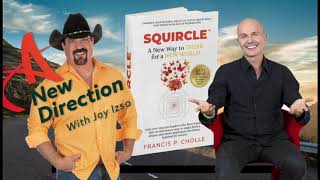
A New Direction -- Thinking Outside the Box to Solve Todays Challenges – Squircle – Francis Cholle
Dear Creativity...Let's Play Podcast, hosted by Amy Isaman featuring Francis Cholle