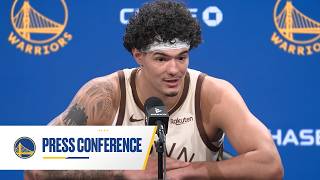
In a post‑game interview after his career‑high 31‑point performance against the Brooklyn Nets, Gui Santos discusses several topics. He explains how the team's grueling schedule—seven games in eleven days and extensive travel—has left players fatigued, contributing to poor decision‑making and a recent surge in turnovers. Santos reflects on the emotional impact of teammate Moses Brown’s serious injury, describing the personal loss and its effect on team morale. He shares the confidence boost from reaching 30 points, noting the rarity of Brazilian players achieving such a feat and the significance of the Latino Night celebration. Santos contrasts his G League experience, where he scored mostly off‑ball, with his NBA role that required more ball‑handling and scoring responsibility. He outlines his daily footwork regimen, including low‑post one‑on‑one drills with coach Noel, and details how he adapted the FIBA gather‑step rule to the NBA, turning it into a legal advantage for scoring and passing. Throughout, he emphasizes hard work, coaching support, and the mental resilience needed to perform at the NBA level.
Chapters
Gui, how you doing, man?
I'm good.
I'm good. Steve said that you guys played 7 games in 11 days. So maybe you got, maybe dragging a little bit. Do you sense that you guys are maybe trying to catch up physically from the road?
It's always hard, you know, when you travel a lot, play a lot of games like we did last week. And now we came back, we have 1 day in between the games at home. That's really great. That helps us. But at the same time, when you come here, you're feeling like kind of tired, you know, because especially long trips like that, if I ask for all the NBA players, is a tiring moment, you know. Everybody get tired, everybody stressed, and especially what happened last game with Mo was a very sensitive moment for us, you know. A special guy like that, and we just like see exactly like What happened with him, that was really, really bad and not a good feeling for us.
Do you think that could be a factor in the turnovers? Because you guys have been piling them up lately.
Tonight too. Yeah, yeah. I think the turnovers were not because of that, you know, but because we kind of tired and taking decisions that we should not take and you usually don't take it. And that's, of course, it's a big problem in turning to turnovers for us. So I think the fact that we tired a little bit, a little bit tired and also not taking the right decisions in the court that combines in a lot of turnovers.
Gui, how much confidence do you draw from your first career 30-point game and the efficiency and just kind of the different all-around ways that you scored today?
It's a good feeling, you know. I was talking to my family right after the game and they were like asking me, oh, how many Brazilian players had 30 points in the NBA? And I think that was, just 3 or 4. I don't know. That was me, Leandro, Varasone, and, uh, Inene Ilaio. So all of us had 30 points. It's special, special. I'm not going to lie, uh, especially in today was the Latino night, you know. So, uh, was very, very good to do that. And of course I'm feeling like very confident. The coach staff always, they give me a lot of confidence, uh, players, and Even when I got the ball on low post, I see coaches saying like, "Go to work, Gui. Go to work. Do what you do." You know? And when you listen to that, you say, "Oh, okay. Yeah.
Now I can go." Gui, you mentioned Moses' injury. How much is the emotional toll from that are you guys still feeling?
Ah, man, it's a really, really tough moment. You know, happened with Jimmy early in the season and now with Moses, especially the way the game was. You know, we were driving to that game and we were like just trying to win.
First game back off a long injury.
Injury that he had on his wrist. And then the way— I feel like the way the injury happened, it was more like even like a big shock for us, you know, the way that he fell on the ground. And when you see what happened with him, that was very, very bad. And especially, like I said, like Moses is one of the greatest human beings that I know. I remember when I got here in my first year right after the draft, I was staying in a hotel in downtown, and he was the first guy that gave me a ride. He was the first guy that was like, "Gui, you need a ride to your spot? I got you, I got you, come on." And, you know, he was always a great guy to be around. He's quiet and also, but, you know, when you lose a guy like that in the season, especially what he brings for the team, you know, like last game we just came back in the game because of him, because he was there bringing energy, defense in, and all that. And now we don't have him on the rest of the season with us. It's really tough.
Congrats, Gui, your career night. So I remember you had a 31-point game in Santa Cruz in G League before. So what's the biggest difference doing the same thing at the NBA level tonight?
I feel like my 31 points in the G League was way more off the ball. Then it was because here I feel I had a ball in my hands a lot in this game tonight. In the G was way more just off cutting and the guy was losing me, losing vision of me, and I was just under the basket wide open and making a lot of threes too. So today I feel was more like, I'm more like I had the ball in my hand and I gotta go and score, you know? So I think that was the biggest difference.
How do you work on your footwork?
Man, like, before every game, I play one-on-one in the low post with Noel, my coach, and every time I just beat him. Now I'm playing like he got some stuff, but, you know, I really work on it every day, every day, even it's like on the touch around the rim. Step-through, the pump fake and all that. So I really work on that every day. And as you guys can see, like, if you work something really, really hard every day, just show up in the game naturally. So a lot of times I don't even think about it. I just do it and it works.
How, how long did it take you to like understand and be able to take advantage of the gather step rule and like kind of the step-through rules?
Ah, that was one thing that I always had. You know, when I was playing back in Brazil, there the gather step was the beginning of the gather step, you know. So I was really taking advantage of that in Brazil when I was playing back there. Then I got here and they were calling a lot of travels on me in the G. And I sit with the coaches and say like, okay, that was legal in FIBA basketball. Now what else I gotta do here to be legal? And then they were like, okay, maybe you can do it. Then I start doing the G, they still calling a travel, but then I guess they have a conversation between them and they're like, "No, that's not a travel, that's a legal move." And then now I'm just, when I had the opportunity to do it, I do it, and either it's to score or find passes, but every time that I stop in two feet, I don't need to rush my movements, you know, I can find passes, I can go straight through or— Yeah. You know, just give the ball away to somebody else and do in the space again. So yeah, it was taking me some time to, took me some time to do it, but after I do it now, it's way, way easier to get into the paint and take decisions because I have way more time to do it.