Hooman Majd, an Iranian writer and journalist, argues that international sanctions on Iran have devastated the economy through currency collapse and inflation, yet ordinary Iranians don't blame their government because domestic media frames the West as unfair. Without a clear pathway linking specific actions to sanction relief, he says, the pressure achieves hardship without diplomatic leverage.
Chapters
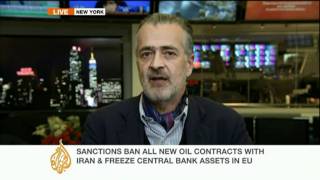
Hooman Majd is an Iranian writer and journalist based in the United States. He's author of The Ayatollah Begs to Differ and The Ayatollah's Democracy and joins us now live from New York. Mr. Majd, welcome to the program. Good to see you there. First of all, briefly, your reaction to this news.
Thanks very much. Well, I think it's a little bit of insanity. I don't understand, and nor do most Iranians, as far as I can tell, understand why the European Union is doing this, or why indeed the US is pressuring other countries to join in sanctions against Iran at this time that are affecting the population more than anything else.
But isn't that the point? You know, if you affect the population in that sense, you're going to put pressure on the government. And we've already seen that it's affecting the banks and so forth. The currency is devalued by something like 70% against the dollar. Apparently there's been a run on the banks, people trying to sell their currency to buy gold instead and various other resources.
Absolutely, absolutely. That does put some pressure on the Iranian government, but nobody in Iran, or at least very few people in Iran, believe that the government is going to cave to European or Western demands just because of these sanctions. And nobody also, or very few people in Iran, believe that the people will rise up against the regime, as is maybe hoped in certain quarters in the West, to topple this regime because of these sanctions. So it's causing pain for ordinary people, and it's not clear what the endgame is. I mean, Catherine Ashton says it's to bring the Iranians to the negotiating table. Well, what happens if they do come to the negotiating table? Are the sanctions then lifted? That's another question that Iranians have, and certainly the Iranian leadership has always had about these sanctions. The more sanctions you put, how do they get— what's the system for them to get lifted? But the Iranian people aren't, you know, generally thinking about sanctions as something that is going to help them in any way. It's only going to hurt them, as it is right now. I mean, initially sanctions were supposed to be targeted at the regime, and that's been expanded now to affect ordinary Iranian people. And it is affecting people in a dramatic way, as you point out. Inflation, for example, small businessmen.
Right. Do you get a sense that possibly that the ordinary person may blame the Iranian government for the sanctions being imposed by the international community for, for not playing ball?
No, not really, because there's a different narrative in Iran, and, and the vast majority of people don't read the New York Times or don't read the Western media all the time. They read the Iranian media, and, you know, the nuclear program is still quite popular, and they're reading the Iranian version of what's been going on, and they're reading a version that says the West is being unfair and demanding things that are unfair. And since it's still a relatively popular program, no, they don't. I mean, think about it. When there was an Arab oil embargo after the '73 war, the Yom Kippur War, and there were gas lines in America— I'm old enough, unfortunately, to remember that— no American was blaming the American administration for backing Israel in that war. They were blaming the Arabs. They started hating Arabs because of that. I'm not saying Iranians have started to hate Europeans or hate Americans, but very rarely do people blame blame their own government for something that another government does to them. They may dislike, and in many instances they do indeed blame President Ahmadinejad's administration for the rhetoric that may have caused, may have enabled the Europeans to be much harsher towards them. And that is, you know, publicly debated in Iran often now that Ahmadinejad is less popular than he was among the conservatives. But people aren't saying, oh gosh, our government should just cave right now and these Americans and the Europeans, they really have our best interests at heart. As I said, the example of the Arab oil embargo.
Right, I just want to jump in there because we're running out of time, but in that case, given everything that you said, what do you believe would provide the disincentive that the international community, the EU, and the United States want to force Iran's hand?
Well, I think that there has to be some sort of system that— they have to really make it clear to the Iranians how these sanctions can be lifted. Life is very difficult for Iranians, for ordinary Iranians. It's becoming very difficult for the leadership as well. So, but they have to make it clear, the West has to make it clear to Iran that if you do this, then this sanction, this set of sanctions will be lifted. So far there's no talk of anything. There's no talk of incentives. There's only talk of punishment and increasing punishment. And I believe that if those incentives, I mean, the Russians proposed a step-by-step plan, which the Iranians received well. I was in Iran last year, and when the Russians proposed that, the Iranians received that very well. They said, well, that makes sense. We understand if we take this step, then these sanctions are lifted and this gets easier for us. But clearly the West isn't in that— isn't interested in that at this point and is interested only in putting more pressure. I mean, even as at the beginning of your program when Catherine Ashton said this is to bring the Iranians to the negotiating table, what happens if they come to the negotiating table? Do these sanctions then get lifted? I mean, even that's not clear. Or is oil still being embargoed? After they sit down and negotiate, or do they have to come to the negotiating table and agree to Western demands? We're not sure. As far as the Iranian leadership is concerned, and as far as the ordinary Iranian people are concerned, it's causing them pain, and I don't know if that's fruitful at this point for the West.
All right, very interesting getting your perspective, Human Majd. We appreciate that. Thanks very much.