Crypto Media | Jason Yanowitz and Michael Ippilito | Pomp Podcast #468
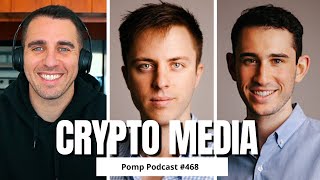
Jason Yanowitz and Michael Ippolito built Blockworks from cold-emailing 300 LinkedIn contacts at 4 am to a 19-podcast network serving institutional crypto investors. They pivoted from a consulting firm to events to media, monetizing through sponsorships from Fidelity and Coinbase. They see institutional adoption accelerating: almost every corporate and fund is now evaluating Bitcoin.
Chapters
All right guys, bang bang! I've got the original OGs of this podcast back together. We'll get to that story in a second, but, uh, I've got Jason and Mike, co-founders of Blockworks, here. Thanks so much for doing this, guys.
Yeah, thanks for having us, F.
All right, let's jump right into your background. Uh, where did you guys meet and how did you start Blockworks?
Yeah, um, We met at, uh, we both went to Emory, uh, Emory University down in Atlanta. Um, so we both went to school down there. Um, we came up to New York, lived together. Uh, Mike and I were kind of our only two friends who didn't go and, uh, do the traditional path of working in banking like most of our other friends did. And I was at, most of our friends studied business and Mike was, uh, I think a classics guy or a psych major. I was a history major. Our two friends were fitsing around. Mike was working in consulting. I worked at this venture firm and then went into a software company. Anyways, Blockworks was a funny founding story with Blockworks. I went to this crypto event on a Sunday. I had been pretty into Bitcoin since I lived in Budapest, Hungary, actually, weirdly enough. I went to this blockchain event with— if you know Amanda Guterman, Consensus. Amanda was speaking, talking about like why Ethereum was going to change the world. Before the event, there was this like side hustle consulting event about how to build a consulting firm. I show up at this event, it's like 1:00 PM on a Sunday, I learned how to create a side hustle in consulting. 2:00 PM, I go hear Amanda Guterman blow my mind about how crazy Ethereum is. I come back to the apartment, I sit Mike down for a real serious conversation. I say, look, buddy, we're I'm launching a consulting firm to help Fortune 500s understand Ethereum and blockchain. You want in? You're my friend who has consulting knowledge, and I'll let you—
Yeah, and I was like, yeah, that sounds like a really stupid idea. No offense there, Jason. But I mean, honestly, like, I had worked at a really small, like a boutique consulting firm. And the thing there is you're selling your brand and trust and all that kind of stuff. And it's really hard to do if you don't have a name. Especially if you're two 23-year-old guys, which is what we were at the time. That was the beginning for— we were the only two within our friend group that really got bitten by the Bitcoin bug. We took the very traditional route of we were passing podcasts back and forth with one another, we were passing articles, getting plugged into Twitter, all the super classic things that everyone does when they first get into the space. The light bulb didn't really go off until we actually started going to New York. We went to a couple of them, but it all really connected at this one event that— It was an expensive event. We each paid like $200 to get in, and we were just super pissed off because the event sucked. You're watching these people on stage, and we were just sitting there and we're like, "Oh my God, everyone in this room paid the same amount of money." I'd ever organized this event, actually made, and what we were gonna do was we were gonna host events to help us build that brand image or that kind of name and trust in the space that would eventually lead to consulting. But that's how we got started as an events company.
And so we have a bunch of hilarious stories I think that we're gonna talk about today. One of them probably starts with the event that I spoke at. Was this the first one you guys ever threw or was this one of the early ones you threw?
This was one of the early ones. So we hosted one in February. Uh, basically Mike and I would wake up— Mike and I had full-time jobs. So we'd wake up at 4:00 AM every single day. We spent no money on marketing for the event. We still, 3 years later, spend $0 on marketing to this day. And, uh, we'd wake up at 4:00 AM. We'd each message about 300 people on LinkedIn between 4:00 and 6:00 AM. Out of the 10,000 people we messaged, about 220 showed up. Everyone paid like $50 a pop. Then we had, then we quit our jobs like the psychos we were after kind of one, after one event.
We had this plan. We were like planning out, yeah, we're going to do this for like 12 months. Our salaries are going to support us, blah, blah, blah. One month later, we both quit our jobs.
Mike pulls trigger, quits his event, says you got to join me. I quit my, I quit my job. And, um, we hosted May event, May 10th, about 10 days after we both quit our jobs, lost money, thought we were complete idiots. Um, and then the third event we had was June 28th. 2018, I think it was called like Capital Raising in the Age of Blockchain or something. And we had some guys from like Grayscale and Genesis speak. And I think you were in maybe Japan or you were overseas, but we had, we emailed you. The funny story here is we emailed you a dozen times. We were ruthless about cold emailing and cold calling back then. I scraped your email somehow and emailed you like 10, 11, 12 times. On the 12th email, you responded. You said, look guys, I don't know who you are. I don't know who you are, but if I come speak at your event, will you stop emailing me? He said, "Sure, absolutely, Mr. Pompliano." And so you show up with Paulina. We had this like bad little venue in Chinatown. You show up with Paulina, you speak, we auto-subscribe you to our newsletter, and the rest is history.
Yeah.
I don't even know if you remember this part, Paul, but you called us back into your office the next day. After that to talk about stuff. And that was, that was like a pivotal moment for me and Jason, you know, getting that email from you. And it was something really innocuous. It was like, so, so what are you guys doing? Like, as a business, like, what are you really doing here? And, you know, we got that email and we were like, oh man, he wants to invest.
I looked at Mike.
I knew it. He wants to invest.
Poppy was good. Guys, I, uh, I like the newsletter. What are you guys up to? I look at Mike, I go, He wants to buy us. No doubt. No doubt.
No, the thing I remember is when I went to the event, it was in a little, you know, sketchy part of town, of Chinatown there. And when I was walking into the event, you had to like go through this like real like weird looking place and like go upstairs or whatever. And there was like, you know, a second there I was like, I might be walking into like a complete scam. These guys might try to kill me. And then I got upstairs and was like, oh, okay, this is like a nice thing. There's food here, they must know what they're doing. Then a bunch of people came, like, I don't know, it was like 200, 300 people, whatever it was. I was like, all right, maybe they actually do know what they're doing.
Yeah, look, since the beginning, we've always tried to help the investor crowd understand crypto, but at the beginning, we had to do some ridiculous things to get folks there. At the beginning, Mike would just ruthlessly cold call family office investors to try to get them to show up, and I would buy Ubers for these people. To make sure that they actually showed up and we'd have Ubers pick them up at their door. So pulled a whole bunch of tricks to get people to get there. But at the end of the day, I mean, people showed up and yeah, and then we launched the pod and then you kind of called us in and launched the podcast with you and that kind of kicked off the whole business, so.
So the part, a story you guys have told me since then is, I don't remember how a podcast came up. I don't think I even knew really what a podcast was. And at some point it was like, oh, we should like do a podcast. And I was like, ah, I don't got time for that. And you guys were like, well, what, like, basically if all you do is you just walk in the room, record the conversation and leave and everything else is done, like, would you do it? And I was like, sure. And I thought that you guys like knew what you were doing, all this stuff. You guys, yeah, we could do that. And then later on I found out that you guys like went home and Googled like, how do you create a podcast? Like, what is a microphone or whatever?
I mean, I'd literally never opened GarageBand in my life. And I taught myself on YouTube how to learn GarageBand overnight. We're like, yeah, Pomp, we got this. I was like, we have a graphic designer who can do this. We pulled up like 99designs.
I'm glad we fooled you, Pomp.
And Mike reached out to a college buddy who did music and we made the jingle. So that's when people hear the Pomp Podcast or what used to be Off the Chain. That's the kind of origin story.
So what's the biggest takeaway from how you guys got started in terms of like, there's a ton of ridiculous things, but you survived and eventually thrived. Like, what was your biggest takeaways starting?
I mean, there's a lot of takeaways, but honestly, I think one of the big takeaways, especially running a bootstrap business, is just to do stuff. And when you do stuff, you kind of create your own luck. Honestly, like, that was a great example of that is just us kind of linking up with you. You know, we hosted a couple of events before that. They were like good, we made a little bit of money, lost a little bit, money, but nothing really happened until, you know, meeting you opened up this whole new line of business for us in the form of podcasts. Um, and that lesson has replicated itself a bunch of ways, but basically if you just kind of put yourself out there and do a whole bunch of different stuff, not everything is going to work, but there are going to be some things that work super, super well. So you kind of end up creating your own luck just by trying a whole bunch of different things and doing stuff.
Yeah, mine is— the thing I would say is just ruthlessly cold call and cold email people and just don't take no for an answer at the beginning when you're launching a business. Um, I mean, if you, if we stopped emailing you after those first 11 emails, right, who knows what would have happened. And I mean, we've, we saw that so many times. Like, I don't know. I remember we sold one time, we sold a family office dinner. We said 15 family offices were going to show up. It was the night before. We had 2 attending out of 15. And Mike scraped every single family office investor in New York City and cold called every single one, and we got 18 to show up. So I don't know, it's just be ruthless with your outreach and good things happen.
Everyone wanted family offices back then. I had no idea what a family office was. Everyone's like, we want these family offices, we want these family offices. And honestly, the only reason we successfully got them is if we had known how hard it was to get in touch, we just never would have even tried. But yeah, those are the early days, honestly.
Hey, it worked. So you guys built out a pretty large business. There's podcasts, there's ad sales, you've got a newsletter, and then you decided like, hey, we wanna kind of take a step back and really be intentional about what we do moving going forward. The name went from Blockworks Group to just Blockworks, you know, a big rebrand there. And you're now relaunching as this financial media company. I think what you guys are doing is really interesting. So talk through a little bit just about the focus on financial media, and specifically helping institutional investors learn about digital assets.
Yeah, maybe I'll take the 2-year evolution of what got us to here, and then Mike, you can talk to the editorial side of things. But I mean, just to Fill the listeners in, after we launched that podcast with you, since then we've taken— we have 19 more podcasts in our network. We work with folks like— we've built shows with Charlie Shrem, and we worked with Meltam Demirors, and Joe Carlson, and we study billionaires, and Ted Seides of Capital Allocators, and Peter McCormick. We've got the largest podcast network in the space, one of the largest podcast networks in financial media in general. Our events business grew from these 6:00 to 10:00 PM events to large-scale conferences that we hosted in places like New York, and Chicago, and London. We built a very successful events and podcasting business over the last few years that does one thing really well, which is help investors understand digital assets. What you are talking about now is on January 12th, we have just— I am not sure when this podcast is coming out, maybe January 12th or 13th, we have just launched our editorial business, Maybe Mike is our operating editor-in-chief right now, so he can talk to that side.
Basically, we figured this out pretty quickly, even when we were just hosting the tinier events, but ever since we've moved into the space, there has not been a good source of knowledge for institutions in crypto. It's been really interesting to watch even over the course of the last 5 or 6 months, when you see the types of people that are getting involved in this space, the Paul Tudor Joneses and the Stanley Druckenmillers of the world. That's one group of institutions. That's the macro hedge funds. But as this space continues to grow and onboard new cohorts of people, there are going to be some kind of like the corporate people or the enterprise blockchain people who are going to be— want to be interested in how is this going to help my business. Then there's going to be a whole other group of people like kind of the tech people, the developer-focused crowd. But then there's this whole big crowd of people, which is the finance crowd. And that gets grouped in our space. We just call them the institutions. But it's really a whole bunch of different groups of people, right? It's kind of the macro finance guys, like the hedge fund traders. But there are also RIAs and kind of wealth management. There are investment banks, commercial banks, insurance companies, all these people are paying attention to crypto now, and they want to learn more. The space up until this point has been entirely retail. Many of the media companies that exist built their audience, built their company serving the audience that existed, which was at that time a retail audience. There really hasn't been much opportunity until now, to actually build a media company that is exclusively focused on serving that new cohort of people that are going to come in. That's what we're really focused on doing on the editorial side of things. That's a little bit about our site.
When you think about the existing media and content, Bitcoin and crypto are very unique, I think, in that there's people who are creating content on Twitter, Instagram memes, Reddit, private WhatsApp groups, kind of like there's all this like user-generated content in the community. And then you've got crypto-native organizations like the CoinDesk, the Blocks, you know, and many others. And then you've got like the traditional folks who are the CNBCs, the Bloombergs, the Yahoo Finances that are trying to cover this from more of a traditional viewpoint. And then you've got this like explosion of podcasts and YouTube channels. And so there's all this content, but what it sounds like you guys are really saying is like all that content is focused on educating the retail sector. Really what you guys are doing is more almost B2B type media where you're gonna go and try to create content that is valuable to these institutional investors and help them get up to speed. Is that a fair way to kind of look at the competitive landscape? Landscape, if you will, and how you guys think you're going to fit into this?
Totally. Yeah. I mean, even like anecdotally, if you listen to what Michael Saylor was saying, there's a bunch of— he's been on the kind of podcast circuit recently, and he describes what it was like educating his board about making that investment decision. And literally, if you listen to them, he was like, I was sending them YouTube videos. That is, that is incredible. First of all, the bet that he made is incredible, but the fact that a board of a public company had to learn about this space, and probably the biggest investment that company has ever made through YouTube videos is absolutely nuts. It shows you how early though, that's insane. To even use a more micro example, let's say you're an RIA or something like that, and you're thinking about— you care about one thing, how am I going to build my business? You've got all these clients now that are asking you, Bitcoin just hit $40,000, what is this? Should I be putting this in my portfolio? Why isn't it already in my portfolio? Why can't you talk to me about this? So what they're thinking is, I got to understand what this stuff is, and I got to understand how I'm going to get paid off it. How is this going to fit into my existing infrastructure? So you can kind of imagine the frustration of someone like that who genuinely wants to learn and get onboarded. And A, they get bombarded in this Twitter community is like, have fun staying poor. But all right, which is, you know, it is what it is. But you can imagine the frustration. They get that on Twitter, and then they go to a lot of these these sites, and it's like really deep dives into DeFi and ZK-SNARKs and all that stuff, and they just kind of throw their hands up and say, this isn't for me. I, you know, I don't care about this, doesn't connect with my life. So really, when we say we're building an institutionally focused brand, you gotta really put yourself in the shoes of these people and try to understand why are they caring about the space. And that's the guiding light for content.
I mean, Pomp, you speak to these folks all day long. I just pulled up one of our another crypto media company, one of the ones that you just mentioned, let me read these 3 articles. Trade Santa is giving away Christmas gifts. Reef Finance debuts as the first Polkadot project on Binance Launchpool. Cyber Vein announces proof-of-contribution consensus mechanism. I'm a 50-year-old gray-haired hedge fund manager looking to allocate 2% to Bitcoin. I'm throwing my hands up, and I'm closing that page and telling my investment committee, that we have no interest in Bitcoin. There's so many different aspects of this space that just don't get covered, from the asset managers to how Bitcoin's intertwined with things like central banking, Fed activity. It's just not getting covered from an institutional light, and that's the next extension of our business is this editorial arm.
Got it. When you guys think about the body of work that goes into this, is this gonna be audio, written, video, a combination? Like, how do you think about the actual editorial output of what you're gonna have?
I think it's a combination of all those things. I think when it comes to content, it has to conform to a specific medium. So when it comes to things like podcasts, podcasts are really good for what we're doing now, like long-form conversations, expositions, kind of deep dives on specific things. That's great. That works really well on podcasts. Written serves a different need. Written is you're kind of covering a certain space, right? And people kind of go there for more information, right? So you got to find a way to just cover a certain specific space and deliver just short-form kind of better, better content. And then I think video is another really interesting medium as well. But I think overall with the mix, we're kind of— I mean, Jason can talk a little bit more about the reasons why, why we decided to play in certain mediums. But the overall guiding light of the content, the audience that you're serving is the same, but it has to be different depending on the medium.
JASON YANOWITZ] On the editorial side of things, Pom, we've just doubled the size of the company in the last 30 days, and we're hiring for a lot more roles for any listeners out there who are interested in joining a crypto media company. Mike is our operating editor-in-chief. He's just built a team. We've hired a senior person from Real Vision. We've hired reporters from places like American Banker, Bloomberg, an ex-CoinDesk employee. So yeah, we're quickly building the editorial team. But again, everything is focused on helping that more traditional investor understand the space.
Got it. And so when you think through the types of stories, like, give us an example of what a hedge fund manager or somebody at an institution would come to you to read about. So they're not reading about CyberChain or whatever other crazy thing, SushiSwap, and kind of all the really nuanced, highly speculative, but yet highly experimental and potentially highly innovative things, but just too in the weeds. What is the type of content that they'll be reading?
Yeah, so we kind of segment our content into 4 different buckets. One is asset management. So literally just covering the space of asset management within crypto. It's such an interesting space, right? The people that are managing money, it's still, like we talked about before, so small, right? But the returns that these people are generating now are crazy. Crazy, and they've got some really interesting strategies, and they're just really interesting people. So one is actually just covering the space of asset management within crypto. The other is finance and financial services, right? So that's really focusing on some of those institutions we were talking about before. Maybe they're not— if they're not buying large chunks of Bitcoin, but maybe it's like an investment bank that's buying a crypto company to start a trading desk. Or maybe it's a bank or large asset manager that's kind of moving into custody. Basically covering existing financial services and how they're starting to play in this space. 3 is macro. So there are— Jason kind of mentioned this before, but there are some topics, like central banking and CBDCs are a really good one, that that's a really great overlay in between— obviously, digital currencies is an idea that was born in crypto, but that cuts right to the heart of kind of traditional finance, right, because it's central banking. So there are areas around kind of interest rates and currencies and central banking and monetary policy that really intersect with crypto. Then finally, the last one is a strong markets focus. Really focusing on things like market structure, what traders are doing, all that good stuff.
Got it. How did you guys think about like from a business perspective, there's so many media models today. There's subscription, there's advertising, there's literally like lead generation, there is a Affiliates.
E-commerce, yeah.
Yeah, like how did you guys think of, or how are you thinking about monetizing the business moving forward?
Yeah, so the first thing that we did is we looked at every single media company, right? And this is everything from Hodinkee with watches to the Wall Street Journal to Bloomberg, which is more of a data company, to things like Morning Brew. We looked at every single media company. Our business has always been based around sponsorships and advertisements, right? So we have a really simple business. We, we help investors understand crypto by giving them information and insights. We build an audience that really trusts us, and we allow brands to tap into that audience. Some of our big clients are like Fidelity Digital Assets, Coinbase, BlockFi, CME Group. They come to us because they want to meet investors interested in crypto, uh, and we'll allow them to tap into that audience through advertisements and sponsorships. We looked at subscription models, we looked at affiliate media models. Basically our conclusion was, if you look at kind of the evolution of digital media over the last, I don't know, 10, 20 years, really decade, I guess I'd call it, B2C media raised a bunch of money and basically got their lunch eaten by social media. Big companies like Vox and BuzzFeed made huge bets that they would leverage social media to build their platforms. What they didn't understand though, is that the value accrued to social media and that it didn't actually accrue to these digital media companies. So what you've seen is basically the evolution of two, two different types of media companies, B2B media companies, right? One of our advisors is a man by the name of Sean Griffey. He runs Industry Dive, really niche media company from an outsider's point of view. Inside the company, they do $40, $50, $60 million in revenue and they're profitable, right? So that's kind of B2B media companies that serve their audience. That's what we are. On the kind of more like webinar, newsletter, our editorial front is a B2B media company that monetizes through sponsorships and ads. And then on the podcast front, um, you look at the podcast space, Wondery just got bought for what, $300 million by Amazon? Gimlet got bought by for $200 million by Spotify. The podcast space is booming right now. And so what we're trying to do is basically leverage talent to sit at the Talent is sitting at the center of this B2B media company, which we think is a really unique model. And we think that every media company in the world needs to have a talent strategy, no different than how CNBC has Andrew Ross Sorkin and how Vox had Kara Swisher, right?
And the POP Podcast has POP, duh.
And the POP Podcast has POP, yeah.
So how do you guys feel or see the institutional kind of openness really changing, the sentiment changing. Obviously, we're talking about kind of your strategy as to how you're gonna move forward. I tend to agree that this is really smart for you to do and will be highly successful. But the sentiment in 2018 is a little bit different than the sentiment in 2019, then '20. And like now in 2021, it feels like everyone is, you know, using #Bitcoin on Twitter. They wanna tell you about how they bought their first Bitcoin. First Bitcoin in 2018, and they're ready to rock and roll. How have you guys seen that sentiment shift over time?
Yeah, it's funny. People think about FOMO, a lot of people use that as a dirty word, but it's not. I know you've talked about this as well that a lot of these guys, they had all the time and opportunity in the world to buy Bitcoin when it was $3,000, $5,000, whatever it was, and they didn't. There's a reflexive property in Bitcoin, whereas the price goes up, the network actually ends up getting more secure, you've got more people participating, it's actually more valuable. I think you're starting to see that take effect in a big way. One of the other problems with Bitcoin overall is that it's always been too small, like scale has always been a huge problem for these guys, where it's like, okay, I'm a $10 billion asset manager, I want to put $100 million to work, the space was just straight up way too small. I think right now, as we are talking, right before this Bitcoin hit $40K, there definitely is some danger of being euphoric settlement. That is not making a comment on the price or where I think it might go, but I definitely think emotions are a little bit high in the space overall. That probably has to end at some point, but I really do think Some of the best info that you can get on this, the sentiment gauge, is actually not listening to people in crypto, but listening to the more macro people. If you tune into some of the macro podcasts, that is the Grant Williams Show, that is Macro Voices, that is Masters in Business, 6 months ago, Bitcoin was a dirty word. Every one of these podcasts, every one of these guys is talking about it, and they are talking about it in sophisticated ways. They are using good arguments, and they are open-minded. To me, that's a really powerful way to measure the sentiment of the overall space.
Is it fair to say that we're now at a point where every single institutional investor is like, I got to have a Bitcoin strategy, and they're actually going in allocating?
Yeah, I can't speak to every single one, but I think so. It's a powerful tool. In the same way, the same social pressure that applied when Bitcoin was at $3,000 is like, what are you doing looking at this? The social pressure is working the exact opposite way, where, hey, it's $40,000. I need to be looking at this today, but why weren't we already paying attention to this, basically? And people also—
go ahead, Mike. Yeah.
Yeah, I was just going to say, and people don't want to be left out, right? So you've got to keep up with performance. If you think that everyone is piling into Bitcoin, and that's going to drive huge returns, you can't be the odd duck left out.
Pomp, we spoke with a portfolio manager at an endowment a few weeks ago. And basically what he described is every single fund manager is looking at this right now. Doesn't mean they're buying. Every fund manager at least has to look at this. Most of them want to allocate a small amount, right? I don't know, a few, few basis points, maybe 1%. If they want to invest, what's happening is they want to invest. They have an investment mandate that says that they can't invest right now. So what they're doing is putting it on their personal inside their personal portfolios. So now you've got these, these hedge fund managers, endowment managers, RIAs, financial advisors who manage most of the money in the world. They are— they have a mandate that says that they can't invest through their fund. They still love Bitcoin. They invest personally. Now there's an incentive for them, right? The beauty of Bitcoin is as soon as you buy it, there's an incentive to make this thing go higher. Just like any other asset. Now, you've got the portfolio managers of the largest asset managers in the world, they might not own it on their funds portfolio, but they own it inside their personal portfolio.
I think we're just at a point now where everyone realizes frankly what most of the Bitcoiners have been saying for a while. This is a necessity. This isn't a privilege. This is a necessity. You have to have this in your portfolio. It is the the single greatest protector of purchasing power, and it's the only asset in the world that can protect you against the chaos in the traditional world, yet still provides you asymmetric opportunities similar to a venture-style investment. It's literally like the apex predator of financial markets. And I think that that sounded nuts at $3,000, that sounded interesting at $20,000, sounds pretty damn smart at $40,000. 40, right? But it's the same comment. It's just literally the price almost opens people's eyes and changes their opinion.
I'll tell you, though, I think price is amazing. So there's Bitcoin the asset and Bitcoin the network, right? And Bitcoin the network as a payment settlement network is arguably more interesting than the asset. Bitcoin the asset will get bigger than gold, right? At some point, there'll be the flippening, and it passes gold. And that's really interesting. Bitcoin, the settlement layer and the network, will become magnitudes larger than the asset. That's interesting because that really globalizes the world, and actually really helps. The asset helps people protect against inflation, things like that. The settlement network and what guys like Jack Mallers— I think you might have invested in Strike— what they're working on is just unbelievable. That's arguably, for any investors who are looking at this, don't just look at Bitcoin, the asset, but look at Bitcoin in its whole as a settlement layer.
Absolutely. Go ahead, Mike.
No, I was going to— the interesting thing about Bitcoin too, and honestly, if you look at something like stablecoins, is it's just a good product. The product works. It's a similar thing when people point at Elon Musk, who just became the richest guy in the world, surpassed Jeff Bezos. Meme Lord Musk. Meme Lord Musk, Meme Lord Musk, as we call him. When people point at Tesla, it's like at the end of the day, the guy made an amazing product. When you look at something like SpaceX, the guy pulled it off. It's the same thing with Bitcoin. You can say all you want, this price seems funny and yada, yada, but at the end of the day, the technology works better than the existing financial system. You can literally send money anywhere in the world, and it'll settle instantaneously with no middleman.
It is—
I actually recently had an experience trying to help someone open a Coinbase and then a brokerage account. The ease of opening a Coinbase is like, click, click, click, you're done. A brokerage account takes 30 minutes to do and multiple approvals. It's a nightmare working with the existing financial system. Look, you can look at price, but at the end of the day, It is just kind of a better product than what exists out there.
Yeah, I, uh, obviously I agree. Uh, what are the things that you guys are looking forward to in 2021, uh, in terms of, obviously, once you get this launched, uh, either milestones for the industry or milestones for, uh, Blockworks?
Yeah, I think, uh, I mean, for Blockworks, what we're really just dead set focused on— we serve one audience, right, which is the institutional audience. So I think we've done a great job building a brand so far in terms of the events and kind of the podcasts, and that's what we're known for. But really what we're doing this year, we're building that editorial kind of brand, right, and onboarding a whole, like the mission statement of what we're doing is we're trying to talk to directly to this whole new group of people that are coming in. In terms of things that I think I'm looking forward to in this space, over the coming year, just keeping on what's happening right now. As more and more people get into the space, not only is it exciting because obviously, the price of Bitcoin and stuff like that, but you just get more diversity of thought and opinion, and you build out the infrastructure, and everything just feels more real. I think just watching as more and more people come into the space, build good products, build successful products, figure out business models, just advance the overall space in general. All that stuff is really, really exciting.
I think there's about to be a huge hiring spree. I mean, the best part of Blockworks is hiring people who don't own Bitcoin and having them buy their first Bitcoin.
Is that a requirement?
It certainly is now. But no, I think— Pomp, I think the 4 biggest things I'm looking forward to— 4 things outside of Blockworks, right? Blockworks, looking forward to growing revenue, and the team's going to double in size again, and all of our metrics that we look at are going to grow, but I think there are 4 themes to look at in 2021. The 4 main Bitcoin themes are going to be one, corporates are going to invest 1% of their cash into Bitcoin. Every corporate is going to be looking at this, and just like a lot of funds, some of them might not do it, but everyone's at least looking to invest 1% of their cash into Bitcoin. The second thing is funds are going to invest 1% to 5% of their portfolios into Bitcoin. The third thing is financial advisors and RIAs are going to start recommending Bitcoin, I think. The fourth thing is I think the M&A space and acquisitions are going to really heat up now that traditional companies want Bitcoin customers. You can sure as hell believe— I know you're a big investor in BlockFi. BlockFi is on an absolute tear right now. How many customers do they have? I'm assuming BlockFi will end up going public at some point, but you can sure as hell guarantee JP Morgan wants access to those BlockFi customers. Corporates investing, funds investing, financial advisors recommending Bitcoin to clients, and the M&A and acquisition space heating up. Those are the 4 big themes that I think will take place this year. It'll be pretty damn exciting to see it play out.
Yeah.
Absolutely.
I would even call a shot a little bit and say— because the other really interesting thing that just recently happened is that OCC announcement, which basically seriously disrupted SWIFT. There's a lot of incentive there for investment banks to get involved in crypto now. The other thing about banks is that they're just in the business of gathering assets. That's what they really do. They're in the asset gathering business and then lending out at a high level. Crypto used to be not very exciting when it was $2 billion or $3 billion market cap asset. Now, it's a trillion-dollar asset, and who knows when it's going to stop. At some point, those banks are going to say, "I need— this is a whole new pool of assets that I want to have access to." Honestly, the best way that they're going to move in there is to buy existing companies that have successfully gathered those assets so far. The M&A space is— I agree with Jason Yanowitz— it's a really interesting space to watch.
The thing too that seems to be really valuable is as these companies grow, they continue to hire more and more people into the from the legacy financial world or legacy media or legacy tech companies and bring them into the crypto space. It feels like that's just only going to accelerate and become faster, bigger, and more important over time.
Yeah. With every single person that comes in, it's another person who owns Bitcoin. Once you own Bitcoin, you're incentivized to tell more people about it. It's an amazing system. I've got this goal going on right now. I just posted on Twitter, get 100 friends to buy Bitcoin, 6 days into the year, I'm at 12. There are thousands of people like me who are telling their friends about Bitcoin. Every single 30-year-old JPMorgan employee who comes over, starts working at Coinbase, they're telling 20 of their old colleagues at JPMorgan about Bitcoin.
There's a really great article by— I think Jason Yanowitz put this out, um, like a couple years ago now. But basically it's the idea that kind of everything follows price. And on these big uptrends in— this is, this has already started, right? Because what ends up happening is the price ends up going up, the media ends up covering it, a bunch of eyeballs get on this space, and then a bunch of people end up moving into the space. Um, so that's a, that's a really exciting thing that you don't necessarily see reflected, but just purely the amount of human capital that's going to get dragged into this space after this recent run-up, that's something that's already in motion. I guarantee that that's already starting. One way to measure that is companies hiring right now, but that's more staffing up in anticipation for a bull run. Over the next 2 or 3 years, the amount of human capital that's going to flow into this space, especially from the legacy financial system, is really, really interesting.
Yeah. It also just feels like as more people come into the space, they're more experienced, they've got different skill set, in some cases, They're more intelligent, right? Like, you just kind of like almost professionalize some of what's going on. But at the same time, what's really important is keeping the same ethos and the same edginess and the same kind of, you know, absolute fanatical obsession that has made Bitcoin what it is. So it's almost like you're going to end up having both sides of the coin where you've got kind of a professionalization and adoption by institutions at the same time. Jump on Twitter real quick, and you'll get told, have fun staying poor by someone who's literally living anywhere in the world and wants to take down the government. It's very rare that an asset can walk the line between those two camps, but that feels like what Bitcoin is doing and will continue to do in the future.
It's an entire industry that understands that the memes are the message. How's that hire, the chief meme officer, coming along?
I have somebody.
I know you, I bet you do.
I have many, I have many people, many people are sitting there, uh, they keep, uh, keep DMing me all this, uh, this nonsense. But I got one guy who, uh, he's working on some other things for me too, but, uh, he is, uh, fire with the memes.
Amazing.
I may or may not have a 40K meme sitting in my, uh, in, in my, uh, arsenal right now, but I have not used it yet. —because while we're recording this, it dumped from $40 down to $37.5. You know, just make sure everyone remembers that, uh, this is a wild beast that can't be, uh, can't be tamed.
Nice little sell order up at $40.
Um, all right, uh, before I let you guys go, uh, I have 3 questions. The first thing is, what is the craziest thing that either of you has seen in the crypto industry?
Oh, man. Where do you even start with that? Craziest thing that we've ever seen in the crypto industry.
On a micro level, it's— I mean, this sounds kind of— I don't want to promote scam stuff, but there are some pretty intelligent scammers out there. Every day, I get hit up in my direct messages on Twitter about some, like, my son just died. Can you send me some Bitcoin? I don't want to promote those, though, so I won't use that. I'll think of a better one. But those are— I mean, I don't know if that exists in other industries.
It's the modern-day Nigerian prince.
Everyone wants to get their hands on some Bitcoin. The craziest thing I've seen, honestly, is— this isn't going to feel that crazy now that Bitcoin's ripping so much and it's becoming the norm, but just every time I hear about Yale's investment manager, Bitcoin to me is still— I heard about this thing in 2015 when I was living in frickin' Budapest, Hungary. Every time I hear about Yale's portfolio manager buying Bitcoin, I don't know if that will ever cease to amaze me. I'll be honest with you.
JASON YANOWITZ] I've actually got one here for you. I actually think the craziest thing that happened in crypto happened in 2018 or 2019, and it was when those pensions invested in Morgan Creek and took that risk. That's the craziest thing, because if you work at a pension, you're tasked with handling money for everyday people, and they're so conservative, and the incentives are not there to take the risk. The fact that they went out on such a limb and invested— you guys are amazing at Morgan Creek. You guys absolutely— The fact that they went and did that is the most amazing thing that I've seen in crypto.
It's the least risky thing they could do.
Probably didn't feel like that at the time. Well said. Well said.
That was my point, was like, hey, you all want to keep playing this crazy game, go ahead, but there's another path. I guess I can say it. Their cost basis in the first fund is $5,500.
Not too shabby, my friend. Not too shabby. Nice little 10xer.
So they're doing, uh, they're doing just fine. Um, all right, the two questions I ask everybody, and then you guys get to ask me a question. Uh, what is the most important book you've each read?
I think for me, actually, Jason introduced me, so you're about to get a twofer here, Jason. But I think The Ascent of Money was actually one of the most interesting ones. And I, I don't come from a background in finance at all. Like, I, like Jason, that I was a classics major in school, classic psychology. Learning about what money is, and how it has evolved, and how things like credit have evolved were really, really instructive and interesting to me. I think getting that full history was really what gave me context, honestly, for my interest in crypto and Bitcoin. I'd say The Ascent of Money is one of my favorites.
For me, I got two answers. One is the one to make me sound sophisticated. It's the book I'm reading right now because I'm a history nerd. It's The Team of Rivals about Lincoln, but that's the one to make me sound more sophisticated than I am. Honestly, I mean, it's almost like a little embarrassing to say, but the books that changed— it's a series of books that changed my life when I was 18. Um, it's Harry Potter. Exactly. That's a 7-part series. I did love that one. But no, it's, it's, it's a book called Think and Grow Rich. There's a book called Rich Dad Poor Dad. It's a book called Richest Man in Babylon. And there's a book called, um, it's a Dale Carnegie book, How to Win Friends and Influence People. And I probably read all 4 of those books at least 10 times in college. And I mean, I was still a shithead in college, but I felt like I had a different mindset than people because of these 4 books. Um, and that totally changed, like reading Rich Dad Poor Dad, I was like, I'm going to be an entrepreneur. I'm never, I'm never working for the man. I'm not doing the 9 to 5 game. And so yeah, it was "Think and Grow Rich," "How to Win Friends and Influence People," "Rich Dad Poor Dad," and "Richest Man in Babylon," as cheesy as those might sound.
Those are the 3 books I read when I was 20 years old that changed my life, so that's good news.
Oh, there you go. Thank you. You could have been in a book club.
Nah, I wasn't talking to anybody about it. Aliens. How much do both of you believe?
Nope. 100%. Not only do I believe in aliens, I think there is a really good chance that they are already here. I don't know if you guys saw this article that came out about this Israeli guy who was in the military for like 30 years, and he just came out and he was like, "Look, man, I've done my whole thing. I've built this respected career. I've worked in the government. I've worked in academics. I never said this before 'cause I was afraid of being called a crackpot, but now I'm old. Aliens exist. There's a Galactic Federation." And there's— it's straight up humanity is not. And you know, honestly, I think everyone's allowed one conspiracy thing that they're allowed to believe in, and this is mine. And I, I fully—
it's not a conspiracy, it's science.
It's— yeah, I agree. I'm right, I'm right there with you.
Jason? Nope. What? Why not? I was in the room the first time you asked this question. You think I'm crazy enough to say no? I just wanted to see your response. Of course aliens exist. I went— I took a 10-day trip I took a trip to Cairo, Egypt, 2 years ago by myself, 10-day trip. I saw those pyramids of Egypt. Once you see those things, aliens, they're a lock. They exist.
You think the aliens built the pyramids?
Absolutely. Damn. Man, I don't know about that. Sorry, I didn't sign up for that.
You haven't seen those things.
I didn't sign on to that.
I never been. I might have to go see. Those things are like geometrically down to the inch, miles apart. And they're to the inch at a 90-degree angle. I mean, I mean, I'm Jewish. I know the Jews are like good at building those things when they're slaves, but like, you don't know. You don't know.
If, if aliens are real, where do you think the most likely place that they are? Area 51?
I got a wild theory. All right, let's hear your theory before we answer. In the ocean.
Yeah, man, the depths, the depths of the ocean. You ever seen going down there?
Nobody's going down there.
Yeah, except for those fish that have the 12-foot rods hanging out with the little light bulb. That is— but like, but they can't talk.
Like, no, nobody's going down there. So like, how do we know that they're just not chilling in the ocean?
That's fact. Can't verify, can't verify.
Just saying, just saying. Oh, this is not my question. I'm not using my question on this one.
All right, what are you going to ask?
I was going to say, would you rather go to the bottom of the ocean or to the moon? Not to the moon.
Well, we're going to the moon altogether anyways, but—
I was a lamb. I had to lay that out.
All right, what questions you guys got for me?
I got a question. If Bitcoin didn't exist in this whole space— you've always said, since the day I met you, you're a tech investor, and that Bitcoin is just some of the most interesting technology in the world. You're not a Bitcoin investor, you're a tech investor. If Bitcoin didn't exist, but you had to dedicate yourself to one space, whether it be biotech, psychedelics, and mushrooms and things like that, self-driving cars, what one space would you dedicate the next decade of your life to?
Just early-stage tech investing.
If you had to get more specific than that, though?
Yeah, so I think that people think of that as like, oh, that's just like investing across. I think of it as it's one very, very specific skill, which is you're actually investing in people and it doesn't matter what they're worried about. It's more psychology, I think, than anything else. And so the way that I think about it is like finding the world's most interesting people who have a higher probability of success going after like a massive market, right? And so like those markets, like by definition, there can't just be 20 people who all win one market. So it's actually like you have to like cut it a different way. And it's just at the earliest stages. There's a lot of people who are really good Series B, Series C investors. A lot of people who are good Series A investors. But like, I kind of think that it's a little bit different and even cheating to some degree to wait till it's a Series B Series B company and be like, oh, this one I think is going to win. Like, yeah, it's working already. And sure, they can mess it up, but like, you have data, you have all this stuff. But it takes an absolute, you know, just, uh, crazy person to sit down with somebody and they say, I'm gonna go build a billion dollar business. And for you to say like, cool, I believe you, here's, you know, $100,000, just $250,000, so let's go do it. And It also takes a crazy person to be the person who sits down saying like, yo, I'm gonna go build a billion-dollar company from scratch. And so like, I just genuinely enjoy meeting those people and having those conversations. And I've now invested in the seed round of 4, yeah, I think 4 companies that are a billion dollars or more. And so like, when you start to get a couple of those data points, you start to realize that people are the exact same from a structure standpoint and the way that they think. They're going after different industries. They're all facing different challenges. But I think that almost the science of identifying those people and studying how to do that is fascinating to me. And so luckily, I get to do Bitcoin and that. But if Bitcoin didn't exist, that would be the obsession that I have.
Can I get a follow-up question there? Which would be— Sure. You said they all kind of look alike, right? 4 companies. What's one trait? I'm sure there are a few different traits, but what's one trait of some of the founders of these companies?
I think that there is a critical thinking and problem-solving trait that usually goes undiscussed. Like everyone wants to talk about like, oh, they're smart. Or, oh, they're good at hiring, or they're good storytellers. Like, yeah, duh, you have to be able to do all that stuff. But at the end of the day, it's just this like deep-seated kind of like fire of when I see a problem, I wanna solve it. When I see another problem, I wanna solve it. And I'm constantly on offense when I see problems rather than defense. A lot of people, when a problem pops up, they go, ooh, I don't wanna, like they go away. There's a hard conversation, conversation, they don't wanna have it. If there's an issue, they would hope that somebody else steps in and solves it before they have to. The best founders that I know who've built the most successful companies, if something happens, they immediately attack. And they just, what's the problem? What's the information that we have? How do we make a good decision here? Who's responsible for owning this in the future? Like, go. And they just do that over and over and over again all day long. And when you're building a company from scratch into a multi-billion dollar business, It's just a series of solving problems and making sound decisions. And so you have to enjoy the problem solving just as much as you do making sound decisions. And I think we always focus on like, oh, this person, you know, smart, successful, yada yada, whatever. But like the problem solving piece is like, that's where you gotta roll up your sleeves and really do the work. And so the best founders, like they really enjoy doing that stuff, even though it might not be fun at all times, 'cause the problems suck or they're expected or is on vacation or holiday or whatever. But just, they just have this like obsession with getting the problem solved and keep marching forward.
That's good. Yeah. All right, Palm, I've got one question for you. What is the best investment you've ever made? And I don't mean which one did you make the most money on? That's not what I'm asking. And wide-ranging, it could be a founder that you invested in.
I know the answer. All right.
I know that. One second. One second.
Plin. Plin, by far. Oh.
Oh, that is great. Not from that sense.
I think it's just when you think about investing, and Plin and I talked about this like very early on in our relationship, I said, look, there's like basically two paths that lead people to having a successful marriage and kind of partnership for like many years. One is you either meet somebody young And you essentially reinvent yourself and they reinvent themselves over and over and over again for literally, you know, let's say you meet, if you're in high school, for example, you meet when you're 16, 17, 18 years old. And then basically you've got to transition from like, okay, we were in high school. It's now we're like in college together. Okay. We survived that and thrived. Then we got to go from college to like early professional life. Then we got to get to like mid to late twenties. Then you got to get it's like, okay, now I wanna have a family, right? Then you get to like, oh, now we're like really doing well professionally. Then it's like, okay, like now our kids have gone off to college. Like there's so many different almost acts to that maturation process. And so the odds that you're gonna meet somebody like really early in life and successfully make a lot of those transitions, especially the earliest ones, it's just really small. Like the sample size you're pulling from is small. It's like, who did I go to high school with? Like, yeah, sure, maybe. But like, That's a really, really difficult thing. Or the second thing is people basically go on their own paths and then eventually they meet at some point, usually kind of late 20s, early 30s, maybe even into their 40s. And when they meet, it's like, hey, I've already had to get some sort of traction in my life in certain aspects without you. But now, like, all of these future transitions, like, that's something that I think we can do together. And so, like, I was in the camp of like, I am never gonna get married. Like, people say that. I was like, I'm never going to get married. Why would you ever get married? That sounds like the dumbest thing in the world. Like, what? You mean that like now you have to make decisions and like somebody else can say like, I don't want to do that, and you might have to listen? Nah. If I want to go party, I'm gonna go party. If I want to eat McDonald's, I want to eat McDonald's. If I don't want to do anything today, I'm not going to do anything today. That was my approach to life. And when I met Polina, it was like almost immediately we were just like, alright, I think that like maybe I'm not going to just do whatever I want for the rest of my life. And so to me, it's just like that investment of like time and like really open-mindedness, I think has been the best investment because what you begin to realize realized is like, it's hard to grow as an individual by yourself. Like, you only have the perspective of the world that you have. And so like, whether it's Plinna like looking over my shoulder being like, eh, I wouldn't tweet that, like, that's— you're not like thinking about this other thing, like, you're gonna be an idiot here. All the way to like me coming up with, oh hey, I have to make a really important decision professionally, like, let's sit down and talk about it. Like, having somebody there that has the same context that has the same kind of goals and aspirations, that's like really, really valuable. And so I think that people just underestimate like that element of it, uh, and they always focus on like what company did I invest in or like, you know, where I chose to move to or whatever. But to me, like, by far that's been the most impactful thing, and like nothing's even close.
That's a great answer. That's a great answer.
BlockFi's a distance She paid, she paid me a lot of money to say episode sponsored by The Profile. The episode is not sponsored by The Profile. We have no free sponsors. You don't get any advertising unless you pay. So we will not be giving out the readtheprofile.com URL in this episode because it's not a paid sponsorship.
We'll only be giving out the URL blockworks.co. Go hit it right now.
Yeah. All right, I appreciate appreciate you guys coming on. Uh, blockworks.co is, uh, the website you guys should go and— well, not you two, you guys are gonna be there anyways, but if you're listening or watching this, you should go check it out. I'm a huge fan of Jason Yanowitz and Mike Yanowitz, uh, and they've been super helpful to me as all this stuff has gotten built. So go check it out, blockworks.co. You two, I will, uh, talk to you soon. We'll definitely do it again in the future. And, uh, to end it, I Gotta, you know, just throw a little jab in there. Mike, your Zoom name is Maria Ippolito, so we'll talk to you next time.
That's the name of my beautiful wife. We try to cut costs.
Not a jab at all. Not a jab at all.
More from Jason
From Media Company to Crypto's Market Infrastructure: Jason Yanowitz on Blockworks' Transformation
Stablecon 2025 - Fireblocks Stage: A Fireside Chat with Jason Yanowitz & Simon Taylor