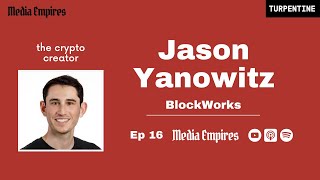
Jason Yanowitz Blockworks Group Podcast 29

In this interview, Jason Yanowitz, co‑founder of Blockworks Group, explains how the company grew from a history‑student‑turned‑venture‑capitalist’s idea into a leading crypto‑focused media and events platform. He recounts his personal journey—from studying history at Emory, living in Budapest and discovering Bitcoin, to working in venture capital and launching Blockworks in 2018 as a solution to the lack of institutional‑grade information on digital assets. Yanowitz describes the rapid shift in institutional sentiment toward Bitcoin, citing the 2009‑2020 monetary stimulus comparison, the fiduciary pressure for a small allocation, and endorsements from figures like Paul Tudor Jones and Andreessen Horowitz. He critiques Goldman Sachs’ recent report that dismissed Bitcoin as an asset class, highlighting logical flaws and generational differences in investment preferences (millennials holding Bitcoin via Grayscale versus boomers’ traditional holdings). Yanowitz predicts that all financial instruments will become digitized, noting a massive wealth transfer from legacy banks to fintech and crypto firms. He shares entrepreneurial advice—launch a venture, hire smarter people, and empower creators in media—and ends with a broader message urging listeners to pay attention to macro‑inflation dynamics and the growing information gap that Blockworks aims to close.
Chapters
Blockworks Group. It's just blockworksgroup.io. Just hopefully our SEO is good enough so that when you Google us, we'll come up. But I mean, just so your listeners know, like a two-sentence about us, we were an events and media company. If you're listening to this show, you probably like podcasts. We operate over 20 shows in the space, right? And so these are finance shows, crypto shows, tech shows, investor shows, uh, basically helping folks understand what the hell is going on, whether it's with Bitcoin, crypto, the Fed pumping money into the space, oil prices going to zero. We help kind of the mass market understand these institutional concepts.
Yeah, it's a great way to sum it up. You've got some really, really good podcasts. You've got Charlie Shrem, The Pump Podcast. You've got Luke Martin, Scott Melker, Wolf of Wall Street. I'd say these are the A-listers, aren't they?
We like to think so.
So, okay, well, let's talk about you for a second, a little bit about your background. You once were a young man studying history at the University of Atlanta, but tell us the story of how you went from there to founding Blockworks.
Yeah, so currently I'm, uh, one of the co-founders of Blockworks Group. Um, we launched 2 years ago, so May of 2018. Before that, I worked in tech for a little bit at a data analytics company that had raised a couple hundred million called Sisense. And before that, I worked in venture capital. But like you mentioned, yeah, I studied history at university, at Emory University down in Atlanta. And I think, I don't know, I went to school to study business and play baseball, and neither of those things happened. Hung up the cleats within 3 weeks of getting to school and also decided I was way more interested in in history, um, than, you know, financial accounting.
So, and so what, what happened? You, you left university. Tell us about your, the, the kind of little roadmap that from there to starting this, this, this amazing company.
Yeah, of course. So it actually starts, uh, back at a university. I lived in Budapest, uh, Hungary for a little bit. Um, and that's why that was 2015, went really deep down the crypto rabbit hole while I was out there. I think what Bitcoin was maybe around $200, $300 a pop. Back then. Um, but it was interesting, right? Because Hungary, for those who are kind of history nerds, will, you know, that they know that, you know, the country was kind of under this communist regime, right? And the, a lot of the citizens had no power. And so a lot of the, the students that I studied with, um, at the, at university, their parents had lived under this communist regime. So the concept of Bitcoin and this self-sovereign money was really, really interesting to them, right? You take a tram in Budapest, nobody's talking on the tram. Why? Well, because they still remember when there were cameras and microphones on the tram. So this concept of like privacy, um, government power, and it's coming back, right? The, the guy who runs Hungary is taking all the power back. He's buying up all the media companies. Um, and it's scary, right? And so that's kind of when I went deep down the Bitcoin rabbit hole. I moved to New York. I worked in venture capital investing in kind of tech, life science, uh, consumer goods products. Like some of your listeners might know, uh, what's one of them? Uh, Dollar Shave Club is one that we invested in. Um, and, uh, really realized that like there, you know, at the time, 2016, 2017, their Bitcoin was, was kind of coming along. Like enterprise blockchain was quite hot back then. Um, but there were no real good sources for institutional folks, hedge funds, private equity firms, VC firms, LPs, GPs, endowments, pensions, high net worth individuals to learn about crypto and Bitcoin. And so, um, you know, there was like Crypto Bobby and Crypto Panda and Crypto Whale on like Twitter and Reddit. And a 70-year-old gray-haired family office investor isn't going to learn about some magical internet money from some guy named Crypto Bobby on Twitter, right? And, um, and so that's when, when our, my co-founder Michael and I realized that, uh, there needed to be a place, um, where the institutional side of things could learn about what the hell's actually happening on the ground in this emerging digital asset ecosystem. And so we launched Blockworks Group as an events company to start. And then, um, and then we layered on the media side with, um, most of your listeners probably know Pomp. Pomp was our first podcast. So that was August 2018.
Wow. You nailed it. You nailed it first time. Yeah.
I got the big fish.
I mean, have you found that institutional opinions have changed over that time on a general sense?
Yeah, absolutely. I mean, how can they not, right? Everybody knows, like, you know, the genesis block of Bitcoin, right? The Times, you know, January 3rd, 2009, Chancellor on the brink of second bailout for banks. Well, at that time, the second bank rescue package was totaling about $50 billion, right? It was announced by the British gov on January 12th, 2009, um, as kind of a response to the ongoing global financial crisis. $50 billion. Now, the recent halving, uh, the New York Times, right, they're the new, the new block that's getting all the press is April 9th, 2020, with $2.3 trillion injection the Fed's plan far exceeds the 2008 rescue, right? So how can you not, uh, if you're an institutional investor, look at this space? I think the big difference was in 2016 and 2017, it was kind of tough to make the argument. It was really hard to argue that Bitcoin was ready for the prime time and ready for, for really portfolios, if you're an investor. Now that's completely flipped on its head where 4 years later, it's really, really hard to argue that Bitcoin shouldn't be in your portfolio. I think that they all— they're starting to realize that they have a fiduciary responsibility, even if it's just 1%, to have some sort of an allocation to Bitcoin.
I agree with you. I mean, Andreessen Horowitz, who— I mean, they must have put nearly a billion already into crypto, and they're betting long term. You've got Paul Tudor Jones saying that they're allocating 2%. I mean, 2% of their investment into Bitcoin. And he even wrote— did you read his paper, The Great Monetary Inflation?
I did. I mean, he basically said, look, he said, he started off, I'm not a millennial investing in crypto, which is quite popular for millennials, but a baby boomer who wants to capture the opportunity set while protecting my capital in, in this rapidly changing environment. And one way to do that, he said, is to be invested in the instruments that respond first to massive increases in global, in global money, right? And what he said is, given that Bitcoin has positive returns over the most recent time frames, a deeper dive was warranted. So what he did is he said, all right, I think this Bitcoin thing looks cool, there's crazy money printing happening, let's Let's dive in. And what he found was, and this is, you know, his, his quote, not mine, is at the end of the day, the best profit maximizing strategy is to own the fastest horse, just own the best performer and not get wed to an intellectual, intellectual side that might leave you, uh, I think he said weeping in the performance dust because you thought you were smarter than the market. And he said, if I'm forced to, forced to forecast, my bet is that the fastest horse is Bitcoin. So he's saying, I'm not an advocate of Bitcoin ownership in isolation, but he recognizes that its potential— it's got a potential in a period when we have the most unorthodox economic policies happening in modern history. Yeah.
I mean, that's, that's huge because he actually listed the 9 asset classes that he said would perform in an environment like we have now post kind of COVID But he said that the whole— that whole report was based around Bitcoin. And he even, he even put those words kind of digital gold. And he also called in a roundabout way, he actually called Satoshi a genius or the concept of Bitcoin was genius.
How can you not? How can you not say that? But yeah, I mean, look, Paul Tudor Jones is one of the most famous hedge fund investors of all time. He's been in the business for a long time. He said, he compared Bitcoin to, he said, Bitcoin reminds me of gold when I first got in the business.
76, in the 1970s. And he should know. Well, that's kind of interesting because Goldman Sachs, um, Jamie Dimon called— he famously called Bitcoin a scam, didn't he, back in 2017? Um, and Goldman Sachs—
yeah, but don't forget now, uh, JP Morgan just started banking Coinbase and Gemini.
So they have— they did. And I also believe when Bitcoin crashed shortly after he said that back in 2017, they were one of the largest buyers. I don't know if that was true, if that was just an urban legend. Goldman Sachs recently said that there was a leaked document or a leaked call that said Bitcoin is not an asset class. And in, uh, it was on May 27th, they discussed the state of the economy. Goldman Sachs, it says in a, in a Cointelegraph report, are appearing to discourage clients from investing in Bitcoin. What do you make of that?
So I've seen the whole report, um, I've read the whole report. Basically what happened is they had a conference call for some of their larger institutional investors to talk about a whole number of different things. It wasn't just to talk about Bitcoin. Um, what happens is they then sent out a report afterwards. There were, uh, 3 or 4 slides on Bitcoin, um, and they really, really tore it apart. Um, and basically, I mean, here are my thoughts, right? Um, I expected the Goldman research team to, to make a data-driven argument about Bitcoin. right? And if you do that and you don't like it, I think that's fair, right? That's just someone making an opinion based on research. Not everybody has to like— some people don't like gold, some people don't like Bitcoin, some people don't like Apple stock, right? Some people don't like bonds. The fact, um, basically rather than make an argument to the one that they made against gold, which was a compelling argument, Goldman's research team launched into a series of non sequiturs basically about the objectionable traits of Bitcoin. And they kind of did what you, what you, what we keep finding the smartest people often do when confronted with Bitcoin is they abandon all reason. They ask, they ask whether Bitcoin is a currency or an asset class. And after defining the only features of a sovereign currency, they concluded that due to Bitcoin's failure, to meet these criteria, it does not classify as an asset class. This makes like so little sense that there's not even a name for this logical fallacy, in my opinion. And there's like, there's so, there's so much there. There's this one slide that was titled cryptocurrencies including Bitcoin are not an asset class. They don't. So, uh, bullet 1, I've got it pulled up right here. Bullet 1, do not generate cash flow like bonds. Bullet 2, do not generate earnings through exposure to global economic growth. Bullet 3, do not provide constant diversification benefits given their unstable correlations. And it keeps going on and on and on. How many asset classes don't generate cash flow like bonds? How many asset classes don't generate earnings? Since when do asset classes demand stable correlations, right? And yeah, I mean, it was kind of comical to folks, I think, reading it.
Well, maybe this is where he needs a deeper dive into the kind of work you guys are doing. You said in an interview once that you're looking to put out insightful content. A really interesting thing that I heard in an interview, I think it was on Spotify, it's a couple of years ago now. You said that we're putting the word digital in front of things that in 10 to 20 years will be the norm. Kids are growing up kids who are growing up learning code have supercomputers in their pockets. I guess this— you're almost saying like Goldman Sachs is— they've got this archaic way of looking at this instead of seeing it as this prescient, it's the next step, it's this evolutionary step. And studying history, I bet you've studied the Industrial Revolution, so forth, you can see that this is where we're at, this sort of step-over point, this tech revolution. Maybe if you put a little bit on that, the next generation, the children who are growing up learning code with supercomputers in their pockets, the digitization of everything you called it. Maybe they just don't understand it yet because they're not young enough.
Yeah. I mean, so there's 3 points to touch on here, right? Number one is, uh, yeah, kids are growing up basically everything is with supercomputers in their pockets. So they will very soon, every stock, bond, currency, and commodity will be digitized, right? Central bank dollars, Bitcoin, bonds, currencies, commodities, all, every stock, right? Everything will be digitized. That will be the norm. That's not going to be like, oh, there's a digitized Right now we're saying there's a digitized dollar, right? That's like saying, oh my, this is a mobile phone. It's not— we don't call it a mobile phone, we call it a phone, right? And we don't call it like email is electronic mail. We don't call it electronic mail anymore. It's just, it's just email, right? And it's just, it's— so I think kids growing up, um, will be very used to concepts like Bitcoin. So number 2, um, I think this shows in that like Goldman's research team, right? They're 40, 50, 60 years old. They had this quote in the, in the, I think it was 2 slides after when we just talked about, they said, uh, Bitcoin's not a scarce asset due to the ability to fork into nearly identical clones. I mean, this is, this is just a shocking failure of research into the technical and cultural differences between—
should have called you, Jason.
The 3 examples that they offer, they offered Bitcoin, Bitcoin Cash, and Bitcoin SV. And that's just like a blatant lack of understanding, like, of what's going on. And then the 3rd thing is, um, I mean, you're seeing it, like, like millennials and young people want Bitcoin. I mean, uh, it was, I think it was Morgan Stanley or like TD Ameritrade or something put out a study of the top 5 holdings by age. And, um, boomers hold like, it was like Apple, something out like, I don't know, Disney and Berkshire Hathaway. And then millennials, it was all the same holdings except Berkshire Hathaway was out and Bitcoin was in. So, and it was through Grayscale's Bitcoin Trust. So millennials, I mean, one of their top 5 holdings right now is Bitcoin. And, uh, I mean, I think it's a, it's a good investment.
Go on Bitcoin. When moon, when Lambo.
Um, throw it back to 2017.
Well, let's, let's wrap this up. I, I, I want to ask you though, 'Cause you're seeing all this kind of exciting stuff, all this really cool, real cool shit happening. What excites you in your life most right now in the space?
There are a few things. One, I think the most exciting thing for me is just personally what's happening in the media space with like, I think a lot of powers going from the media companies to the creators. That's really exciting to me. And we're looking to build a business around that. Um, but specifically within crypto, I think you've got a massive transfer of wealth from traditional archaic financial providers. Um, old finance banks— Goldman Sachs at a 5-year low, Citigroup is at a 5-year low, Wells Fargo's at a 10-year low, Western Union's at a 3-year low. New fintech— Bitcoin is, uh, up 30% this year. Stripe is all-time highs. Square, all-time highs. Crypto stablecoins, all-time highs. So you've got a massive transfer of wealth from like old archaic financial infrastructure to the new. And it's perfectly— it's at a perfect time when everything's getting flipped on its head. And it's honestly just an interesting time to be alive and an interesting time to be into economics and Bitcoin and, you know, care what's going on in the world.
So I love the way you put that. Now I'm excited. What are you most proud of? In your life right now?
I think, uh, just take— I think everyone who's thinking about launching a business should launch a business. Um, a business could be forming an LLC, or it could be launching your YouTube show, or it could be throwing a podcast up there. It could be, you know, having the courage to charge people for your newsletter, right? And, um, No, I'm proud that 2 years ago we took this leap of faith and launched our business and we've hired people who are way smarter than us and way better than us at pretty much everything. And we've got a great, great, amazing team of people around us. And I think that's what I'm most proud of.
And my final question, if you could put a message on a billboard and the whole world could see it, what would you put on that billboard?
Um, I mean, you've got to go with the obvious one of buy Bitcoin, but if I had to not be, not be that obvious, because I'm sure all of your guests will say that, um, I, I think I would say pay attention. Um, I think what's happening right now is, uh, I mean, everyone says that there's going to be mass and massive inflation, right? There's not, there's not going to be massive inflation, right, in the countries where the debt is, uh, the developing markets that issue debt in the currency that they print, such as the eurozone, China, the US, they're going to be able to carry out expansionary policy without creating domestic inflation for like, like CPI inflation, like consumer goods. But what happens is, um, a, like emerging economies that are forced to issue debt in a currency that they don't control will be put under severe pressure. And that's where you're going to see an inflationary spiral that will cause a flight of wealth into 3 safe haven assets: gold, Bitcoin, and the US dollar. But really what's happening is like, there's not going to be inflation in consumer goods products, but there's going to be inflation in financial assets. And I think I would just say pay attention, right? Because like, there's a— the wealth— the income inequality gap is just getting bigger and bigger. And like, it's just because people aren't A lot of people aren't paying attention and a lot of people don't have the resources to understand what's going on. And that's what Blockworks Group is trying to do. Understand that, you know, just solve that information gap.
Yeah. And there's actually a really good article on that on your website. And you, there was a thread on your Twitter feed that explains what you were just talking about there. Well, Jason, thanks for coming on the show today. You are an absolute wealth of information. I've really enjoyed myself. Um, I wish you good luck in all your endeavors.
Thank you, my friend. It's great to be here. If anyone's listening and wants to connect, I've got DMs open on Twitter and LinkedIn. So just @JasonYanowitz on Twitter or add me on LinkedIn or shoot me an email, whatever it may be. So thanks for having me on, Bob. I appreciate it.
More from Jason
From Media Company to Crypto's Market Infrastructure: Jason Yanowitz on Blockworks' Transformation



Stablecon 2025 - Fireblocks Stage: A Fireside Chat with Jason Yanowitz & Simon Taylor