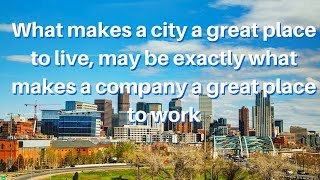
Kenny Chapman compares what makes cities thrive to what makes companies succeed. Great cities have strong culture, resident buy-in, connectedness, and affordable living. Chapman maps each directly to business: organizational culture drives profit, employee commitment runs deep, communication builds advocacy, and fair pay gives people buying power.
Chapters
Hey, my friend Kenny Tatman here, the blue collar coach living in Denver this week and I want to make a quick point to you. I'm down staying at a great condo in what they call Lo Doe here in Denver lower downtown. Now, there is a time when you would not want to walk around down here. And although you have all kinds of different things happening in the city, I was thinking, how did they turn this thing around? How did they make it so vibrant? It's one of America's fastest growing cities right now. All kinds of culture, all kinds of amazing things happening. People are entertained, they feel great about what's going on. The energy, you can feel it. So I got to thinking. I said, what makes a great city? And so I look up, I had the opportunity to meet Arianna Huffington last year and I jumped on the Huffington Post and said, what makes a great city? Well, so I found four things. They had several more. But I want to tie four things today of what people say make a great city like our wonderful city of Denver. How does that translate to us when it comes to our companies and when we're working in the service contracting world, what does that mean to us? Well, here's four factors that I want you to think about that make a great city. And this very well could be yours. Number one, they say it's culture. Now, this just isn't about how many art museums you have or how many museums that you might have. It goes deeper than that. It goes to a point of what's the local flair? What does it look like when you have the opportunity to have locals creating their own stuff? How deep does it go when it comes to, you know, we're willing to have all these different ethnicities and different types of things going on. What's the diversification look like? The same is true in our own organizations, right? Culture, culture, culture. If you follow us at all, you're going to hear that a lot because I believe culture is, translates to profitability. Well, guess what? It's the exact same thing when it comes to a city. And it's the number one thing that they say, right? So we think about that second thing. They say buy in. And it's like, buy in when it comes to a city. What are you talking about? They're saying buy in by the people, right? So we want our team to buy into what we're doing, buy into who we are, buy into where we stand in the community. They're saying that we need residents. When people buy into a city and really get it, you know, I Jumped on the front of this video and I said, lo do you know, it's like, yeah, loto people feel good about it. They feel good about the energy when it comes to this, you know, so we think about that. It's not just about participation when it comes to buy in, but it's about how deep does that go? Okay, think about your own organization. You've got people that are totally bought in, and it could be your managers and then it stops there. Or even worse, it could not be your managers, and then it's definitely not going to your front line. But how deep does your buy in go when it comes to your company? Great cities come from buying going throughout different layers of the community. Third thing, they say connectedness. How connected are the residents to the city? Well, let's say that we're the city in the service business now. How connected are our team members, our residents when it comes to our organization? Are they talking great about the city? Here in Lodo, do people leave Denver, they go out here to DIA and they go somewhere else. They say, where do you live? I live in Denver, Colorado. Really? Tell me about it. Do they rave about it or do they go, yeah, you probably don't want to come here. Think about the organization that you're running. Think about the team members that you're with. How connected do they feel? That all loops back to buy in and culture, by the way. But connectedness is very, very important. That's something that makes companies and cities go from average to awesome, right? And it's about communication. Cities use social media a lot to communicate. Hey, there's this new restaurant happening. Don't forget there's this entertainment going on this weekend. How are we communicating with our team? Think about that for a moment. Last thing, cost of living, right? Not all money is made the same, not all money spent the same. So think about that cost of living. What does that translate to? That translates to buying power. That's. It doesn't matter if you make a dollar if you can buy a house for a penny, right? So it's not about the money, it's about the buying power. So we talk about hourly rates and obviously we run coaching programs with people all over the world. And how much do your techs make and how much this and how much that? It's really not about that. It's about what are they getting for the value of their money. So when it comes to a city, people look at cost of living based on what I earn, based on how much it costs. What does that look like? When it comes together in our organization, it translates to compensation. And I want you to think about that. It's entire compensation. How connected are you with your team when it comes to here's how much money you can make here and what that means to you is A, B, C and D. Not sell this, sell that, get this commission, get that. Let's start really looking at these things. My friends, I want you to have a better than average company. I want you to have a rock and roll organization that feeds you, feeds your life, feeds your team members, feeds your community. So you can also have a great community and a great company within that community. Think about the culture you've got, think about the buy in levels you have, think about the connectedness between the team members and then don't let them forget that they're making more money than they could somewhere else. And if that's not the case, find a way to fix that. My friends, I'm Kenny Chapman, the blue collar coach. Until we talk again from Denver, Colorado. Have a better than fantastic day. I'll see you soon.